Understanding RCCB Sensitivity: The Foundation of Electrical Safety
Selecting the right Residual Current Circuit Breaker (RCCB) sensitivity is one of the most critical decisions in electrical system design. The sensitivity rating—measured in milliamperes (mA)—determines how quickly an RCCB responds to earth leakage currents, directly impacting both personal safety and equipment protection. An improperly selected sensitivity can result in either inadequate protection against electric shock or excessive nuisance tripping that disrupts operations.
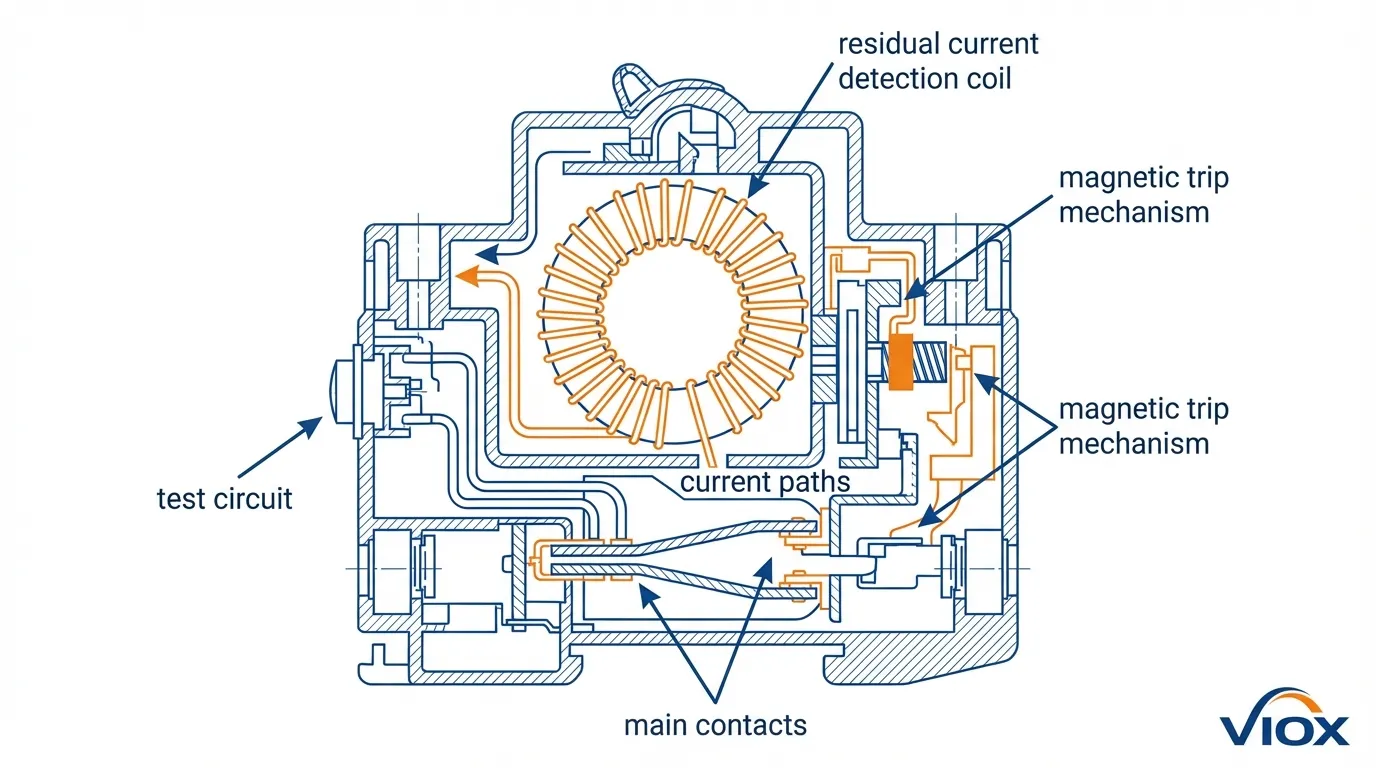
RCCB sensitivity represents the residual operating current (IΔn) at which the device will trip and disconnect the circuit. This threshold is carefully calibrated based on physiological research into human body current tolerance and fire prevention requirements. Understanding the relationship between sensitivity levels and their applications is essential for electrical contractors, panel builders, and facility managers responsible for safe electrical installations.
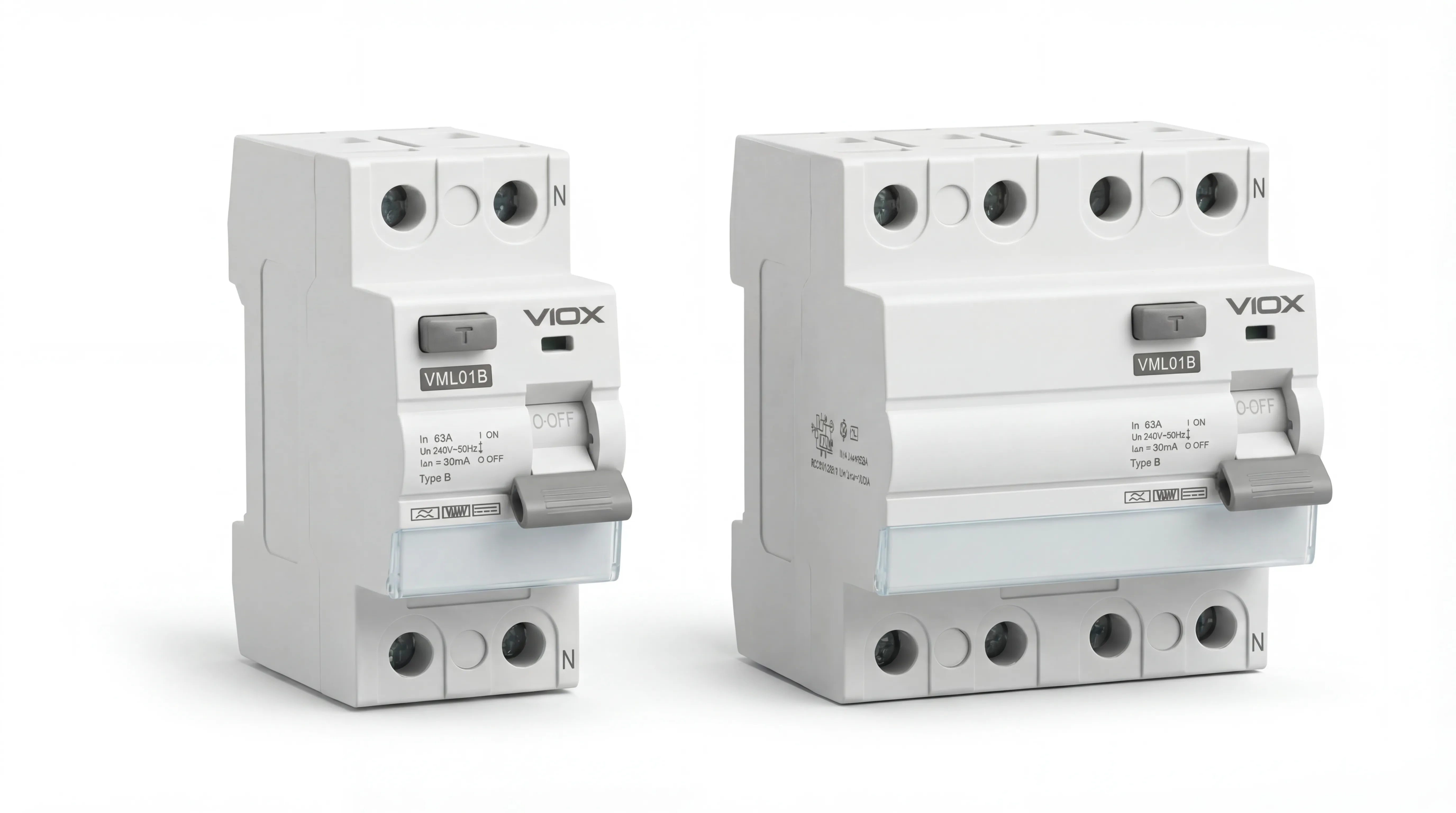
RCCB Sensitivity Ratings Explained
The Science Behind Sensitivity Levels
The selection of standard RCCB sensitivity ratings is based on decades of research into electrical safety, particularly the work of Charles Dalziel at the University of California, Berkeley. His studies established the current-time envelope for ventricular fibrillation—the most dangerous consequence of electric shock. The 30mA threshold emerged as the maximum safe leakage current that the human body can withstand without risk of fatal cardiac arrest.
According to IEC 61008-1, RCCBs are classified by their rated residual operating current (IΔn), with common values including:
| Sensitivity Rating | Primary Protection Type | Typical Applications | Trip Current Range |
|---|---|---|---|
| 10mA | Enhanced personal protection | Medical facilities, bathrooms, swimming pools | 5mA – 10mA |
| 30mA | Personal protection (standard) | Residential circuits, socket outlets, wet locations | 15mA – 30mA |
| 100mA | Equipment protection + fire prevention | Commercial buildings, office circuits, light industrial | 50mA – 100mA |
| 300mA | Fire protection | Industrial installations, main distribution, upstream selectivity | 150mA – 300mA |
| 500mA | Fire protection (large installations) | Heavy industrial, main incomer protection | 250mA – 500mA |
Physiological Effects and Safety Thresholds
Understanding human body response to electric current is crucial for proper RCCB selection:
- 1-10mA: Perception threshold, tingling sensation, no harmful effects
- 10-30mA: Muscular contraction, painful but typically not fatal, let-go threshold at ~20mA
- 30-100mA: Severe muscular contraction, breathing difficulty, potential ventricular fibrillation
- >100mA: High probability of ventricular fibrillation, cardiac arrest, fatal without immediate intervention
This physiological data directly informs the IEC 61008-1 standard requirements for RCCB sensitivity ratings.
Application-Based Selection Guide
Residential Applications
For residential installations, 30mA sensitivity is the universal standard for personal protection. This applies to:
- All socket outlet circuits
- Bathroom and kitchen circuits
- Outdoor power points
- Circuits supplying portable equipment
- Lighting circuits in wet locations
Special Consideration: In homes with swimming pools or hot tubs, 10mA RCCBs may be required for circuits within the pool zone, as specified by local electrical codes.
Commercial Applications
Commercial buildings typically employ a tiered approach:
| Circuit Type | Recommended Sensitivity | Justification |
|---|---|---|
| Office socket outlets | 30mA | Direct personal protection |
| Server rooms | 100mA or 300mA | Minimize nuisance tripping from equipment leakage |
| Main distribution | 300mA (Type S – selective) | Fire protection + selectivity with downstream devices |
| HVAC equipment | 100mA – 300mA | Equipment protection, higher leakage tolerance |
| Lighting circuits | 30mA or 100mA | Based on circuit length and load type |
Industrial Applications
Industrial environments require careful analysis of load characteristics and operational requirements:
- Production equipment: 100mA – 300mA to prevent nuisance tripping from motor drives and inverters
- Main switchboard: 300mA – 500mA selective RCCBs for fire protection
- Operator stations: 30mA for direct personnel protection
- Outdoor substations: 300mA for fire prevention
For industrial settings, consider RCBO alternatives that combine overcurrent and residual current protection in a single device.
Critical Selection Criteria
1. Total Leakage Current Assessment
A fundamental calculation for RCCB selection involves estimating the total normal leakage current of the protected circuits. As a safety rule:
Maximum Total Leakage Current ≤ 0.3 × IΔn
For example, if your circuit has a total normal leakage current of 8mA, you need:
- Minimum RCCB sensitivity: 8mA ÷ 0.3 = 26.7mA → Select 30mA RCCB
This 30% rule prevents nuisance tripping while maintaining adequate safety margins. Typical leakage currents include:
- Computers and IT equipment: 0.5-3mA per device
- Variable frequency drives: 5-50mA depending on size
- Long cable runs: 0.01-0.03mA per meter
- Fluorescent lighting: 0.5-2mA per fixture
2. Selectivity and Discrimination
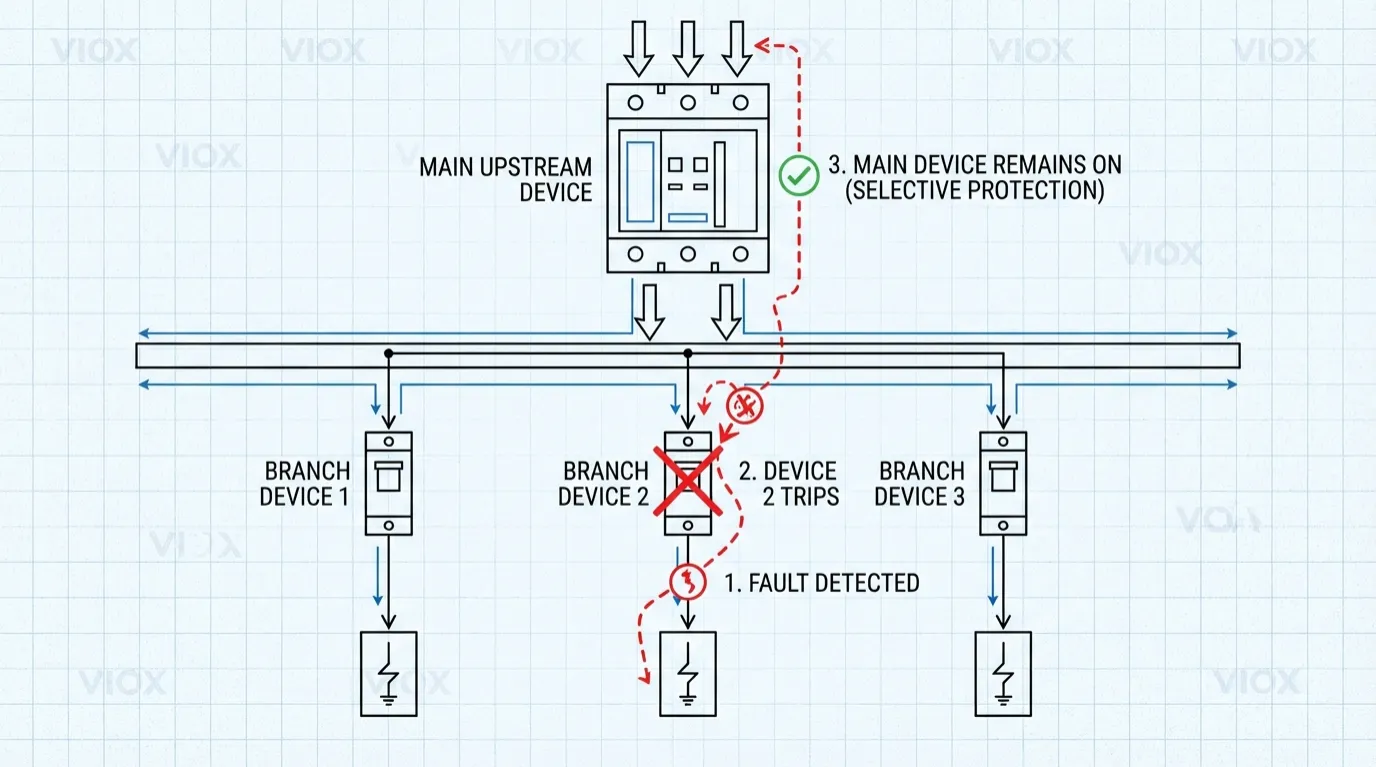
In cascaded protection systems, proper selectivity ensures that only the RCCB closest to the fault trips, maintaining power to unaffected circuits. Achieve selectivity through:
| Upstream RCCB | Downstream RCCB | Selectivity Method |
|---|---|---|
| 300mA Type S (time-delayed) | 30mA instantaneous | Time + current discrimination |
| 100mA Type S | 30mA instantaneous | Time + current discrimination |
| 300mA instantaneous | 100mA instantaneous | Current discrimination only (limited) |
Type S (Selective) RCCBs incorporate a time delay (typically 40-80ms) that allows downstream devices to trip first during fault conditions.
3. Load Characteristics
Different loads generate varying levels of normal leakage current:
Low Leakage Loads (suitable for 30mA protection):
- Resistive heating
- Incandescent lighting
- Simple motor loads
- Basic appliances
High Leakage Loads (require 100mA-300mA protection):
- Variable frequency drives (VFDs)
- Switch-mode power supplies
- Electronic ballasts
- IT equipment with EMI filters
- Long cable runs (>100m)
For circuits with electronic equipment and inverters, consider Type A, Type F, or Type B RCCBs in addition to proper sensitivity selection.
4. Installation Environment
Environmental factors influence sensitivity selection:
- Wet locations (bathrooms, outdoor areas): Mandatory 30mA for shock protection
- Dry commercial spaces: 100mA acceptable for equipment protection
- Industrial facilities: 300mA for main distribution, 30mA for operator areas
- Medical locations: 10mA for patient areas (IEC 60364-7-710)
IEC 61008-1 Compliance Requirements
| Parameter | Requirement | Verification Method |
|---|---|---|
| Trip at IΔn | Must trip between 0.5 × IΔn and 1.0 × IΔn | Type test with sinusoidal AC current |
| Non-trip at 0.5 × IΔn | Must not trip below 0.5 × IΔn | Continuous application test |
| Trip time at IΔn | ≤ 300ms (general), ≤ 150ms (Type S at 2×IΔn) | Time measurement during type test |
| Trip time at 5 × IΔn | ≤ 40ms | High-current trip test |
| Rated current (In) | Must carry In continuously without tripping | Temperature rise test |
| Short-circuit withstand (Inc) | Typically 6kA or 10kA | Prospective fault current test |
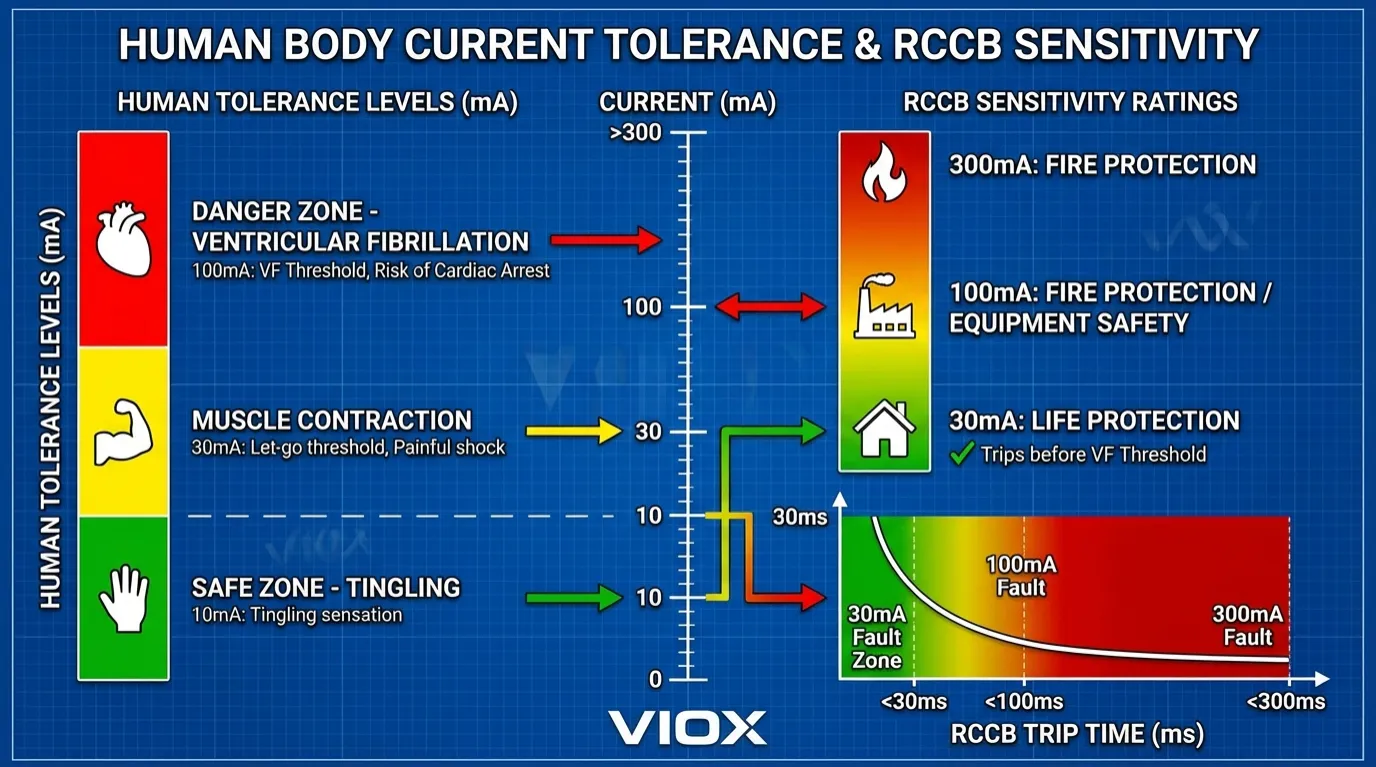
Sensitivity vs. Trip Time Characteristics
Understanding trip time performance is critical for safety analysis:
| Sensitivity | Trip Time at IΔn | Trip Time at 5×IΔn | Application Priority |
|---|---|---|---|
| 10mA | ≤ 300ms | ≤ 40ms | Maximum personal protection |
| 30mA | ≤ 300ms | ≤ 40ms | Standard personal protection |
| 100mA | ≤ 300ms | ≤ 40ms | Equipment + fire protection |
| 300mA | ≤ 300ms (or 150ms for Type S) | ≤ 40ms | Fire protection |
| 300mA Type S | ≤ 500ms | ≤ 150ms | Selective fire protection |
The trip time decreases significantly as fault current increases, providing faster protection during severe faults while maintaining stability during minor leakage conditions.
Common Selection Mistakes to Avoid
Mistake 1: Oversensitivity for High-Leakage Circuits
Installing a 30mA RCCB on circuits with variable frequency drives or extensive IT equipment leads to chronic nuisance tripping. Solution: Calculate total leakage current and select 100mA or 300mA sensitivity with appropriate Type (A, F, or B).
Mistake 2: Undersensitivity for Personnel Protection
Using 100mA or 300mA RCCBs on socket outlet circuits violates safety codes and leaves personnel vulnerable to electric shock. Solution: Always use 30mA for circuits where direct human contact is possible.
Mistake 3: Ignoring Selectivity Requirements
Installing multiple 30mA RCCBs in series without considering selectivity causes widespread outages during single faults. Solution: Use 300mA Type S upstream with 30mA instantaneous downstream.
Mistake 4: Wrong RCCB Type for Load
Using Type AC RCCBs with DC-sensitive loads (solar inverters, EV chargers, VFDs) may prevent proper tripping. Solution: Match RCCB type to load characteristics—use Type B for EV charging applications.
Mistake 5: Neglecting Cable Length
Long cable runs generate significant capacitive leakage current (0.01-0.03mA/m). A 500m cable can produce 5-15mA leakage, consuming half the margin of a 30mA RCCB. Solution: Account for cable leakage in total leakage calculations.
Practical Selection Workflow
Step 1: Identify the primary protection objective
- Personal protection → 30mA (or 10mA for enhanced protection)
- Fire protection → 100mA, 300mA, or 500mA
Step 2: Calculate total circuit leakage current
- Sum all connected equipment leakage
- Add cable capacitive leakage (length × 0.02mA/m)
- Ensure total ≤ 0.3 × selected IΔn
Step 3: Verify regulatory compliance
- Check local electrical codes (NEC, IEC 60364, BS 7671)
- Confirm required sensitivity for specific locations
- Ensure proper RCCB type (AC, A, F, B) for load
Step 4: Design selectivity scheme
- Use time-delayed (Type S) RCCBs upstream
- Maintain 3:1 current ratio between cascaded devices
- Verify coordination with manufacturer data
Step 5: Select appropriate rated current (In)
- RCCB In ≥ maximum load current
- Consider diversity factors for multiple loads
- Ensure coordination with upstream overcurrent protection
For comprehensive guidance on circuit protection selection, refer to our 5-step framework for panel builders.
Frequently Asked Questions
Q: Can I use a 100mA RCCB instead of 30mA to reduce nuisance tripping?
A: No, not for circuits requiring personal protection. Regulations mandate 30mA sensitivity for socket outlets and areas with direct human contact. For high-leakage equipment, install dedicated circuits with appropriate sensitivity or use Type A/F RCCBs that better handle electronic loads.
Q: What’s the difference between Type S and standard RCCBs?
A: Type S (Selective) RCCBs incorporate a time delay (40-500ms) before tripping, allowing downstream protection devices to operate first. This maintains power to unaffected circuits during faults. Use Type S for upstream protection in cascaded systems.
Q: How do I calculate if my circuit needs 30mA or 100mA sensitivity?
A: Sum the normal leakage current of all connected equipment plus cable leakage (length × 0.02mA/m). The total should not exceed 30% of the RCCB’s rated sensitivity. If total leakage is >9mA, consider 100mA sensitivity (unless personal protection mandates 30mA).
Q: Will a 10mA RCCB provide better protection than 30mA?
A: Yes, 10mA offers enhanced protection and is required in high-risk areas like medical facilities and swimming pool zones. However, 10mA devices are more susceptible to nuisance tripping and should only be used where specifically required or where enhanced protection justifies the trade-off.
Q: Can I install a 300mA RCCB on a residential main switchboard?
A: Yes, for fire protection and to provide selectivity with downstream 30mA RCCBs. However, the 300mA device alone does not provide adequate personal protection—you must have 30mA RCCBs protecting all socket outlet circuits and other areas requiring shock protection.
Q: What happens if I select the wrong RCCB type (AC instead of A) with correct sensitivity?
A: Even with correct sensitivity, the wrong type may fail to detect certain fault currents. Type AC RCCBs don’t reliably detect DC residual currents from electronic equipment, potentially leaving circuits unprotected. Always match RCCB type to load characteristics in addition to selecting proper sensitivity.
Key Takeaways
- 30mA sensitivity is mandatory for personal protection in residential and commercial socket outlet circuits—this is non-negotiable for safety and code compliance.
- Calculate total leakage current before selecting sensitivity: ensure the sum of equipment leakage plus cable leakage remains below 30% of the RCCB’s rated sensitivity to prevent nuisance tripping.
- Use selectivity principles in multi-level protection systems: install 300mA Type S RCCBs upstream with 30mA instantaneous devices downstream to maintain power to unaffected circuits during faults.
- Match RCCB type to load characteristics: sensitivity alone isn’t enough—Type AC, A, F, or B selection depends on whether loads generate DC components or high-frequency leakage currents.
- 100mA and 300mA sensitivities serve equipment protection and fire prevention roles, not personal protection—never substitute these for 30mA devices in areas with direct human contact.
- IEC 61008-1 compliance ensures RCCBs trip between 0.5× and 1.0× their rated sensitivity within specified time limits—verify certification when sourcing devices.
- Environmental factors matter: wet locations always require 30mA protection regardless of load type, while dry industrial environments may accommodate higher sensitivities for operational reliability.
For reliable, certified RCCBs with precise sensitivity ratings and comprehensive technical support, explore the VIOX RCCB product range designed for demanding B2B applications.