

Direct Answer: Do You Need a 15 Amp or 20 Amp Breaker?
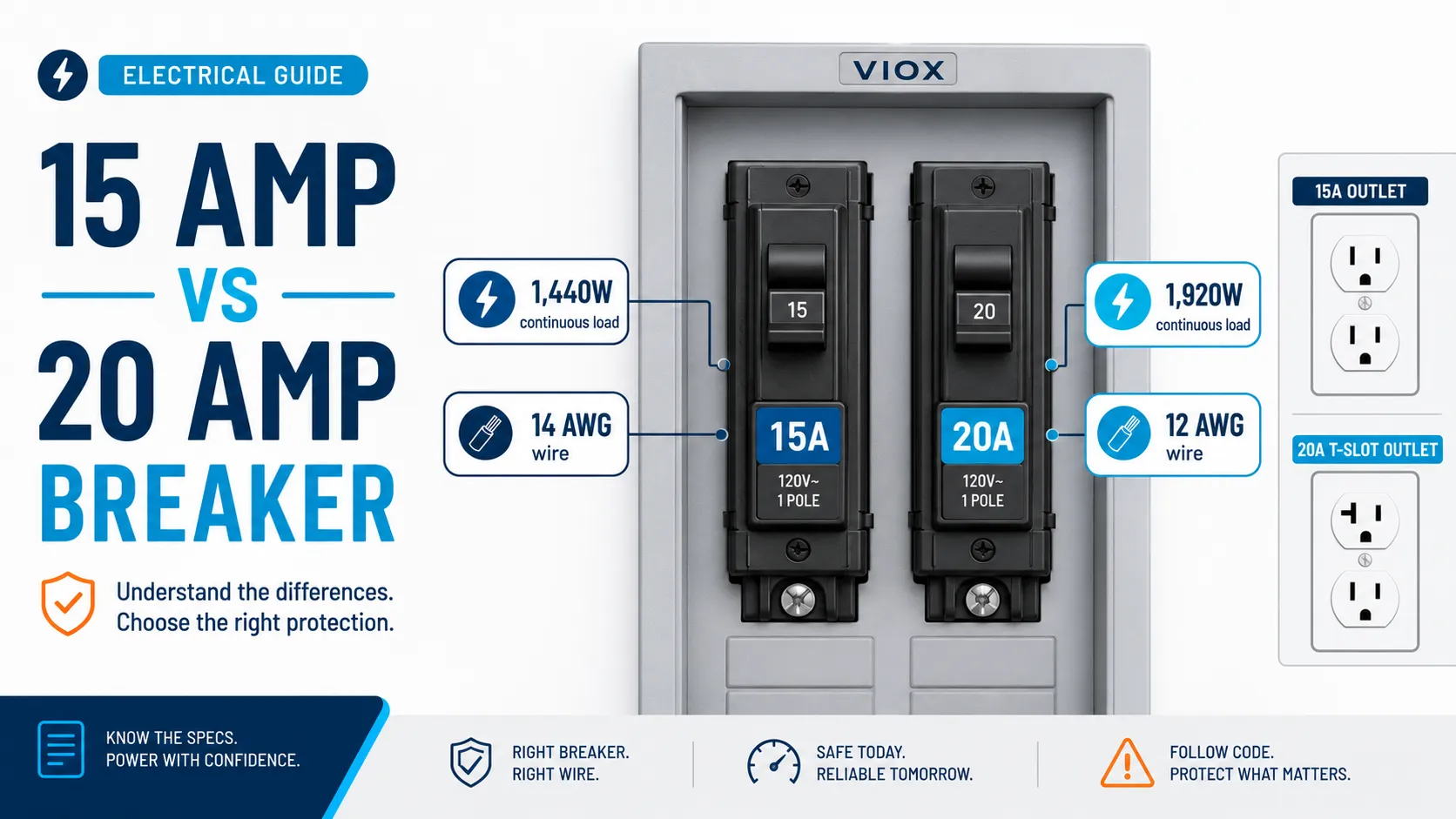
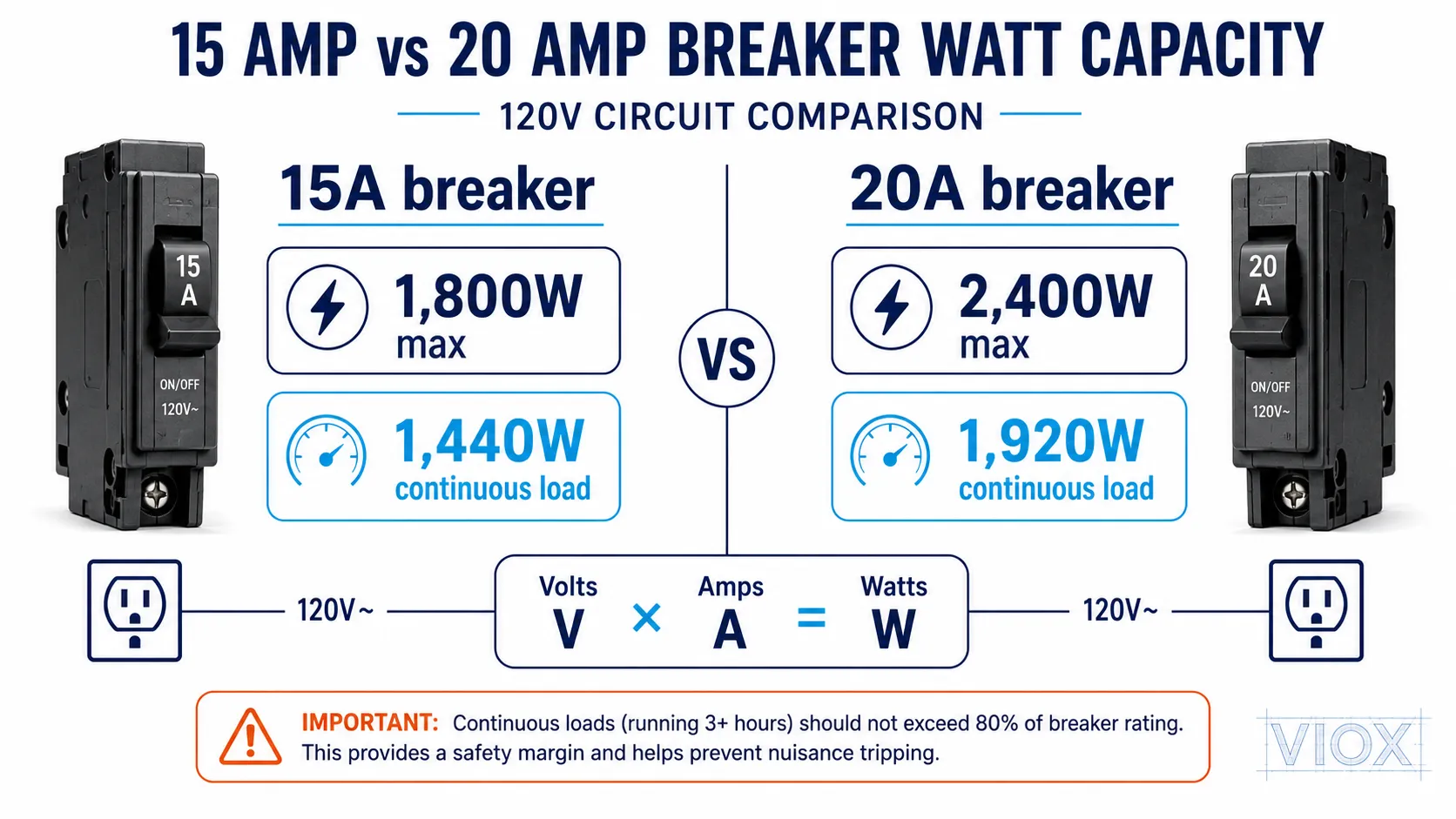
For a standard 120V household circuit, a 15 amp breaker can handle up to 1,800 watts, or about 1,440 watts for continuous loads. A 20 amp breaker can handle up to 2,400 watts, or about 1,920 watts for continuous loads.
Choose a 15A breaker for light-duty circuits with properly rated 14 AWG copper wiring. Choose a 20A breaker only when the entire circuit is wired with properly rated 12 AWG copper wiring and the load, outlet type, or room requirement justifies the higher capacity.
Never replace a 15 amp breaker with a 20 amp breaker just to stop nuisance tripping. If the circuit wiring is 14 AWG copper, installing a 20A breaker can allow the wire to overheat before the breaker trips.
15 Amp vs 20 Amp Breaker at a Glance
| Question | 15 Amp Breaker | 20 Amp Breaker |
|---|---|---|
| Maximum watts at 120V | 1,800W | 2,400W |
| Recommended continuous load at 120V | 1,440W | 1,920W |
| Common copper wire size | 14 AWG | 12 AWG |
| Typical outlet/circuit use | Bedrooms, lighting, general light loads | Kitchens, laundry, bathrooms, garage, heavier receptacle loads |
| Can it use a 20A receptacle? | No | Yes, when circuit design allows |
| Can it use 15A receptacles? | Yes | Often yes on multi-outlet circuits, depending on local code |
| Main risk if oversized | Wire overheating and fire risk | Higher cost and unnecessary capacity if load is small |
How Many Watts Can a 15 Amp Breaker Handle?
A 15 amp breaker on a 120V circuit has a theoretical maximum power of:
120V x 15A = 1,800W
For continuous loads, many electricians use the 80% rule:
1,800W x 80% = 1,440W
That means a 15A circuit is normally best kept around 1,440 watts when the load will run for a long time. This matters for space heaters, lighting banks, small appliances, and office equipment that may operate continuously.
If your circuit trips when you run a heater, vacuum, microwave, or hair dryer, the breaker may not be the problem. The circuit may simply be overloaded. For a deeper explanation of overload symptoms, see VIOX’s guide to circuit overload causes and fixes.
How Many Watts Can a 20 Amp Breaker Handle?
A 20 amp breaker on a 120V circuit has a theoretical maximum power of:
120V x 20A = 2,400W
For continuous loads:
2,400W x 80% = 1,920W
This is why 20A circuits are commonly used for areas where multiple appliances or higher-demand receptacle loads are expected, such as kitchens, laundry areas, bathrooms, garages, workshops, and some dedicated equipment circuits.
If your main question is watt capacity, VIOX also has a separate guide on how many watts a 20 amp circuit breaker can handle.
15A and 20A Breaker Wattage Chart
| Circuit Voltage | 15A Breaker Max Load | 15A Continuous Load | 20A Breaker Max Load | 20A Continuous Load |
|---|---|---|---|---|
| 120V | 1,800W | 1,440W | 2,400W | 1,920W |
| 240V | 3,600W | 2,880W | 4,800W | 3,840W |
Most household receptacle questions in North America are about 120V circuits. Some air conditioners, heaters, pumps, and appliances may use 240V circuits, so always check the equipment nameplate before choosing a breaker.
Wire Size: The Most Important Safety Check
Breaker size must protect the wire, not just match the appliance.
| Breaker Size | Common Copper Wire Size | Why It Matters |
|---|---|---|
| 15A | 14 AWG copper | Common for lighting and general light-duty circuits |
| 20A | 12 AWG copper | Required for many 20A branch circuits because it can carry more current |
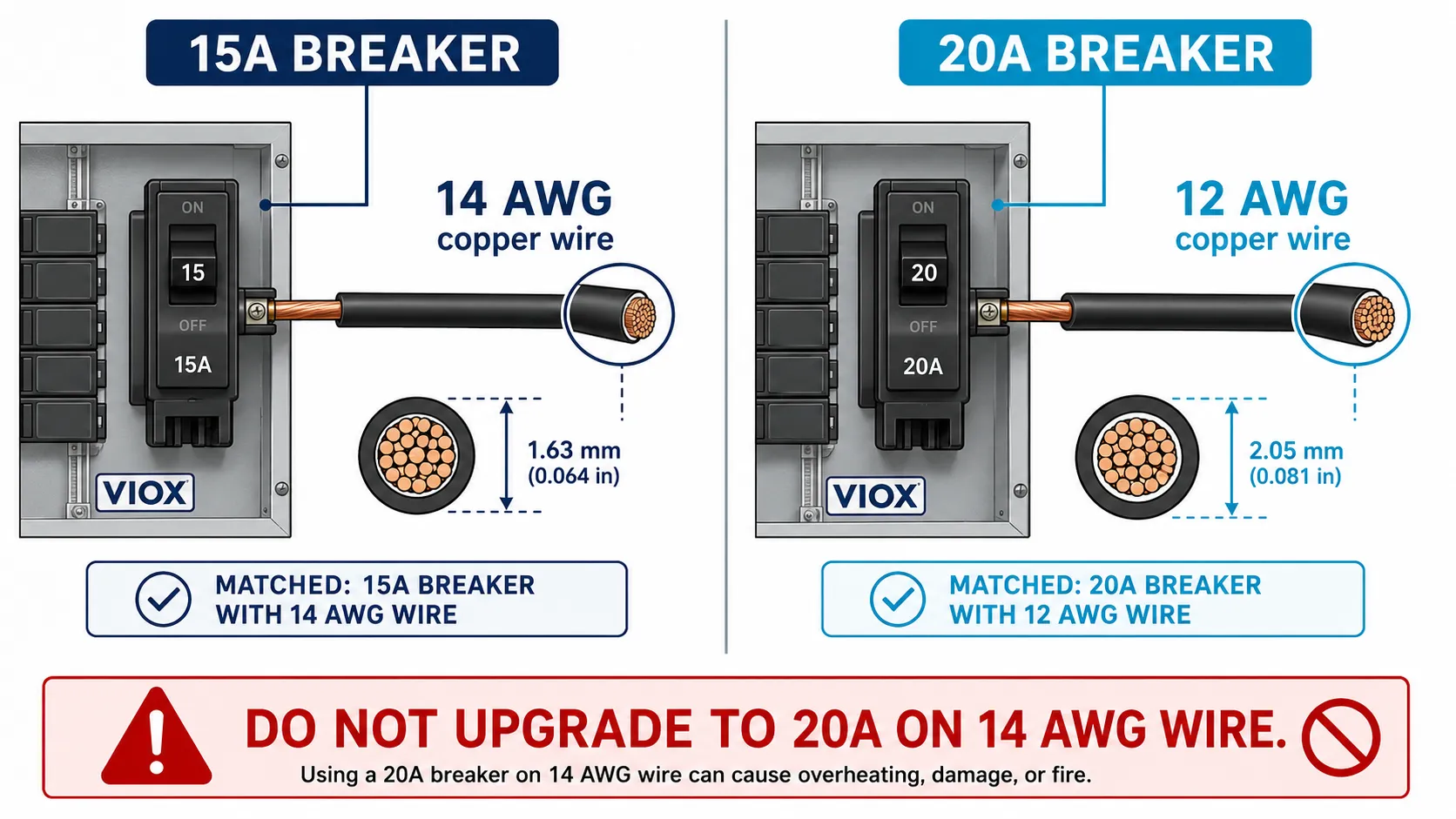
The dangerous mistake is replacing a 15A breaker with a 20A breaker when the circuit wiring is still 14 AWG copper. The breaker may stop tripping, but the wire can become the weak point.
Long cable runs may also require larger conductors to reduce voltage drop. If you are dealing with long 12/2 cable runs, see VIOX’s guide to maximum distance for 12/2 wire on a 20 amp breaker.
15 Amp Outlet vs 20 Amp Outlet
A 15A receptacle has two vertical slots and a grounding slot. A 20A receptacle usually has one T-shaped slot so it can accept a 20A plug.
| Outlet Question | Practical Answer |
|---|---|
| Can a 20A outlet be installed on a 15A breaker? | No. A 20A receptacle should not be supplied by a 15A circuit. |
| Can 15A outlets be used on a 20A circuit? | Often yes on multi-outlet branch circuits in NEC-based installations, but local code and circuit design matter. |
| Does a 20A outlet mean the circuit is 20A? | Not always. Check the breaker, wire size, and panel schedule. |
| Does a 20A breaker require 20A outlets everywhere? | Not necessarily. Many 20A general-use circuits use 15A receptacles where allowed. |
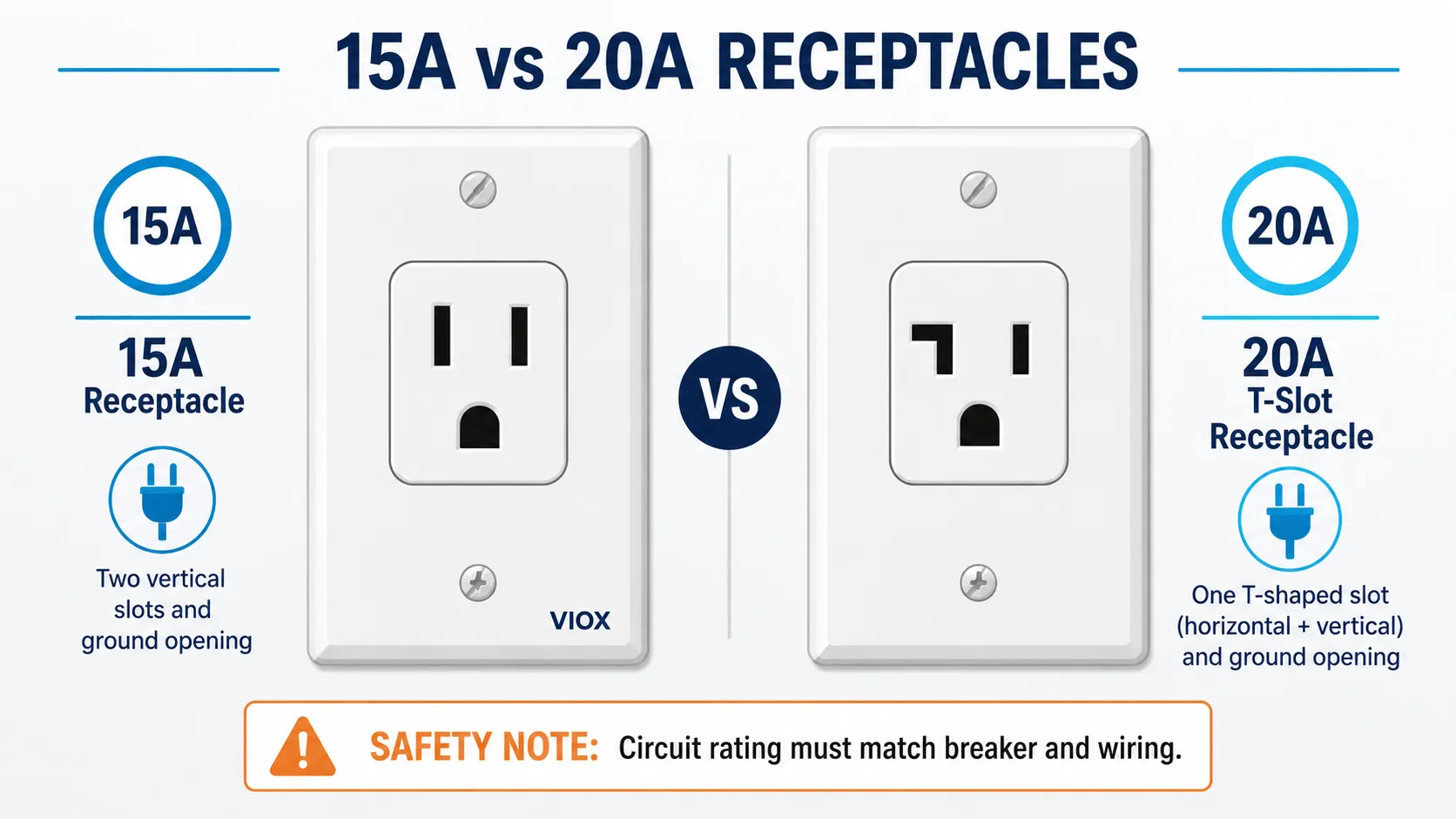
The outlet shape alone is not enough. A safe answer requires checking the breaker rating, wire gauge, receptacle rating, circuit type, and applicable local electrical code.
When Should You Use a 15 Amp Breaker?
A 15 amp breaker is usually suitable for:
- Bedroom lighting and receptacle circuits where the expected load is modest
- General lighting circuits
- Small rooms with low appliance demand
- Existing 14 AWG copper branch circuits
- Circuits where the connected equipment nameplate does not require a 20A circuit
The advantage of a 15A circuit is not that it is “weaker.” It is correctly matched to smaller branch-circuit wiring and lighter loads. If the circuit is properly designed, a 15A breaker protects the conductors before they overheat.
When Should You Use a 20 Amp Breaker?
A 20 amp breaker is usually considered when the circuit has:
- 12 AWG copper wiring or larger conductors rated for the circuit
- Kitchen countertop receptacle loads
- Laundry receptacles
- Bathroom receptacles
- Garage or workshop receptacle circuits
- A dedicated appliance that specifies a 20A branch circuit
- Repeated overload trips caused by legitimate load demand, not by a fault
In many U.S. NEC-based installations, kitchens, laundry areas, bathrooms, and similar higher-demand areas commonly use 20A branch circuits. Exact requirements depend on the code edition adopted locally and the circuit purpose.
Can I Replace a 15 Amp Breaker with a 20 Amp Breaker?
Only if the entire circuit is rated for 20 amps.
Before upgrading, a qualified electrician should verify:
- The entire branch circuit uses suitable 12 AWG copper wire or an approved equivalent
- All junction boxes, splices, terminals, and devices are rated for the circuit
- The receptacle type is suitable for the circuit design
- The panel accepts that breaker type
- The load calculation supports the change
- The installation complies with local electrical code
If any part of the circuit is 14 AWG copper, keep the breaker at 15A unless the wiring is replaced or the circuit is redesigned.
When Does a 15 Amp Breaker Trip?
A 15 amp breaker does not necessarily trip the instant current rises slightly above 15 amps. Residential breakers are designed with time-current behavior.
In simple terms:
- A small overload may take time to trip.
- A larger overload trips faster.
- A short circuit or ground fault can trip very quickly.
- Heat inside the panel, loose connections, aging breakers, or repeated overloads can affect real behavior.
This explains why a circuit may run a heavy appliance for a short time but trip after several minutes. It also explains why a motor or air conditioner may trip a breaker at startup even if the running watts look acceptable.
Why Breakers Use a Trip Curve, Not a Single Trip Point
A circuit breaker does not behave like a simple on/off switch at exactly 15.0A or 20.0A. It follows a trip curve, also called a time-current curve. The curve shows how long the breaker can carry different overload levels before opening the circuit.
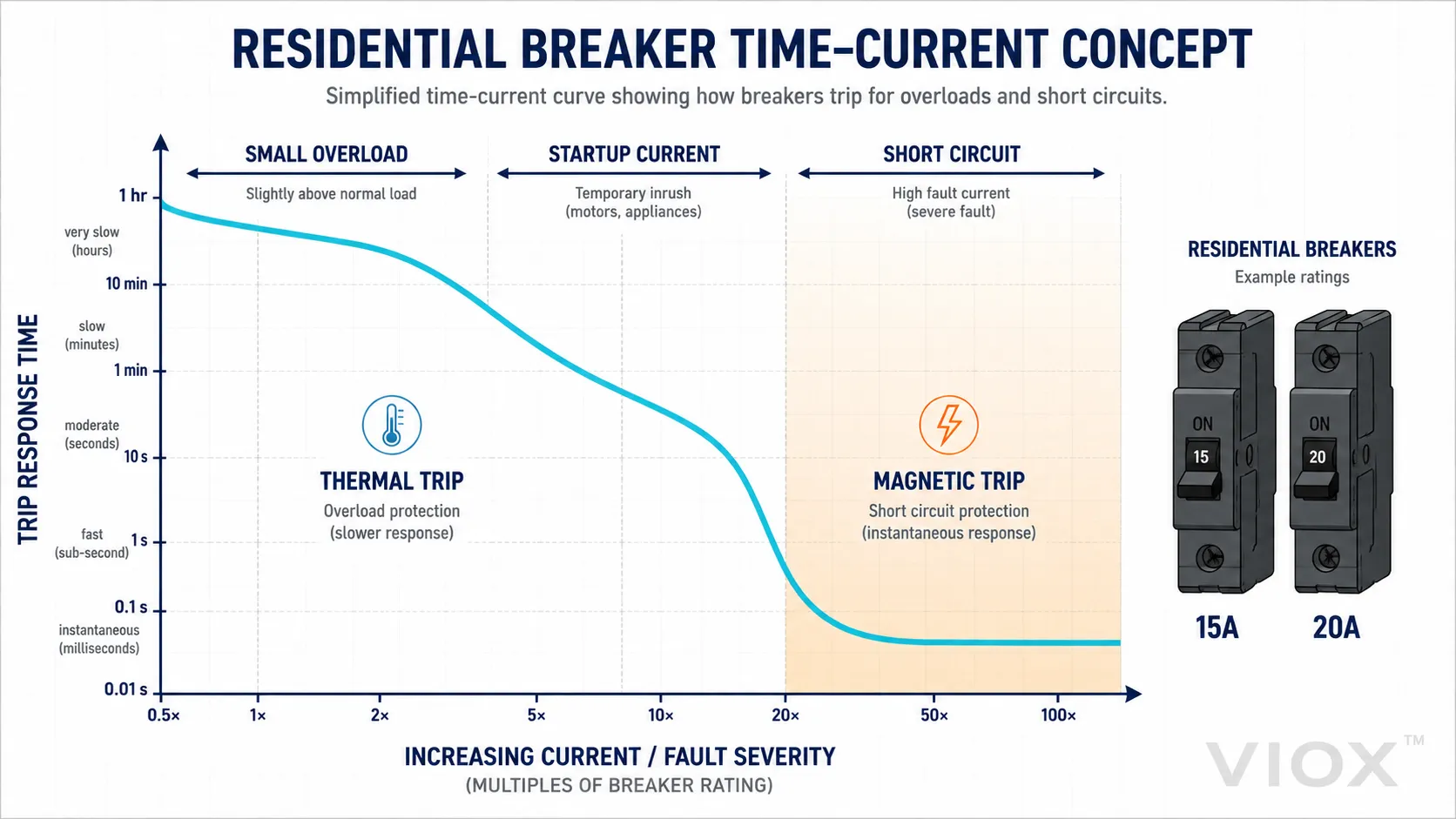
For example, a small overload may trip slowly because the thermal element needs time to heat. A severe short circuit trips much faster through the magnetic mechanism. This is why two circuits with the same breaker size can behave differently when powering motors, compressors, or appliances with high startup current.
In IEC-style miniature circuit breakers, trip curves are often described as B, C, or D curves, based on how much inrush current the breaker allows before magnetic tripping. North American residential breakers are not always labeled in exactly the same B/C/D format, but the same engineering idea applies: the breaker’s time-current characteristic must match the load and protect the wiring.
For a deeper explanation of B, C, D, K, and Z trip characteristics, see VIOX’s guide to MCB types and trip curves.
Why a Breaker Trips Even When the Watts Look Safe
The math may say the circuit is below 1,440W or 1,920W, but the breaker can still trip because watts alone do not tell the whole story.
Common causes include:
- Startup current: Motors, compressors, pumps, and some appliances can draw several times their running current at startup.
- Multiple hidden loads: Lights, chargers, refrigerators, fans, and small appliances may already be on the same circuit.
- Loose connections: Heat from a poor connection can cause nuisance tripping or create a fire risk.
- Old or weak breaker: Breakers can wear out after repeated trips or harsh conditions.
- Wrong breaker type: Some loads require a breaker with the correct curve, AFCI/GFCI function, or manufacturer-approved panel compatibility.
If a breaker trips repeatedly, do not keep resetting it without finding the cause.
Room-by-Room Guide: 15A or 20A?
| Area or Load | Typical Circuit Choice | Notes |
|---|---|---|
| Bedroom receptacles | 15A or 20A | Depends on wiring, local code, and load plan |
| General lighting | Often 15A | Lighting loads are usually lower, but not always |
| Kitchen countertop receptacles | Commonly 20A | Higher appliance demand |
| Bathroom receptacles | Commonly 20A | Hair dryers and grooming appliances draw high current |
| Laundry receptacle | Commonly 20A | Washer and related loads may require dedicated circuit planning |
| Garage or workshop | Often 20A | Tools, chargers, and compressors may need higher capacity |
| Window air conditioner | Depends on nameplate | Check voltage, amperage, plug type, and manufacturer instructions |
| Space heater | Often needs careful load planning | A 1,500W heater nearly fills a 15A continuous-load recommendation |
Common Mistakes to Avoid
Mistake 1: Upgrading the Breaker Without Upgrading the Wire
This is the most dangerous mistake. A larger breaker may stop nuisance trips, but it may also allow the wire to carry more current than it was designed for.
Mistake 2: Choosing by Outlet Shape Only
A T-slot receptacle suggests a 20A receptacle, but the breaker and wiring still need to be verified.
Mistake 3: Ignoring Continuous Loads
A circuit that looks acceptable for a short load may be overloaded if the same load runs for hours.
Mistake 4: Treating Breaker Trips as an Annoyance
A trip is a warning. It may indicate overload, short circuit, ground fault, arc fault, loose wiring, equipment failure, or a damaged breaker.
Mistake 5: Assuming a 20A Circuit Solves Every Problem
Some equipment needs a dedicated circuit, a different voltage, a GFCI/AFCI breaker, or a manufacturer-specified circuit size. A larger breaker is not automatically safer.
Quick Selection Checklist
Before choosing between a 15A and 20A breaker, check:
- What voltage is the circuit: 120V or 240V?
- What is the actual load in amps or watts?
- Is the load continuous?
- What wire gauge is installed?
- Is the circuit copper or aluminum?
- What outlet type is installed?
- Is the circuit dedicated or shared?
- Does the appliance nameplate specify breaker size?
- Does the local code require a 20A circuit for that location?
- Is the breaker approved for the panel?
FAQ
How many watts can a 15 amp breaker handle?
At 120V, a 15 amp breaker can handle up to 1,800 watts. For continuous loads, a practical limit is about 1,440 watts.
How many watts can a 20 amp breaker handle?
At 120V, a 20 amp breaker can handle up to 2,400 watts. For continuous loads, a practical limit is about 1,920 watts.
How many watts will trip a 15 amp breaker?
It depends on how much overload exists and how long it lasts. A breaker may not trip instantly at slightly over 15 amps, but sustained overloads, high startup current, or short circuits can trip it.
How many amps can a 15 amp breaker handle?
A 15 amp breaker is designed for a 15A circuit. For continuous loads, the usable load is commonly limited to about 12 amps.
How many volts can a 15 amp breaker handle?
It depends on the breaker’s voltage rating. Many residential breakers are used on 120V or 120/240V systems, but you must read the breaker label and panel requirements.
Can I put a 20 amp outlet on a 15 amp breaker?
No. A 20A receptacle should not be installed on a 15A circuit because it can invite loads that exceed the circuit rating.
Can I use 15 amp outlets on a 20 amp breaker?
Often yes on multi-outlet 20A branch circuits in NEC-based installations, but the final answer depends on local code, circuit design, and receptacle listing.
Can I replace a 15 amp breaker with a 20 amp breaker?
Only if the wiring and entire circuit are rated for 20 amps. If the circuit uses 14 AWG copper wiring, do not install a 20A breaker.
Do I need a 15A or 20A breaker for an air conditioner?
Check the air conditioner nameplate and installation instructions. Some small units use 15A circuits, while larger units may require 20A, 240V, or a dedicated circuit.
Is a 20 amp breaker better than a 15 amp breaker?
Not automatically. The better breaker is the one correctly matched to the wire size, load, outlet type, panel, and electrical code requirements.
Conclusion
Use a 15 amp breaker for properly wired light-duty circuits, usually with 14 AWG copper conductors. Use a 20 amp breaker when the circuit wiring, outlets, load, and code requirements support a 20A branch circuit.
The safest rule is simple: do not size the breaker only by the appliance. Size it to protect the wire and match the circuit design.