

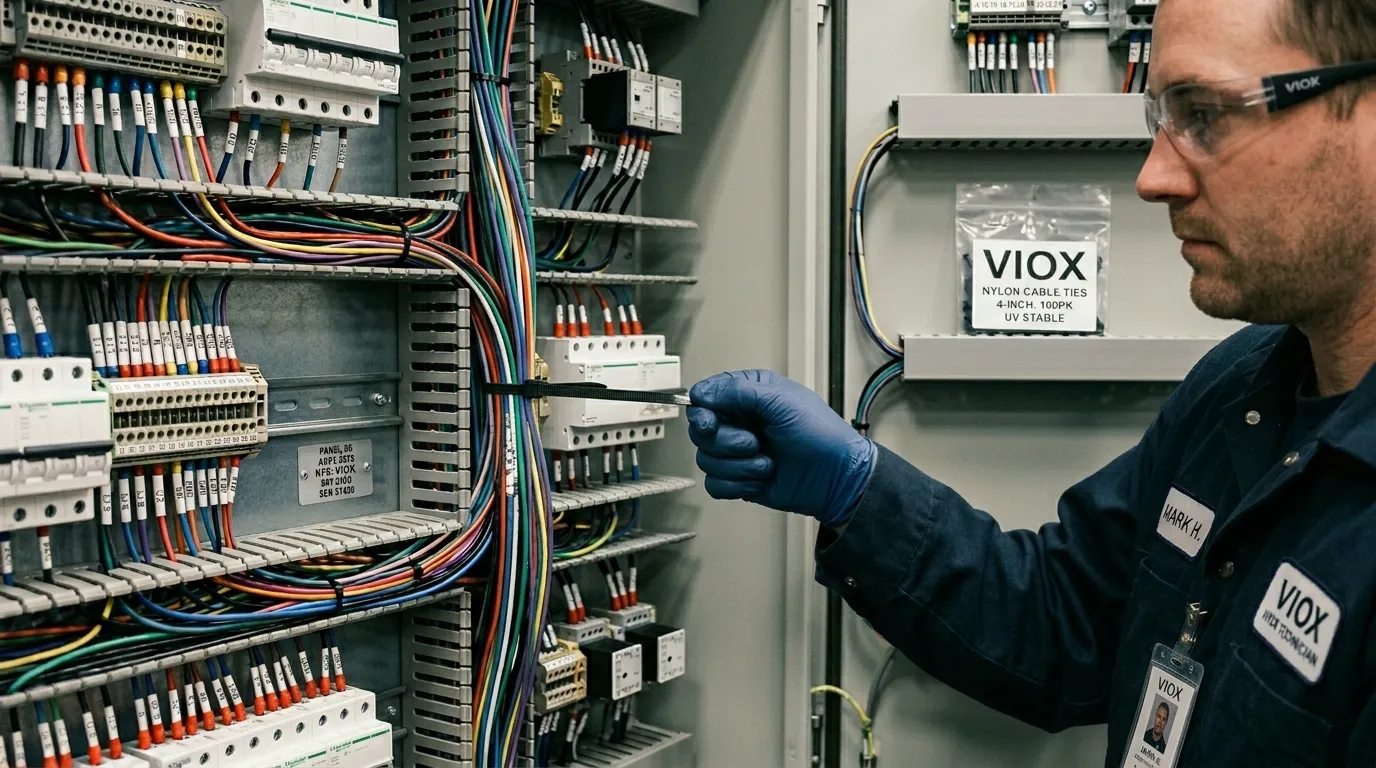
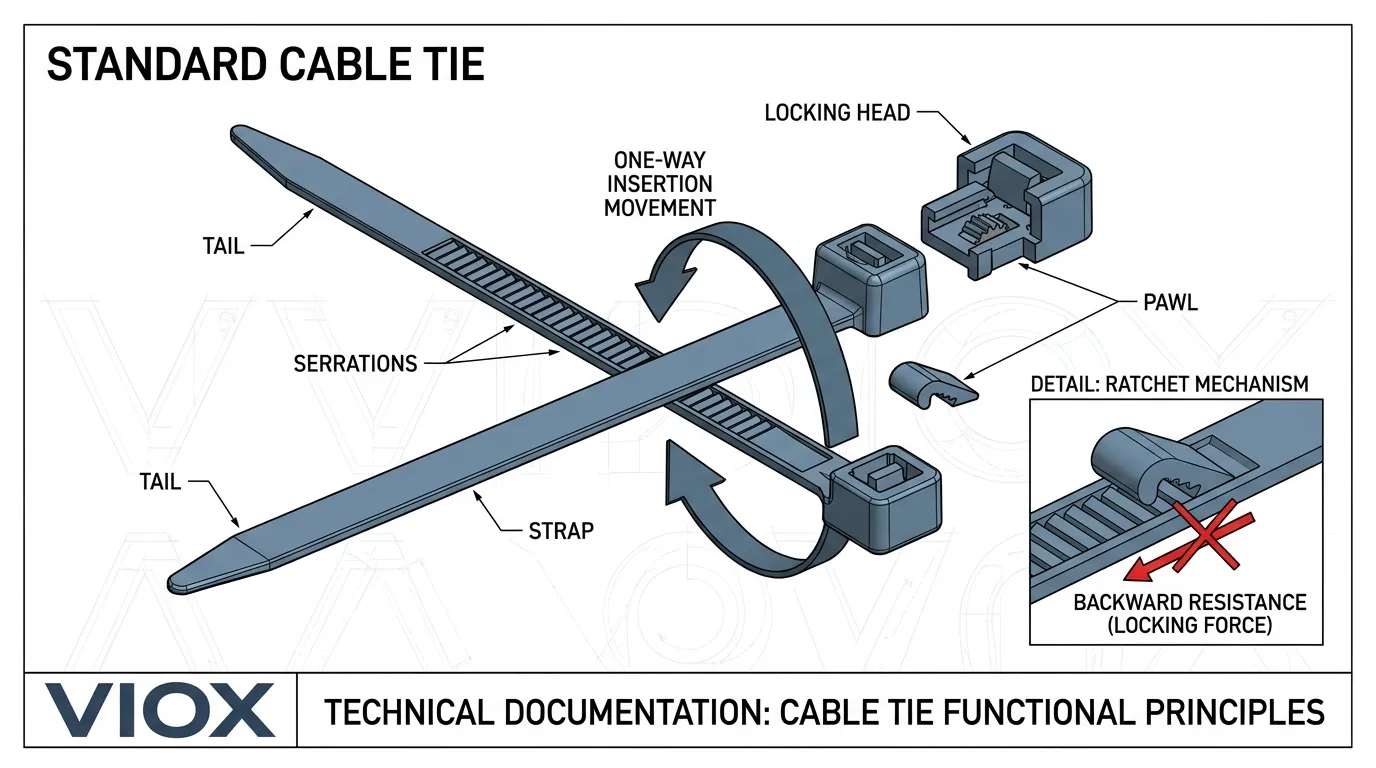
Cable ties work through a one-way locking mechanism. The serrated strap is inserted through the tie head, where a small internal pawl or ratchet engages the teeth on the strap. This allows the tie to tighten in one direction while resisting backward movement, which is why the bundle stays secured once the tie is pulled tight.
That is the short answer. In practical use, the real performance of a cable tie depends on the locking head design, strap material, installation tension, environmental conditions, and whether the selected tie matches the job.
Quick Mechanism Table
| Part | Function | Why it matters |
|---|---|---|
| Strap | Wraps around the bundle | Provides the body of the tie and carries the load |
| Serrations or teeth | Engage with the locking head | Create the one-way grip that prevents loosening |
| Locking head | Receives the strap and holds the mechanism | Controls how the tie locks and resists pullback |
| Pawl or ratchet tab | Bites into the strap teeth | Creates the one-direction locking action |
| Tail | The free end pulled during installation | Used to tighten the tie around the bundle |
How the Cable Tie Locking Head Works
The head is the most important part of the mechanism.
When the tail of the tie is pushed through the head:
- the strap enters the head opening
- the internal pawl flexes to let the teeth move forward
- the strap slides in one direction as the tie tightens
- once tension is released, the pawl settles against the teeth
- backward movement is resisted, which keeps the tie locked
This simple one-way action is what makes cable ties fast, cheap, and effective for bundling and fastening.
In a standard nylon cable tie, the locking element is designed for quick installation and permanent retention. In other cable tie styles, the locking mechanism may be releasable, metal-based, or reinforced for specialized conditions.
Why Cable Ties Stay Tight
Cable ties stay tight because the locking head is designed to allow forward movement and resist reverse movement.
That resistance comes from:
- the geometry of the teeth
- the shape and stiffness of the pawl
- the material of the tie
- the amount of installation tension
As long as the tie is properly selected and not overloaded, the head and strap work together to maintain the bundle.
This is also why cable ties are so widely used in electrical work. They create a fast and compact fastening method without requiring screws, adhesives, or separate clips for every application.
The Main Parts of a Cable Tie
Most people understand cable ties as “plastic strips that lock,” but the mechanism becomes clearer when you break the product into parts.
Strap body
The strap wraps around the bundle and carries the mechanical load.
Serrated surface
The serrations are the part that interacts with the locking head. Without them, the tie would not hold in the same one-way manner.
Locking head
The head guides the strap and contains the locking feature.
Pawl or locking tongue
This is the part that engages the strap. In nylon ties, it is typically molded into the head. In some metal ties, the locking mechanism is different and can be more suitable for harsh environments.
Why Cable Ties Fail or Loosen
Cable ties are simple, but they still fail when they are misapplied.
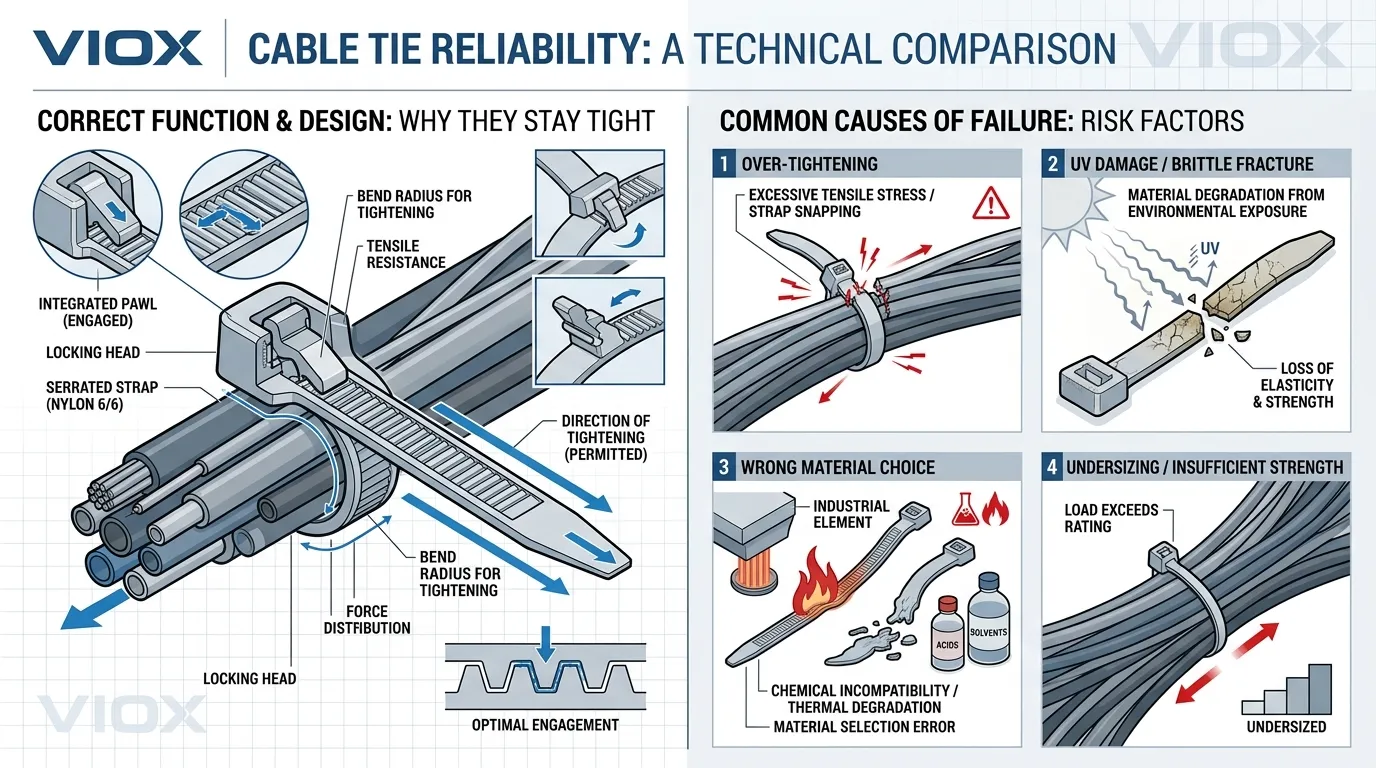
Common reasons cable ties fail
| Failure cause | What happens | Why it matters |
|---|---|---|
| Wrong material selection | The tie becomes brittle, weak, or degraded | Material must match UV, heat, chemical, or corrosion exposure |
| Over-tightening | The bundle or the tie is damaged | Excess tension can pinch insulation or stress the head |
| Undersizing | The tie cannot carry the load or fit the bundle correctly | A too-small tie may slip, stretch, or break |
| Environmental exposure | Sunlight, heat, moisture, or chemicals reduce performance | Outdoor and industrial use need the right tie type |
| Low-quality manufacturing | Head, pawl, or strap geometry is inconsistent | Poor-quality ties often fail at the locking head or under load |
This is why “how do cable ties work” is not just a mechanism question. It is also a selection question.
If the application is demanding, Best Materials for Cable Ties, Understanding High Temperature Cable Ties, and Science of UV Resistant Cable Ties are the most useful next reads.
How Different Cable Tie Types Work
Not all cable ties use exactly the same retention logic in practice.
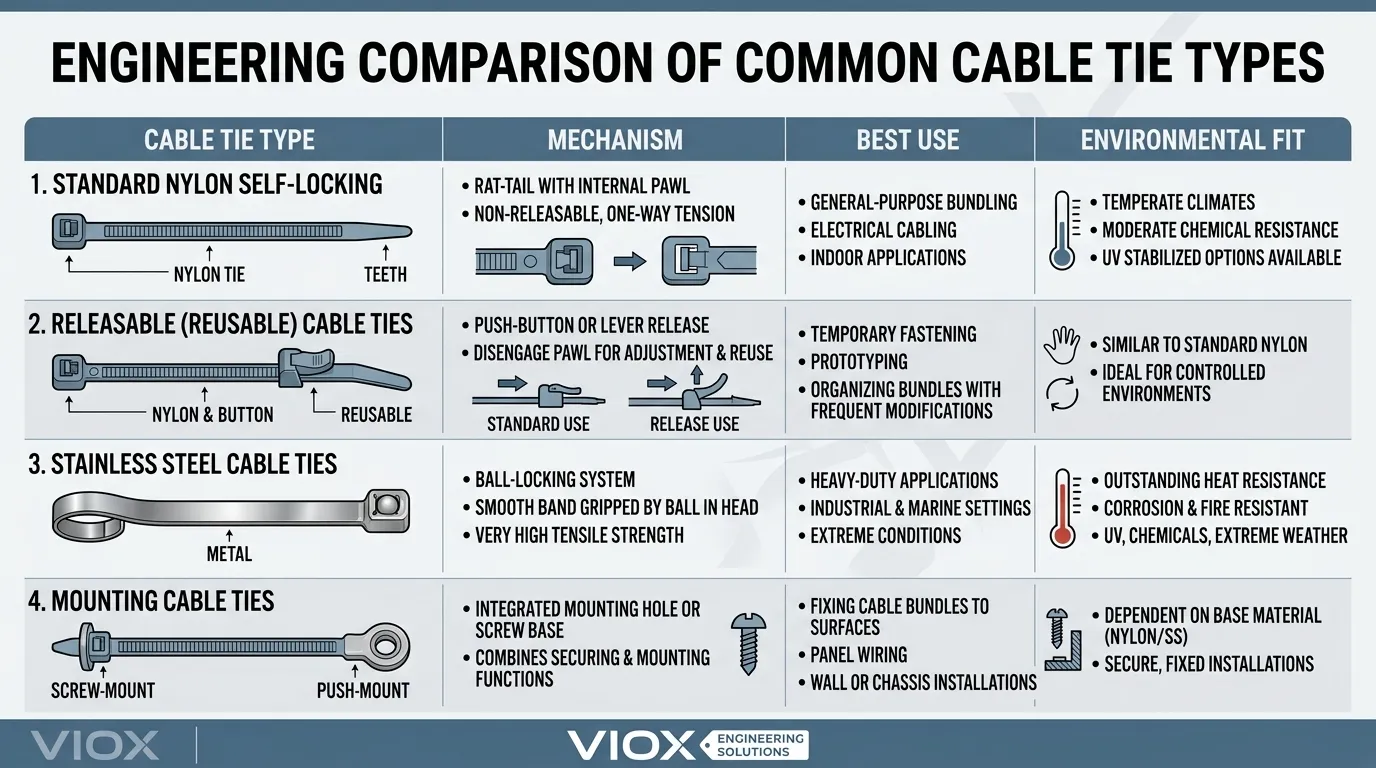
Nylon 6/6 cable ties
These are the most common self-locking cable ties used in general electrical bundling. In many product catalogs, the default “standard nylon cable tie” is actually a Nylon 6/6 tie with a molded pawl-and-serration design.
They are widely used because they balance:
- cost
- ease of installation
- general mechanical strength
- suitability for everyday indoor cable management
Nylon 12 cable ties
Nylon 12 cable ties are often selected where the environment is more demanding, especially when moisture resistance, weather exposure, or lower water absorption matter more than the lowest purchase cost.
In practice, Nylon 12 is more likely to appear in:
- outdoor installations
- solar-related cable management
- harsher environmental conditions
- applications where long-term environmental stability matters more
Releasable cable ties
These include a release feature so the strap can be loosened or opened without cutting the tie. They are useful where temporary fastening or re-entry is needed.
Stainless steel cable ties
These are used where heat, corrosion, or mechanical demands are much higher than nylon can comfortably handle. Their locking approach differs from standard nylon designs and is better suited to harsh environments.
For that category, Stainless Steel Cable Ties Guide and How to Use Metal Cable Ties are better follow-up pages.
Cable ties with mounting or fastening features
Some cable ties are designed not only to bundle but also to attach the bundle to a surface or structure.
Examples include:
- screw-hole cable ties
- adhesive mount combinations
- magnetic mount combinations
Those styles matter because the “work” of the cable tie is no longer just bundling. It also becomes routing or fixing the bundle in place.
Related reading:
- Benefits of Cable Ties with Screw Holes
- Adhesive Cable Tie Mounts Selecting Guide
- Full Guide to Mounting Cable Ties
Standards, Flame Ratings, and Code-Sensitive Selection
For basic household use, people often choose cable ties by size and material alone. In professional electrical work, that is usually not enough.
When cable ties are used in code-sensitive or specification-driven installations, buyers and installers should also check the relevant product standard, flame rating, and environment-specific requirements.
Standards and ratings worth checking
| Item | Why it matters |
|---|---|
| UL 62275 | Common North American reference for cable tie and fastening-device performance in many professional applications |
| IEC 62275 | International reference point for cable tie performance and classification in many markets |
| UL94 V-2 / V-0 | Helps indicate flammability behavior of the cable tie material |
| Plenum-rated suitability | Important in North American air-handling or plenum spaces where material selection is more restricted |
This does not mean every cable tie in every application must be selected the same way. It means that once the installation moves from casual bundling to electrical infrastructure, material and standards compliance become part of how the cable tie “works” in the real world.
In other words, a cable tie can lock perfectly and still be the wrong product if:
- the flame rating is not suitable
- the environmental resistance is wrong
- the standard reference does not match the project requirement
- the installation location has plenum or similar code-driven constraints
How Tight Should a Cable Tie Be?
A cable tie should be tight enough to secure the bundle, but not so tight that it damages insulation, crushes soft materials, or creates unnecessary stress.
In electrical work, over-tightening is one of the most common mistakes. A tie that is too tight can:
- deform cable insulation
- create localized stress
- reduce bundle flexibility
- make maintenance harder
That is why tensioning tools and proper tie sizing matter more in professional work than many people expect.
If you are choosing size rather than mechanism, Cable Tie Size Chart is the best next page.
Are Cable Ties Permanent?
Many standard cable ties are effectively single-use fastening devices. Once tightened, they are not intended to be loosened and reused.
That does not mean every cable tie is permanent in the same way. Some releasable designs can be reopened, and some metal ties are chosen for long-term service in harsher environments.
The key point is simple: a standard nylon tie is usually designed for one-way installation, not repeated reuse.
FAQ
How do cable ties lock?
Cable ties lock through a one-way mechanism inside the head. The pawl or ratchet engages the teeth on the strap and resists backward movement once the tie is tightened.
How do zip ties work?
Zip ties work the same way as cable ties. The term “zip tie” is a common informal name for the same basic fastening concept.
Why do cable ties stay tight?
They stay tight because the locking head allows the strap to move forward during tightening but resists reverse movement once the pawl engages the serrations.
Can cable ties be reused?
Standard nylon cable ties are usually not intended for reuse. Releasable cable ties are the better option when reopening is needed.
Why do cable ties break?
Cable ties usually break because of wrong material choice, over-tightening, environmental exposure, undersizing, or poor manufacturing quality.
What nylon is most common for standard cable ties?
Nylon 6/6 is the most common general-purpose material for standard cable ties, while Nylon 12 is more often considered where environmental exposure or lower water absorption is a stronger priority.
Do cable ties need to meet UL or IEC standards?
In professional or specification-driven installations, they often do. UL 62275 and IEC 62275 are common reference standards depending on the market and project context, and buyers may also need to check flame ratings or plenum-related requirements where applicable.
Are stainless steel cable ties different from nylon cable ties?
Yes. Stainless steel cable ties are used for harsher environments and higher-demand applications, and they do not behave exactly like standard molded nylon self-locking ties.

