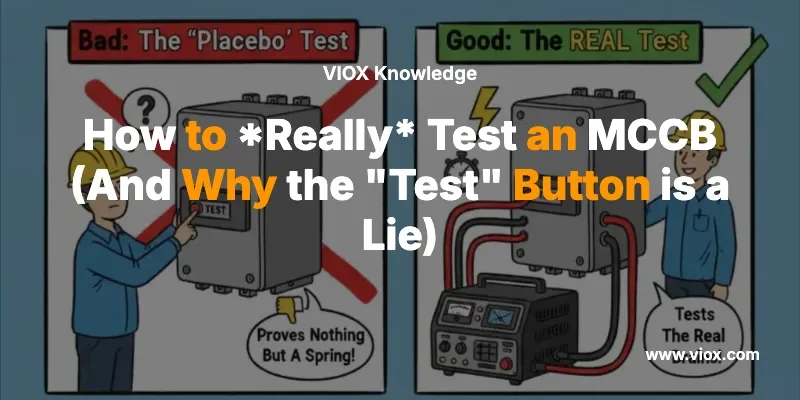
Estás en el sitio, frente a un gigantesco MCCB (interruptor automático en caja moldeada) de 400 A que actúa como la “puerta principal” de una línea de fábrica crítica.
Debes “probarlo”. Ves el pequeño botón “Pulsar para disparar” (PTT). Lo pulsas.
CLONK.
El interruptor se dispara.
Tu trabajo está hecho, ¿verdad? ¿Has “probado” el interruptor?
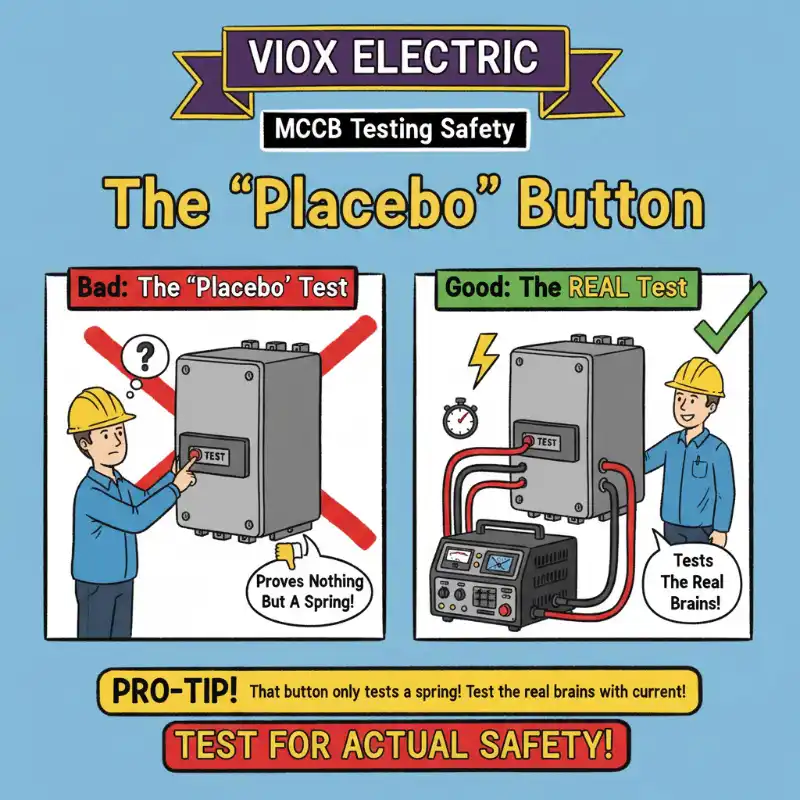
No. Has hecho nada sino probar un resorte. Acabas de caer en “El botón ‘Placebo’”.” Esta es la verdad sobre esa “prueba” y cómo realmente saber si tu interruptor es un “guardián” o solo una “bomba”.”
La analogía del “detector de humo”: lo que ese botón en realidad hace

El mayor momento “¡Ajá!” en seguridad eléctrica es este: presionar ese botón “Test” es exactamente como presionar el botón “Test” en el detector de humo de tu casa.
Piénsalo.
- Lo que prueba: La bocina suena. La batería tiene energía. El bocina funciona.
- Lo que NO prueba: Que el “sensor de humo” (el real cerebro) realmente puede detectar humo.
Ese botón “Test” del MCCB es lo mismo. Es una prueba mecánica no una eléctrico inteligente.
El botón PTT es solo una pequeña varilla de plástico que evita los verdaderos “cerebros” y “empuja” mecánicamente el pestillo de disparo final. Has confirmado que el “percutor” funciona, no que el “gatillo” realmente pueda ser accionado por los sensores.
Los “Dos Cerebros” Que El Botón “Placebo” Ignora
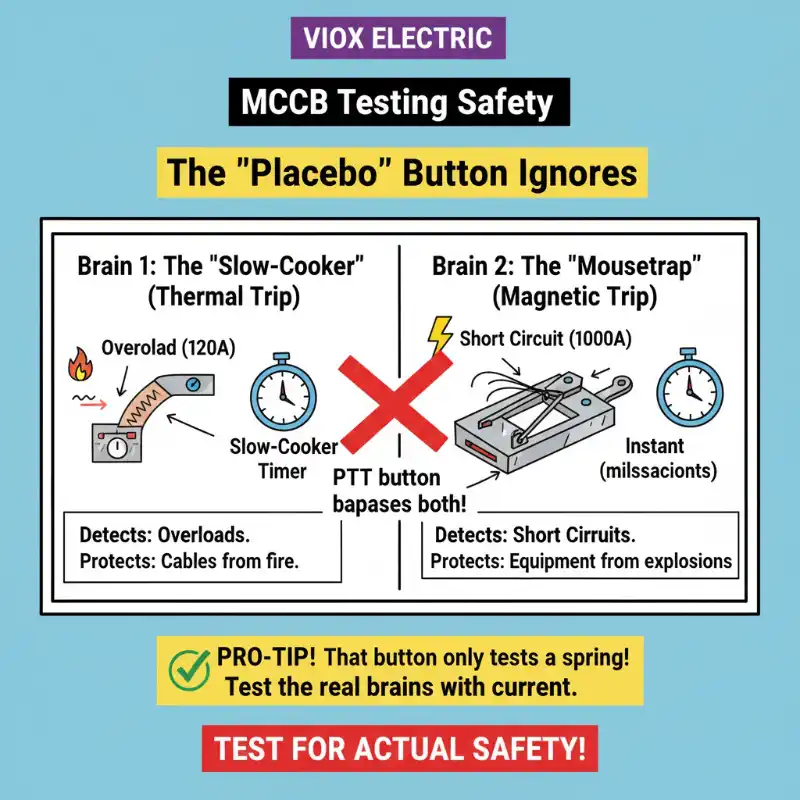
Un interruptor tiene dos real “cerebros” (unidades de disparo) que están diseñados para salvar tu equipo y tu vida. Ese botón “placebo” no prueba ninguno de ellos.
Cerebro 1: La “Olla de Cocción Lenta” (Disparo Térmico)
- Su trabajo: Detectar sobrecargas sobrecargas lentas.
- (por ejemplo, un interruptor de 100 A funcionando a 120 A durante 10 minutos). Cómo funciona: Una tira bimetálica (dos metales) se calienta lentamente con el exceso de corriente. A medida que se calienta, se dobla y, finalmente, como un temporizador de "olla de cocción lenta", se dobla.
- lo suficiente como para "empujar" el pestillo de disparo. Por qué es importante:.
Esto evita que tus cables se sobrecalienten en la pared, se derritan y provoquen un incendio.
- Su trabajo: Detectar cortocircuitos Cerebro 2: La "Trampa para Ratones" (Disparo Magnético).
- (por ejemplo, un interruptor de 100 A funcionando a 120 A durante 10 minutos). Su trabajo: instantáneamente Detectar fallas repentinas de alta corriente (por ejemplo, una falla de 1000 A por un cortocircuito).
- lo suficiente como para "empujar" el pestillo de disparo. Cómo funciona: Un electroimán instantáneamente.
(en milisegundos) genera un poderoso campo magnético a partir de la enorme sobretensión de corriente. Este campo“
The “800A Failure”: When a “Breaker” Becomes a “Switch”
“So what?” you say. “If the spring works, the brains are probably fine.”
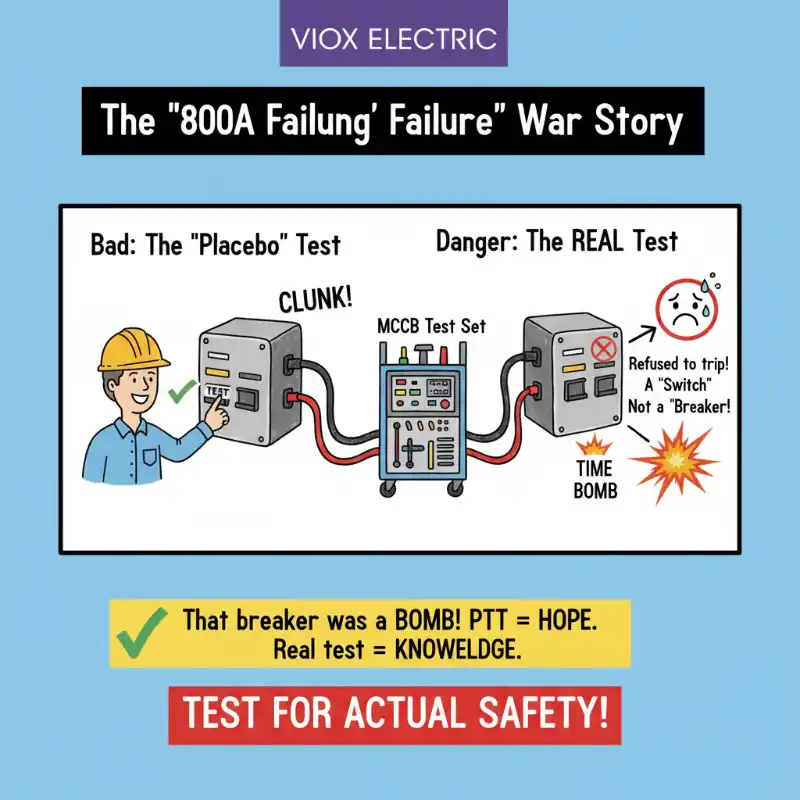
This is the exact thinking that leads to catastrophe. This is “The 800A Failure.”
A “war story” from a senior power systems engineer:
“We were hired to do the annual PM (Preventive Maintenance) at a factory. They had a 400A MCCB on a main feeder. It was 20 years old.
The first thing we did? We pressed the PTT button. CLONK. It tripped perfectly. The plant manager smiled.
Then, we hauled in “The Beast.”
We connected our ‘Primary Current Injection’ test set. This machine doesn’t poke the button; it “feeds” the breaker real current.
We started ‘feeding’ it. 500 Amps… 600 Amps… 800 Amps…
Nada.
The breaker refused to trip. We pushed it all the way to 1200A before it finally, reluctantly, opened.
That 400A “Breaker” had died years ago. It was just a 400A “Switch.”
For 20 years, that entire factory line had cero overload protection. The grease inside the breaker had dried. The springs were weak. The “brains” (the thermal unit) were dead.
It was a “ticking time bomb” that passed its “placebo test” every single year.
El Real Test: “Feeding the Beast” (Primary Current Injection)

So, how do you realmente test an MCCB? How do you test the “smoke sensor,” not just the “horn”?
You “Feed the Beast.”
This is not a job for a standard electrician; it’s a job for a specialized NETA (International Electrical Testing Association) Power Systems Engineer.
- The Tool: A specialized, high-current “MCCB Test Set.” This machine is often the size of a large suitcase, weighs 50kg, and can cost $20,000 or more.
- The Process: The engineer isolates the breaker and connects this “Beast” to it. The machine then en realidad injects 500A, 1000A, or 3000A of real, traceable current through the breaker’s “brains.”
- El Resultado: They use a stopwatch (or an integrated timer) to “race” the breaker against its known trip curve (the TCC, or Time-Current Curve).
- “Did it trip at 800A in the specified 5-10 seconds?” (Thermal Brain: PASS)
- “Did it trip at 3000A in 0.04 seconds?” (Magnetic Brain: PASS)
PRO-TIP: An Electrician installs the breaker and performs the PTT (mechanical) test. A NETA Test Engineer certifies the breaker with a Primary Current Injection (electrical) test. Know your role. Never sign off on a PTT test as a “functional safety test.” You’re signing off on “hope,” not “knowledge.”
Conclusion: “Peace of Mind” vs. “Actual Safety”
That little “Test” button is not a test. It’s a “mechanical reset.” It’s “El botón ‘Placebo’”.”
It’s designed to give the building manager or a non-professional “Peace of Mind.”
El real test, “Primary Current Injection,” is what provides “Actual Safety.”
When you build a critical system, you build it on certainty. VIOX MCCBs are engineered to the highest standards, with clear trip curves, ready to be certified by a professional test set. Don’t just hope your “brains” work—saber lo hacen.
Explore nuestra VIOX MCCB línea y construya con certeza.
La Precisión Técnica De La Nota
**Normas y fuentes de referencia**
- Este artículo se basa en los procedimientos de prueba estándar de NETA (Asociación Internacional de Pruebas Eléctricas) para MCCB.
- "Dos cerebros" (térmico/magnético) es una descripción estándar de una unidad de disparo "térmico-magnética" según lo definido por IEC 60947-2 and NEMA AB 1.
- The PTT (Push-to-Trip) button's function is mechanical and does not test the overcurrent-sensing components.

**Timeliness Statement**
All technical principles and testing standards referenced are accurate as of November 2025.