Quick Answer: Contactor vs Motor Starter
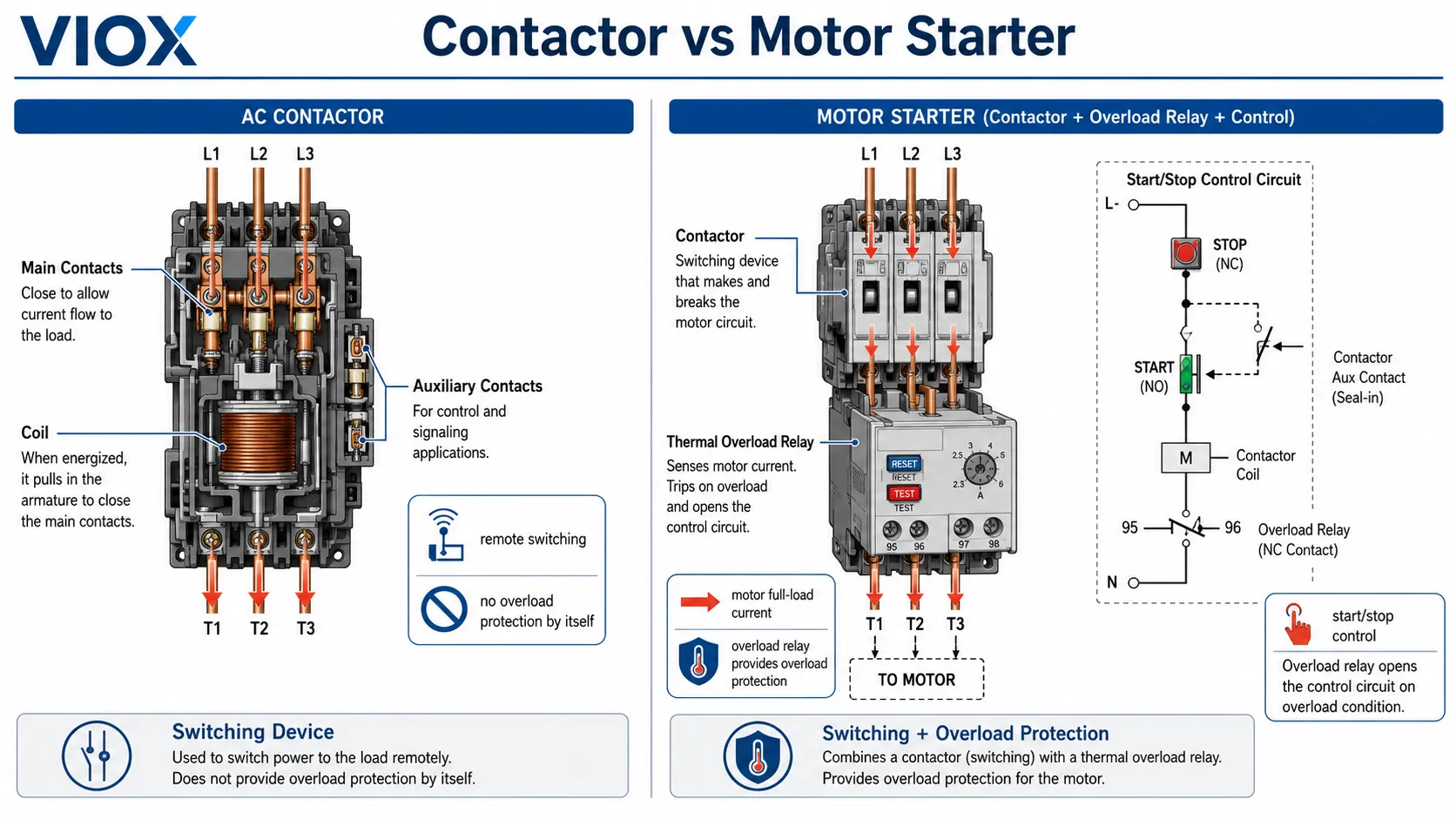
A contactor is an electrically operated switching device. It turns power to a load on or off, but it does not normally provide motor overload protection by itself. A motor starter is a motor-control assembly that usually combines a contactor with an overload relay and a control circuit, so it can start and stop a motor while helping protect it from sustained overload.
The short version is simple:
Contactor = switching. Motor starter = switching + motor overload protection + control.
That distinction matters because many motors need more than remote on/off control. They also need overload protection, no-voltage release, start/stop control, and coordination with short-circuit protection. A standalone contactor can be part of that system, but it is not the complete starter by itself.
For product context, see VIOX AC contactor and thermal overload relay options. This article focuses on the difference between contactors and motor starters, when each is used, and how to avoid common selection mistakes.
Contactor vs Motor Starter Comparison Table
| Feature | Contactor | Motor Starter |
|---|---|---|
| Main function | Switches power on or off | Starts/stops a motor and provides overload protection |
| Core components | Coil, main contacts, auxiliary contacts, arc-control structure | Contactor + overload relay + start/stop control circuit |
| Overload protection | No, unless a separate overload relay or protection device is added | Yes, usually through thermal or electronic overload relay |
| Short-circuit protection | No | Not by the starter alone; requires fuse, circuit breaker, MPCB, or combination starter arrangement |
| Typical load | Motors, lighting, heating, capacitor banks, general controlled loads | Motors, pumps, fans, compressors, conveyors, machine drives |
| Selection basis | Load current, voltage, utilization category, coil voltage, duty | Motor full-load current, HP/kW, voltage, overload class, starter type, short-circuit coordination |
| Control function | Remote electrical switching | Start/stop, overload trip, undervoltage release, interlocking if needed |
| Common standard context | IEC 60947-4-1, UL 60947-4-1, NEMA / IEC ratings | IEC 60947-4-1, UL 60947-4-1, NEMA starter sizing, local motor-control rules |
| Best fit | Switching a load where protection is handled elsewhere | Controlling and protecting a motor circuit |
What Is a Contactor?
A contactor is an electrically operated switch designed to control power circuits. When the coil is energized, the main contacts close and allow current to flow to the load. When the coil is de-energized, the contacts open and disconnect the load.
Contactors are commonly used for:
- electric motors
- lighting banks
- heating loads
- capacitor switching
- HVAC equipment
- pumps and fans
- industrial automation panels
The key point: a contactor is primarily a switching device. It can switch a motor circuit, but it does not automatically protect the motor from sustained overload unless it is combined with an overload relay or another motor protection device.
For a deeper device-level background, see What Is a Contactor?.
Main Parts of a Contactor
| Part | Function |
|---|---|
| Coil / electromagnet | Creates the magnetic force that pulls the contactor closed |
| Main contacts | Carry load current to the motor or other electrical load |
| Auxiliary contacts | Provide control signals, interlocking, holding circuits, or status feedback |
| Arc-control structure | Helps control arcing when the contacts open under load |
| Enclosure / frame | Holds and insulates the switching mechanism |
What a Contactor Does Well
A contactor is good when you need remote or automatic switching of a load. It can be controlled by a pushbutton, timer, relay, programmable logic controller (PLC), float switch, pressure switch, thermostat, or building automation system.
It is especially useful when the load must be switched frequently or from a control circuit that is separate from the power circuit.
What a Contactor Does Not Do by Itself
A contactor does not normally provide:
- motor overload protection
- locked-rotor protection by itself
- short-circuit interruption
- branch-circuit protection
- disconnecting means
Short-circuit current must be cleared by a properly rated fuse, circuit breaker, motor protection circuit breaker (MPCB), or combination starter arrangement. This is not just a design preference; standards for contactors and starters recognize that contactors and starters are not normally designed to interrupt short-circuit current by themselves.
If you are comparing switching and protection roles, Contactor vs Circuit Breaker explains that boundary in more detail.
What Is a Motor Starter?
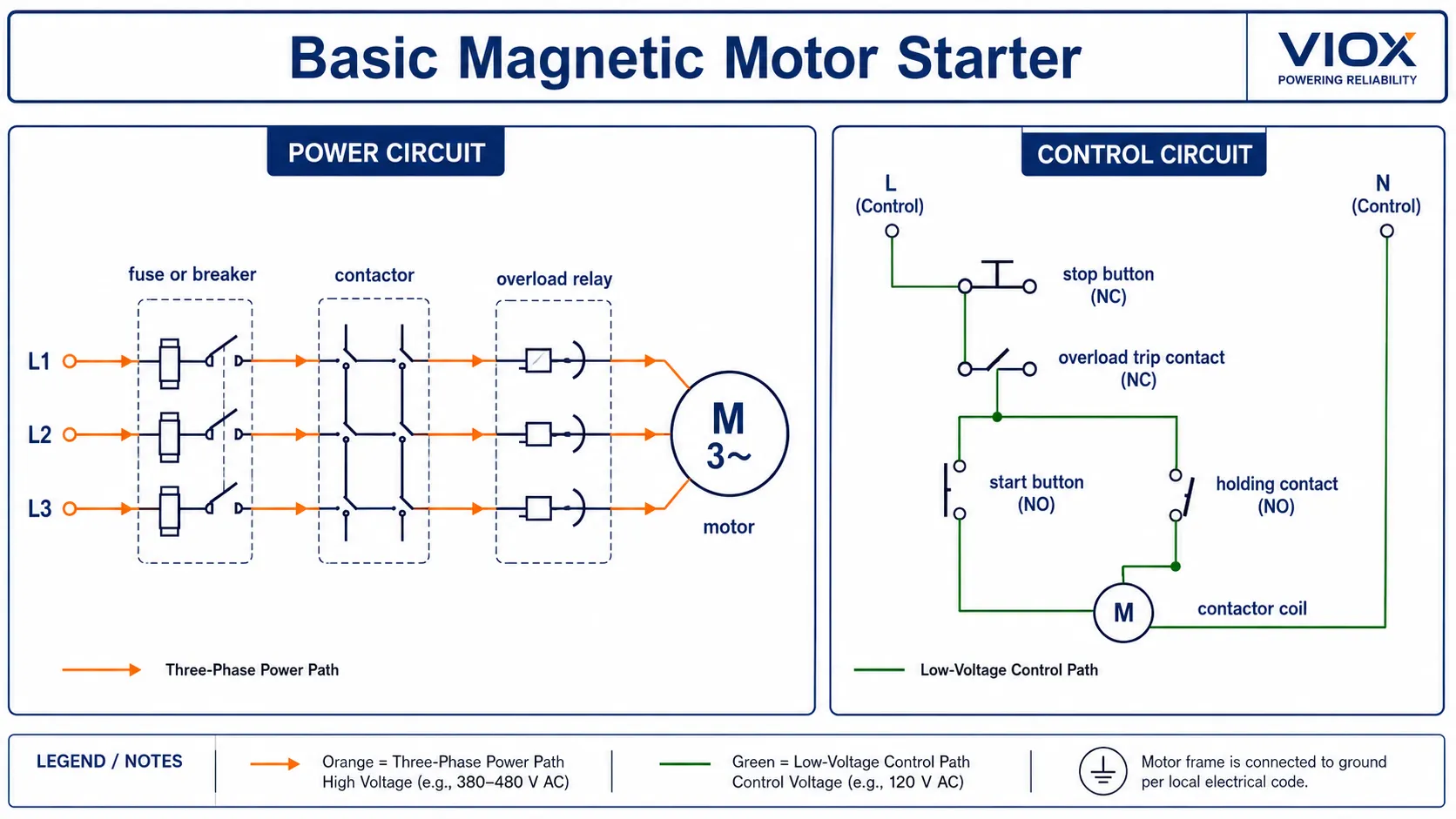
A motor starter is a device or assembly used to start, stop, and protect an electric motor. In many low-voltage industrial applications, a basic magnetic motor starter contains:
- a contactor for switching motor power
- an overload relay for motor overload protection
- a start/stop control circuit
- auxiliary contacts for holding and interlocking
- enclosure or panel integration when required
The contactor is the switching part. The overload relay is the motor-protection part. Together, they form the starter’s core.
Is a Motor Starter Just a Contactor with Overload Protection?
In the simplest practical sense, yes: a basic motor starter is often a contactor plus overload relay with the required control wiring.
But in real panels, the starter may include more than those two parts:
- start and stop pushbuttons
- auxiliary contacts
- selector switches
- indicator lights
- control transformer
- fuse or breaker coordination
- disconnecting means
- enclosure
- reversing interlocks
- timer or star-delta transition circuit
That is why the word "starter" can mean a small device combination or a complete enclosed motor-control assembly, depending on market and application.
Is a Motor Starter the Same as a Magnetic Starter?
In many North American contexts, a magnetic starter means an electromagnetically operated motor starter that uses a contactor and an overload relay. The "magnetic" part refers to the contactor coil and magnetic mechanism.
A magnetic starter typically provides:
- remote start/stop control
- no-voltage release, so the motor does not restart automatically after a power failure unless the control circuit commands it
- overload relay trip function
- contactor switching of the motor circuit
The term is common in industrial, HVAC, pump, compressor, and machine-control applications. In IEC-oriented markets, the same idea is often described more directly as a contactor with an overload relay, a DOL starter, or a motor starter assembly.
Contactor Only vs Contactor + Overload Relay vs Combination Starter
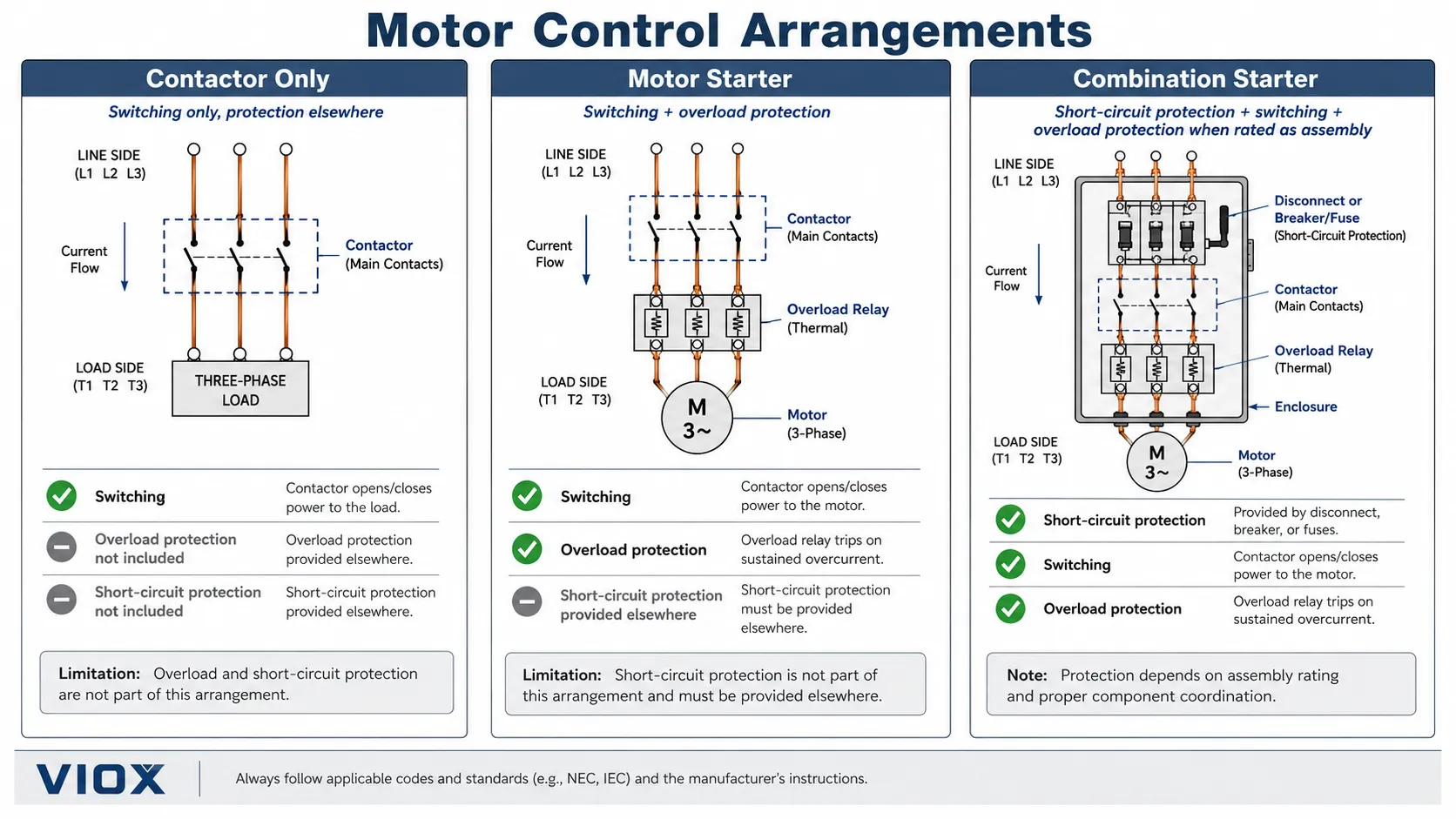
This is the practical part many articles skip. In a real electrical panel, there are several possible arrangements.
| Arrangement | Components | What It Provides | What It Does Not Provide by Itself |
|---|---|---|---|
| Contactor only | Contactor + control signal | Remote on/off switching | Motor overload protection, short-circuit protection |
| Contactor + overload relay | Contactor + thermal or electronic overload relay | Basic motor starter function: switching + overload protection | Short-circuit protection unless coordinated with fuse/breaker |
| MPCB + contactor | Motor protection circuit breaker + contactor | Short-circuit and overload protection from MPCB, remote switching from contactor | May still require disconnect/enclosure depending on design |
| Combination starter | Disconnect or breaker/fuse + contactor + overload relay + enclosure | Integrated motor control and coordinated protection arrangement | Must be selected and rated as a complete system |
| Soft starter | Power electronics + bypass/contactors depending design | Reduced-voltage starting and stopping | Full speed control; usually still needs upstream protection |
| VFD | Variable frequency drive + protection/controls | Speed control, ramping, motor control functions | Not a drop-in replacement for every starter; requires drive-specific protection and wiring rules |
For starter-type details beyond this comparison page, use the Types of Motor Starters Selection Guide.
Does a Motor Starter Provide Short-Circuit Protection?
This is where many explanations become technically loose.
A basic motor starter provides overload protection, not complete short-circuit protection by itself. The overload relay is designed to respond to sustained overload current, not high-magnitude fault current.
Short-circuit protection must be provided by a suitable device such as:
- fuse
- circuit breaker
- motor protection circuit breaker
- protected starter
- combination starter assembly
The starter and short-circuit protective device must be coordinated according to the applicable standard, equipment ratings, and project requirement.
So the correct statement is:
A motor starter normally includes overload protection. Short-circuit protection must be provided by a fuse, circuit breaker, MPCB, or a rated combination starter arrangement.
When Should You Use a Contactor?
Use a standalone contactor when you need controlled switching and the necessary protection is already handled elsewhere.
Typical contactor-only applications include:
- lighting control
- electric heating control
- capacitor bank switching where a suitable contactor type is selected
- simple remote switching of non-motor loads
- motor control where overload and short-circuit protection are provided separately
- PLC-controlled switching inside an engineered panel
The selection should match:
- load type
- rated operational current
- voltage
- AC or DC duty
- utilization category such as AC-1, AC-3, AC-4, DC-1, or DC motor duty
- coil voltage
- number of poles
- auxiliary contact requirements
- expected switching frequency
For motor circuits, the utilization category matters. A contactor rated for a resistive load is not automatically suitable for motor starting or jogging duty. VIOX’s guide to contactor utilization categories explains AC-1, AC-3, AC-4, and related categories.
When Should You Use a Motor Starter?
Use a motor starter when the load is an electric motor that requires controlled starting and overload protection.
Typical applications include:
- pumps
- fans
- compressors
- conveyors
- machine tools
- mixers
- industrial process motors
- irrigation motors
- HVAC motor loads
The starter selection should start from the motor nameplate:
- full-load current
- voltage
- phase
- frequency
- horsepower or kilowatt rating
- duty cycle
- starting frequency
- service factor if applicable
- ambient and enclosure conditions
For a basic DOL starter, the contactor switches the motor and the overload relay protects against sustained overload. For heavier starting, frequent starts, long acceleration, reversing, jogging, or reduced-voltage starting, the starter arrangement must be selected more carefully.
If overload relay sizing is the main question, see the Thermal Overload Relay Selection Guide.
Motor Starter vs Soft Starter vs VFD
A motor starter is not the same as a soft starter or a variable frequency drive.
| Device | Main Purpose | Best Fit |
|---|---|---|
| DOL motor starter | Starts motor directly across the line and provides overload protection | Simple motors where full-voltage starting is acceptable |
| Star-delta starter | Reduces starting current by starting in star and running in delta | Larger motors where reduced starting current is needed |
| Soft starter | Uses power electronics to ramp voltage during start/stop | Pumps, conveyors, compressors where mechanical shock or inrush is a concern |
| VFD | Controls motor speed by adjusting frequency and voltage | Variable-speed applications, process control, energy optimization |
Soft starters and VFDs may include motor protection functions, but they still need appropriate upstream short-circuit protection and installation according to the manufacturer’s instructions.
For star-delta applications, see the Star Delta Starter Wiring Diagram and Selection Guide.
Selection Guide: How to Decide Quickly
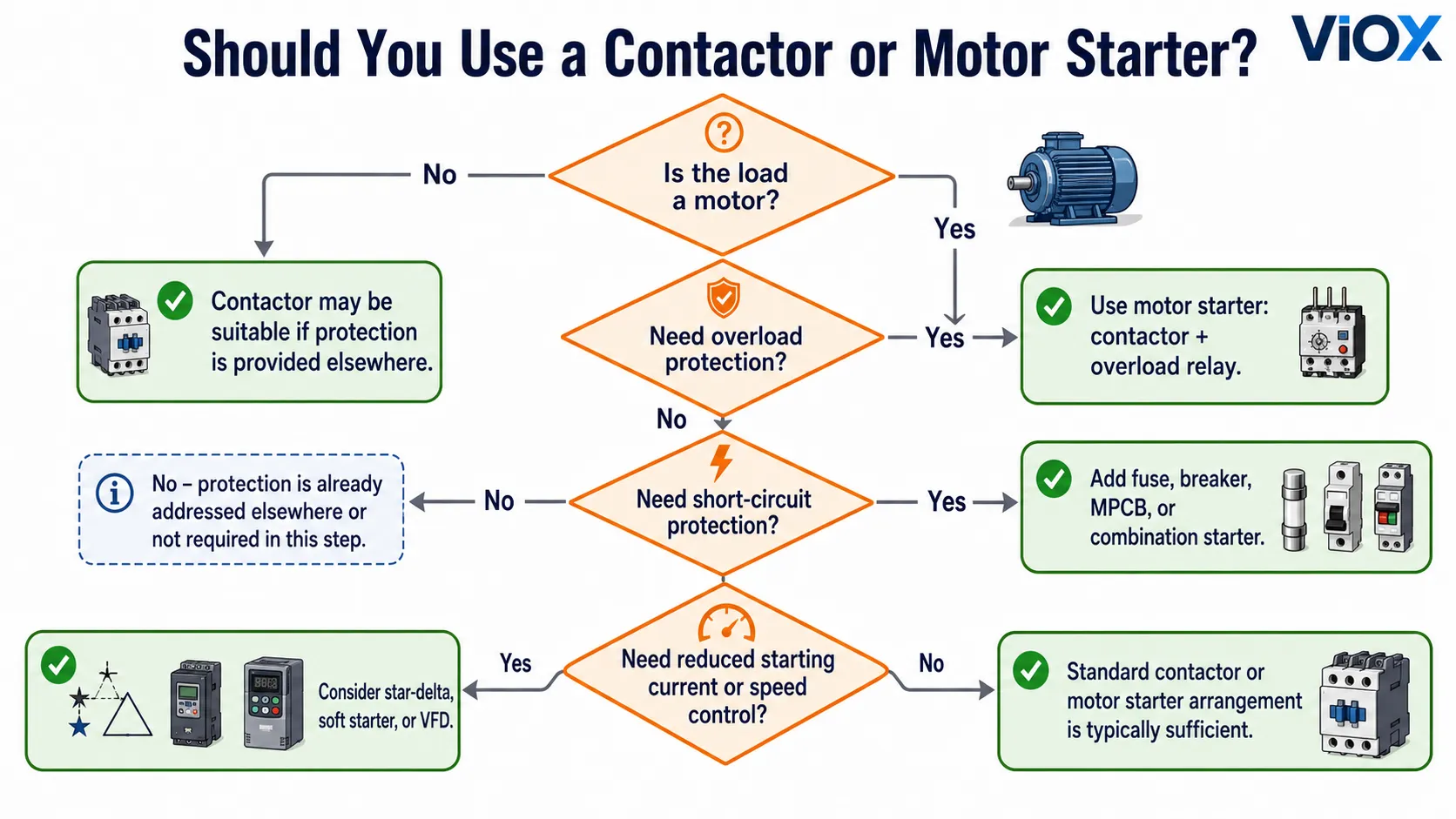
Use this decision sequence:
Step 1: Is the load a motor?
If no, a contactor may be enough if the circuit has suitable protection elsewhere.
If yes, continue to overload protection.
Step 2: Does the motor need overload protection?
For most motor applications, yes. Use a motor starter arrangement, such as contactor + overload relay, MPCB + contactor, or a combination starter.
Step 3: Is short-circuit protection already provided?
If not, select and coordinate a fuse, breaker, MPCB, or combination starter. Do not expect the contactor or overload relay to clear short-circuit current alone.
Step 4: Is reduced-voltage starting or speed control needed?
If full-voltage direct starting causes excessive inrush, voltage dip, mechanical shock, or process stress, consider a star-delta starter, soft starter, or VFD.
Step 5: What control and environment are required?
Confirm coil voltage, auxiliary contacts, enclosure rating, ambient temperature, duty cycle, switching frequency, and any local standard requirements.
Common Selection Mistakes
Mistake 1: Using a Contactor Alone as a Motor Starter
A contactor can switch a motor, but it does not protect the motor from sustained overload by itself. If no overload relay, MPCB, drive protection, or other motor protection is provided, the motor can overheat during overload conditions.
Mistake 2: Assuming a Starter Clears Short Circuits
A basic contactor + overload relay starter does not replace a fuse or breaker. Short-circuit protection must be handled by a correctly rated protective device or a rated combination starter.
Mistake 3: Selecting Only by Horsepower
Horsepower or kilowatt rating is useful, but final selection should check full-load current, voltage, utilization category, duty cycle, ambient conditions, and overload relay range.
Mistake 4: Ignoring Utilization Category
AC-1 and AC-3 ratings are not the same. A contactor that is acceptable for a resistive load may be unsuitable for motor starting. Frequent jogging, plugging, or reversing can require a different duty category.
Mistake 5: Putting a Contactor on the VFD Output Incorrectly
A contactor may be used on the line side of a VFD for isolation or control if the drive manufacturer permits it. Switching the load side of a running VFD can damage the drive or motor system. Always follow the VFD manufacturer’s wiring rules.
Mistake 6: Treating Soft Starters and VFDs as Simple Motor Starters
Soft starters and VFDs are motor control devices, but they are not the same as basic electromechanical starters. They require their own protection, bypass, EMC, cooling, and installation considerations.
FAQ
Is a motor starter the same as a contactor?
No. A contactor is a switching device. A motor starter usually includes a contactor plus overload protection and a control circuit. The contactor is one part of the starter.
Can I use a contactor without an overload relay?
Yes, but only when overload protection is provided elsewhere or the load does not require motor overload protection. For most motor applications, a contactor alone is not enough.
Does a motor starter provide short-circuit protection?
A basic motor starter provides overload protection, not complete short-circuit protection. Short-circuit protection must come from a fuse, circuit breaker, MPCB, protected starter, or combination starter arrangement.
What is a magnetic starter?
A magnetic starter is an electromagnetically operated motor starter, typically made from a contactor, overload relay, and start/stop control circuit. The term is especially common in North American motor-control language.
What is the difference between a motor starter and a soft starter?
A basic motor starter switches the motor directly on and off. A soft starter uses power electronics to gradually ramp voltage during starting and stopping, reducing mechanical shock and inrush current.
Do I need a motor starter if I already have a circuit breaker?
Usually yes, if the motor needs start/stop control and overload protection. A circuit breaker may provide short-circuit and branch-circuit protection, but it does not always provide the correct motor overload and control function by itself.
Is an overload relay required for a motor?
Most motor circuits need overload protection. This may be provided by an overload relay, MPCB, drive protection, or another approved motor protection method depending on the system design and local code.
What is the difference between a combination starter and a magnetic starter?
A magnetic starter commonly means contactor + overload relay + control circuit. A combination starter usually adds a disconnecting means and short-circuit protective device, such as a fuse or breaker, in a rated assembly or enclosure.
Can a contactor protect a motor from single phasing?
A contactor alone does not detect single phasing. Some overload relays, electronic motor protection relays, or advanced starters can provide phase-loss protection depending on design.
How do I choose between contactor only and motor starter?
Choose a contactor only when switching is the main requirement and protection is handled separately. Choose a motor starter when the load is a motor that needs overload protection and start/stop control.
Final Answer
A contactor and a motor starter are closely related, but they are not the same device.
Use a contactor when you need remote switching of a load and the required protection is provided elsewhere. Use a motor starter when you need to start and stop a motor while also providing overload protection and control logic.
The most practical rule is:
For general switching, use a contactor. For motor control with overload protection, use a motor starter. For short-circuit protection, coordinate the starter with a fuse, breaker, MPCB, or combination starter.
VIOX supplies contactors, overload relays, and motor-control components for panel builders, OEM equipment, HVAC systems, pumps, fans, compressors, and industrial automation panels. For model selection, confirm motor full-load current, voltage, control voltage, utilization category, overload relay range, starting method, and enclosure requirements.
Related VIOX Guides
- AC Contactor
- Thermal Overload Relay
- What Is a Contactor?
- Contactor vs Circuit Breaker
- Thermal Overload Relay vs MPCB
- Types of Motor Starters Selection Guide
- Star Delta Starter Wiring Diagram and Selection Guide
- Contactor Utilization Categories