On this page
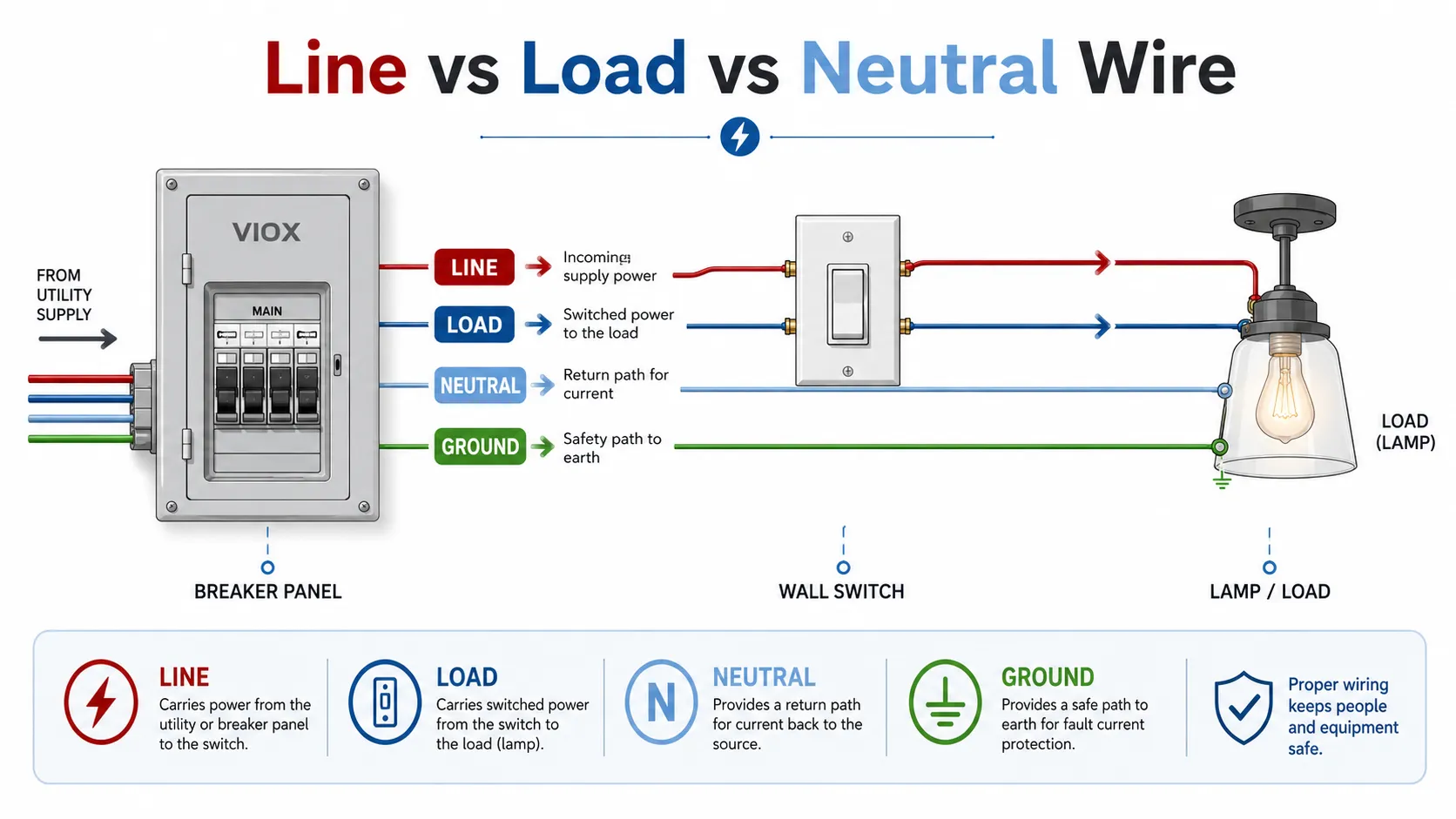
The difference is simple: line wire brings power from the source to a device, load wire carries power from that device to the downstream load, and neutral wire completes the circuit by carrying return current back to the source.
But there is one detail that causes most wiring confusion: line and load are device-relative terms. A wire can be the load wire on one device and become the line wire for the next device downstream. Neutral is different. It is a circuit conductor, not a “source side” or “load side” label.
Safety note: This article is for electrical education and component selection context. Identifying live conductors or changing wiring should be done by a qualified person using proper test equipment and local code requirements. Color alone is not a reliable safety test.
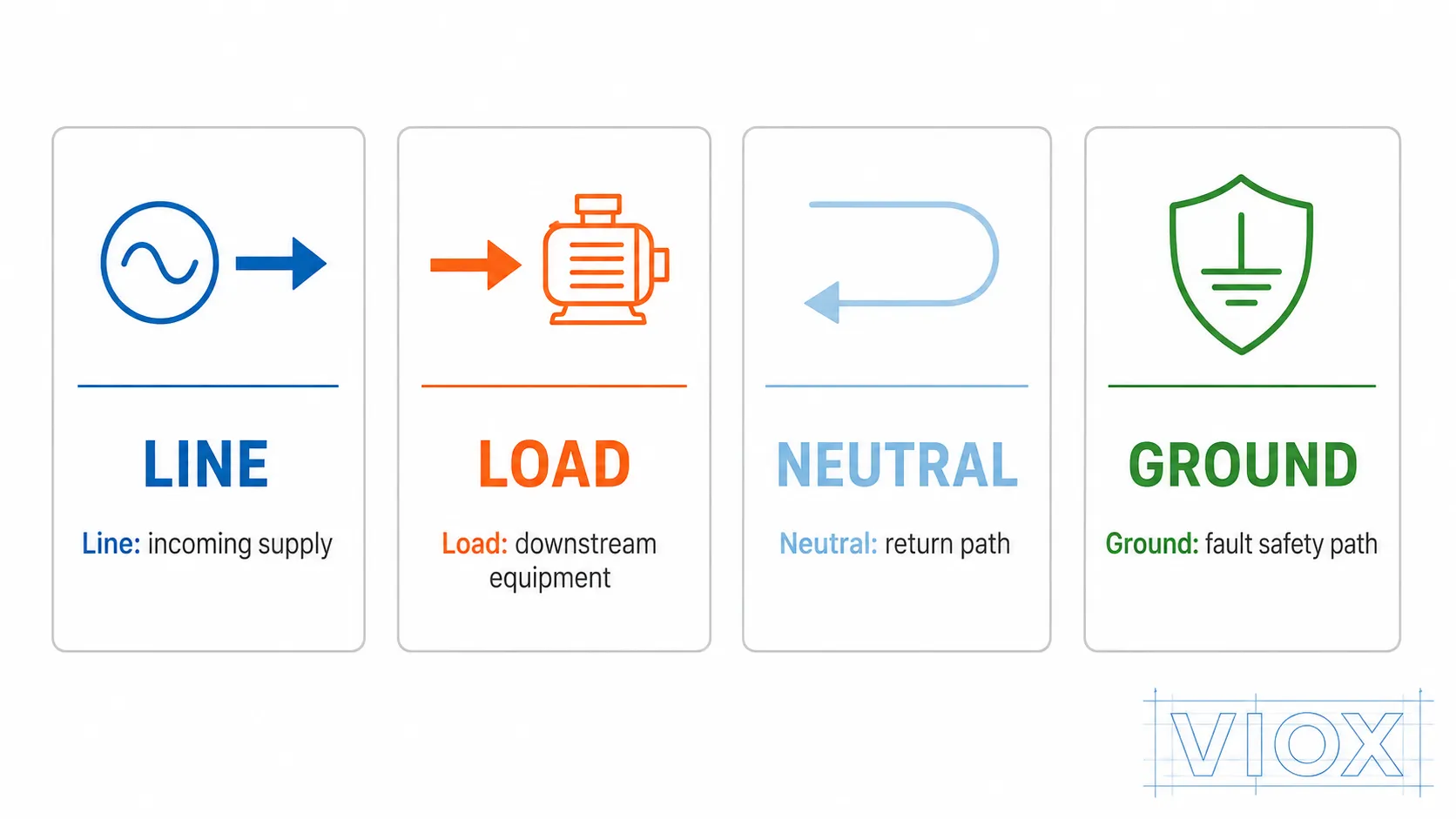
Quick Comparison: Line, Load, Neutral, and Ground
| Wire Term | What It Means | Usually Energized? | Common Color in Many U.S. Systems | Main Function | Important Caution |
|---|---|---|---|---|---|
| Line wire | Incoming supply conductor feeding a device | Yes, when circuit is energized | Black, red, or another ungrounded conductor color | Brings power from breaker, source, or upstream device | Dangerous even before the switch or device operates |
| Load wire | Outgoing conductor from a device to a downstream load | Only when the device passes power | Often black, red, or another hot conductor color | Sends power to a light, outlet, motor, appliance, or next device | Color is not fixed; function depends on where it connects |
| Neutral wire | Grounded circuit conductor returning current to the source | Can carry current during normal operation | White or gray in many U.S. systems | Completes the circuit return path | Not a “safe wire”; an open or shared neutral can be hazardous |
| Ground wire | Equipment grounding conductor | Normally no current | Green, green/yellow, or bare copper | Provides a fault-current path for safety | Should not be used as a neutral conductor |
If you remember only one rule, remember this: line and load describe direction through a device; neutral and ground describe conductor function in the electrical system.
What Is a Line Wire?
A line wire is the conductor that supplies power to a device from the source side of the circuit. The source may be a circuit breaker, fuse, distribution board, main panel, transformer, power supply, or upstream switch.
In a wall switch, the line wire is usually the always-hot conductor feeding the switch. In a ground-fault circuit interrupter (GFCI) receptacle, the line terminals receive the incoming power supply. In a circuit breaker panel, the line side is the supply side feeding the breaker.
For VIOX circuit protection products such as MCBs and RCBOs, line-side and load-side marking matters because the device must be wired according to its terminal labeling and product instructions. Some devices are line/load sensitive; others may be less direction-sensitive depending on design and standard.
What Is a Load Wire?
A load wire is the conductor that leaves a device and carries power to the connected load or downstream circuit. The load may be a light fixture, receptacle, appliance, motor, relay coil, control circuit, or another protective device.
For example, in a basic light switch:
Power source / breaker -> LINE terminal of switch
LOAD terminal of switch -> Light fixture
Neutral conductor -> Light fixture neutral return
Ground conductor -> Equipment grounding path
When the switch is OFF, the line side may still be energized, while the load side should not be energized through that switch. When the switch is ON, the switch connects line to load and power reaches the light.
This is why “load wire color” is a risky search query. A load wire does not have one universal color. It is often the same color family as other hot conductors, and its function must be confirmed by circuit position and testing, not color alone.
What Is a Neutral Wire?
A neutral wire is the grounded circuit conductor that provides the normal return path for current. In many single-phase AC circuits, current flows from the line conductor through the load and returns through the neutral conductor.
Neutral is often near ground potential in a correctly wired system, but that does not make it harmless. A neutral conductor can carry load current. If a neutral connection opens, loosens, or is shared incorrectly, downstream equipment may behave unpredictably, and dangerous voltages may appear where users do not expect them.
In practical terms:
- Neutral completes the circuit during normal operation.
- Neutral is not the same as ground.
- Neutral should not be casually tied to ground at outlets, switches, or equipment.
- Neutral may still be hazardous if the circuit is energized, miswired, or loaded.
For a deeper explanation of voltage relationships, see VIOX’s guide to voltage vs current.
What Is a Ground Wire?
A ground wire, or equipment grounding conductor, is a safety conductor. It is not intended to carry normal operating current. Its job is to provide a low-impedance path for fault current so protective devices can operate during a fault.
Ground and neutral are sometimes bonded at a defined point in the electrical system, such as the service equipment in many installations. That does not mean they are interchangeable downstream. In branch circuits and equipment wiring, using ground as neutral can create shock hazards and code violations.
Line vs Load: The Most Common Source of Confusion
The phrase line vs load does not mean “one color vs another color.” It means incoming side vs outgoing side of a device.
| Example Device | Line Side | Load Side |
|---|---|---|
| Light switch | Incoming hot feed | Switched hot going to the light |
| GFCI outlet | Incoming supply from panel | Downstream receptacles protected by the GFCI |
| Circuit breaker | Supply bus or source side | Protected circuit conductor leaving the breaker |
| Disconnect switch | Incoming source | Outgoing equipment feed |
| Contactor | Supply terminals | Load terminals feeding motor, heater, or equipment |
A conductor can change labels depending on the device you are looking at. The wire leaving one switch may be the load wire for that switch, but when it reaches the next device, it may become that device’s line feed.
That is why professional diagrams label terminals and direction clearly instead of relying only on wire color.
Line and Load on a Switch
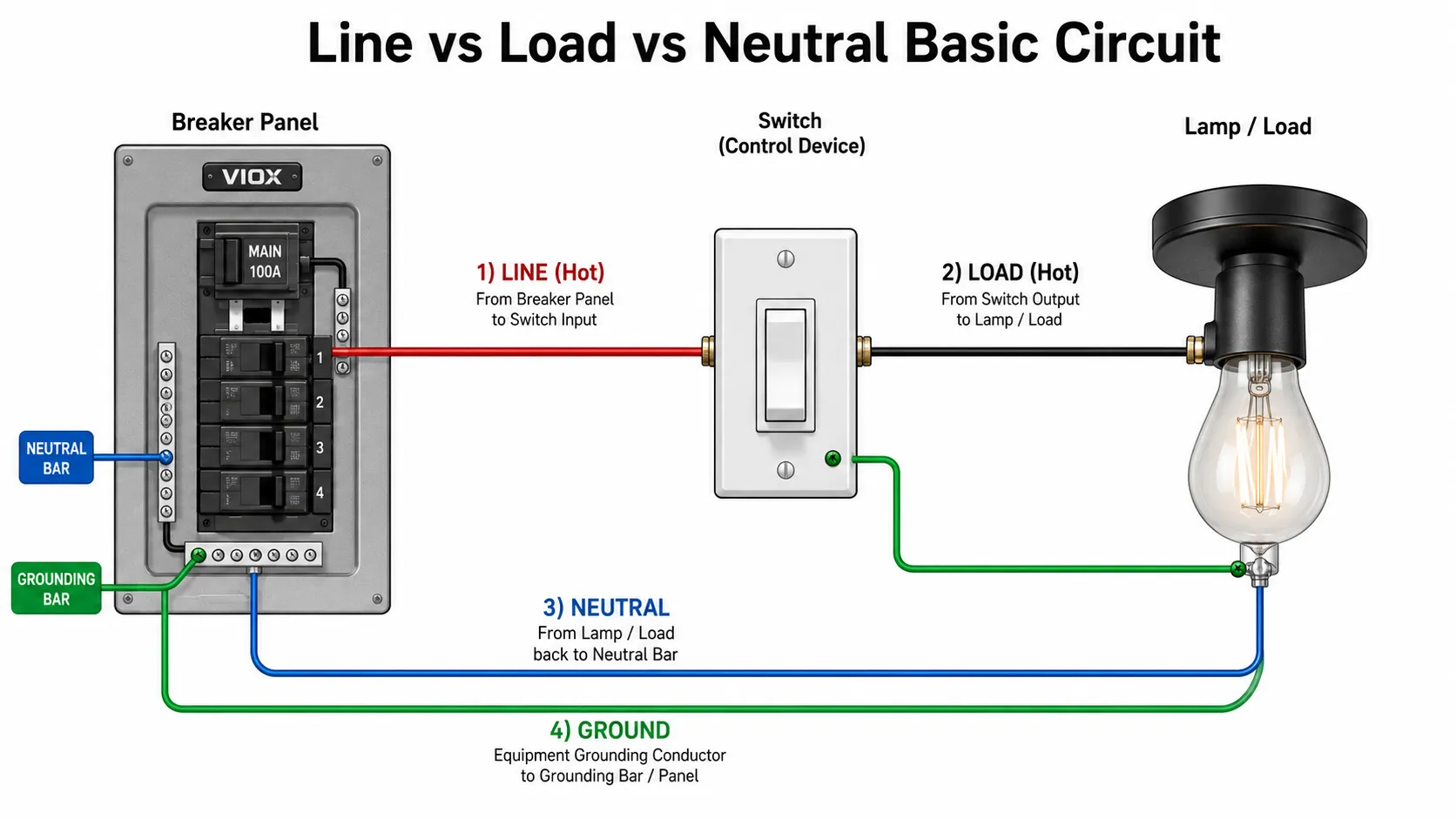
In a simple single-pole switch circuit, the line conductor brings power into the switch, and the load conductor sends switched power to the lamp or equipment.
Breaker hot conductor
        |
      LINE
   [ Switch ]
      LOAD
        |
     Light fixture
        |
     Neutral return
In many traditional switch loops, the wiring may not look intuitive inside the wall box. A white conductor may be re-identified and used as an ungrounded conductor in certain wiring methods. That is one reason “white means neutral” is not enough for safe identification.
If you are troubleshooting or replacing a switch, label conductors before disconnecting them and verify function with appropriate test equipment.
Line and Load on a GFCI Outlet
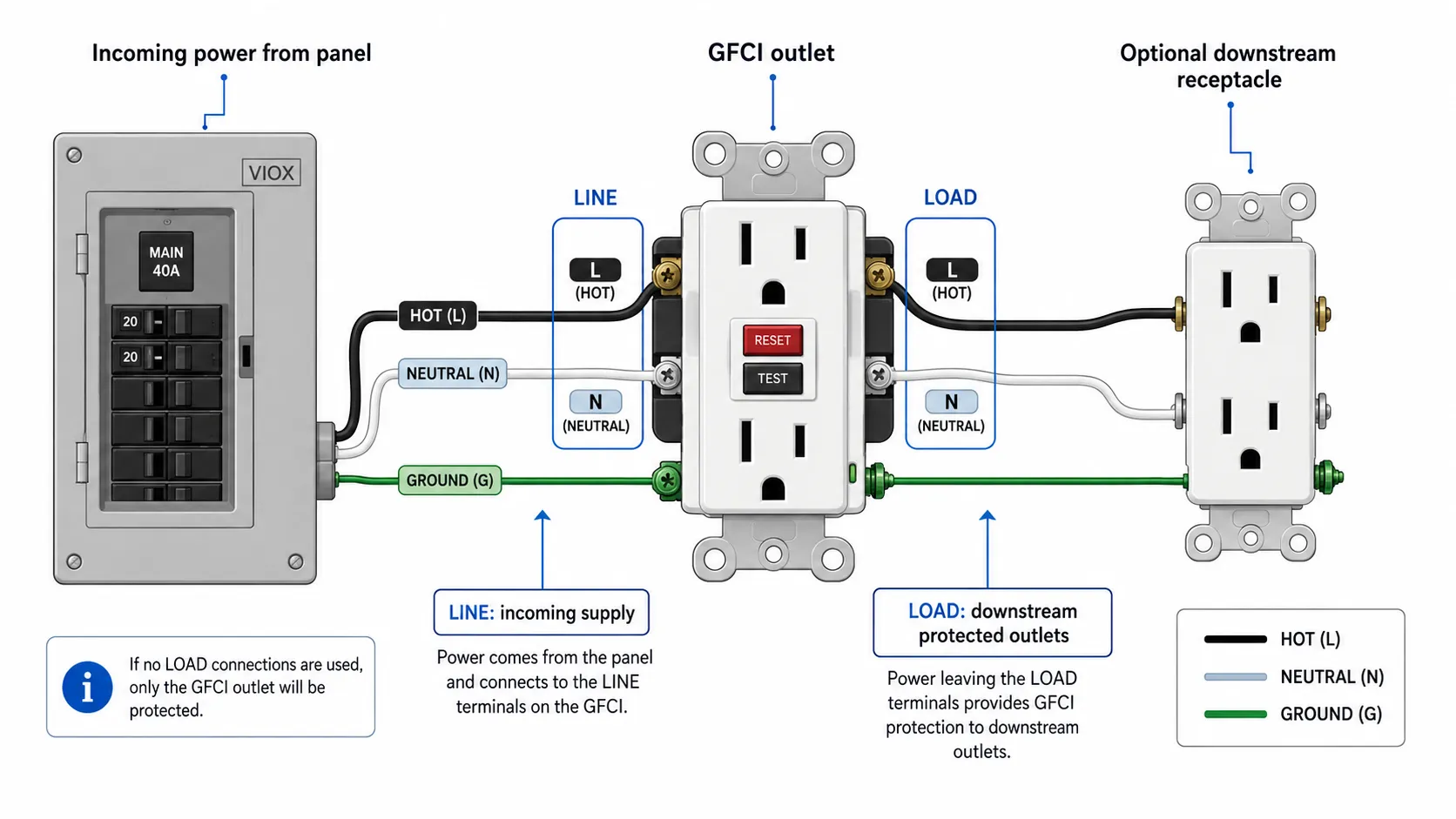
GFCI receptacles make line/load identification especially important.
| Terminal | Function | What Happens if Miswired? |
|---|---|---|
| LINE | Receives incoming power from the panel | The device may not reset or may not provide expected protection |
| LOAD | Feeds downstream receptacles through the GFCI protection | Downstream outlets may lose protection or power if connected incorrectly |
On a GFCI outlet, the line terminals are for the incoming supply. The load terminals are used only when you want the GFCI device to protect additional downstream outlets. If there is no downstream protection requirement, the load terminals may remain unused according to the device instructions.
This is different from a standard receptacle, where terminals may simply pass power onward without built-in ground-fault protection.
Line, Load, Neutral, and Ground in One Circuit
Here is a practical way to visualize the four terms in a basic circuit:
Panel / breaker
   |
   |  LINE hot conductor
   v
[Switch or device]
   |
   |  LOAD hot conductor
   v
[Lamp, outlet, or appliance]
   |
   |  NEUTRAL return conductor
   v
Panel neutral bar / source return

GROUND conductor connects metal enclosures and equipment grounding points for fault protection.
Line and load describe the energized path through a device. Neutral describes the return conductor. Ground describes the safety bonding path.
Line-to-Line vs Line-to-Neutral
Some searches mix up wire identification with voltage measurement. Line-to-line and line-to-neutral describe voltage measured between conductors.
| Measurement | What It Means | Typical Use |
|---|---|---|
| Line-to-neutral | Voltage between one line conductor and neutral | Single-phase loads, receptacles, lighting, control circuits |
| Line-to-line | Voltage between two line conductors | Split-phase, three-phase, or higher-power loads |
| Line-to-ground | Voltage between line and equipment ground | Useful for troubleshooting, but not a substitute for understanding neutral condition |
| Neutral-to-ground | Voltage between neutral and ground | Should usually be low in a healthy circuit, but depends on load, wiring, and system design |
For example, in many North American residential systems, a common branch circuit may measure about 120 V line-to-neutral, while some larger loads use about 240 V line-to-line. In many other regions, line-to-neutral voltage may be around 230 V. Always follow the system voltage and local electrical standard for the specific installation.
Wire Color Codes: Useful Clues, Not Final Proof
Wire color can help, but it should never be the only identification method. Color conventions vary by country, age of installation, cable type, and whether conductors were re-identified.
| Function | Common U.S. Color Clue | Common IEC-Style Color Clue | Caution |
|---|---|---|---|
| Line / hot | Black, red, blue, or other non-white/non-green colors | Brown, black, gray depending on phase | Must be verified; colors vary |
| Neutral | White or gray | Blue | Can still carry current |
| Ground / protective earth | Green or bare copper | Green/yellow | Should not be used as neutral |
| Load hot | Often same color family as hot conductors | Often same color family as phase conductors | No universal “load color” exists |
If a previous installer used nonstandard colors or failed to re-identify conductors, a color-based guess can be wrong. This is especially common in older homes, mixed wiring systems, control panels, and repaired circuits.
How to Identify Line, Load, and Neutral Safely
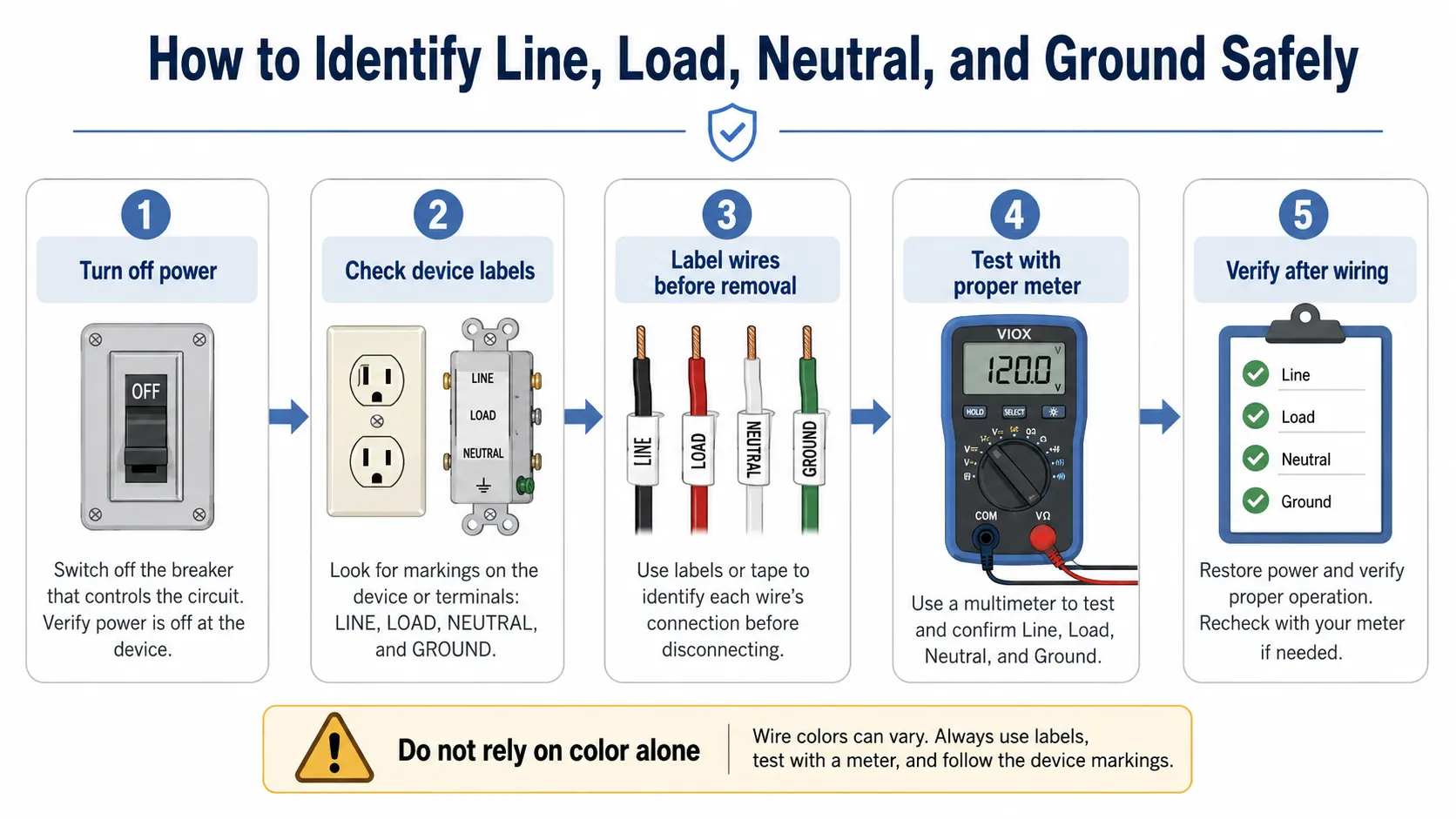
The safe method depends on the circuit and local practice, but the general logic is:
| Step | What a Qualified Person Checks | Why It Matters |
|---|---|---|
| 1. Turn off and secure power before touching conductors | Breaker, disconnect, lockout where required | Prevents shock and accidental energization |
| 2. Inspect terminal labels | LINE, LOAD, L, N, input, output, source, equipment markings | Device markings are more reliable than assumptions |
| 3. Label wires before removing old devices | Tape or tags | Prevents losing line/load identity during replacement |
| 4. Use an appropriate tester or multimeter | Confirm energized conductor and voltage relationship | Identifies line, neutral, and ground function |
| 5. Test under safe conditions only | Follow proper measurement category and meter safety rating | Reduces measurement hazard |
| 6. Verify after wiring | Correct operation, downstream protection, no abnormal heating or tripping | Confirms the device works as intended |
Never use trial-and-error wiring on live circuits. If the wiring box contains multiple cables, shared neutrals, multi-way switching, aluminum conductors, or unclear old wiring, call a qualified electrician.
Common Mistakes When Identifying Line, Load, and Neutral
Mistake 1: Thinking Load Wire Means Neutral Wire
A load wire is usually an outgoing energized conductor feeding the load. Neutral is the return conductor. They are not the same thing.
Mistake 2: Assuming White Always Means Neutral
White or gray is commonly used for neutral in many U.S. systems, but there are permitted and improper cases where a white conductor may be used differently. Always verify function.
Mistake 3: Wiring GFCI Line and Load Backwards
GFCI devices depend on correct line/load terminal use. Miswiring can cause reset problems, loss of downstream protection, or unexpected no-power conditions.
Mistake 4: Treating Neutral as Safe to Touch
Neutral can carry current and can become dangerous under open-neutral, shared-neutral, or miswired conditions. Treat all conductors as potentially energized until verified otherwise.
Mistake 5: Using Ground as Neutral
Ground is a safety conductor, not a normal current return path. Using ground as neutral can energize equipment grounding paths and create shock hazards.
Mistake 6: Ignoring Device Markings
Switches, breakers, GFCIs, RCBOs, contactors, and disconnects may have specific line/load or input/output markings. Always follow the product’s wiring diagram and instructions.
Where Line and Load Matter in Electrical Products
Line/load identification is not only a residential wiring issue. It matters in many VIOX product categories:
- In MCB and breaker circuits, line and load markings help define source and protected circuit direction.
- In RCBO circuits, correct live and neutral routing is important because the residual-current sensor must monitor the intended conductors.
- In control panels, contactor line terminals and load terminals determine the correct power path to motors, heaters, or lighting circuits.
- In surge protection, phase, neutral, and protective earth routing affect device selection and installation layout.
The core rule is the same: read the device marking, confirm the wiring diagram, and verify the circuit before energizing.
FAQ
What is the difference between line and load?
Line is the incoming power side of a device. Load is the outgoing side that feeds the connected equipment or downstream circuit. The terms are relative to the device being wired.
Is load wire the same as hot wire?
A load wire is often a hot conductor after a switch, breaker, GFCI, contactor, or other device passes power to the load. However, “load” describes the conductor’s position in the circuit, while “hot” describes an energized ungrounded conductor.
What is a load wire on a switch?
On a switch, the load wire is the switched conductor that leaves the switch and feeds the light or device. It is energized when the switch is ON and not energized through that switch when the switch is OFF.
What is a neutral wire?
A neutral wire is the grounded circuit conductor that carries return current back to the source during normal operation. It completes the circuit but should not be treated as harmless.
What does a neutral wire do?
Neutral provides the normal return path for current. In many AC circuits, current flows from line through the load and returns through neutral.
What color is the load wire?
There is no universal load wire color. In many systems, the load wire uses the same color family as hot conductors, such as black or red in U.S.-style wiring. Always identify it by circuit function and testing, not color alone.
What color is line and neutral?
In many U.S. systems, line or hot conductors are commonly black or red, and neutral is commonly white or gray. In many IEC-style systems, line conductors may be brown, black, or gray, and neutral is often blue. Local rules and existing wiring conditions must be checked.
What is line-to-line vs line-to-neutral?
Line-to-neutral is voltage measured between a line conductor and neutral. Line-to-line is voltage measured between two line conductors. Line-to-line voltage is commonly used for higher-power loads or multi-phase systems.
What is line, load, neutral, and ground?
Line brings power into a device. Load sends power out of the device to the connected load. Neutral returns current to the source. Ground provides a safety path for fault current and normally should not carry operating current.
What is load and line in an MCB?
In an MCB circuit, the line side is typically the supply side, and the load side is the protected outgoing circuit. Always follow the markings and wiring instructions for the specific breaker model, because terminal conventions and installation requirements can vary.
Conclusion
Line, load, neutral, and ground are not interchangeable terms. Line means incoming supply to a device. Load means outgoing power from that device. Neutral is the normal return conductor. Ground is the safety conductor for fault protection.
For searchers trying to identify a wire, the most important lesson is this: do not rely on color alone. Use the device markings, understand the circuit role, and verify with proper test equipment. When the wiring is unclear, damaged, old, or tied into protective devices such as GFCI, RCBO, or breakers, the safe choice is to have a qualified electrician inspect it before energizing the circuit.