Walk into any electrical supply house and ask for a surge protector, and the first question you’ll hear is, “How many joules?” This single specification dominates purchasing decisions, yet most buyers don’t understand what surge protector joules actually measure—or why a higher number doesn’t automatically mean better protection.
Surge protector joules quantify the energy absorption capacity of a surge protective device (SPD), typically through Metal Oxide Varistor (MOV) technology. For commercial and industrial applications, proper specification requires evaluating installation location (UL 1449 Type), Voltage Protection Rating (VPR), nominal discharge current (In), and system compatibility. This guide provides the technical framework B2B buyers need to specify surge protection that actually works.


What Are Surge Protector Joules?
Joules measure the total surge energy a protective device can absorb before its components fail. In surge protectors, this happens through Metal Oxide Varistors (MOVs)—semiconductor components that act as voltage-dependent resistors.
Under normal voltage (120V or 240V), MOVs present high resistance. When voltage spikes above the clamping threshold (330V to 500V), the MOV’s resistance drops instantly to near zero, diverting surge current to ground. The diverted energy dissipates as heat, gradually degrading the MOV. A 2,000-joule device might handle twenty 100-joule surges or two 1,000-joule events before failure.
IEEE and ANSI standards model typical indoor surges at approximately 6 kV and 3 kA, delivering roughly 90 joules per event. This reality underscores why proper grounding and layered protection strategies matter more than maximum joule ratings alone.
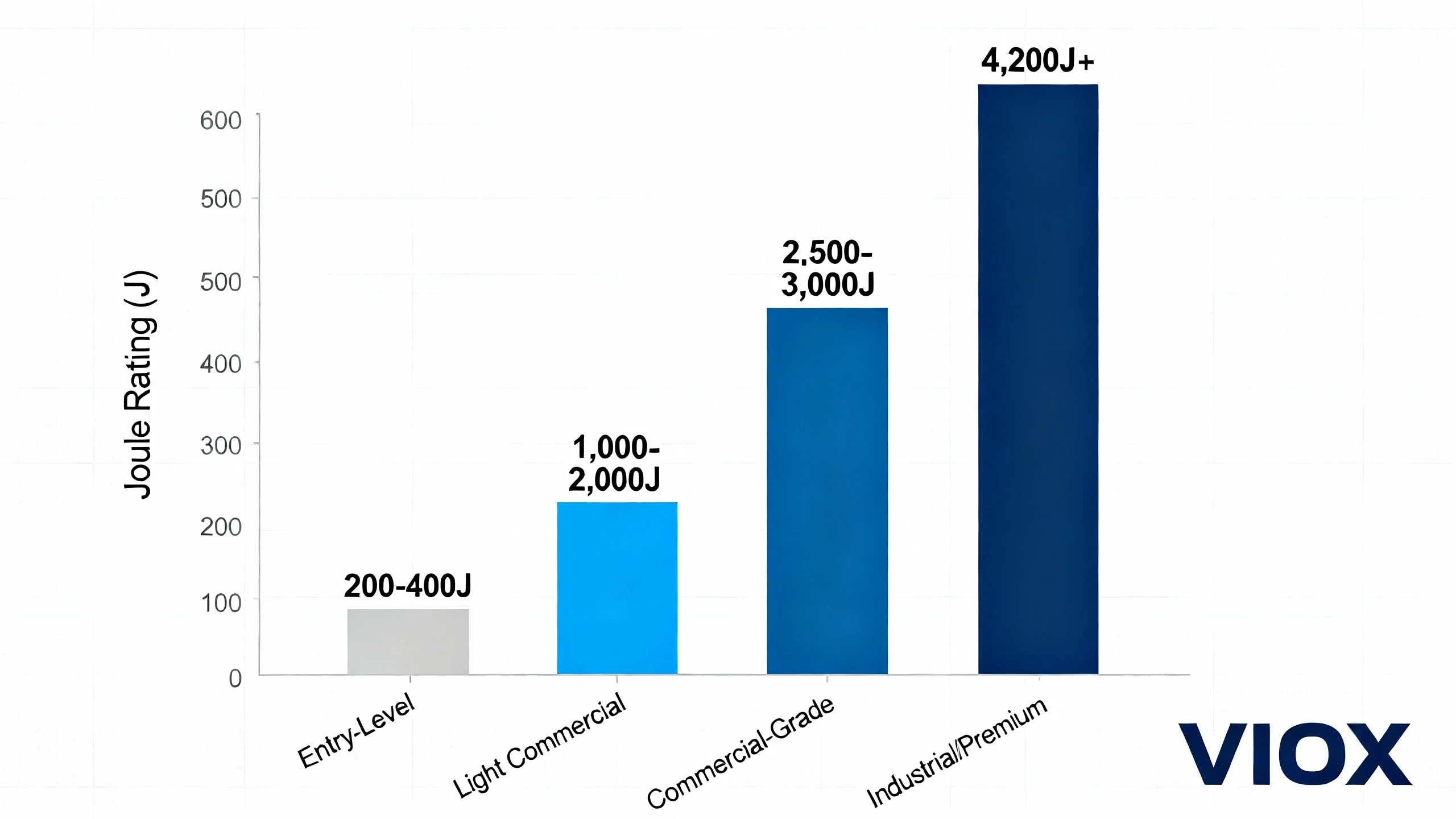
Joule Rating Ranges by Application
| Application Type | Recommended Joules | Typical Use Cases |
|---|---|---|
| Entry-Level | 200-400J | Basic home electronics (not recommended for commercial) |
| Consumer/Light Commercial | 1,000-2,000J | Office workstations, light equipment |
| Commercial-Grade | 2,500-3,000J | Server rooms, lab equipment, telecom gear |
| Industrial/Premium | 4,200J+ | Critical systems, high-value equipment |
Understanding Joule Ratings: The Standardization Problem
No industry standard governs how manufacturers test and report joule capacity. UL 1449—the primary safety standard for surge protective devices—does not specify energy absorption testing or require joule rating disclosure. Two problems emerge:
A 2,000-joule rating from one vendor may differ significantly from another vendor’s 2,000-joule rating. Exaggerated joule claims appear frequently, particularly in consumer products.
Point-of-use plug-in protectors use joules as a rough durability indicator. Panel-mounted SPDs specify surge current handling capacity (nominal discharge current in kA) as the primary metric.
Clamping voltage matters more than total joules. A device with 330V clamping and 1,500 joules provides tighter protection than a 500V device with 3,000 joules. Lower clamping voltage prevents higher voltage from reaching sensitive electronics.
Beyond Joules: Critical Specifications That Matter More
Commercial and industrial surge protection depends on these specifications more than joule ratings.
UL 1449 Type Classification
| Type | Installation Location | Surge Environment | Typical Applications |
|---|---|---|---|
| Type 1 | Line side of main disconnect | Highest surge current | Service entrance protection |
| Type 2 | Load side, distribution panels | Moderate surge levels | Branch panel protection |
| Type 3 | Point-of-use equipment | Attenuated surges | Individual equipment protection |
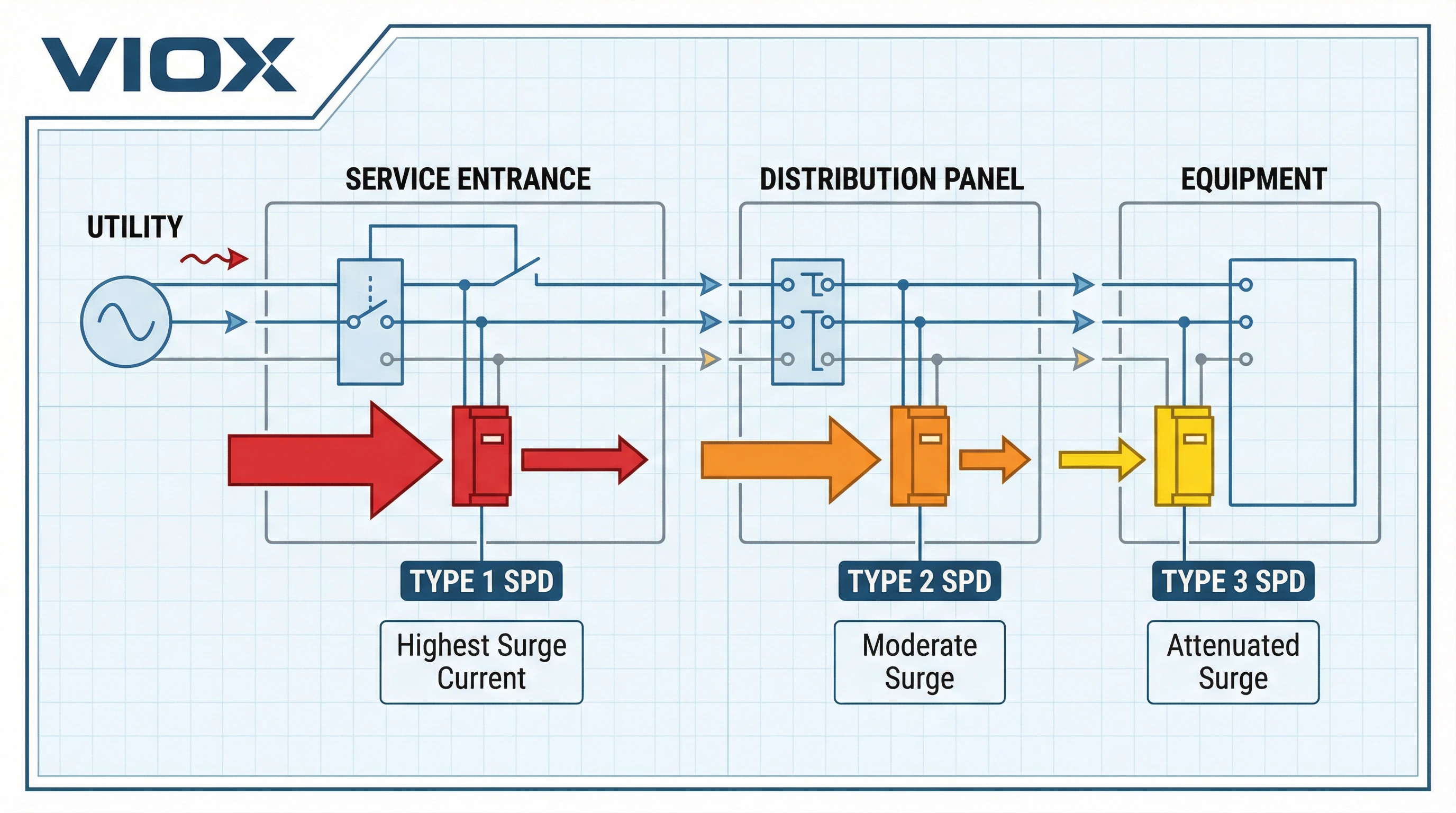
Specifying the wrong Type for an installation location compromises protection and may violate electrical code.
Voltage Protection Rating (VPR)
VPR quantifies maximum let-through voltage under standardized testing (6 kV, 3 kA combination wave). Standard VPR ratings for 120V circuits:
| VPR Rating | Protection Level | Recommended For |
|---|---|---|
| 330V | Tightest protection | Sensitive electronics, PLCs, servers, telecom |
| 400V | Excellent protection | VFDs, control systems, medical equipment |
| 500V | Good protection | General industrial machinery |
| 600-800V | Basic protection | Less sensitive equipment |
VPR represents a standardized, testable specification enabling direct manufacturer comparison. Unlike joule ratings, VPR cannot be manipulated. When specifying panel-mount surge protection, VPR should be your primary criterion.
Nominal Discharge Current (In)
Nominal discharge current measures surge current (8/20 µs waveform) a device can withstand repeatedly without degradation. Common In ratings: 3 kA, 5 kA, 10 kA, 15 kA, 20 kA per mode.
Service entrance in commercial facilities needs minimum 10 kA In. Industrial facilities with motor loads, welding equipment, or high-power machinery should consider 15-20 kA In ratings. Point-of-use protection typically requires only 3-5 kA In, since upstream attenuation reduces surge energy.
MCOV and SCCR
Maximum Continuous Operating Voltage (MCOV) must be rated for at least 125% of nominal system voltage. In 120V systems, specify minimum 150V MCOV; for 277V systems, minimum 320V MCOV.
Short Circuit Current Rating (SCCR) must meet or exceed available fault current at installation point. Installing an SPD with inadequate SCCR creates fire hazards.
Surge Protector Joules: Selection Guide by Application
Point-of-Use Plug-In Protection
| Equipment Type | Minimum Joules | Clamping Voltage | Additional Requirements |
|---|---|---|---|
| Office equipment | 1,500-2,000J | 400V or lower | UL 1449 listing, status indicator |
| Server/telecom | 2,500-3,000J | 330-400V | Connected equipment warranty |
| Lab instruments | 2,500-3,000J | 330V | Isolated ground compatibility |
Avoid consumer-grade 200-800 joule power strips in commercial facilities. The $15 cost difference becomes irrelevant after a single preventable equipment failure.
Service Entrance and Panel Protection Specifications
| Installation Point | UL Type | Min. In Rating | Recommended VPR | SCCR Consideration |
|---|---|---|---|---|
| Service entrance | Type 1 | 10-15 kA | 330-400V | Match available fault current |
| Distribution panels | Type 2 | 10 kA | 330-400V | Coordinate with upstream protection |
| Critical equipment panels | Type 2 | 10-15 kA | 330V | Lowest let-through for sensitive loads |
Panel-mount SPDs should specify performance through In rating rather than joules. Focus on UL 1449 Type, VPR, In, MCOV, and SCCR.
Layered Surge Protection Strategy
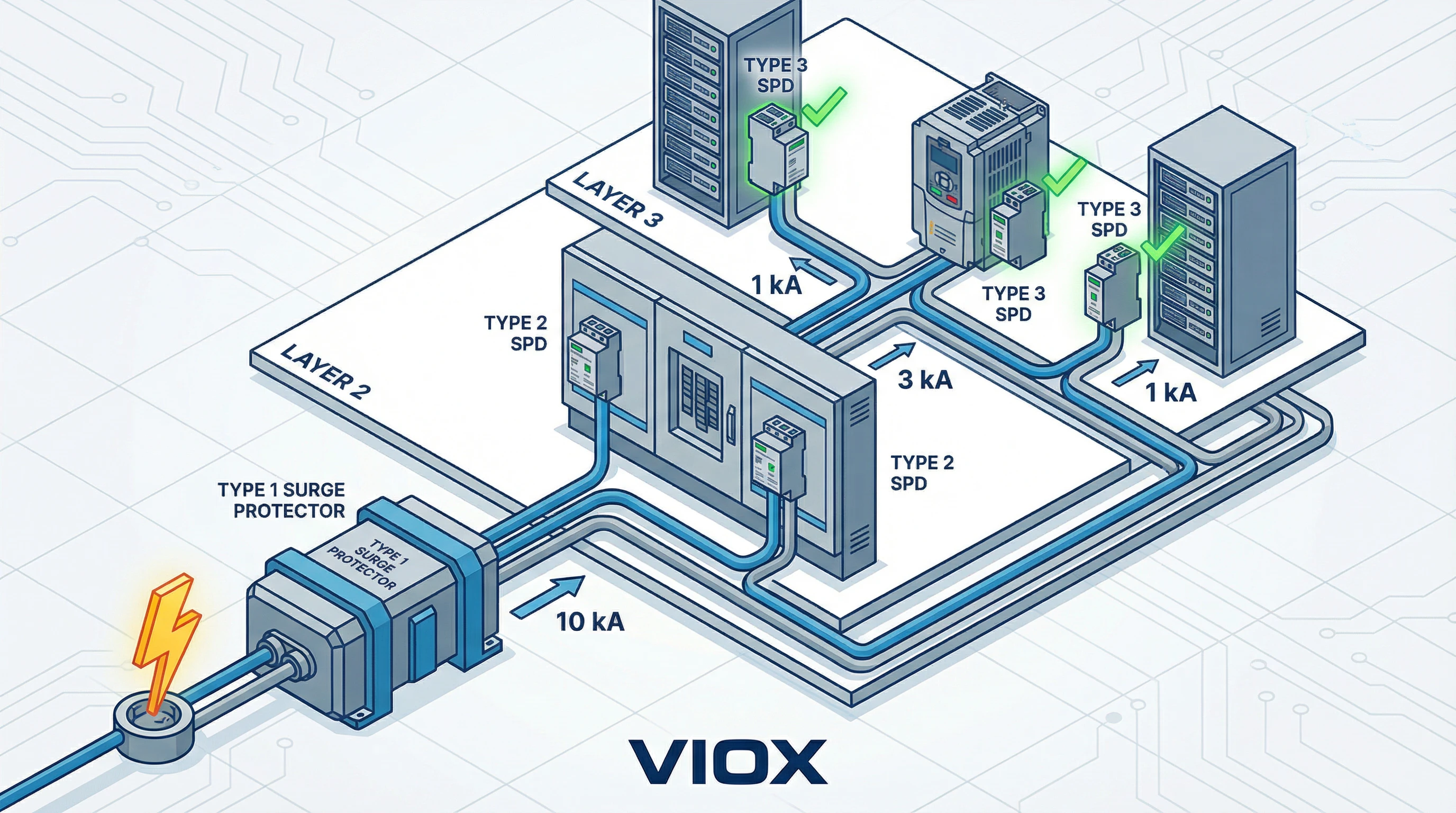
Effective surge protection uses distributed protection at multiple points. No single surge protector—regardless of joule rating—provides complete facility protection.
Three-tier protection model:
- Service entrance (Type 1): Arrests high-energy surges from utility before entering facility wiring
- Distribution panels (Type 2): Catches surges bypassing first layer, reduces energy before reaching branch circuits
- Point-of-use (Type 3): Final defense at equipment connections, limiting let-through to tolerable levels
Surge energy attenuates through building wiring. A 10 kA surge at service entrance may drop to 3 kA at a distribution panel 50 feet away, then to 1 kA at equipment another 30 feet distant. Each layer faces progressively lower stress.
Coordination requirements: Downstream devices should have clamping voltage 15-20% lower than upstream devices, ensuring sequential activation rather than competition.
Ground resistance should measure below 5 ohms (commercial), preferably below 2 ohms (critical facilities). Poor grounding undermines even premium surge protectors.
VIOX Commercial Surge Protection Solutions
VIOX Electric Equipment supplies commercial-grade surge protection engineered for B2B applications—fleet operators, industrial facilities, and critical infrastructure.
VIOX SPD Product Specifications
| Product Line | UL Type | Joule Rating | VPR | In Rating | Key Features |
|---|---|---|---|---|---|
| VIOX-1000 Series | Type 3 | 2,500J | 330V | 5 kA | Plug-in, LCD display, connected equipment warranty |
| VIOX-3000 Series | Type 2/3 | 3,500J | 330V | 10 kA | Panel-mount or plug-in, status relay output |
| VIOX-5000 Series | Type 1/2 | N/A | 330V | 20 kA | Service entrance, NEMA 4X enclosure, remote monitoring |
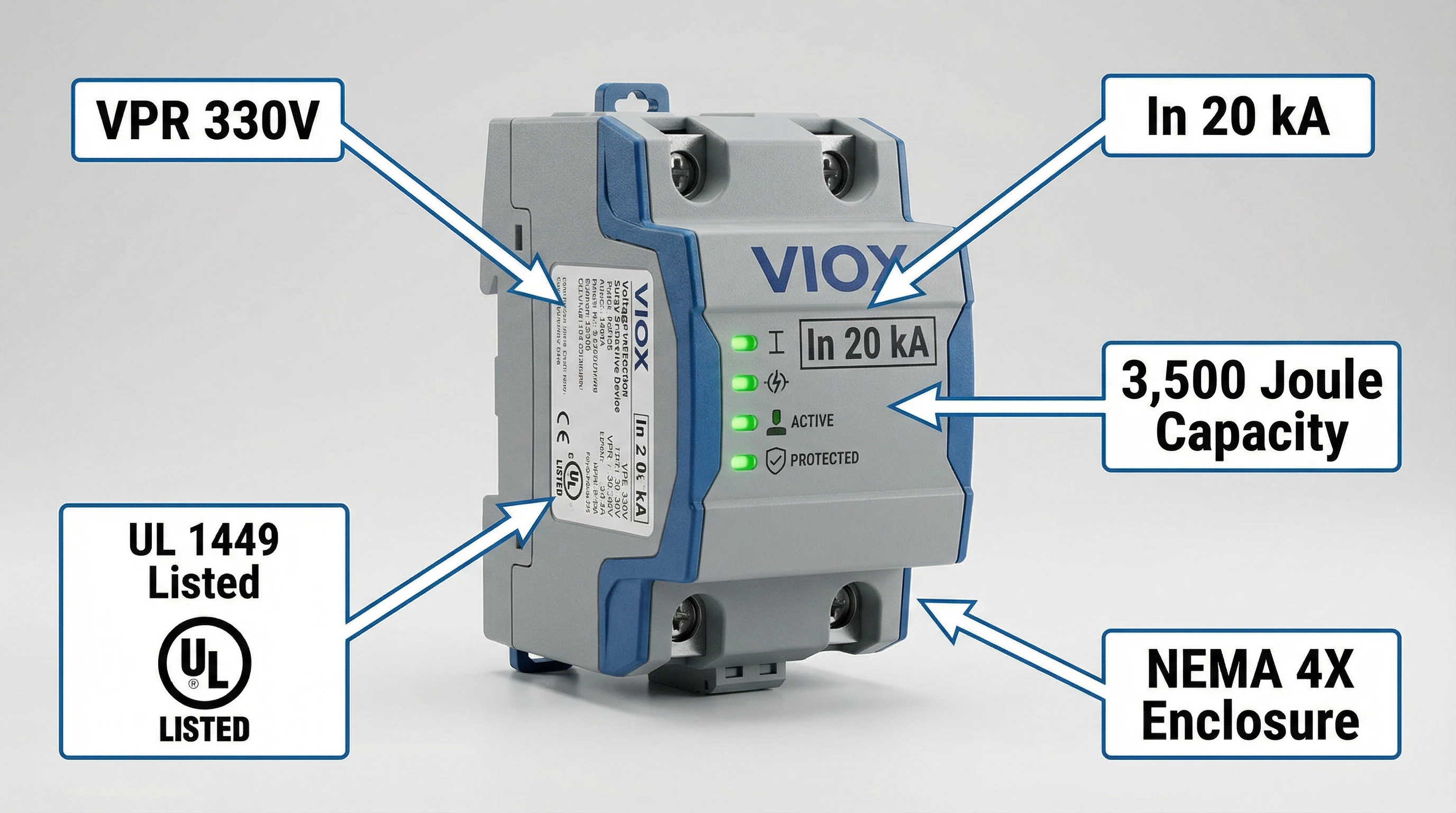
All VIOX surge protectors include:
- UL 1449 4th Edition certification
- Thermal disconnect protection
- Visual and audible status indicators
- 2-year commercial warranty
- Technical specification consultation
VIOX supports volume purchases with custom specifications, factory testing documentation, and integration consultation. Contact our B2B sales team for project-specific recommendations.
Frequently Asked Questions
Q: What does surge protector joules mean?
A: Joules measure total surge energy a device can absorb before failure. Higher joules generally indicate longer service life, but it’s not a standardized metric. Compare UL 1449 VPR and In ratings for reliable performance comparison.
Q: How many joules do I need for commercial equipment?
A: For plug-in protection: minimum 1,500-2,000J for office equipment, 2,500-3,000J for sensitive electronics. For panel-mount protection, focus on In rating (10-20 kA) rather than joules.
Q: Is higher joule rating always better?
A: Not necessarily. Clamping voltage (VPR) matters more. A 330V device with 1,500J protects better than a 500V device with 3,000J. Additionally, joule testing isn’t standardized across manufacturers.
Q: What’s the difference between Type 1, Type 2, and Type 3 surge protectors?
A: Type 1 installs at service entrance (line side of main disconnect), Type 2 at distribution panels (load side), and Type 3 at point-of-use equipment. Each handles different surge environments and testing requirements.
Q: Do I need surge protection if I have circuit breakers?
A: Yes. Circuit breakers protect against overcurrent (excessive amperage), not voltage spikes. Surge protectors address voltage transients that breakers cannot detect or prevent.
Q: How long do surge protectors last?
A: Service life depends on surge exposure. Quality devices with 2,500J+ capacity typically last 3-7 years in commercial environments. Replace immediately after major surge events or when status indicators show failure.
Q: Can I use residential surge protectors in commercial facilities?
A: Not recommended. Consumer units (200-800J) fail rapidly under commercial surge exposure and lack proper certifications. Specify commercial-grade devices with UL 1449 listing and appropriate In ratings.
Surge protector joules provide useful context for plug-in devices but represent only one factor in proper surge protection specification. For B2B applications, prioritize UL 1449 Type classification, Voltage Protection Rating (VPR), and nominal discharge current (In) over marketing-driven joule claims.
Implement layered protection strategies placing appropriate devices at service entrance, distribution panels, and point-of-use locations. This distributed approach delivers superior protection compared to single high-joule devices.
The investment in commercial-grade surge protection pays immediate returns through prevented equipment damage. A single VFD or server replacement costs $2,000 to $25,000; quality surge protection costs a fraction of one repair.
For detailed technical specifications, application consultation, and volume pricing on VIOX commercial surge protector systems, visit viox.com or contact our B2B technical sales team.