Reliable power quality is no longer a luxury; it is a baseline requirement for modern infrastructure. For electrical contractors and facility managers, the conversation has shifted from “Do we need surge protection?” to “How do we ensure our Surge Protective Device (SPD) installation meets the latest NEC 2023 requirements and protects critical assets?”
Voltage transients—whether caused by external lightning strikes or internal load switching—can degrade circuitry over time or cause catastrophic immediate failure. While competitors like Schneider Electric, Eaton, and Siemens have long established the baseline for the industry, VIOX is redefining the standard by combining robust IEC/UL compliance with installer-friendly engineering.
This guide details the technical requirements, code mandates, and best practices for SPD installation, ensuring your projects are compliant, safe, and built to last.
The Regulatory Landscape: NEC 2023 and Safety Standards
The National Electrical Code (NEC) has progressively tightened requirements regarding surge protection. The most significant shift began in 2020 and was solidified in the 2023 code cycle.
NEC Article 230.67: The Residential Mandate
Under NEC 2023 Article 230.67, all services supplying dwelling units must have a Type 1 or Type 2 SPD installed. This requirement applies to:
- Single-family homes
- Multi-family structures
- Guest rooms and guest suites in hotels/motels
The code specifies that the SPD must be an integral part of the service equipment or located immediately adjacent to it. For contractors, this means surge protection is now a standard line item on service upgrades and new builds, not an optional upsell.
NEC Article 242: Overvoltage Protection
Previously found in Article 285, the requirements for SPDs are now housed in Article 242 (Overvoltage Protection). This article dictates that SPDs must be:
- Listed: Devices must be tested and listed by a Nationally Recognized Testing Laboratory (NRTL) like UL or ETL.
- Short-Circuit Current Rating (SCCR): The SPD must have an SCCR equal to or greater than the available fault current at the point of installation. Installing an SPD with a 22kA SCCR rating on a panel with 65kA available fault current is a code violation and a severe safety hazard.
Decoding SPD Categories: Types 1, 2, 3, and 4
Selecting the correct device depends entirely on where it sits within the electrical distribution system. Misapplication here is a common cause of inspection failures.
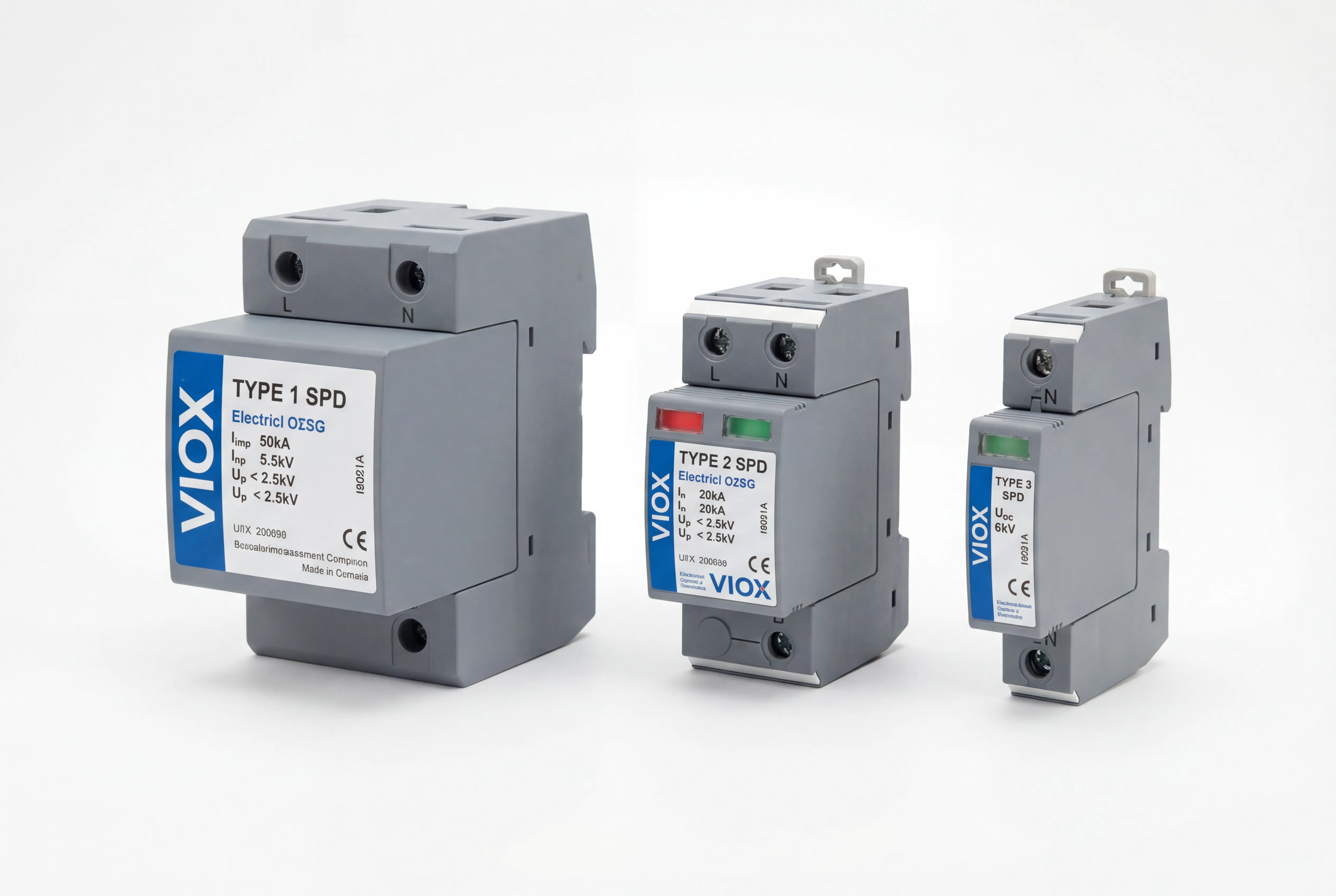
Type 1: Line-Side Protection
Type 1 SPDs are the heavy lifters. They are permanently connected devices intended for installation between the secondary of the service transformer and the line side of the service disconnect overcurrent device.
- Application: Service entrances, metering banks, and locations where no overcurrent protection is present upstream.
- VIOX Advantage: Our Type 1 units are engineered to handle high-energy surges without external fusing, simplifying installation in tight service cabinets.
Type 2: Load-Side Protection
Type 2 SPDs are installed on the load side of the main service disconnect. This is the most common application for commercial and industrial panels.
- Application: Distribution panels, branch panels, and industrial control cabinets.
- Requirement: These usually require a dedicated circuit breaker or fuse disconnect.
Type 3: Point-of-Use
Type 3 SPDs are installed at a minimum conductor length of 10 meters (30 feet) from the electrical service panel. These are often strip protectors or receptacle-based devices designed to protect specific sensitive loads.
Type 4: Component Assemblies
These are component assemblies consisting of one or more Type 5 components (like MOVs—Metal Oxide Varistors) meant to be integrated into other equipment. They are not intended for standalone field installation.
Critical Performance Metrics
When specifying an SPD, looking beyond the brand name is vital. You must evaluate the performance ratings defined by UL 1449 (North America) and IEC 61643 (International).
1. Nominal Discharge Current (In)
This represents the peak value of current (8/20μs waveform) the SPD can conduct 15 times without failing.
- Standard: Type 1 SPDs typically require 10kA or 20kA.
- Recommendation: For critical infrastructure, VIOX recommends specifying 20kA In to ensure longevity.
2. Maximum Continuous Operating Voltage (MCOV)
The MCOV must be higher than the nominal system voltage to prevent the SPD from conducting during normal operation. If the MCOV is too close to the nominal voltage, minor utility swells could cause the SPD to clip prematurely, shortening its lifespan.
3. Voltage Protection Rating (VPR) / Up
Often called “clamping voltage,” this is the residual voltage the SPD lets through to the equipment during a surge.
- The lower, the better. A 600V VPR offers better protection than a 1000V VPR.
- Trade-off: Lower VPR often means components are under higher stress. VIOX balances this by using thermally protected MOV technology to maintain low VPR without sacrificing durability.
4. Maximum Surge Current (Imax)
This is the single-shot rating—the maximum current the device can handle once before failing. While competitors often market massive numbers (e.g., 300kA) as a primary selling point, engineering best practices suggest that a higher In (durability) is more valuable than an excessive Imax (capacity) for most applications.
The Zone of Protection Strategy
A single SPD at the main service entrance is rarely sufficient for a commercial facility. High-frequency transients can be induced downstream of the main panel, or “ring waves” can amplify voltage as they travel through building wiring.
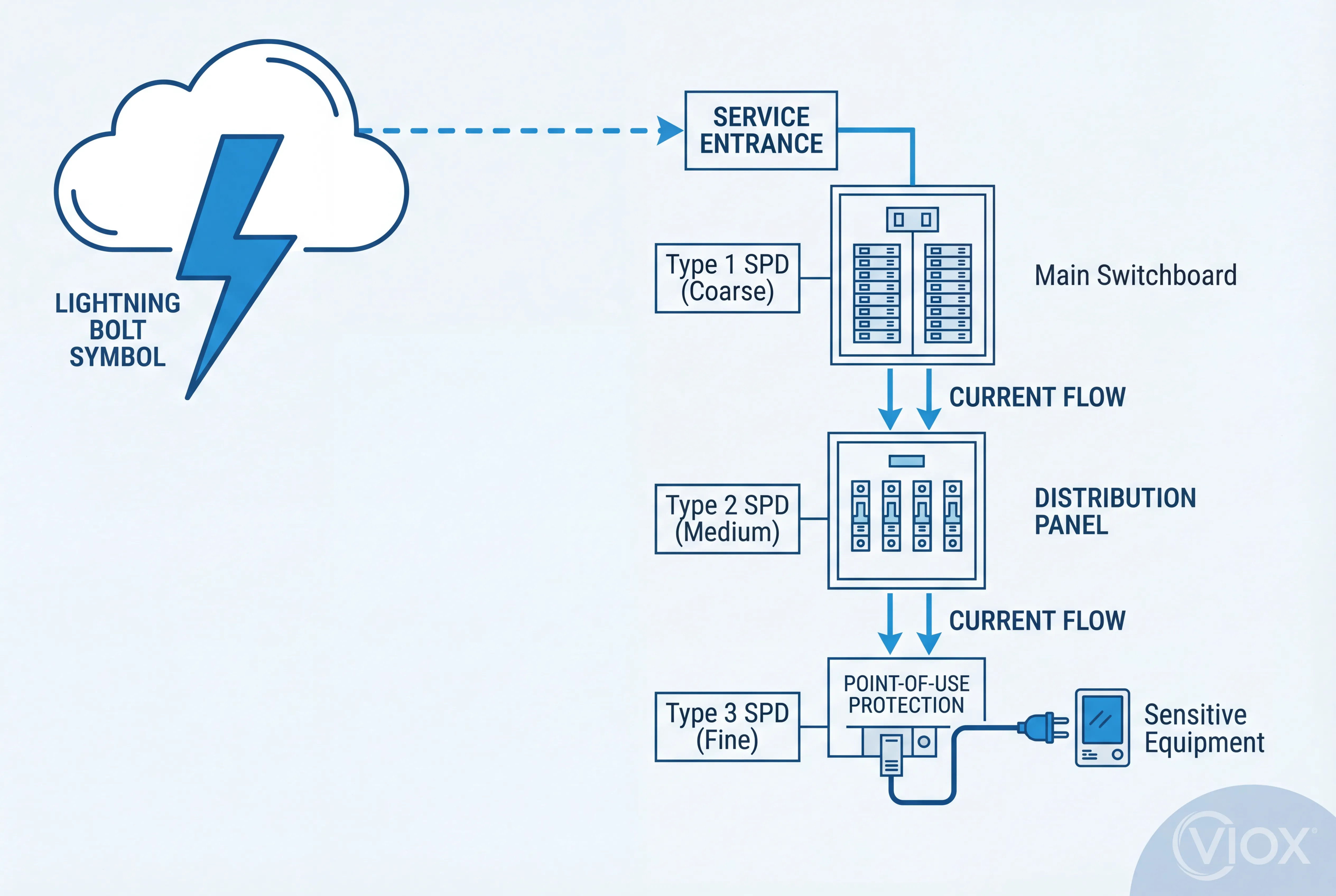
To combat this, a Cascading Protection strategy (or Zoned Protection) is required.
- Zone A (Service Entrance): Handle the massive energy from external grid switching or lightning. (Type 1 SPD).
- Zone B (Distribution): Clamp down on residual voltage and internal switching surges from HVAC or elevators. (Type 2 SPD).
- Zone C (Critical Load): Fine protection for PLCs, servers, and medical equipment. (Type 3 SPD).
Installation Best Practices: Where Most Fail
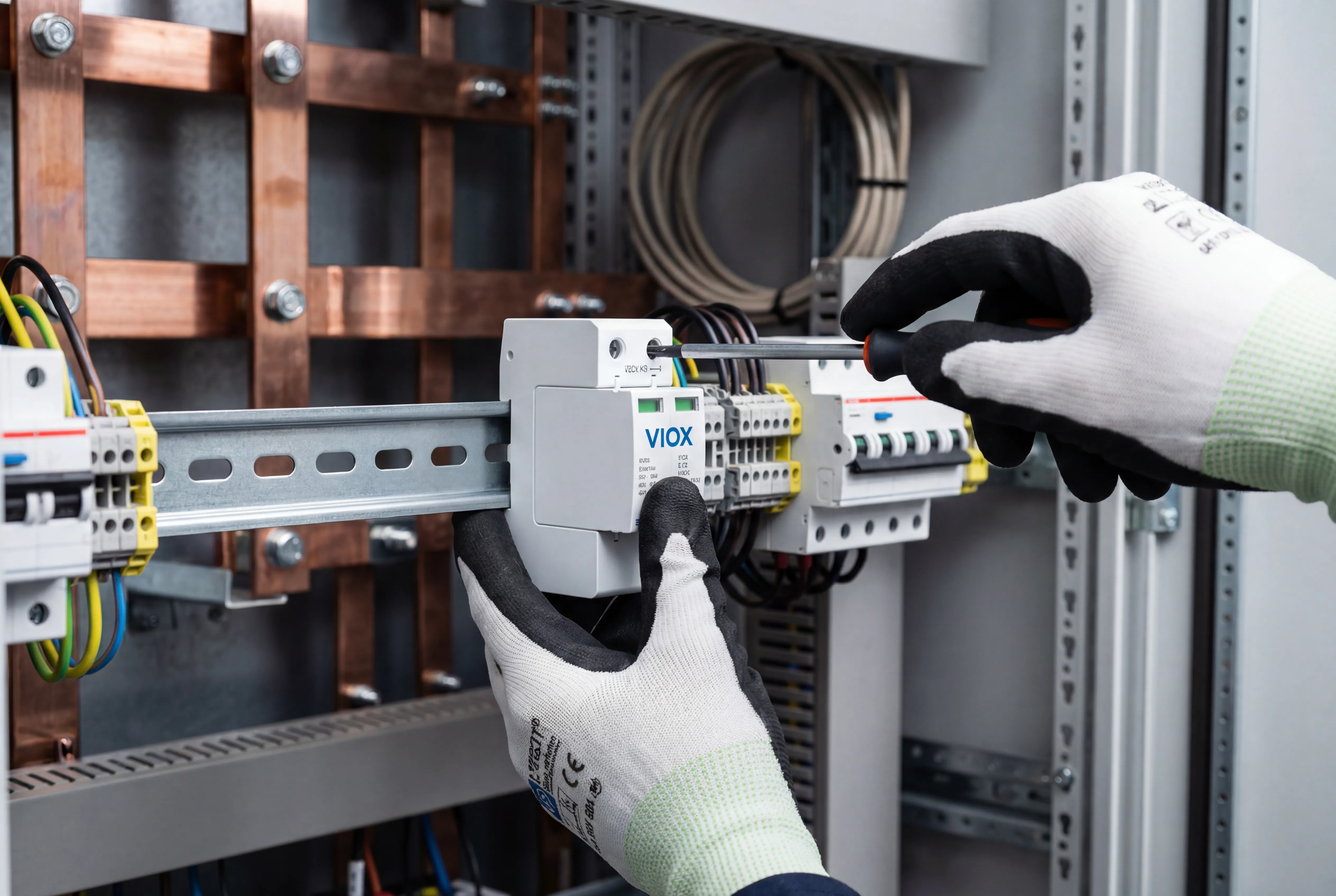
Even the highest-rated VIOX SPD will fail to protect equipment if installed incorrectly. The physics of lightning and high-frequency transients dictate that impedance is the enemy.
The “Lead Length” Rule
At surge frequencies, wire has significant impedance. A rule of thumb is that every inch of wire adds roughly 15-25 volts of let-through voltage during a surge event.
- The Goal: Keep leads as short and straight as possible. Ideally, under 10 inches (250mm).
- The Mistake: Coiling excess wire inside the panel. This creates an inductor, which increases impedance and renders the SPD less effective.
- The Fix: Trim conductors to the exact length needed. Avoid sharp 90-degree bends; use sweeping curves.
Grounding and Bonding
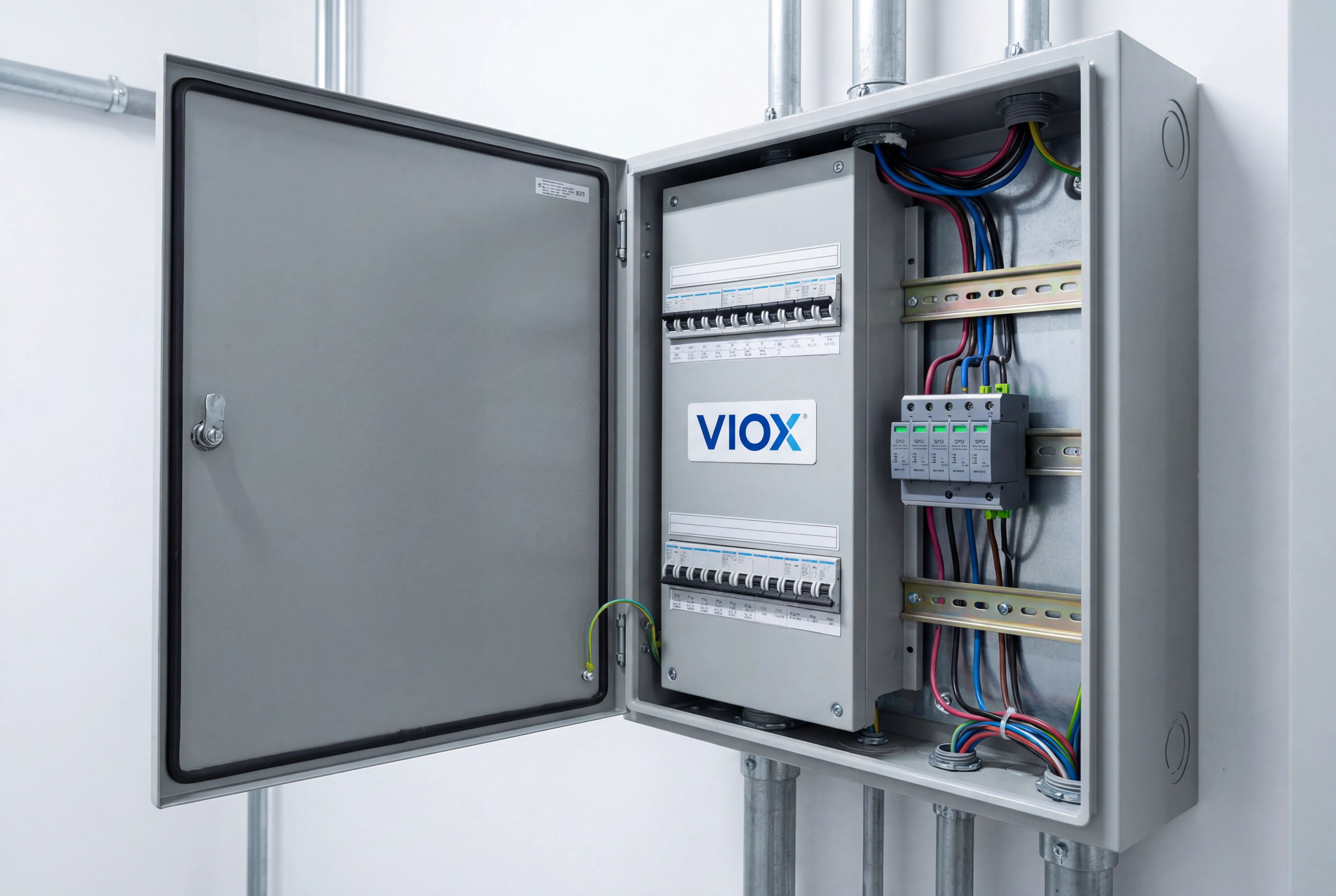
The SPD diverts energy to the ground. If the path to the ground is high resistance, the energy has nowhere to go. Ensure the grounding conductor is bonded directly to the panel’s ground bus. Do not daisy-chain the ground connection with other devices.
Overcurrent Protection Coordination
For Type 2 devices connected via a circuit breaker:
- Use a dedicated breaker (typically 20A or 30A, depending on the manufacturer’s manual).
- Locate the breaker as close to the SPD as possible to minimize wire length.
- Ensure the breaker matches the panel’s AIC rating.
Industrial vs. Residential Considerations
While the principles of surge protection remain the same, the environments differ drastically.
Industrial Environments
In manufacturing plants, the threat is often internal. Large inductive loads—such as VFDs (Variable Frequency Drives), heavy motors, and arc welders—generate thousands of micro-surges daily. These don’t always destroy equipment instantly but cause “electronic rust,” leading to premature failure of control boards and sensors.
- VIOX Solution: We recommend SPDs with EMI/RFI noise filtering for industrial panels to clean up the power, not just clamp surges.
Lightning Prone Areas
For facilities in Florida or the Midwest, lightning protection systems (LPS) are common. If a building has lightning rods (Franklin rods), a Type 1 SPD is mandatory at the service entrance to handle the potential ground potential rise (GPR) and partial currents from a strike.
Diagnostics and Maintenance
Surge protection is a silent service. You generally don’t know it’s working until the light goes out. All VIOX industrial SPDs come equipped with:
- Visual Status Indicators: Green (Good) / Red (Replace).
- Dry Contacts (Remote Signaling): Crucial for facility managers. This allows the SPD to be wired into a Building Management System (BMS) or SCADA system, sending an alert if protection is compromised.
Pro Tip: Include SPD inspection in your annual thermal imaging and maintenance PMs. A compromised MOV module might generate heat before it fails completely.
Frequently Asked Questions (FAQ)
1. Is surge protection required by law?
Yes, for specific applications. NEC 2023 Article 230.67 mandates SPDs for all dwelling units. Article 700.8 requires them for emergency systems, and Article 708.20 requires them for Critical Operations Power Systems (COPS).
2. Can I install a Type 2 SPD in a Type 1 application?
Generally, no. Type 2 devices are not rated to be installed ahead of the main service disconnect unless specifically listed for that purpose. Doing so violates the listing and code.
3. Do SPDs affect the electricity bill?
No. SPDs are passive devices. They consume negligible power (milliamps for the LED indicators) and do not restrict current flow to your loads.
4. What is the difference between a Surge Arrester and an SPD?
In the past, “Surge Arrester” referred to medium/high voltage (>1000V) utility protection, while TVSS (Transient Voltage Surge Suppressor) referred to low voltage. Modern terminology (NEC Article 242) uses “Surge Arrester” for >1000V and “Surge Protective Device (SPD)” for <1000V systems.
5. Why did my SPD fail?
SPDs are sacrificial devices. They are designed to degrade over time as they absorb energy. A failure usually means the device did its job by sacrificing itself to save downstream equipment. However, premature failure can be caused by sustained overvoltage (swells) that exceed the device’s MCOV rating.
6. Does VIOX offer replacements for other brands?
Yes. VIOX SPDs are designed with standard DIN-rail mounts and universal form factors, making them excellent retrofits for aging panels originally outfitted with obsolete ABB, Phoenix Contact, or Citel devices.
Ensuring electrical safety requires more than just meeting code; it requires understanding the physics of power quality. For technical data sheets or to consult with a VIOX application engineer regarding your specific facility, visit our Technical Resources page.