

Introduction: The Small Enclosure Challenge
Electrical control panels and server cabinets face a critical vulnerability: fire. In confined spaces—where circuit breakers, terminals, and transformers operate at high density—a single fault can trigger thermal runaway within seconds. Traditional fire suppression solutions present a paradox for facility managers: gas-based systems like FM-200 struggle in micro-volumes due to pressure derating, while dry chemical agents leave corrosive residue that damages sensitive electronics.
Solid aerosol fire suppression addresses these constraints directly. Unlike gaseous suppressants that require substantial volume to achieve effective concentration, condensed aerosols generate ultra-fine particulate that floods small enclosures rapidly—often within 6 seconds—while remaining non-conductive and non-corrosive. For DIN rail-mounted systems in electrical cabinets, this difference is transformative.
Solid aerosol is the superior choice for small enclosures, grounded in technical standards, real-world performance data, and how modern fire protection is designed.
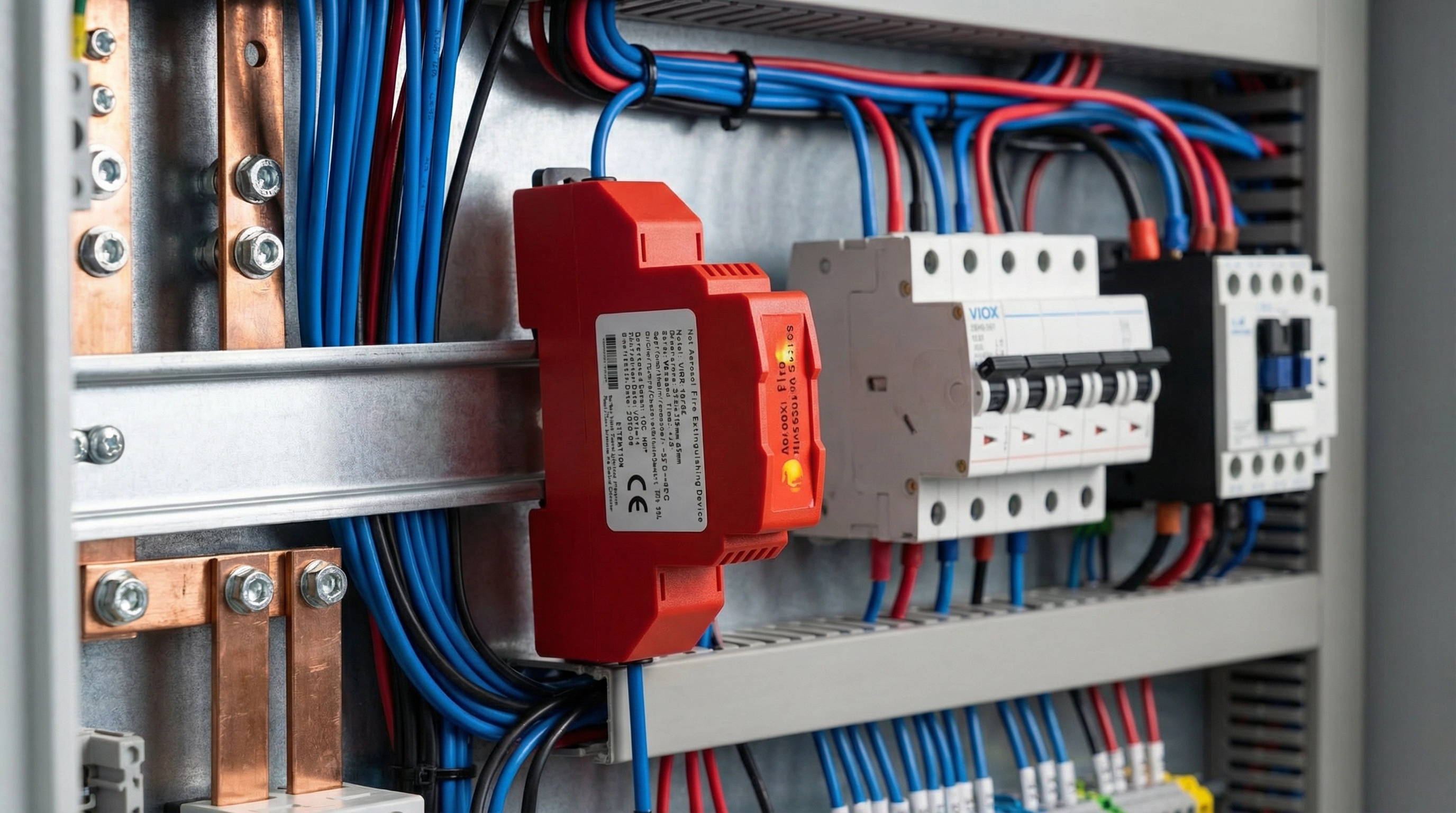
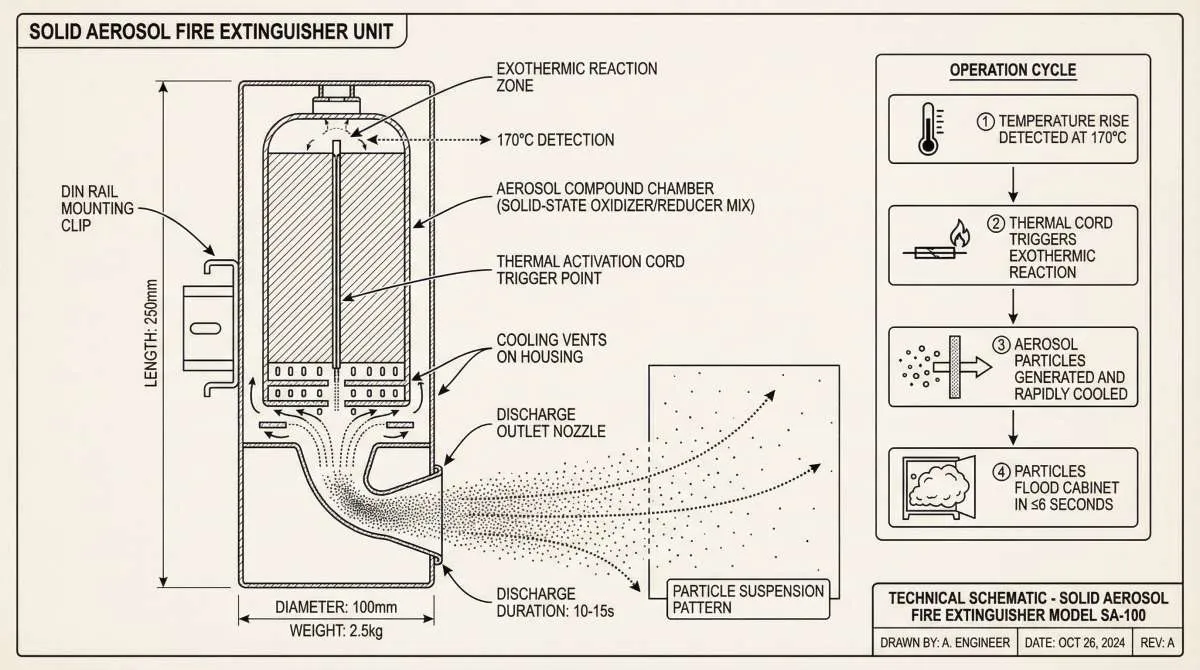
Solid Aerosol vs. Gas-Based Fire Suppression: A Direct Comparison
| Factor | Solid Aerosol | Gas-Based (FM-200) | Dry Chemical |
|---|---|---|---|
| Footprint in Small Cabinets | Ultra-compact (84.5 × 18 × 60mm); mounts directly on DIN rail | Requires cylinder + distribution piping; occupies significant space | Messy, requires external mounting |
| Activation Speed | ≤6 seconds to full suppression | 15-30 seconds (dependent on volume) | 10-20 seconds |
| Pressure Impact | Minimal; non-pressurized solid-state operation | Positive/negative pressure surges; requires venting | Moderate pressure release |
| Residue After Discharge | Micron-sized particulate; non-conductive, non-corrosive, easily cleaned | Zero residue; clean discharge | Heavy powder residue; hygroscopic and corrosive |
| Electrical Safety | Non-conductive; safe for energized equipment at ≤1000V | Non-conductive but pressure derating in confined spaces | Risk of conductive path if moisture absorbed |
| Performance in 0.1–0.8 m³ | Optimal; designed for micro-volumes | Pressure derating; less effective at small scale | Acceptable but residual contamination risk |
| Maintenance Burden | Zero; non-pressurized, 10-year service life, no annual checks | Annual pressure verification, recharge cycles | Regular residue cleanup, component replacement |
| Environmental Impact | Minimal; non-toxic, biodegradable particulate | High GWP (FM-200: ~3,220); subject to phase-down | Particulate accumulation concerns |
| Standard Compliance | ISO 15779, NFPA 2010, UL 2775 | NFPA 2001, UL 2166 | Limited industrial standards |
| Cost for DIN Rail Retrofit | Low; self-contained, no complex piping | Moderate to high; requires system redesign | Moderate; ongoing residue management |
What This Means: For enclosures under 1 m³, solid aerosol suppresses faster, needs no maintenance, and leaves no residue. Gas cylinders simply can’t compete in these tight spaces.
How Solid Aerosol Fire Suppression Works
Solid aerosol systems operate on a fundamentally different principle than gaseous suppressants. Instead of storing a liquid or gas under pressure, aerosol generators contain a stable solid-state mixture of oxidizer and reducing agent. Upon activation, this compound undergoes a controlled exothermic reaction, producing fine particulate and inert gases that flood the protected volume.
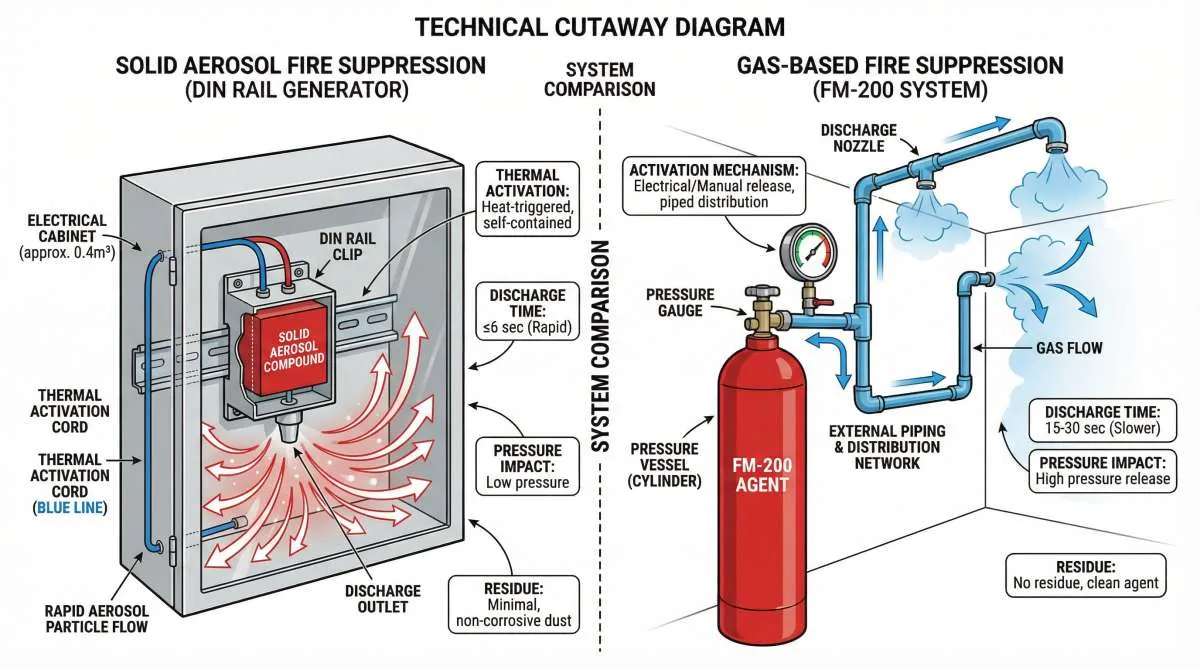
The Mechanism:
- Thermal Detection: A heat-sensitive cord running through the cabinet detects temperature rise (typically 170°C). This triggers mechanical activation of the aerosol generator, even during total power loss.
- Instantaneous Generation: The solid compound reacts rapidly, producing cooled aerosol particulate (cooled via precision venting to maintain safe casing temperatures).
- Rapid Flooding: The discharge outlets direct the aerosol into the enclosed space within 6 seconds or less, achieving design concentration throughout the cabinet.
- Sustained Suspension: Unlike gaseous agents that diffuse and concentrate-decay, aerosol particles remain suspended for extended periods, preventing re-ignition even if hotspots remain.
- Post-Discharge Safety: The residual fine particulate is non-conductive and non-corrosive, allowing safe cleanup and equipment restoration without damage to circuit boards or connectors.
Why This Design Matters:
For a 0.3 m³ electrical cabinet, achieving effective fire suppression is a race against thermal runaway. Gas-based systems need to reach a minimum agent concentration relative to volume. In micro-volumes, that’s harder without creating pressure hazards. Aerosol generators, by contrast, are built for exactly these tight spaces. A 10-gram or 20-gram unit protects 0.4–0.8 m³ effectively because the particulate doesn’t depend on achieving a specific vapor concentration. Instead, aerosol particles physically interrupt combustion through cooling and displacement—processes that work even in compact cabinets.
Why Solid Aerosol Wins for Small Electrical Enclosures
1. Zero Pressure Hazard
Gaseous fire suppression systems in small, sealed enclosures face a critical challenge: pressure excursions. When FM-200 or other halocarbon gases discharge into a confined space, they create both positive and negative pressure waves. In a 0.4 m³ cabinet, this pressure surge can exceed the structural integrity of doors and panels if venting is inadequate. Solid aerosol generators are non-pressurized and produce minimal pressure impact, eliminating the need for pressure relief vents and simplifying cabinet design.
2. No Maintenance, Zero Lifecycle Costs
Gas cylinders require annual pressure verification, periodic recharge cycles, and certification inspections. By contrast, VIOX solid aerosol extinguishers are maintenance-free for their entire 10-year service life. There is no pressure gauge to monitor, no recharge schedule, and no degradation of agent performance. This translates to lower total cost of ownership for facility managers managing large panel installations.
3. Non-Corrosive, Safe for Sensitive Electronics
The micron-sized aerosol particulate generated is electrically non-conductive and non-corrosive. It will not damage circuit boards, solder joints, or connector contacts. After discharge, residue can be wiped or blown away—leaving no damage pathway. Gas-based systems leave zero residue (cleaner post-incident) but cannot be installed as compactly; dry chemical agents leave heavy, hygroscopic residue that corrodes delicate components and demands immediate cleanup.
4. Rapid Knockdown in Micro-Volumes
Electrical fires in cabinets propagate at thermal runaway speeds. Solid aerosol achieves full suppression in 6 seconds or less, limiting fire spread and secondary damage. Gas systems require 15–30 seconds to achieve full concentration in larger spaces; in small cabinets, the margin is narrower.
5. DIN Rail Compatibility: True Retrofit Solution
VIOX DIN rail aerosol extinguishers mount directly onto 35mm DIN rails using standard clips, integrating seamlessly alongside MCBs, contactors, and terminal blocks. No piping, no remote cylinders, no complex system redesign. This makes aerosol the practical choice for retrofitting fire suppression into existing panels or densely populated control cabinets.
6. Works Without AC Power
The thermal activation cord operates mechanically, triggering the generator even during total power loss. This is critical for electrical cabinets where fire may accompany an electrical fault that cuts all DC and AC supplies. Gas systems require electrical actuation (solenoid valve) unless dual-redundant detection is engineered in at higher cost.
7. Environmental Advantage
FM-200 (HFC-227ea) has a GWP of ~3,220 and is subject to phase-down under EU F-Gas Regulations and the U.S. AIM Act. Solid aerosol particulate is non-toxic and biodegradable, with minimal environmental footprint. For organizations with strict ESG compliance targets, aerosol offers a sustainable alternative.
Technical Standards & Regulatory Compliance
Solid aerosol fire suppression systems operate within a well-established international regulatory framework, ensuring safety, reliability, and interoperability across markets.
ISO 15779: Global Standard for Condensed Aerosol Systems
ISO 15779 specifies component requirements, test methods, design recommendations, and safety guidance for fixed condensed aerosol fire-extinguishing systems. It mandates that systems suppress Class A (surface), B (flammable liquid), and C (electrical) fires in total-flooding configurations. The standard emphasizes system performance in enclosed volumes and provides explicit guidance on installation, maintenance, and occupancy limits.
NFPA 2010: North American Standard
NFPA 2010 is the U.S./Canada consensus standard dedicated to fixed aerosol fire-extinguishing systems, complementing NFPA 2001 (for clean gaseous agents). It covers system design, installation, testing, maintenance, and inspection protocols aligned with North American electrical codes and life-safety requirements.
UL 2775: Product Certification Standard
UL 2775 (updated from ULC/ORD-C2775) is the harmonized product safety and performance standard for fixed condensed aerosol extinguishing system units in the U.S. and Canada. VIOX DIN rail aerosol extinguishers are designed and tested to UL 2775 specifications, ensuring that each unit meets rigorous performance, reliability, and safety criteria before leaving the factory.
VIOX Certifications
VIOX aerosol fire extinguishers carry full compliance certifications including ISO 9001 (quality management), ISO/IEC 2775 (product safety), CE marking (EU technical harmonization), and CSA/UL listing for North American markets. This multi-standard certification pathway ensures customers can deploy VIOX units with confidence in global markets.
Frequently Asked Questions
Q: Can solid aerosol residue damage sensitive electronics?
A: No. The aerosol particulate is non-conductive and non-corrosive. After discharge, the micron-sized particles can be easily wiped or blown away without harming circuit boards, solder joints, or connector contacts. Gas-based systems leave zero residue but cannot retrofit small spaces; dry chemical leaves heavy corrosive residue requiring immediate cleanup.
Q: What happens if the cabinet loses all power during a fire?
A: VIOX aerosol extinguishers activate via a heat-sensitive thermal cord that operates mechanically at 170°C—no electricity required. This ensures protection even during catastrophic power failure, a critical advantage over gas systems that require solenoid valve actuation.
Q: How does aerosol perform in very cold or very hot environments?
A: VIOX extinguishers operate reliably from -40°C to +70°C for integrated models and -50°C to +90°C for standard types. This range covers outdoor solar combiner boxes, EV charging stations, and high-temperature industrial environments where gas systems may fail.
Q: Is annual maintenance required?
A: No. Solid aerosol extinguishers are maintenance-free for 10 years. There is no pressure gauge to verify, no recharge cycles, and no annual certification inspections. This eliminates ongoing operational costs that gas systems incur.
Q: Can VIOX aerosol extinguishers be installed on existing DIN rails?
A: Yes. VIOX units mount directly onto standard 35mm DIN rails (IEC 60715 TH35 profile) using integrated clips. Installation takes minutes with no tools required, making retrofit retrofitting practical even in operational facilities.
VIOX delivers what other systems can’t:
The units themselves are ultra-compact—they mount directly on 35mm DIN rails without needing floor space or remote cylinders. No installation headaches, no system redesigns. Maintenance? Zero. You install it and forget about it for 10 years. No pressure gauges to check, no recharge cycles, no annual certifications. That’s the real cost advantage.
The residue is non-corrosive and non-conductive, so your circuit boards stay intact. When a discharge happens, you wipe away a fine dust and get back online. No damage, no hidden failures from chemical contamination. And here’s the safety angle: the thermal cord works even if power fails completely. That’s critical when fire breaks out during an electrical fault.
VIOX manufactures every aerosol generator in-house at its Wenzhou, China facility, controlling the entire production chain from chemical formulation to final assembly. This vertical integration ensures 100% reliability, with every unit subjected to full inspection before shipment.
Contact VIOX today for a customized quote on DIN rail aerosol fire suppression. We provide free samples, expert technical consultation, and logistics support to get your protection in place on schedule.

