
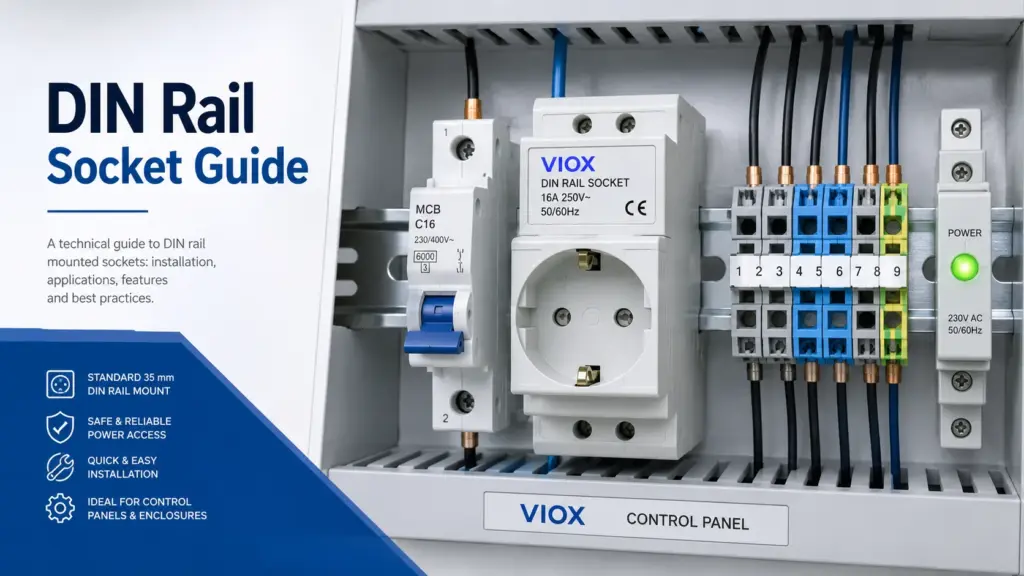
A DIN rail socket is a modular power outlet designed to snap onto a standard DIN rail inside a control cabinet, distribution board, or electrical enclosure. It provides a convenient local power point for maintenance tools, test instruments, laptops, panel lighting, or small auxiliary equipment.
Unlike a normal wall outlet, a DIN rail mounted socket is built for panel integration. The important selection points are not only plug shape, but also voltage, current rating, regional socket standard, module width, terminal design, grounding, protective device coordination, and the environment inside the enclosure.
For panel builders and OEM buyers, the safest way to specify one is simple: choose the socket standard required by the end market, confirm the panel voltage and current rating, provide suitable overcurrent and residual-current protection where required, and verify that the socket fits the available 35 mm DIN rail space.
Quick Answer: What Is a DIN Rail Socket?
A DIN rail socket, also called a DIN rail mounted socket, DIN rail socket outlet, or DIN rail power socket, is an electrical socket that mounts directly onto a DIN rail. It is commonly installed inside electrical panels to provide service power without drilling a separate wall outlet into the enclosure.
Most units are designed for the standard 35 mm top-hat DIN rail defined by IEC/EN 60715. The rail provides mechanical mounting only; it is not a live busbar. Power is supplied through terminals on the socket body, usually with line, neutral, and protective earth connections depending on the socket type.
Typical use cases include:
- Powering a laptop during programmable logic controller (PLC) commissioning
- Supplying a test instrument or portable work light inside a control cabinet
- Providing a service outlet in a distribution board
- Supplying small auxiliary equipment inside an enclosure
- Creating a modular power point beside MCBs, terminal blocks, timers, and relays
If you need the physical mounting rail itself, see the VIOX DIN rail product page. If you need the socket device, see VIOX DIN rail socket options.
DIN Rail Socket vs DIN Rail Mounted Socket vs Socket Outlet
These terms are often used for the same product, but buyers should be careful because some similar phrases mean different devices.
| Term | What It Usually Means | Important Note |
|---|---|---|
| DIN rail socket | General term for a power outlet mounted on DIN rail | Main product category |
| DIN rail mounted socket | Same device, emphasizing the mounting method | Common buyer term |
| DIN rail socket outlet | More formal electrical wording | Often used in specifications |
| DIN rail power socket | Emphasizes AC power access inside the panel | Useful for service outlet applications |
| DIN rail power outlet | North American wording for the same idea | Often searched with US/NEMA sockets |
| DIN rail relay socket | A relay base, not a power outlet | Used to hold plug-in relays |
| DIN socket | Often means a circular signal connector | Not the same as a DIN rail socket |
This distinction matters. A customer searching for a “DIN rail relay socket” may need a relay base. A customer searching for a “DIN rail socket US” usually wants a NEMA-style DIN rail mounted power receptacle for a North American panel.
Where DIN Rail Sockets Are Used
DIN rail sockets are most useful when a panel needs a safe, fixed, and organized service power point.
Control Cabinets
In automation cabinets, technicians often need temporary power for programming cables, laptops, handheld meters, label printers, or inspection lights. A DIN rail power socket keeps this access inside the panel layout instead of relying on loose extension cords.
Distribution Boards
In low-voltage distribution boards, a DIN rail socket can provide a service outlet near protective devices such as MCBs, timers, meters, or terminal blocks. It should still be protected by a suitable circuit protective device according to the local installation rules.
Machine Panels
Machine builders may install a DIN rail socket for commissioning and service. In export panels, the plug standard must match the destination country. A Schuko socket may be appropriate for parts of Europe, while a BS1363 or NEMA version may be required for the UK or North American market.
Building Automation Panels
Heating, ventilation, lighting, access control, and small building management panels often need a compact socket for service equipment. In these panels, available rail width and front clearance are usually the limiting factors.
DIN Rail Socket Types by Plug Standard
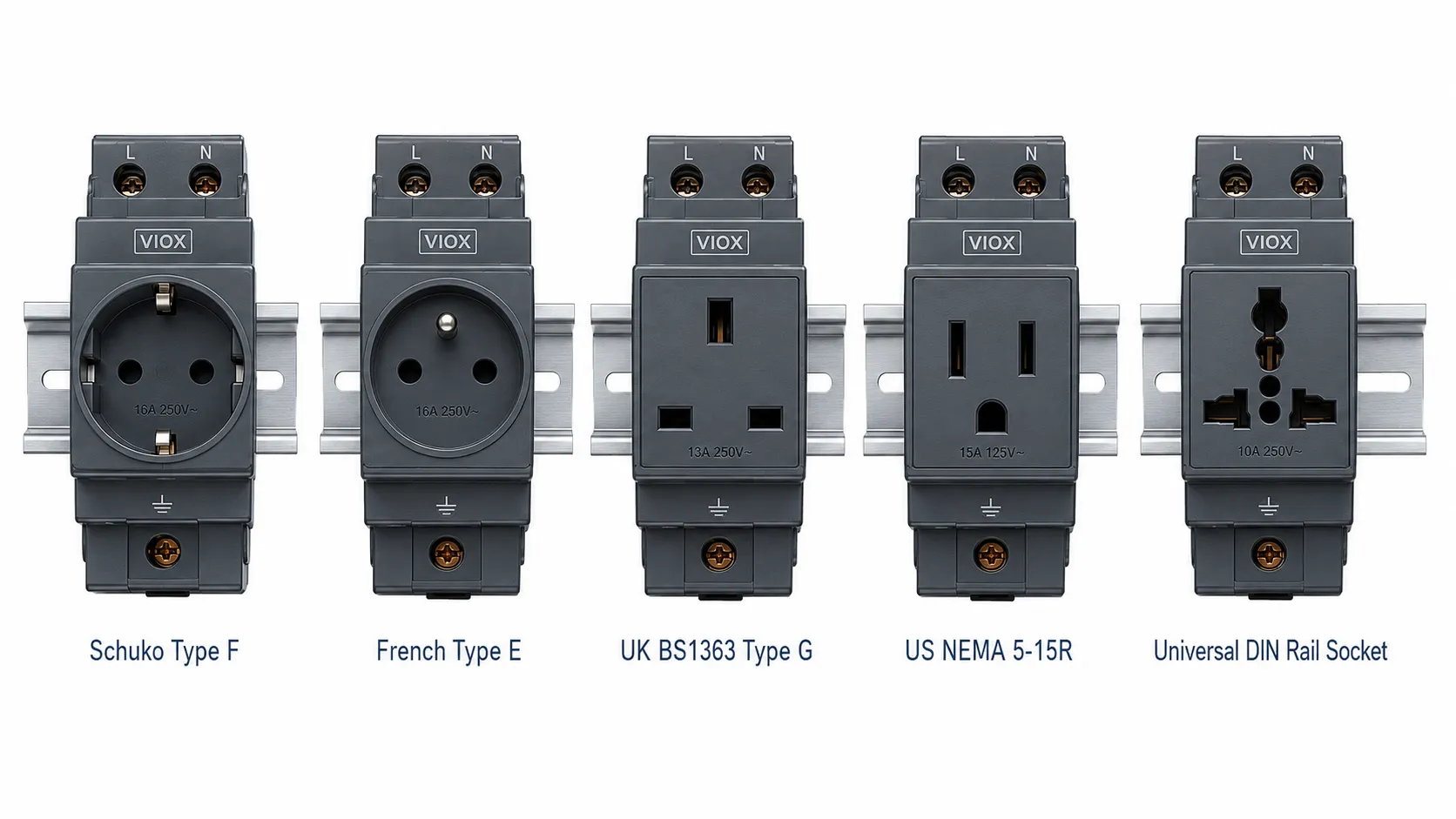
The most visible difference between DIN rail sockets is the plug standard. A DIN rail socket is not universal just because it mounts on a DIN rail. The plug face must match the market, voltage system, and approval requirements.
| Socket Type | Common Market | Typical Panel Use | Selection Note |
|---|---|---|---|
| Schuko / Type F | Germany and many European markets | Service socket in 230 V panels | Check local earthing and shutter requirements |
| French Type E | France, Belgium and related markets | Local plug compatibility | Earth pin arrangement differs from Schuko |
| BS1363 / Type G | UK and some Commonwealth markets | 13 A panel service outlet | Plug-side fuse and shutter expectations differ from EU sockets |
| NEMA 5-15R / 5-20R | US, Canada, Mexico | 120 V control panel service outlet | Verify voltage, current, grounding, and panel standard requirements |
| Australian / Type I | Australia, New Zealand, China variants | Regional export panels | Check national plug configuration |
| Universal socket | Mixed export panels | Convenience in multi-market products | Use carefully; verify local approval acceptance |
Universal sockets may look convenient, but they are not always accepted in regulated installations. For export equipment, it is usually better to specify the correct regional socket standard instead of using a universal face by default.
Key Ratings to Check Before Choosing a DIN Rail Power Socket
A DIN rail socket looks simple, but the wrong specification can create overheating, poor plug retention, nuisance tripping, or approval problems.
| Parameter | Why It Matters |
|---|---|
| Rated voltage | Must match the panel supply, such as 120 V AC or 230 V AC depending on market |
| Rated current | Must match the socket, wiring, protective device, and expected load |
| Plug standard | Determines which plug can be inserted safely |
| Module width | Determines how much DIN rail space the socket occupies |
| Terminal type | Affects wiring speed, conductor compatibility, and maintenance |
| Protective earth connection | Critical for Class I equipment and service safety |
| Shutter design | Required or expected in many socket systems |
| Indicator lamp | Useful for showing power presence, but not a substitute for testing |
| Built-in switch | Allows local isolation of the socket only if designed and rated for that function |
| Built-in fuse | Optional feature; do not assume every DIN rail socket includes fuse protection |
| Certification or approval | Must match the target market and panel approval route |
For the wiring side of the panel, a good socket installation also depends on correct terminal blocks, conductor routing, and labeling. VIOX also supplies terminal blocks for organized control cabinet wiring.
Physical Construction: Housing, Contacts, Terminals, and Module Width
For OEM panels and distributor orders, the mechanical construction matters almost as much as the plug face. A DIN rail socket may pass a basic visual check but still become a weak point if the housing softens, the contacts lose spring pressure, or the terminal is not suitable for the conductor size used in the panel.
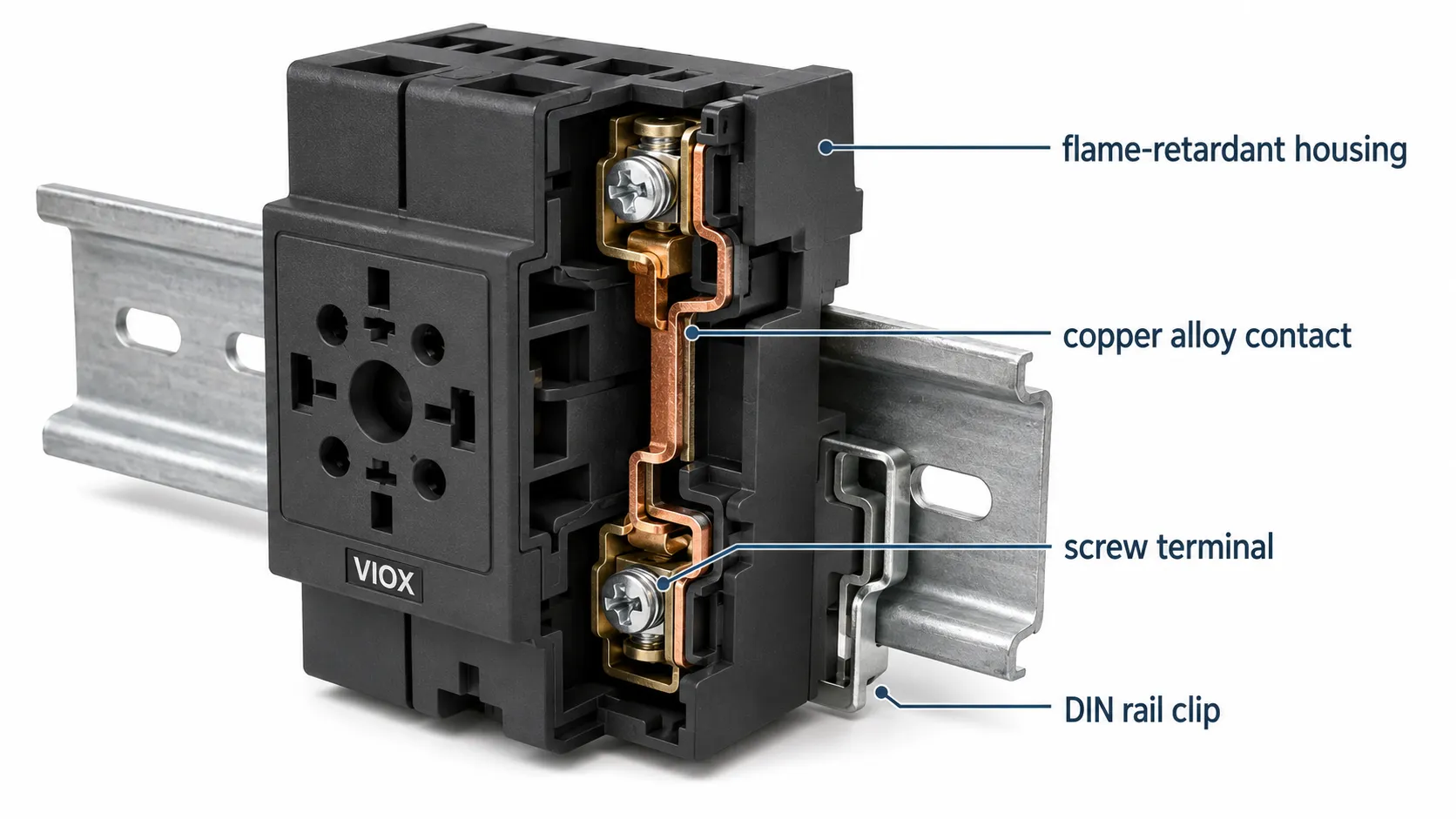
When comparing suppliers, request the following physical specifications on the datasheet:
| Construction Item | What to Check | Why It Matters |
|---|---|---|
| Housing material | Flame-retardant engineering plastic such as PA66 or PC, with UL94 V-0 or equivalent flame rating where required | Reduces flame-spread risk inside crowded electrical enclosures |
| Contact material | High-conductivity copper alloy or brass with suitable plating | Affects contact resistance, heat rise, and plug retention over time |
| Terminal type | Screw clamp, cage clamp, or spring terminal depending on model | Determines installation speed, vibration performance, and maintenance needs |
| Wiring capacity | Confirm solid and flexible conductor range, such as common 1.5 mm² to 6 mm² or larger ranges depending on model | Prevents undersized or poorly clamped conductors |
| Terminal torque | Follow the exact datasheet value; some VIOX DIN rail socket installation references list 1.2 N·m for standard models and 2.8 N·m for the M1011 series | Incorrect torque can cause overheating, loose wiring, or terminal damage |
| Module width | Confirm the number of 18 mm modules or total width in millimeters | Prevents last-minute DIN rail layout problems |
Do not treat these values as universal across all sockets. A compact Schuko DIN rail socket, a BS1363 socket, and a US NEMA socket may have different housing widths, terminal depth, conductor ranges, and tightening requirements.
Typical DIN Rail Socket Module Widths
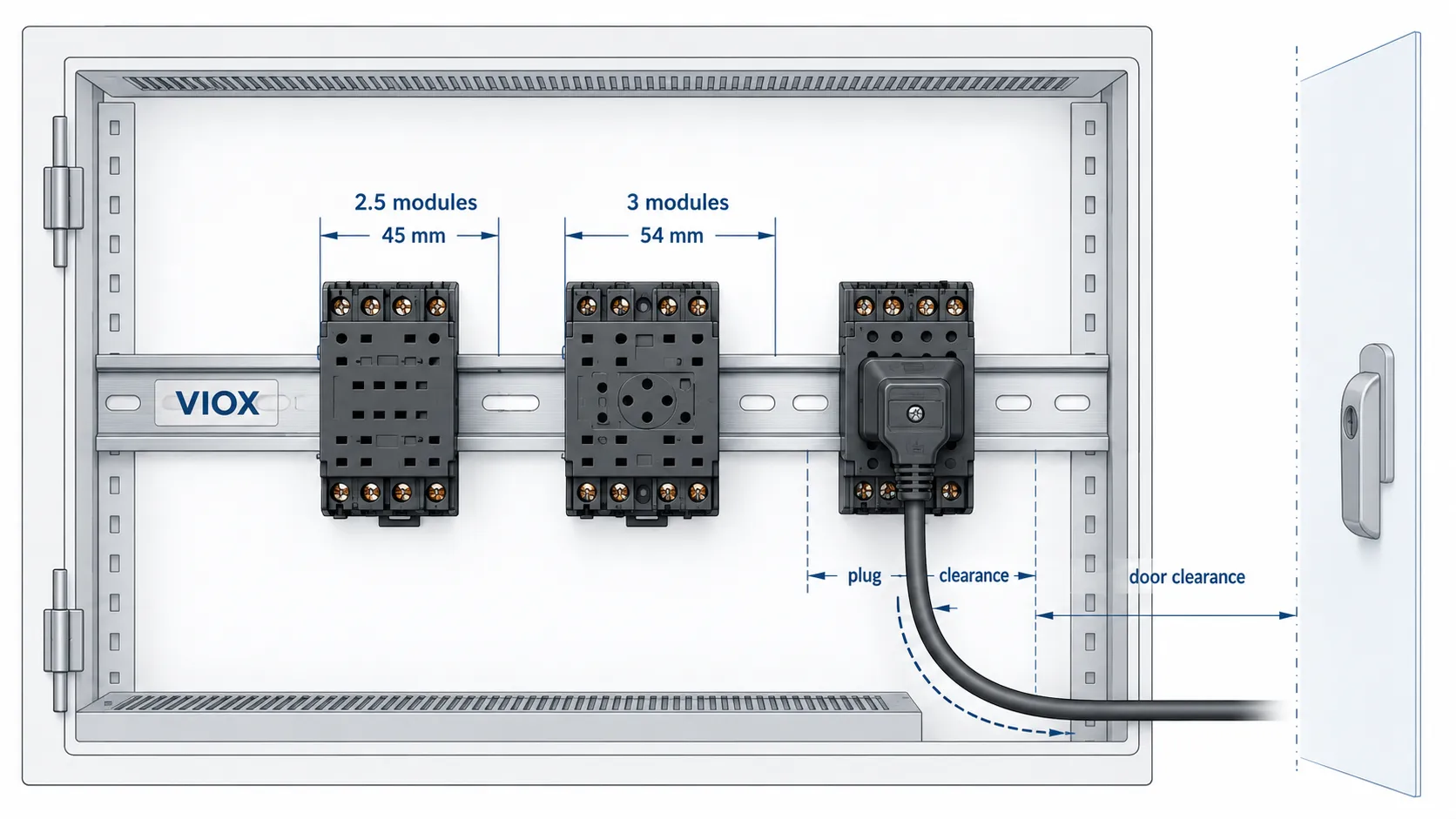
DIN rail devices are commonly planned in 18 mm modules. In VIOX DIN rail socket product examples, the common module widths are:
| Socket Version | Typical Module Width | Approximate Width |
|---|---|---|
| German Schuko | 2.5 modules | About 45 mm |
| French standard | 2.5 modules | About 45 mm |
| Italian dual standard | 2.5 modules | About 45 mm |
| UK BS1363 | 3 modules | About 54 mm |
| Swiss standard | 3 modules | About 54 mm |
| US NEMA 5-15 | 3 modules | About 54 mm |
This is a useful planning reference, not a substitute for the final dimension drawing. Always confirm the front width, mounting depth, plug insertion clearance, and door clearance before freezing the cabinet layout.
DIN Rail Socket US, UK, EU, and Universal Versions
Search data often separates DIN rail sockets by region because the plug face is the buyer’s first concern.
DIN Rail Socket US
A US DIN rail socket normally refers to a NEMA-style receptacle mounted in a modular DIN rail housing. These are often used in North American industrial control panels where a 120 V service outlet is required.
For US projects, check:
- NEMA configuration, such as 5-15R or 5-20R
- Voltage and current rating
- Grounding arrangement
- Whether the panel standard or local code requires additional protection
- Whether the service outlet must be supplied from a control transformer or a dedicated branch circuit
DIN Rail Socket UK
A UK DIN rail socket usually refers to a BS1363 Type G socket in a DIN rail module. These sockets are physically larger than many European socket faces, so rail space and cover cutout clearance should be checked early.
DIN Rail Socket EU
European DIN rail sockets commonly use Schuko Type F or French Type E designs. The correct choice depends on the destination market. In export panels, do not assume all European plugs and earthing systems are interchangeable.
Universal DIN Rail Socket
A universal DIN rail socket can accept multiple plug shapes, but it may not be suitable for every installation. It should be used only where the project specification, local regulations, and approval requirements allow it.
DIN Rail Socket Wiring: What the Panel Designer Must Plan
DIN rail socket wiring should be treated as a real branch or auxiliary circuit, not as an afterthought.
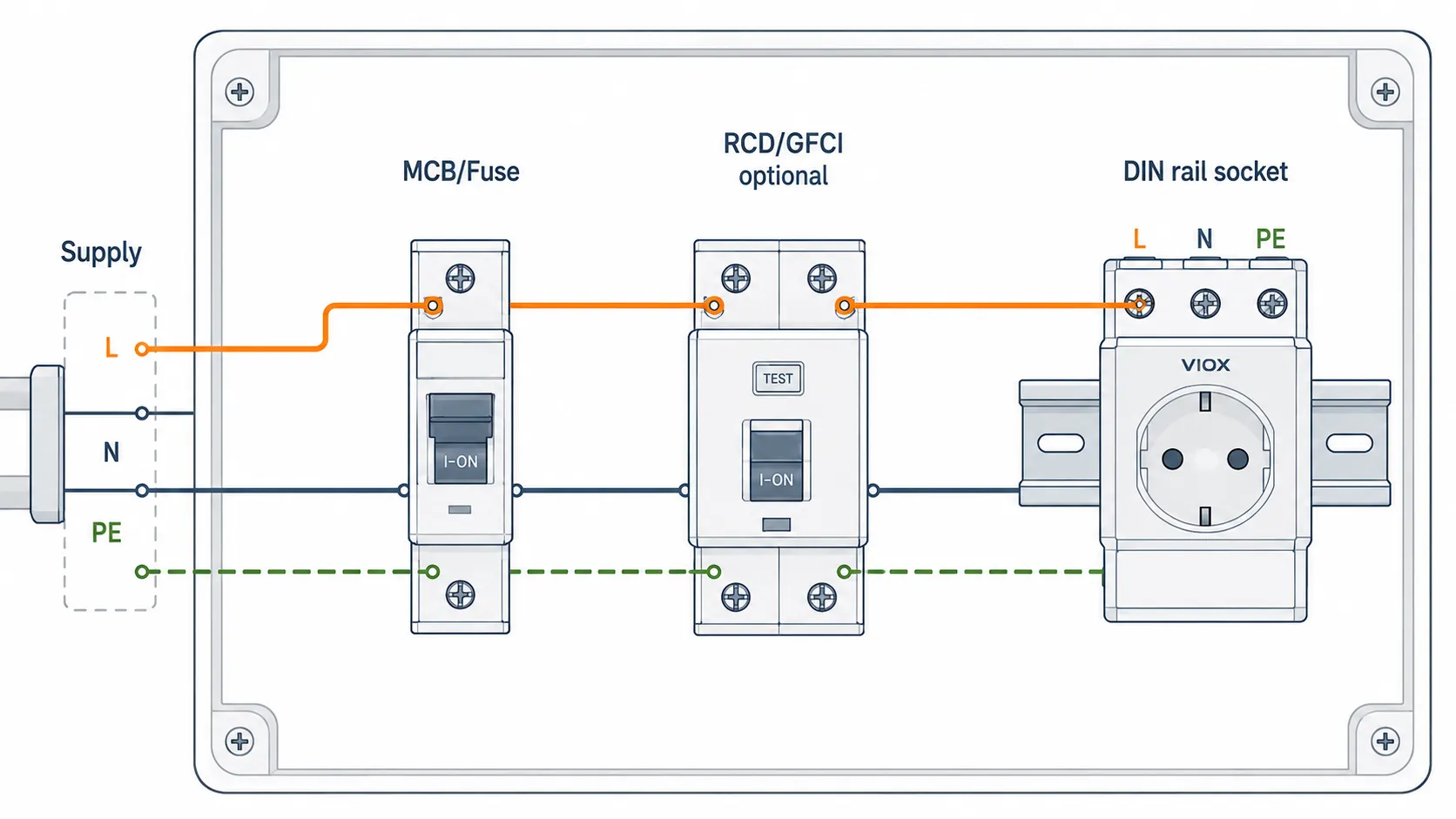
A typical AC socket circuit includes:
- Line or live conductor
- Neutral conductor where required by the supply system
- Protective earth conductor
- Overcurrent protection such as an MCB or fuse
- Residual-current protection such as RCD/GFCI where required by local rules
- Clear labeling for voltage and source
The DIN rail itself does not supply power to the socket. The socket must be wired through its terminals according to the manufacturer’s instructions. Conductor size, terminal torque, stripping length, and protective device rating should follow the product datasheet and the local electrical code.
In practice, many field failures come from ordinary details: a stranded conductor inserted without a ferrule where one is required, a screw terminal tightened by feel instead of to the specified torque, or a 3-module socket added after the cabinet layout was already crowded. For panel builders, the socket should be placed on the drawing with the same discipline as an MCB, relay, or terminal block.
For panel safety, avoid connecting a DIN rail socket directly to a busbar or supply terminal without proper circuit protection. A service outlet inside a cabinet can still be a shock, fire, or overload risk if it is treated as “just a convenience socket.”
DIN Rail Socket vs DIN Rail Power Supply
A DIN rail socket and a DIN rail power supply solve different problems.
| Device | Function | Typical Output |
|---|---|---|
| DIN rail socket | Provides an AC plug-in outlet inside the panel | Same AC supply type as the socket circuit |
| DIN rail power supply | Converts AC input to DC output for control devices | Commonly 12 V DC, 24 V DC, or other DC outputs |
Use a DIN rail socket when a technician or device needs a plug-in AC outlet. Use a DIN rail power supply when control components need a stable DC supply, such as PLCs, relays, sensors, and communication modules.
DIN Rail Socket vs DIN Rail Relay Socket
This is one of the easiest search-term traps.
A DIN rail socket outlet is a power receptacle. A DIN rail relay socket is a relay base used to mount and wire a plug-in relay. They are both DIN rail mounted, but they are not interchangeable.
| Feature | DIN Rail Socket Outlet | DIN Rail Relay Socket |
|---|---|---|
| Main purpose | Provide plug-in power | Hold and wire a relay |
| User interface | Accepts a power plug | Accepts a relay module |
| Typical circuit | Service power or auxiliary power | Control circuit switching |
| Common mistake | Treating it as a general power tap without protection | Confusing relay base with power socket |
If the application is control switching, a relay or timer relay socket may be needed instead of a power outlet.
How to Choose the Right DIN Rail Socket
Use this checklist before ordering.
| Selection Question | What to Confirm |
|---|---|
| Which country or region will use the panel? | Schuko, BS1363, NEMA, French Type E, Australian, or other socket standard |
| What is the panel supply voltage? | Match socket voltage rating and wiring system |
| What current can the socket circuit safely supply? | Match socket rating, wire size, and protective device |
| How much rail space is available? | Check module width, total millimeter width, mounting depth, and plug clearance |
| What housing and contact materials are specified? | Confirm flame-retardant plastic, contact material, plating, and heat-rise performance |
| What conductor size and torque are allowed? | Match terminal capacity, ferrule use, stripping length, and tightening torque to the datasheet |
| Does the socket need a switch or indicator? | Select optional switched or LED indicator version only if required |
| Is residual-current protection required? | Follow local code and project specification |
| Will the panel be exported? | Confirm local plug standard and approval route early |
| Is the socket for service only or continuous load? | Do not use a small service socket as a hidden permanent high-load outlet |
Common Mistakes to Avoid
Mistake 1: Choosing the Plug Face Only
The plug face is important, but it is not the whole specification. A correct DIN rail power socket must also match the voltage system, current rating, enclosure layout, wiring method, and approval needs.
Mistake 2: Confusing DIN Rail Socket with DIN Socket
“DIN socket” often refers to a round signal connector used in electronics or audio applications. It does not automatically mean a DIN rail mounted power outlet.
Mistake 3: Using a Universal Socket for Every Export Panel
Universal sockets may simplify purchasing, but they can create approval or safety questions. A regional socket version is usually better for professional equipment when the destination market is known.
Mistake 4: No Dedicated Protection
A panel socket should be protected like a real circuit. The correct protective device depends on the voltage system, socket rating, conductor size, and local installation rules.
Mistake 5: Forgetting Plug Clearance
DIN rail width is not the only space requirement. The plug body and cable bend radius also need clearance from the cabinet door, cable duct, and adjacent devices.
Mistake 6: Ignoring Housing and Terminal Quality
Two DIN rail sockets with the same plug face and current rating are not automatically equal. For industrial panels, check flame-retardant housing material, contact metal, terminal design, conductor range, and tightening torque before approving a supplier. These details decide whether the socket stays cool and mechanically secure after years of service access.
FAQ
What is a DIN rail socket used for?
A DIN rail socket is used to provide a plug-in power outlet inside a control panel, distribution board, or electrical enclosure. It is commonly used for service tools, commissioning laptops, portable test equipment, and small auxiliary loads.
Is a DIN rail socket the same as a DIN rail power supply?
No. A DIN rail socket provides a plug-in AC outlet. A DIN rail power supply converts AC to DC for control devices such as PLCs, sensors, relays, and communication modules.
Is a DIN rail relay socket the same as a DIN rail socket outlet?
No. A DIN rail relay socket is a base for a plug-in relay. A DIN rail socket outlet is a power receptacle for an electrical plug.
What is a DIN rail socket US version?
A DIN rail socket US version usually means a NEMA-style DIN rail mounted receptacle for North American panels. The exact NEMA configuration, voltage, current rating, grounding, and approval requirements must be checked for the project.
Can a DIN rail socket be installed in any electrical panel?
Only if there is enough DIN rail space, safe plug clearance, suitable wiring, proper protection, and compliance with the applicable local code and panel standard. The socket must be installed according to the manufacturer’s instructions.
Does a DIN rail socket need an MCB or fuse?
In most professional panels, the socket circuit should have appropriate overcurrent protection. The exact protective device depends on the socket rating, conductor size, supply voltage, and local installation rules.
Can a DIN rail socket be used for permanent equipment power?
It can supply equipment only when the socket, wiring, protective device, and installation are rated for that duty. Many panel sockets are intended mainly as service outlets, so continuous loads should be checked carefully.
What size DIN rail does a DIN rail socket use?
Most DIN rail sockets are designed for standard 35 mm top-hat rail according to IEC/EN 60715. Always check the product datasheet, because module width and mounting depth vary by socket type.
Conclusion
A DIN rail socket is a small component, but it affects panel usability, service safety, and export compatibility. The best choice is not simply the cheapest socket that clips onto a rail. It is the version that matches the destination plug standard, panel voltage, current rating, rail space, grounding method, and required protection.
For control cabinets, distribution boards, and OEM electrical panels, specify the socket early together with the DIN rail layout, MCB or fuse protection, terminal wiring, and enclosure clearance. That prevents last-minute panel redesign and gives technicians a safer, cleaner service power point.