

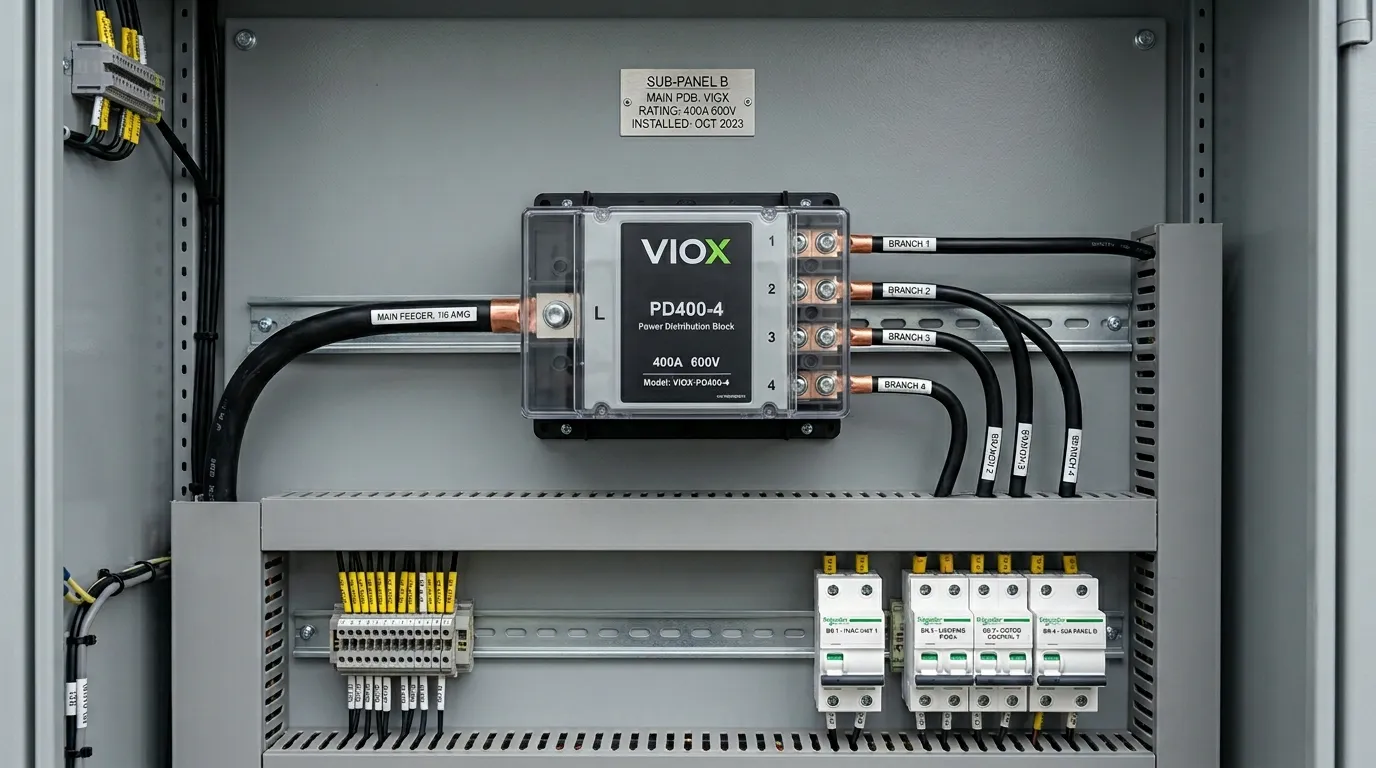
Power distribution blocks can be a very good choice when one incoming conductor must be split into multiple outgoing conductors in a clean, compact, and serviceable way. They help reduce loose field splicing, improve panel organization, and make conductor routing easier to inspect and maintain.
But power distribution blocks are not automatically the best option in every panel. They add cost, consume space, and can become a real weak point if conductor size, enclosure style, torque control, or application fit are handled poorly. In practice, the value of a PDB depends less on the idea of “power splitting” and more on whether the selected block truly matches the feeder, branch conductors, and protection environment.
If you need the base definition first, start with what a power distribution block is.
Power Distribution Blocks Pros and Cons at a Glance
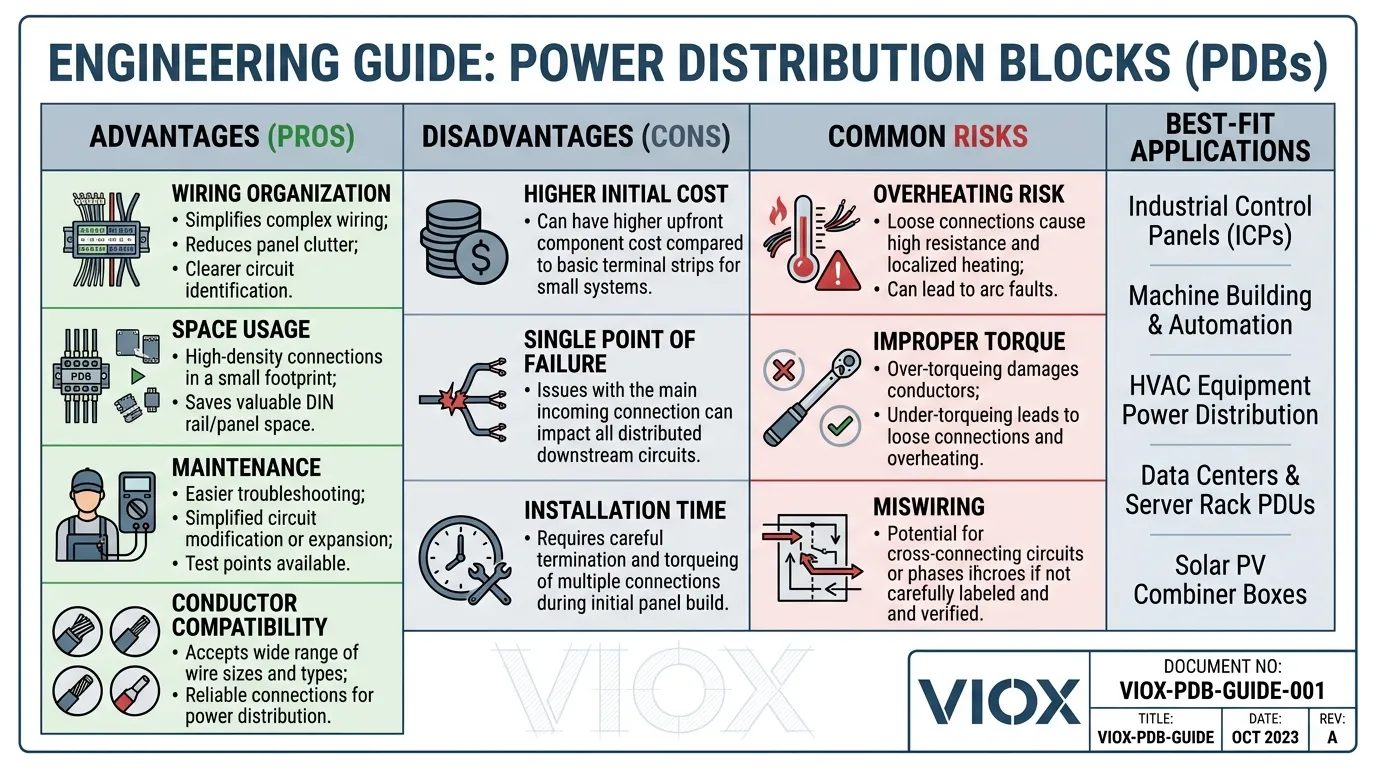
| Area | Main advantage | Main limitation |
|---|---|---|
| Wiring organization | Creates a cleaner and more structured way to split power | Adds another component that must be correctly selected and installed |
| Panel assembly | Can reduce ad-hoc splicing and simplify repeatable builds | Consumes panel space that may be limited in compact designs |
| Maintenance | Makes conductor identification and service work easier | Loose terminations or wrong conductor fit can create heat and reliability problems |
| Scalability | Useful when one feeder must serve several downstream loads | Not ideal for every current level or every enclosure condition |
| Standardization | Helps OEMs and panel builders use consistent power distribution layouts | A poor match between block rating and real application can create false confidence |
What Are the Main Advantages of Power Distribution Blocks?
The strongest advantage of a power distribution block is controlled conductor distribution. Instead of relying on improvised joints or awkward feed-through arrangements, a PDB gives the panel a defined connection point for one-to-many or few-to-many power routing.
The main benefits of PDBs
| Advantage | Why it matters | Typical benefit in real panels |
|---|---|---|
| Cleaner power branching | Keeps feeder and branch distribution more organized | Easier routing inside control panels and distribution enclosures |
| Better assembly consistency | Supports repeatable panel layouts across builds | Useful for OEM production and standard panel designs |
| Easier maintenance and inspection | Makes it simpler to identify where power is split | Faster troubleshooting and clearer service work |
| Reduced dependence on field splicing | Avoids makeshift multi-conductor joins in tight spaces | Helps create a more professional and controlled build |
| More flexible conductor management | Can accommodate different conductor sizes within one distribution point | Helpful where one larger incoming conductor feeds several smaller outgoing circuits |
In short, a PDB often improves build quality because it turns a messy wiring problem into a defined component choice.
That benefit becomes even clearer in panels where multiple outgoing circuits must be supplied from one upstream protective device or one main feeder. In those cases, a distribution block can make the layout easier to build, inspect, and document.
For a more selection-focused next step, how to choose the right UKK distribution block is the most relevant follow-up.
What Are the Main Disadvantages of Power Distribution Blocks?
The disadvantages are mostly application-related. A PDB is useful when it is doing the right job. It becomes a liability when it is chosen because it “looks convenient” without checking conductor fit, enclosure protection, heat, or available space.
The main drawbacks of PDBs
| Limitation | What it means in practice | Why it gets overlooked |
|---|---|---|
| Extra component cost | Adds material cost compared with the cheapest wiring shortcuts | The assembly benefit is obvious, but the ROI is not always checked |
| Space consumption | Can take up meaningful panel area, especially in compact builds | Designers often confirm current but not footprint |
| Termination sensitivity | Wrong conductor range or weak tightening creates overheating risk | Buyers may assume one size fits all conductor combinations |
| Application mismatch | A PDB may be used where a terminal block or busbar is more appropriate | “Distribution” components are often confused with one another |
| Protection assumptions | A distribution block does not replace proper overcurrent coordination | It is easy to overestimate what a connector component actually does |
The biggest practical risk is not that a PDB is inherently bad. It is that the block is treated like a universal solution for any branch distribution problem. That assumption causes most of the real field issues: loose conductors, poor conductor fit, panel crowding, and temperature rise at a connection point that should have been straightforward.
When a Power Distribution Block Is Usually Worth It
A power distribution block is usually a good choice when the design needs:
- one incoming conductor feeding several outgoing conductors
- a cleaner alternative to improvised splitting or splicing
- better panel serviceability
- repeatable internal wiring layouts across multiple builds
- a compact distribution point for feeder branching in a protected enclosure
Typical good-fit applications include:
- industrial control panels
- machine panels
- OEM distribution assemblies
- commercial equipment cabinets
- compact sub-distribution or auxiliary power sections
In those cases, the real value is not only electrical connection. It is layout discipline. A PDB helps create a cleaner internal architecture that is easier to build and easier to maintain.
When a Power Distribution Block Is the Wrong Choice
Power distribution blocks are not the best answer in every distribution design.
They are usually the wrong choice when:
- the current level or thermal duty points toward a busbar-based solution
- the application needs modular signal or control termination rather than power splitting
- the environment requires a different enclosure style or protection concept
- available panel space is too limited for the chosen block geometry
- the conductor mix does not fit the termination range cleanly
This is especially important in projects where people confuse these three roles:
- power distribution block for feeder splitting
- terminal block for organized circuit termination and modular connection
- busbar for higher-current or differently structured power distribution
That is why comparison pages matter here. If the design question is really about architecture rather than a single component, bus bars vs terminal blocks is a better decision page than a generic PDB product list.
The Most Common PDB Selection Mistakes
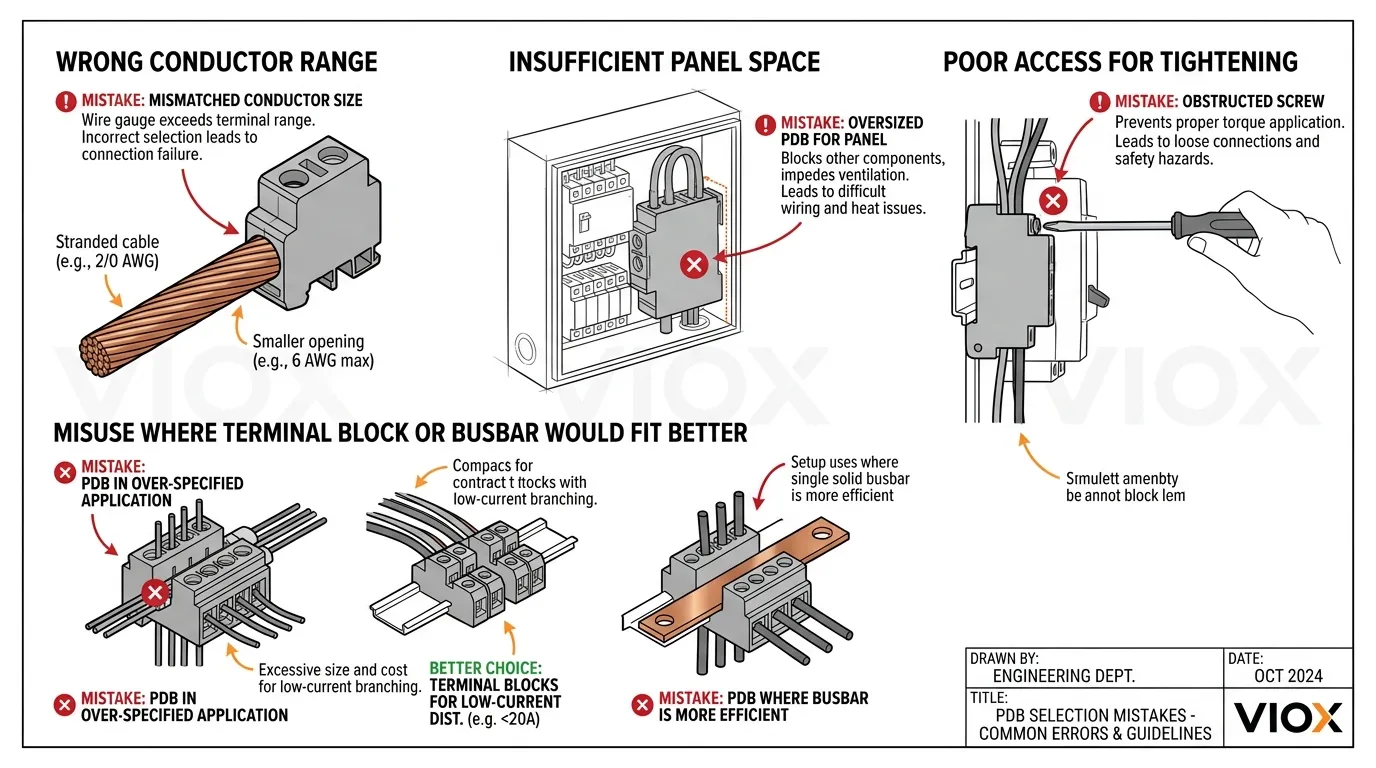
Many of the “cons” people associate with power distribution blocks are actually selection mistakes.
1. Choosing by current rating only
A current rating matters, but it is not the whole decision. A block can look acceptable on paper while still being a poor fit because of conductor range, enclosure style, short-circuit conditions, or branch count.
2. Ignoring conductor compatibility
One of the most common errors is assuming the block will accept whatever conductors are on hand. In practice, conductor material, cross-section range, ferrule use, and the number of outgoing conductors all affect fit and reliability.
3. Underestimating panel space
A PDB may solve one wiring problem while creating a layout problem somewhere else. Clearance, routing room, access for tightening, and neighboring device spacing should all be checked before final selection.
4. Using a PDB where a terminal block would be better
If the goal is modular circuit termination, labeling, and field service flexibility, a terminal block system may be the more natural choice. A PDB is stronger when the main need is power splitting, not signal or circuit-by-circuit organization.
For that broader decision, how to choose the right terminal block for your electrical project is the right adjacent guide.
5. Treating the block as a protection device
A power distribution block is a connection and distribution component. It does not replace the need for proper upstream protection, coordinated conductor sizing, or overall panel protection design.
Power Distribution Block vs Terminal Block vs Busbar
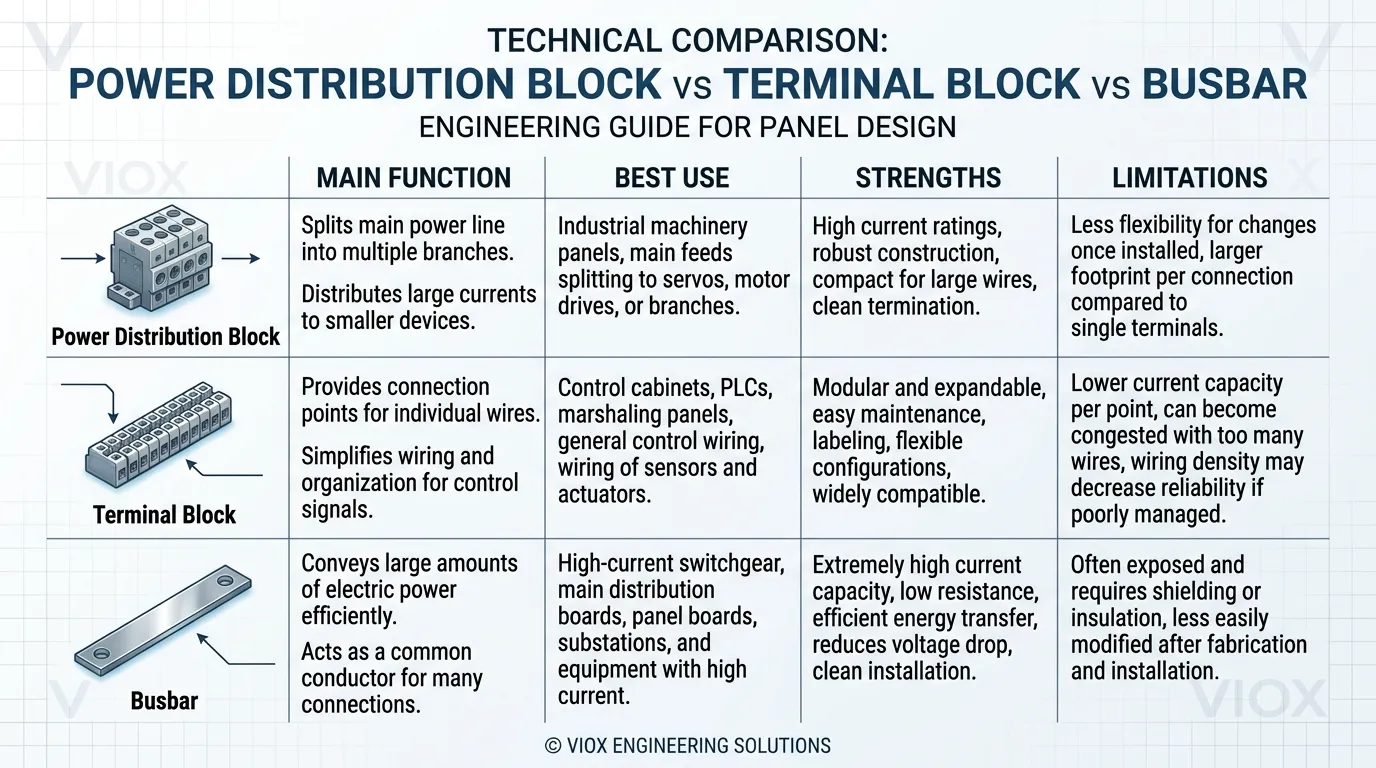
This is one of the most useful distinctions for buyers and designers.
| Component | Best use | Where it is stronger | Where it is weaker |
|---|---|---|---|
| Power distribution block | Splitting one feeder into multiple outgoing conductors | Compact and practical feeder branching | Less ideal when modular circuit termination is the priority |
| Terminal block | Structured circuit termination and organized connection points | Excellent for modular layouts, identification, and service access | Not always the best choice for compact feeder power splitting |
| Busbar | Higher-current or more architecture-driven power distribution | Stronger for larger current distribution strategies and rigid power layouts | Usually less convenient for small multi-conductor branching inside compact panels |
So the decision is not whether a PDB is “better” in general. The right question is whether the distribution task is primarily:
- feeder splitting
- modular termination
- higher-current structured distribution
If it is feeder splitting in a protected panel environment, a power distribution block often makes sense. If not, another distribution component may fit better.
If your design is leaning toward a modular distribution assembly rather than a classic PDB, what a terminal block distribution module is may be a better next read.
Are Power Distribution Blocks Worth It in Small Panels?
Sometimes yes, but not automatically.
In a small panel, a PDB can improve wiring clarity and reduce messy conductor joins. But small panels also amplify the two biggest drawbacks:
- space pressure
- access difficulty during assembly and maintenance
That is why a PDB in a small enclosure should be justified by actual layout improvement, not habit. If the block creates crowding, awkward conductor bends, or poor tool access, the neatness benefit disappears quickly.
A Practical Decision Checklist
Before deciding that the pros outweigh the cons, check these points:
| Question | Why it matters |
|---|---|
| How many outgoing conductors need to be supplied? | Confirms whether a PDB actually solves a real branching problem |
| Do the incoming and outgoing conductor ranges match the block? | Poor conductor fit is one of the biggest reliability risks |
| Is there enough panel space for safe routing and access? | Layout problems often show up after purchase, not before |
| Is the application better served by a terminal block or busbar? | Prevents using the wrong product family for the job |
| Does the protection architecture around the block make sense? | A PDB should fit into the broader distribution and protection design |
| Will maintenance staff be able to inspect and retighten connections if needed? | Serviceability matters as much as first assembly |
FAQ
What are the main pros of power distribution blocks?
The main advantages are cleaner feeder branching, better panel organization, easier maintenance, and more repeatable internal wiring compared with ad-hoc conductor splitting.
What are the main cons of power distribution blocks?
The main disadvantages are extra cost, panel space consumption, and the risk of poor performance if conductor compatibility, tightening quality, or application fit are not checked carefully.
Are power distribution blocks worth it?
They are often worth it when one incoming conductor must be split cleanly into multiple outgoing conductors and the panel benefits from a structured, serviceable distribution point. They are less attractive when space is too tight or when another component family fits the task better.
When should I use a power distribution block instead of a terminal block?
Use a power distribution block when the main need is compact power splitting from one feeder to several outgoing conductors. Use a terminal block when the priority is modular circuit termination, labeling, and organized connection architecture.
Is a power distribution block better than a busbar?
Not in general. A PDB is usually better for compact feeder branching inside a panel, while a busbar is often better for higher-current or more structurally distributed power layouts.
What is the biggest mistake when choosing a power distribution block?
The biggest mistake is selecting it by current rating alone. Conductor range, enclosure style, branch layout, service access, and application fit are just as important.