

On this page
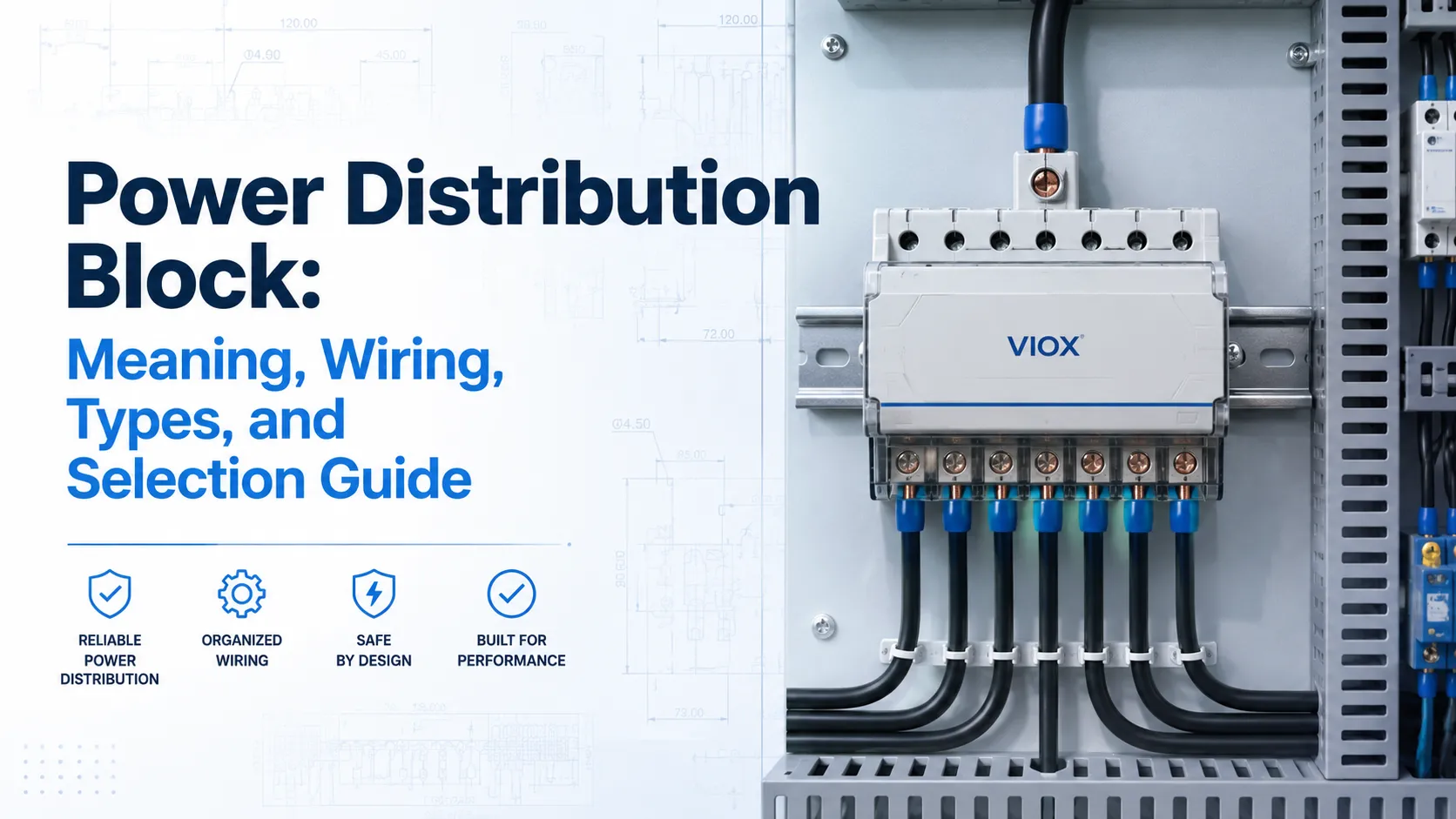
A power distribution block is an electrical connection device that takes one incoming power feed and distributes it to multiple outgoing circuits. It is used inside control panels, distribution boxes, machinery, automotive systems, battery systems, and low-voltage DC equipment to make power wiring cleaner, safer, and easier to maintain.
In simple terms, a power distribution block solves this problem:
One supply cable enters the panel, but several devices or branch circuits need power.
Instead of stacking multiple conductors under one terminal, making unsafe splices, or creating messy wiring, a distribution block provides a defined input terminal and several output terminals. The conductive bar inside the block carries current from the input to the outputs, while the insulated housing helps separate live conductors from the panel structure and adjacent circuits.
Power Distribution Block Meaning at a Glance
| User Question | Short Answer |
|---|---|
| What is a power distribution block? | A device that distributes one incoming power feed to multiple outgoing circuits |
| What does a power distribution block do? | It organizes branch power wiring and reduces multiple splices or stacked terminals |
| Is a power distribution block a protection device? | Not always. Non-fused blocks distribute power only; fused blocks add branch protection |
| Is it the same as a terminal block? | No. Terminal blocks mainly connect wires; power distribution blocks split power |
| Is it the same as a busbar? | No. A busbar is a common conductor; a distribution block is a packaged connection device with defined terminals |
| Is PDB the same as PDU? | Usually no. PDB often means power distribution block; PDU usually means power distribution unit, especially in data centers |
How Does a Power Distribution Block Work?
A power distribution block works by using an internal conductive element to connect one supply conductor to several output terminals.
The basic current path is:
- Power enters through the main input terminal.
- Current flows through an internal copper, brass, or aluminum conductive body.
- The block distributes current to multiple output terminals.
- Each output feeds a downstream device, circuit, fuse holder, breaker, relay, controller, sensor group, or load.
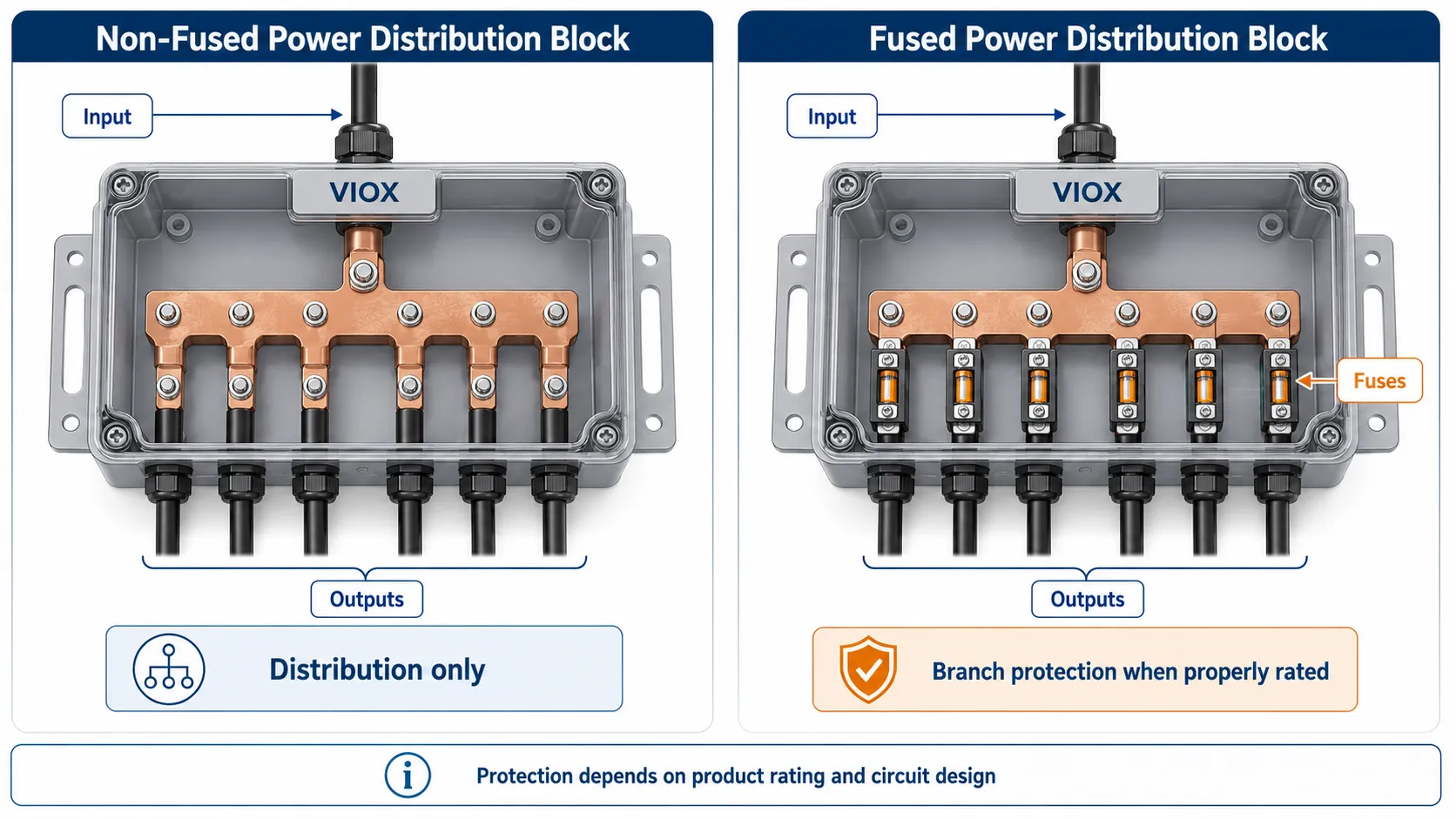
In a non-fused distribution block, the block does not interrupt overload or short-circuit current by itself. Protection must come from an upstream breaker, fuse, or downstream branch protection device.
In a fused distribution block, each output may include a fuse or fuse holder. This allows the block to distribute power and provide branch-circuit protection, depending on the product design and rating.
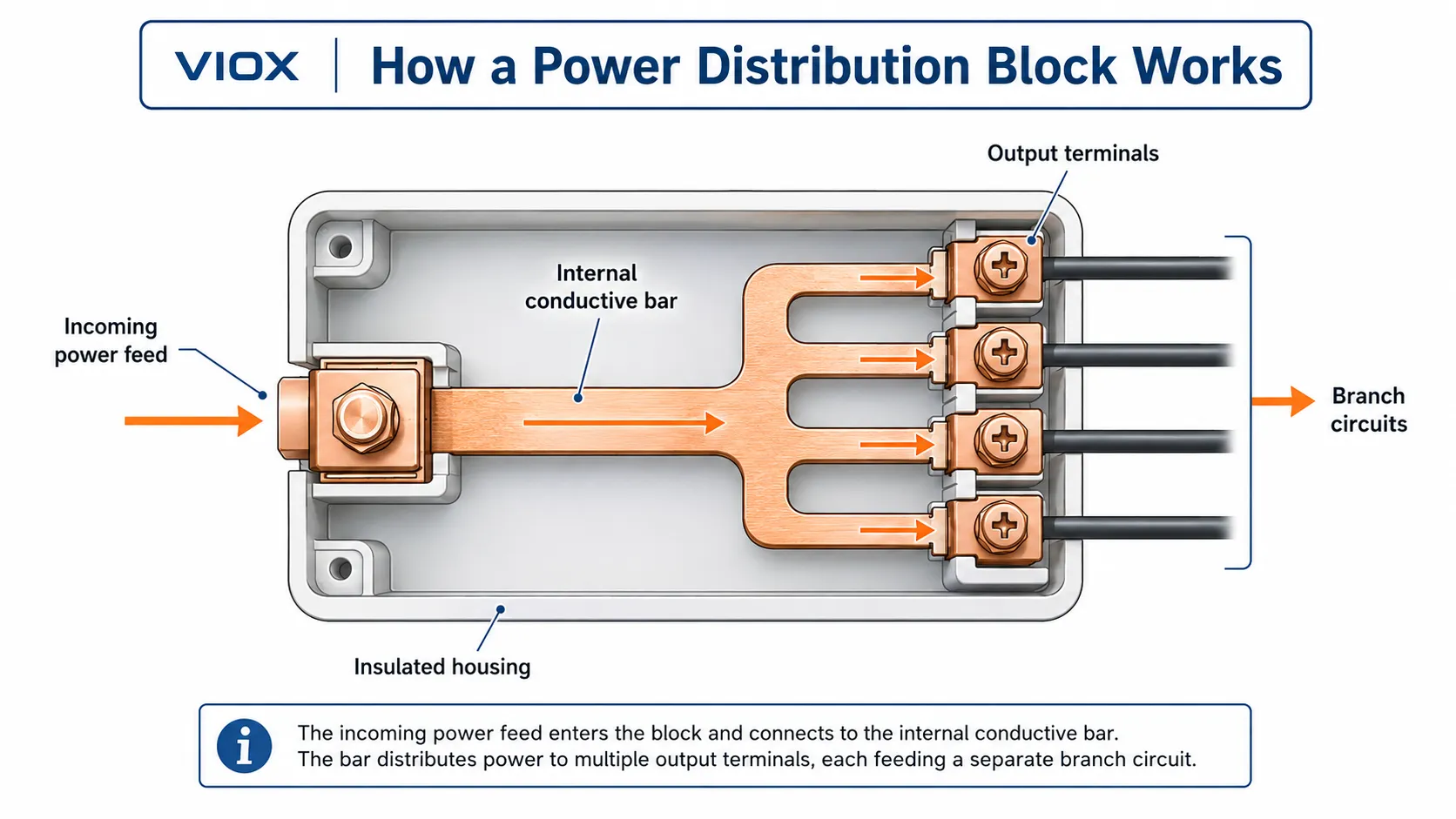
Main Parts of a Power Distribution Block
| Part | Function | What to Check |
|---|---|---|
| Input terminal | Receives the main incoming power feed | Cable size, tightening method, current rating |
| Output terminals | Feed multiple branch circuits | Number of outputs, output wire range, branch current |
| Conductive bar/body | Carries current from input to outputs | Material, plating, temperature rise, current capacity |
| Insulated housing | Provides touch protection and phase separation | Voltage rating, flame resistance, creepage and clearance |
| Cover or protective shield | Reduces accidental contact risk | Required in many panel layouts |
| Mounting base | Holds the block on DIN rail or panel surface | DIN rail, screw mount, panel space |
| Fuse elements, if included | Provides branch overcurrent protection | Fuse type, voltage rating, interrupting rating, replacement access |
Types of Power Distribution Blocks
Power distribution blocks are not all the same. The correct type depends on voltage, current, conductor size, protection requirement, and panel layout.
Non-Fused Power Distribution Blocks
A non-fused power distribution block distributes power but does not include built-in fuses. It is best used when overcurrent protection is provided upstream or downstream by a properly selected breaker, fuse, or protective device.
Common uses include:
- control panel power branching
- DC positive or negative distribution
- machine wiring
- low-voltage distribution boxes
- battery accessory circuits
- power splitting before terminal groups
Fused Power Distribution Blocks
A fused power distribution block combines power distribution with fuse protection for outgoing branches. It is useful when each branch circuit needs individual protection or easier fault isolation.
Fused blocks are often selected for:
- control circuits
- DC equipment
- auxiliary loads
- automation panels
- equipment where branch protection and compact wiring are both needed
The fuse must match the circuit voltage, current, load type, and available fault current. Do not treat a fused block as automatically suitable for every short-circuit condition.
Modular Power Distribution Blocks
Modular power blocks allow panel builders to expand or configure the system more flexibly. These are useful when the number of outputs, poles, or branch circuits may change during equipment design.
DIN Rail Power Distribution Blocks
DIN rail distribution blocks are common in industrial control cabinets because they are easy to mount, replace, and align with other DIN rail components.
Panel-Mounted Power Distribution Blocks
Panel-mounted distribution blocks are fixed directly to a mounting plate or enclosure backplate. They are common when higher current, larger conductors, or stronger mechanical support is required.
AC and DC Power Distribution Blocks
Some distribution blocks are used in AC panels, while others are used in DC systems such as battery equipment, automotive wiring, telecom power, solar auxiliary circuits, or low-voltage control systems.
Always check whether the product is rated for the actual AC or DC voltage. DC circuits can have different arc and insulation requirements, especially where switching, fusing, or fault interruption is involved.
Power Distribution Block vs Terminal Block vs Busbar vs PDU
This is where many search results become confusing. A power distribution block is related to terminal blocks, busbars, and power distribution units, but it is not the same thing.
| Device | Main Function | Typical Use | Key Difference |
|---|---|---|---|
| Power distribution block | Distributes one input to multiple outputs | Control panels, machinery, DC systems, power branching | Designed for power splitting |
| Terminal block | Connects and organizes conductors | Control wiring, sensors, signals, panel wiring | Mainly wire-to-wire connection, not necessarily power splitting |
| Busbar | Common high-current conductor | Distribution boards, switchgear, battery systems | Usually a conductor system, not a packaged multi-output block |
| Power distribution unit (PDU) | Distributes power through outlets or managed outputs | Data centers, server racks, IT equipment | Usually an equipment-level unit, not a simple wiring block |
| Distribution box | Enclosure containing protective and distribution devices | Buildings, panels, branch circuits | A complete enclosure, not a single connection component |
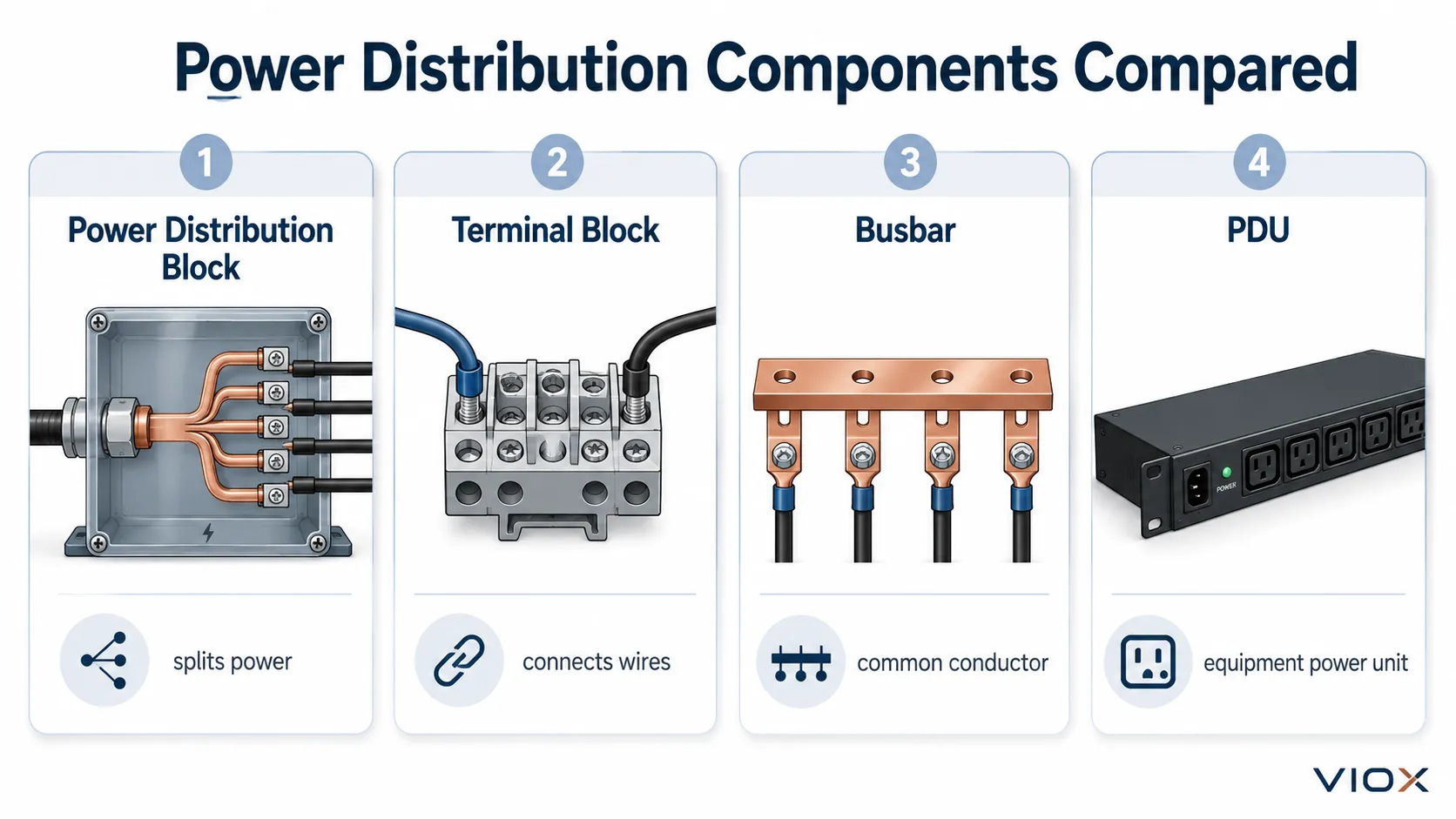
If someone says “PDB,” confirm whether they mean power distribution block or power distribution board. If someone says “PDU,” they may mean power distribution unit, especially in IT and data center contexts.
UL 1953 vs UL 1059: Why the Standard Matters in North American Panels
For North American industrial panels, the difference between a power distribution block and a terminal block is not only a naming issue. It can affect panel approval.
In many UL-oriented applications:
- UL 1953 is associated with power distribution blocks used for feeder and branch power distribution.
- UL 1059 is associated with terminal blocks used for wire connection and terminal applications.
This distinction matters because a component that looks like a distribution block may still be evaluated or listed as a terminal block. If an engineer uses a UL 1059 terminal block as the main feeder distribution point where a UL 1953 power distribution block is required, the panel may face problems during inspection or UL 508A review.
The practical rule is simple:
Do not select by appearance. Select by listing, category, SCCR, voltage rating, current rating, conductor range, and the actual circuit role.
| Application Question | What to Verify |
|---|---|
| Is this block used on the feeder side? | Check whether the component is evaluated for power distribution block use, not only terminal connection |
| Is it a branch distribution point? | Verify branch circuit suitability and protection arrangement |
| Is SCCR required for the panel? | Confirm the block SCCR and how it coordinates with upstream protection |
| Is the product only a terminal block? | Do not assume it can replace a feeder power distribution block |
| Is the panel built for UL 508A? | Check the panel builder’s component requirements and documentation path |
This does not mean every project must use the same standard path. Requirements depend on the market, panel standard, authority having jurisdiction, and the product’s exact listing. But for export panels and OEM equipment going into the US or Canada, this is one of the most common hidden mistakes in distribution block selection.
Where Power Distribution Blocks Are Used
Industrial Control Panels
Power distribution blocks are used to feed PLCs, relays, contactors, sensors, power supplies, and auxiliary circuits from a common supply. They help keep wiring organized and make troubleshooting easier.
Machinery and OEM Equipment
OEM machinery often needs compact internal power distribution. A distribution block can split incoming power to heaters, drives, fans, controllers, lights, or safety circuits.
Distribution Boxes and Enclosures
Inside a distribution box or enclosure, a power distribution block can provide a neat transition from one incoming feeder to multiple outgoing conductors. It should be selected according to current, voltage, conductor size, enclosure space, and protection coordination.
DC Power Systems
DC distribution blocks are common in battery systems, telecom panels, automotive equipment, marine equipment, solar auxiliary systems, and low-voltage DC control circuits. Polarity marking and DC voltage rating are especially important.
Automotive and Mobile Equipment
In vehicles, power distribution blocks help distribute battery power to accessories, lighting, audio systems, control modules, and auxiliary equipment. The block must be selected for vibration, temperature, current, and conductor retention.
Renewable Energy and Battery Equipment
Power distribution blocks can appear in auxiliary DC circuits, battery-related equipment, and low-voltage control sections. For PV string combining or high-energy DC protection, however, use purpose-designed combiner boxes, DC breakers, fuses, and DC-rated protective devices rather than treating a general power distribution block as a solar protection device.
How to Choose a Power Distribution Block
Use the application and electrical ratings first. Do not select a distribution block only by appearance or number of terminals.
| Selection Factor | What to Check | Common Mistake |
|---|---|---|
| Rated voltage | AC/DC voltage rating and insulation level | Using an AC-rated block in DC service without verification |
| Rated current | Input and output current ratings | Checking only the input rating and ignoring branch output ratings |
| Number of poles | Single-pole, two-pole, three-pole, four-pole | Mixing live, neutral, positive, negative, and PE functions incorrectly |
| Number of outputs | How many branch circuits are needed | Overcrowding terminals or adding unsafe parallel wires |
| Conductor size | Input and output wire range | Using a cable outside the approved terminal range |
| Fused or non-fused | Whether branch protection is required | Assuming every distribution block includes overcurrent protection |
| Mounting method | DIN rail, panel mount, screw mount | Choosing a block that does not fit the cabinet layout |
| Short-circuit rating / SCCR | Available fault current and upstream protection | Ignoring fault coordination in industrial panels |
| Material | Copper, brass, aluminum, plating, insulation housing | Ignoring corrosion, heating, or conductor compatibility |
| Touch protection | Cover, shroud, finger-safe design | Leaving energized terminals exposed in serviceable areas |
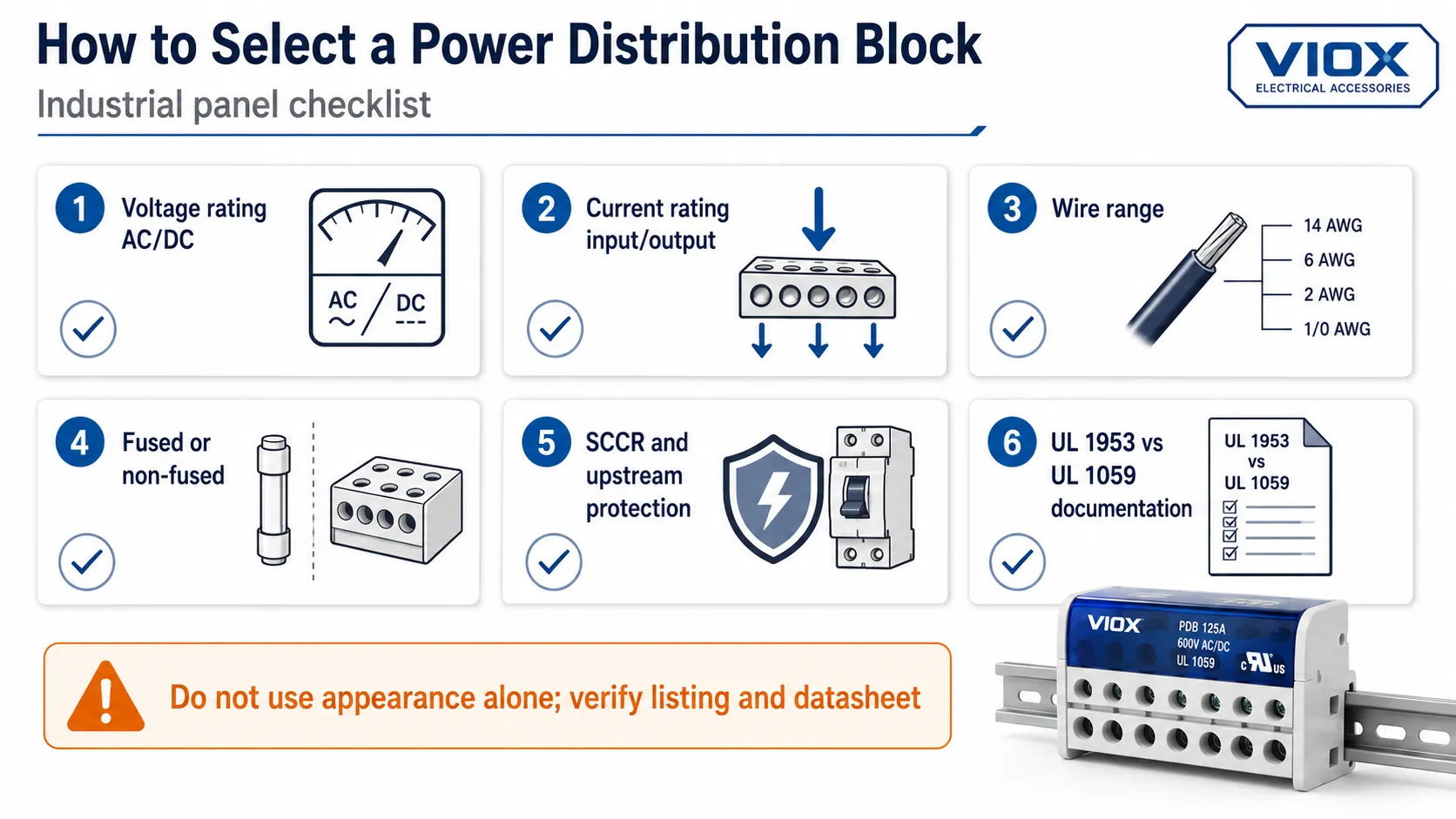
Fused vs Non-Fused Power Distribution Blocks
| Feature | Non-Fused Distribution Block | Fused Distribution Block |
|---|---|---|
| Main job | Distributes power | Distributes power and protects branches |
| Built-in protection | No | Yes, depending on fuse type |
| Best use | When protection is handled elsewhere | When branch circuits need individual fuse protection |
| Maintenance | Simple connection device | Fuse inspection and replacement may be required |
| Fault isolation | Depends on upstream/downstream protection | Easier branch fault identification |
| Selection focus | Voltage, current, conductor size, mounting | All non-fused factors plus fuse voltage, current, and interrupting rating |
AC vs DC Power Distribution Blocks
| Application | What Matters |
|---|---|
| AC control panel | Rated voltage, current, insulation, conductor size, panel layout |
| DC battery circuit | DC voltage rating, polarity, current capacity, conductor retention |
| Solar auxiliary DC circuit | DC rating, enclosure environment, coordination with fuses or breakers |
| Automotive DC circuit | Vibration, temperature, cable retention, corrosion resistance |
| Industrial DC control | Polarity labeling, branch protection, wiring clarity |
Do not assume a block suitable for low-voltage AC is automatically suitable for DC. The issue is not only normal current carrying. It is also insulation, polarity, heat, fault behavior, and the protective device used with the block.
Common Wiring and Selection Mistakes
| Mistake | Why It Is a Problem | Better Practice |
|---|---|---|
| Putting multiple wires under one terminal not rated for it | Loose connection and overheating risk | Use a block with enough outputs |
| Ignoring output current rating | Branch terminals may be overloaded | Check both input and output ratings |
| Using non-fused block where branch protection is needed | Downstream circuit may not be protected | Use fused block or separate protective devices |
| Mixing AC and DC assumptions | Ratings may not transfer correctly | Confirm AC/DC voltage rating in datasheet |
| Wrong conductor size | Poor clamping, overheating, or pull-out | Match terminal wire range |
| Poor labeling | Troubleshooting becomes slow and unsafe | Label input, outputs, polarity, and circuit function |
| No touch protection | Accidental contact risk | Use covers, shields, or finger-safe designs where required |
| Ignoring SCCR | Industrial panels may fail fault-current requirements | Coordinate block with upstream protection and panel SCCR |
Power Distribution Block Installation Basics
For safe installation, follow the manufacturer datasheet and applicable electrical code. General good practices include:
- mount the block securely on DIN rail or panel surface
- keep input and output conductors clearly separated
- use the approved conductor size and type
- tighten terminals according to manufacturer torque instructions
- avoid mixing copper and aluminum conductors unless the block is rated for it
- provide covers or barriers where required
- label circuits clearly
- keep high-current conductors away from sensitive signal wiring where practical
- verify upstream and downstream protection
- inspect for heat discoloration during maintenance
Do not use this article as a replacement for a product datasheet. The exact conductor range, torque value, temperature rating, SCCR, and voltage rating must come from the specific block model.
FAQ
What is a power distribution block?
A power distribution block is an electrical component that distributes one incoming power feed to multiple outgoing circuits using an internal conductive body and insulated terminal housing.
What does a power distribution block do?
It simplifies power wiring by splitting one supply into multiple branch connections. It helps organize wiring, reduce splices, and make panels easier to build and maintain.
Is a power distribution block the same as a terminal block?
No. A terminal block mainly connects conductors. A power distribution block is specifically intended to distribute power from one input to several outputs.
Is a power distribution block the same as a busbar?
No. A busbar is a conductor used for common power distribution. A power distribution block is a packaged component with defined terminals, insulation, mounting, and wire connection points.
Does a power distribution block provide overload protection?
Only if it is a fused power distribution block or includes integrated protective devices. A non-fused block does not provide overload or short-circuit protection by itself.
What is a DC power distribution block?
A DC power distribution block distributes DC power from one source to several loads. It is used in battery systems, vehicles, telecom panels, control circuits, and low-voltage DC equipment. The block must be rated for the actual DC voltage and current.
What is the difference between PDB and PDU?
PDB often means power distribution block or power distribution board depending on context. PDU usually means power distribution unit, especially in data centers and rack power systems. Always confirm the context before selecting equipment.
How do I choose a power distribution block?
Check rated voltage, rated current, input and output wire range, number of poles, number of outputs, fused or non-fused design, mounting method, short-circuit rating, insulation material, and whether the block is suitable for AC or DC service.
Conclusion
A power distribution block is a practical way to distribute one incoming power feed to multiple outgoing circuits inside panels, machines, vehicles, battery systems, and low-voltage distribution equipment.
The key is to treat it as a rated electrical component, not just a convenient wiring accessory. Choose the block by voltage, current, conductor size, number of outputs, fused or non-fused function, AC/DC rating, mounting method, touch protection, and short-circuit coordination. When those details are correct, a power distribution block makes wiring cleaner, safer, easier to maintain, and more reliable.