

Na tej stronie
Krótka odpowiedź
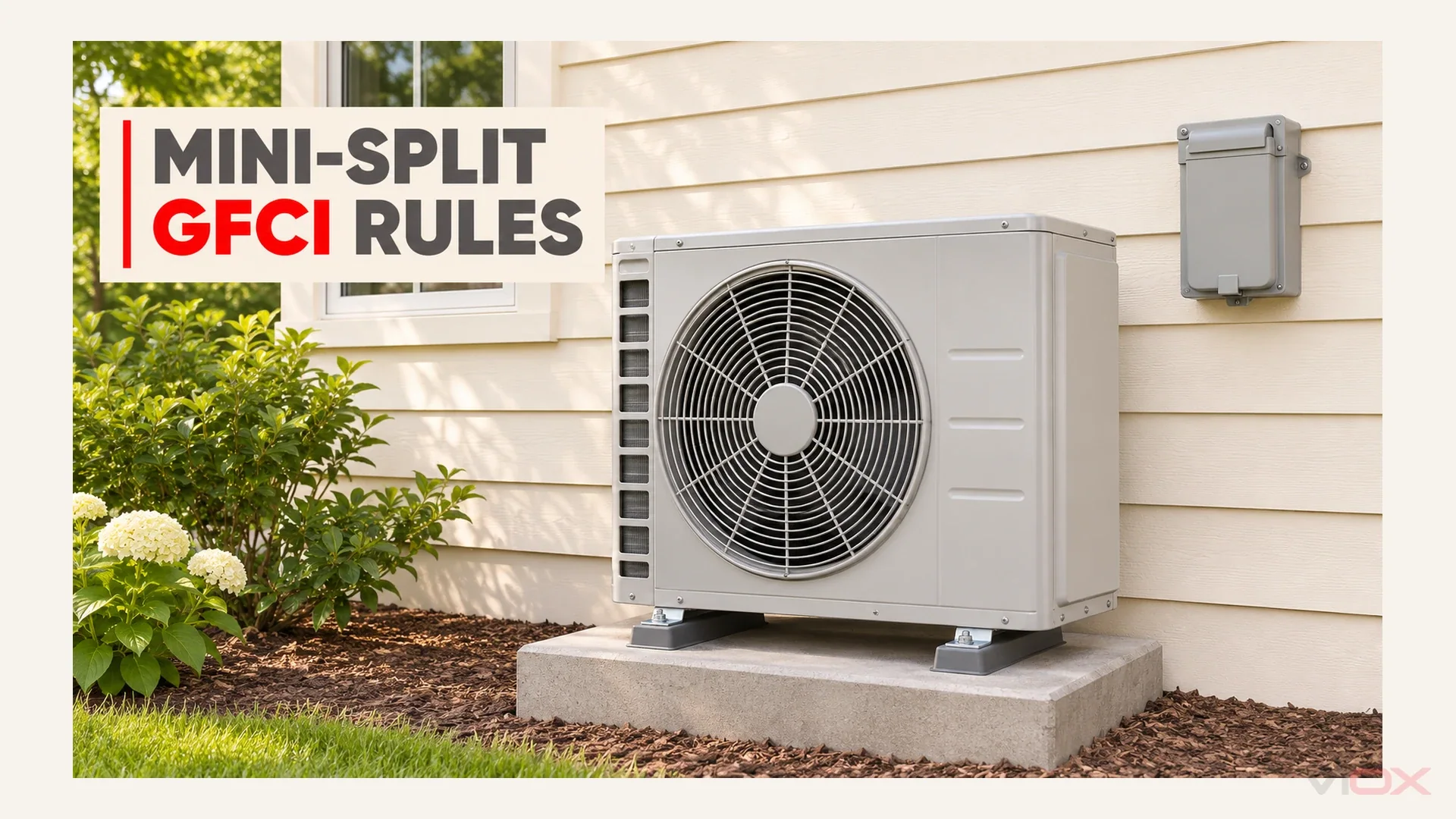
A residential outdoor mini-split or heat-pump supply may require ground-fault circuit-interrupter (GFCI) protection even when the equipment is hardwired. The dated HVAC exception in NEC 210.8(F) expired on September 1, 2026, but the rule applied to a particular job depends on the adopted edition, local amendments and replacement provisions. Check those first. Then verify the equipment instructions, protective-device listing and panel compatibility. An HF marking addresses high-frequency performance; it does not replace the device’s protection class.
Code and source review: November 9, 2026. This guide covers US dwelling outdoor mini-splits and heat pumps. It does not cover commercial three-phase drives or swimming-pool equipment. Panel work and energized diagnosis belong to qualified electrical personnel under the applicable safety procedure; homeowners should collect documents and observable symptoms without opening electrical covers.
What Changed on September 1, 2026?
The important change was the sunset of a time-limited exception, not a nationwide adoption date. A jurisdiction can still use an older NEC edition whose adopted text contains that sunset. Conversely, adopting the 2026 edition does not establish that every provision applies unchanged locally.
An electrical “outlet” is not limited to a receptacle. A hardwired outdoor unit can fall within the relevant outlet requirement. Minnesota’s current residential checklist expressly includes air conditioners, heat pumps and split mini-HVAC equipment after the exception’s expiration. Hardwiring alone therefore does not answer the GFCI question. Minnesota residential inspection checklist, item 026
| Code reference or event | Co należy ustalić | Dlaczego to ma znaczenie |
|---|---|---|
| 2020 NEC 210.8(F) | Dwelling outdoor-outlet scope: single-phase supplies, no more than 150 V to ground and 50 A, subject to the applicable exceptions and adopted amendments | The supply voltage to ground and branch-circuit rating matter, not only the equipment’s line-to-line label. |
| 2023 edition | The relevant public text retains the 50 A scope and the dated listed-HVAC exception | An older adopted edition is not automatically a continuing HVAC exemption. |
| September 1, 2026 | Expiration date written into the listed-HVAC exception | Check whether the local adopted rule retains, changes or deletes it. |
| 2026 edition | The public text uses a 60 A scope; Exception No. 3 permits listed Class C SPGFCI protection for listed HVAC equipment | Do not carry the older current limit into a 2026 assessment or assume the alternative exists in every local code. |
The edition-specific electrical scope and proposed sunset change can be inspected in NFPA’s public TIA 1924 document. That document contains proposed revisions, not proof that the requested extension was issued. For construction, consult the complete adopted code rather than this abbreviated crosswalk.
The question to ask the inspector is specific: “For this address, permit and new-installation or replacement scope, which version of 210.8(F), exceptions and local amendments apply?” That produces a usable answer where “Does my state use the new NEC?” may not.
The same section can arise in EV-charger GFCI questions, but an HVAC-specific exception or protective arrangement is not transferable to EV equipment.
TIA 1924: A Requested Extension Is Not an Approved Exemption
TIA means Tentative Interim Amendment. AHRI submitted Log No. 1924 to move the HVAC exception’s expiration to September 1, 2028, across the 2020, 2023 and 2026 editions. The official proposal identifies a September 9, 2026 comment deadline. A comment deadline is not an effective date.
The latest dated appeal update verified for this guide is ACCA’s November 4, 2026 report. It describes appeals following rejection of the proposed extension and says the Standards Council is scheduled to consider them at its December 15-16 meeting. This is the appellant’s status report, not a published NFPA decision granting an extension. ACCA November 4 update
Do not quote a job on the assumption that September 2028 has already replaced the expired date. Before installation, verify any subsequently issued NFPA amendment and how the adopting authority treats it. An appeal, an industry request and a locally adopted change are different records.
Local Adoption and Replacement Rules Can Change the Answer
Two official examples show why a national yes/no answer is incomplete. They are examples, not a substitute for checking the project’s own authority having jurisdiction (AHJ).
| Jurisdiction example, checked November 9, 2026 | Verified official position | What to record for the job |
|---|---|---|
| Texas | The September 1 adoption announcement adopts the 2026 NEC with a limited exception concerning certain outdoor-outlet GFCI requirements | Obtain the exact applicable exception and local requirements before specifying protection. Do not infer unamended enforcement from the adoption date. |
| Minnesota | The 2026 NEC applies to electrical permits filed on or after August 17, 2026; earlier permits use the 2023 NEC | Record the permit date. Its October 5 FAQ also provides a limited replacement-enforcement policy. |
Źródła: Texas adoption announcement oraz Minnesota adoption guidance.
Minnesota’s FAQ says the department will not enforce this GFCI requirement for replacement of an existing HVAC unit or disconnect where the stated existing-equipment conditions apply and the existing feeder or branch circuit is not altered or extended. That is a bounded state policy, not permission to label all heat-pump replacements exempt everywhere. The same FAQ explains that installation instructions cannot override code compliance. Minnesota 2026 NEC FAQ, items 1 and 4
If the scope changes from replacing equipment to extending a circuit, revisit the decision before ordering the breaker. Keep the AHJ’s answer with the permit and equipment documents.
Class A, Class C and HF Describe Different Things
Do not shop from a three-way menu labeled “Class A versus Class C versus HF.” Class identifies the protective category. HF identifies evaluated high-frequency performance and can coexist with a class designation.
Keep arc-fault protection separate too; GFCI versus AFCI explains that functional distinction.
| Identyfikacja | Co ci mówi | Czego to nie rozstrzyga |
|---|---|---|
| GFCI klasy A | The personnel-protection category; the familiar operating range is 4-6 mA | Compatibility with every inverter load, or suitability for an arbitrary panel |
| Listed Class C SPGFCI | A special-purpose protective arrangement with its own grounding and application conditions | A universal drop-in breaker replacement or an unrestricted higher trip setting |
| HF marking | Evaluated performance in the presence of specified high-frequency leakage conditions | A separate protection class, permission to omit grounding, or guaranteed compatibility with every heat pump |
UL’s circuit-breaker marking guide identifies Class A breaker/GFCI protection with a maximum 6 mA ground-fault threshold. UL’s historical GFCI guide information describes the 4-6 mA operating range. These milliamperes are not the breaker handle’s load-current rating.
What Class C SPGFCI changes
SPGFCI means special-purpose ground-fault circuit-interrupter. UL describes special-purpose protection commonly operating in the 15-20 mA range, while also describing Class C designs with lower thresholds for limited let-go protection. Verify the exact listing and instructions; the class letter alone is not a complete trip specification.
The protective arrangement can include grounding-path monitoring. Determine the actual grounding, monitoring and conductor requirements for the listed product instead of assuming either that a separate pilot conductor is always necessary or that no extra provisions are needed.
For the 2026 HVAC permission, the protective device must be listed Class C equipment used within the permitted application. The disconnect warning is “Warning: Class C SPGFCI Protection Provided for HVAC Unit.” Verify the adopted text and complete product instructions. UL special-purpose GFCI guidance
What the HF marking adds
UL wskazuje Class A GFCIs marked HF for loads producing high-frequency leakage from conversion electronics. Its guidance also identifies the relevant certification categories: KCXS for GFCIs and DKUY for circuit-breaker/GFCI combinations. Check the actual certification record and markings, not a retailer’s “inverter compatible” description. UL high-frequency GFCI guidance
An HF-rated protective device is not the same thing as an external high-frequency filter. Adding a filter is an equipment modification requiring a supported design; it is not an interchangeable shopping alternative.
Why an Inverter Heat Pump Can Trip a GFCI
A GFCI responds to differential current: current leaving on the monitored circuit conductors that does not return through those monitored conductors. On a typical line-to-line supply, the comparison is between the relevant current-carrying conductors, not an assumed load neutral.
Inverter power conversion and electromagnetic-interference filtering can create capacitive current paths to equipment ground. Distributed capacitance associated with the connected equipment can also contribute. Switching and startup can change the magnitude and frequency content of the differential current seen by the protective device. This is a possible compatibility mechanism, not a universal leakage value for mini-splits.
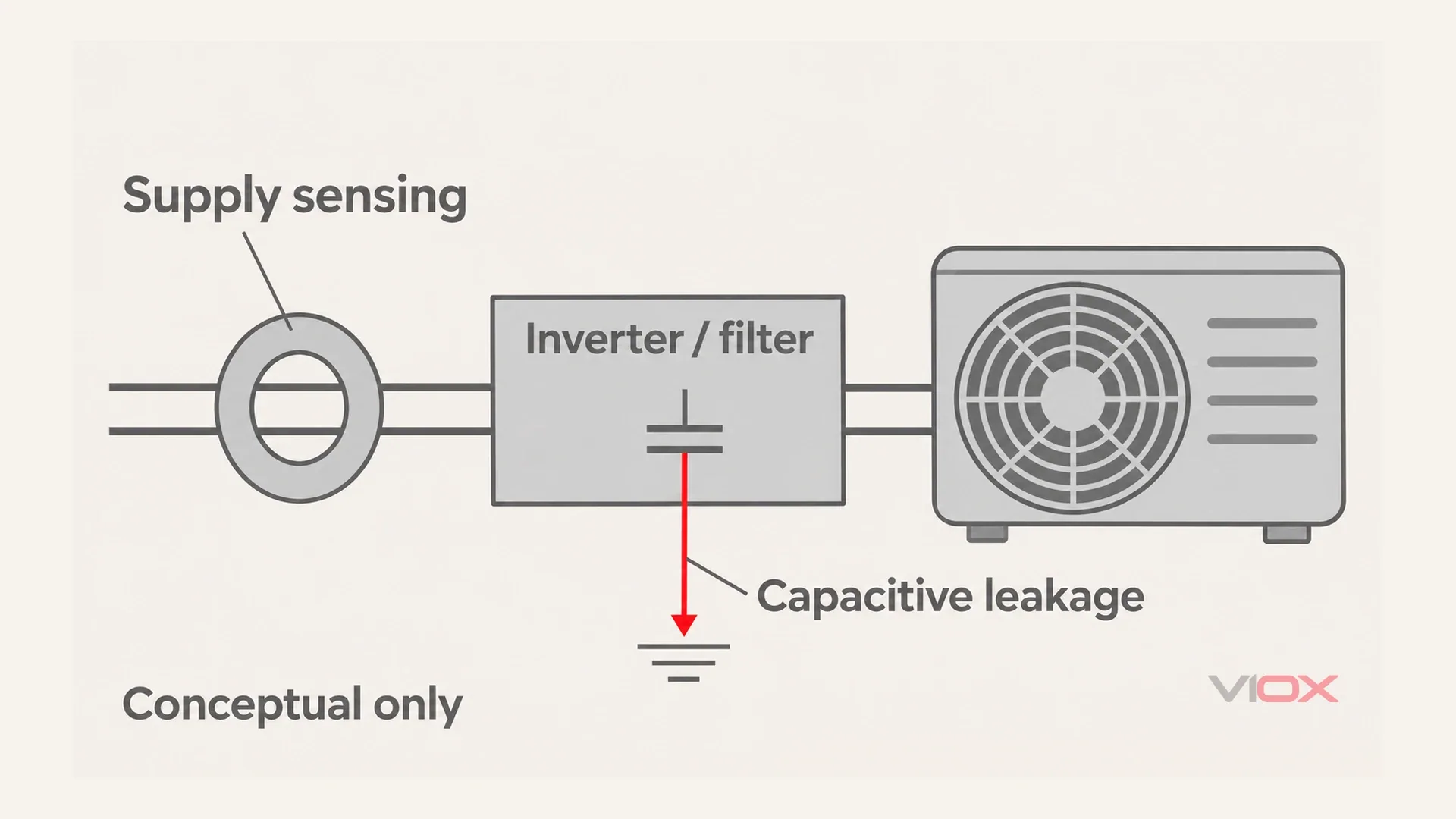
Frequency response matters, but “it trips on startup” does not prove a harmless high-frequency event. NFPA’s TIA substantiation discusses both frequency-dependent responses and startup or lower-frequency effects. Do not reduce every reported incompatibility to one filter explanation.
A damaged cable, insulation defect or other genuine fault can produce a trip too. Neither an inverter label nor successful operation on a different breaker proves the original trip was unnecessary. For conversion-system background, see what a VFD does; that explanation does not make a mini-split equivalent to a field-installed industrial drive.
Read the Exact Nameplate and Instructions Before Selecting Protection
Record the outdoor model, approved indoor/outdoor combination, supply voltage and phase, manual revision and applicable service bulletins. Check whether auxiliary heaters or other loads have separate supplies. The sales description “mini-split” does not establish the installation’s complete electrical configuration.
Keep three specifications separate:
- MCA, minimum circuit ampacity: the marked supply-conductor ampacity requirement, interpreted with the applicable installation rules.
- MOCP/MOP, maximum overcurrent protection: the marked upper limit for the specified protective device; check whether the instructions distinguish fuses from circuit breakers.
- GFCI class and HF performance: separate protection characteristics that MCA and MOCP do not identify.
Do not choose a breaker by rounding up running current, copying another unit’s breaker or treating MOCP as a normal operating-current reading. Do not apply an extra sizing multiplier to marked values without establishing which calculation the applicable rules require. UL’s heating and cooling equipment marking guide explains these marking functions; use the installed model’s documents for the actual values.
If an instruction appears to prohibit GFCI protection while the adopted rule requires it, obtain a written resolution from the equipment manufacturer and AHJ. Ask for the exact supported protective arrangement, product identification and applicable revision. Do not treat an old support article for a discontinued series as instructions for a current model, or treat a manufacturer’s compatibility statement as a local code amendment.
Na przykład, Pioneer’s P1/PC01 support article expressly concerns discontinued Quantum WYS, CYB, RYB, UYB and FYB systems and contains a GFCI/AFCI compatibility warning. That establishes the scope of that support statement, not a rule for all Pioneer equipment or permission to remove protection required at an installation. Confirm current instructions for the actual system.
The Installer’s Decision Table
| Bramka | Wymagane dowody | Proceed only when |
|---|---|---|
| Establish jurisdiction | Address, permit date, adopted edition, amendments and replacement policy | The applicable outdoor-HVAC requirement is identified. |
| Establish equipment | Exact model combination, nameplate, instructions and bulletins | Supply and protective-device requirements are known. |
| Resolve the protection path | Required class; any Class C permission; HF marking and product listing | The selected arrangement satisfies both local rules and equipment conditions. |
| Verify panel and installation | Authorized breaker family, poles, ratings, connection requirements and any separate enclosure | Compatibility is documented; physical fit alone is insufficient. |
| Complete acceptance | Required markings, inspection, manufacturer startup procedure and recorded results | No unresolved trip or instruction conflict remains. |
For each installation, retain a short decision record: applicable rule; equipment/manual revision; protective-device model and listing; panel authorization; any monitoring provisions; required warning; AHJ clarification; commissioning outcome. This makes the choice reviewable without turning a homeowner’s symptom into an unsupported diagnosis.
If no documented compliant combination has been established, pause procurement or commissioning and escalate. Do not substitute an IEC RCD merely because its residual-current rating appears convenient. Regional terminology and certification are separate questions, explained in RCD versus GFCI protection.
What to Do When the System Already Trips
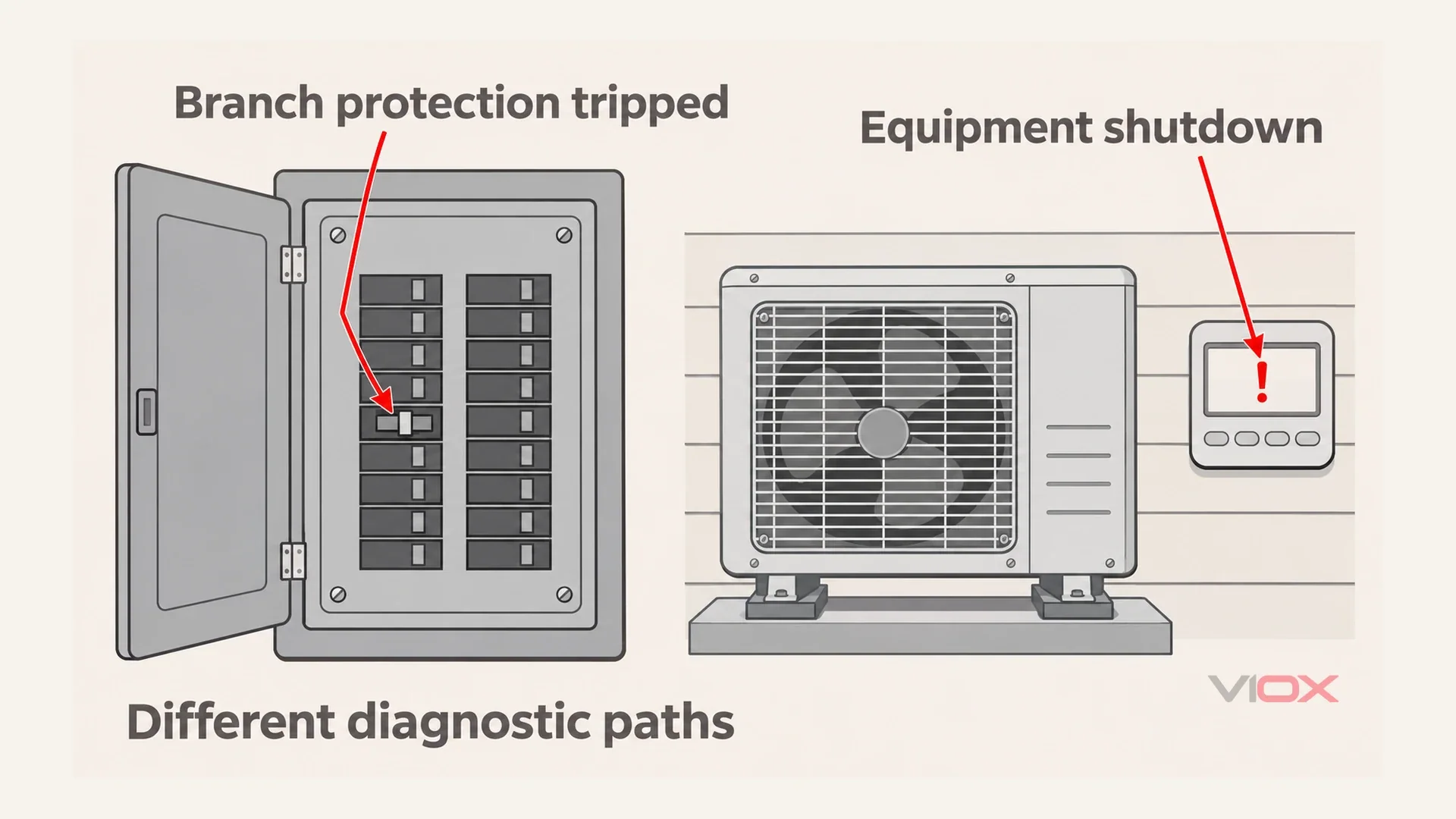
First establish what stopped the equipment. Did the panel protective device open, or is the supply still present while the heat pump reports a fault? Record the visible indication and event time without opening covers. An equipment error display is not proof that the GFCI operated.
Next, give the electrician and HVAC technician the model information and a sequence: reset or start command, fan operation, compressor start, speed change, defrost or heating mode. A repeatable association helps investigation; it does not establish the fault mechanism by itself.
Qualified personnel should confirm the actual trip function and evaluate the circuit and equipment under the approved diagnostic procedure before calling it a compatibility issue. Generic wiring and moisture diagnosis belongs in the AFCI/GFCI troubleshooting guide; no universal leakage number in a general article replaces the unit’s test instructions.
Before replacement, document the installed protective device’s class, HF marking if any, listing and panel authorization. Send that information to the equipment manufacturer and confirm the proposed change with the AHJ. A larger ampere rating does not solve a residual-current compatibility problem.
Do not repeatedly reset unexplained trips, disconnect protective grounding, bypass required GFCI protection or install an unapproved filter to keep heating running. Arrange a safe alternative heating or cooling plan while the fault or compatibility issue is resolved. Only release the installation after the required checks and unresolved conflicts are closed.
Pytania i odpowiedzi
Does a mini-split need a GFCI breaker under the 2026 NEC?
A covered dwelling outdoor outlet needs the protection required by the locally adopted rule. A hardwired unit is not automatically exempt. Establish edition, amendments, permit and replacement conditions first; the required protection is not necessarily supplied by a panel breaker in every permitted arrangement.
What is a Class C SPGFCI, and when can it replace Class A protection?
It is listed special-purpose protection with specific application and grounding conditions. The 2026 HVAC exception permits it within its stated scope, including the required disconnect warning. Use it only where the adopted rules, product listing and equipment instructions support that arrangement.
Why does my mini-split trip the GFCI on startup?
Startup can expose a real electrical fault or a compatibility issue involving the equipment’s differential-current behavior and the protective device. Timing alone cannot distinguish them. Record the exact models and observations, then have qualified personnel investigate before changing protection.
Can an inverter heat pump and a GFCI work together?
They can form a supported installation, but compatibility is not universal. Class A devices with an HF marking are one evaluated technology to investigate. Confirm the exact product and equipment combination rather than assuming every conventional device fails or every HF device succeeds.
My state has not adopted the 2026 NEC. Does the exemption still apply?
Not necessarily. The September 2026 sunset also appears in the relevant older-edition exception. The adopted text, local amendments and treatment of the particular job decide the answer. A proposed extension or an unresolved appeal does not itself extend the local exemption.