電流制限回路ブレーカーのガイド:保護&スペック

限流遮断器ガイド:保護機能と仕様
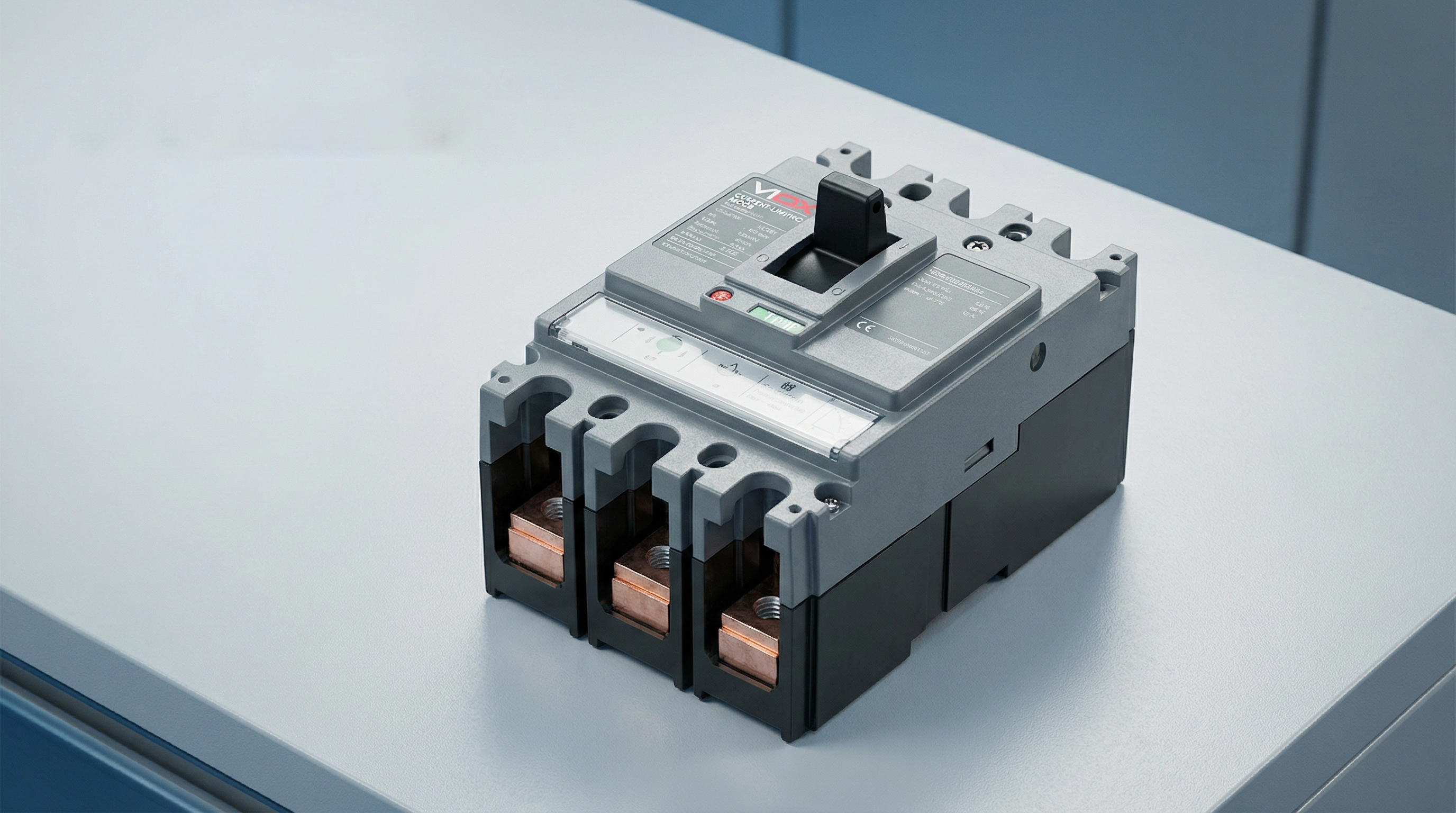
Professional header image showing a modern current-limiting MCCB with VIOX branding
図1: 限流遮断器は、破壊的なピーク値に達する前に故障電流を遮断することで電気システムを保護します。VIOX Electric社は、IEC 60947-2およびUL 489規格に準拠して設計された限流形MCCBを製造しています。.


現代の電気システムにおいて、短絡故障はミリ秒単位で壊滅的なエネルギーを放出する可能性があります。50,000アンペアの予想故障電流は、母線を曲げるのに十分な強力な磁気力、銅導体を蒸発させるのに十分な強烈な熱エネルギー、および作業員を危険にさらすアークフラッシュ災害を発生させます。しかし、この破壊の大部分は防止可能です。.

限流遮断器は、回路保護技術における根本的な進歩を表しています。交流波形の自然なゼロクロッシングで故障を遮断する従来の遮断器とは異なり、限流遮断器はミリ秒単位で動作し、故障電流が破壊的なピークに達する前にこれを抑制します。この迅速な介入により、電気設備への機械的・熱的ストレスが大幅に軽減され、精密電子機器の損傷から保護され、アークフラッシュ災害が著しく緩和されます。.

配電システムを設計する電気技術者、保護装置を選定するパネルメーカー、重要インフラを担当する施設管理者にとって、限流技術を理解することは不可欠です。本ガイドでは、限流遮断器の動作原理、性能を定義する主要な仕様、およびこの技術が標準的な回路保護よりも決定的な利点を発揮する状況について説明します。.

限流遮断器とは何ですか?

限流遮断器は、短絡電流が最大予想ピーク値に達する前に遮断するように設計された保護装置です。この能力により、通常は故障電流が自然な零点で遮断される前に完全なピーク値に達するまで許容する従来の遮断器と区別されます。.

電気システムで短絡が発生すると、電流は非常に高い速度で上昇を開始し、ミリ秒単位で数万アンペアに達する可能性があります。標準的な遮断器はこの故障状態を検知し、トリップ機構を作動させますが、遮断プロセスには時間がかかります。この短い間隔の間に、故障電流は完全な予想ピークに達し、導体、母線、下流設備に負荷をかける膨大なエネルギーを放出する可能性があります。.

一方、限流遮断器は並外れた速さで動作します。UL 489(北米の配線用遮断器規格)によれば、遮断器が故障を半サイクル未満(通常10ミリ秒未満)で遮断する場合、「限流」とみなされます。この高速応答により、系統電圧に対抗する高いアーク電圧が発生し、電流の流れを効果的に抑制し、通過ピーク電流を予想故障電流よりもはるかに低い値に強制的に低下させます。.

その結果は劇的です:予想故障電流が実効値50,000アンペア(対称)であっても、限流遮断器は実際のピーク電流を15,000アンペア以下に制限する可能性があります。このピーク電流と総故障エネルギーの低減により、下流設備は、そうでなければ発生する機械的力、熱損傷、アークフラッシュの危険から保護されます。.

限流遮断器の動作原理
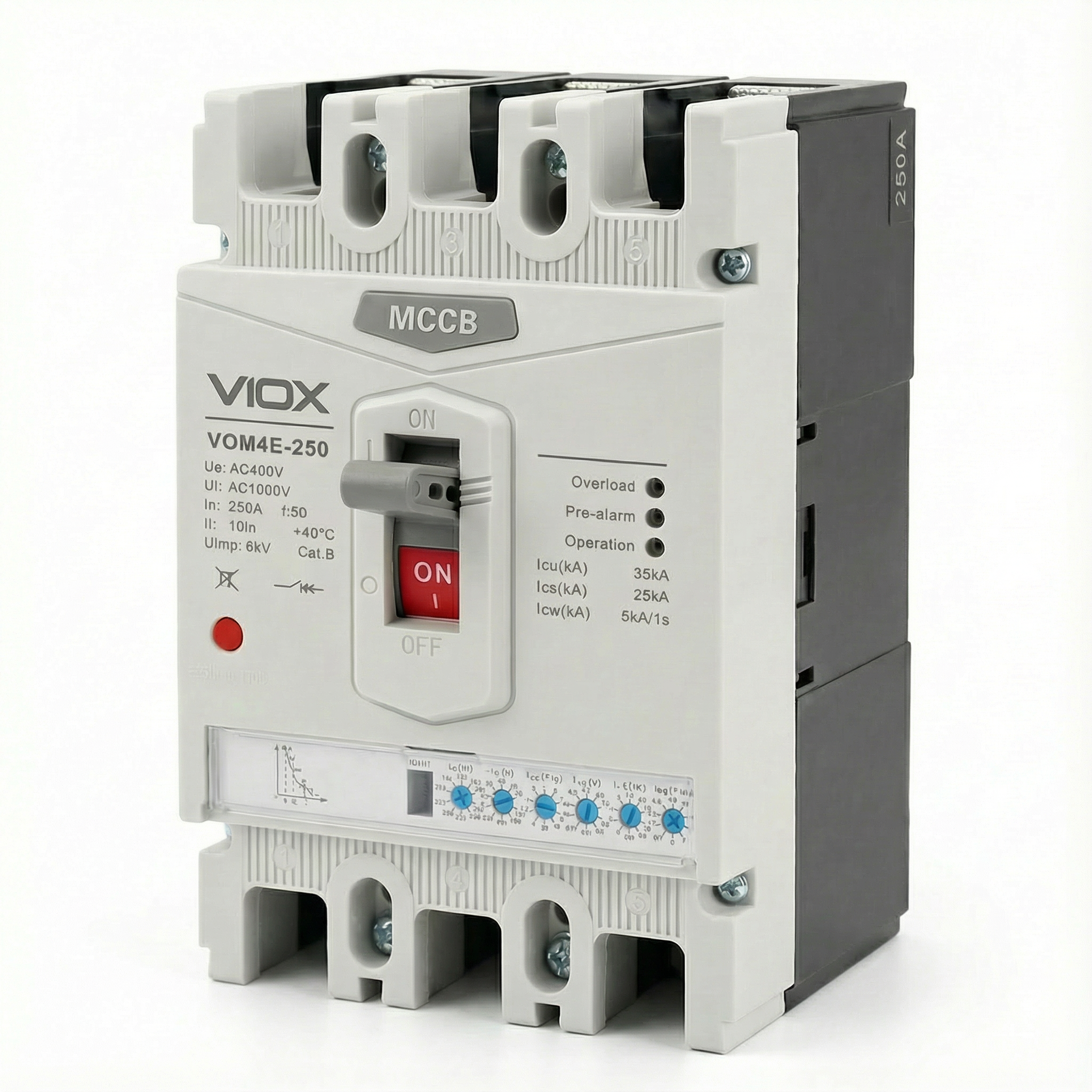
Current-limiting molded case circuit breaker product photograph
図2:限流 配線用遮断器(MCCB)は、 超高速故障遮断を可能にする特殊な内部機構を備えており、通常10ミリ秒未満で故障を遮断します。.

これらの遮断器の限流能力は、機械設計、電磁気学、アーク管理を慎重に設計して組み合わせた結果です。このプロセスは、いくつかの連携したメカニズムを通じて、ミリ秒単位で展開します。.

電磁力による接点分離

最初の重要な要素は、超高速の接点分離です。高い故障電流が遮断器の接点を流れると、この電流によって生成される巨大な磁場が強力な電磁力を生み出します。限流遮断器は、これらの力を利用して分離を補助する接点構成で設計されています。つまり、磁場が反発力を生み出して文字通り接点を吹き飛ばすように配置されています。.

この「電磁反発」は、より高い故障電流が実際に接点分離を加速することを意味します。遮断器はトリップ機構の機械力だけに依存せず、故障電流自体が接点をより速く開くためのエネルギーを供給します。これにより、故障発生から1~2ミリ秒以内という極めて迅速な接点分離が保証されます。.

アークの発生と伸長

接点が高速で分離すると、隙間に電気アークが形成されます。このアークは抑制すべき問題というよりも、電流制限の主要な手段となります。遮断器の内部構造は、このアークを接点から急速に遠ざけ、アークシュートと呼ばれる特別に設計された消弧室に導き入れるように設計されています。.

電流の流れによって生成される磁場とアークランナーの物理的形状が、アークを上方のアークシュートへと導きます。アークが移動・伸長するにつれて、その長さは劇的に増加します。より長いアークを維持するにはより高い電圧が必要であり、このアーク電圧が故障電流を駆動する系統電圧に対抗します。.

アークの整流と分割

アークシュートには、特定の構成(多くの場合V字型)で配置された一連の金属板(アークスプリッターまたはアークディバイダー)が含まれています。アークがシュート内に導かれると、これらの板に接触し、「整流」されます。つまり、主アーク経路からスプリッタープレートへと移行します。.

このプロセスにより、単一の高エネルギーアークが直列接続された複数の小さなアークに効果的に分割されます。各小さなアークは独自の電圧降下を発生させます。例えば、アークシュートに20枚のスプリッタープレートが含まれている場合、総アーク電圧は系統電圧の何倍にも達する可能性があります。累積アーク電圧が系統電圧を超えると、電流は急速に減少することを余儀なくされます。.

アークの冷却と消弧

金属製スプリッタープレートは、ヒートシンクとしても機能し、アークを急速に冷却します。プレートはアークの表面積を増やし、熱を逃がします。周囲の空気や消弧ガスと組み合わさることで、この冷却によりアークの導電性が低下します。.

高いアーク電圧(電流の流れに対抗)とアーク冷却(導電性の低下)の相互作用により、電流はゼロに向かって強制されます。遮断器は、故障電流がその予想ピークに達する前に、サイクルの一部の時間内でアークを消弧し、故障を遮断します。.

This entire sequence—from fault detection through contact separation, arc elongation, splitting, and extinction—occurs in under 10 milliseconds. The current is interrupted not at a natural zero crossing but forcibly, by creating conditions where the arc cannot be sustained.

主な技術仕様

Understanding current-limiting performance requires familiarity with three critical specifications that define how effectively a breaker limits fault current and protects downstream equipment.

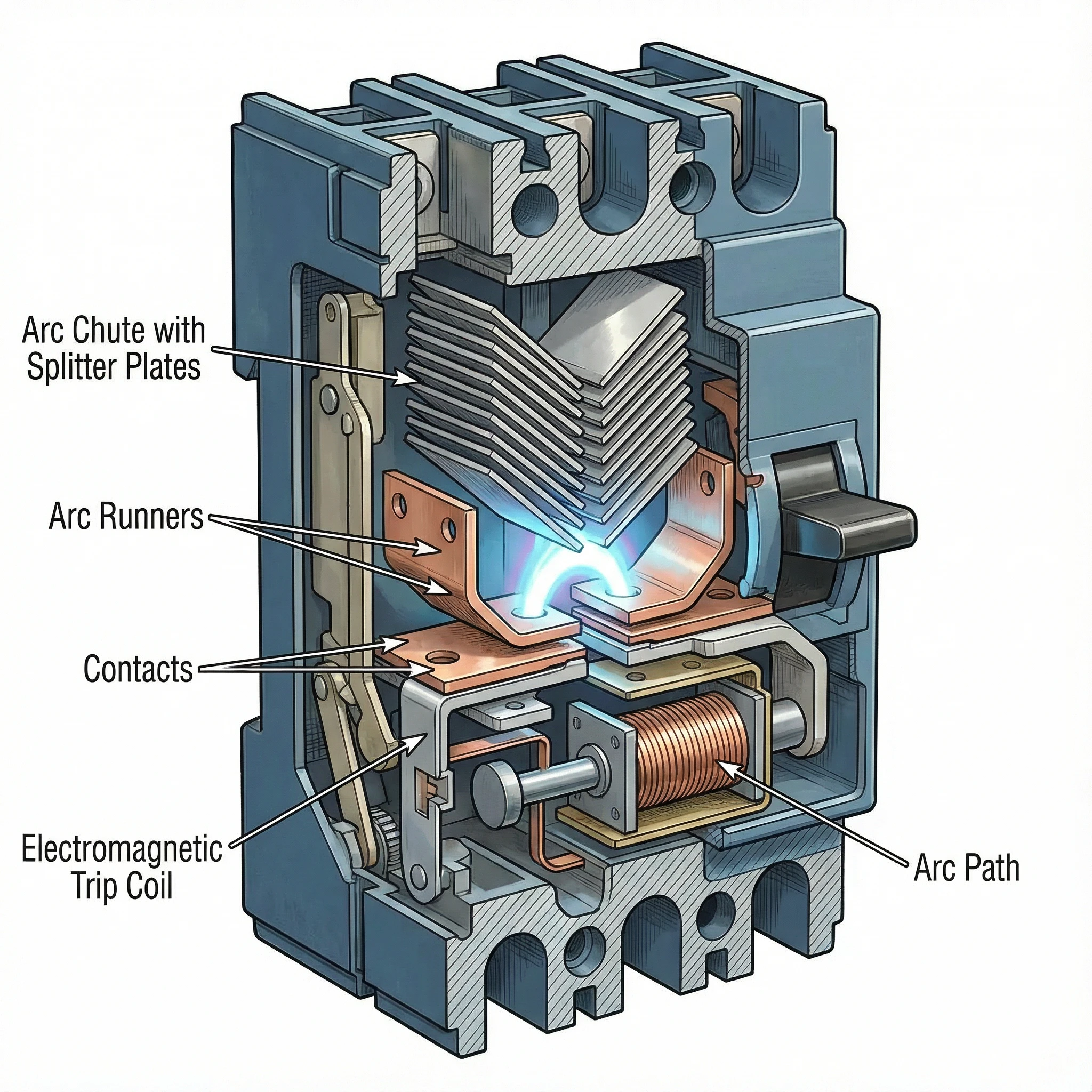
Technical cutaway illustration of current-limiting circuit breaker internal mechanism
Figure 3: Internal mechanism of a current-limiting circuit breaker. The arc chute with multiple splitter plates divides the arc into smaller segments, while arc runners guide the arc away from contacts. This design creates high arc voltage that opposes the fault current, forcing rapid extinction.

Let-Through Current (Ip)

について let-through current (Ip) is the actual peak current that flows through the breaker during a fault, measured in amperes. This value represents the breaker’s current-limiting effectiveness: a lower Ip indicates better current limitation.

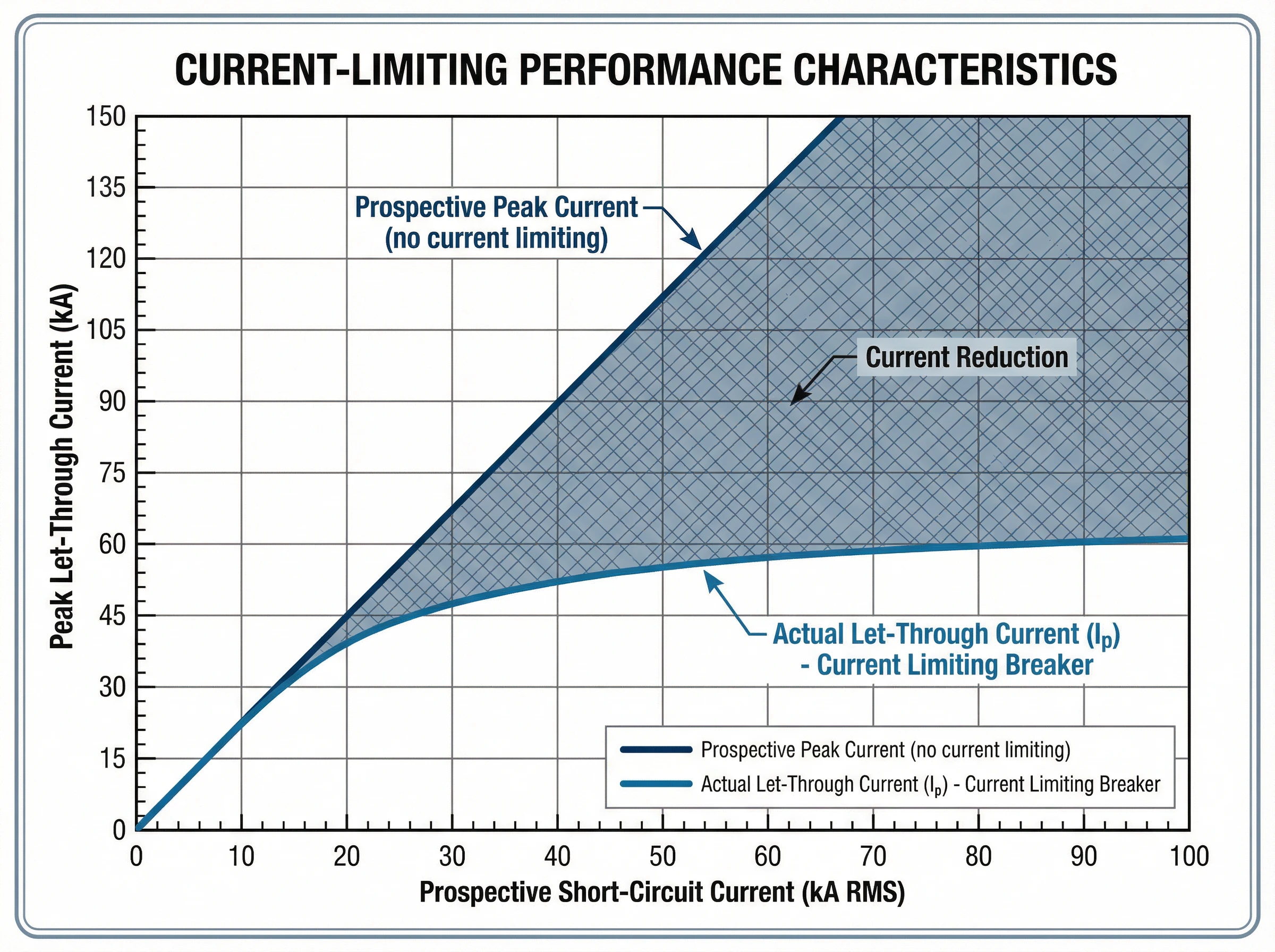
Manufacturers provide let-through current data in the form of characteristic curves. These graphs plot the peak let-through current (Ip) on the vertical axis against the prospective short-circuit current (RMS symmetrical amperes) on the horizontal axis. For any given prospective fault level at the installation point, the curve shows the maximum peak current that will actually flow.

For example, if the available fault current at a panelboard is 42,000 amperes RMS symmetrical, a current-limiting breaker might limit the actual peak current to just 18,000 amperes. This reduction from prospective to actual peak current protects busbars from bending, prevents conductor overheating, and reduces mechanical stress on all downstream components.

Thermal Stress (I²t)

について I²t value (pronounced “I-squared-t”), measured in ampere-squared seconds (A²s), quantifies the thermal energy let through by the breaker during fault clearing. It represents the integral of the current squared over the total clearing time.

This specification is critical for protecting cables and sensitive electronic equipment. The insulation of cables has a specific thermal withstand rating expressed as I²t. If the protective device lets through more thermal energy than the cable can withstand, the insulation will be damaged even if the cable doesn’t physically melt.

Current-limiting breakers dramatically reduce I²t compared to standard breakers. For the same prospective fault current, a current-limiting device might have an I²t value 50-80% lower than a conventional breaker. This reduced thermal stress prevents conductor damage, protects cable insulation, and extends equipment life.

Manufacturers provide I²t curves similar to let-through current curves, showing the maximum thermal energy as a function of prospective fault current. Some standards define energy-limiting classes for circuit breakers based on their I²t performance.

Breaking Capacity (Icu and Ics)

について 遮断容量 defines the maximum fault current the breaker can safely interrupt. Two ratings are relevant under IEC 60947-2 (the international standard for low-voltage circuit breakers):

  • 最終破断容量(Icu): The maximum fault current the breaker can interrupt without being destroyed. After interrupting a fault at Icu level, the breaker may not be suitable for continued service and might require replacement. This represents the breaker’s absolute upper limit.
  • サービスブレーク容量(Ics): The maximum fault current the breaker can interrupt multiple times while remaining fully functional and reliable for continued service. Ics is expressed as a percentage of Icu (typically 50%, 75%, or 100%). For critical applications requiring high reliability, breakers with Ics = 100% Icu are preferred.

The fundamental selection rule is straightforward: the breaker’s Icu must be equal to or greater than the prospective short-circuit current at the point of installation. Current-limiting breakers can achieve high breaking capacities (50kA, 85kA, or higher) in compact form factors because the current-limiting action itself reduces the energy the breaker must handle.

The Interrelationship of Specifications

These specifications work together to define protection performance. When a fault occurs up to the breaker’s Icu rating, the current-limiting action reduces both the peak current (Ip) and the total thermal energy (I²t) to values far below what the prospective fault would produce. This coordinated reduction in peak mechanical stress and thermal damage is what makes current-limiting breakers essential for protecting modern electrical systems with high available fault currents.

Standards and Compliance

Current-limiting circuit breakers are governed by rigorous international and regional standards that define performance requirements, testing procedures, and safety criteria.

Let-through current performance curve graph
Figure 4: Let-through current performance curve showing how a current-limiting breaker dramatically reduces peak fault current. The shaded area represents the current reduction achieved, protecting equipment from destructive mechanical and thermal stress.

IEC 60947-2: International Standard

IEC 60947-2 is the international standard for low-voltage circuit breakers used in industrial and commercial applications. This comprehensive standard establishes:

  • Performance categories: The standard distinguishes between Category A breakers (no intentional short-circuit time delay) and Category B breakers (with short-time withstand capability). Most modern current-limiting MCCBs are Category A devices.
  • Breaking capacity verification: IEC 60947-2 specifies rigorous test sequences to verify both ultimate breaking capacity (Icu) and service breaking capacity (Ics). These tests involve multiple making and breaking operations under specified fault conditions.
  • Current-limiting performance: While the standard doesn’t mandate current limitation, it provides test procedures to verify and document let-through current and I²t performance for breakers claiming current-limiting capability.
  • Coordination and selectivity: The standard establishes requirements for back-up protection (cascading), where a current-limiting breaker upstream protects a downstream breaker with lower breaking capacity than the prospective fault current at its location.

UL 489: North American Standard

UL 489 is the Underwriters Laboratories standard for molded case circuit breakers in North America. Key provisions include:

  • Current-limiting definition: UL 489 specifies that a circuit breaker qualifies as “current limiting” if it clears a fault in less than half a cycle (typically under 10 milliseconds for 60 Hz systems).
  • Let-through testing: The standard requires extensive testing to generate let-through current curves that show the actual peak current as a function of prospective fault current.
  • Short-circuit ratings: UL 489 defines interrupting ratings (IR) and establishes test procedures to verify breaker performance at rated voltage and current levels.

コンプライアンスと認証

For electrical system designers and specifiers, standards compliance ensures:

  • Verified performance: Certified breakers have undergone rigorous third-party testing to confirm their current-limiting capability and breaking capacity.
  • Design confidence: Engineers can rely on published let-through curves and I²t data for equipment protection analysis and arc flash calculations.
  • Regulatory acceptance: Standards-compliant breakers meet electrical code requirements in their respective markets (IEC zones or North American installations).

VIOX current-limiting circuit breakers are designed and tested to meet both IEC 60947-2 and UL 489 requirements, ensuring global applicability and verified protection performance.

アプリケーションと使用例

Current-limiting circuit breakers deliver critical benefits in electrical systems where high available fault currents threaten equipment integrity and personnel safety.

Data Centers and Critical IT Infrastructure

Modern data centers face extraordinary fault current challenges. High-density server racks, powerful UPS systems, and multiple utility feeds create available fault currents that can exceed 65kA or more. Current-limiting breakers are essential in these environments:

  • IT equipment protection: Servers, storage arrays, and networking gear contain sensitive electronics vulnerable to even brief overcurrent events. Current-limiting breakers reduce the fault energy to levels that prevent component damage.
  • 選択的調整: Data center reliability depends on isolating faults without cascading outages. Current-limiting breakers facilitate coordination between upstream and downstream protection, ensuring only the affected circuit trips.
  • Arc flash mitigation: Maintenance personnel work on energized equipment regularly. By reducing peak fault current and clearing time, current-limiting breakers dramatically lower arc flash incident energy, improving worker safety and potentially reducing PPE requirements.
  • Compact installations: Current-limiting technology enables high breaking capacity (50kA-100kA) in compact MCCBs, supporting dense power distribution without requiring oversized switchgear.

Industrial Manufacturing Facilities

Industrial plants with large motors, transformers, and extensive distribution networks face fault currents that can damage production equipment:

  • モーター・コントロール・センター: Protecting motor starters, variable frequency drives, and control electronics from fault current stress. Current-limiting breakers prevent damage to expensive drive electronics and ensure production continuity.
  • High-capacity feeders: Where multiple power sources or large transformers create fault currents exceeding 50kA, current-limiting breakers provide protection without requiring expensive high-interrupting-capacity switchgear throughout the system.
  • 機器の保護: Busbars, cable trays, and panel components have mechanical strength limits. Current-limiting breakers reduce the magnetic forces during faults, preventing physical damage to distribution infrastructure.

Commercial Buildings with High Power Density

Office towers, hospitals, and retail centers increasingly deploy high-power systems:

  • Main and sub-main distribution: Current-limiting breakers on main service entrances and distribution boards protect against utility-supplied fault currents while enabling effective downstream coordination.
  • 非常用電源システム: Generator and transfer switch protection where multiple sources increase available fault current.
  • Renovation and expansion: Adding capacity to existing buildings often increases fault current levels. Current-limiting breakers can sometimes eliminate the need for complete system upgrades by providing adequate protection within existing infrastructure ratings.

Cascading Protection (Back-Up Protection)

One of the most valuable applications is enabling cascading or series rating. A current-limiting breaker installed upstream can protect downstream breakers with lower breaking capacity than the prospective fault current at their location. This allows:

  • コスト最適化: Using less expensive, lower-rated breakers downstream while maintaining full protection.
  • Simplified specification: Standardizing on common breaker types throughout the facility while the current-limiting main breaker provides system-wide protection.
  • System flexibility: Adding circuits or loads without necessarily upgrading all downstream protection devices.

Current Limiting vs Standard Circuit Breakers

Understanding the distinction between current-limiting and standard circuit breakers clarifies when each technology is appropriate.

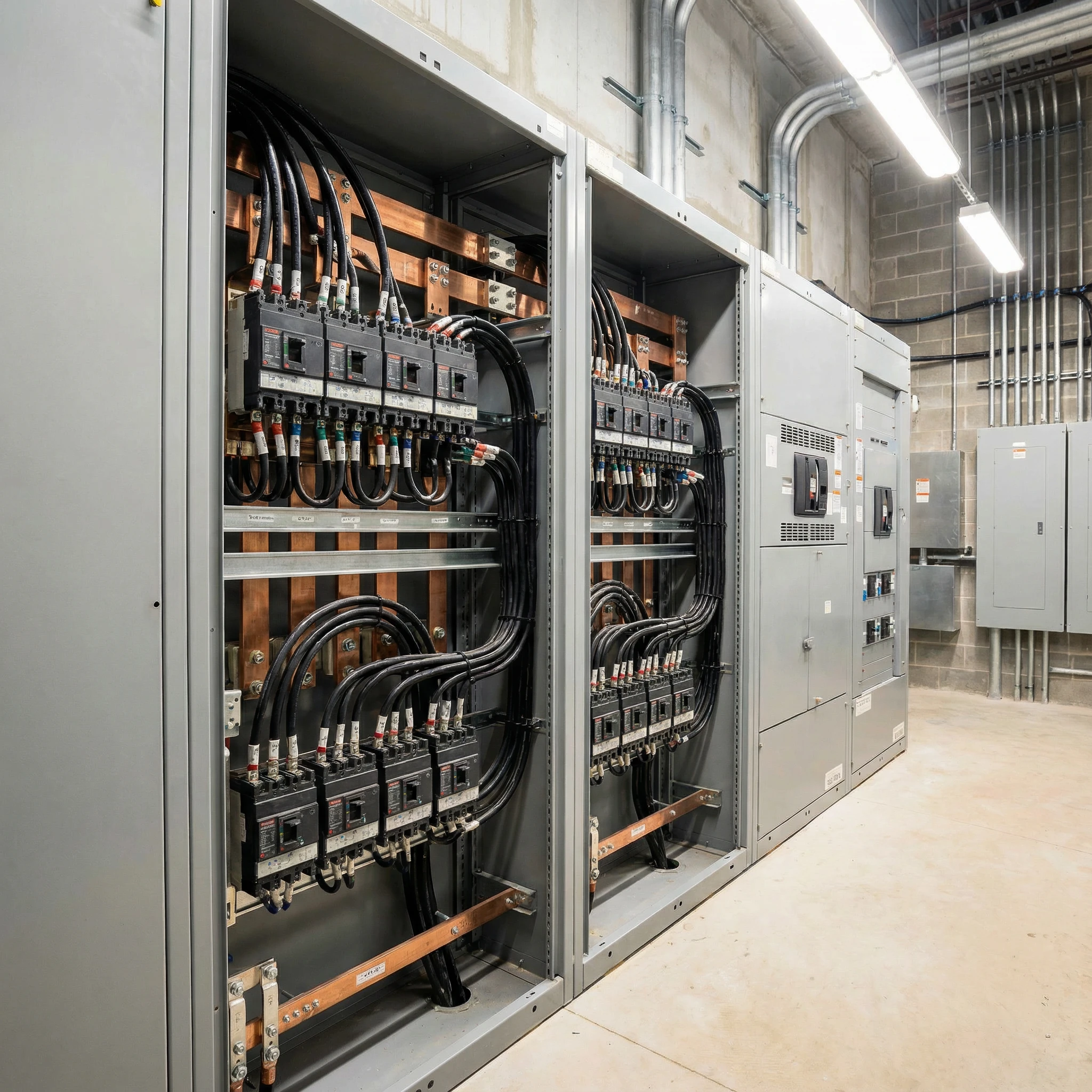
Industrial electrical installation of current-limiting MCCBs
Figure 5: Current-limiting circuit breakers installed in industrial switchgear protecting high-power distribution systems. These applications commonly face fault currents exceeding 50kA, where current limitation is essential for equipment protection and arc flash mitigation.

Interruption Method

Standard Breakers: Conventional circuit breakers detect a fault and initiate the trip mechanism, but allow the fault current to rise to its prospective peak value. Interruption occurs at or near a natural current zero crossing, typically after 0.5 to 1.5 cycles (8-25 milliseconds at 60 Hz). During this time, the full fault current stresses the system.

Current-Limiting Breakers: These devices act within milliseconds to forcibly interrupt the current before it reaches its prospective peak. Through electrodynamic contact separation and arc voltage build-up, they clear the fault in less than half a cycle (under 10 milliseconds), dramatically reducing both peak current and total fault energy.

Peak Current and Mechanical Stress

Standard Breakers: The full prospective fault current flows, creating maximum magnetic forces. For a 50kA prospective fault, the full 50kA (70kA peak asymmetrical) generates enormous mechanical stress on busbars, terminals, and connections.

Current-Limiting Breakers: The let-through current is significantly reduced. For the same 50kA prospective fault, a current-limiting breaker might limit the actual peak to 15-20kA, reducing magnetic forces by 60-70%.

Thermal Energy (I²t)

Standard Breakers: Longer clearing time and higher peak current result in substantial thermal energy release. Cables, busbars, and connections absorb significant heat, potentially damaging insulation.

Current-Limiting Breakers: Reduced peak current and ultra-fast clearing dramatically lower I²t values, often by 50-80%. This protects cable insulation, prevents conductor annealing, and safeguards sensitive electronics from thermal stress.

Arc Flash Incident Energy

Standard Breakers: Higher fault current and longer clearing time increase arc flash incident energy, requiring higher-level PPE and creating greater safety hazards for maintenance personnel.

Current-Limiting Breakers: Reduced fault current magnitude and duration significantly decrease arc flash energy. This can lower the arc flash boundary, reduce PPE requirements, and improve overall electrical safety.

Cost and Complexity Trade-offs

Standard Breakers: Generally less expensive per unit. Suitable for applications where fault currents are moderate and equipment ratings adequately exceed available fault levels.

Current-Limiting Breakers: Higher initial cost, but can reduce total system cost by:

  • Allowing lighter-duty downstream components
  • Enabling cascading protection with lower-rated breakers
  • Reducing panel reinforcement requirements
  • Protecting expensive equipment from damage
  • Lowering arc flash mitigation costs

各タイプを選択するタイミング

Choose Standard Breakers when:

  • Available fault current is well below the system’s short-circuit rating
  • Budget constraints are paramount and fault levels don’t justify current-limiting protection
  • Coordination can be achieved without current limitation

Choose Current-Limiting Breakers when:

  • Available fault currents exceed 20-25kA
  • Protecting sensitive electronic equipment (data centers, control systems)
  • Seeking arc flash hazard reduction
  • Enabling cascading protection to reduce costs
  • Facility expansion has increased fault levels beyond original equipment ratings

選考基準

Selecting the right current-limiting circuit breaker requires evaluating several technical and application factors.

Calculate Available Fault Current

The first step is determining the prospective short-circuit current at the installation point. This requires:

  • Utility transformer capacity and impedance
  • Conductor lengths and sizes
  • Impedance of distribution components
  • Contribution from motors and generators

Many utilities provide fault current data, or qualified electrical engineers can perform short-circuit calculations using industry-standard methods (IEC 60909 or IEEE standards). The breaker’s ultimate breaking capacity (Icu) must meet or exceed this calculated fault current.

Evaluate Equipment Protection Requirements

Consider what needs protection:

  • 敏感な電子機器: Data centers, control systems, and telecommunications equipment benefit significantly from reduced let-through current and I²t.
  • Busbar and conductor ratings: If fault currents approach or exceed the short-circuit withstand ratings of busbars, cables, or panel components, current limitation becomes essential.
  • Existing equipment: When expanding facilities, current-limiting breakers can sometimes protect existing infrastructure without requiring complete replacement.

Assess Arc Flash Hazard Mitigation Needs

If arc flash studies indicate high incident energy levels requiring extensive PPE or creating unacceptable worker hazards, current-limiting breakers can significantly reduce arc flash energy. Review arc flash calculations to determine if current limitation would lower the hazard category and improve safety.

Consider Coordination Requirements

Selective coordination—ensuring only the breaker nearest the fault trips—is critical in many applications:

  • Cascading protection: If downstream breakers have breaking capacities lower than available fault current, a current-limiting breaker upstream can provide back-up protection.
  • Critical loads: Data centers, hospitals, and industrial processes require fault isolation without unnecessary outages. Current-limiting breakers facilitate coordination by reducing let-through energy.

Review Let-Through Current Curves

Manufacturers provide let-through current (Ip) and I²t curves for their current-limiting breakers. Compare these curves against:

  • Equipment withstand ratings
  • Cable I²t limits
  • Arc flash energy reduction targets
  • Coordination requirements with downstream devices

Verify Standards Compliance

Ensure the breaker meets applicable standards:

  • IEC 60947-2 for international/industrial applications
  • UL 489 for North American installations
  • Local electrical codes and certification requirements

結論

Current-limiting circuit breakers represent a critical advancement in electrical protection technology, addressing the fundamental challenge of high fault currents in modern power systems. By interrupting faults in milliseconds and dramatically reducing peak let-through current and thermal stress, these devices protect expensive equipment, improve personnel safety, and enable more flexible system designs.

For electrical engineers and facility managers working with high-power distribution systems—particularly data centers, industrial facilities, and commercial buildings with fault currents exceeding 25kA—current-limiting technology delivers measurable benefits in equipment protection, arc flash mitigation, and coordination flexibility. The key specifications (let-through current Ip, thermal stress I²t, and breaking capacity Icu) provide the engineering data needed to verify protection performance and ensure safe, reliable operation.

VIOX Electric manufactures current-limiting circuit breakers engineered to IEC 60947-2 and UL 489 standards, offering breaking capacities from 35kA to 100kA and comprehensive let-through performance curves. For technical specifications, application guidance, or to discuss your specific protection requirements, contact VIOX’s engineering team.

Protect your critical infrastructure with proven current-limiting technology. VIOX Electricへのお問い合わせ to discuss your circuit protection needs.

著絵

こんにちは、私はジョー、専用のプロフェッショナルで12年以上の経験を電気産業です。 でVIOX電気、私は高品質の電気的ソリューションのニーズに応えております。 私の専門知識に及ぶ産業用オートメーション、住宅の配線は、商用電気システム。お問い合わせ[email protected] がることができます。

テーブルの内容
    追加ヘッダーの始発のテーブルの内容
    今すぐ見積もりを依頼する