


در این صفحه
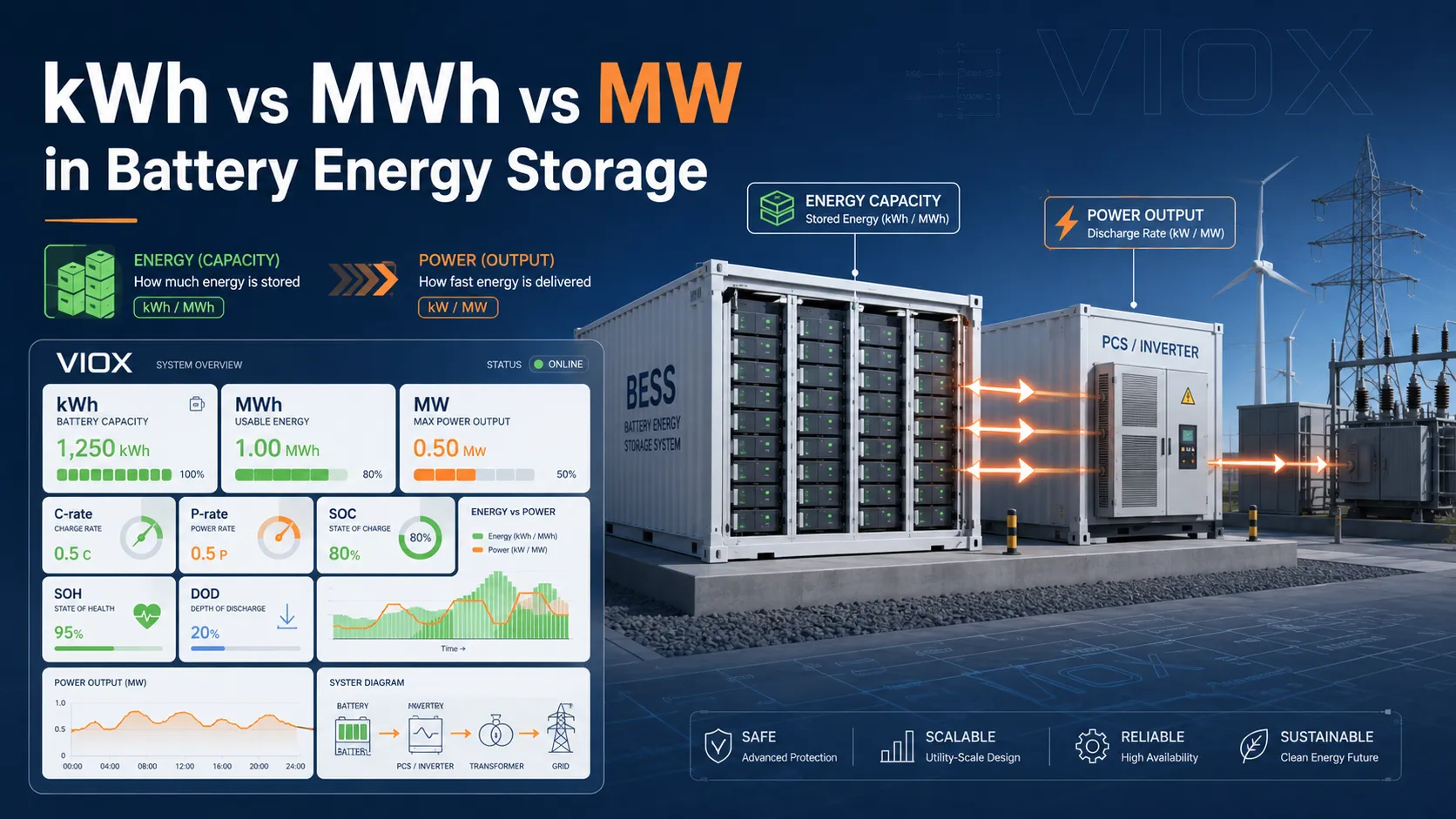
If you are new to battery energy storage, the units can feel like alphabet soup: کیلووات ساعت (kWh), MWh, MW, C-rate, P-rate, SOC, SOH, عمق تخلیه (DOD), آمپر ساعت (Ah), وات ساعت (Wh), و نمادهای باتری مانند 1P416S. این موارد با یکدیگر مرتبط هستند، اما مقیاسهای اندازهگیری یکسانی ندارند.
پاسخ کوتاه ساده است:
- کیلووات ساعت (kWh)، مگاوات ساعت (MWh) و گیگاوات ساعت (GWh) انرژی را اندازهگیری میکنند: how much electricity a battery can store or deliver.
- kW, MW, and GW measure power: how fast that energy can be charged or discharged.
- C-rate measures current relative to battery capacity.
- P-rate measures power relative to stored energy.
- SOC, SOH, and DOD describe battery operating state, ageing, and used capacity.
For the narrower difference between power and energy, see VIOX’s guide on kW vs kWh. This article focuses specifically on battery energy storage system (BESS) units and battery-pack terminology.
جدول مرجع سریع
| اصطلاح | Full meaning | Measures | Typical use in BESS |
|---|---|---|---|
| کیلووات ساعت (kWh) | Kilowatt-hour | انرژی | Home battery capacity, cabinet capacity, usable energy |
| MWh | Megawatt-hour | انرژی | Commercial and grid-scale storage capacity |
| گیگاواتساعت (GWh) | گیگاواتساعت | انرژی | ظرفیت ذخیرهسازی در مقیاس بزرگ ملی، نیروگاهی یا ناوگانی |
| کیلووات (kW) | کیلووات | قدرت | خروجی اینورتر کوچک، نرخ شارژ/دشارژ |
| MW | مگاوات | قدرت | خروجی سیستم تبدیل توان (PCS) در مقیاس نیروگاهی یا خروجی نیروگاه |
| C-rate | نرخ جریان مبتنی بر ظرفیت | جریان شارژ/دشارژ نسبت به ظرفیت آمپر-ساعت | تنش سلول و پک، طراحی حرارتی، تأثیر بر طول عمر |
| P-rate | نسبت توان به انرژی | توان نسبت به ظرفیت انرژی | مدت زمان و ابعاد توان سیستم ذخیرهسازی انرژی باتری (BESS) |
| SOC | وضعیت شارژ (SOC) | سطح شارژ باقیمانده | وضعیت عملکرد لحظهای باتری |
| SOH | State of health | Ageing or remaining health | Degradation, warranty, lifetime evaluation |
| DOD / DoD | Depth of discharge | Used portion of battery capacity | Cycling window, usable energy, lifetime control |
| آمپر ساعت (Ah) | Ampere-hour | Charge capacity | Cell and module capacity |
| وات ساعت (Wh) | Watt-hour | انرژی | Cell, module, pack, and system energy |
kWh, MWh, and GWh: Energy Units
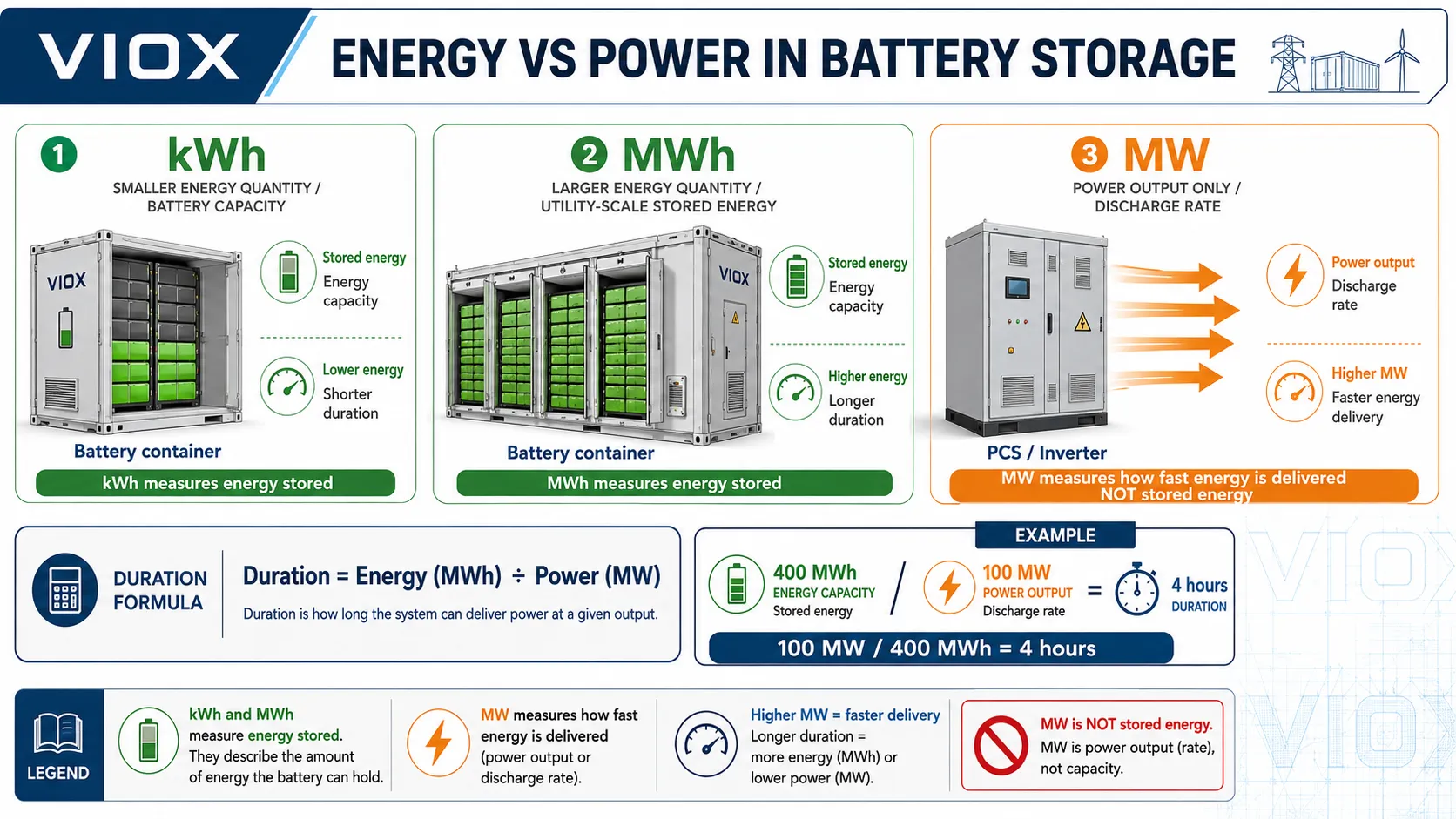
kWh, MWh, and GWh all measure energy. In battery storage, energy tells you how much electricity the battery can store and later deliver.
The conversions are:
1 kWh = 1,000 Wh
1 MWh = 1,000 kWh
1 GWh = 1,000 MWh = 1,000,000 kWh
Typical use cases:
- A residential battery might be described as 10 kWh.
- A commercial battery container might be 500 kWh یا 1 MWh.
- A grid-scale battery plant might be 100 MWh, 400 MWh, or larger.
- National storage pipelines are often discussed in گیگاواتساعت (GWh).
Energy capacity answers this question:
How much electricity can the battery store?
It does not tell you how fast the battery can deliver that electricity. That is power.
MW: Power, Not Energy
MW measures power, not stored energy. Power is the rate at which energy is charged or discharged.
The conversions are:
1 kW = 1,000 W
1 MW = 1,000 kW
1 GW = 1,000 MW
In a BESS project, the MW rating is usually connected to:
- power conversion system (PCS) rating
- inverter output
- grid interconnection limit
- توان شارژ/دشارژ
- قابلیت پیکسایی (Peak shaving) یا پاسخ فرکانسی
توان به این پرسش پاسخ میدهد:
باتری با چه سرعتی میتواند انرژی را تحویل دهد یا جذب کند؟
الف ۵۰ مگاوات باتری میتواند با نرخ بسیار بالاتری نسبت به یک ۵ مگاوات باتری دشارژ شود، اما این لزوماً به معنای ذخیرهسازی انرژی بیشتر نیست. انرژی به مگاواتساعت (MWh) بستگی دارد.
MW vs MWh: How to Calculate Storage Duration
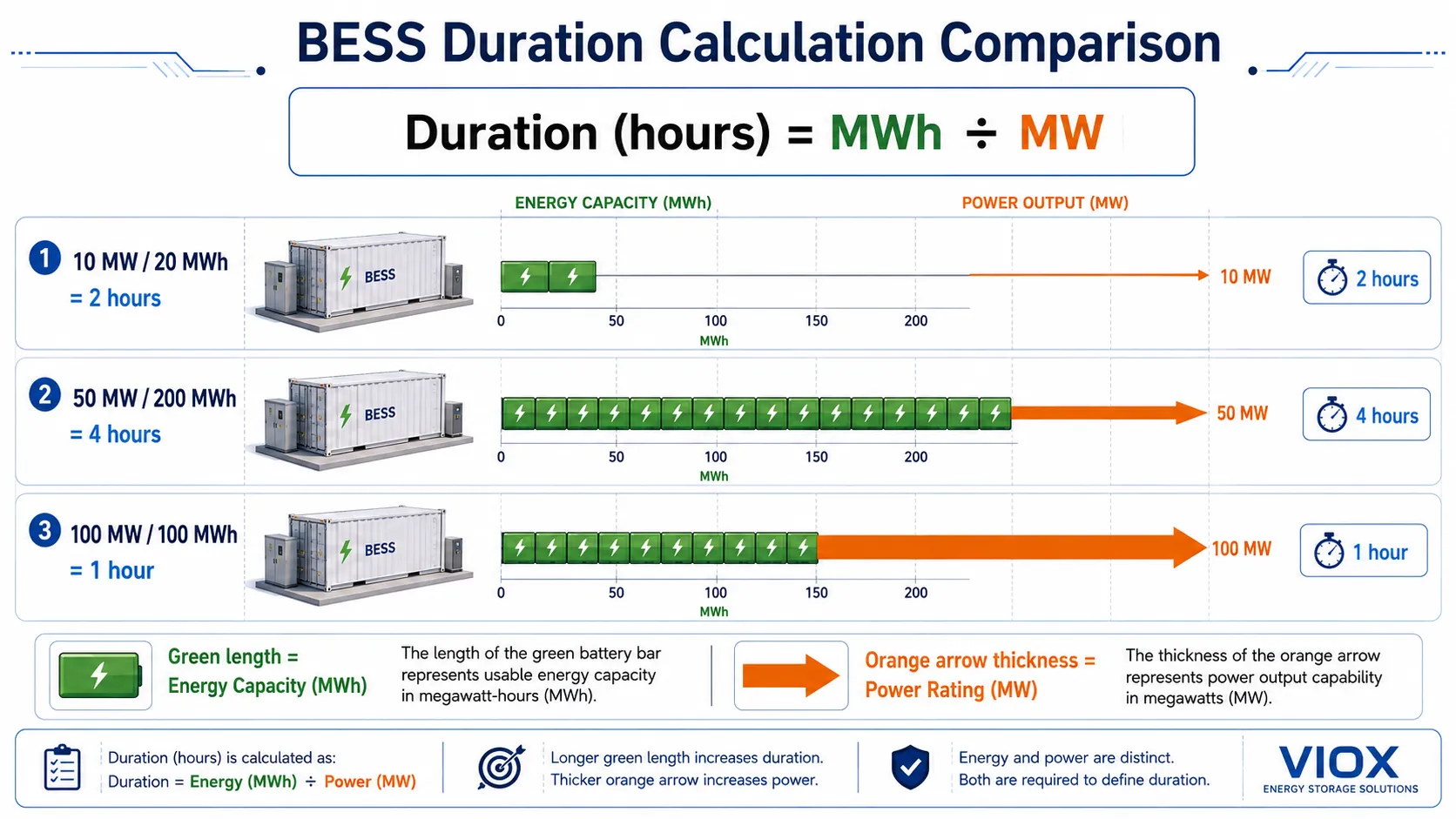
The most important BESS formula is:
Duration (hours) = Energy (MWh) ÷ Power (MW)Or:
Energy (MWh) = Power (MW) × Duration (hours)مثال ها:
| BESS rating | محاسبه | Approximate duration |
|---|---|---|
| ۱۰ مگاوات / ۲۰ مگاواتساعت | ۲۰ مگاواتساعت ÷ ۱۰ مگاوات | 2 ساعت |
| ۵۰ مگاوات / ۲۰۰ مگاواتساعت | ۲۰۰ مگاواتساعت ÷ ۵۰ مگاوات | 4 ساعت |
| ۱۰۰ مگاوات / ۱۰۰ مگاواتساعت | ۱۰۰ مگاواتساعت ÷ ۱۰۰ مگاوات | ۱ ساعت |
| ۲۵۰ مگاوات / ۱,۰۰۰ مگاواتساعت | ۱,۰۰۰ مگاواتساعت ÷ ۲۵۰ مگاوات | 4 ساعت |
This is why a battery project is often described using both numbers: power / energy.
For example, a 100 MW / 400 MWh system is commonly described as a four-hour battery because:
400 MWh ÷ 100 MW = 4 hoursNameplate Energy vs Usable Energy
Be careful: nameplate energy is not always the same as usable energy.
A battery may be advertised as 5 MWh, but the usable energy may be lower because of:
- state-of-charge limits
- depth-of-discharge limits
- thermal limits
- degradation reserve
- inverter and auxiliary losses
- warranty operating window
For project work, always distinguish:
- nominal or nameplate energy
- usable energy
- guaranteed energy at a defined condition
This is one reason BESS datasheets and warranties must be read carefully.
P-Rate in BESS
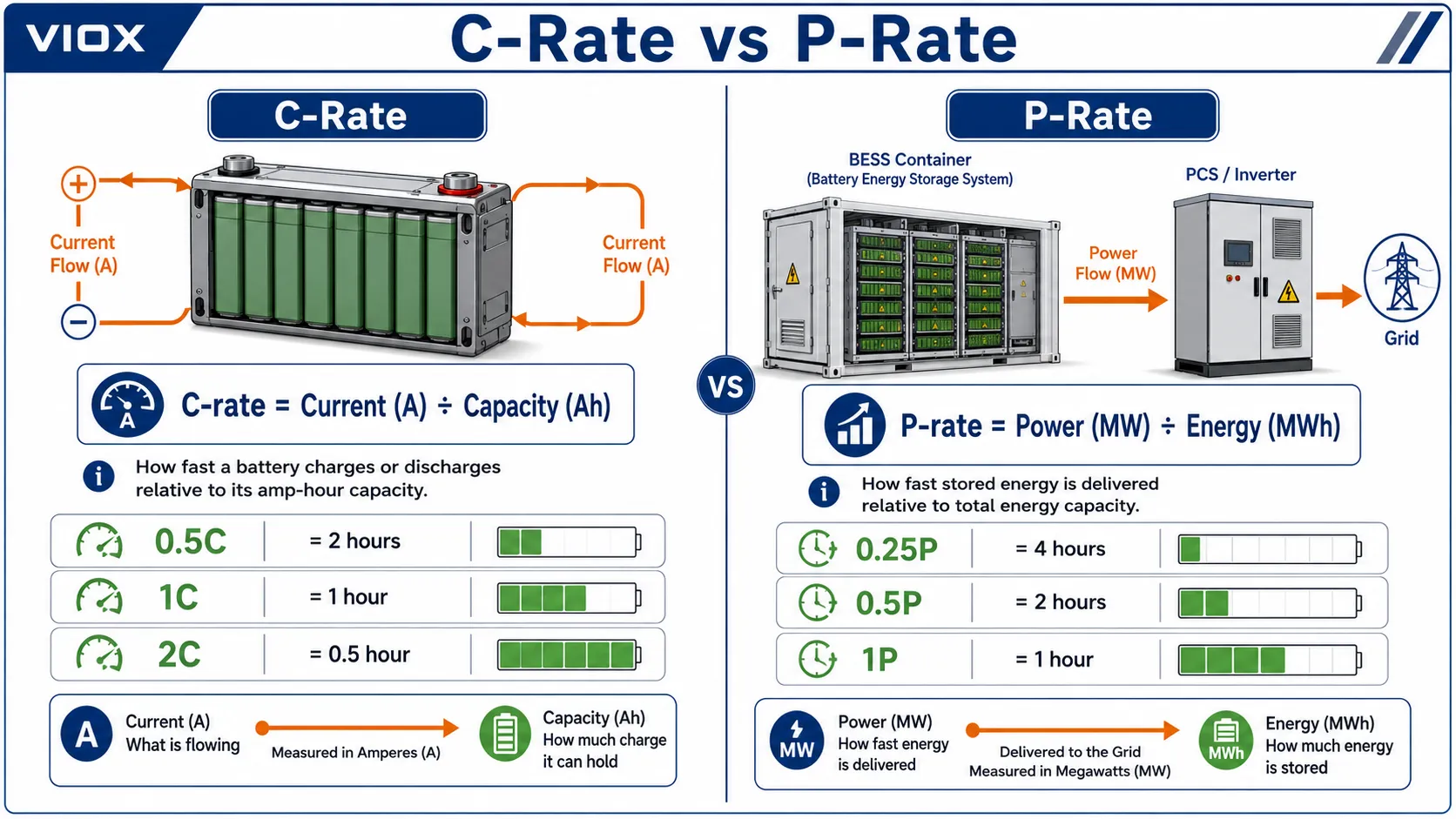
P-rate is the ratio between power and energy capacity. It is widely useful in BESS because project-level systems are usually described in MW and MWh rather than cell current and Ah.
The simplified formula is:
P-rate = Power rating (MW) ÷ Energy capacity (MWh)مثال ها:
| BESS rating | P-rate | Approximate full-power duration |
|---|---|---|
| 10 MW / 40 MWh | 0.25P | 4 ساعت |
| ۱۰ مگاوات / ۲۰ مگاواتساعت | 0.5P | 2 ساعت |
| 10 MW / 10 MWh | 1P | ۱ ساعت |
| 10 MW / 5 MWh | 2P | 0.5 hour |
P-rate answers:
How aggressively is the BESS being charged or discharged relative to its stored energy?
A high P-rate system is optimized for short, high-power events such as frequency response. A lower P-rate system is more suitable for longer duration applications such as energy shifting.
C-Rate in Cells and Battery Packs
C-rate describes charge or discharge current relative to battery capacity. It is more common at cell, module, and pack level than at grid-project level.
The simplified formula is:
C-rate = Current (A) ÷ Capacity (Ah)If a battery cell is rated at 100 Ah:
| فعلی | C-rate | زمان تقریبی در تخلیه کامل ایدهآل |
|---|---|---|
| 25 آمپر | 0.25C | 4 ساعت |
| 50 آمپر | 0.5C | 2 ساعت |
| 100 آمپر | 1C | ۱ ساعت |
| 200 آمپر | 2C | 0.5 hour |
وبسایت Battery University همین مفهوم پایه را توضیح میدهد: نرخ 1C معادل یک ساعت تخلیه، 0.5C معادل حدود دو ساعت و 2C معادل حدود 30 دقیقه در شرایط سادهسازی شده است. عملکرد واقعی باتری ممکن است به دلیل تلفات داخلی، محدودیتهای ولتاژ، دما، محدودیتهای سیستم مدیریت باتری (BMS) و شیمی سلول متفاوت باشد.
نرخ C در مقابل نرخ P
| مورد | C-rate | P-rate |
|---|---|---|
| Based on | Current vs Ah capacity | Power vs energy capacity |
| Common level | Cell, module, pack | BESS project, PCS, plant |
| فرمول | A ÷ Ah | مگاوات (MW) ÷ مگاواتساعت (MWh) |
| کاربرد اصلی | تنش باتری، طراحی حرارتی، انتخاب سلول | مدت زمان ذخیرهسازی، کاربرد در شبکه، ابعاد پروژه |
| مثال | ۱۰۰ آمپر برای یک سلول ۱۰۰ آمپرساعت = 1C | ۵۰ مگاوات / ۲۰۰ مگاواتساعت = 0.25P |
این دو با هم مرتبط هستند، اما یکسان نیستند. نرخ C مستقیماً به جریان باتری و ظرفیت آمپرساعت بستگی دارد. نرخ P به توان و انرژی وابسته است. رابطه بین آنها با تغییر ولتاژ، بازدهی، محدوده عملکرد و پیکربندی سیستم تغییر میکند.
آمپرساعت (Ah) در مقابل واتساعت (Wh): ظرفیت در مقابل انرژی
Ah measures charge capacity. Wh measures energy. This distinction matters because two batteries with the same Ah rating can store different energy if their voltage is different.
The formula is:
Wh = Ah × VOr:
kWh = Ah × V ÷ 1,000مثال:
| باتری | آمپر ساعت (Ah) | Nominal voltage | انرژی |
|---|---|---|---|
| Battery A | 100 Ah | ۱۲ ولت | ۱.۲ کیلووات ساعت |
| باتری B | 100 Ah | ۴۸ ولت | ۴.۸ کیلووات ساعت |
| باتری C | 100 Ah | ۸۰۰ ولت | ۸۰ کیلووات ساعت |
All three are 100 Ah batteries, but they are not the same energy capacity. In high-voltage storage systems, Wh or kWh is usually more useful than Ah alone.
Series and Parallel: What S and P Mean
Battery packs are built by connecting cells or modules in series and parallel.
- Series (S) increases voltage.
- Parallel (P) increases Ah capacity and current capability.
Simplified rules:
Series voltage = cell voltage × number of cells in series
Parallel capacity = cell Ah × number of parallel strings
For a deeper beginner explanation, see VIOX’s guide on series and parallel circuits.
Series Example
If one lithium cell has a nominal voltage of 3.2 V:
416 cells in series = 416 × 3.2 V = 1,331.2 V nominalThe Ah capacity stays the same as one cell or one parallel group, but the voltage rises.
Parallel Example
If one cell is 100 Ah:
4 cells in parallel = 4 × 100 Ah = 400 AhThe nominal voltage stays the same as one cell, but the Ah capacity rises.
What Does 1P416S Mean?
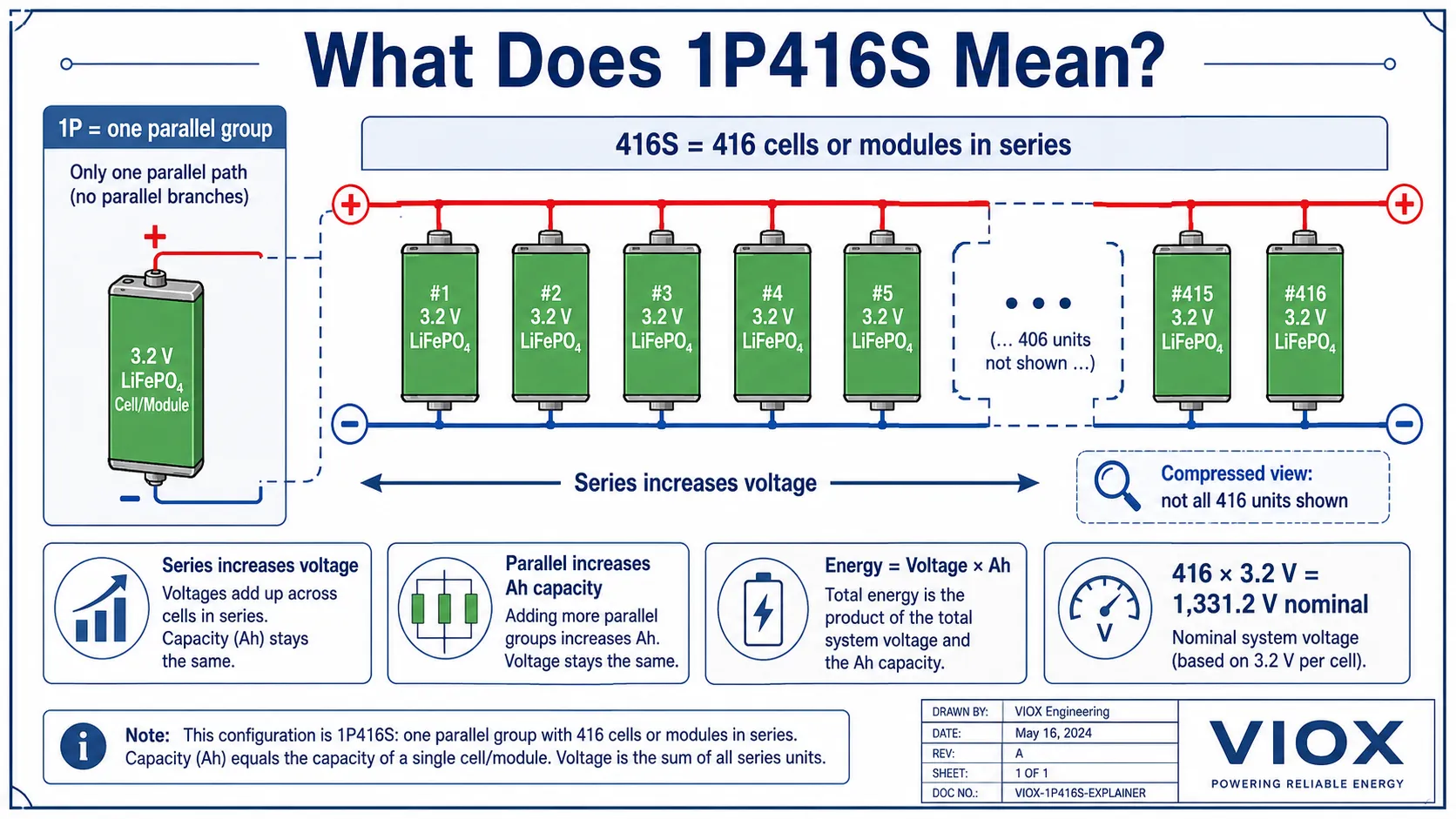
In battery notation, 1P416S usually means:
- 1P: one parallel group
- 416S: ۴۱۶ سلول یا واحد متصلشده به صورت سری
اگر هر سلول دارای ولتاژ نامی ۳.۲ ولت و ظرفیت ۱۰۰ آمپر-ساعت باشد:
ولتاژ نامی = ۴۱۶ × ۳.۲ ولت = ۱۳۳۱.۲ ولتاگر این نمادگذاری به جای سلولهای تکی به ماژولها اشاره داشته باشد، همان منطق اعمال میشود، اما ولتاژ و ظرفیت هر بلوک سازنده باید از برگه داده (دیتاشیت) ماژول استخراج شود.
ولتاژ یا انرژی پک را تنها بر اساس نمادگذاری S/P حدس نزنید. شما همچنان به موارد زیر نیاز دارید:
- ولتاژ نامی سلول یا ماژول
- نرخ آمپر-ساعت (Ah) سلول یا ماژول
- usable SOC window
- BMS limits
- series/parallel architecture
- manufacturer datasheet
SOC vs SOH vs DOD
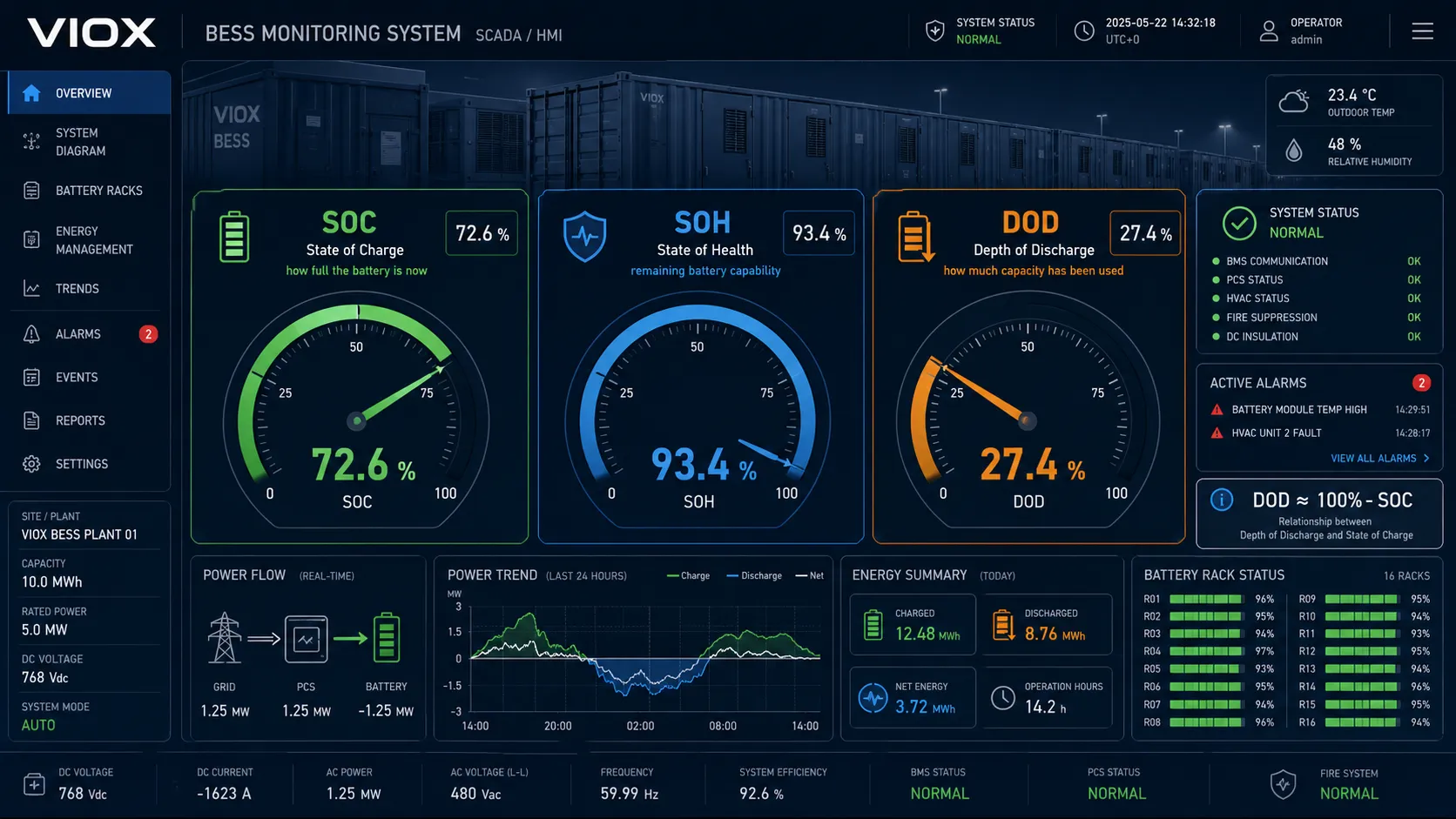
SOC, SOH, and DOD are battery state terms. They are often confused because all three use percentages.
| اصطلاح | معنی | Simple interpretation |
|---|---|---|
| SOC | وضعیت شارژ (SOC) | How full the battery is now |
| SOH | State of health | How much battery capability remains compared with new or rated condition |
| عمق تخلیه (DOD) | Depth of discharge | How much of the battery has been used or is allowed to be used |
SOC: State of Charge
SOC tells you the current charge level of the battery.
مثال ها:
- 100% SOC means the battery is full according to its defined operating window.
- 50% SOC means it is halfway charged.
- 10% SOC means it is near the lower operating limit.
In real systems, 0% and 100% displayed SOC do not always mean the electrochemical cell is absolutely empty or absolutely full. The BMS may reserve margins at the top and bottom to protect battery life and safety.
DOD: Depth of Discharge
DOD tells you how much of the battery capacity has been used or is allowed to be used.
In the simplified current-state relationship:
DOD = 100% - SOCIf a battery is at 30% SOC, it has approximately 70% DOD relative to a simple full-to-empty scale.
But in project documents, DOD is often used to describe the permitted operating window. For example, an 80% DOD operating strategy may mean the system uses only 80% of nameplate energy to reduce ageing or preserve warranty margin.
SOH: State of Health
SOH describes battery ageing and remaining capability. A new battery may be treated as 100% SOH. As it ages, usable capacity, internal resistance, power capability, or efficiency may degrade.
Commonly, SOH is discussed as:
SOH ≈ present usable capacity ÷ original usable capacity × 100%However, SOH is not always calculated the same way by every manufacturer. Some BMS algorithms consider capacity, impedance, cycle count, temperature history, and power capability. For warranty or asset valuation, always check how the supplier defines SOH.
Usable Energy Example: Why SOC and DOD Matter
Suppose a BESS has:
- nameplate energy: 1 MWh
- allowed DOD: 90%
- usable energy before efficiency losses: 0.9 MWh
If the PCS is rated at 500 kW:
Usable duration = 0.9 MWh ÷ 0.5 MW = 1.8 hoursIf the same 1 MWh battery is limited to 80% DOD:
Usable energy = 1 MWh × 80% = 0.8 MWh
Usable duration = 0.8 MWh ÷ 0.5 MW = 1.6 hours
The battery did not change physically. The usable operating window changed.
This is why serious BESS evaluation should always ask:
- Is the MWh value nameplate or usable?
- At what SOC window?
- At what temperature?
- At what power level?
- At what SOH or warranty point?
- Before or after AC-side efficiency losses?
اشتباهات رایج
Mistake 1: Using MW and MWh Interchangeably
MW is power. MWh is energy. A 100 MW battery and a 100 MWh battery are not the same statement. A complete BESS rating usually needs both.
Mistake 2: Assuming a Larger MWh Rating Means Higher Power
A 200 MWh battery can have a 50 MW PCS or a 100 MW PCS. The MWh rating tells you stored energy, not inverter output power.
Mistake 3: Ignoring Duration
A 100 MW / 100 MWh system and a 100 MW / 400 MWh system both have the same power rating, but one is roughly one hour and the other is roughly four hours.
Mistake 4: Confusing Ah with Energy
Ah alone is incomplete unless voltage is known. Always convert Ah to Wh or kWh when comparing battery systems with different voltages.
Mistake 5: Treating C-Rate and P-Rate as the Same
C-rate is current-based. P-rate is power-based. They often point in the same direction, but they are not identical because voltage and efficiency matter.
Mistake 6: Quoting 100% DOD as Normal Usable Energy
Many lithium battery systems do not use the full theoretical cell range in normal operation. The BMS may limit SOC window to protect safety, life, and warranty performance.
Mistake 7: Reading 1P416S Without Cell Data
S/P notation tells you the connection architecture, not the final kWh by itself. You still need cell voltage and Ah rating.
سوالات متداول
What is the difference between kWh and MWh in battery storage?
kWh and MWh both measure energy. 1 MWh equals 1,000 kWh. Residential and small commercial batteries are often described in kWh, while utility-scale BESS projects are usually described in MWh.
What is the difference between MW and MWh?
MW measures power, or how fast energy is delivered. MWh measures energy, or how much electricity is stored. A battery rated 50 MW / 200 MWh can deliver 50 MW for about four hours before considering losses and operating limits.
How do I calculate battery storage duration?
Use:
Duration = Energy ÷ PowerFor example, 200 MWh ÷ 50 MW = 4 hours.
What does 1C mean in batteries?
1C means the battery is charged or discharged at a current equal to its Ah capacity. A 100 Ah cell at 1C is charged or discharged at 100 A under simplified conditions.
What is the difference between C-rate and P-rate?
C-rate compares current with Ah capacity. P-rate compares power with energy capacity. C-rate is more common at cell and pack level, while P-rate is useful for BESS project duration and power sizing.
What does SOC mean?
SOC means state of charge. It describes how full the battery is at a given moment, usually as a percentage.
What does SOH mean?
SOH means state of health. It describes how much performance or capacity remains compared with the battery’s new or rated condition. The exact calculation method depends on the BMS and manufacturer.
What does DOD mean?
DOD means depth of discharge. It describes how much battery capacity has been used or is allowed to be used. In a simplified current-state view, DOD is approximately 100% minus SOC.
What does 1P416S mean?
1P416S usually means one parallel group and 416 series-connected cells or modules. The total voltage depends on the voltage of each series unit, and the total energy also depends on Ah capacity.
Is a 100 MW battery bigger than a 50 MW battery?
It has a higher power rating, but not necessarily more stored energy. A 100 MW / 100 MWh battery stores less energy than a 50 MW / 200 MWh battery, even though its power rating is higher.
منابع مرتبط VIOX
- راهنمای کامل سیستمهای ذخیره انرژی باتری
- What Are Electrical Energy Storage Systems?
- What’s the Difference Between kW vs. kWh?
- Series and Parallel Circuits: What’s the Difference?
- BESS Surge Protection Guide