Άμεση απάντηση
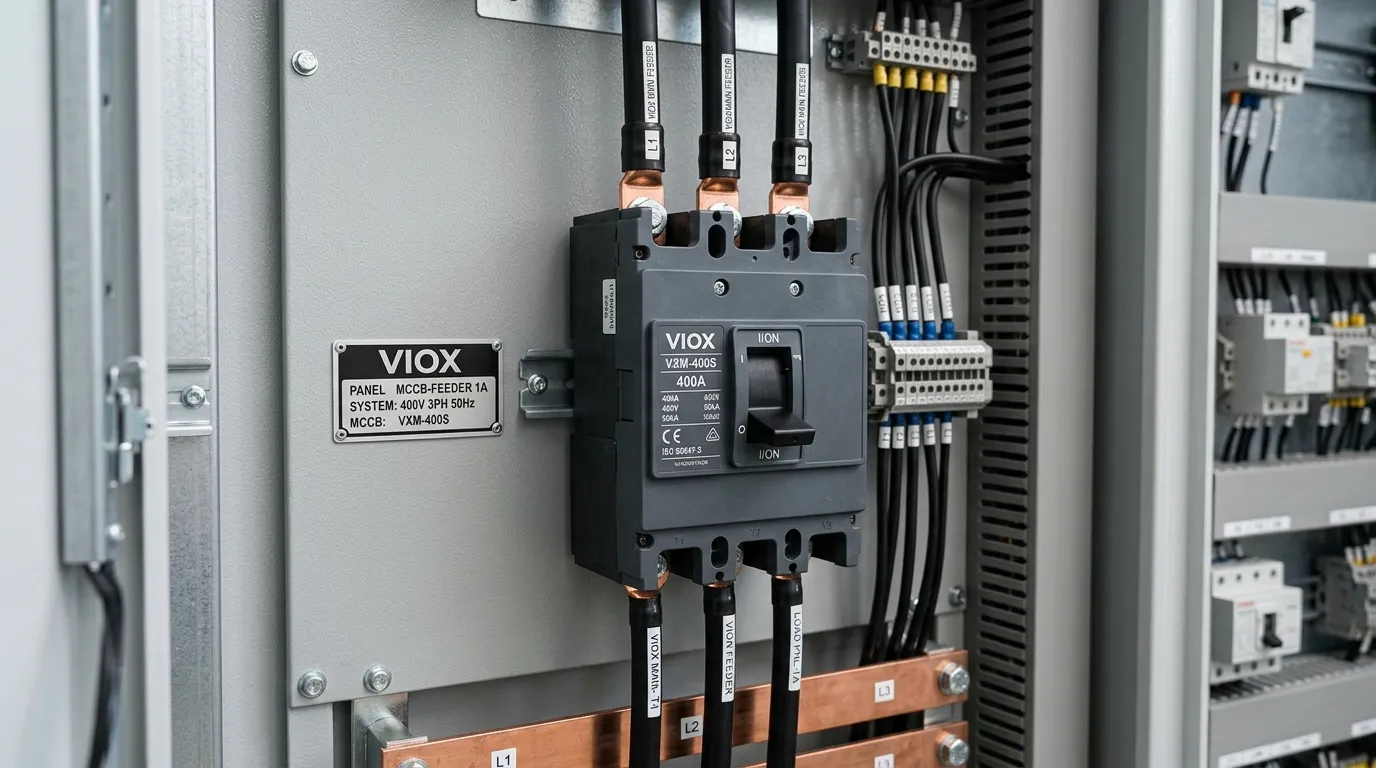
A molded case circuit breaker (MCCB) is a low-voltage circuit breaker used to protect feeders, larger branch circuits, machinery supplies, and distribution equipment against overloads and short circuits. Compared with a smaller MCB, an MCCB typically offers a higher current range, higher breaking capacity, and more flexible trip-unit options for commercial and industrial power systems.
In practical terms, an MCCB sits in the middle of the low-voltage protection hierarchy:
- MCB for smaller final circuits
- MCCB for larger feeders and higher-duty branch protection
- ACB for the highest-current low-voltage switchboard roles
If you’re trying to decide whether your system has outgrown a miniature breaker, that is the practical threshold: an MCCB is the heavier-duty low-voltage breaker used when the circuit needs more capacity and more protection flexibility than a miniature breaker can usually provide.
If you only need the acronym explanation, see Πλήρης Μορφή MCCB: Molded Case Circuit Breaker (Αυτόματος Διακόπτης Χυτής Θήκης).
Βασικά συμπεράσματα
- An MCCB is a διακόπτης κυκλώματος με χυτευμένη θήκη used for low-voltage feeder and higher-duty circuit protection.
- MCCBs are commonly used where current, fault level, or trip-setting requirements exceed the practical range of standard MCBs.
- The most important things to understand are: what is inside an MCCB, how it trips, and which ratings matter.
- The key ratings are not just current and voltage. They also include breaking capacity, trip-unit type, and accessory requirements.
- An MCCB guide should explain fundamentals first. Detailed selection, comparison, and trip-unit tuning can then branch into more specialized pages.
Τι είναι ένα MCCB;
An MCCB is an overcurrent protective device enclosed in a molded insulating housing. It is designed for low-voltage systems where the circuit demands more robust protection than a miniature branch breaker can typically offer.
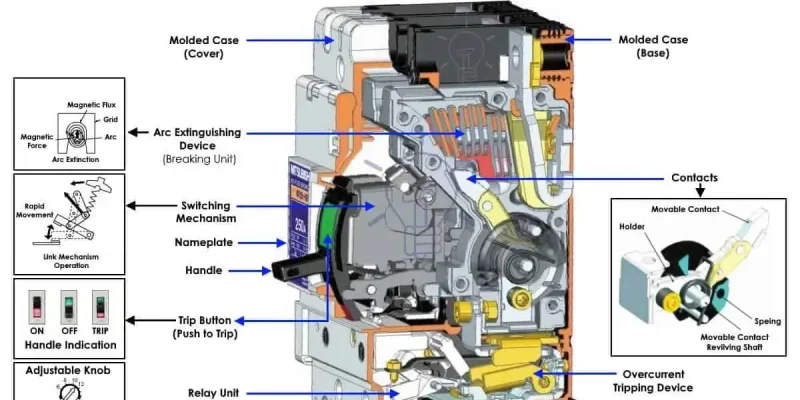
The phrase molded case refers to the insulating enclosure that contains the current-carrying contacts, the operating mechanism, the arc-interruption structure, and the trip unit. The breaker is not open-frame like an ACB, and it is not as compact or limited in duty as a small DIN-rail miniature breaker.
In most real installations, MCCBs are used for:
- outgoing feeders from distribution boards
- larger motor and machinery circuits
- sub-main distribution
- generator and transfer-related feeder protection
- panelboard and switchboard branch protection above typical MCB duties
If you want the product-level view rather than the educational overview, see the VIOX MCCB page.
How an MCCB Works
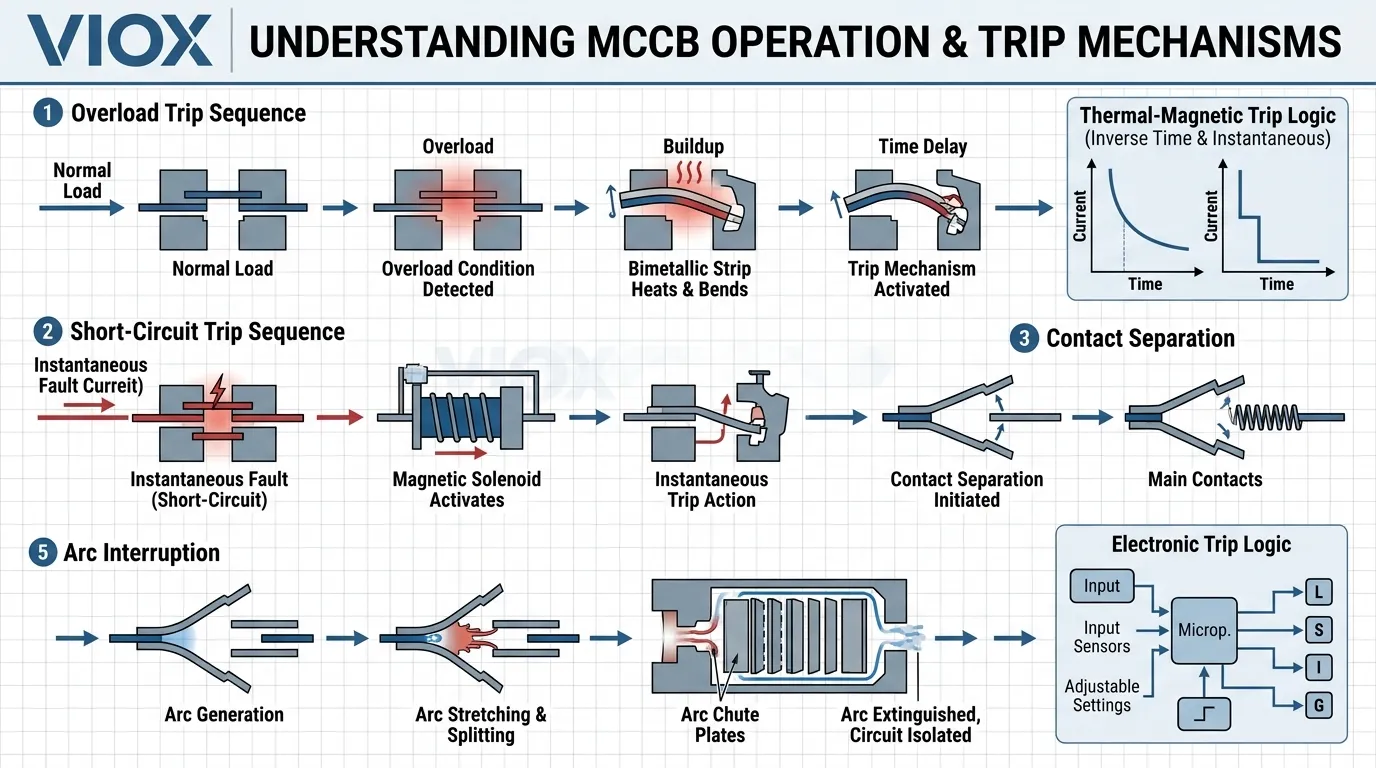
At a high level, an MCCB performs two jobs:
- It carries normal load current continuously within its rating.
- It opens the circuit automatically when a fault condition exceeds its trip characteristics.
The breaker detects faults through its trip system, which may be:
- thermal-magnetic
- electronic
In a thermal-magnetic MCCB:
- the thermal element responds to sustained overload conditions
- the magnetic element responds to higher short-circuit currents
In an electronic MCCB:
- current is measured more precisely
- trip logic can often be adjusted across multiple protection functions
- coordination and application flexibility are usually higher
In more advanced applications, that usually means the engineer is no longer thinking only in terms of “will it trip?” but also in terms of πώς it trips. Electronic trip units are often discussed through protection functions such as L, S, I, and sometimes G:
L= long-time protectionS= short-time protectionI= instantaneous protectionG= ground-fault protection where provided
Those settings shape the device’s time-current characteristic (TCC) and are central to coordination studies. In other words, an electronic MCCB is often selected not just for higher current, but because its trip behavior can be tuned to fit the rest of the system.
The interruption sequence itself is mechanical and electrical. When the trip unit commands the breaker to open, the contacts separate, an arc forms, and the arc is forced into the arc-control structure until the fault current is interrupted safely.
For the detailed technology comparison, see Ηλεκτρονικό έναντι Θερμομαγνητικού MCCB.
What Is Inside an MCCB?
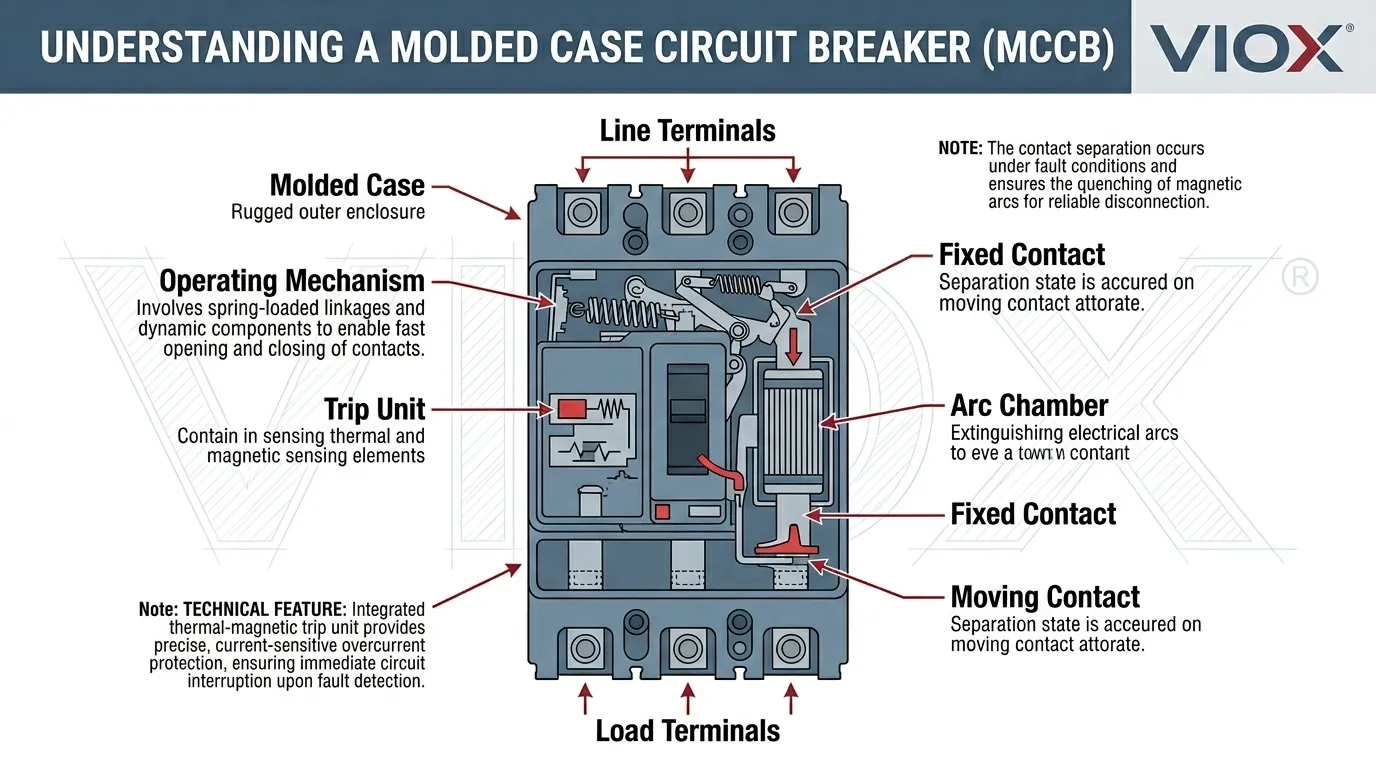
This is one of the most useful ways to answer the inside mccb query, because many readers are really asking how the device is built and why it costs more than a miniature breaker.
The typical internal sections of an MCCB include:
1. Molded Insulating Case
The enclosure provides mechanical protection, insulation, dimensional stability, and support for the internal parts. It must tolerate heat, fault stress, and long service life in switchboards and panels.
2. Fixed and Moving Contacts
These carry current in normal operation and separate when the breaker trips. Contact design affects temperature rise, reliability, and electrical endurance.
3. Operating Mechanism
The operating mechanism stores and releases energy to open or close the contacts. This is the part the user interacts with through the handle, but it is also the mechanical system that ensures the contacts open decisively under fault conditions.
4. Trip Unit
The trip unit is the protection brain of the MCCB. Depending on breaker type, it may be:
- thermal-magnetic
- electronic with adjustable settings
In more advanced designs, the trip unit supports functions such as long-time, short-time, and instantaneous protection, and sometimes additional logic depending on the product family.
5. Arc Chute or Arc-Interruption Structure
When the breaker opens under fault current, an electrical arc forms. The arc chute stretches, cools, and divides the arc so the breaker can interrupt current safely.
6. Line and Load Terminals
These connect the MCCB into the system. In practical installation work, terminal quality, torque control, conductor fit, and busbar interface are all important to long-term reliability.
7. Accessories
Many MCCBs support accessories such as:
- βοηθητικές επαφές
- shunt trips
- απελευθερώσεις υποτάσεως
- motor operators
- alarm contacts
These turn the breaker from a simple protective device into part of a broader control and monitoring system.
If accessories are central to your application, related specialist topics such as auxiliary contacts and shunt-trip functions are worth covering separately.
Key MCCB Ratings You Should Understand
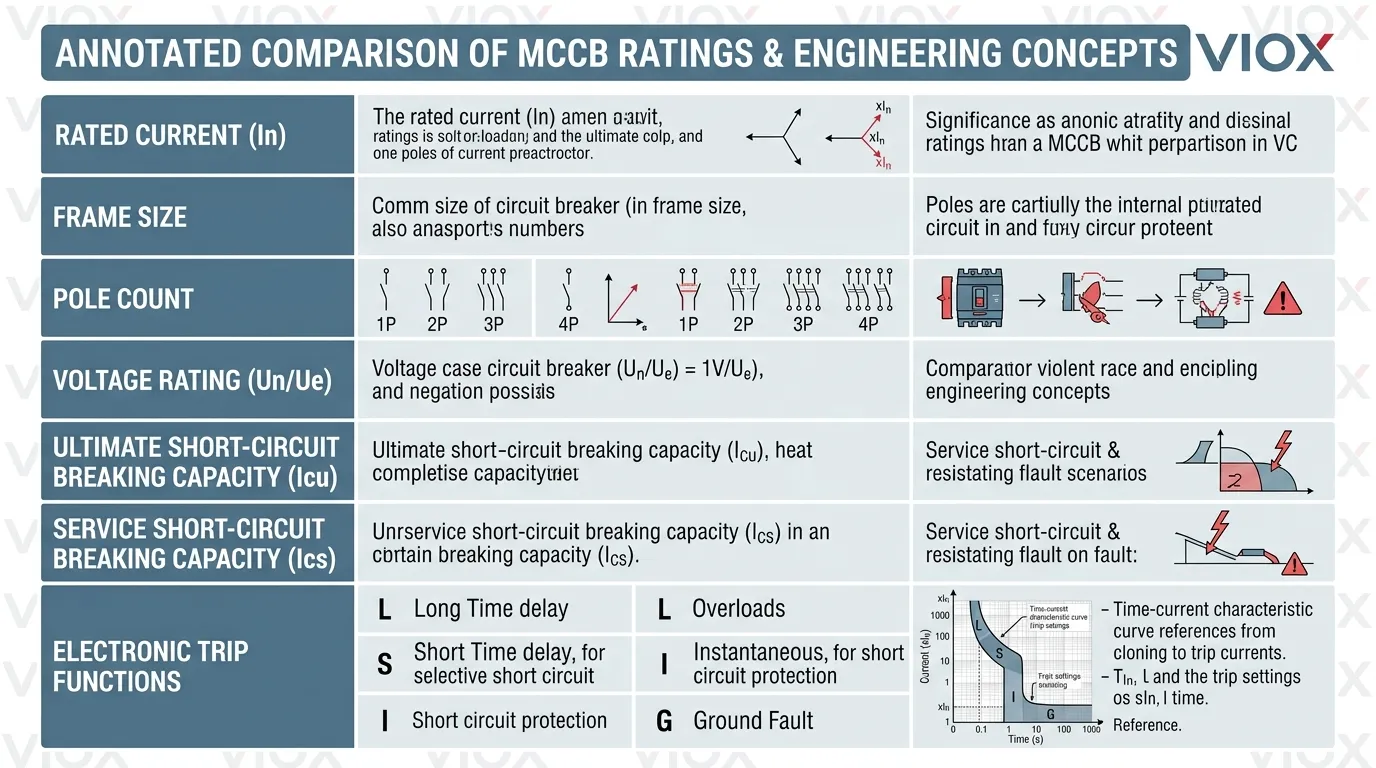
One reason engineers move from simple breaker discussions into MCCB-specific content is that the ratings start to matter a lot more.
Ονομαστικό ρεύμα
This is the current the breaker is intended to carry under defined conditions. It is one of the first values people look at, but it is not the only one that matters.
Μέγεθος Πλαισίου
The frame establishes the physical breaker platform and current envelope. Different trip settings may exist within the same frame family.
Εκτίμηση Τάσης
The breaker must match the system voltage and the application context, including AC or DC suitability where relevant.
Pole Count
Common pole configurations include:
- 2-πολικό
- 3-πολικός
- 4-πολικός
Pole count selection depends on system architecture, conductor switching requirements, and neutral treatment.
Ικανότητα θραύσης
This is one of the most important MCCB parameters. The breaker must be able to interrupt the prospective fault current available at the installation point.
Key terms often include:
IcuIcs
These ratings affect whether the breaker is suitable for the actual fault level and service expectation of the installation.
For a more focused discussion, see Πώς να Διαβάσετε τις Πινακίδες MCCB για Ηλεκτρική Ασφάλεια.
Τύπος Μηχανισμού Απόζευξης
Trip-unit architecture strongly affects:
- adjustability
- συντονισμός
- repeatability
- monitoring potential
That is why an MCCB guide should mention trip-unit type even at the fundamentals level.
Common Types of MCCBs
There are several useful ways to classify MCCBs. A practical guide should keep the taxonomy simple.
By Trip Technology
- thermal-magnetic MCCB
- electronic MCCB
This is often the most meaningful classification in real projects because it directly affects settings, accuracy, and coordination. Once a system requires selective coordination, tighter setting control, or more advanced protection logic, the conversation usually moves toward electronic trip units and their TCC behavior rather than simple fixed-trip breaker selection.
By Application Duty
Some MCCBs are selected for straightforward feeder protection, while others are chosen because the application requires:
- higher interrupting performance
- more adjustable trip behavior
- stronger coordination support
- accessory integration
By Mounting and System Integration
Depending on the manufacturer and system, MCCBs may be integrated into panelboards, switchboards, machinery assemblies, or dedicated protective compartments.
For most readers, the useful question is not “How many MCCB types exist?” but rather:
Which trip technology, rating class, and accessory set fit my application?
Πού Χρησιμοποιούνται οι MCCB;
MCCBs are widely used in low-voltage commercial and industrial systems. Typical applications include:
- main outgoing feeders from a low-voltage distribution board
- sub-distribution and panel feeders
- motor and machinery supply circuits
- HVAC distribution
- generator feeder protection
- transfer-related power distribution assemblies
- larger branch circuits where MCB capacity is not enough
This is one reason the mccbs query tends to attract engineers, panel builders, and procurement teams rather than casual residential users. MCCBs usually appear where system duty is higher and the consequences of poor selection are more serious.
MCCB vs MCB: A Short Practical Comparison
This page should explain the basic difference, but not replace the dedicated comparison page.
| Χαρακτηριστικό γνώρισμα | MCCB | MCB |
|---|---|---|
| Τυπικός ρόλος | Feeder and higher-duty branch protection | Smaller final circuits |
| Εύρος ρεύματος | Broader and higher | Lower and more limited |
| Σπάζοντας ικανότητα | Γενικά υψηλότερο | Γενικά χαμηλότερο |
| Trip setting flexibility | Συχνά ευρύτερη | Usually simpler |
| Εφαρμογές | Commercial and industrial distribution | Residential and lighter-duty branch circuits |
The practical takeaway is simple:
- choose MCB for smaller final circuits
- choose MCCB where the duty level, fault level, or protection flexibility goes beyond that range
For the dedicated comparison, see MCCB vs MCB.
How to Choose an MCCB: High-Level Selection Logic
This page should give readers the framework, then hand off detailed sizing to the specialized guide.
At a high level, MCCB selection starts with:
- ρεύμα φορτίου
- τάση του συστήματος
- αριθμός πόλων
- available short-circuit current
- required breaking capacity
- trip-unit type
- accessory and control requirements
- συντονισμός με ανάντη και κατάντη συσκευές
That is enough for the fundamentals page.
If the reader is already sizing a real panel, they should go deeper into the dedicated guide: Πώς να επιλέξετε ένα MCCB για έναν πίνακα.
Installation, Maintenance, and Testing Basics
MCCBs are often treated as durable, low-maintenance devices, but that should not be confused with “ignore them forever.”
At a basic level, good practice includes:
- correct conductor and terminal matching
- proper torque application
- thermal inspection of loaded connections
- visual inspection for damage or overheating
- periodic functional checks appropriate to the installation
For breakers with electronic trip units, testing and verification may go beyond a simple mechanical check. A proper maintenance plan depends on:
- breaker duty
- fault history
- criticality of the system
- manufacturer guidance
This guide only needs to establish that testing matters. It does not need to become the dedicated testing page.
Common Mistakes People Make with MCCBs
1. Treating Current Rating as the Only Selection Factor
Current rating matters, but an MCCB can still be wrong if the breaking capacity, trip-unit type, or coordination is unsuitable.
2. Using an MCCB Where an MCB Would Do
Overspecifying protection can waste budget and space without adding real value.
3. Using an MCB Where an MCCB Is Required
This is the opposite error, and often the more dangerous one. Higher fault duty, larger feeders, and more demanding applications often require MCCB-level protection.
4. Ignoring Trip-Unit Technology
Trip-unit choice affects not only protection performance but also adjustability and selectivity.
5. Skipping Nameplate Review
Many selection errors happen because the breaker label is not fully understood. Breaking capacity, frame, and trip details all matter.
Συχνές Ερωτήσεις
What is a molded case circuit breaker?
A molded case circuit breaker is a low-voltage overcurrent protective device enclosed in a molded insulating housing. It is used for feeder and higher-duty branch protection where current level, fault duty, or trip flexibility exceed the practical range of a miniature breaker.
Ποια είναι η διαφορά μεταξύ MCCB και MCB;
An MCCB is generally used for larger circuits, higher fault levels, and more demanding protection duties, while an MCB is usually used for smaller final circuits with simpler protection requirements.
What is inside an MCCB?
A typical MCCB contains a molded insulating case, fixed and moving contacts, an operating mechanism, a trip unit, arc-control components, terminals, and often optional accessories such as auxiliary contacts or shunt trips.
Where are MCCBs used?
MCCBs are commonly used in low-voltage commercial and industrial distribution systems, including feeders, machinery circuits, sub-distribution boards, and larger branch circuits.
What do Icu and Ics mean on an MCCB?
They are breaking-capacity-related ratings that help determine whether the breaker is suitable for the available short-circuit current and expected service duty in the system.
Is every MCCB electronic?
No. MCCBs may use thermal-magnetic or electronic trip technology, depending on the application and product family.
How do I choose the right MCCB?
You choose the right MCCB by matching the current, voltage, pole count, available fault level, breaking capacity, trip-unit type, and coordination requirements of the installation.
Συμπέρασμα
If you want the clearest answer to what is molded case circuit breaker, it is this:
An MCCB is a low-voltage circuit breaker for feeders and higher-duty branch circuits where current level, fault level, or trip flexibility exceed the normal working range of a miniature breaker.
That is also why this page should exist separately from: