

Σε αυτή τη σελίδα
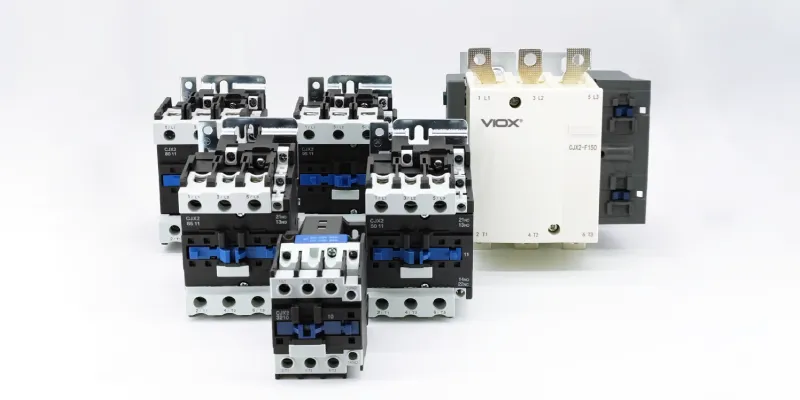
Η κύρια διαφορά μεταξύ ενός Επαφέας εναλλασσόμενου ρεύματος και Ο επαφέας DC είναι ο τρόπος με τον οποίο κάθε συσκευή διαχειρίζεται το ρεύμα που μεταγωγίζει. Ένα ρελέ ισχύος AC έχει σχεδιαστεί για εναλλασσόμενο ρεύμα, όπου το ρεύμα διέρχεται φυσικά από το μηδέν πολλές φορές ανά δευτερόλεπτο. Ένα ρελέ ισχύος DC έχει σχεδιαστεί για συνεχές ρεύμα, όπου το τόξο δεν έχει φυσική διέλευση από το μηδέν και είναι πολύ πιο δύσκολο να σβήσει.
Αυτή η διαφορά επηρεάζει σχεδόν κάθε σημαντικό μέρος του ρελέ: το πηνίο, τον μαγνητικό πυρήνα, το διάκενο επαφών, τον θάλαμο κατάσβεσης τόξου, το υλικό των επαφών, τη σήμανση πολικότητας και την κατηγορία χρήσης. Ένα ρελέ δεν πρέπει ποτέ να επιλέγεται μόνο με βάση την ένταση του ρεύματος. Ο τύπος φορτίου, ο τύπος τάσης, η τάση πηνίου, ο κύκλος μεταγωγής και η κατηγορία χρήσης κατά IEC πρέπει να αντιστοιχούν στην εφαρμογή.
Για τυπικό έλεγχο κινητήρων AC, συστήματα HVAC, φωτισμό και ωμικά φορτία AC, ένα ρελέ ισχύος AC είναι συνήθως η σωστή επιλογή. Για μπαταρίες, φωτοβολταϊκά, ηλεκτρικά οχήματα, κινητήρες DC, οδηγούς DC και συστήματα αποθήκευσης ενέργειας, απαιτείται κανονικά ένα ρελέ με προδιαγραφές DC.
Ρελέ ισχύος AC έναντι DC: Γρήγορη σύγκριση
| Χαρακτηριστικό γνώρισμα | Επαφέας ΕΝΑΛΛΑΣΣΌΜΕΝΟΥ ρεύματος | ΣΥΝΕΧΉΣ Επαφέας |
|---|---|---|
| Τρέχων τύπος | Εναλλασσόμενο ρεύμα (AC) | Συνεχές ρεύμα (DC) |
| Συμπεριφορά τόξου | Το τόξο εξασθενεί φυσικά σε κάθε μηδενική διέλευση | Το τόξο είναι συνεχές και δυσκολότερο να σβήσει |
| Μαγνητικός πυρήνας | Ελασματοποιημένος πυρήνας για τη μείωση της θέρμανσης από δινορεύματα | Ο συμπαγής πυρήνας είναι συνηθισμένος επειδή η μαγνητική ροή είναι σταθερή |
| Δακτύλιος βραχυκύκλωσης (Shading ring) | Συνήθως απαιτείται για τη μείωση του βόμβου και του συντονισμού (chatter) | Δεν απαιτείται σε ένα κανονικό μαγνητικό σύστημα συνεχούς ρεύματος (DC) |
| Συμπεριφορά πηνίου | Το ρεύμα του πηνίου επηρεάζεται από την εμπέδηση και τη θέση του οπλισμού | Το ρεύμα του πηνίου περιορίζεται κυρίως από την αντίσταση της περιέλιξης ή από κύκλωμα εξοικονόμησης ενέργειας |
| Καταστολή τόξου | Βασίζεται εν μέρει στη διέλευση από το μηδέν του εναλλασσόμενου ρεύματος (AC) και στον θάλαμο απόσβεσης τόξου | Απαιτεί ισχυρότερο θάλαμο απόσβεσης τόξου, μεγαλύτερο διάκενο επαφών, μαγνητική εκτόξευση τόξου ή σφραγισμένο θάλαμο τόξου |
| Ευαισθησία πολικότητας | Συνήθως δεν είναι ευαίσθητο στην πολικότητα από την πλευρά του φορτίου | Ορισμένοι επαφείς συνεχούς ρεύματος (DC) είναι ευαίσθητοι στην πολικότητα λόγω της μαγνητικής εκτόξευσης τόξου |
| Τυπικά φορτία | Κινητήρες AC, HVAC, αντλίες, ανεμιστήρες, φωτισμός, θερμαντήρες | Μπαταρίες, ηλεκτρικά οχήματα (EV), φωτοβολταϊκά, συστήματα αποθήκευσης ενέργειας (BESS), περονοφόρα ανυψωτικά, κινητήρες DC, σιδηροδρομικά και ναυτιλιακά συστήματα DC |
| Κοινές κατηγορίες IEC | AC-1, AC-3, AC-4 | DC-1, DC-3, DC-5 |
| Εναλλαξιμότητα | Μη χρησιμοποιείτε για DC εκτός εάν το επιτρέπει το φύλλο δεδομένων | Μπορεί να είναι χρησιμοποιήσιμο για ορισμένα φορτία AC μόνο εάν οι ονομαστικές τιμές του πηνίου και των επαφών ταιριάζουν, αλλά συχνά δεν είναι οικονομικά αποδοτικό |
Τι είναι ένας επαφέας AC;
Ένα Επαφέας εναλλασσόμενου ρεύματος είναι μια ηλεκτρομηχανική συσκευή μεταγωγής σχεδιασμένη για τον έλεγχο φορτίων AC από απόσταση. Χρησιμοποιεί ένα πηνίο για τη δημιουργία μαγνητικού πεδίου που έλκει έναν οπλισμό, κλείνοντας τις κύριες επαφές και επιτρέποντας τη ροή ρεύματος προς το φορτίο.
Οι επαφείς AC χρησιμοποιούνται ευρέως σε:
- έλεγχος τριφασικού επαγωγικού κινητήρα
- συμπιεστές και ανεμιστήρες συστημάτων HVAC
- αντλίες και φυσητήρες
- κυκλώματα φωτισμού
- ωμικά φορτία θέρμανσης
- συστοιχίες πυκνωτών, όταν καθορίζεται επαφέας για φορτία πυκνωτών
- γενικοί βιομηχανικοί πίνακες ελέγχου
Το βασικό σημείο σχεδιασμού είναι ότι το εναλλασσόμενο ρεύμα (AC) διέρχεται από το μηδέν σε κάθε ημιπερίοδο. Σε ένα σύστημα 50 Hz, υπάρχουν 100 διελεύσεις από το μηδέν ανά δευτερόλεπτο. Σε ένα σύστημα 60 Hz, υπάρχουν 120 διελεύσεις από το μηδέν ανά δευτερόλεπτο. Αυτό βοηθά τον επαφέα να σβήσει το τόξο κατά το άνοιγμα των επαφών.
Αυτό δεν σημαίνει ότι τα τόξα AC είναι ακίνδυνα. Οι επαφείς εξακολουθούν να χρειάζονται σωστές ονομαστικές τιμές χρήσης, κατάλληλα υλικά επαφών και κατάλληλους θαλάμους απόσβεσης τόξου. Ωστόσο, η μεταγωγή AC είναι συνήθως λιγότερο απαιτητική από τη μεταγωγή DC στην ίδια τάση και ένταση, επειδή το ρεύμα βοηθά φυσικά στην κατάσβεση του τόξου.
Για προϊόντα ελέγχου κινητήρων AC, δείτε το VIOX Επαφέας εναλλασσόμενου ρεύματος σειρά προϊόντων.
Τι είναι ένας ρελές ισχύος συνεχούς ρεύματος (DC Contactor);
A Ο επαφέας DC είναι ένας ρελές ισχύος σχεδιασμένος για τη μεταγωγή φορτίων συνεχούς ρεύματος. Επειδή το συνεχές ρεύμα δεν διέρχεται φυσικά από το μηδέν, ένα τόξο DC μπορεί να συνεχιστεί μετά το άνοιγμα των επαφών, εκτός εάν ο ρελές είναι σχεδιασμένος να αναγκάζει το τόξο να επιμηκυνθεί, να ψυχθεί, να διασπαστεί ή να μεταφερθεί σε θάλαμο απόσβεσης τόξου.
Οι ρελέ ισχύος DC χρησιμοποιούνται συνήθως σε:
- συστήματα αποθήκευσης ενέργειας μπαταριών (BESS)
- ηλεκτρικά οχήματα και συστήματα φόρτισης EV
- κυκλώματα φωτοβολταϊκών DC
- κινητήρες DC και ρυθμιστές στροφών DC
- περονοφόρα ανυψωτικά μηχανήματα και αυτόνομα κατευθυνόμενα οχήματα (AGVs)
- σιδηροδρομικά και ναυτιλιακά συστήματα ισχύος συνεχούς ρεύματος (DC)
- διανομή ισχύος συνεχούς ρεύματος (DC) σε τηλεπικοινωνίες
- συστήματα ελέγχου και εφεδρείας συνεχούς ρεύματος (DC) έκτακτης ανάγκης
Οι επαφείς συνεχούς ρεύματος (DC) αποκτούν όλο και μεγαλύτερη σημασία καθώς αναπτύσσονται τα συστήματα ηλιακής ενέργειας, μπαταριών, ηλεκτρικών οχημάτων (EV) και διανομής συνεχούς ρεύματος. Ωστόσο, ένας επαφέας DC δεν είναι απλώς ένας επαφέας εναλλασσόμενου ρεύματος (AC) με διαφορετική ετικέτα. Ο εσωτερικός σχεδιασμός ελέγχου του τόξου είναι διαφορετικός.
Πηνίο AC έναντι Πηνίου DC
Το πηνίο είναι ένα από τα σημεία όπου είναι πιο εύκολο να γίνει λάθος κατά την επιλογή.
Πηνίο επαφέα AC
Ένα πηνίο AC τροφοδοτείται από εναλλασσόμενο ρεύμα. Το ρεύμα του περιορίζεται τόσο από την αντίσταση της περιέλιξης όσο και από την επαγωγική αντίδραση. Όταν ο οπλισμός είναι ανοιχτός, το μαγνητικό διάκενο είναι μεγάλο και το πηνίο μπορεί να τραβήξει υψηλότερο ρεύμα εισόδου (inrush current). Αφού κλείσει ο οπλισμός, το μαγνητικό κύκλωμα βελτιώνεται και το ρεύμα συγκράτησης μειώνεται.
Οι περισσότεροι επαφείς AC χρησιμοποιούν ελασματοποιημένο μαγνητικό πυρήνα και δακτύλιος σκίασης. Ο ελασματοποιημένος πυρήνας μειώνει τη θέρμανση από δινορεύματα. Ο δακτύλιος βραχυκύκλωσης (shading ring) βοηθά στη διατήρηση της μαγνητικής έλξης κατά τις στιγμές που το εναλλασσόμενο ρεύμα διέρχεται από το μηδέν, μειώνοντας τον θόρυβο και τους κραδασμούς.
Πηνίο επαφέα DC
Ένα πηνίο DC τροφοδοτείται από συνεχές ρεύμα. Επειδή το σταθερό συνεχές ρεύμα δεν δημιουργεί την ίδια εναλλασσόμενη μαγνητική ροή με το AC, ο μαγνητικός πυρήνας είναι συχνά συμπαγής αντί για ελασματοποιημένος. Το ρεύμα του πηνίου περιορίζεται κυρίως από την αντίσταση της περιέλιξης ή από ένα ηλεκτρονικό κύκλωμα εξοικονόμησης ενέργειας (economizer) στους μεγαλύτερους επαφείς.
Πολλοί μεγαλύτεροι επαφείς DC χρησιμοποιούν μια στρατηγική σύζευξης και συγκράτησης (pickup-and-hold). Ο επαφέας μπορεί να χρειάζεται υψηλότερη ισχύ για να κλείσει και στη συνέχεια χαμηλότερη ισχύ για να παραμείνει κλειστός. Ένας εξοικονομητής μειώνει τη θέρμανση του πηνίου και την κατανάλωση ενέργειας αφού ο επαφέας έχει κλείσει.
Καταστολή υπερτάσεων πηνίου: Αντι-ηλεκτρεγερτική δύναμη (Back-EMF) και επαγωγική ανάκρουση
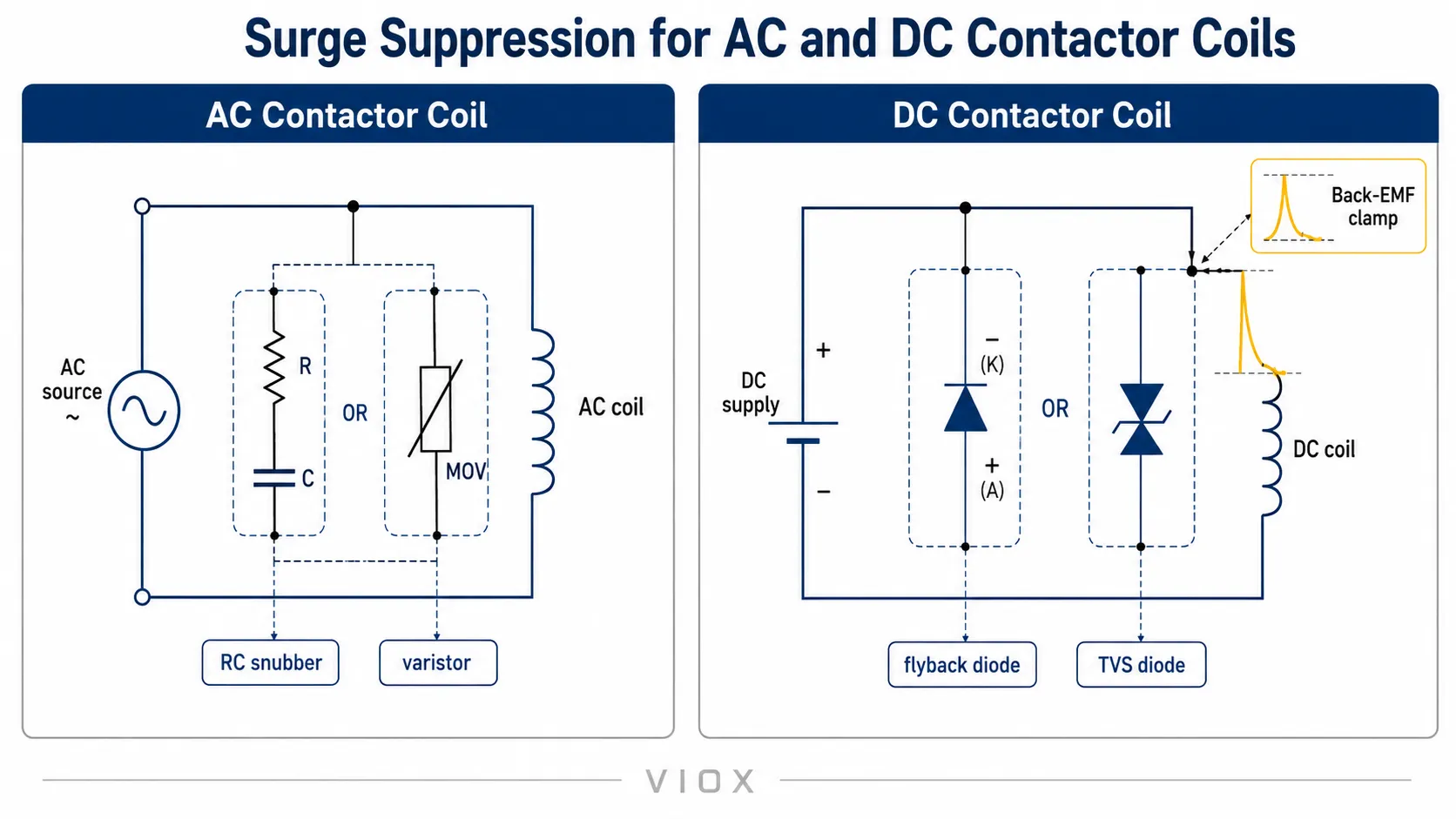
Το ίδιο το πηνίο αποτελεί επαγωγικό φορτίο. Όταν το κύκλωμα ελέγχου απενεργοποιεί το πηνίο, το καταρρέον μαγνητικό πεδίο μπορεί να δημιουργήσει μια αιχμή τάσης γνωστή ως αντίθετη ηλεκτρεγερτική δύναμη (Back-EMF) ή επαγωγική ανάδραση. Εάν αυτή η αιχμή δεν ελεγχθεί, μπορεί να προκαλέσει ζημιά σε εξόδους PLC, επαφές ρελέ, επαφές χρονοδιακοπτών, αισθητήρες ή ηλεκτρονικές πλακέτες ελέγχου.
Για πηνία AC, η καταστολή επιτυγχάνεται συχνά με ένα κύκλωμα RC snubber ή μια μονάδα βαρίστορ, ανάλογα με το κύκλωμα ελέγχου και τη σειρά εξαρτημάτων του κατασκευαστή. Για πηνία DC, μια δίοδος ελεύθερης ροής (flyback diode) είναι συνηθισμένη σε απλά κυκλώματα, ενώ μια δίοδος καταστολής παροδικής τάσης (TVS) ή ένας ειδικός καταστολέας υπερτάσεων μπορεί να προτιμάται όταν απαιτείται ταχύτερος χρόνος απελευθέρωσης.
Αυτή η λεπτομέρεια έχει σημασία στους πίνακες αυτοματισμού. Μια δίοδος ελεύθερης ροής περιορίζει αποτελεσματικά την αιχμή τάσης, αλλά μπορεί να επιβραδύνει την απελευθέρωση του επαφέα επειδή το ρεύμα του πηνίου φθίνει πιο αργά. Σε κυκλώματα διακοπής έκτακτης ανάγκης, ασφαλείας ή ακολουθιών υψηλής ταχύτητας, ελέγχετε πάντα τον χρόνο απελευθέρωσης του επαφέα και το εγκεκριμένο εξάρτημα καταστολής στο φύλλο δεδομένων.
Τι συμβαίνει εάν η τάση του πηνίου είναι λανθασμένη;
Η εφαρμογή λανθασμένης τροφοδοσίας στο πηνίο μπορεί να προκαλέσει άμεσα προβλήματα:
- Ένα πηνίο DC συνδεδεμένο σε AC μπορεί να παρουσιάσει κραδασμούς (chatter), υπερθέρμανση ή αποτυχία σωστού κλεισίματος.
- Ένα πηνίο AC συνδεδεμένο σε DC μπορεί να υπερθερμανθεί επειδή στερείται της προβλεπόμενης συμπεριφοράς σύνθετης αντίστασης AC.
- Δεν μπορεί να θεωρηθεί ότι ένα πηνίο 24 V δέχεται τόσο 24 V AC όσο και 24 V DC, εκτός εάν αναφέρεται ρητά στο δελτίο τεχνικών δεδομένων.
- Ένα πηνίο γενικής χρήσης AC/DC αποτελεί ειδικό σχεδιασμό και όχι προεπιλεγμένο χαρακτηριστικό.
Να ελέγχετε πάντα την τάση και τον τύπο ρεύματος του πηνίου στην ετικέτα του ρελέ ισχύος ή στο δελτίο τεχνικών δεδομένων.
Ελασματοποιημένος πυρήνας έναντι συμπαγούς πυρήνα
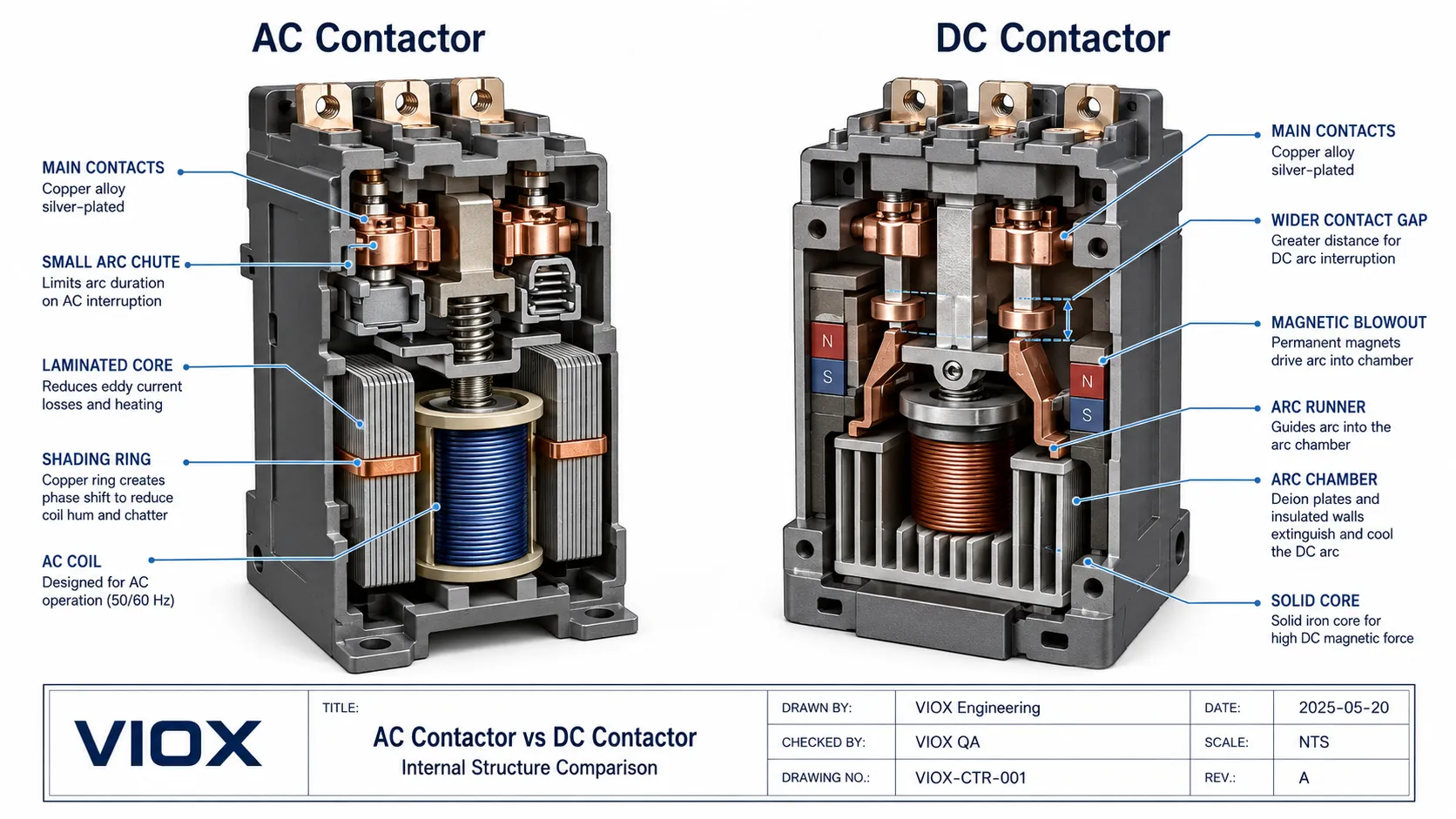
Ο μαγνητικός πυρήνας αποτελεί μια άλλη σημαντική διαφορά.
| Χαρακτηριστικό πυρήνα | Επαφέας ΕΝΑΛΛΑΣΣΌΜΕΝΟΥ ρεύματος | ΣΥΝΕΧΉΣ Επαφέας |
|---|---|---|
| Μαγνητική ροή | Εναλλασσόμενο | Σταθερό |
| Κίνδυνος δινορευμάτων | Υψηλότερη | Πολύ χαμηλότερο |
| Τυπική κατασκευή πυρήνα | Ελασματοποιημένος χάλυβας πυριτίου | Ο συμπαγής σίδηρος ή χάλυβας είναι συνηθισμένος |
| Δακτύλιος βραχυκύκλωσης (Shading ring) | Συνηθισμένο | Συνήθως δεν απαιτείται |
| Σύνηθες σύμπτωμα βλάβης | Βόμβος, κραδασμοί, υπερθέρμανση σε περίπτωση αστοχίας του πηνίου ή του δακτυλίου βραχυκύκλωσης | Υπερθέρμανση πηνίου λόγω λανθασμένης τάσης ή προβλήματος στον οικονομιστή |
Σε έναν επαφέα AC, το μαγνητικό πεδίο μεταβάλλεται συνεχώς. Ένας συμπαγής πυρήνας θα επέτρεπε την κυκλοφορία δινορευμάτων, προκαλώντας θερμότητα. Τα ελάσματα διακόπτουν αυτές τις διαδρομές κυκλοφορίας των ρευμάτων.
Σε έναν επαφέα DC, το μαγνητικό πεδίο είναι σταθερό μετά την ενεργοποίηση, επομένως η θέρμανση από δινορεύματα αποτελεί μικρότερο πρόβλημα. Ένας συμπαγής πυρήνας μπορεί να χρησιμοποιηθεί αποτελεσματικά.
Αυτός είναι ο λόγος για τον οποίο η ερώτηση εκπαιδευτικού τύπου “τα συγκροτήματα επαφέων AC αποτελούνται από ελασματωμένο ___, ενώ τα συγκροτήματα DC είναι συμπαγή” αναδεικνύει τη διαφορά στον μαγνητικό πυρήνα.
Γιατί οι επαφείς DC χρειάζονται ισχυρότερη κατάσβεση τόξου
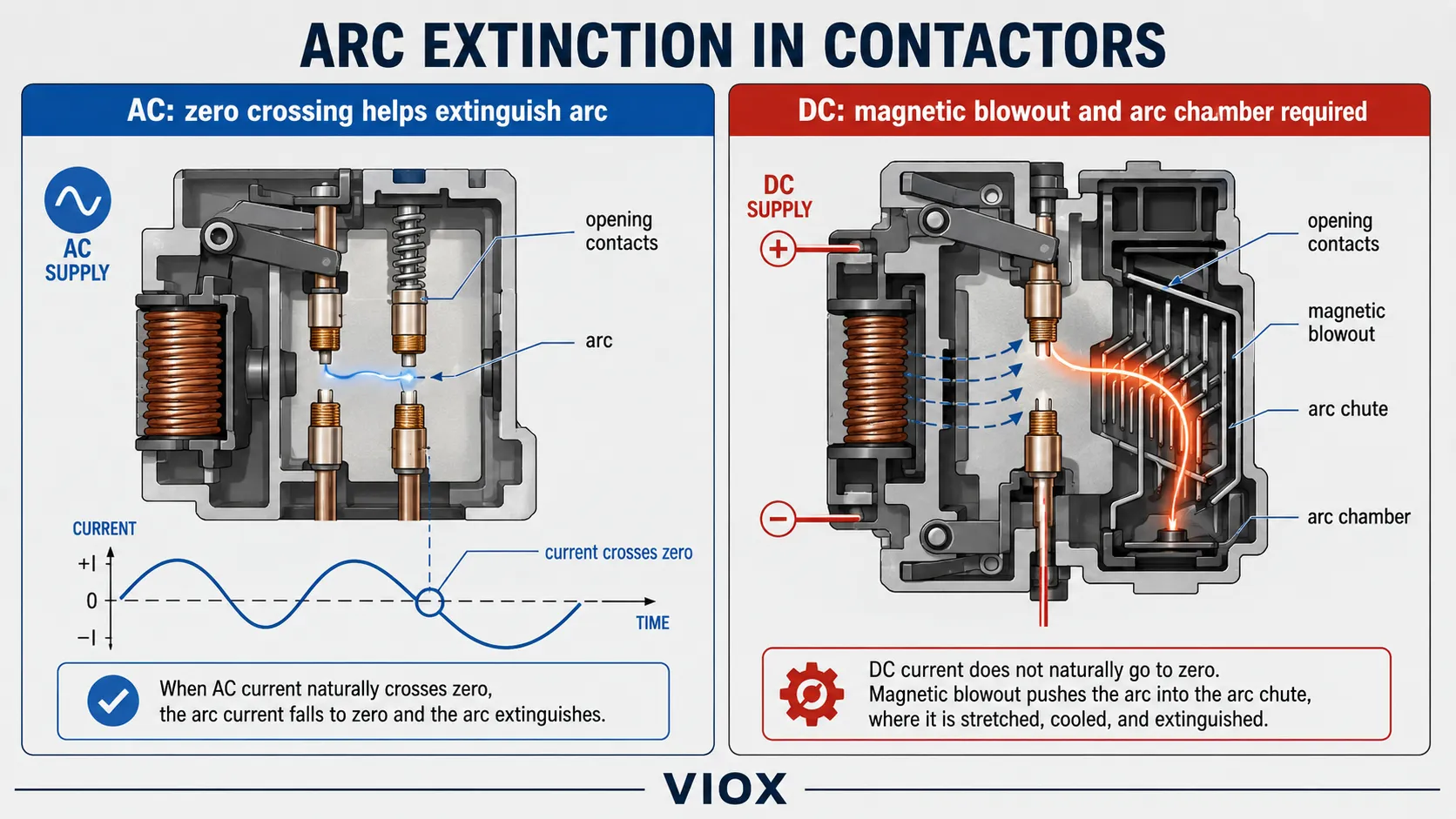
Όταν ένας επαφέας ανοίγει υπό φορτίο, οι επαφές διαχωρίζονται, αλλά το ρεύμα μπορεί να συνεχίσει να ρέει μέσω ενός τόξου. Η δυσκολία δεν έγκειται μόνο στο άνοιγμα των επαφών, αλλά στην ασφαλή κατάσβεση του τόξου.
Κατάσβεση τόξου AC
Σε ένα κύκλωμα AC, το ρεύμα διασχίζει φυσικά το μηδέν. Εκείνη τη στιγμή, το τόξο χάνει ενέργεια. Εάν το διάκενο των επαφών και ο θάλαμος απόσβεσης έχουν ανακτήσει επαρκή διηλεκτρική αντοχή, το τόξο δεν επαναφλέγεται.
Οι επαφείς AC εξακολουθούν να χρησιμοποιούν θαλάμους απόσβεσης τόξου και κατάλληλη γεωμετρία επαφών, αλλά η μηδενική διέλευση τους προσφέρει ένα σημαντικό πλεονέκτημα.
Κατάσβεση τόξου DC
Σε ένα κύκλωμα DC, δεν υπάρχει φυσική μηδενική διέλευση. Μόλις σχηματιστεί το τόξο, μπορεί να συνεχίσει να καίει εάν ο επαφέας δεν μπορεί να το αναγκάσει να σβήσει. Αυτό μπορεί να οδηγήσει σε διάβρωση των επαφών, συγκόλληση επαφών, ζημιά στη μόνωση ή αποτυχία ασφαλούς διακοπής του φορτίου.
Οι επαφείς DC ενδέχεται να χρησιμοποιούν:
- ευρύτερα διαστήματα επαφών
- δομές μαγνητικής απόσβεσης τόξου
- οδηγούς τόξου (arc runners)
- ισχυρότεροι θάλαμοι απόσβεσης τόξου
- ερμητικά κλειστοί θάλαμοι τόξου
- σχεδιασμοί με πλήρωση αερίου ή κενού σε ορισμένους επαφείς υψηλών επιδόσεων
- έλεγχος τόξου ανάλογα με την πολικότητα
Για μια βαθύτερη εξήγηση σχετικά με τα ηλεκτρικά τόξα και τους θαλάμους απόσβεσης τόξου, δείτε τον οδηγό της VIOX σχετικά με τι είναι το ηλεκτρικό τόξο σε έναν αυτόματο διακόπτη ισχύος.
Είναι οι επαφείς συνεχούς ρεύματος (DC) ευαίσθητοι στην πολικότητα;
Ορισμένοι επαφείς DC είναι ευαίσθητοι στην πολικότητα, ειδικά εκείνοι που χρησιμοποιούν μόνιμους μαγνήτες για την κατάσβεση του τόξου. Το μαγνητικό πεδίο έχει σχεδιαστεί για να ωθεί το τόξο προς μια συγκεκριμένη κατεύθυνση μέσα στον θάλαμο κατάσβεσης. Εάν η κατεύθυνση του ρεύματος αντιστραφεί, το τόξο ενδέχεται να ωθηθεί μακριά από την προβλεπόμενη διαδρομή του.
Αυτός είναι ο λόγος για τον οποίο οι ακροδέκτες των επαφέων DC μπορεί να φέρουν σήμανση πολικότητας ή κατεύθυνσης γραμμής/φορτίου. Μην αγνοείτε αυτές τις σημάνσεις. Σε συστήματα μπαταριών και φωτοβολταϊκά συστήματα, το αντίστροφο ρεύμα, η κατεύθυνση φόρτισης/εκφόρτισης και η αμφίδρομη λειτουργία πρέπει να λαμβάνονται υπόψη κατά την επιλογή.
Εάν η εφαρμογή απαιτεί αμφίδρομη ροή ρεύματος, επιβεβαιώστε ότι ο επαφέας είναι ονομαστικά κατάλληλος για αυτή τη χρήση. Μην υποθέτετε ότι κάθε επαφέας DC είναι αμφίδρομος.
Υλικά επαφών και φθορά επαφών
Η μεταγωγή AC και DC μπορεί να καταπονήσει τις επιφάνειες των επαφών με διαφορετικό τρόπο.
Οι επαφείς AC χρησιμοποιούν συνήθως επαφές από κράμα αργύρου, σχεδιασμένες για μεταγωγή κινητήρων AC και ωμικών φορτίων. Οι επαφείς DC ενδέχεται να απαιτούν υλικά και δομές επαφών που αντιστέκονται καλύτερα στη διάβρωση από το τόξο DC και στη μεταφορά υλικού.
Σημαντικοί έλεγχοι που σχετίζονται με τις επαφές περιλαμβάνουν:
- ονομαστική τάση λειτουργίας
- ονομαστικό ρεύμα λειτουργίας
- κατηγορία χρήσης
- καμπύλη ηλεκτρικής αντοχής
- διάκενο επαφών
- τον σχεδιασμό του θαλάμου απόσβεσης τόξου
- σήμανση πολικότητας
- Την επαγωγή του φορτίου
- αναμενόμενη συχνότητα μεταγωγής
- συντονισμός προστασίας από βραχυκύκλωμα
Η συγκόλληση των επαφών προκαλείται συχνά από υπερβολικό ρεύμα εισόδου, λανθασμένη κατηγορία χρήσης, συμβάντα βραχυκυκλώματος, εσφαλμένη εφαρμογή σε συνεχές ρεύμα (DC) ή ανεπαρκή κατάσβεση του τόξου για το συγκεκριμένο φορτίο.
Κατηγορίες χρήσης κατά IEC: AC-1, AC-3, DC-1, DC-3, DC-5
Το ίδιο φυσικό πλαίσιο επαφέα μπορεί να έχει διαφορετικές ονομαστικές τιμές ρεύματος ανάλογα με την κατηγορία φορτίου. Αυτός είναι ένας από τους σημαντικότερους κανόνες επιλογής.
Οι κατηγορίες χρήσης κατά IEC χρησιμοποιούνται για την περιγραφή του τύπου φορτίου και του κύκλου μεταγωγής. Για τους επαφείς και τους εκκινητές κινητήρων, οι κατηγορίες αυτές σχετίζονται με το πρότυπο IEC 60947-4-1.
| Κατηγορία | Τυπικό φορτίο | Πρακτική Σημασία |
|---|---|---|
| AC-1 | Μη επαγωγικά ή ελαφρώς επαγωγικά φορτία εναλλασσόμενου ρεύματος (AC), όπως οι ωμικές αντιστάσεις θέρμανσης | Ευκολότερη λειτουργία μεταγωγής AC |
| AC-3 | Κινητήρες βραχυκυκλωμένου δρομέα, εκκίνηση και διακοπή λειτουργίας κατά τη διάρκεια της περιστροφής | Συνήθης λειτουργία επαφέα κινητήρα |
| AC-4 | Λειτουργία κινητήρα με αντίστροφη πέδηση (plugging), βηματική κίνηση (inching) και αναστροφή | Πολύ πιο απαιτητική λειτουργία μεταγωγής κινητήρα |
| DC-1 | Μη επαγωγικά ή ελαφρώς επαγωγικά φορτία DC | Ευκολότερη λειτουργία μεταγωγής DC |
| DC-3 | Κινητήρες DC παράλληλης διέγερσης, εκκίνηση, αντίστροφη πέδηση, βηματική κίνηση, δυναμική πέδηση | Πιο απαιτητική λειτουργία κινητήρα DC |
| DC-5 | Σειριακοί κινητήρες συνεχούς ρεύματος (DC), εκκίνηση, αντίστροφη πέδηση (plugging), λειτουργία βηματισμού (inching), δυναμική πέδηση | Βαριά καταπόνηση κινητήρων συνεχούς ρεύματος (DC) |
Αυτός είναι ο λόγος για τον οποίο ένας επαφέας με ονομαστική τιμή για υψηλό ρεύμα στην κατηγορία AC-1 μπορεί να έχει πολύ χαμηλότερη ονομαστική τιμή στις κατηγορίες AC-3 ή DC. Το ονομαστικό ρεύμα από μόνο του δεν αρκεί.
Μπορείτε να χρησιμοποιήσετε έναν επαφέα AC για DC;
Σε γενικές γραμμές, μην χρησιμοποιείτε επαφέα AC για φορτίο DC, εκτός εάν το δελτίο τεχνικών δεδομένων του κατασκευαστή το επιτρέπει ρητά για τη συγκεκριμένη τάση, το ρεύμα και την κατηγορία χρήσης DC.
Ο κίνδυνος δεν είναι ότι το πηνίο δεν μπορεί να οπλίσει. Ο μεγαλύτερος κίνδυνος είναι ότι οι κύριες επαφές δεν μπορούν να διακόψουν με ασφάλεια το τόξο συνεχούς ρεύματος. Σε χαμηλή τάση και χαμηλό ρεύμα DC, ορισμένοι κατασκευαστές ενδέχεται να επιτρέπουν ειδική συνδεσμολογία πόλων σε σειρά ή υποβιβασμό ισχύος (derating). Αλλά αυτό πρέπει να προκύπτει από το δελτίο τεχνικών δεδομένων και όχι από εικασίες.
Τα κυκλώματα μπαταριών υψηλού ρεύματος, φωτοβολταϊκών, ηλεκτρικών οχημάτων (EV) και κινητήρων DC πρέπει να χρησιμοποιούν επαφείς ειδικά σχεδιασμένους για μεταγωγή συνεχούς ρεύματος.
Μπορείτε να χρησιμοποιήσετε έναν ρελέ ισχύος DC για AC;
Μερικές φορές ένας ρελέ ισχύος DC μπορεί να είναι φυσικά ικανός να διακόψει ένα φορτίο AC, αλλά δεν αποτελεί αυτόματα τη σωστή επιλογή.
Πρέπει να ελέγξετε:
- εάν οι κύριες επαφές είναι ονομαστικά κατάλληλες για την τάση AC και την κατηγορία φορτίου
- εάν η τροφοδοσία του πηνίου αντιστοιχεί στο κύκλωμα ελέγχου
- εάν ο ρελέ ισχύος είναι υπερδιαστασιολογημένος ή ασύμφορος για τη συγκεκριμένη εργασία
- εάν η εφαρμογή απαιτεί κατηγορία χρήσης AC, όπως AC-1 ή AC-3
Σε πολλές συνηθισμένες εφαρμογές κινητήρων AC, ένας τυπικός ρελέ ισχύος AC είναι απλούστερος, φθηνότερος και καταλληλότερος.
Οδηγός Εφαρμογής: Πότε να χρησιμοποιήσετε κάθε τύπο
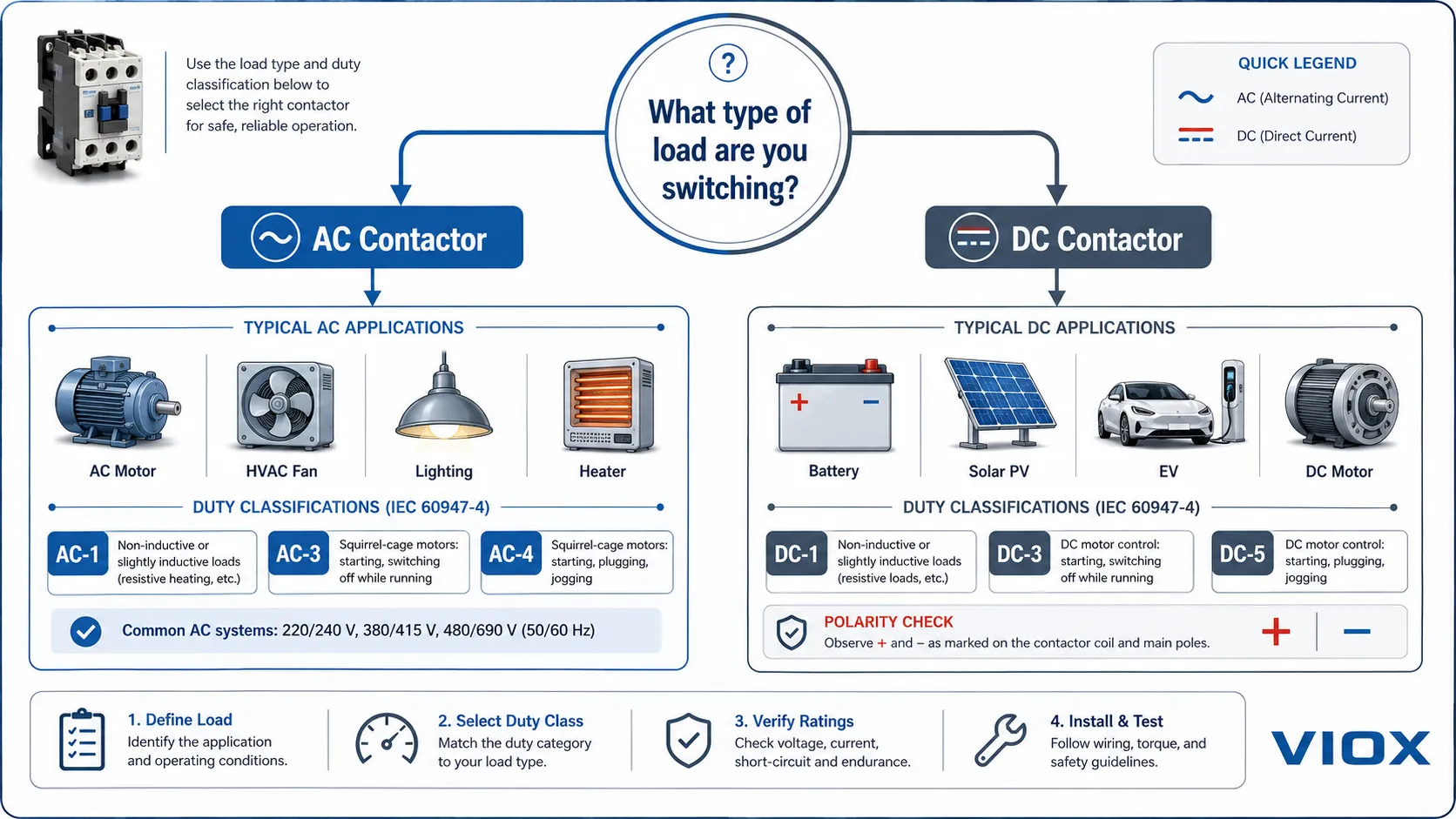
| Εφαρμογή | Προτεινόμενος τύπος ρελέ ισχύος | Λόγος |
|---|---|---|
| Τριφασικός επαγωγικός κινητήρας | Επαφέας εναλλασσόμενου ρεύματος | Σχεδιασμένο για κατηγορίες χρήσης κινητήρων AC όπως η AC-3 |
| Συμπιεστής ή ανεμιστήρας HVAC | Επαφέας εναλλασσόμενου ρεύματος | Κοινή εφαρμογή ρελέ ισχύος γενικής χρήσης ή κινητήρα |
| Ωμικός θερμαντήρας AC | Επαφέας εναλλασσόμενου ρεύματος | Η κατηγορία AC-1 ενδέχεται να εφαρμόζεται ανάλογα με τον σχεδιασμό |
| Πίνακας φωτισμού | Επαφέας εναλλασσόμενου ρεύματος | Χρήση κατάλληλης ονομαστικής τιμής για φορτία φωτισμού |
| Διακόπτης συνεχούς ρεύματος (DC) φωτοβολταϊκών | Ο επαφέας DC | Απαιτείται ικανότητα διακοπής τόξου συνεχούς ρεύματος (DC) |
| Αποθήκευση ενέργειας σε μπαταρίες | Ο επαφέας DC | Υψηλό συνεχές ρεύμα (DC) και πιθανά ζητήματα πολικότητας/αμφίδρομης ροής |
| Αποσύνδεση μπαταρίας ηλεκτρικού οχήματος (EV) | Ο επαφέας DC | Εφαρμογή διακοπής συνεχούς ρεύματος (DC) κρίσιμης σημασίας για την ασφάλεια |
| Κινητήρας συνεχούς ρεύματος (DC) περονοφόρου ανυψωτικού ή AGV | Ο επαφέας DC | Ο κύκλος λειτουργίας του κινητήρα DC ενδέχεται να απαιτεί εξέταση των κατηγοριών DC-3 ή DC-5 |
| Σύστημα κίνησης συνεχούς ρεύματος (DC drive) | Ο επαφέας DC | Πρέπει να αντιστοιχούν η τάση, η ένταση, η αυτεπαγωγή και ο κύκλος λειτουργίας |
Τύποι επαφέων: Πού εφαρμόζονται το AC και το DC
Η φράση τύποι επαφέων μπορεί να σημαίνει πολλά πράγματα. Το AC έναντι του DC είναι μόνο μία ταξινόμηση.
Οι συνήθεις τύποι επαφέων περιλαμβάνουν:
- Επαφέας εναλλασσόμενου ρεύματος
- Ο επαφέας DC
- αρθρωτός επαφέας
- επαφέας για πυκνωτές
- επαφέας ειδικού σκοπού
- επαφέας αναστροφής
- επαφέας ασφαλείας
- επαφέας κενού
- βοηθητικός επαφέας
Για εφαρμογές αυτοματισμού κτιρίων και διανομής σε ράγα DIN, ένας αρθρωτός επαφέας μπορεί να είναι καταλληλότερος από έναν τυπικό επαφέα κινητήρα. Για την προστασία του κινητήρα, ο επαφέας χρησιμοποιείται συχνά μαζί με θερμικό υπερφόρτωσης ή εκκινητή κινητήρα, όχι μόνος του.
Λίστα ελέγχου επιλογής για ρελέ ισχύος AC και DC
Πριν επιλέξετε έναν ρελέ ισχύος, επιβεβαιώστε τα ακόλουθα:
| Στοιχείο επιλογής | Τι να Ελέγξετε |
|---|---|
| Τύπος ρεύματος φορτίου | AC ή DC |
| Τάση κύριας επαφής | Ονομαστική τάση λειτουργίας για το φορτίο |
| Ρεύμα κύριας επαφής | Ονομαστικό ρεύμα λειτουργίας υπό τη σωστή κατηγορία χρήσης |
| Τάση πηνίου | Τάση ελέγχου και τύπος πηνίου AC/DC |
| Τύπος φορτίου | Κινητήρας, θερμαντήρας, μπαταρία, φωτοβολταϊκά (PV), φωτισμός, πυκνωτής, οδηγός συνεχούς ρεύματος (DC drive) |
| Κατηγορία χρήσης | AC-1, AC-3, AC-4, DC-1, DC-3, DC-5 ή άλλη σχετική κατηγορία |
| Συχνότητα μεταγωγής | Αναμενόμενες λειτουργίες ανά ώρα ή κύκλος λειτουργίας, σύμφωνα με το φύλλο δεδομένων |
| Καταστολή τόξου | Σχεδιασμός μηδενικής διέλευσης AC ή σχεδιασμός μαγνητικού/θαλάμου τόξου DC |
| Πολικότητα | Απαιτείται για πολλούς επαφείς συνεχούς ρεύματος (DC contactors) |
| Προστασία από βραχυκύκλωμα | Ασφάλεια, μικροαυτόματος (MCB), αυτόματος διακόπτης ισχύος (MCCB) ή συντονισμός προστασίας ανάντη |
| Περιβάλλον | Θερμοκρασία, κραδασμοί, σκόνη, υγρασία, τύπος περιβλήματος |
| Αξεσουάρ | Βοηθητικές επαφές, διατάξεις αλληλομανδάλωσης, καταστολείς, οικονομικοί διακόπτες (economizers) |
Για μια ευρύτερη επισκόπηση των ρελέ ισχύος (contactors), δείτε τον οδηγό της VIOX σχετικά με τι είναι ένα ρελέ ισχύος.
Σημείωση πεδίου μηχανικού: Η αστοχία συνήθως δεν είναι ανεπαίσθητη
Κατά την αντιμετώπιση προβλημάτων στο πεδίο, ένας ρελέ ισχύος AC που χρησιμοποιείται λανθασμένα σε κύκλωμα DC συνήθως δεν παρουσιάζει αστοχία όπως ένα ρελέ μικρού σήματος με ελαφρώς μαυρισμένη επαφή. Το σύνηθες μοτίβο είναι πολύ πιο εμφανές: οι επαφές κολλούν (συγκόλληση), ο θάλαμος απόσβεσης τόξου καίγεται, το πλαστικό περίβλημα αποχρωματίζεται ή η προστασία ανάντη ενεργοποιείται αφού ο ρελέ δεν μπορεί πλέον να διακόψει το φορτίο.
Ένας χρήσιμος εμπειρικός κανόνας είναι ο εξής: εάν το φορτίο είναι συστοιχία μπαταριών, κινητήρας DC, φωτοβολταϊκή συστοιχία, φορτιστής ή κύκλωμα αποθήκευσης ενέργειας, μην ξεκινάτε από τον κατάλογο ρελέ ισχύος AC κάνοντας “αυθαίρετη υποβάθμιση ονομαστικών τιμών”. Ξεκινήστε από την τάση DC, την κατεύθυνση του ρεύματος, την επαγωγή του φορτίου, την κατηγορία χρήσης και τα δεδομένα διακοπής DC του κατασκευαστή. Αυτή είναι η οδός που αποφεύγει τις περισσότερες δαπανηρές αστοχίες ρελέ ισχύος.
Συνηθισμένα Λάθη
Λάθος 1: Επιλογή μόνο βάσει αμπέρ
Μια ονομαστική τιμή 100 A δεν σημαίνει ότι ο ρελέ μπορεί να μεταγωγίσει 100 A σε κάθε εφαρμογή. Η ωφέλιμη ονομαστική τιμή εξαρτάται από την τάση, τον τύπο AC/DC, την κατηγορία φορτίου, τον κύκλο μεταγωγής και τα δεδομένα του κατασκευαστή.
Λάθος 2: Αγνοώντας τον τύπο του πηνίου
Ένα πηνίο 24 V AC και ένα πηνίο 24 V DC δεν είναι το ίδιο, εκτός εάν το προϊόν διαθέτει πηνίο γενικής χρήσης AC/DC. Η λανθασμένη τροφοδοσία του πηνίου μπορεί να προκαλέσει κραδασμούς, υπερθέρμανση ή αποτυχία σύζευξης.
Λάθος 3: Παράλειψη της καταστολής υπερτάσεων πηνίου
Όταν ένα πηνίο απομαγνητίζεται, η αντίστροφη ηλεκτρεγερτική δύναμη (back-EMF) μπορεί να προκαλέσει ζημιά στις εξόδους PLC, στις επαφές χρονοδιακόπτη ή στις επαφές ρελέ. Χρησιμοποιήστε τη μέθοδο καταστολής που συνιστά ο κατασκευαστής και ελέγξτε εάν ο καταστολέας μεταβάλλει τον χρόνο απελευθέρωσης.
Λάθος 4: Χρήση επαφέα AC σε κύκλωμα μπαταρίας DC
Τα συστήματα μπαταριών μπορούν να παρέχουν υψηλό ρεύμα σφάλματος και να διατηρήσουν τόξα DC. Χρησιμοποιήστε έναν επαφέα με ονομαστικά χαρακτηριστικά κατάλληλα για την τάση, το ρεύμα, την πολικότητα και τον κύκλο λειτουργίας DC.
Λάθος 5: Αγνοώντας την πολικότητα DC
Εάν ένας επαφέας DC χρησιμοποιεί μαγνητική απόσβεση τόξου, η πολικότητα μπορεί να καθορίσει εάν το τόξο θα κατευθυνθεί σωστά στον θάλαμο απόσβεσης. Ακολουθείτε πάντα τις σημάνσεις των ακροδεκτών και τα διαγράμματα των τεχνικών φυλλαδίων.
Λάθος 6: Παράλειψη της επαγωγής φορτίου
Οι κινητήρες συνεχούς ρεύματος (DC), τα πηνία, οι ηλεκτρομαγνήτες και οι μεγάλες διαδρομές καλωδίων μπορούν να αυξήσουν την καταπόνηση κατά τη μεταγωγή. Τα επαγωγικά φορτία DC είναι πολύ πιο δύσκολο να διακοπούν από τα απλά ωμικά φορτία.
ΣΥΧΝΈΣ ΕΡΩΤΉΣΕΙΣ
Σε τι χρησιμοποιείται ένας επαφέας συνεχούς ρεύματος (DC contactor);
Ένας επαφέας DC χρησιμοποιείται για τη μεταγωγή φορτίων DC, όπως μπαταρίες, φωτοβολταϊκά κυκλώματα, συστήματα ηλεκτρικών οχημάτων (EV), κινητήρες DC, περονοφόρα ανυψωτικά μηχανήματα, συστήματα αποθήκευσης ενέργειας και διανομή ισχύος DC.
Μπορώ να χρησιμοποιήσω έναν επαφέα AC για εφαρμογές DC;
Μόνο εάν το δελτίο τεχνικών δεδομένων του κατασκευαστή επιτρέπει ρητά τη χρήση του επαφέα για τη συγκεκριμένη τάση, ένταση και κατηγορία φορτίου DC. Διαφορετικά, η χρήση ενός επαφέα AC για DC μπορεί να προκαλέσει παρατεταμένο ηλεκτρικό τόξο, κόλλημα των επαφών ή αδυναμία διακοπής του κυκλώματος.
Χρειάζονται τα πηνία των επαφέων καταστολή υπερτάσεων;
Συχνά, ναι. Τα πηνία AC χρησιμοποιούν συνήθως κυκλώματα RC (snubbers) ή βαρίστορ, ενώ τα πηνία DC χρησιμοποιούν συχνά δίοδο ελεύθερης ροής (flyback diode), δίοδο TVS ή ειδικούς καταστολείς υπερτάσεων. Το κατάλληλο εξάρτημα εξαρτάται από το κύκλωμα ελέγχου και τον απαιτούμενο χρόνο απελευθέρωσης.
Μια δίοδος ελεύθερης ροής (flyback diode) επιβραδύνει έναν επαφέα DC;
Μπορεί. Μια δίοδος flyback περιορίζει αποτελεσματικά την επαγωγική αιχμή τάσης, αλλά μπορεί να επιβραδύνει την αποσβέση του ρεύματος του πηνίου και να αυξήσει τον χρόνο απελευθέρωσης του επαφέα. Για ταχύτερη απελευθέρωση, μια δίοδος TVS ή ένας καταστολέας εγκεκριμένος από τον κατασκευαστή μπορεί να αποτελεί καλύτερη επιλογή.
Γιατί οι επαφείς AC παράγουν βόμβο;
Οι επαφείς AC μπορεί να παράγουν βόμβο επειδή το μαγνητικό πεδίο μεταβάλλεται με την κυματομορφή του εναλλασσόμενου ρεύματος. Ένας δακτύλιος σκίασης (shading ring) βοηθά στη μείωση του συντονισμού, αλλά χαλαρά ελάσματα, χαμηλή τάση, ακαθαρσίες ή ένας κατεστραμμένος δακτύλιος σκίασης μπορεί να αυξήσουν τον θόρυβο.
Είναι οι επαφείς DC ευαίσθητοι στην πολικότητα;
Ορισμένοι επαφείς DC είναι ευαίσθητοι στην πολικότητα, ειδικά όταν χρησιμοποιούν μόνιμους μαγνήτες για την κατάσβεση του τόξου. Ελέγχετε πάντα τις σημάνσεις των ακροδεκτών και το φύλλο δεδομένων.
Τι είναι η κατηγορία AC-3 στις ονομαστικές τιμές των επαφέων;
Η AC-3 είναι μια κατηγορία χρήσης κατά IEC που χρησιμοποιείται συνήθως για την εκκίνηση και τη διακοπή λειτουργίας κινητήρων βραχυκυκλωμένου δρομέα. Είναι μία από τις πιο κοινές κατηγορίες επαφέων κινητήρων AC.
Τι είναι η κατηγορία DC-1 στις ονομαστικές τιμές των επαφέων;
Η DC-1 είναι μια κατηγορία χρήσης για μη επαγωγικά ή ελαφρώς επαγωγικά φορτία DC. Πρόκειται για ελαφρύτερη καταπόνηση σε σχέση με τις κατηγορίες κινητήρων DC, όπως η DC-3 ή η DC-5.
Είναι το ρελέ το ίδιο με τον επαφέα;
Όχι. Το ρελέ χρησιμοποιείται συνήθως για κυκλώματα ελέγχου χαμηλής ισχύος ή σημάτων, ενώ ο επαφέας είναι σχεδιασμένος για τη μεταγωγή φορτίων υψηλότερης ισχύος. Για μια βαθύτερη σύγκριση, δείτε τον οδηγό της VIOX επαφέας έναντι ρελέ.
Συμπέρασμα
Οι επαφείς AC και DC μπορεί να φαίνονται παρόμοιοι εξωτερικά, αλλά είναι κατασκευασμένοι με βάση διαφορετικές αρχές ηλεκτρικής φυσικής. Οι επαφείς AC βασίζονται εν μέρει στη φυσική διέλευση από το μηδέν και χρησιμοποιούν ελασματοποιημένους πυρήνες, δακτυλίους βραχυκύκλωσης και ονομαστικές τιμές χρήσης AC. Οι επαφείς DC πρέπει να διαχειρίζονται συνεχή τόξα, ζητήματα πολικότητας, ευρύτερα διαστήματα επαφών, ισχυρότερη κατάσβεση τόξου και κατηγορίες χρήσης DC.
Για ασφαλή επιλογή, ξεκινήστε με τον τύπο φορτίου και τον τύπο ρεύματος, στη συνέχεια επαληθεύστε την τάση πηνίου, την τάση επαφής, την κατηγορία χρήσης, την πολικότητα, τη συχνότητα μεταγωγής και την προστασία από βραχυκύκλωμα. Εάν η εφαρμογή αφορά μπαταρίες, φωτοβολταϊκά, συστήματα ηλεκτρικών οχημάτων (EV), κινητήρες DC ή αποθήκευση ενέργειας, χρησιμοποιήστε έναν επαφέα ειδικά ονομασμένο για μεταγωγή DC, αντί να υποθέσετε ότι ένας επαφέας AC μπορεί να προσαρμοστεί.