Bei der Spezifizierung von Überspannungsschutzgeräten (SPDs) für internationale Projekte stehen Ingenieure vor einem Labyrinth aus widersprüchlichen Normen, Testprotokollen und Zertifizierungsanforderungen. Ein einziger Spezifikationsfehler kann zu nicht konformen Installationen, fehlgeschlagenen Inspektionen oder – schlimmer noch – zu unzureichendem Schutz bei kritischen Überspannungsereignissen führen. Dieser umfassende Leitfaden entschlüsselt die drei weltweit dominierenden Überspannungsschutznormen: IEC 61643, UL 1449 und GB 18802, und zeigt ihre technischen Unterschiede, gegenseitigen Anerkennungsmöglichkeiten und praktischen Auswirkungen auf die globale Elektroanlagenauslegung auf.
Verständnis der drei wichtigsten Überspannungsschutznormen
IEC 61643: Der globale Rahmen
Die Normenreihe IEC (International Electrotechnical Commission) 61643 stellt die weltweit am weitesten verbreitete Überspannungsschutznorm dar. IEC 61643-11 befasst sich speziell mit Niederspannungsnetzen, während IEC 61643-21 Telekommunikations- und Signalnetze abdeckt. Die IEC-Normen, die von über 80 Ländern im Rahmen des CB-Verfahrens übernommen wurden, bilden die Grundlage für die europäischen EN-Normen und beeinflussen viele nationale Vorschriften weltweit.
Die neueste Revision, IEC 61643-01:2024, ersetzt IEC 61643-11:2011 und etabliert einen erweiterten grundlegenden Rahmen, der alle SPD-Typen umfasst, die vor direkten und indirekten Blitzeinwirkungen schützen. Diese Aktualisierung spiegelt die sich entwickelnden technologischen Anforderungen wider und verschärft die Leistungsstandards in der gesamten Branche.
UL 1449: Nordamerikanischer Sicherheitsstandard
UL 1449 dient als maßgebliche Benchmark für Überspannungsschutzgeräte in Nordamerika. Die UL 1449, die nun in ihrer 5. Ausgabe vorliegt, hat sich von frühen TVSS-Standards (Transient Voltage Surge Suppressor) zu modernen SPD-Anforderungen erheblich weiterentwickelt. Die 3. Ausgabe (2009) markierte einen Paradigmenwechsel, indem sie zuvor getrennte Kategorien unter dem einheitlichen Begriff “Surge Protective Device” zusammenfasste und sich an die IEC-Terminologie anpasste.
Artikel 285 des National Electrical Code (NEC) schreibt vor, dass SPDs UL 1449-gelistet sein müssen, wodurch nicht gelistete Geräte in gewerblichen und Wohninstallationen effektiv ausgeschlossen werden. UL 1449 betont Sicherheitsparameter wie die Kurzschlussfestigkeit (SCCR) und thermische Schutzmechanismen, um katastrophale Ausfallarten zu verhindern.
GB 18802: Chinas nationaler Standard
GB 18802 stellt Chinas nationalen Standard für Überspannungsschutzgeräte dar, der eng an IEC 61643 angelehnt ist, aber spezifische Anforderungen für den chinesischen Markt enthält. GB/T 18802.11 befasst sich mit Niederspannungsnetzen (entspricht IEC 61643-11), während GB/T 18802.21 Telekommunikationsanwendungen abdeckt. Chinesische Hersteller müssen die GB-Normen für den Inlandsverkauf einhalten, streben aber auch IEC- und UL-Zertifizierungen für Exportmärkte an.
Wichtige technische Unterschiede: Eine vergleichende Analyse
Klassifizierungssysteme und Terminologie
| Aspekt | IEC 61643 | UL 1449 | GB 18802 |
|---|---|---|---|
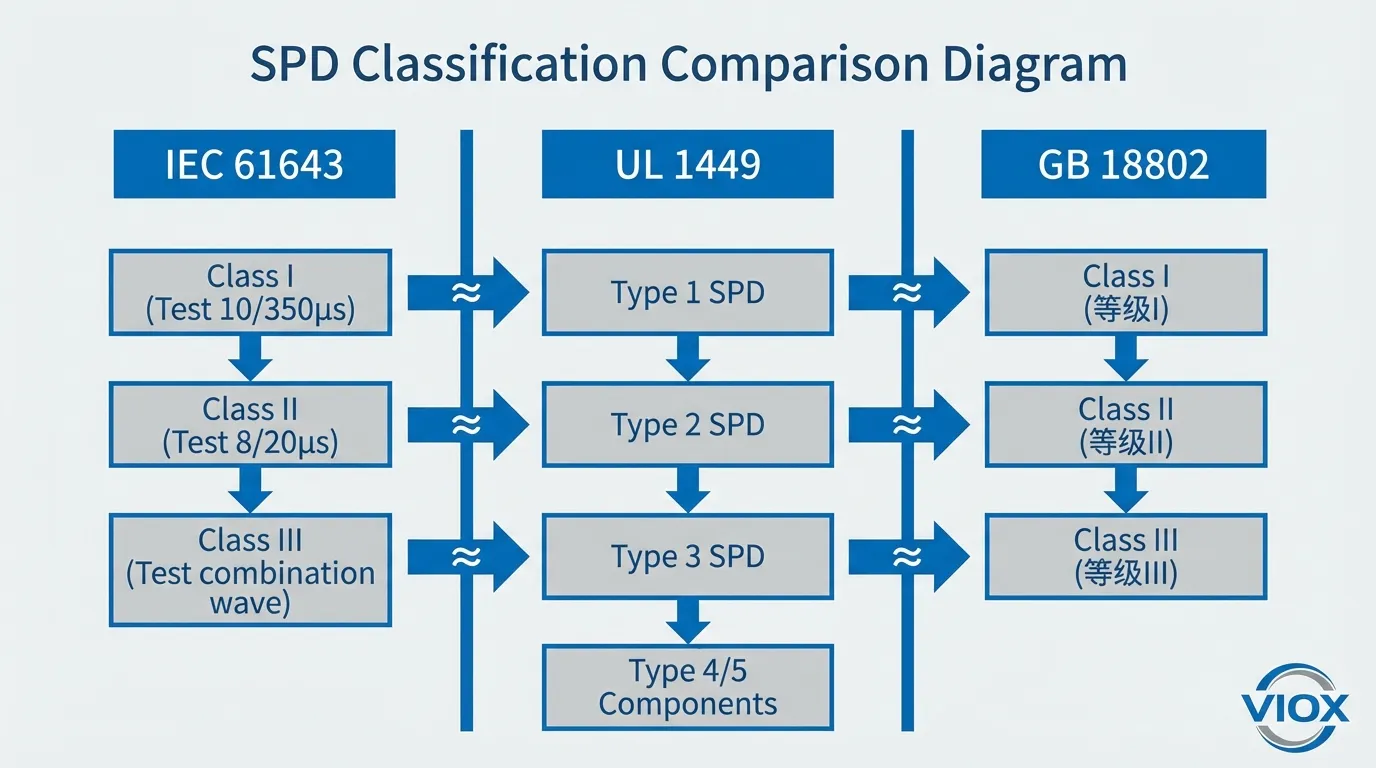
| Klassifizierung | Klasse I, II, III basierend auf Testwellenformen | Typ 1, 2, 3 basierend auf dem Installationsort | Klasse I, II, III (harmonisiert mit IEC) |
| Primäre Testwellenform | Klasse I: 10/350μs Klasse II: 8/20μs Klasse III: Kombinationswelle |
Typ 1: 10/350μs oder 8/20μs Typ 2: 8/20μs Typ 3: Kombinationswelle |
Identisch mit IEC 61643 |
| Schlüsselparameter | Nennableitstoßstrom (In) und Blitzstoßstrom (Iimp) | Nennableitstoßstrom (In) und SCCR | Nennableitstrom (In) |
| Spannung Schutzniveau | Up (kV) | VPR – Voltage Protection Rating (V) | Up (kV) |
| Installationsfokus | Energiekoordination zwischen den Klassen | Standortbezogen (Serviceeingang, Panel, Point-of-Use) | Energiekoordination (ähnlich wie IEC) |
Der grundlegende Unterschied liegt in der Philosophie: IEC- und GB-Normen klassifizieren SPDs nach ihrer Energieaufnahmekapazität und Testwellenform, während UL 1449 Geräte primär nach dem Installationsort innerhalb des elektrischen Systems kategorisiert.
Testwellenformen und Energiewerte
IEC 61643 Testanforderungen:
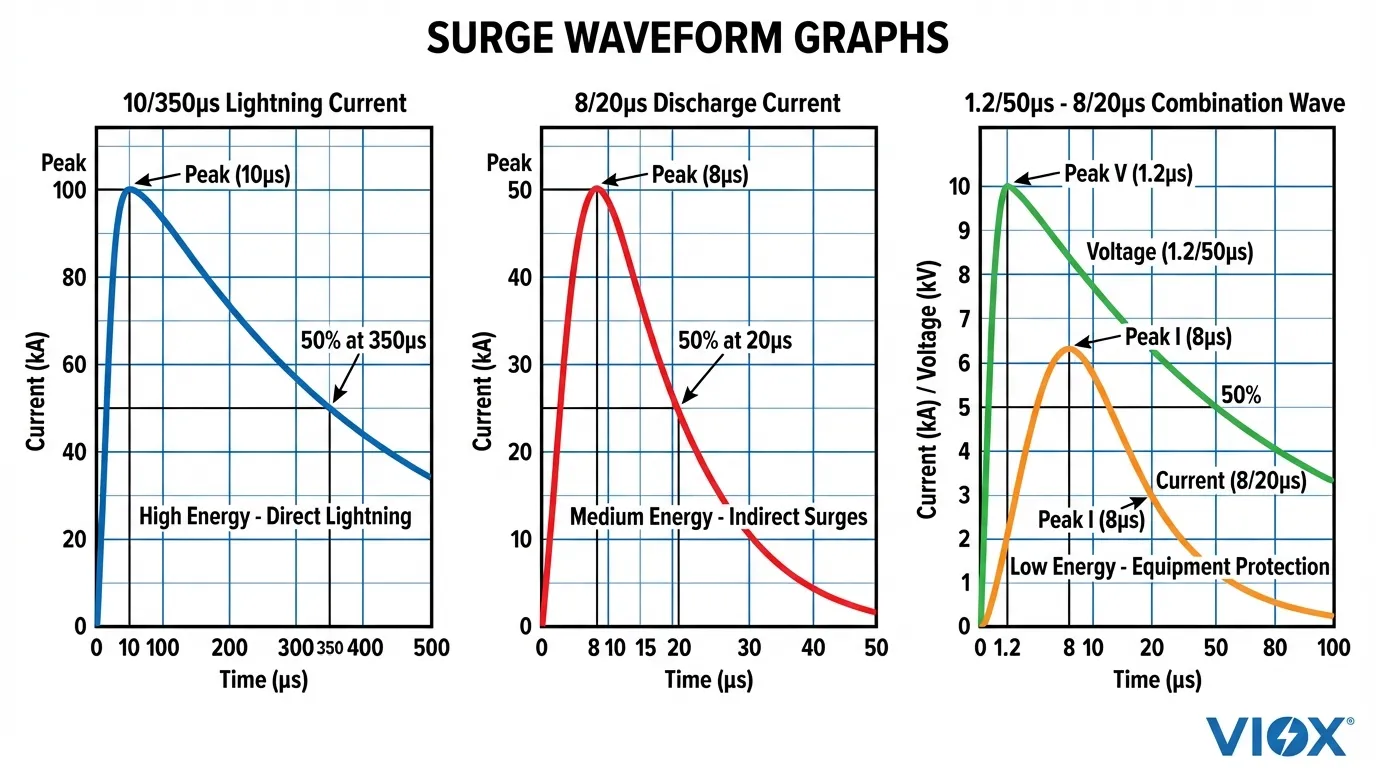
- SPDs der Klasse I: Müssen der 10/350μs Blitzstromwellenform mit Blitzstoßstromwerten (Iimp) von 12,5 kA bis 100 kA pro Pol standhalten. Diese Wellenform simuliert direkte Blitzeinschläge mit hohem Energieinhalt (bis zu 10 MJ/Ω spezifische Energie).
- SPDs der Klasse II: Getestet mit 8/20μs Stromwellenform, Nennableitstoßstrom (In) typischerweise 5kA, 10kA, 20kA oder 40kA.
- SPDs der Klasse III: Getestet mit Kombinationswelle (1,2/50μs Spannung, 8/20μs Strom), die Restüberspannungen in der Nähe von Geräten simuliert.
UL 1449 Testanforderungen:
- Typ 1 SPDs: Müssen 10/350μs- oder 8/20μs-Tests mit einem minimalen In von 10 kA oder 20 kA bestehen. Zusätzlich getestet auf SCCR (Short Circuit Current Rating) bis zu 200 kA ohne externen Überstromschutz.
- Typ-2-EPPDs: Getestet mit 8/20μs Wellenform, In-Werte von 3kA, 5kA, 10kA oder 20kA. Muss mindestens 10 Meter (30 Fuß) vom Serviceeingang entfernt installiert werden, sofern nicht anders bewertet.
- Typ 3 SPDs: Kombinationswellentest, typischerweise niedrigere Energiewerte (≤5kA).
GB 18802 Testanforderungen:
GB-Normen folgen den IEC-Testprotokollen präzise und verwenden identische Wellenformen und Energiewerte. Diese Harmonisierung erleichtert die gegenseitige Anerkennung zwischen chinesischen und internationalen Märkten.
Spannungsschutzpegel: Up vs. VPR
Ein entscheidender Unterschied ergibt sich in der Art und Weise, wie Normen die Schutzwirksamkeit definieren:
IEC/GB-Ansatz – Up (Schutzspannungspegel):
- Gemessen in Kilovolt (kV)
- Stellt die maximale Spannung dar, die während Überspannungsereignissen an den SPD-Klemmen auftritt
- Typische Werte: 1,5 kV, 2,0 kV, 2,5 kV für 230-V-Systeme
- Muss unterhalb der Bemessungsstoßspannungsfestigkeit des Geräts liegen
UL-Ansatz – VPR (Voltage Protection Rating):
- Gemessen in Volt (V)
- Definiert als die maximale Spannung, die während eines standardisierten Tests mit einer 6kV/3kA-Wellenform gemessen wird
- Übliche Werte: 330 V, 400 V, 600 V, 700 V für 120-V-Systeme
- Ein niedrigerer VPR deutet auf einen besseren Schutz für empfindliche Elektronik hin
Die Umrechnung zwischen den Systemen erfordert eine sorgfältige Analyse. Ein UL-VPR von 330 V entspricht ungefähr einem IEC-Up von 1,5 kV für 120-V-Systeme, aber eine direkte Äquivalenz wird durch unterschiedliche Testbedingungen und Messmethoden erschwert.
Installationsanforderungen und Systemkoordination
IEC 61643 / GB 18802 Ansatz: Blitzschutzzonen (LPZ)
IEC-Normen sind in den umfassenderen Blitzschutzrahmen der IEC 62305 integriert und definieren den Schutz basierend auf Blitzschutzzonen:
- LPZ 0A: Direkten Blitzeinschlägen ausgesetzt
- LPZ 0B: Geschützt vor direkten Einschlägen, aber teilweisem Blitzstrom ausgesetzt
- LPZ 1: Geschützt vor direkten Einschlägen, begrenzter Stoßstrom
- LPZ 2+: Weiter geschützte Zonen mit progressiv geringerer Stoßstrombelastung
SPD-Installation gemäß LPZ:
- SPDs der Klasse I: Installiert an der LPZ 0-1 Grenze (Serviceeingang mit externem Blitzschutz)
- SPDs der Klasse II: Installiert an der LPZ 1-2 Grenze (Verteilertafeln)
- SPDs der Klasse III: Installiert bei LPZ 2+ (in der Nähe empfindlicher Geräte)
Die Energiekoordination erfordert, dass Up1 < Up2 < Up3 und die Ansprechzeiten sich um ≥10μs gemäß den Koordinationsprinzipien der IEC 61643-12 unterscheiden. Ein Mindestabstand von 10 Metern zwischen den Kabeln oder Entkopplungsinduktivitäten (≥15μH) gewährleistet eine ordnungsgemäße Koordination.
UL 1449 Ansatz: Standortbasierte Klassifizierung
UL 1449 definiert SPD-Typen nach Installationsort innerhalb des elektrischen Verteilungssystems:
Typ 1 SPD-Installation:
- Zwischen der Sekundärseite des Speisetransformators und der Leitungsseite der Hauptüberstromschutzeinrichtung
- Lastseite der Hauptserviceausrüstung (einschließlich Zählersteckdosengehäuse)
- Kann ohne externe Überstromschutzeinrichtung installiert werden
- Mindestleiterquerschnitt: #6 AWG Kupfer, maximale Länge 18 Zoll
Typ 2 SPD-Installation:
- Lastseite der Hauptüberstromschutzeinrichtung
- An Verteilerfeldern und Unterverteilern
- Mindestens 10 Meter (30 Fuß) Leiterlänge vom Servicepanel entfernt, sofern nicht anders bewertet
- Erfordert Koordination mit dem vorgeschalteten Überstromschutz
Typ 3 SPD-Installation:
- Point-of-Use-Schutz in der Nähe empfindlicher Geräte
- Beinhaltet Überspannungsschutz-Steckdosenleisten und SPD vom Steckdosentyp
- Mindestens 10 Meter von Typ 2 SPD oder Panel entfernt
Der UL-Ansatz betont den physischen Standort und die Koordination mit Überstromschutzeinrichtungen, während sich die IEC auf die Energiekoordination zwischen den Schutzstufen konzentriert.
Zertifizierung und Wege zur gegenseitigen Anerkennung
Das CB-Schema: Internationale gegenseitige Anerkennung
Das IECEE CB-Schema (Certification Bodies Scheme) stellt den wichtigsten Weg für die internationale gegenseitige Anerkennung von Überspannungsschutzgeräten dar. Das von der International Electrotechnical Commission betriebene CB-Schema ermöglicht es Herstellern, Prüfberichte und Zertifikate zu erhalten, die in über 50 Ländern akzeptiert werden.
Funktionsweise des CB-Schemas:
- Der Hersteller wählt ein von der IEC anerkanntes CB-Prüflabor (CBTL) aus
- Das Produkt wird gemäß den IEC 61643-Normen geprüft
- CBTL stellt ein CB-Prüfzertifikat und einen CB-Prüfbericht aus
- Nationale Zertifizierungsstellen (NCBs) in den Mitgliedsländern akzeptieren die CB-Dokumentation
- Der Hersteller beantragt die nationale Zertifizierung unter Verwendung des CB-Zertifikats (reduzierte Prüfung erforderlich)
Vorteile der CB-Zertifizierung:
- Einzelprüfung nach IEC-Normen, die in mehreren Märkten akzeptiert wird
- Deutliche Kostensenkung (Vermeidung redundanter Prüfungen)
- Schnellere Markteinführungszeit für den globalen Vertrieb
- Gegenseitige Anerkennung zwischen den teilnehmenden Ländern
Wesentliche Einschränkung: Das CB-Schema umfasst nicht die Vereinigten Staaten oder Kanada. Die UL 1449-Zertifizierung erfordert auch mit gültigem CB-Zertifikat eine separate Prüfung.
Strategien zur Doppelzertifizierung
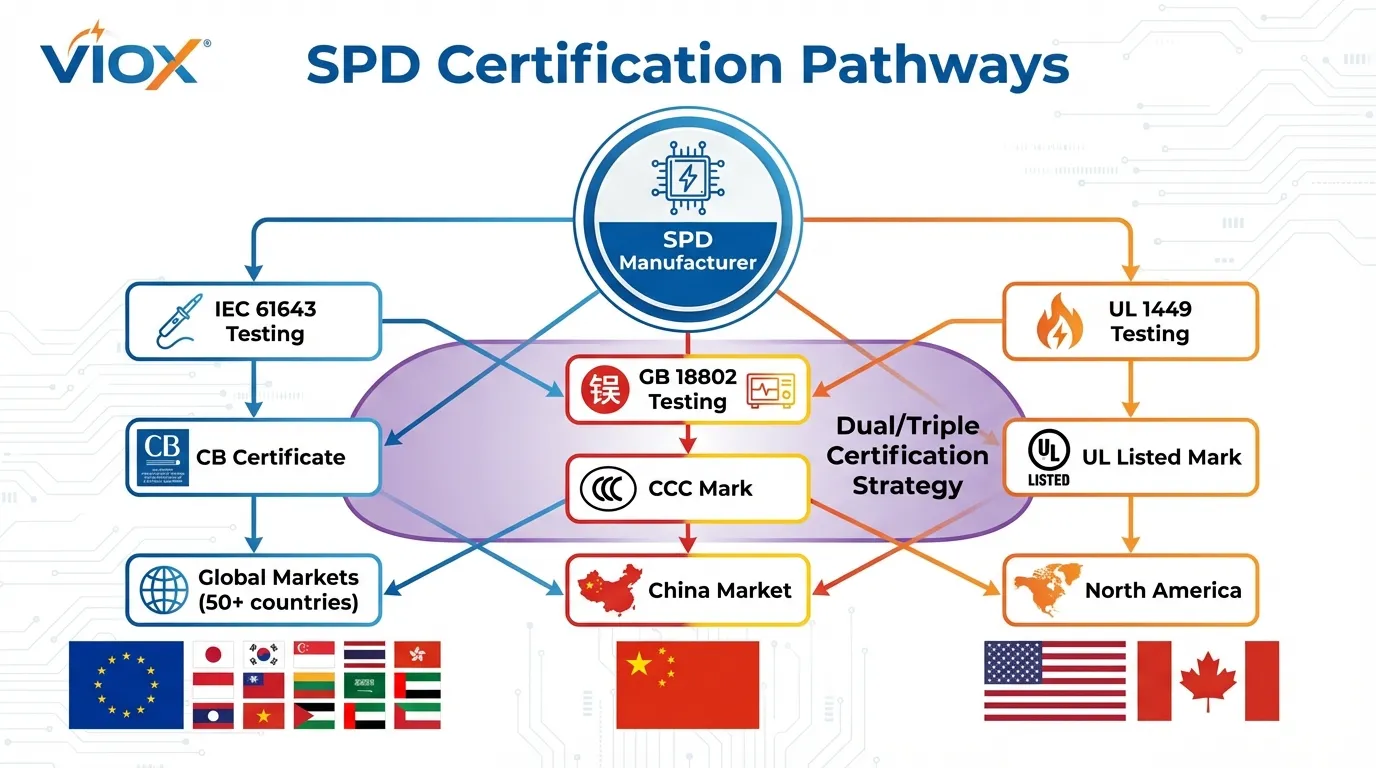
Führende Hersteller verfolgen mehrere Zertifizierungen, um Zugang zu globalen Märkten zu erhalten:
Häufige Zertifizierungskombinationen:
| Zielmärkte | Erforderliche Zertifizierungen | Prüfnormen |
|---|---|---|
| Europa, Asien, Naher Osten | CE-Kennzeichnung, CB-Zertifikat | IEC 61643-11, EN 61643-11 |
| Nord-Amerika | UL-gelistet, CSA | UL 1449 5th Ed, CSA C22.2 |
| China | CCC-Kennzeichnung | GB 18802.11 |
| Global (umfassend) | CB + UL + CCC | IEC 61643 + UL 1449 + GB 18802 |
| Australien/Neuseeland | RCM-Zeichen | AS/NZS 61643 (basierend auf IEC) |
Testeffizienz: Obwohl die CB-Zertifizierung die UL-Testanforderungen nicht aufhebt, können Hersteller IEC-Testdaten nutzen, um UL-Testverfahren zu informieren, wodurch potenziell die Gesamtprüfzeit und -kosten reduziert werden. Einige Testergebnisse (z. B. Bauteilcharakterisierung) können über verschiedene Standards hinweg wiederverwendet werden.
Praktische Implikationen für die Beschaffung
Bei der Spezifizierung von SPDs für internationale Projekte sollten Ingenieure Folgendes berücksichtigen:
Für IEC/GB-Märkte:
- CB-Zertifikat oder lokale NCB-Zulassung überprüfen
- Konformität mit IEC 61643-11 oder GB 18802.11 bestätigen
- TÜV-, DEKRA- oder gleichwertige Drittanbieterzertifizierung prüfen
- Integration in das Blitzschutzsystem IEC 62305 überprüfen
Für nordamerikanische Märkte:
- UL 1449 Listed-Zeichen erforderlich (nicht nur “UL Recognized Component”)
- SCCR-Wert muss den Anforderungen des Systemfehlerstroms entsprechen
- Konformität mit NEC Artikel 285 bestätigen
- Auf optionale UL 1283 EMI/RFI-Filterliste prüfen
Für globale Projekte:
- Geräte mit mehreren Zertifizierungen spezifizieren (CB + UL + CCC)
- Sicherstellen, dass der Hersteller aktive Zertifizierungen unterhält (jährliche Audits)
- Zertifizierungsdokumentation vor der Beschaffung anfordern
- Regionale Spannungs- und Frequenzunterschiede berücksichtigen (120 V/60 Hz vs. 230 V/50 Hz)
Leistungsparameter: Ein detaillierter Vergleich
Strombelastbarkeit
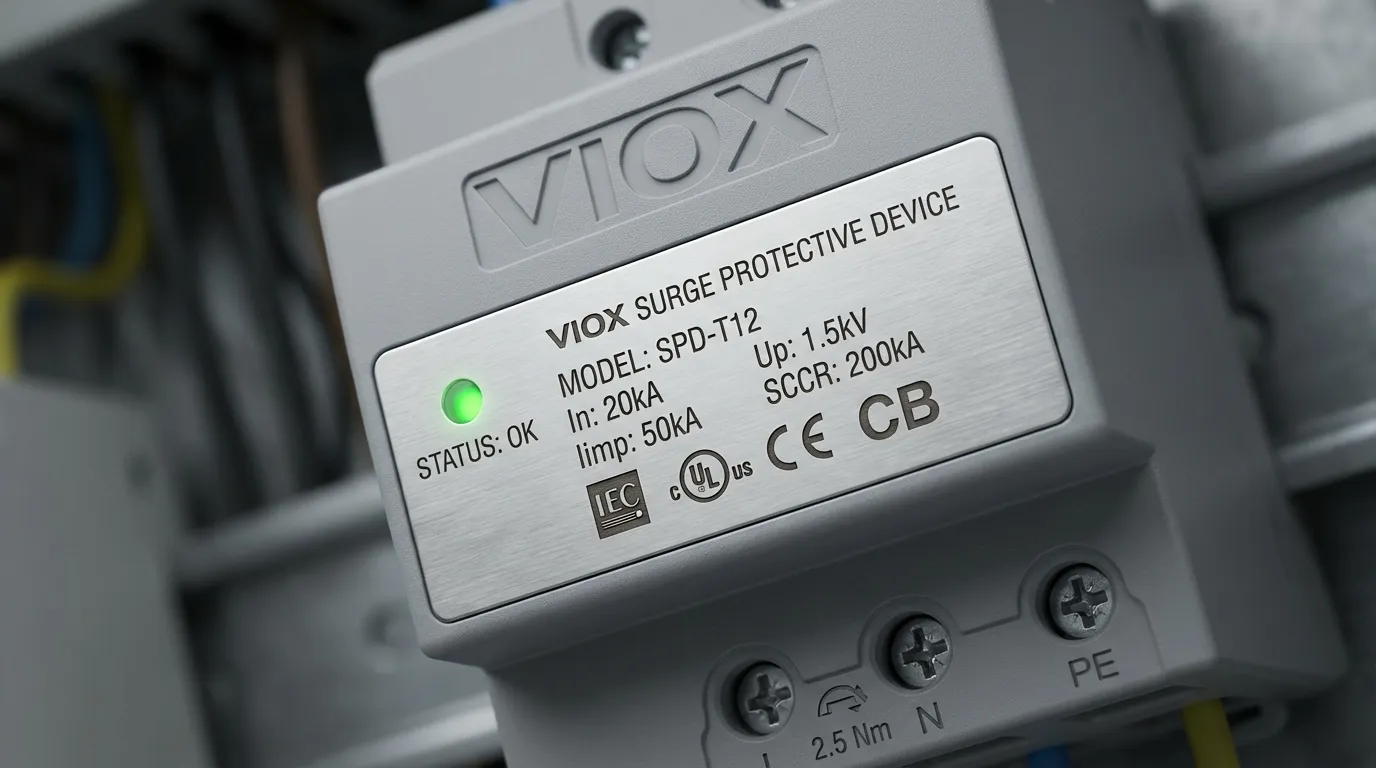
| Parameter | IEC 61643 | UL 1449 | GB 18802 | Bedeutung |
|---|---|---|---|---|
| Nenn-Entladestrom (In) | 5, 10, 20, 40 kA (8/20μs) | 3, 5, 10, 20 kA (8/20μs) | Identisch mit IEC | Standardprüfstrom, dem SPD mehrfach standhalten kann |
| Stoßstrom (Iimp) | 12,5, 25, 50, 100 kA (10/350μs) | Nicht explizit definiert (Typ 1 geprüft nach 10/350μs) | Identisch mit IEC | Spitzenblitzstromfestigkeit |
| Maximaler Ableitstoßstrom (Imax) | Typischerweise 2× In | Typischerweise 2× In | Identisch mit IEC | Maximaler Stoßstrom bei Einzelereignissen |
| Kurzschlussstromfestigkeit (SCCR) | Kein primärer Parameter | 5, 10, 25, 50, 100, 200 kA | Kein primärer Parameter | Maximaler Fehlerstrom, dem SPD ohne externen ÜSS standhalten kann |
Entscheidende Unterscheidung: Die SCCR-Anforderung von UL 1449 ist einzigartig und kritisch für nordamerikanische Installationen. Ein SPD mit unzureichendem SCCR kann bei Kurzschlussbedingungen katastrophal ausfallen und möglicherweise Brände oder Geräteschäden verursachen. IEC-Normen setzen die Koordination mit externen Überstromschutzeinrichtungen voraus.
Spannungsnennwerte und Systemkompatibilität
| System Spannung | IEC 61643 Uc (MCOV) | UL 1449 MCOV | GB 18802 Uc | Anwendung |
|---|---|---|---|---|
| 120V (L-N) | 150V AC | 150V AC | 150V AC | Nordamerikanische Einphasen |
| 230V (L-N) | 275V AC | 320V AC | 275V AC | Europäische/Asiatische Einphasen |
| 277V (L-N) | 320V AC | 320V AC | 320V AC | Nordamerikanische Gewerbe |
| 400V (L-L) | 440V AC | 480V AC | 440V AC | Dreiphasensysteme |
Uc (MCOV) – Maximale Dauerspannung: Die maximale Effektivspannung, die kontinuierlich an das SPD angelegt werden kann, ohne eine Verschlechterung zu verursachen. Gemäß den Anforderungen von GB 18873 muss Uc mindestens das 1,15-fache der Systemspannung betragen, um Fehlauslösungen zu vermeiden.
Ansprechzeit und Durchlassspannung
Vergleich der Ansprechzeiten:
- MOV-basierte SPDs: <25 Nanosekunden (alle Standards)
- GDT-basierte SPDs: <100 Nanosekunden (IEC/GB), variiert (UL)
- Hybrid-SPDs: <25 Nanosekunden anfängliche Reaktion (MOV), GDT bietet Backup
Durchlassspannung (Restspannung):
- IEC/GB: Gemessen als Up während des In-Tests (z. B. 1,5 kV für 230-V-System)
- UL: Gemessen als VPR während des 6kV/3kA-Tests (z. B. 330V für 120-V-System)
- Niedrigere Werte weisen auf einen besseren Schutz für empfindliche Elektronik hin
Die unterschiedlichen Messmethoden erschweren einen direkten Vergleich. Im Allgemeinen bietet ein UL VPR von 330 V einen gleichwertigen Schutz wie ein IEC Up von 1,5 kV, wenn die Unterschiede in der Systemspannung berücksichtigt werden.
Regionale Überlegungen und Marktzugang
Europäische Union: CE-Kennzeichnung und EN-Normen
Europäische Märkte erfordern eine CE-Kennzeichnung, die die Konformität mit EU-Richtlinien wie der Niederspannungsrichtlinie (LVD) und der EMV-Richtlinie anzeigt. SPDs müssen EN 61643-11 (identisch mit IEC 61643-11) und oft EN 62305 für Blitzschutzsysteme erfüllen.
Hauptanforderungen:
- Prüfung durch eine benannte Stelle (für bestimmte Anwendungen)
- Technische Dokumentation, die die Konformität nachweist
- Konformitätserklärung
- CE-Kennzeichnung auf Produkt und Verpackung
China: CCC-Zertifizierung
Das China Compulsory Certificate (CCC)-Zeichen ist für SPDs, die auf dem chinesischen Markt verkauft werden, obligatorisch. Die Prüfung muss von in China ansässigen Labors nach GB 18802-Normen durchgeführt werden.
CCC-Prozess:
- Antrag bei einer benannten Zertifizierungsstelle
- Typprüfung in einem von CQC zugelassenen Labor
- Werksinspektion und Audit des Qualitätssystems
- Jährliche Überwachungsaudits zur Aufrechterhaltung der Zertifizierung
Zeitleiste: 3-6 Monate für die Erstzertifizierung, laufende jährliche Audits erforderlich.
Nordamerika: UL-Listung und NEC-Konformität
Die UL 1449-Listung ist aufgrund der Anforderungen von NEC Artikel 285 und der lokalen Elektrovorschriften faktisch obligatorisch. Darüber hinaus schreiben viele Versicherungsgesellschaften und Facility Manager UL-gelistete Geräte vor.
UL-Listungsprozess:
- Einreichung von Produktmustern bei einer UL-Prüfstelle
- Vollständige Prüfung gemäß UL 1449 5. Ausgabe
- Werksinspektion und Qualitätsaudit
- Vierteljährliche Folgeinspektionen
- Jährliche Aktenprüfung und potenzielle Wiederholungsprüfung
Laufende Konformität: UL führt unangemeldete Werksinspektionen durch und kauft Muster aus Vertriebskanälen zur Verifizierungsprüfung. Nichteinhaltung kann zur Aussetzung oder Aufhebung der Listung führen.
Praktischer Leitfaden zur Auswahl: Zuordnung von Normen zu Anwendungen
Industrielle Einrichtungen
Empfohlene Vorgehensweise:
- Serviceeingang: IEC Klasse I / UL Typ 1 / GB Klasse I (Iimp ≥ 50kA)
- Verteilertafeln: IEC Klasse II / UL Typ 2 / GB Klasse II (In ≥ 20kA)
- Empfindliche Geräte: IEC Klasse III / UL Typ 3 / GB Klasse III (VPR ≤ 330V oder Up ≤ 1,5kV)
Multi-Standard-Konformität: Für multinationale Einrichtungen sollten SPDs mit dualer IEC/UL-Zertifizierung spezifiziert werden, um eine konsistente Schutzphilosophie über globale Standorte hinweg zu gewährleisten und gleichzeitig die lokalen Vorschriften zu erfüllen.
PV-Solaranlagen
Solaranlagen erfordern spezielle SPDs, die IEC 61643-31 (DC-Seite) und IEC 61643-11 (AC-Seite) oder UL 1449 mit PV-spezifischer Bewertung erfüllen.
Kritische Überlegungen:
- DC-Spannungsfestigkeit bis zu 1500V
- Schutz vor Verpolung
- Kompatibilität mit Erdschlusserkennung
- Temperaturreduzierung für Außeninstallationen
VIOX bietet umfassende Solar-SPD-Lösungen, die sowohl nach IEC 61643-31 als auch nach UL 1449 für globale PV-Projekte zertifiziert sind. Besuchen Sie viox.com/spd für detaillierte Spezifikationen.
Rechenzentren und IT-Infrastruktur
Priorität: Niedrigste mögliche Durchlassspannung zum Schutz empfindlicher Elektronik
Spezifikation:
- UL VPR ≤ 330V oder IEC Up ≤ 1,5kV
- Schnelle Reaktionszeit (<25ns)
- Koordinierter mehrstufiger Schutz
- Fernüberwachungsfunktion
- Konformität mit ANSI/TIA-942 Rechenzentrumsstandards
Anwendungen für Wohnzwecke
Mindestschutz:
- SPD für das ganze Haus: IEC Klasse II / UL Typ 2 an der Haupttafel (In ≥ 10kA)
- Point-of-Use: UL Typ 3 Überspannungsschutzleisten für empfindliche Elektronik (VPR ≤ 400V)
Erweiterter Schutz (Hochrisikobereiche):
- Fügen Sie IEC Klasse I / UL Typ 1 am Serviceeingang hinzu, wenn das Gebäude über ein externes Blitzschutzsystem verfügt
- Koordination mit RCCB/GFCI-Geräten (Typ B für PV-Systeme)
Häufige Spezifikationsfehler und wie man sie vermeidet
Fehler 1: Annahme, dass IEC- und UL-Klassifizierungen gleichwertig sind
Problem: Die Angabe “Typ 2 SPD” ohne Klärung des Standards kann dazu führen, dass ein IEC Klasse II-Gerät empfangen wird, wenn UL Typ 2 beabsichtigt war, oder umgekehrt.
Lösung: Geben Sie immer sowohl den Standard als auch die Klassifizierung an: “SPD gemäß IEC 61643-11 Klasse II Anforderungen” oder “UL 1449 Typ 2 gelistete SPD”.”
Fehler 2: Ignorieren von SCCR-Anforderungen in Nordamerika
Problem: Die Auswahl von SPD ausschließlich auf der Grundlage des Stoßstromnennwerts (In) ohne Überprüfung des SCCR kann bei Kurzschlussereignissen zu katastrophalen Ausfällen führen.
Lösung: Berechnen Sie den Systemfehlerstrom und spezifizieren Sie SCCR ≥ verfügbarer Fehlerstrom. Für die meisten kommerziellen Installationen gilt ein SCCR von mindestens ≥ 65 kA; Industrieanlagen können 100–200 kA erfordern.
Fehler 3: Unzureichende Koordination zwischen Schutzstufen
Problem: Die Installation mehrerer SPDs ohne ordnungsgemäße Energiekoordination kann zu gleichzeitigem Betrieb, verminderter Wirksamkeit oder vorzeitigem Ausfall führen.
Lösung:
- Halten Sie einen Mindestabstand von 10 Metern zwischen den SPD-Stufen ein.
- Verwenden Sie Entkopplungsinduktivitäten (≥15μH), wenn eine physische Trennung nicht möglich ist.
- Überprüfen Sie die Hierarchie Up1 < Up2 < Up3
- Stellen Sie sicher, dass die Reaktionszeitunterschiede ≥10μs gemäß IEC 61643-12 betragen.
Fehler 4: Übersehen von Spannungsunterschieden im System
Problem: Die Spezifizierung von SPDs mit 230 V Nennspannung für 120 V Systeme (oder umgekehrt) führt entweder zu unzureichendem Schutz oder zu unerwünschten Abschaltungen.
Lösung: Überprüfen Sie immer die Systemspannung und spezifizieren Sie die entsprechende Uc (MCOV):
- 120V Systeme: Uc ≥ 150V
- 230V Systeme: Uc ≥ 275V
- 277V Systeme: Uc ≥ 320V
Zukünftige Trends: Harmonisierung und intelligente SPDs
IEC 61643-01:2024: Auf dem Weg zur globalen Angleichung
Die neue Norm IEC 61643-01:2024 stellt einen bedeutenden Schritt in Richtung globaler Harmonisierung dar. Zu den wichtigsten Verbesserungen gehören:
- Erweiterter Anwendungsbereich, der alle SPD-Typen umfasst
- Verbesserte technische Anforderungen an die Schutzleistung
- Verbesserte Koordinationsrichtlinien
- Bessere Abstimmung mit dem Blitzschutzrahmenwerk IEC 62305
Diese Entwicklung deutet auf eine allmähliche Konvergenz zwischen IEC- und regionalen Normen hin, obwohl eine vollständige Harmonisierung noch Jahre entfernt ist.
Intelligente SPDs und Fernüberwachung
Moderne SPDs verfügen zunehmend über intelligente Funktionen:
- Echtzeit-Protokollierung von Überspannungsereignissen
- Überwachung des Verschlechterungszustands und vorausschauende Wartungswarnungen
- Fernanzeige des Status über Gebäudeleitsysteme
- IoT-Konnektivität für Cloud-basierte Überwachung
Diese Funktionen werden zunehmend in den IEC-, UL- und GB-Rahmenwerken standardisiert, was globale Produktplattformen mit regionalen Zertifizierungsvariationen ermöglicht.
Wichtigste Erkenntnisse
- IEC 61643 bietet den globalen Rahmen , der von über 80 Ländern im Rahmen des CB-Verfahrens übernommen wurde und die Energiekoordination und Blitzschutzzonen hervorhebt.
- UL 1449 ist für nordamerikanische Märkte obligatorisch, mit besonderen Anforderungen, einschließlich SCCR-Werten und standortbezogener Klassifizierung, die sich grundlegend vom IEC-Ansatz unterscheiden.
- GB 18802 ist eng an IEC 61643 angelehnt, wodurch chinesisch zertifizierte Produkte relativ einfach an internationale Märkte mit CB-Zertifizierung angepasst werden können.
- Das CB-Verfahren ermöglicht die gegenseitige Anerkennung in über 50 Ländern, schließt aber die USA/Kanada NICHT ein, was separate UL-Tests für den nordamerikanischen Zugang erfordert.
- Die Spannungsschutzparameter unterscheiden sich erheblich: IEC/GB verwenden Up (kV), während UL VPR (V) verwendet, gemessen unter unterschiedlichen Testbedingungen, was einen direkten Vergleich komplex macht.
- Duale oder dreifache Zertifizierungsstrategien (IEC + UL + GB) bieten maximalen Marktzugang, erfordern aber erhebliche Investitionen in Tests und laufende Compliance-Wartung.
- Die Anforderungen an die Systemkoordination variieren: IEC betont die Energiekoordination mit spezifischer Up-Hierarchie und Reaktionszeitunterschieden; UL konzentriert sich auf den physischen Standort und die Koordination mit dem Überstromschutz.
- SCCR ist entscheidend für die UL-Konformität , aber kein primärer Parameter in den IEC/GB-Normen – dieser Unterschied kann zu Spezifikationsfehlern in internationalen Projekten führen.
- Regionale Spannungsunterschiede (120V/60Hz vs. 230V/50Hz) erfordern eine sorgfältige Auswahl von MCOV; GB 18873 schreibt Uc ≥ 1,15 × Systemspannung vor.
- Die zukünftige Harmonisierung schreitet voran mit IEC 61643-01:2024, aber eine vollständige globale Angleichung bleibt in weiter Ferne – Ingenieure müssen alle drei Normen für internationale Arbeiten verstehen.
Häufig gestellte Fragen (FAQ)
F: Kann ich ein IEC-zertifiziertes SPD in einer nordamerikanischen Installation verwenden?
A: Nein. NEC Artikel 285 schreibt vor, dass SPDs UL 1449-gelistet sein müssen. Selbst wenn ein SPD die technischen Anforderungen der IEC 61643 erfüllt, kann es ohne UL-Zertifizierung nicht legal installiert werden. Das CB-Verfahren bietet keine gegenseitige Anerkennung mit UL.
F: Was ist der Unterschied zwischen UL Listed und UL Recognized für SPDs?
A: UL Listed SPDs (Typ 1, 2, 3) sind vollständige, eigenständige Geräte, die für bestimmte Installationen zugelassen sind. UL Recognized Components (Typ 4, 5) sind unvollständige Baugruppen, die in ein gelistetes Endprodukt integriert werden müssen. Geben Sie für vor Ort installierte SPDs immer “UL Listed” an.
F: Wie rechne ich zwischen IEC Up- und UL VPR-Werten um?
A: Eine direkte Umrechnung ist aufgrund unterschiedlicher Testbedingungen nicht möglich. Als grobe Richtlinie für 120V-Systeme: VPR 330V ≈ Up 1,5kV; VPR 400V ≈ Up 1,8kV. Für 230V-Systeme: VPR 600V ≈ Up 2,0kV. Stellen Sie immer sicher, dass beide Parameter die Anforderungen an den Geräteschutz erfüllen.
F: Benötige ich unterschiedliche SPDs für 50Hz- und 60Hz-Systeme?
A: Die meisten modernen SPDs sind sowohl für den 50Hz- als auch für den 60Hz-Betrieb ausgelegt. Überprüfen Sie jedoch immer, ob das Typenschild beide Frequenzen angibt. Das Hauptaugenmerk liegt auf der Spannungsfestigkeit (Uc/MCOV), nicht auf der Frequenz.
F: Welche Zertifizierungen besitzt VIOX für Überspannungsschutzgeräte?
A: VIOX-Überspannungsschutzgeräte sind nach mehreren internationalen Normen zertifiziert, darunter IEC 61643-11, UL 1449 5th Edition, GB 18802, und verfügen über CB-Zertifikate für den globalen Marktzugang. Unsere Produkte werden von TÜV-, UL- und CQC-Labors strengen Tests unterzogen, um die Konformität in allen wichtigen Märkten sicherzustellen. Besuchen Sie viox.com/spd für spezifische Produktzertifizierungen.
F: Wie oft sollten SPDs getestet oder ausgetauscht werden?
A: IEC 62305- und UL-Richtlinien empfehlen eine jährliche Sichtprüfung und Prüfung der Statusanzeigen. SPDs sollten sofort nach einem größeren Überspannungsereignis (angezeigt durch thermische Trennung oder Änderung der Statusanzeige) oder nach 10 Jahren Betriebsdauer, auch ohne sichtbare Verschlechterung, ausgetauscht werden. Moderne SPDs mit Überspannungszählern ermöglichen datengestützte Austausch-Entscheidungen.
Fazit: Navigation durch globale Überspannungsschutznormen
Das Verständnis der Unterschiede zwischen IEC 61643, UL 1449 und GB 18802 ist für Ingenieure, die Überspannungsschutz in der heutigen globalisierten elektrischen Infrastruktur spezifizieren, unerlässlich. Obwohl diese Normen gemeinsame Ziele verfolgen – den Schutz von Geräten und Personal vor transienten Überspannungen – schaffen ihre unterschiedlichen Ansätze zur Klassifizierung, Prüfung und Zertifizierung echte Herausforderungen für internationale Projekte.
Der Schlüssel zu einer erfolgreichen Spezifikation liegt in der Erkenntnis, dass es sich hierbei nicht nur um unterschiedliche Bezeichnungen für dieselben Anforderungen handelt. Die energiebasierte Klassifizierung der IEC, der standortbezogene Ansatz der UL und der IEC-harmonisierte Rahmen der GB spiegeln jeweils unterschiedliche regulatorische Philosophien und Marktbedürfnisse wider. Ingenieure müssen die Normauswahl sorgfältig auf den Projektstandort abstimmen, die Zertifizierungspfade über das CB-Verfahren und nationale Stellen verstehen und häufige Spezifikationsfehler vermeiden, die zu nicht konformem oder unzureichendem Schutz führen können.
Als führender B2B-Hersteller von elektrischen Geräten verfügt VIOX über umfassende Zertifizierungen nach IEC-, UL- und GB-Standards, die eine nahtlose Bereitstellung von Überspannungsschutzlösungen in jedem globalen Markt ermöglichen. Unser Engineering-Team versteht die Nuancen internationaler Standards und kann Sie bei der optimalen SPD-Auswahl für Ihre spezifische Anwendung beraten.
Sind Sie bereit, Überspannungsschutz für Ihr nächstes Projekt zu spezifizieren? Kontaktieren Sie den technischen Support von VIOX oder besuchen Sie viox.com/spd , um unser komplettes Sortiment an global zertifizierten Überspannungsschutzgeräten zu erkunden. Unsere Anwendungsingenieure stehen Ihnen bei der Auslegung von Normen, der Produktauswahl und der Systemkoordination zur Seite, um sicherzustellen, dass Ihre Installation alle geltenden Anforderungen erfüllt – egal wo auf der Welt sich Ihr Projekt befindet.
Mehr lesen
- Was ist ein Überspannungsschutzgerät?
- Überspannungsschutzgerät Typ 1 vs. Typ 2 vs. Typ 3
- TVSS vs. SPD: UL 1449 Standard-Leitfaden
- Ultimativer SPD-Kaufratgeber für Distributoren
- So wählen Sie das richtige SPD für Ihre Solarstromanlage
- Anforderungen an die SPD-Installation: Einhaltung von Vorschriften und Sicherheitsstandards
- Wo SPDs installieren: Leitfaden für Schalttafeln