Many electrical contractors start their business with residential wallbox installations. It is a straightforward model: a dedicated circuit, a standard breaker, and a 7kW charger. However, as you scale into commercial projects—fleet depots, office parking lots, and retail charging hubs—the rules change drastically.
As we discussed in our comparison of residential vs. industrial circuit breakers, the equipment that protects a home is often insufficient for the thermal and mechanical stresses of a commercial environment. This is especially true for Electric Vehicle (EV) infrastructure, where “continuous load” takes on a new level of intensity.
This guide outlines the critical engineering differences between residential and commercial EV charging protection, ensuring your installations meet strict NEC/IEC compliance standards and avoid costly liability issues.
Part 1: The Load Profile Difference (Intermittent vs. Continuous)
The fundamental difference between residential and commercial charging lies in the duty cycle.
Residential: The “Cool Down” Cycle
A typical home charger (Level 2, 7.4kW) runs for 6–8 hours overnight. Once the car is full, the load drops to near zero, allowing the breaker and wiring to cool down significantly before the next use. For these applications, a standard Miniature Circuit Breaker (MCB) is perfectly adequate. Thermal accumulation is rarely an issue unless the panel is already overcrowded (see our guide on 100A panel upgrades).
Commercial: The “Heat Soak” Reality
Commercial chargers operate back-to-back. As soon as one vehicle leaves, another plugs in. In a fleet scenario, a 22kW AC charger or a DC Fast Charger might run at maximum capacity for 12–18 hours a day.
Under NEC Article 625, EV charging is defined as a continuous load, requiring overcurrent protection sized at 125% of the device’s rating. However, in commercial settings, simple sizing isn’t enough. Standard MCBs can suffer from thermal derating inside a hot outdoor enclosure, leading to “nuisance tripping” even when no fault exists.
The Solution: Molded Case Circuit Breakers (MCCB)
For commercial distribution panels (>100A) or high-power AC strings, we recommend moving from MCBs to MCCBs.
- Thermal Stability: MCCBs have larger mass and better heat dissipation capabilities.
- Adjustable Trips: Unlike fixed-trip MCBs, many MCCBs allow you to fine-tune the thermal and magnetic trip settings to coordinate with downstream chargers.
- Durability: They are built to withstand the high inrush currents often associated with powering up banks of chargers simultaneously.
Learn more about when to switch device types in our guide: What is a Molded Case Circuit Breaker (MCCB)? and understand the speed differences in MCCB vs. MCB Response Time.
Part 2: Earth Leakage Requirements (The Type B RCCB Factor)
This is the most common compliance failure we see in commercial bids. Installers assume the “Type A” RCD used in homes is sufficient for commercial lots. It is often not.
The Hidden Danger: Smooth DC Leakage
EVs charge using DC power. The conversion happens either inside the car (AC charging) or outside (DC charging). If an insulation fault occurs on the DC side of the vehicle’s onboard charger, smooth DC residual current can flow back into the AC supply.
- Residential (Single Car): Many modern home chargers have built-in 6mA DC detection (per IEC 62955). This allows you to use a standard Type A RCD upstream.
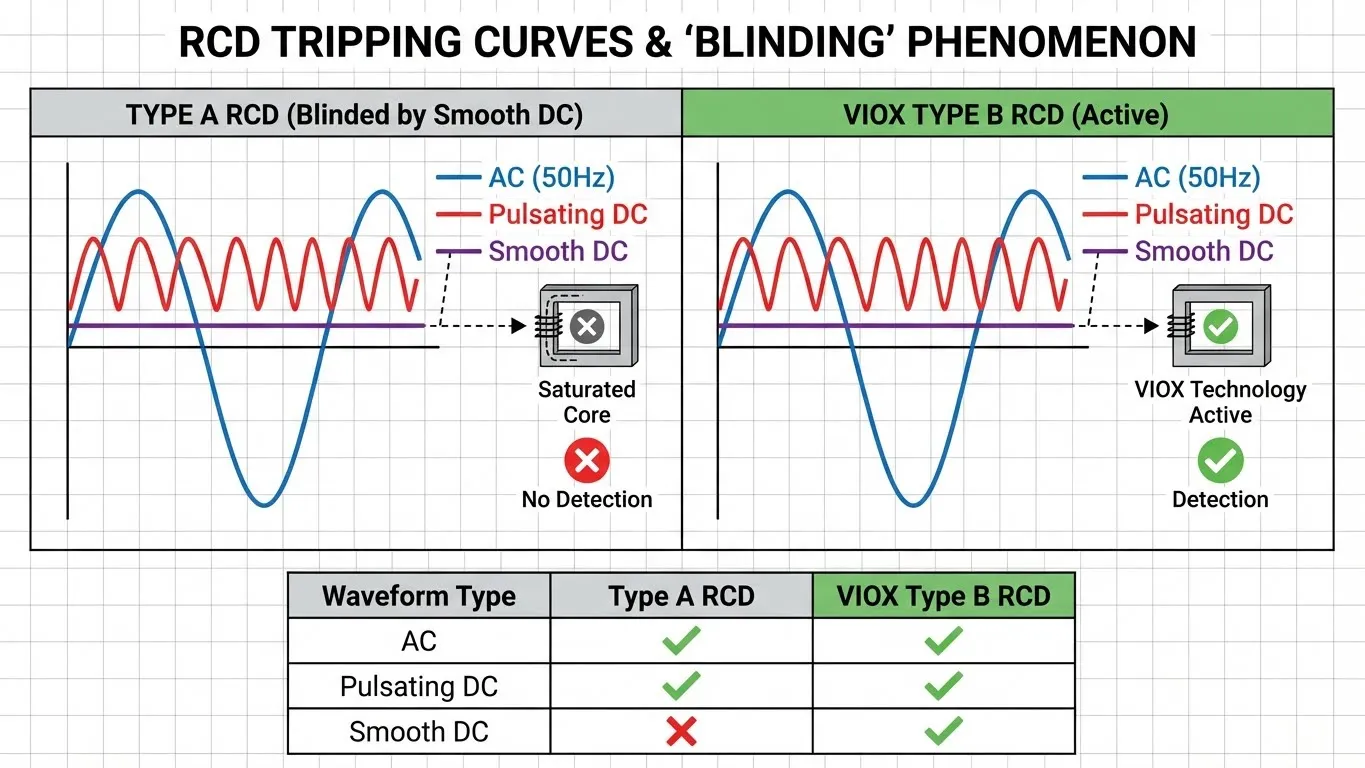
- Commercial (Multiple Cars): In a parking lot with 10+ chargers, small amounts of DC leakage can accumulate. More critically, smooth DC current >6mA can saturate (“blind”) a standard Type A or Type AC RCD, preventing it from tripping during a lethal AC ground fault.
Why “EV Charging, Type B RCCB” is the Standard
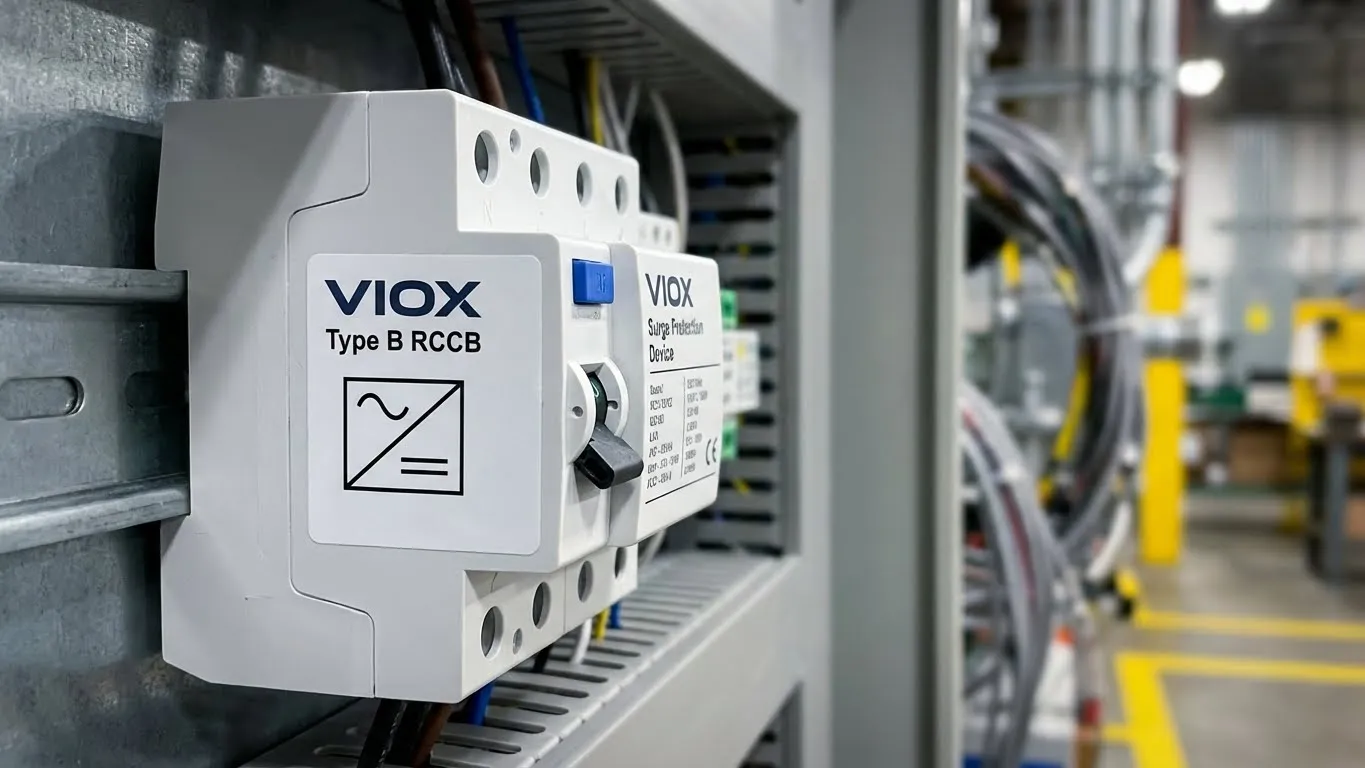
For commercial installations, especially where you cannot guarantee the internal protection specs of every charger (or every car visiting the lot), Type B RCCBs are the safest engineering choice.
A Type B RCCB detects:
- Sinusoidal AC residual currents.
- Pulsating DC residual currents.
- Smooth DC residual currents (which Type A misses).
- High-frequency residual currents (common with inverter-based chargers).
Using a Type B device ensures that one fault doesn’t compromise the safety of the entire panel. For a deep dive into the technical curves, read RCCB for EV Charging: Type B vs Type F vs Type EV.
Part 3: Surge Protection Levels (SPD)
Lightning doesn’t care if a charger is residential or commercial, but the consequences of a strike differ massively.
- Residential: A surge might fry one charger. The home is likely protected by a Type 2 SPD at the main breaker box.
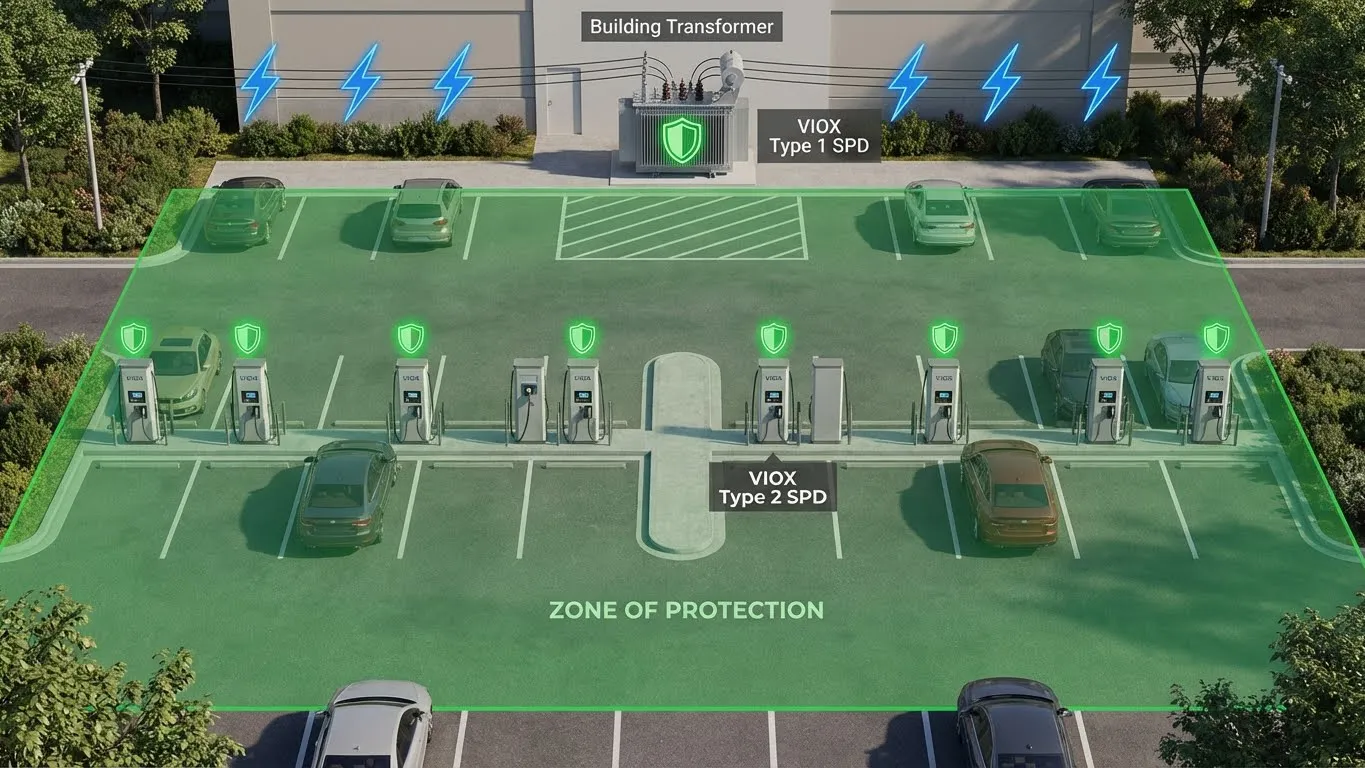
- Commercial: Parking lots often have light poles (lightning magnets) and long underground cable runs that act as antennas for induced surges. A strike nearby can destroy every charger in the network simultaneously.
The Two-Tier Defense Strategy
Commercial EV distribution boards require a robust SPD strategy:
- Main Feeder (Service Entrance): Install a Type 1+2 SPD. This handles the massive energy of direct lightning currents (10/350 μs waveform).
- Sub-Panels/Charger Pedestals: If the distance from the main panel to the charger exceeds 10 meters (33 ft), IEC 60364-4-44 recommends installing an additional Type 2 SPD locally at the charger.
Do not skip this step. The cost of replacing 10 commercial chargers is astronomical compared to the cost of proper surge protection. See our analysis: Do EV Chargers Need Surge Protection?
Part 4: Metering, Connectivity & Signal Protection
Unlike residential units where the user just plugs in, commercial chargers are “smart” devices. They require:
- OCPP Connectivity: For billing and load balancing.
- RFID Readers: For user authentication.
- Smart Metering: MID-certified energy metering for revenue grade accuracy.
Protecting the “Brain”
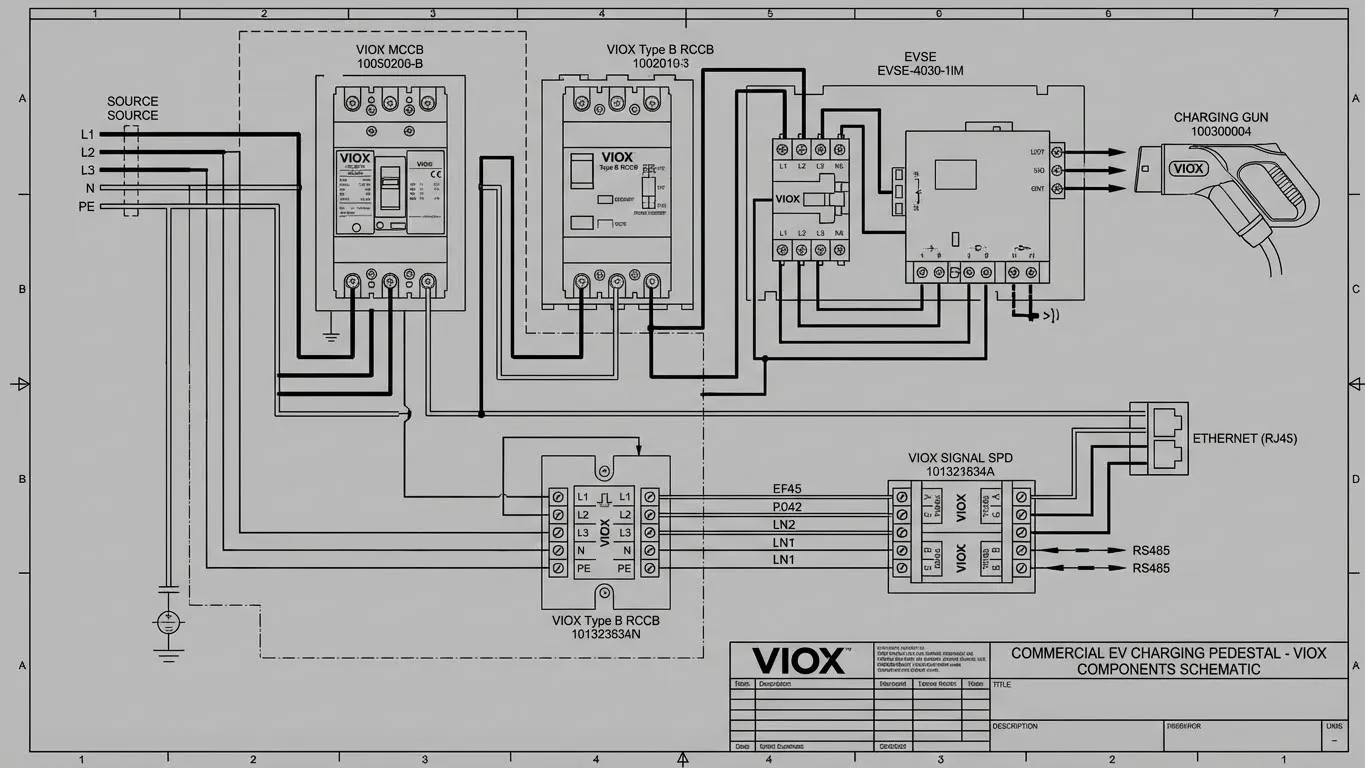
These communication lines (Ethernet, RS485, or 4G LTE modules) are highly sensitive to voltage spikes. A power surge might spare the robust power contacts but fry the delicate communication board, rendering the charger “offline” and useless for revenue generation.
Commercial Best Practice:
Install Signal SPDs (Data Line Surge Protectors) alongside your power SPDs. This is rarely done in residential jobs but is standard spec for reliable commercial infrastructure.
Comparative Analysis: Residential vs. Commercial EV Protection
The following table breaks down the key component and cost differences for installers estimating projects.
| Feature | Residential (Level 2 Wallbox) | Commercial (Fleet / Public) |
|---|---|---|
| Primary Protection | MCB (Miniature Circuit Breaker) | MCCB (Molded Case Breaker) for Mains |
| Overcurrent Sizing | 125% of load (e.g., 40A for 32A charger) | 125% + Thermal Derating Factor (due to enclosure heat) |
| Earth Leakage | Type A (often sufficient if 6mA DC integrated) | Type B RCCB (Mandatory for compliance & safety) |
| Surge Protection | Type 2 (Main Panel) | Type 1+2 (Main) + Type 2 (Pedestal) |
| Connectivity | Wi-Fi (Direct consumer router) | Ethernet/4G + Signal SPD Protection |
| Enclosure Rating | NEMA 3R / IP54 | NEMA 4X / IP65 (Vandal & Corrosion Resistant) |
| Est. Protection Cost | Low (~$50-$150 per circuit) | High (~$300-$600 per circuit) |
| Common Failure Point | Breaker trips due to lack of dedicated circuit | Overheating panels & blinded RCDs |
Frequently Asked Questions (FAQ)
1. Can I use a Type A RCCB for commercial EV chargers?
Generally, no. Unless you can guarantee that every charger connected has a built-in RDC-DD (Residual Direct Current Disconnection Device) compliant with IEC 62955, and that the upstream leakage won’t accumulate, Type A is risky. Type B is the industry standard for commercial safety to prevent “blinding” from DC leakage.
2. Why do my commercial EV breakers trip when the weather gets hot?
This is likely thermal derating. Standard MCBs are calibrated for 30°C (86°F). Inside a crowded outdoor panel in the summer, temps can exceed 50°C (122°F), causing the breaker to trip below its rated current. Using MCCBs or derating your breakers (e.g., using a 50A breaker for a 32A load, if wire gauge permits) can solve this.
3. Do I need a disconnect switch at every charger?
NEC Article 625.43 requires a disconnect means that is lockable in the open position. For commercial pedestals, this is often required to be visible and within sight of the charger to ensure safety during maintenance.
4. What is the difference between Type 1 and Type 2 Surge Protection for EVs?
Type 1 is designed to handle direct lightning strikes and is installed at the main service entrance. Type 2 handles indirect surges (switching surges, distant strikes) and is installed at sub-panels or machines. Commercial outdoor lots need Type 1 protection at the source.
5. Is a “Type EV” RCD the same as Type B?
Not exactly. “Type EV” usually refers to a specific tripping curve optimized for EV charging, often functioning similarly to a Type A + 6mA DC detection. A full Type B RCCB is a more comprehensive device that protects against a wider range of frequencies and DC faults, making it the superior choice for mixed commercial loads.
6. How does load balancing affect breaker sizing?
Dynamic Load Management (DLM) allows you to install more chargers than your main service panel would traditionally handle. However, the physical branch circuit protection for each individual charger must still be sized for the charger’s maximum potential output, unless the load management system is a “listed” energy management system (EMS) recognized by code to limit current physically.
Ready to spec your next commercial project?
Don’t let residential habits create commercial liabilities. Upgrade your protection standard with VIOX’s range of MCCBs, Type B RCCBs, and industrial SPDs.
Contact VIOX Engineering Support Today for a consultation on your single-line diagram.