
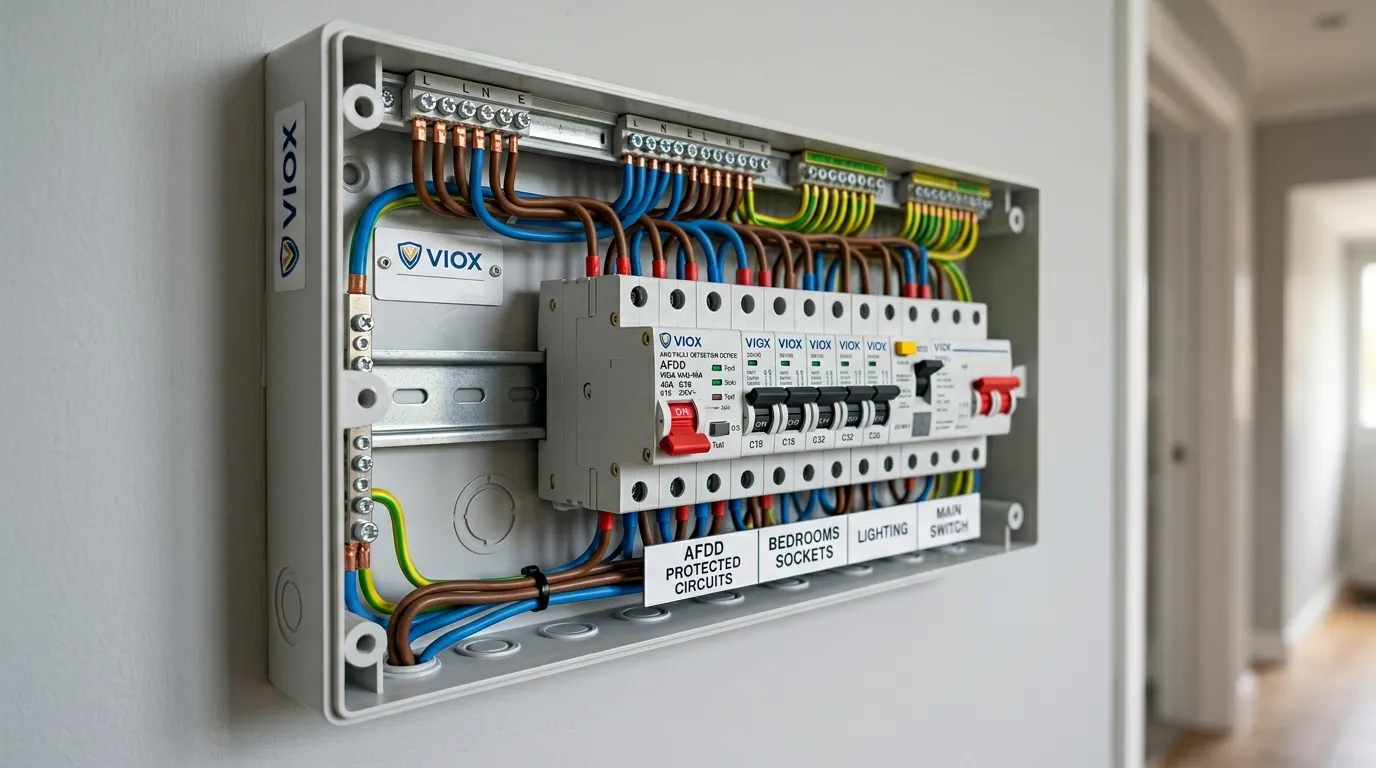
AFDD stands for Arc Fault Detection Device. In an electrical system, an AFDD is used to detect arc-fault conditions that conventional overload or residual-current devices may not identify in the same way.
That short definition matters because AFDD is often confused with AFCI, RCBO, and MCB devices. In practice, an AFDD belongs to a different protection category: it focuses on dangerous arc faults that can develop from damaged conductors, loose connections, or degraded insulation.
What Does AFDD Stand For?
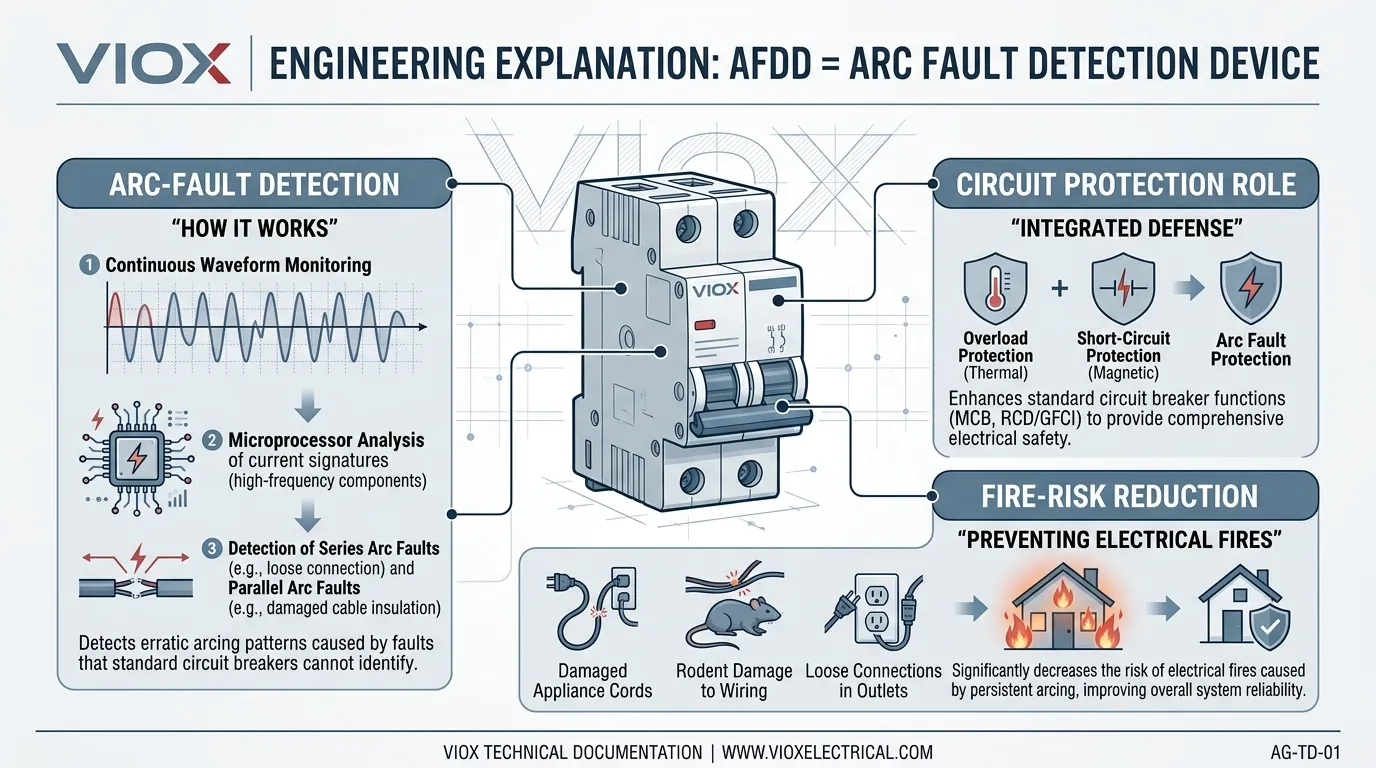
AFDD means Arc Fault Detection Device.
Each part of the term points to the device function:
- Arc Fault refers to an unintended electrical arc that can generate heat and fire risk.
- Detection means the device is designed to identify arc-fault signatures rather than only large overcurrent events.
- Device means it is part of the protective architecture of a circuit, whether integrated with other functions or used in a dedicated format.
This is why AFDD is not just another circuit breaker label. It addresses a fault type that standard overcurrent protection may not detect early enough.
For the broader protection context, VIOX already has a more detailed technical article on understanding AFDD IEC 62606 arc fault protection.
Quick Reference Table
| Term | Full form | Main function | Typical use |
|---|---|---|---|
| AFDD | Arc Fault Detection Device | Detects arc-fault conditions associated with fire risk | Circuits where arc-fault detection is required or recommended |
| AFCI | Arc Fault Circuit Interrupter | North American arc-fault protection term and device family | Residential and code-driven arc-fault protection contexts |
| RCBO | Residual Current Breaker with Overcurrent Protection | Residual-current, overload, and short-circuit protection | Individual circuit combined protection |
| MCB | Miniature Circuit Breaker | Overload and short-circuit protection | General branch-circuit overcurrent protection |
What Does an AFDD Do?
An AFDD is designed to identify electrical arcing behavior that may indicate a developing fire hazard.
This makes it different from devices that focus mainly on:
- overload
- short circuit
- residual current
In practical terms, an AFDD helps address fault patterns such as:
- damaged cable insulation
- loose or deteriorated connections
- series or parallel arc-fault conditions, depending on device design
- wiring defects that may not immediately create a large enough fault current to trip a conventional breaker
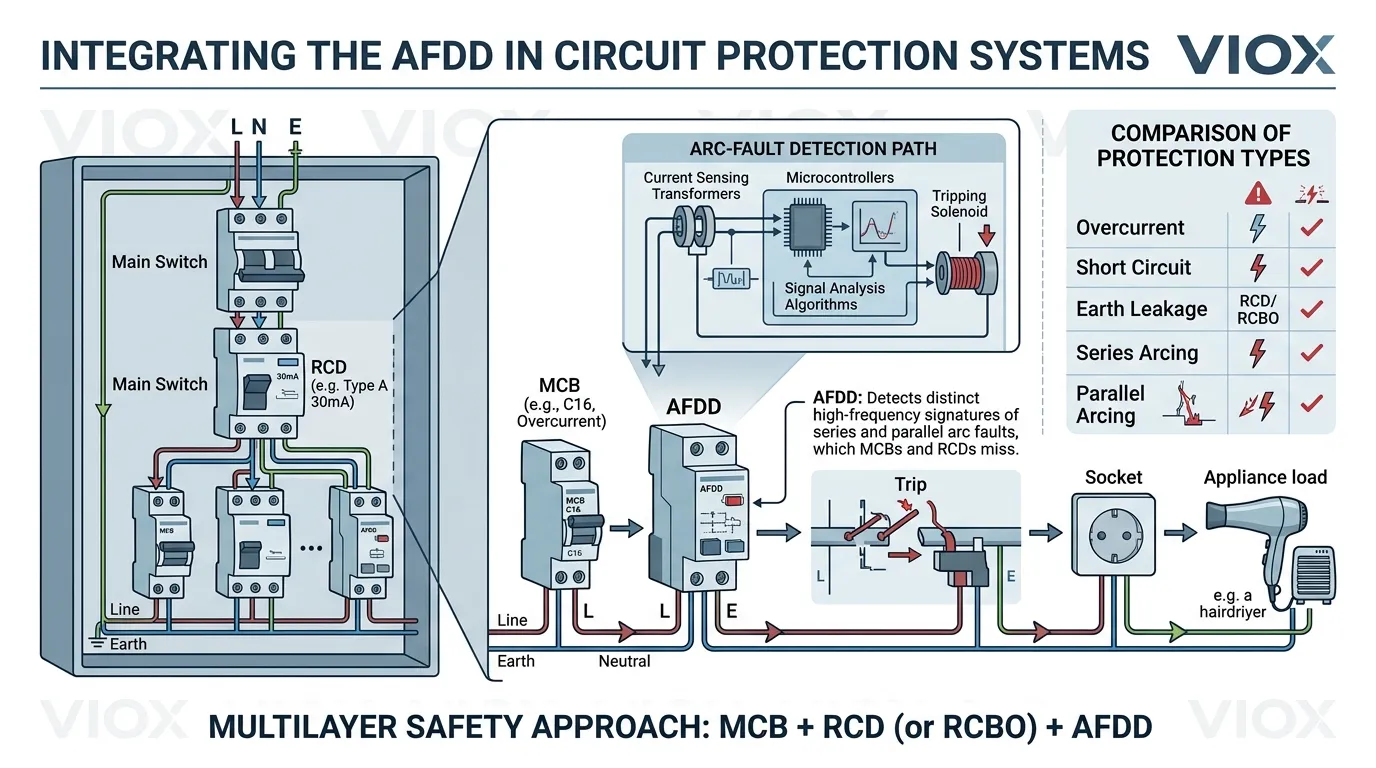
That does not mean an AFDD replaces every other protective device. In most protection schemes, it works alongside other devices rather than replacing the whole protection architecture.
How Does an AFDD Work?
An AFDD does not operate like a simple overload device. It analyzes electrical behavior in the circuit and looks for arc-fault signatures associated with hazardous arcing.
While specific detection logic varies by manufacturer and product family, the general principle is that the device evaluates the waveform and fault pattern to distinguish suspicious arcing from normal circuit behavior.
This matters because dangerous arcs do not always look like ordinary short circuits. A wiring fault can produce heat and fire risk without creating a conventional overcurrent event large enough to trip an MCB quickly.
What AFDDs Are Not Designed To Do Alone
An AFDD is not the same as:
- a pure overload protective device
- a pure residual-current device
- a universal replacement for every MCB or RCBO
Depending on the product design, AFDD protection may be combined with overcurrent protection in one assembly, but the core AFDD function remains arc-fault detection.
Where Are AFDDs Commonly Used?
AFDDs are used in circuits where arc-fault risk reduction is an important design objective.
Common application contexts include:
- residential circuits with higher fire-safety sensitivity
- sleeping areas or critical occupancy spaces in some project specifications
- public buildings or special installations where enhanced electrical fire protection is considered
- applications guided by IEC-oriented design practices or project-level requirements
The exact requirement to use AFDDs depends on market, project specification, and applicable standards. That is why a good AFDD article should explain the device clearly without making blanket claims across all countries.
AFDD vs AFCI vs RCBO vs MCB
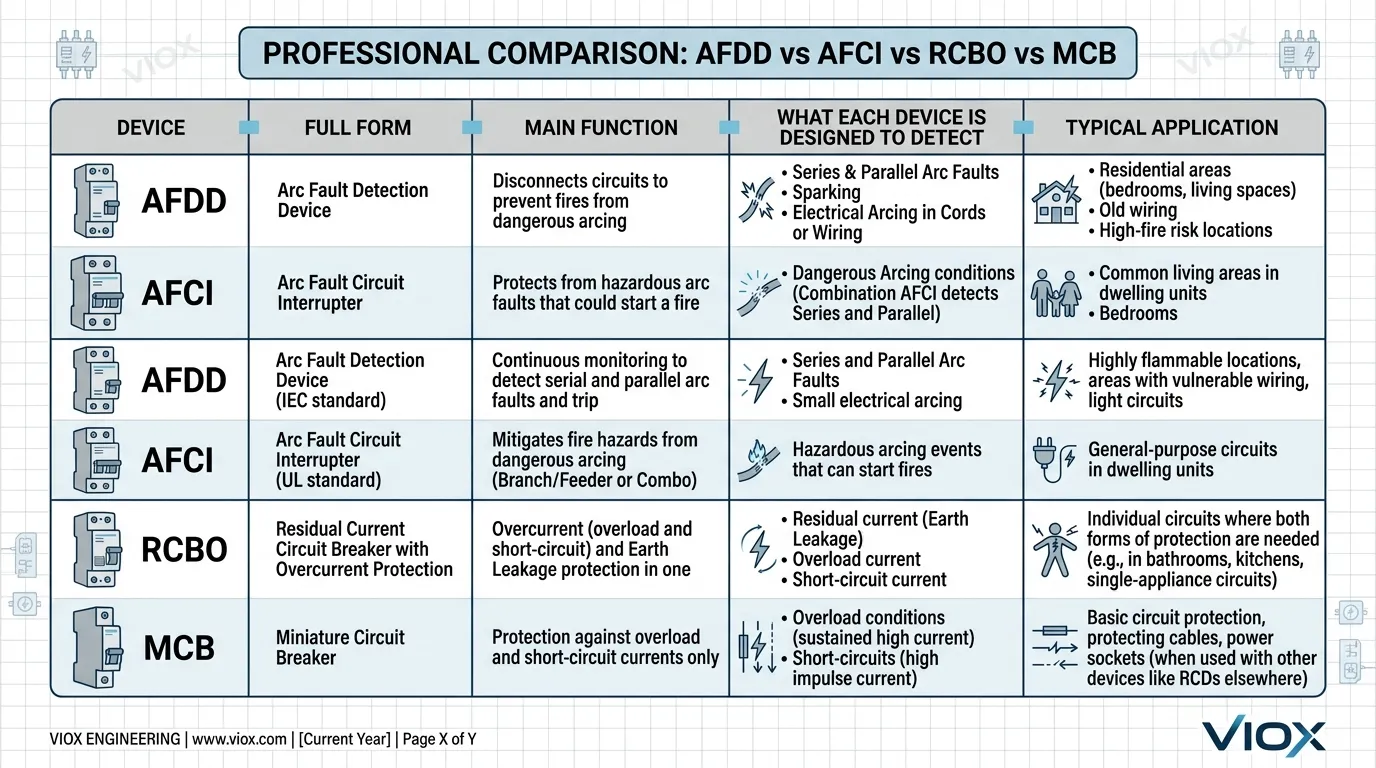
This is the comparison layer that matters most after the acronym itself.
Comparison Table
| Device | Main role | What it does not do by itself | Typical reason to choose it |
|---|---|---|---|
| AFDD | Arc-fault detection | Does not replace proper overcurrent or residual-current planning by itself | Arc-fault risk reduction |
| AFCI | Arc-fault protection term used mainly in North American contexts | Terminology and implementation differ by market | Arc-fault protection in North American usage |
| RCBO | Residual-current plus overload and short-circuit protection | Does not directly replace arc-fault detection | Combined circuit protection |
| MCB | Overload and short-circuit protection | Does not detect arc-fault patterns in the same way | Standard overcurrent protection |
AFDD vs AFCI
The easiest way to read this difference is:
- AFDD is the more common IEC-style term
- AFCI is the more common North American term
They are closely related in purpose because both deal with arc-fault protection, but the naming, market language, and device implementation context can differ.
AFDD vs RCBO
An RCBO is mainly about residual-current protection plus overcurrent protection.
An AFDD is mainly about arc-fault detection.
This is why one device does not automatically replace the other. They address different fault categories and may appear together in a broader protection strategy.
For that specific comparison, VIOX already has a focused article on RCBO vs AFDD.
AFDD vs MCB
An MCB responds to overload and short-circuit conditions.
An AFDD focuses on detecting dangerous arcing behavior.
In practical terms:
- an MCB is still essential for ordinary overcurrent protection
- an AFDD adds a different layer of protection where arc-fault risk is a concern
How To Read Basic AFDD Specifications
Once the full form is clear, the next practical question is how to interpret an AFDD in a product or project context.
Common specification areas include:
- voltage and frequency rating
- pole configuration
- rated current where combined protection is involved
- integration with overcurrent protection
- applicable standards context
- installation environment and circuit type
The exact information shown on a product depends on whether the AFDD is a standalone arc-fault device or a combined protection unit.
Basic Specification Guide
| Specification item | Why it matters | Common risk if ignored |
|---|---|---|
| Rated current | Important when the AFDD includes overcurrent protection | Wrong circuit fit |
| Pole format | Must match the circuit arrangement | Incorrect installation format |
| Device configuration | Some products combine AFDD with breaker functions | Wrong assumptions about protection scope |
| Standards context | Affects product interpretation across markets | Mixing IEC and North American terms |
| Application fit | Arc-fault relevance differs by circuit type | Treating AFDD as a universal requirement |
How To Choose the Right AFDD
Selecting an AFDD should start with the application, not just the acronym.
Selection Table
| Selection factor | Why it matters | Typical mistake |
|---|---|---|
| Market terminology | AFDD and AFCI are not always labeled the same way | Mixing device categories across markets |
| Circuit type | Arc-fault risk relevance differs by application | Assuming every circuit needs the same approach |
| Protection architecture | AFDD may need to work alongside MCB, RCBO, or other devices | Treating AFDD as a total replacement device |
| Product format | Standalone and combined configurations differ | Buying by acronym only |
| Project requirements | Standards and specifications can drive device choice | Ignoring project-level compliance needs |
At a practical level, selection should review:
- the target market
- the circuit application
- whether overcurrent protection is already provided
- whether combined protection is preferred
- the relevant project or code requirements
Common Misunderstandings About AFDDs
Several misunderstandings appear repeatedly in AFDD discussions:
- assuming AFDD is just another name for RCBO
- treating AFDD and AFCI as identical in all market contexts
- assuming overload protection automatically covers arc-fault risk
- choosing by acronym without checking whether the product includes combined protection functions
AFDD should be understood as part of a broader protection system, not as an isolated marketing label.
Conclusion
The AFDD full form is Arc Fault Detection Device. That definition is simple, but it matters because AFDD refers to a specific protection function focused on dangerous electrical arcs that may contribute to fire risk.
In practice, the next step is understanding how AFDD differs from AFCI, RCBO, and MCB devices. Once that distinction is clear, it becomes much easier to read specifications, interpret drawings, and choose the right protection architecture for the circuit.
FAQ
What is the full form of AFDD in electrical?
AFDD stands for Arc Fault Detection Device.
What does an AFDD do?
An AFDD is designed to detect arc-fault conditions associated with electrical fire risk.
Is AFDD the same as AFCI?
Not exactly. They are closely related in purpose, but AFDD is typically the IEC-style term while AFCI is more common in North American terminology.
Is AFDD the same as RCBO?
No. An RCBO focuses on residual-current protection plus overcurrent protection, while an AFDD focuses on arc-fault detection.
Does an MCB provide the same protection as an AFDD?
No. An MCB protects against overload and short circuit, but it does not detect arc-fault conditions in the same way as an AFDD.
Where are AFDDs commonly used?
AFDDs are used in installations where arc-fault risk reduction is required or preferred, depending on the market, project type, and applicable standards.