On this page
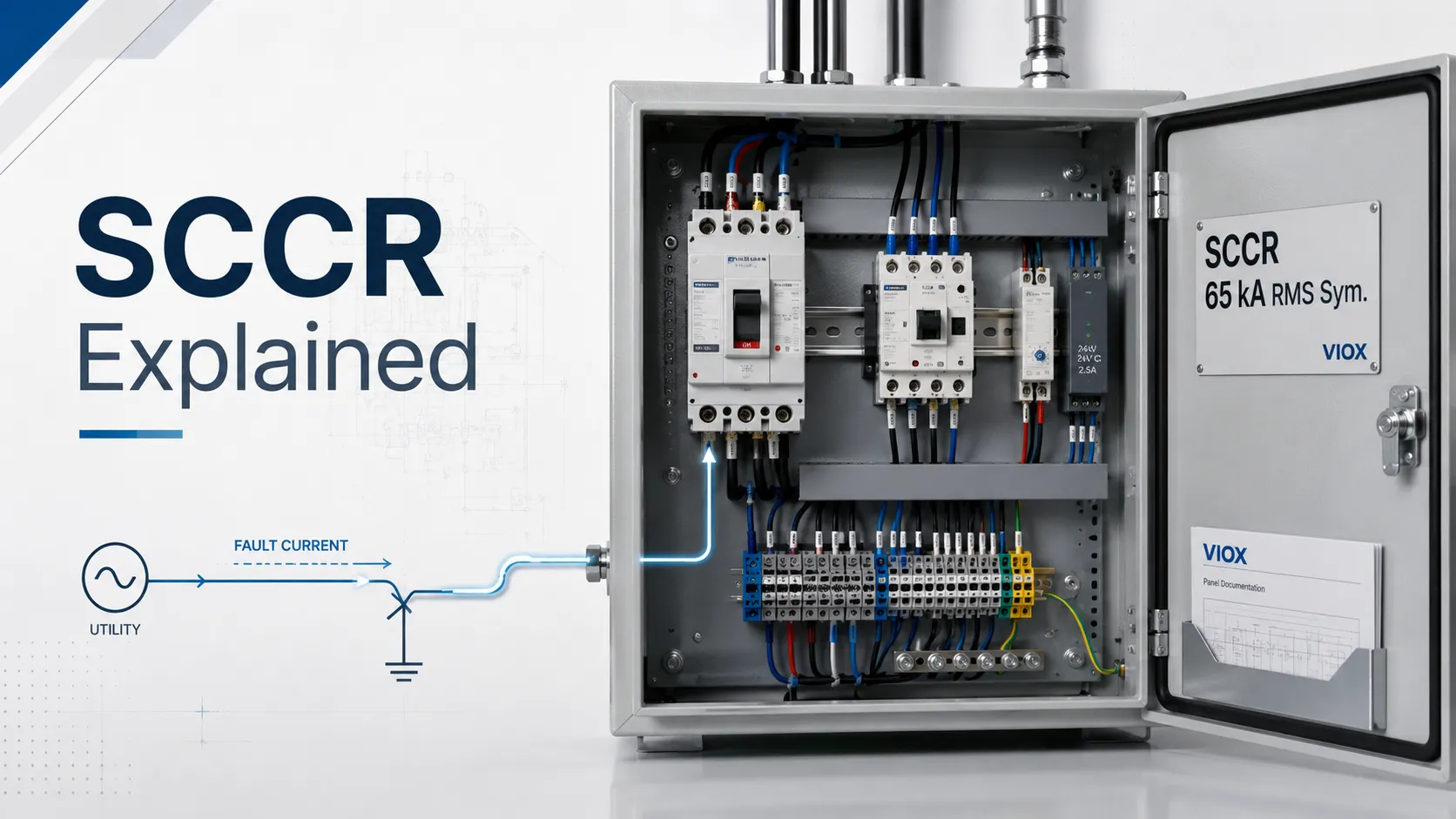
SCCR stands for Short-Circuit Current Rating. It is the maximum short-circuit current that an electrical component or complete assembly can safely withstand under specified conditions without creating an unacceptable fire, shock, or explosion hazard.
For industrial control panels, SCCR is not just a component number. It is a rating of the complete power circuit inside the panel. The marked SCCR must be equal to or greater than the available fault current at the installation point.
A common mistake is assuming the main circuit breaker’s interrupting rating is the same as the panel SCCR. It is not. A panel with a 65 kAIC main breaker can still have a 5 kA SCCR if a downstream contactor, terminal block, power distribution block, or disconnect switch is only rated 5 kA and no valid tested combination rating is used.
Quick Answer: What Is SCCR?
SCCR is the short-circuit withstand rating of equipment or an assembly. It tells you the maximum fault current the equipment can endure safely until the upstream protective device clears the fault.
The basic compliance rule is:
Equipment SCCR must be equal to or higher than the available fault current where the equipment is installed.
If the available fault current is 22 kA and the panel SCCR is 5 kA, the panel is not suitable for that location. The solution is not simply to install a larger breaker. The panel’s internal components, overcurrent protection, and tested combination ratings must be reviewed.
SCCR Full Form and Meaning
SCCR = Short-Circuit Current Rating.
It is usually expressed in kiloamperes (kA) at a maximum voltage, for example:
Short-Circuit Current Rating: 10 kA RMS symmetrical, 480 V maximum
or:
SCCR: 65 kA RMS symmetrical, 600 V maximum
The voltage matters. A rating at one voltage is not automatically valid at another voltage unless the component or assembly documentation allows it.
SCCR vs Available Fault Current vs kAIC
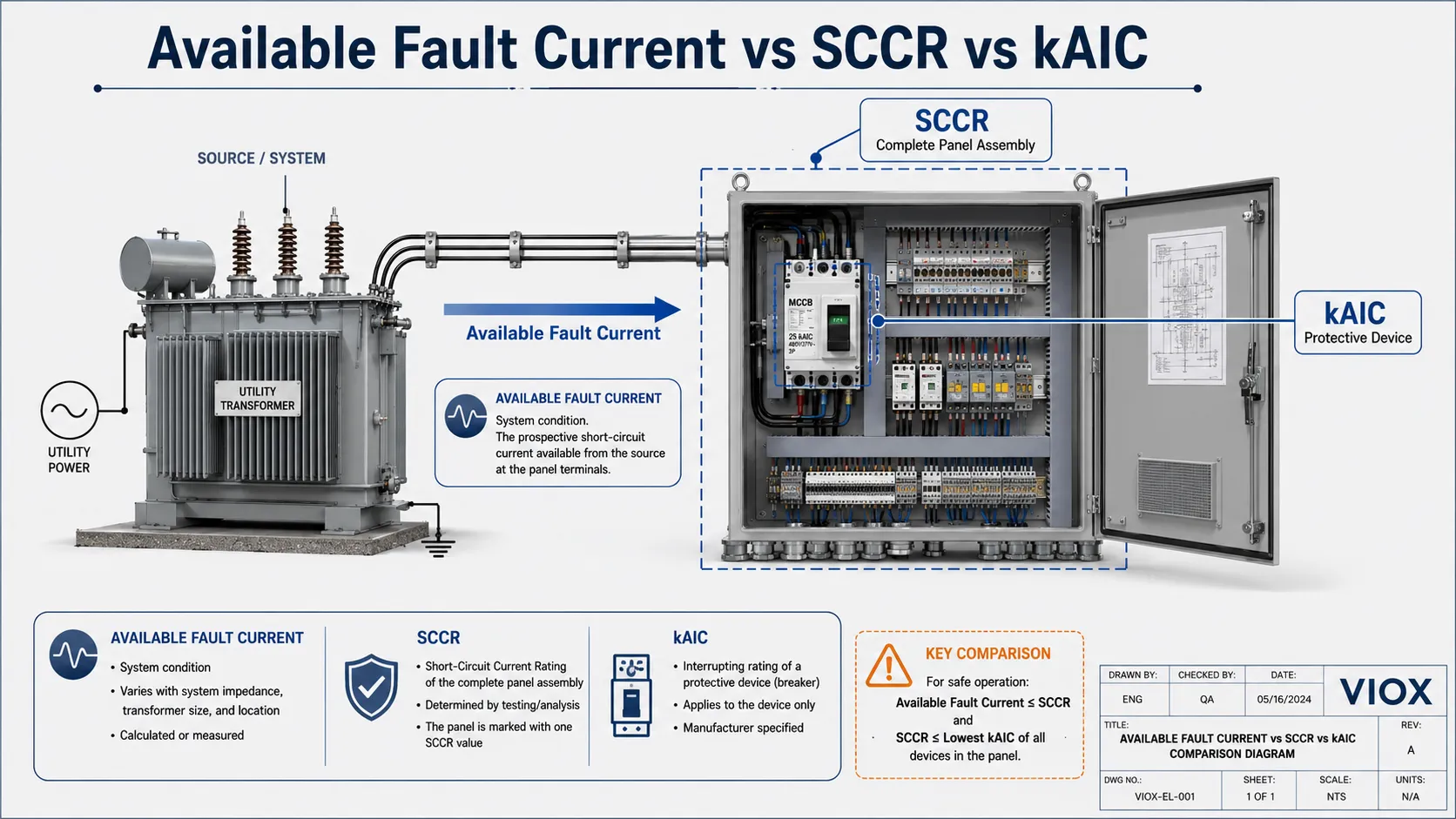
These three terms are often confused.
| Term | Meaning | Common Mistake |
|---|---|---|
| SCCR | Maximum short-circuit current an assembly or component can withstand safely | Treating it as the same as breaker interrupting rating |
| Available fault current | Maximum fault current available at the installation point | Forgetting to calculate or document it before installation |
| kAIC / interrupting rating | Breaker or fuse ability to interrupt fault current | Assuming the main breaker kAIC equals panel SCCR |
| Series rating | Tested combination of upstream and downstream protective devices | Mixing components without tested data |
| Panel SCCR label | Marked SCCR of the complete equipment | Marking only the main breaker interrupting rating |
The simplest way to separate them:
- Available fault current is what the electrical system can deliver.
- Interrupting rating is what a breaker or fuse can safely interrupt.
- SCCR is what the equipment can safely withstand.
All three must be compatible.
Where SCCR Is Required
SCCR is especially important for industrial control panels, machinery panels, switchboards, panelboards, motor control equipment, and assemblies installed in facilities with high available fault current.
In North American practice, SCCR is commonly discussed with:
- NEC requirements for equipment suitability and marking
- UL 508A industrial control panel methodology
- Available fault current documentation
- AHJ or inspector review
- Panel labels and nameplates
For IEC-style global designs, similar safety goals appear through short-circuit withstand and assembly verification under standards such as IEC 61439. However, North American SCCR marking and UL 508A calculation methods are a specific compliance framework that export machine builders must understand.
How to Calculate SCCR of a Control Panel
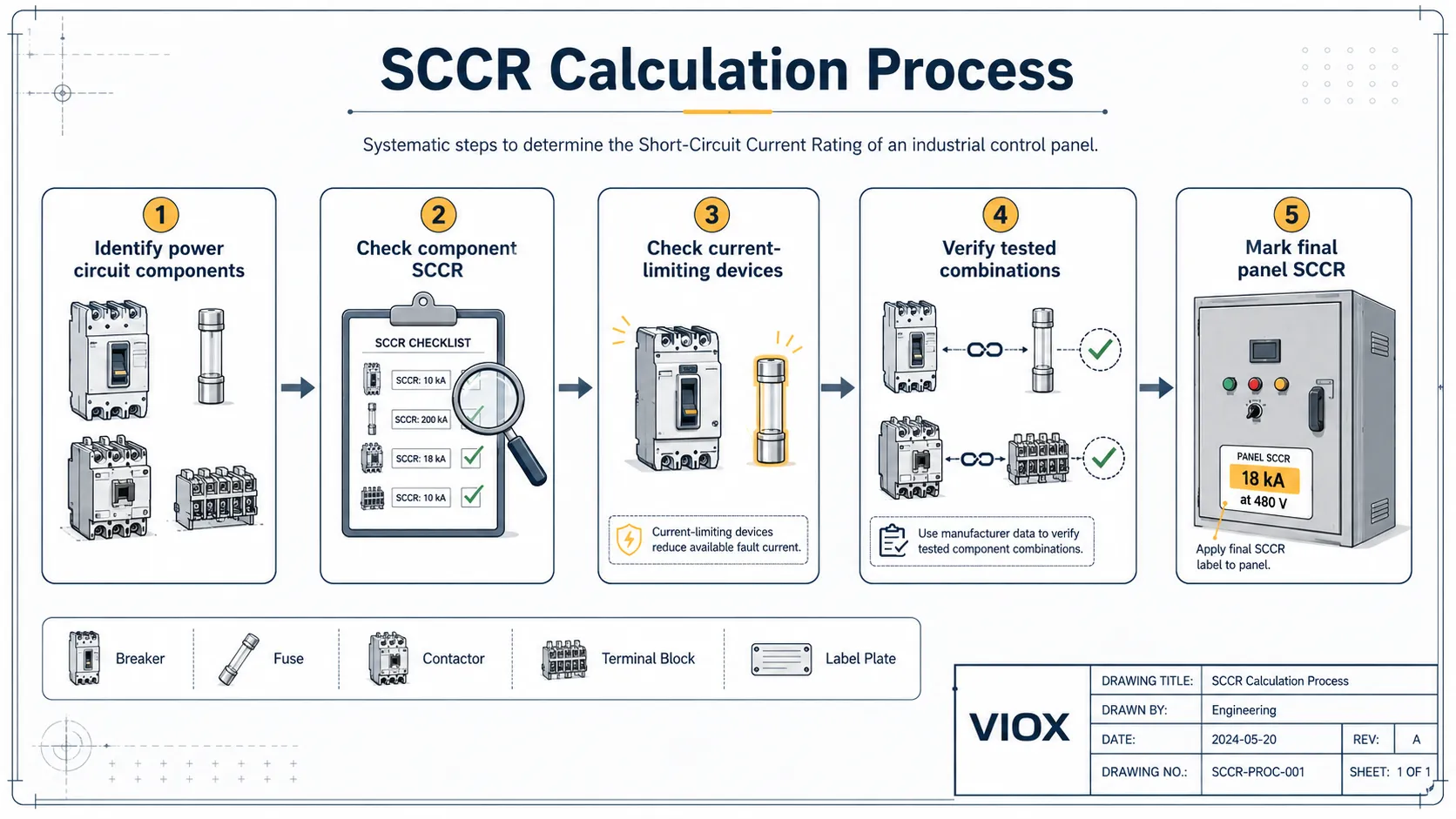
For industrial control panels, the most common analytical approach follows UL 508A Supplement SB logic. The exact calculation must be done according to the applicable standard and product documentation, but the practical workflow is:
| Step | What to Do | Key Question |
|---|---|---|
| 1 | Identify all power circuit components | Which components carry load current or fault current? |
| 2 | Find each component SCCR | Is the rating marked, in the datasheet, defaulted, or based on a tested combination? |
| 3 | Identify overcurrent protective devices | Are there current-limiting fuses or breakers? |
| 4 | Check manufacturer combination ratings | Is the higher rating valid only with a specific fuse or breaker? |
| 5 | Determine the limiting SCCR | Which component or branch limits the panel rating? |
| 6 | Mark the final SCCR | Does the marked SCCR meet or exceed available fault current? |
Control-only devices such as push buttons, pilot lights, relay coils, and PLC inputs are not usually the limiting components for SCCR because they are not in the power circuit supplying the load. Power circuit components such as contactors, motor starters, disconnects, power distribution blocks, terminal blocks, drives, and overcurrent devices must be reviewed.
SCCR Calculation Example
Here is a simplified example to show the logic.
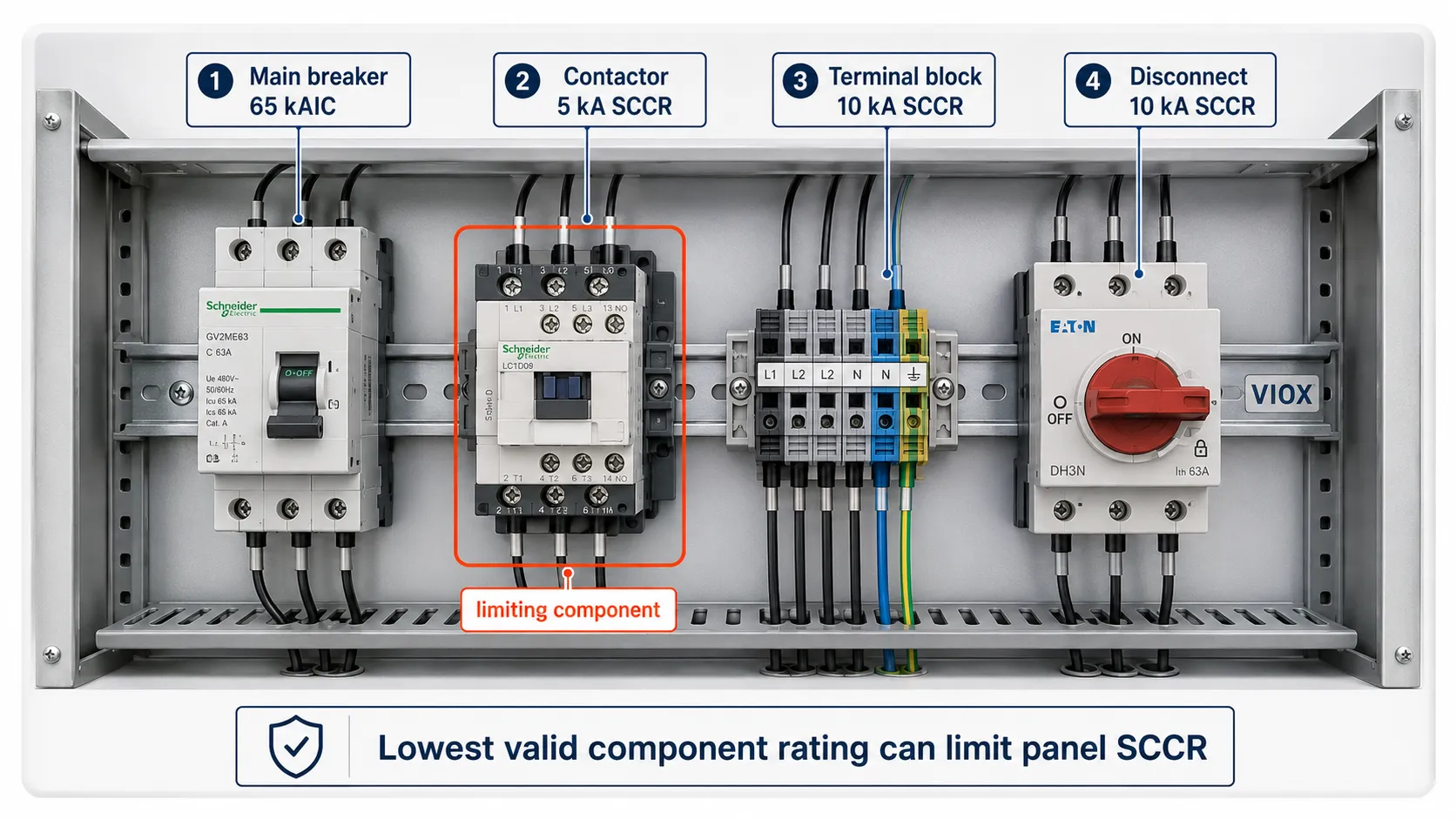
Assume an industrial control panel has:
| Component | Rating Information |
|---|---|
| Available fault current at installation | 22 kA |
| Main circuit breaker interrupting rating | 65 kAIC |
| Contactor SCCR | 5 kA |
| Terminal block SCCR | 10 kA |
| Disconnect switch SCCR | 10 kA |
| Valid tested current-limiting combination | None documented |
In this case, the panel SCCR may be limited to 5 kA by the contactor, even though the main breaker has a 65 kAIC interrupting rating.
That means:
- The main breaker can interrupt up to its rated fault current under its own test conditions.
- The panel assembly may still only withstand 5 kA because of the lowest-rated power circuit component.
- If the available fault current is 22 kA, a 5 kA panel SCCR is not adequate for that location.
This example is why SCCR calculation cannot stop at the main breaker.
How UL 508A Supplement SB Is Used
UL 508A Supplement SB provides an analytical method for determining SCCR of industrial control panels. Panel builders commonly use it to determine and mark SCCR without destructive short-circuit testing of every custom panel.
The typical sources for component SCCR are:
- A marked SCCR on the component
- Manufacturer datasheet or UL documentation
- UL 508A default values where allowed
- Tested combination ratings with specified overcurrent protective devices
When a component has no marked rating, default values may be conservative. That can lower the complete panel SCCR. This is why selecting marked, high-SCCR components can matter in industrial panel design.
Current-Limiting Devices and Series Combination Ratings
Current-limiting fuses or current-limiting circuit breakers can reduce peak let-through current and energy. In some tested combinations, they allow downstream components to be used at a higher assembly SCCR than their standalone rating.
But this only works when the combination is documented and valid.
Do not assume:
- Any Class J fuse automatically raises every panel to 100 kA
- Any current-limiting breaker creates a higher SCCR
- Similar-looking components can be substituted in a tested combination
- A series-rated scheme remains valid after changing brands or part numbers
For a higher SCCR claim, the exact combination of upstream protective device and downstream component must be supported by the manufacturer’s tested data or accepted method.
SCCR Label and Panel Marking Requirements
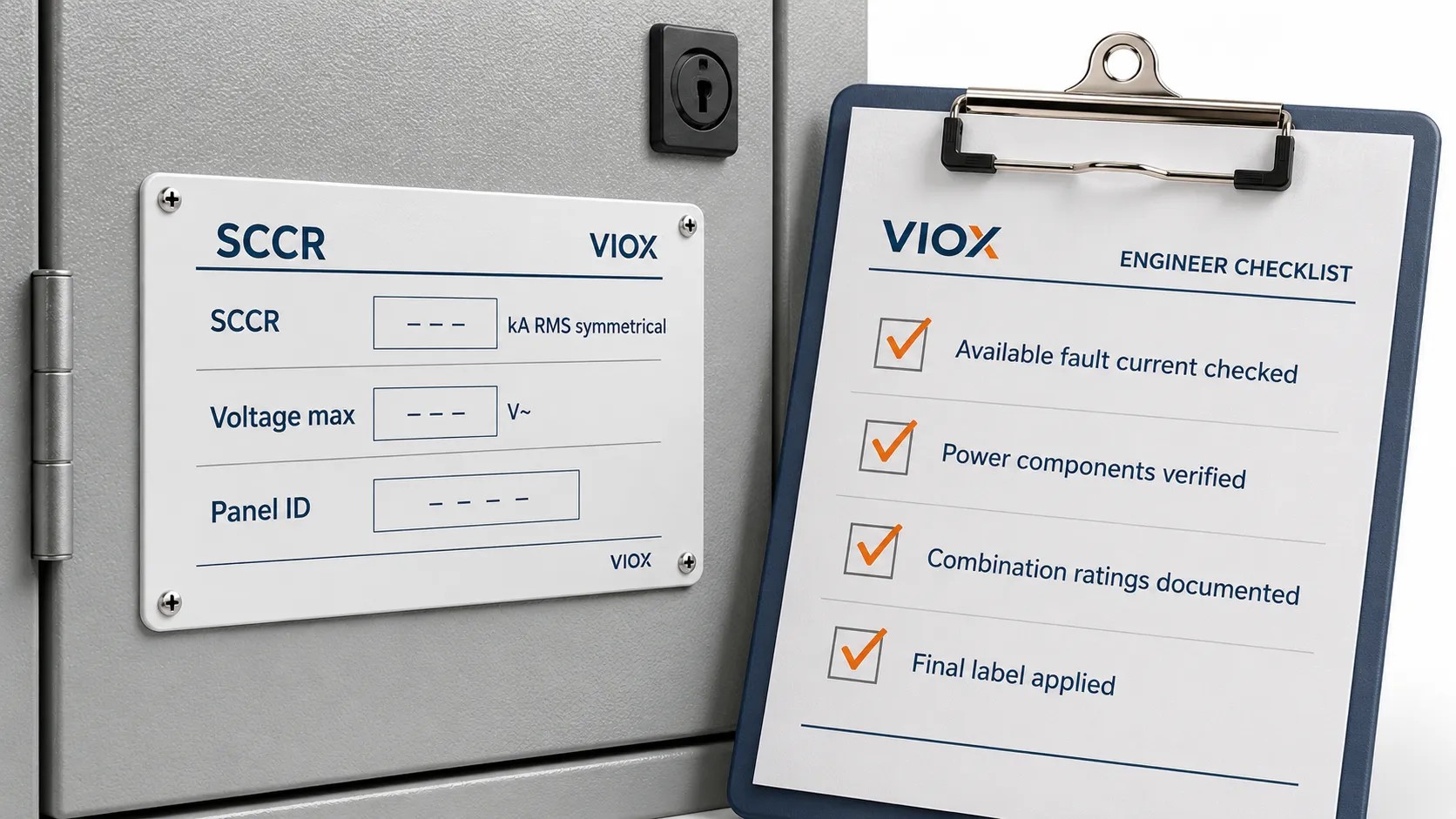
A proper industrial control panel label should clearly state the panel SCCR. A typical marking format is:
Short-Circuit Current Rating: 10 kA RMS symmetrical, 480 V maximum
or:
SCCR: 65 kA RMS symmetrical, 600 V maximum
Depending on the equipment type and jurisdiction, panel labels may also include:
- Manufacturer name
- Voltage and phase
- Full-load current
- Maximum overcurrent protective device rating
- Wiring diagram or drawing reference
- Enclosure rating
- SCCR value and voltage
For field installation, available fault current may also need to be documented and marked according to the adopted code and AHJ requirements. The installer and panel builder do not perform the same role: the panel builder marks the equipment SCCR, while the installer must verify that the marked SCCR is suitable for the available fault current at the installation point.
What Happens If Available Fault Current Exceeds SCCR?
If available fault current exceeds the equipment SCCR, the equipment is not suitable for that installation point.
Possible consequences include:
- Component rupture during a short circuit
- Fire or arc-flash hazard
- Explosive failure of contactors, drives, blocks, or switches
- Enclosure damage
- Failed inspection
- Code violation
- Production downtime
- Liability risk
This is why an AHJ or inspector may reject a panel even if it appears to operate normally. SCCR is about fault safety, not normal operation.
How to Increase SCCR Safely
If the calculated SCCR is too low, common engineering options include:
| Method | How It Helps | Caution |
|---|---|---|
| Use higher-SCCR components | Raises the weakest link in the power circuit | Must verify all branches, not just one device |
| Use current-limiting fuses | Reduces let-through current and energy | Must use valid fuse class and tested combination data |
| Use tested combination ratings | Allows higher SCCR for specific device combinations | Part numbers and conditions must match exactly |
| Split the panel into sections | Limits exposure of lower-rated equipment | Requires careful design and labeling |
| Reduce available fault current | Use impedance, transformer location, or distribution changes | Must be engineered, not guessed |
| Redesign the power circuit | Remove or replace limiting components | Requires updated documentation and label |
Never increase the SCCR label by assumption. The new rating must be supported by component data, tested combination ratings, analysis, or testing accepted by the applicable standard and AHJ.
Common SCCR Mistakes
Mistake 1: Using kAIC as the Panel SCCR
The main breaker interrupting rating is not automatically the panel SCCR. The panel may be limited by a downstream contactor, terminal block, disconnect, drive, or power distribution block.
Mistake 2: Ignoring Available Fault Current
SCCR only matters when compared with the available fault current at the installation point. A panel rated 10 kA may be acceptable in one location and unacceptable in another.
Mistake 3: Assuming Current-Limiting Protection Always Raises SCCR
Current-limiting protection helps only when the component combination and let-through data support the rating.
Mistake 4: Replacing Components Without Rechecking SCCR
Changing a contactor, breaker, fuse holder, terminal block, or power distribution block can change the limiting SCCR.
Mistake 5: Forgetting the Label
Even if the calculation is correct, the panel still needs proper marking and documentation for inspection and future maintenance.
Mistake 6: Mixing IEC and UL Language Without Translation
IEC concepts such as short-circuit withstand current, Icw, Icu, and Ics are not always one-to-one replacements for North American SCCR marking. Export panels may need a separate review.
SCCR Documentation Checklist
Before releasing or installing a control panel, keep:
| Document | Purpose |
|---|---|
| One-line diagram | Shows power circuit structure |
| Component list | Identifies devices included in SCCR calculation |
| Component SCCR data | Proves ratings used in the calculation |
| Tested combination documentation | Supports higher ratings where used |
| Available fault current value | Confirms installation suitability |
| Calculation date | Helps inspectors and future maintenance teams |
| Final SCCR label | Marks the equipment rating visibly |
| Revision history | Shows whether later changes affect SCCR |
FAQ
What does SCCR stand for?
SCCR stands for Short-Circuit Current Rating. It is the maximum short-circuit current an electrical component or assembly can safely withstand under specified conditions.
How do you calculate SCCR of a control panel?
Identify all power circuit components, find each component SCCR, apply valid default values or manufacturer ratings, check current-limiting or tested combination ratings, and determine the limiting SCCR of the complete power circuit.
Is SCCR the same as kAIC?
No. SCCR is a withstand rating for equipment or assemblies. kAIC is an interrupting rating for circuit breakers or fuses. A panel’s SCCR can be lower than the main breaker kAIC.
Who marks the SCCR on an industrial control panel?
The panel builder or equipment manufacturer normally determines and marks the SCCR on the industrial control panel. The installer must verify that the marked SCCR is suitable for the available fault current at the installation point.
Can the main breaker interrupting rating be used as panel SCCR?
No. The main breaker interrupting rating alone does not define the SCCR of the complete panel. Downstream power circuit components must also be considered.
What happens if SCCR is lower than available fault current?
The equipment is not suitable for that installation point. During a fault, the panel may fail violently, create fire or arc-flash hazards, and fail inspection.
Does a control-only panel need SCCR?
A panel containing only control circuit components may not require the same SCCR evaluation as a power circuit panel. If the panel includes power circuit components feeding loads, SCCR must be evaluated.
When should SCCR be recalculated?
Recalculate SCCR when power circuit components are added, replaced, modified, relocated, or when the facility electrical system changes in a way that affects available fault current.
Conclusion
SCCR is the short-circuit withstand rating of equipment and assemblies. It is not the same as available fault current and not the same as the interrupting rating of a breaker or fuse.
For industrial control panels, the practical question is: Is the marked SCCR of the panel equal to or greater than the available fault current where the panel will be installed? If not, the panel must be redesigned, protected with valid current-limiting combinations, relocated, or otherwise engineered to meet the required rating.
Treat SCCR as part of panel safety engineering, not as a label added at the end. The calculation should be tied to the actual power circuit, component ratings, tested combinations, available fault current, and inspection requirements.