

On this page
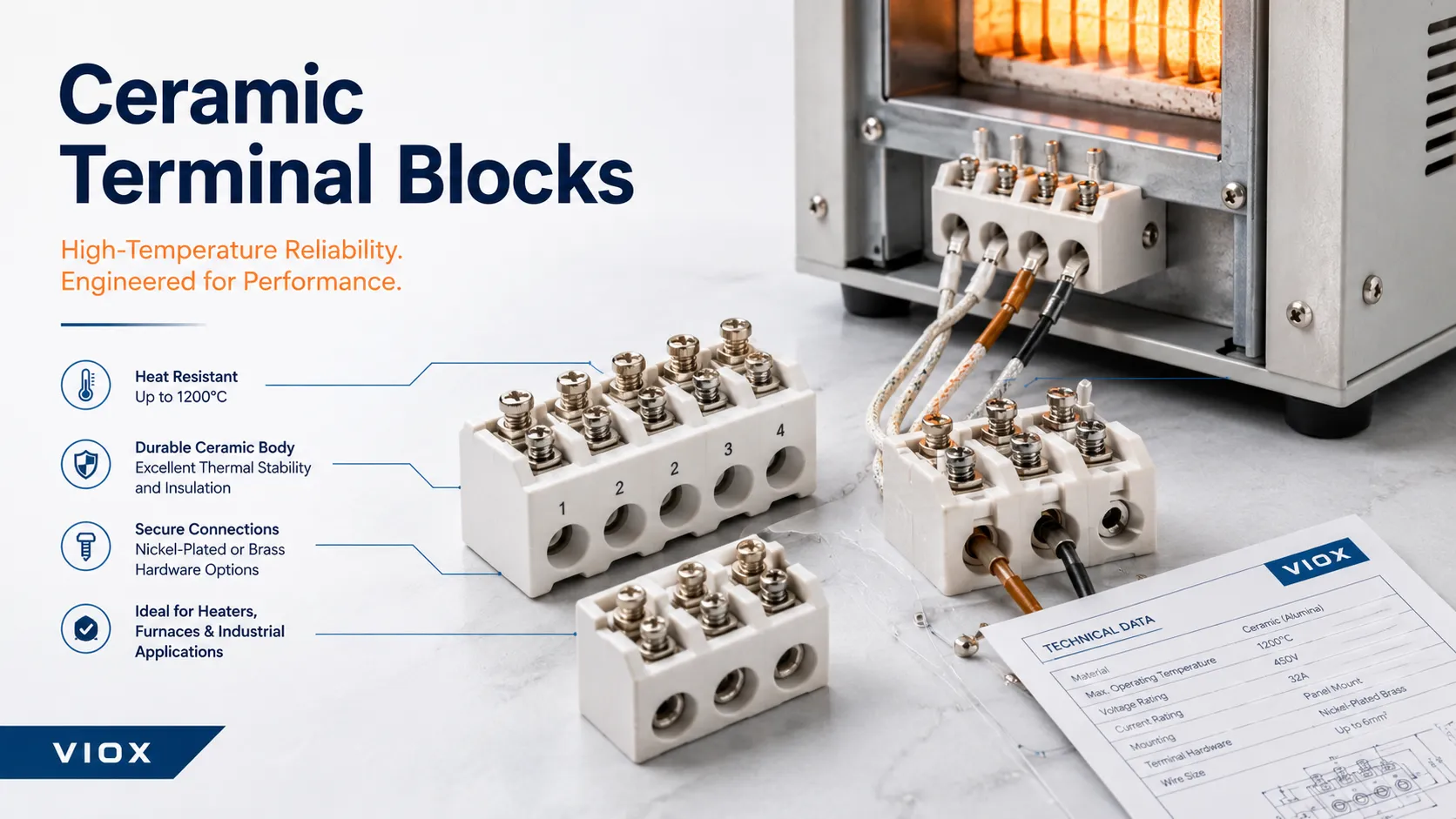
Standard nylon (PA66) and polycarbonate terminal blocks begin to soften, deform, and lose screw clamping pressure once continuous ambient temperatures exceed 105°C–120°C. Whenever a wiring junction sits inside or adjacent to a heating element, industrial oven, kiln, furnace, or high-wattage lamp housing operating between 120°C and 800°C, engineers must step up from thermoplastic housings to a glazed or unglazed ceramic insulator. This guide focuses strictly on ceramic vs. plastic thermal limits, steatite vs. porcelain vs. alumina material grades, metal screw bottlenecks, and high-temperature field wiring practices. If you are ready to match pole counts, wire cross-sections, or mounting dimensions, review our complete ceramic terminal block specifications and size chart.
Ceramic Terminal Block vs Plastic Terminal Block
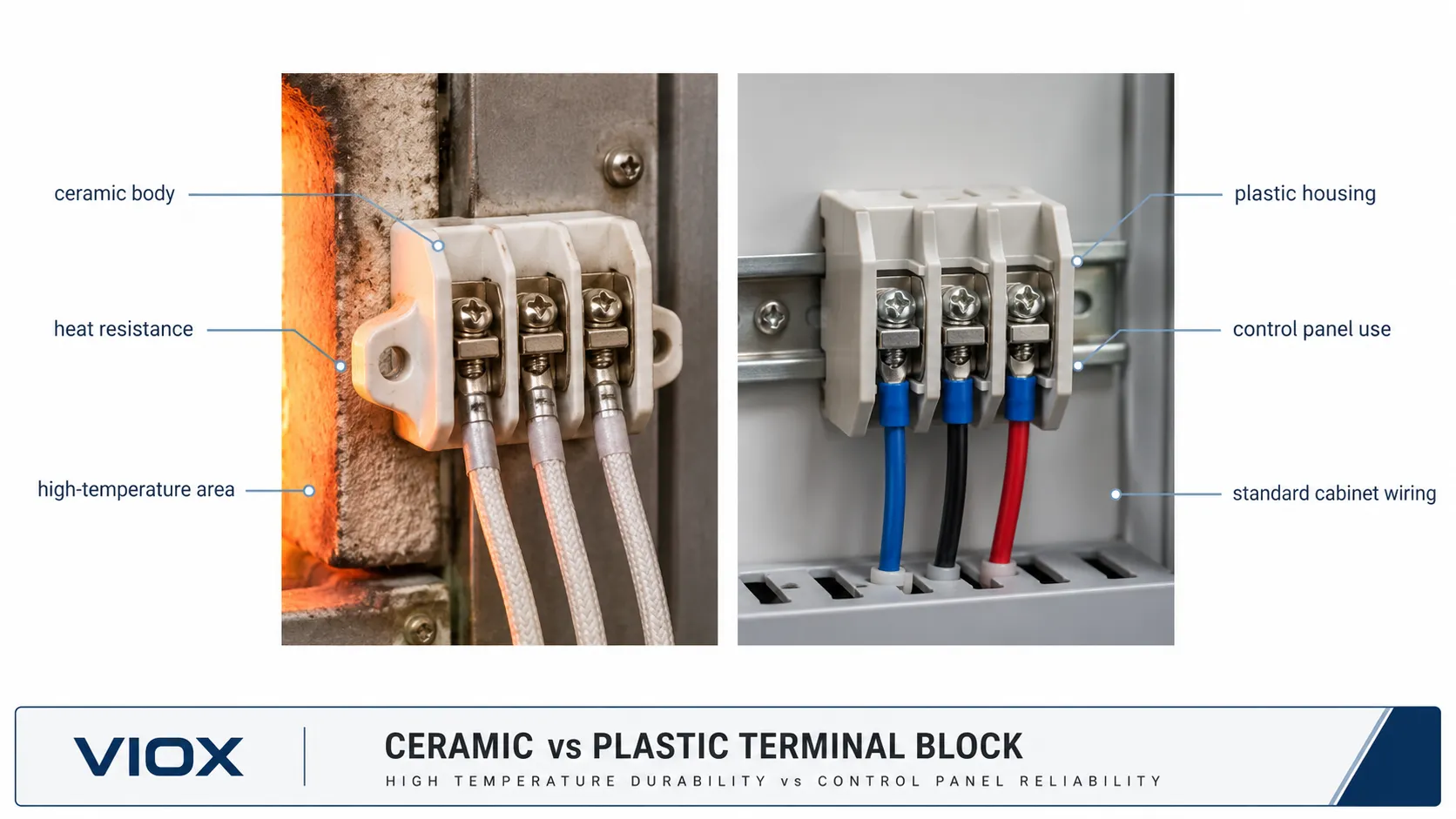
The simplest way to understand the product is to compare it with a normal plastic terminal block.
| Feature | Ceramic Terminal Block | Plastic Terminal Block |
|---|---|---|
| Main advantage | High-temperature resistance | Lower cost, flexible form factor, broad control panel use |
| Insulation body | Ceramic, porcelain, or steatite-type ceramic material | PA66, PC, PBT, or other engineering plastics |
| Heat performance | Better for hot equipment and radiant heat areas | Suitable for normal control panels and moderate temperatures |
| Mechanical behavior | Hard and heat-stable but brittle | Usually better impact resistance |
| Typical mounting | Screw mount, panel mount, equipment mount, terminal strip | DIN rail, PCB, panel, plug-in, feed-through |
| Common applications | Ovens, heaters, furnaces, kilns, lighting, thermocouples | Control cabinets, machines, PLC wiring, distribution panels |
| Main risk | Cracking, wrong screw torque, wrong wire size, undersized current rating | Heat deformation, insulation aging, poor temperature margin |
Use ceramic when heat is the main design constraint. Use standard plastic terminal blocks when the application is a normal control panel environment and the datasheet ratings match the installation.
Why Ceramic Terminal Blocks Are Used for High-Temperature Wiring
Heat changes electrical connections in three ways:
- Insulation materials age faster. Many plastics lose mechanical strength or deform when exposed to continuous high temperature.
- Metal parts expand and contract. Thermal cycling can loosen poor screw connections if the clamp design is weak or the conductor is poorly prepared.
- Contact resistance creates more heat. A loose or undersized connection can become a local hot spot, especially in heater circuits.
A ceramic connector block solves the insulation-body problem by using a material that maintains insulation and mechanical shape at temperatures where many plastics would be unsafe. This is why ceramic terminal blocks are common near heating elements, thermal equipment, and high-temperature wiring transitions.
However, the connection is still only as reliable as the whole design:
- correct conductor size
- correct screw clamp pressure
- suitable metal insert material
- suitable terminal spacing
- suitable wire insulation temperature rating
- stable mounting surface
- proper strain relief
In a heater or oven, the terminal block may survive the heat, but the wire insulation, crimp ferrule, screw, or surrounding enclosure may still be the limiting part.
Ceramic, Porcelain, and Steatite Terminal Blocks: Are They the Same?
Industrial buyers and design engineers often see these terms used in overlapping ways:
- ceramic terminal block
- porcelain terminal block
- steatite terminal block
- ceramic connector block
- porcelain connector block
- ceramic terminal strip
They are related, but not always identical.
| Term | Practical Meaning | Buyer Note |
|---|---|---|
| Ceramic terminal block | Broad term for terminal blocks with ceramic insulating bodies | Standard industry nomenclature for heat-resistant connector blocks |
| Porcelain terminal block | Often used for white ceramic electrical connector blocks | Common in lighting, heating, and appliance contexts |
| Steatite terminal block | Refers to a magnesium silicate ceramic material often used for electrical insulation | Check datasheet material and temperature rating |
| Ceramic connector block | General connector wording, often used by buyers outside panel-building terminology | Confirm pole count, wire size, and rating |
| Ceramic terminal strip | Multi-pole strip-style ceramic terminal block | Common for heaters, ovens, and appliance wiring |
The safest purchasing approach is not to rely on the name alone. Ask for the datasheet and confirm the electrical rating, temperature rating, body material, screw material, and dimensions.
Material Limits: Ceramic Body vs Metal Hardware
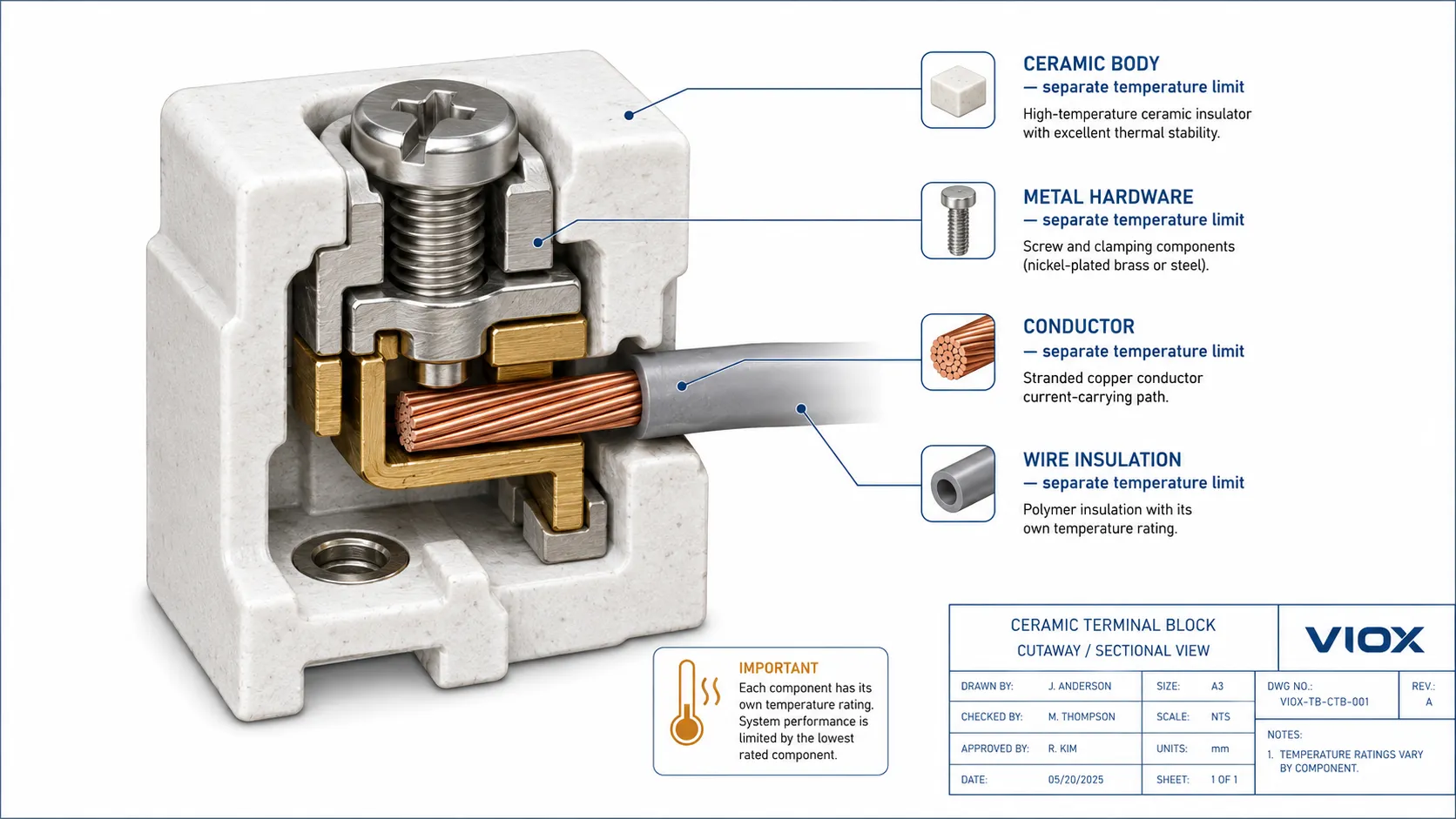
One reason ceramic terminal blocks are misunderstood is that the ceramic body and the conductive hardware do not share the same temperature limit.
Steatite ceramic materials can withstand very high temperatures in insulation applications, often far above the temperature limits of common plastic housings. In practical terminal blocks, however, the usable temperature is normally limited by:
- screw material
- conductive insert material
- plating system
- conductor type
- wire insulation
- current loading
- oxidation environment
- mechanical stress during thermal cycling
As a practical engineering rule, ordinary brass hardware may oxidize heavily in high-temperature service. For higher-temperature heater and furnace applications, stainless steel screws, nickel-plated parts, or other high-temperature metal options may be required. The correct choice depends on the real ambient temperature, conductor temperature, current, and exposure time.
For VIOX ceramic terminal block projects, buyers can specify the required operating environment so the housing material, screw material, and conductive insert configuration can be checked together rather than selected as separate parts.
Sizing Poles, Current Ratings & Mounting Dimensions
Once you have verified that your operating temperature exceeds PA66 plastic limits and selected the right ceramic grade and hardware alloy, the next step is matching physical pole count (2-pole, 3-pole, 4-pole, or multi-pole strips), wire gauge (1.5–16 mm²), and mounting hole spacing. For complete CTB, TB, and TBH electrical ratings, dimensional charts, and direct factory ordering, visit the VIOX Ceramic Terminal Block catalog and size chart.
Ceramic Terminal Block Applications
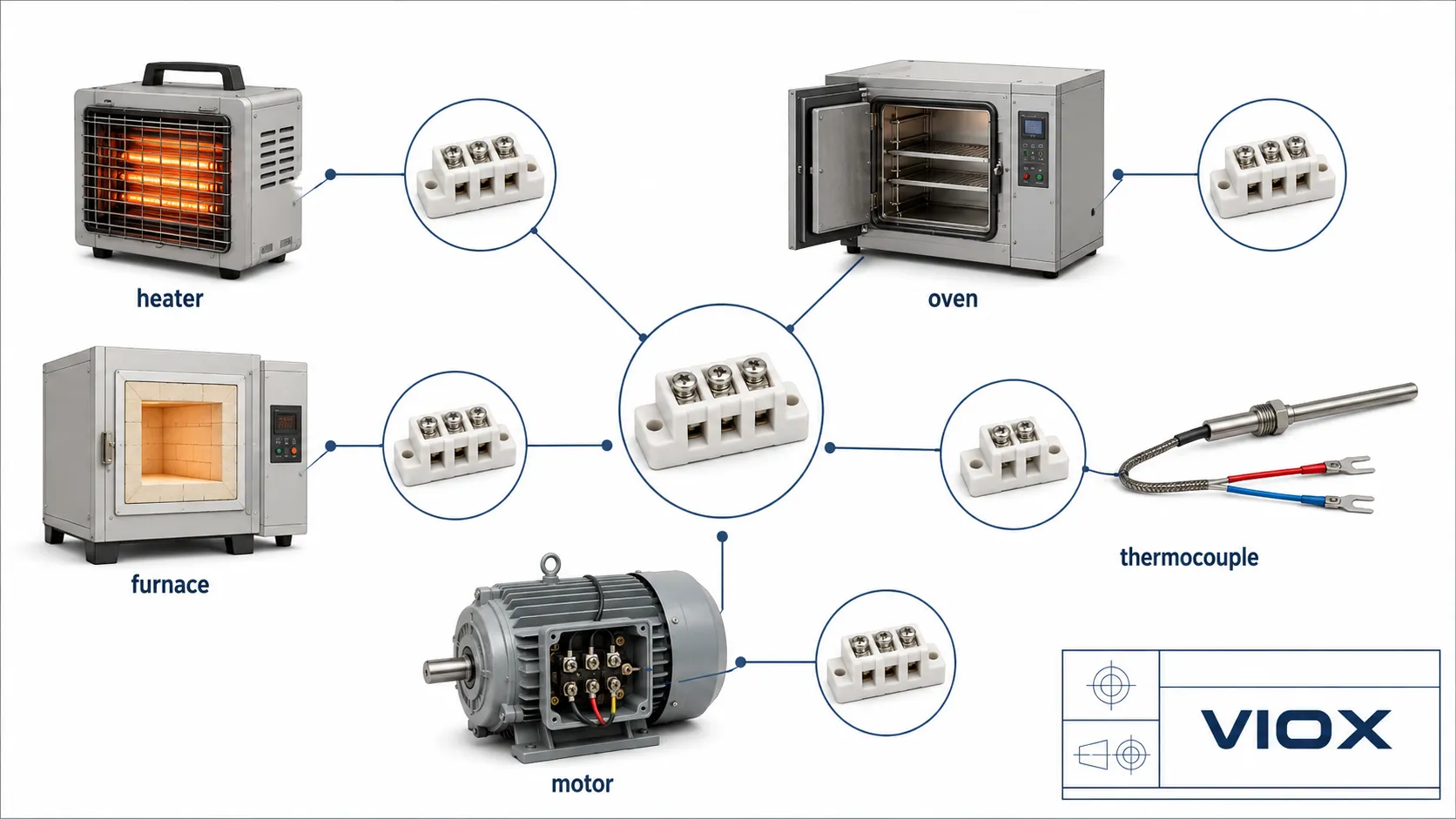
| Application | Why Ceramic Is Used | Selection Focus |
|---|---|---|
| Electric heaters | High heat near heating elements | Current rating, temperature rating, screw stability |
| Ovens | Elevated ambient temperature and thermal cycling | Ceramic body, wire insulation, service access |
| Furnaces | High temperature and harsh thermal environment | Temperature margin, mounting stability, insulation spacing |
| Kilns | Radiant heat and long heating cycles | Ceramic material, screw material, conductor rating |
| Infrared lamps | Heat near lamp holder and wiring area | Compact size, temperature rating, insulation spacing |
| Thermocouples | Hot measurement points | Signal wire compatibility and stable contact |
| HVAC heating equipment | Heater banks and thermal cycling | Current rating and maintenance access |
| Motor terminal areas | Heat plus mechanical stress | Screw retention, vibration resistance, spacing |
High-Temperature Wiring Practices & Common Field Mistakes
Mistake 1: Assuming All White Connector Blocks Are High Temperature
Some white terminal blocks are ceramic, but appearance is not enough. Verify material and temperature rating from the datasheet.
Mistake 2: Choosing Ceramic but Using Low-Temperature Wire
The terminal block may survive, but the wire insulation may fail first. The whole connection must be rated for the environment.
Mistake 3: Overtightening the Screw
Ceramic is hard but brittle. Excessive screw force, uneven mounting pressure, or impact can crack the body.
For repeat production, use a controlled assembly process rather than hand-feel tightening. The correct torque should come from the specific model datasheet or factory instruction, because screw size, ceramic geometry, and metal insert design all affect the safe tightening range.
Mistake 4: Using the Wrong Pole Count
Do not force extra conductors into a smaller block. Use the correct 2-pole, 3-pole, 4-pole, or multi-pole configuration.
Mistake 5: Ignoring Contact Resistance
A high-temperature environment makes poor connections worse. Loose screws, damaged strands, or undersized conductors can create localized heating.
Mistake 6: Treating Thermocouple Wiring Like Power Wiring
Thermocouple circuits may require special conductor compatibility and careful routing. A power-style ceramic block may not be the best choice for precision measurement circuits.
Frequently Asked Questions
At what temperature must I switch from a plastic (PA66) terminal block to a ceramic terminal block?
Switch from PA66 polyamide plastic to ceramic whenever continuous operating temperature at the junction exceeds 105°C–120°C, or when radiant heat from heaters, ovens, or exhaust ducts causes thermal cycling that softens plastic housings and loosens screw torque.
What is the difference between steatite, porcelain, and alumina ceramic terminal blocks?
Electrical porcelain handles typical industrial heater junctions up to roughly 300°C–500°C; steatite (magnesium silicate ceramic) offers tighter dimensional tolerances, higher mechanical strength, and lower dielectric loss for 500°C–800°C continuous duty; high-purity alumina is reserved for extreme kiln and laboratory environments above 800°C.
If ceramic withstands 800°C, why can a ceramic terminal block still fail at 350°C?
The limiting factor is almost always the metal hardware and conductor—not the ceramic body. Standard brass inserts and zinc-plated steel screws oxidize and lose clamping force around 200°C–250°C; continuous duty above 300°C requires nickel-plated brass or stainless-steel screws paired with high-temperature nickel/fiberglass or mica-insulated wire.
How do I prevent ceramic terminal blocks from cracking during installation?
Mount the block onto a flat metal surface (use a thin mica or fiber washer on uneven sheet metal), never use an impact driver on mounting screws, and tighten terminal screws steadily to the specified torque without side-loading the ceramic partition walls.
Why should I never use standard PVC-insulated wire with a ceramic terminal block?
PVC insulation melts and chars above 70°C–105°C. Pairing PVC wire with a 500°C ceramic block causes insulation failure right at the terminal throat; always use silicone-rubber (180°C–200°C), PTFE (260°C), or fiberglass/mica-braided nickel wire (400°C–500°C+) rated for the full junction temperature.
Conclusion
Choosing between plastic and ceramic terminal blocks is a thermal-system decision, not just a housing swap. Above 120°C, ceramic prevents housing melt and tracking, but long-term reliability depends equally on matching the ceramic grade (porcelain, steatite, or alumina), specifying oxidation-resistant screw alloys, and terminating properly rated high-temperature wire without over-torquing the ceramic body. To select exact 2-pole, 3-pole, or multi-pole configurations, explore our ceramic terminal block specifications and size chart.