

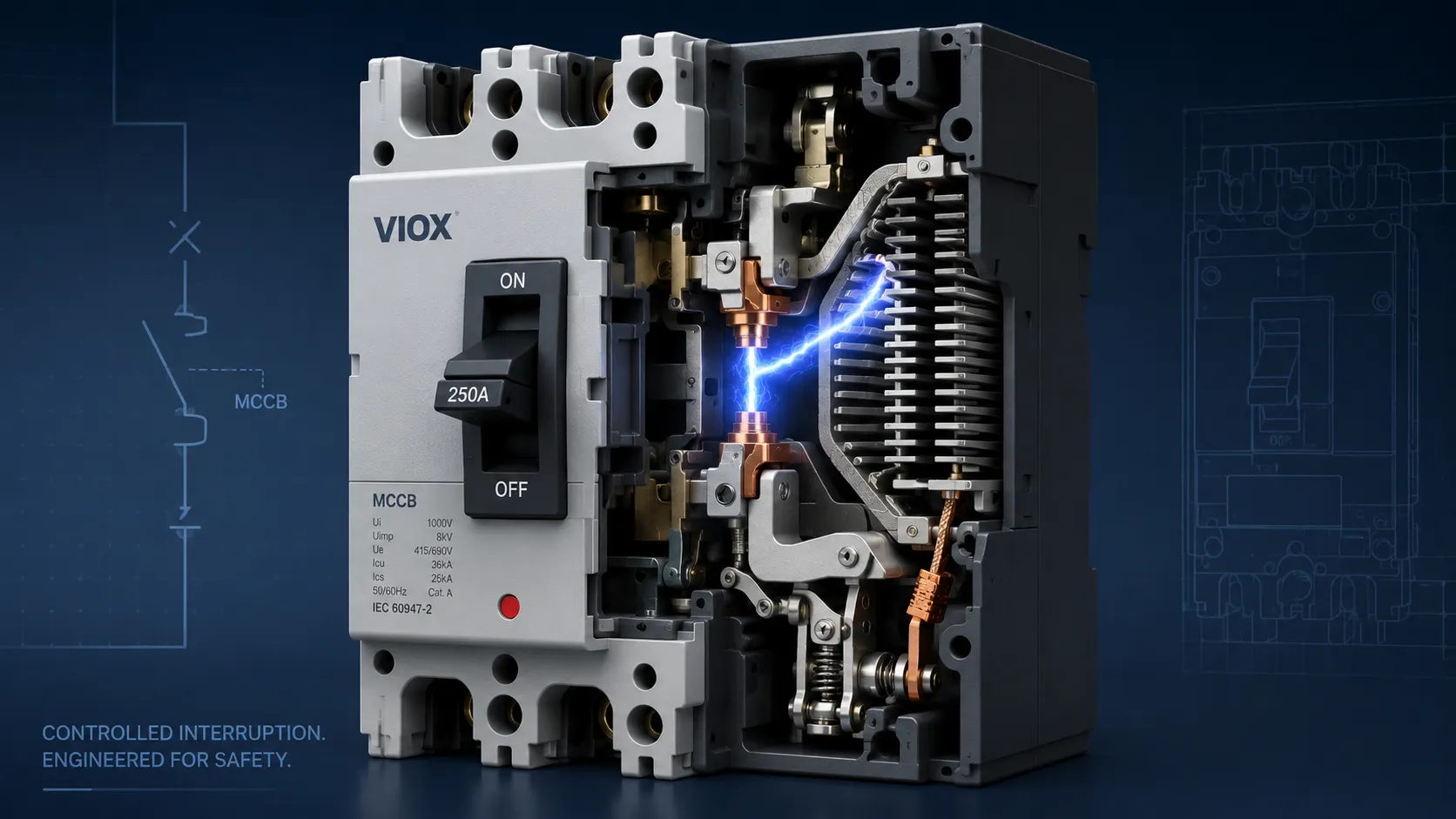
Um arco em um disjuntor é uma descarga elétrica luminosa que se forma entre contatos que se separam quando o disjuntor abre um circuito energizado. O arco permite que a corrente continue fluindo brevemente através do ar ou gás ionizado até que o disjuntor force o arco a resfriar, alongar, dividir e extinguir.
Um disjuntor não interrompe a corrente no instante em que seus contatos se separam. Ele primeiro precisa controlar o arco criado durante a interrupção e, em seguida, extinguir esse arco para que o circuito possa abrir com segurança.
É por isso que o controle de arco é uma das partes mais importantes do projeto de um disjuntor. Um disjuntor com extinção de arco deficiente pode sofrer erosão dos contatos, superaquecimento, danos ao isolamento ou falha ao interromper a falha com segurança.
Resumo dos principais termos sobre arcos
| Prazo | Significado | Papel em um disjuntor |
|---|---|---|
| Arco | Descarga luminosa condutiva através do intervalo de abertura dos contatos | Permite que a corrente continue brevemente após a separação dos contatos |
| Formação de arco | Processo onde gás ionizado se forma entre os contatos | Ocorre durante a comutação ou interrupção de falha |
| Tensão do arco | Tensão através do arco durante a interrupção | Ajuda a opor-se à corrente do circuito e auxilia na extinção |
| Câmara de extinção de arco | Caminho condutor que guia o arco para longe dos contatos | Move o arco para a câmara de extinção |
| Calha de arco | Conjunto que divide e resfria o arco | Ajuda a extinguir o arco de forma segura |
| Placa divisora de arco | Placa metálica dentro da câmara de extinção | Divide o arco em segmentos menores |
| Câmara de extinção de arco | Espaço ou estrutura onde ocorre a extinção do arco | Contém e controla a energia do arco |
| Extinção de arco | Processo de extinção do arco | Necessário para uma interrupção segura |
Como ocorre a formação de arco em um disjuntor
A formação do arco começa quando os contatos do disjuntor se abrem enquanto a corrente ainda está fluindo.
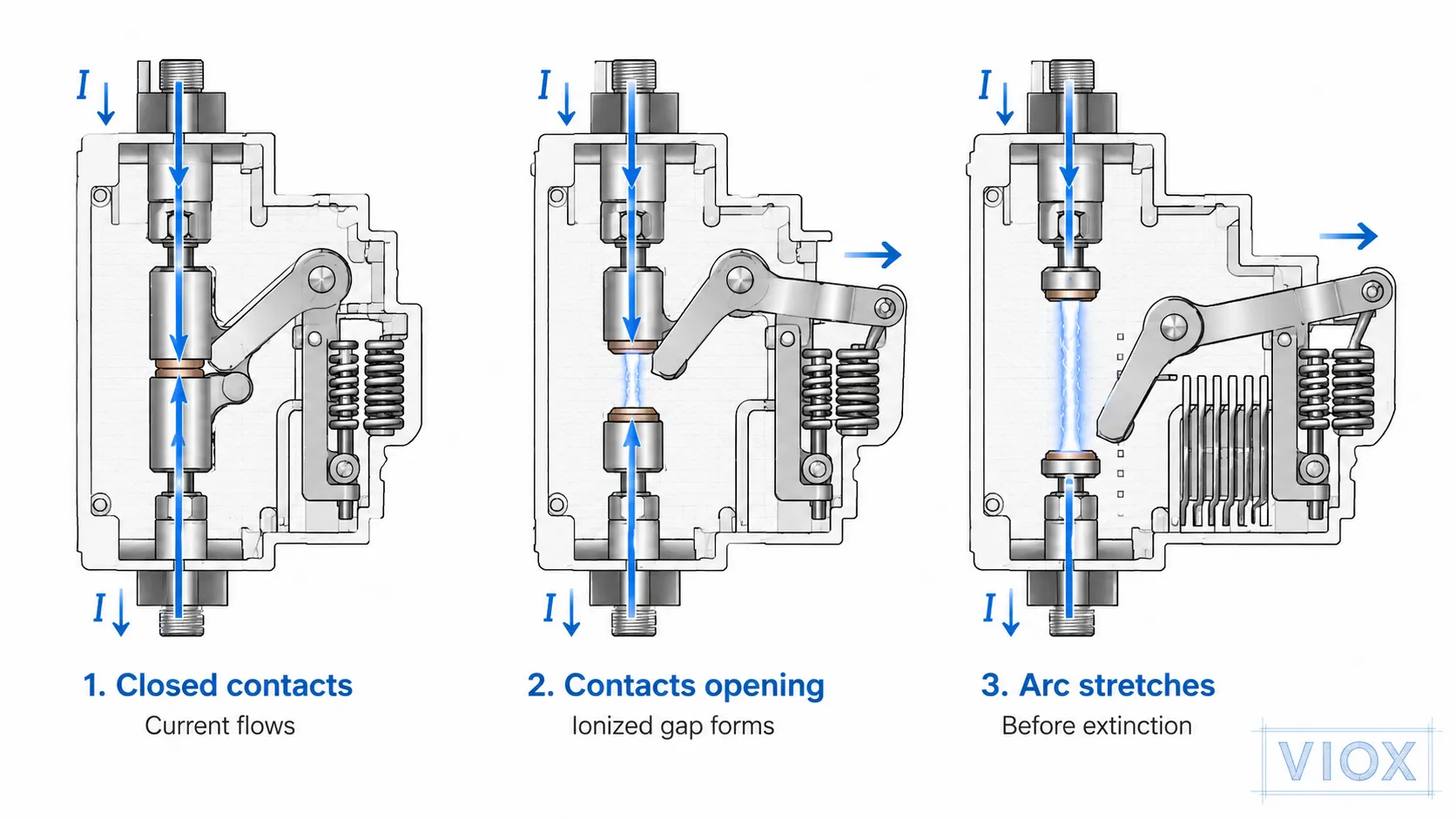
A sequência de interrupção geralmente funciona da seguinte forma:
- O disjuntor detecta uma sobrecarga, curto-circuito ou operação de comutação manual.
- O mecanismo de operação separa os contatos.
- A corrente tenta continuar fluindo através do pequeno espaço entre os contatos.
- O ar ou gás entre os contatos torna-se ionizado.
- Um arco condutor é formado.
- O disjuntor direciona o arco para o sistema de controle de arco.
- O arco é alongado, dividido, resfriado e extinto.
O arco não é um defeito por si só. É um evento físico normal durante a interrupção da corrente. O desafio de engenharia é controlá-lo de forma rápida e segura.
Por que um arco se forma quando os contatos se abrem
Quando os contatos estão fechados, a corrente flui através de um caminho metálico. Quando começam a se separar, a área de contato diminui, a resistência aumenta e o calor sobe. Ao mesmo tempo, o campo elétrico através do espaço de abertura pode ionizar o meio circundante.
Uma vez que o meio se torna condutor, a corrente pode continuar através do plasma do arco, mesmo que os contatos metálicos não estejam mais se tocando.
É por isso que os disjuntores precisam de mais do que um simples interruptor mecânico. Eles precisam de estruturas de controle de arco que possam lidar com a energia liberada durante a interrupção.
Contatos Principais vs. Contatos de Arco
Em disjuntores de baixa tensão maiores, especialmente muitos MCCBs e ACBs, o caminho da corrente pode incluir contactos principais e contatos de arqueamento.
| Tipo Do Contato | Função Principal | Por que isso importa |
|---|---|---|
| Contatos principais | Conduzir corrente com baixa resistência durante a operação normal | Projetado para condutividade e baixo aquecimento |
| Contactos de arco | Absorver o arco durante a abertura e o fechamento | Proteger os contatos principais contra erosão severa por arco |
A sequência típica é abertura primeiro / fechamento por último para contatos de arco em relação ao sistema de contatos principais, dependendo do projeto do disjuntor. Durante a abertura, os contatos principais se separam primeiro, de modo que o arco é transferido para os contatos de arco. Durante o fechamento, os contatos de arco se fecham primeiro, para que os contatos principais não sejam danificados pelo estresse elétrico inicial.
Este sincronismo de contatos é uma das razões pelas quais um disjuntor é mais complexo do que um simples interruptor. Ele deve conduzir corrente de forma eficiente durante o serviço normal e sobreviver a eventos de interrupção repetidos durante falhas.
Guia de arco em um disjuntor
Um guia de arco é uma parte condutora que ajuda a mover o arco para longe dos contatos principais e em direção à câmara de extinção.
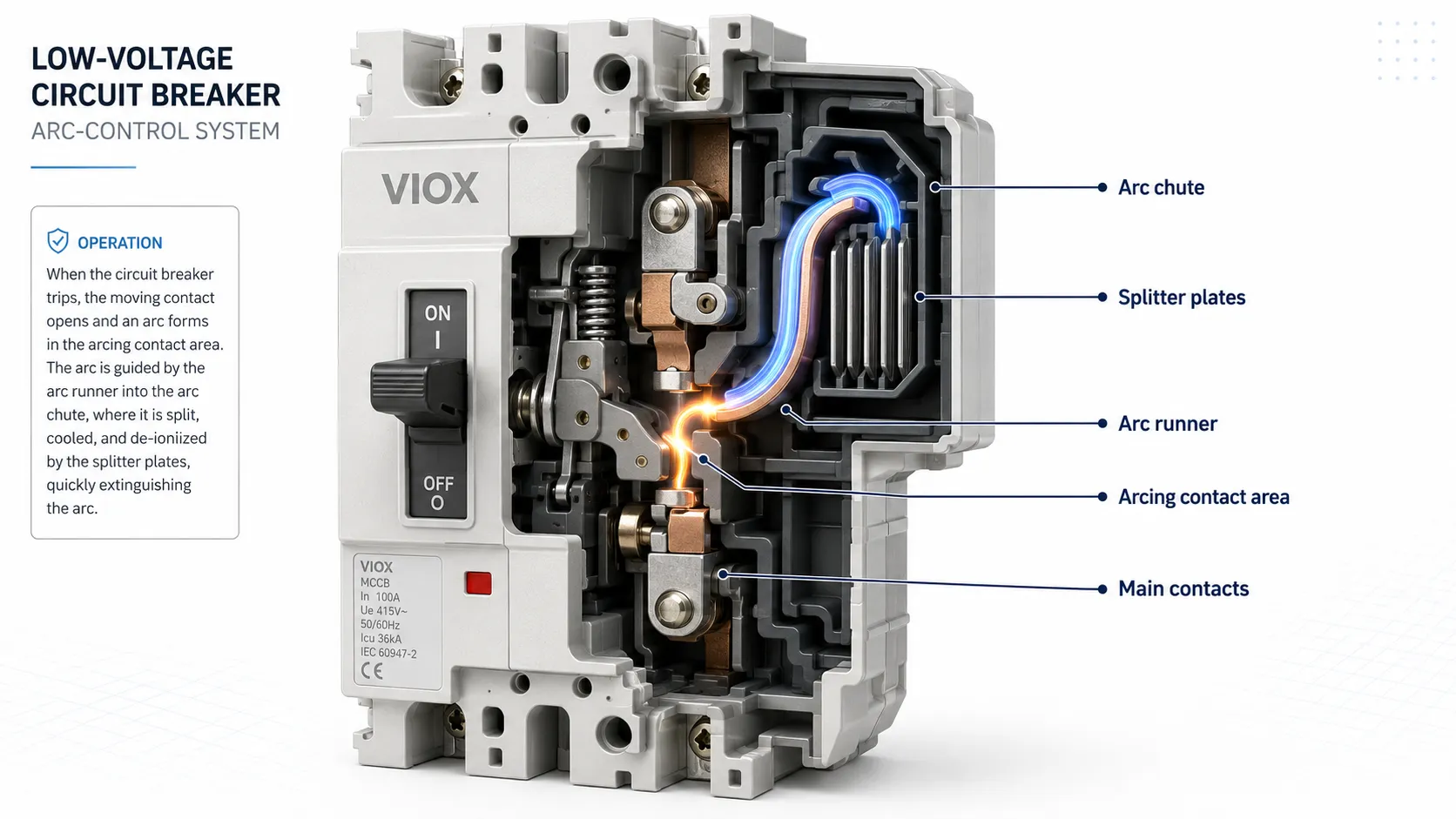
Sua função é prática:
- reduzir danos aos contatos;
- guiar o arco para o caminho correto;
- ajudar a transferir o arco da área de contato para a câmara de arco;
- apoiar uma extinção de arco mais rápida e controlada.
Em muitos projetos de disjuntores, o guia de arco trabalha em conjunto com as forças magnéticas geradas pela corrente de falta. Uma maneira simplificada de expressar a força motriz é F = I × L × B, em que F é a força que atua sobre o arco, I é a corrente do arco, L é o comprimento efetivo do arco no campo magnético, e B é a densidade de fluxo magnético. No projeto prático de disjuntores, uma corrente de curto-circuito maior pode criar uma força de acionamento magnético mais forte, ajudando a empurrar o arco ao longo do condutor para dentro da câmara de extinção, onde ele pode ser dividido e resfriado.
F = I × L × BComo a força magnética move o arco para dentro da câmara de extinção
Quando uma corrente elevada flui através de um disjuntor, o caminho da corrente cria um campo magnético. O próprio arco também transporta corrente. A interação entre o arco que transporta corrente e o campo magnético cria uma força que pode empurrar o arco para longe dos contatos.
Este movimento magnético é útil porque:
- afasta o arco da superfície de contato;
- transfere o arco em direção ao condutor de arco (arc runner);
- direciona o arco para as placas divisórias (splitter plates);
- reduz o tempo que o arco permanece na área de contato principal.
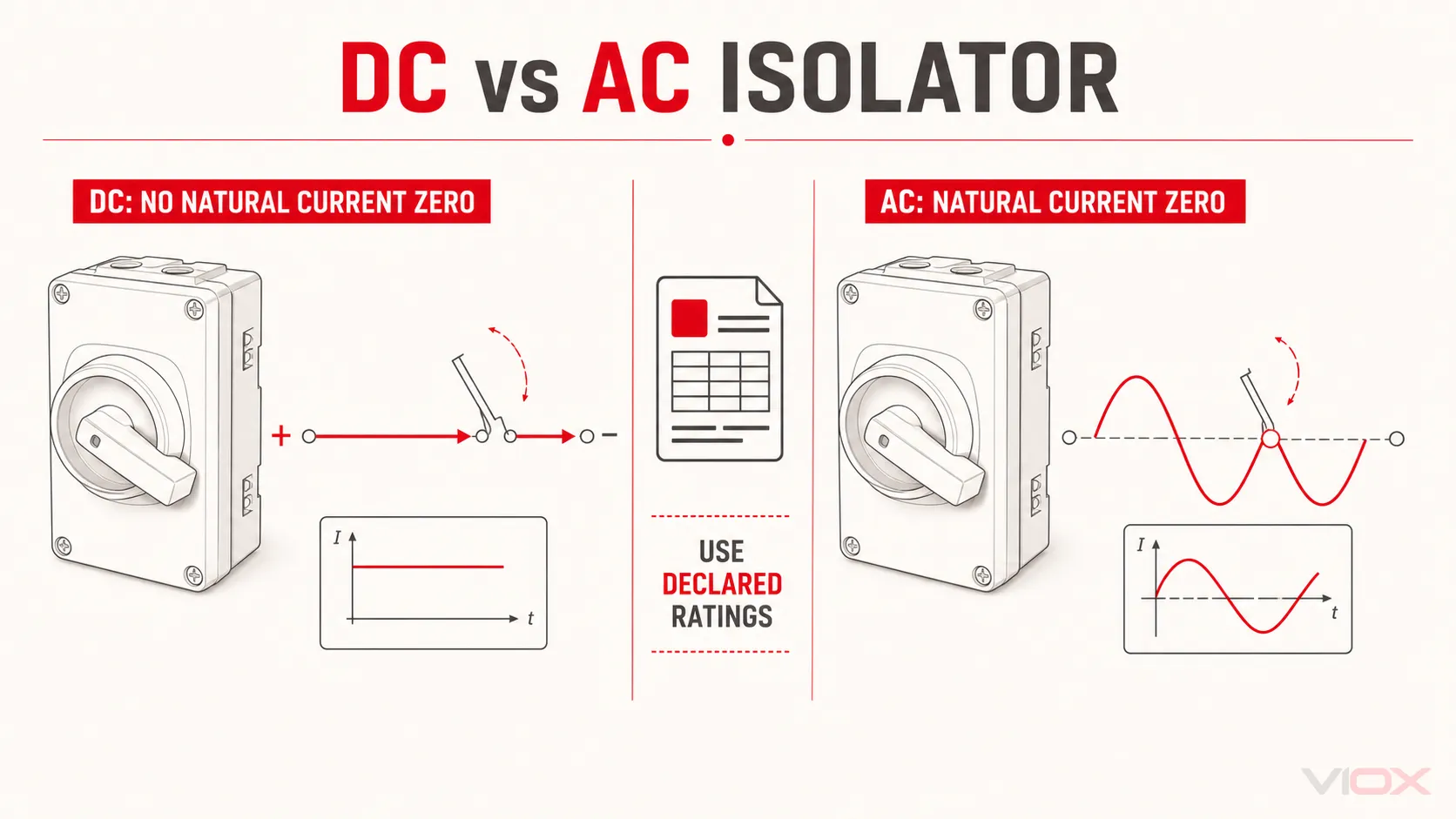
Em disjuntores CC, o controle magnético do arco torna-se ainda mais importante porque não há passagem natural por zero da corrente. É também por isso que a polaridade pode ser relevante em alguns projetos de disjuntores CC.
Do ponto de vista do design do produto, a presença de uma câmara de extinção de arco por si só não é suficiente. O formato do condutor de arco, a velocidade de abertura dos contatos, o alinhamento das placas divisórias, o caminho de ventilação e o material isolante ao redor da câmara afetam se o arco se moverá de forma limpa para a zona de extinção em vez de permanecer próximo aos contatos.
Câmara de Extinção de Arco
Um câmara de extinção de arco é a estrutura que ajuda a extinguir o arco após ele deixar a área de contato. É frequentemente composta por múltiplas placas divisórias ou placas de arco dispostas dentro de uma câmara isolante.
A câmara de extinção de arco funciona através de:
- alongamento do caminho do arco;
- divisão de um arco grande em segmentos de arco menores;
- arrefecimento do gás ionizado quente;
- aumento da tensão do arco;
- auxílio na desionização do caminho do arco;
- contenção de gases quentes e partículas dentro do design do disjuntor.
A frase câmara de extinção de arco refere-se geralmente ao espaço ou conjunto onde ocorre este controlo de arco.
Materiais de Contacto: Por que são utilizadas ligas de Tungsténio-Cobre e Prata
Os contactos dos disjuntores devem conduzir corrente durante a operação normal e resistir ao aquecimento por arco durante a interrupção. Isso cria um compromisso de materiais.
As estratégias comuns de materiais de contacto incluem ligas à base de prata para condutividade e resistência ao arco, e materiais do tipo tungsténio-cobre onde é necessária uma maior resistência à erosão por arco. O material exato depende do tipo de disjuntor, classificação de corrente, aplicação e design do fabricante.
O conceito de engenharia fundamental é este: o tungsténio proporciona resistência à erosão por arco com alto ponto de fusão, enquanto o cobre melhora a condutividade e a transferência de calor. O objetivo é manter a estrutura do contacto estável sob aquecimento repetido por arco, mantendo uma resistência de contacto aceitável.
Isto é mais preciso do que dizer que o tungsténio-cobre é usado apenas para reduzir a emissão de eletrões. Nos contactos de disjuntores, o ponto de fusão, a resistência à erosão, o comportamento térmico, a condutividade e a integridade mecânica são todos importantes.
O que é extinção de arco?
Extinção de arco é o processo de extinguir o arco para que a corrente pare de fluir.
Os disjuntores podem utilizar diferentes métodos de extinção de arco, dependendo do tipo e da classe de tensão:
| Tipo de disjuntor | Método comum de extinção de arco |
|---|---|
| MCB | Câmara de extinção de arco com placas separadoras |
| Disjuntor em caixa moldada | Câmara de arco, guias de arco, placas separadoras, isolamento moldado |
| ACB | Interrupção de arco em ar com câmaras de arco maiores |
| Disjuntor CC | Câmara de extinção de arco com sopro magnético ou design multipolar em série |
| Disjuntor de alta tensão | Métodos de interrupção a vácuo, SF6, sopro de ar ou outros métodos especializados |
Para disjuntores de baixa tensão (MCBs e MCCBs), as câmaras de extinção de arco e as placas separadoras são os componentes mais conhecidos.
O que é Tensão de Arco?
Tensão do arco é a tensão através do arco durante a interrupção. À medida que o disjuntor estica, divide e resfria o arco, a tensão de arco aumenta. Quando a tensão de arco se torna suficientemente alta em relação às condições do circuito, a corrente pode ser forçada a diminuir e o arco pode ser extinto.
Em termos práticos, um bom sistema de controle de arco aumenta a resistência e o resfriamento do arco para que a corrente não possa continuar através do caminho ionizado.
A tensão de arco não é um valor de catálogo fixo. Ela inclui quedas de tensão próximas às regiões do cátodo e ânodo, além do gradiente de tensão ao longo da coluna do arco. No projeto de disjuntores de baixa tensão, a questão importante é se a geometria dos contatos, o guia de arco, a pilha de placas separadoras, o fluxo de gás e o isolamento da câmara conseguem elevar a tensão de arco rapidamente o suficiente sob a condição de curto-circuito testada.
Esta é uma das razões pelas quais a geometria dos contatos, guias, placas, formato da câmara e fluxo de gás são importantes no projeto de disjuntores.
Arco em CA vs Arco em CC em Disjuntores
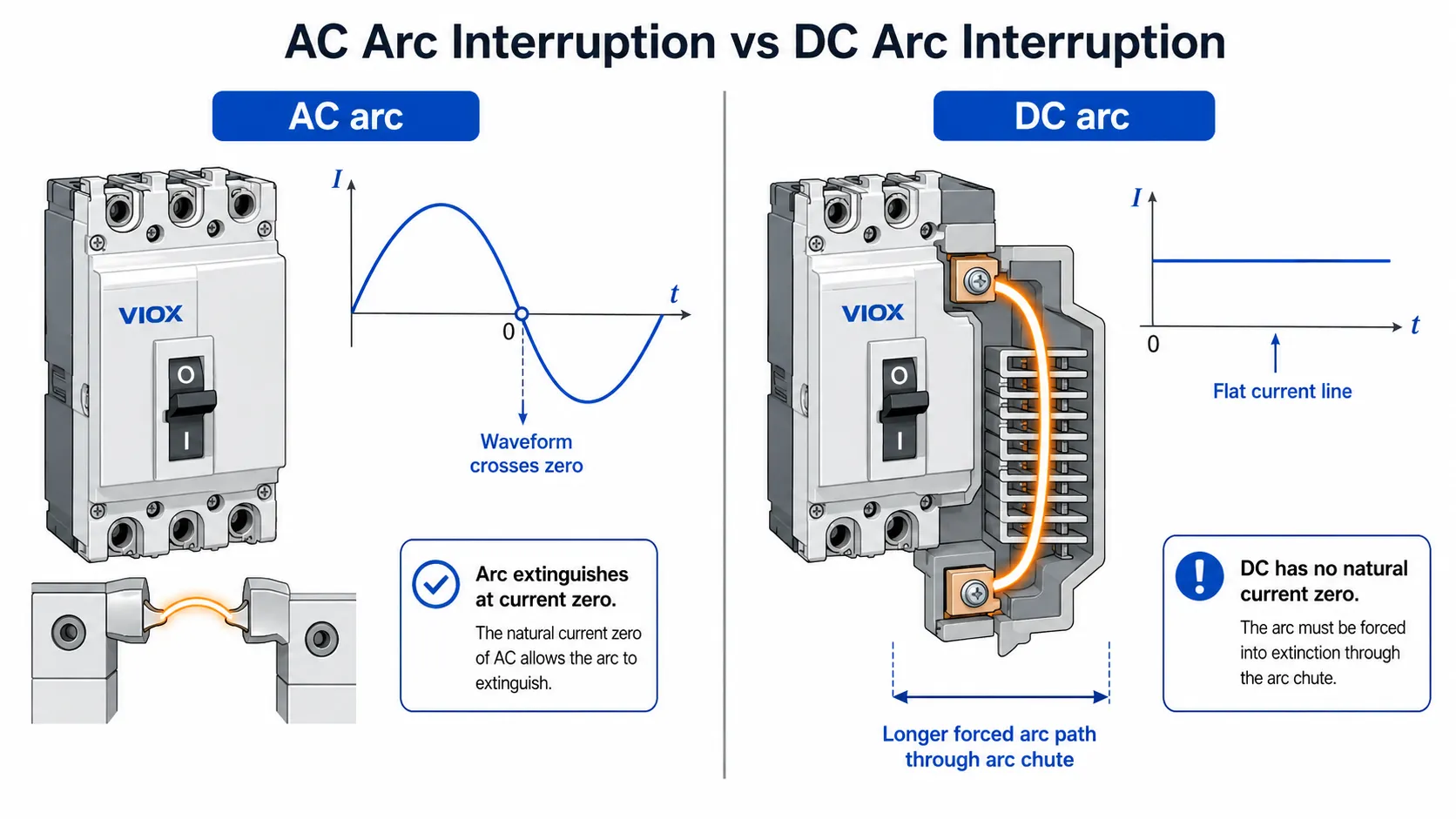
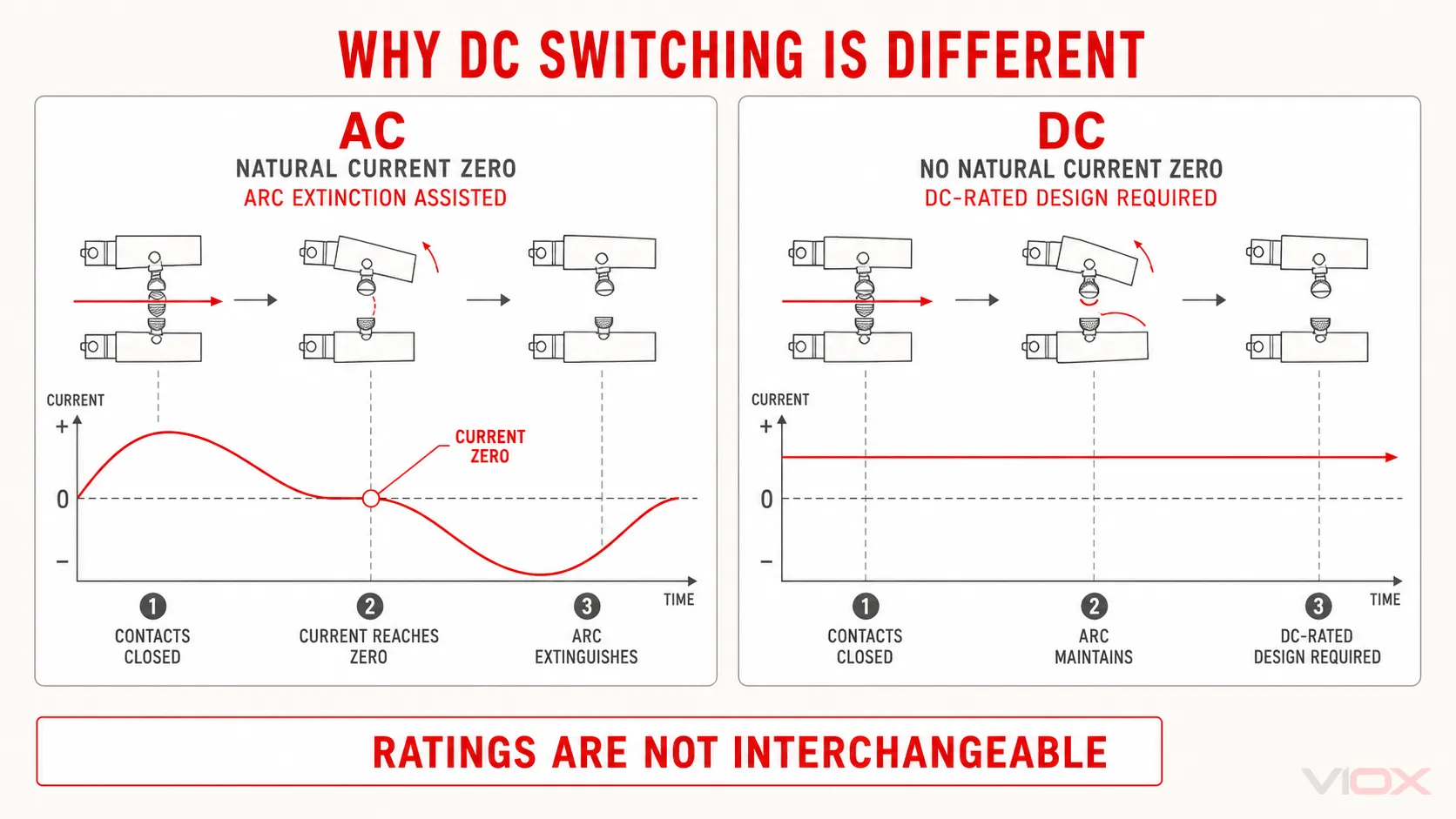
Arcos em CA e CC comportam-se de maneira diferente.
| Recurso | Arco em CA | Arco DC |
|---|---|---|
| Passagem por zero da corrente | Cruzamento natural por zero a cada meio ciclo | Sem passagem natural por zero |
| Extinção de arco | Auxiliado pela passagem por zero da corrente | Deve ser forçado pelo projeto do disjuntor |
| Projeto do disjuntor | A câmara de extinção de arco com classificação para CA pode ser suficiente para a sua especificação | Requer design de extinção de arco classificado para CC |
| Consideração de polaridade | Geralmente menos crítico em disjuntores CA de baixa tensão | Importante em muitos disjuntores CC polarizados |
É por isso que um disjuntor CA não deve ser usado automaticamente em um circuito CC. Arcos CC podem persistir a menos que o disjuntor seja especificamente projetado e classificado para interrupção em CC.
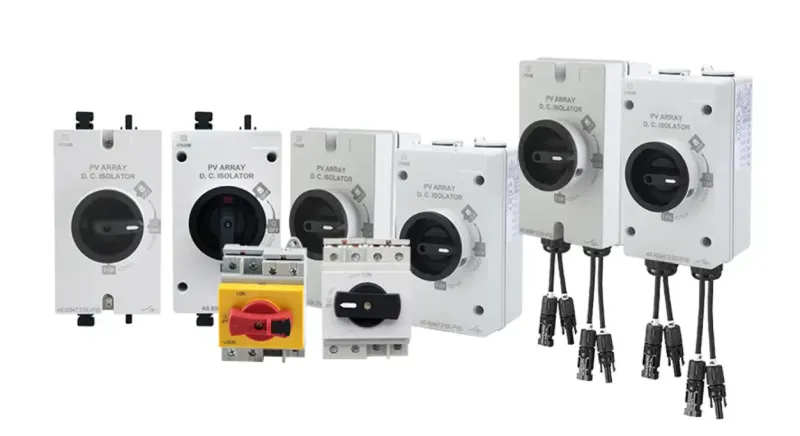
Para detalhes sobre disjuntores CC, veja O Que É um Disjuntor CC?.
Arco em MCB vs MCCB vs ACB
| Tipo de disjuntor | Onde ocorre o controle de arco | Diferença prática |
|---|---|---|
| MCB | Câmara de extinção de arco compacta próxima ao sistema de contatos | Espaço reduzido, rápida divisão do arco, tamanho de carcaça limitado |
| Disjuntor em caixa moldada | Câmara de arco moldada maior e guias de arco | Tamanhos de carcaça maiores e estruturas de interrupção mais robustas |
| ACB | Câmara de arco de ar maior | Utilizado em painéis de baixa tensão de corrente mais elevada |
O princípio básico é semelhante: o disjuntor abre os contatos, forma um arco, conduz o arco para uma câmara, divide-o e resfria-o, interrompendo a corrente. O tamanho físico e a capacidade de interrupção variam conforme o tipo de disjuntor.
Para peças internas de MCCB, veja Estrutura interna e componentes do MCCB.
IEC 60947-2, UL 489 e capacidades de interrupção de arco
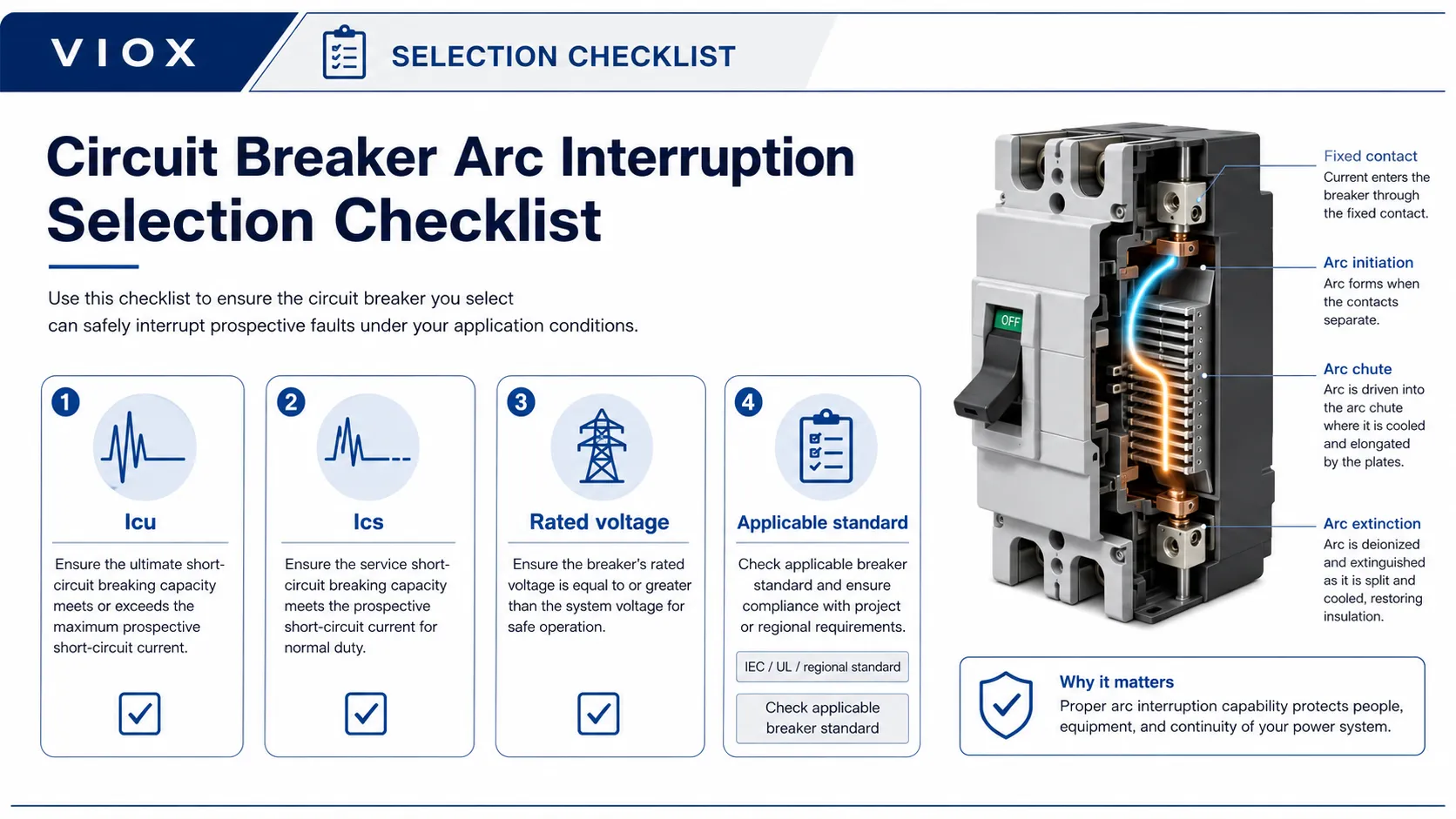
A interrupção de arco não é avaliada apenas pelo design visual. Os disjuntores são testados sob estruturas normativas que definem como o desempenho da interrupção é verificado.
Para disjuntores industriais de baixa tensão, IEC 60947-2 é um contexto normativo fundamental. Nos mercados norte-americanos de disjuntores de derivação e em caixa moldada, UL 489 é uma referência chave. A norma aplicável depende do tipo de produto, mercado e instalação.
As classificações importantes relacionadas à interrupção de arco incluem:
| Classificação | Significado | Por que se relaciona com o controle de arco |
|---|---|---|
| Icu | Capacidade última de interrupção de curto-circuito | Verifica se o disjuntor pode interromper uma falta severa sob condições de teste definidas |
| Ics | Capacidade de serviço de interrupção de curto-circuito | Indica o desempenho após a interrupção sob condições de teste relacionadas ao serviço |
| Icw | Corrente suportável de curta duração | Importante para a seletividade e comportamento de suportabilidade em alguns tipos de disjuntores |
| Tensão nominal | Tensão na qual a interrupção é testada | Tensões mais altas geralmente tornam a extinção do arco mais exigente |
Estas classificações devem ser lidas na folha de dados e no contexto da norma. Um disjuntor com uma câmara de extinção de arco de aparência robusta ainda precisa de uma capacidade de interrupção testada adequada para o circuito real.
Para a orientação de seleção de produtos VIOX, a questão prática não é se um disjuntor possui uma câmara de arco visível. Quase todo disjuntor de baixa tensão possui alguma forma de estrutura de controle de arco. A questão mais útil é se o sistema de contatos, o guia de arco, a pilha de placas de extinção, o isolamento moldado, o caminho de ventilação e a estrutura dos terminais são validados em conjunto sob as condições de teste de capacidade de interrupção exigidas. É aqui que o Icu, Ics, a tensão nominal e a norma aplicável importam mais do que a aparência visual.
Arco em um disjuntor vs. Disjuntor de detecção de arco
A mesma palavra “arco” aparece em dois tópicos diferentes sobre disjuntores, mas os significados são distintos.
| Prazo | Significado |
|---|---|
| Arco em um disjuntor | O arco interno formado quando os contatos do disjuntor se abrem durante a interrupção |
| Arco elétrico | Arco elétrico indesejado em fiações, cabos, terminais ou equipamentos |
| Disjuntor de detecção de arco / AFCI | Um disjuntor projetado para detectar assinaturas perigosas de falha de arco em um circuito |
Um arco normal de disjuntor ocorre dentro do dispositivo durante a comutação ou interrupção de falha. Uma falha de arco ocorre fora do sistema de contatos pretendido e pode indicar fiação danificada, conexões soltas ou falha de isolamento.
Sinais de possíveis problemas de arco elétrico no disjuntor
O arco elétrico dentro do dispositivo é normal durante a interrupção, mas sintomas externos anormais não devem ser ignorados.
Chame um eletricista ou técnico qualificado se notar:
- cheiro de queimado perto de um quadro elétrico;
- zumbido, chiado ou estalidos vindos de um disjuntor;
- danos por calor ou descoloração;
- isolamento derretido perto dos terminais;
- desarmes repetidos do disjuntor;
- arco visível fora do disjuntor;
- terminais soltos ou danificados.
Não abra nem inspecione o interior de disjuntores energizados. Os disjuntores são dispositivos de segurança selados ou montados, não sendo câmaras de arco reparáveis em campo.
Erosão por arco, pites nos contatos e quando o arco do disjuntor se torna um problema
Cada evento de interrupção pode sobrecarregar os contatos do disjuntor. Em serviço normal, isso é esperado, mas falhas severas repetidas ou condições precárias dos terminais podem acelerar o desgaste.
Sinais possíveis de estresse excessivo relacionado ao arco incluem:
- contatos com pites ou erodidos em equipamentos industriais reparáveis;
- descoloração ao redor dos terminais ou aberturas de ventilação;
- odor incomum após a operação;
- danos na carcaça do disjuntor;
- disparos repetidos sob condições de carga semelhantes;
- aumento da resistência de contato em equipamentos onde a medição faz parte da prática de manutenção.
Para minidisjuntores selados, a inspeção do contato interno geralmente não é prática. Para painéis de maior porte que permitem manutenção, a inspeção e a manutenção devem seguir as instruções do fabricante e os procedimentos de segurança do local.
Equívocos comuns sobre arcos em disjuntores
Erro 1: Pensar que qualquer arco significa que o disjuntor está com defeito
Um arco interno durante a interrupção é normal. O disjuntor foi projetado para controlá-lo.
Erro 2: Achar que uma câmara de extinção de arco evita todos os danos ao disjuntor
A câmara de extinção de arco reduz e controla a energia do arco, mas interrupções repetidas de alta corrente de falta ainda podem sobrecarregar os contatos e componentes internos.
Erro 3: Confundir o arco do disjuntor com a proteção contra arco elétrico
O controle interno de arco do disjuntor e a detecção de falha de arco AFCI são tópicos diferentes.
Erro 4: Usar premissas de arco em CA para disjuntores em CC
Arcos em CC são mais difíceis de extinguir porque não há passagem natural por zero. Use disjuntores com classificação CC para circuitos em CC.
Erro 5: Ignorar a condição dos terminais
Terminais soltos podem causar aquecimento externo e centelhamento. Isso é diferente do arco interno normal formado durante a interrupção do disjuntor.
FAQ
Uma câmara de extinção de arco de CA pode extinguir um arco de CC?
Não automaticamente. A interrupção em CA beneficia-se das passagens naturais por zero da corrente, enquanto a interrupção em CC deve forçar o arco a alongar-se, resfriar-se e extinguir-se sem esse auxílio. Um disjuntor utilizado em circuitos de CC deve ser especificamente classificado para a tensão, corrente, condição de polaridade e aplicação em CC.
Qual é a diferença entre contatos de arco e contatos principais?
Os contatos principais são otimizados para a condução de corrente com baixa resistência durante a operação normal. Os contatos de arco são projetados para suportar o estresse elétrico durante a abertura e o fechamento, de modo que os contatos principais não fiquem expostos à pior erosão por arco.
Com que frequência os contatos de arco devem ser inspecionados em disjuntores industriais?
Siga as instruções de manutenção do fabricante do disjuntor e o procedimento de segurança elétrica do local. A frequência de inspeção depende do tipo de disjuntor, histórico de falhas, regime de comutação, ambiente e se o dispositivo é reparável. MCBs selados e muitos MCCBs são normalmente substituídos em vez de abertos para inspeção de contatos.
Por que um disjuntor apresenta cheiro de queimado após desarmar?
Um odor leve após uma interrupção severa pode vir de gases quentes e subprodutos do arco dentro do disjuntor. Cheiro de queimado persistente, descoloração, isolamento derretido, aquecimento nos terminais ou desarmes repetidos não são normais e devem ser verificados antes que o circuito seja reenergizado.
Uma classificação Icu mais alta significa uma câmara de extinção de arco melhor?
Não por si só. Icu é a capacidade de interrupção de curto-circuito última testada sob condições definidas. O design da câmara de extinção de arco é importante, mas também a velocidade dos contatos, a geometria dos condutores, o isolamento moldado, o design dos terminais, a tensão nominal e a sequência completa de testes. O Ics também é importante porque indica o desempenho de curto-circuito em serviço sob a norma aplicável.
O arco elétrico em um disjuntor pode ser reparado?
Para MCBs selados e muitos MCCBs, danos internos por arco elétrico não são reparáveis em campo. Substitua o dispositivo se a inspeção ou a orientação do fabricante indicar danos. Disjuntores maiores e reparáveis podem ter procedimentos de manutenção aprovados pelo fabricante, mas o reparo deve ser feito apenas por pessoal qualificado usando peças e métodos de teste aprovados.
Recursos VIOX relacionados
Conclusão
Um arco em um disjuntor é um evento elétrico normal, porém intenso, criado quando os contatos se abrem sob corrente. O disjuntor deve mover esse arco para um sistema de controle de arco, dividi-lo, resfriá-lo, elevar a tensão do arco e extingui-lo.
As partes mais importantes a entender são as guia de arco, câmara de extinção de arco, placas de extinção de arcoe câmara de extinção de arco. Esses componentes são o que permitem que um disjuntor interrompa a corrente com segurança, em vez de agir como um simples interruptor.