

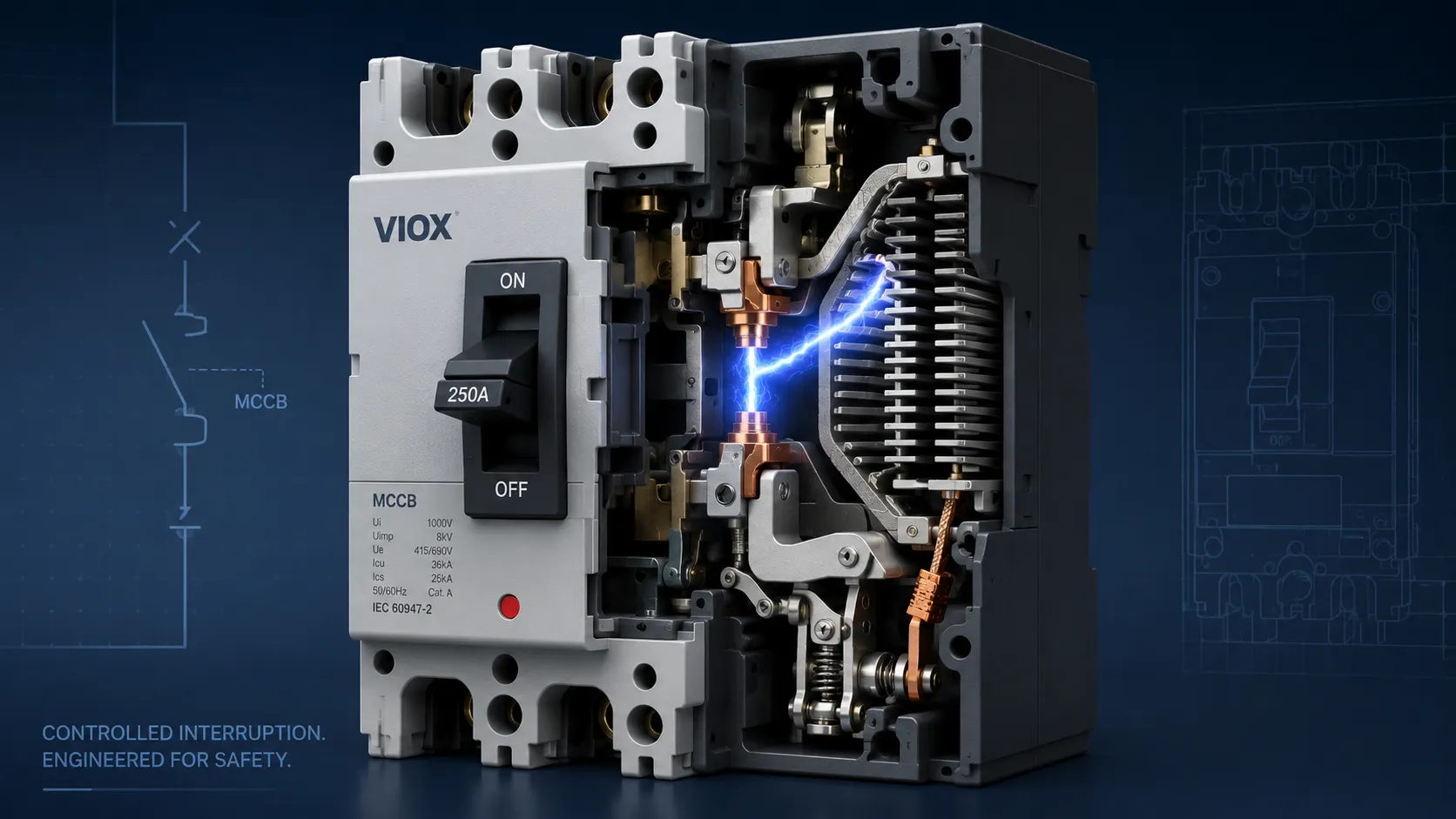
An arc sa isang circuit breaker ay isang maliwanag na electrical discharge na nabubuo sa pagitan ng mga naghihiwalay na contact kapag binubuksan ng breaker ang isang circuit na may daloy ng kuryente. Pinahihintulutan ng arc na magpatuloy ang daloy ng kuryente sa loob ng maikling sandali sa pamamagitan ng ionized na hangin o gas hanggang sa pilitin ng breaker ang arc na lumamig, humaba, mahati, at mamatay.
Hindi agad humihinto ang daloy ng kuryente sa isang circuit breaker sa sandaling maghiwalay ang mga contact nito. Kailangan muna nitong kontrolin ang arc na nalilikha sa panahon ng pagkaputol ng daloy, at pagkatapos ay patayin ang arc na iyon upang ligtas na mabuksan ang circuit.
Ito ang dahilan kung bakit ang arc control ay isa sa pinakamahalagang bahagi ng disenyo ng circuit breaker. Ang breaker na mahina ang kakayahang magpatay ng arc ay maaaring makaranas ng pagkasira ng contact (erosion), sobrang pag-init, pagkasira ng insulation, o pagkabigong maputol ang fault nang ligtas.
Mga Pangunahing Termino sa Arc sa Isang Sulyap
| Termino | Ibig sabihin | Papel sa isang Circuit Breaker |
|---|---|---|
| Arc | conductive luminous discharge sa kabuuan ng puwang ng nagbubukas na contact | Pinapayagan ang kuryente na magpatuloy nang sandali matapos maghiwalay ang mga contact |
| Pagbuo ng arc | Proseso kung saan ang ionized gas ay nabubuo sa pagitan ng mga contact | Nangyayari habang naglilipat (switching) o napuputol ang daloy dahil sa fault |
| Arc voltage | Boltahe sa kabuuan ng arc habang nagaganap ang pagkaputol ng daloy | Tumutulong na labanan ang kuryente sa circuit at sumusuporta sa pagpawi ng arc |
| Arc runner | Konduktibong daanan na gumagabay sa arc palayo sa mga contact | Inililipat ang arc patungo sa arc chute |
| Arc chute | Assembly na naghahati at nagpapalamig sa arc | Tumutulong na mapatay ang arc nang ligtas |
| Arc splitter plate | Metal plate sa loob ng arc chute | Hinahati ang arc sa mas maliliit na bahagi ng arc |
| Arc extinguishing chamber | Espasyo o istruktura kung saan nagaganap ang pagpatay sa arc | Naglalaman at kumokontrol sa enerhiya ng arc |
| Pagpapatay ng arc | Proseso ng pagpapatay sa arc | Kinakailangan para sa ligtas na pagputol ng daloy |
Paano Nangyayari ang Pagbuo ng Arc sa isang circuit breaker
Nagsisimula ang pagbuo ng arc kapag bumukas ang mga contact ng breaker habang dumadaloy pa ang kuryente.
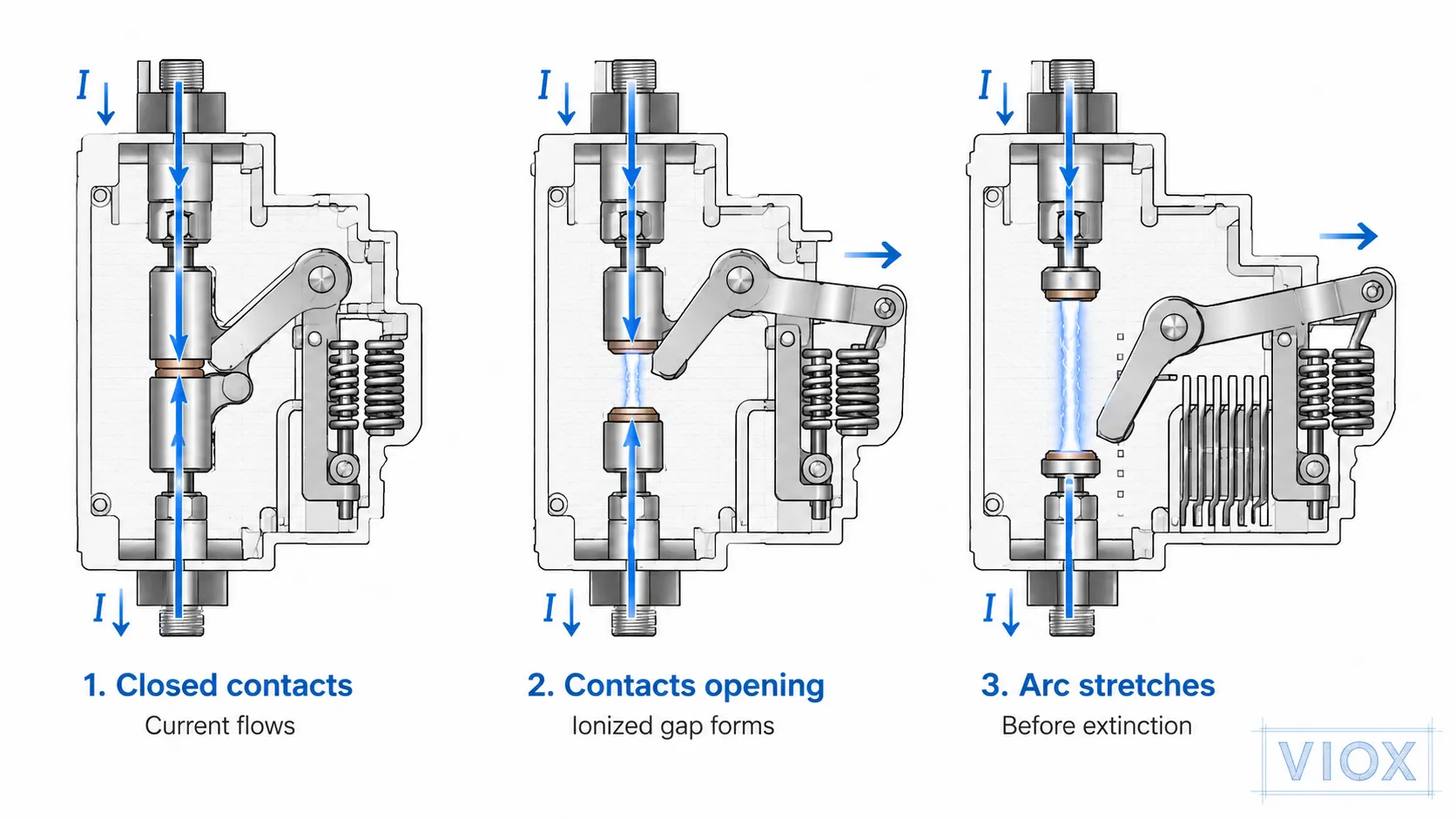
Ang pagkakasunod-sunod ng pagputol ng daloy ay karaniwang gumagana nang ganito:
- Natutukoy ng breaker ang overload, short circuit, o manual na operasyon ng paglipat.
- Pinaghihiwalay ng operating mechanism ang mga contact.
- Sinusubukang magpatuloy ng agos ng kuryente sa maliit na puwang ng mga contact.
- Nagiging ionized ang hangin o gas sa pagitan ng mga contact.
- Nabubuo ang isang conductive arc.
- Itinutulak ng breaker ang arc patungo sa arc-control system.
- Ang arc ay pinahahaba, hinahati, pinapalamig, at pinapatay.
Ang arc mismo ay hindi isang depekto. Ito ay isang normal na pisikal na pangyayari sa panahon ng pagputol ng kuryente. Ang hamon sa engineering ay ang kontrolin ito nang mabilis at ligtas.
Bakit nabubuo ang arc kapag bumubukas ang mga contact
Kapag nakasara ang mga contact, dumadaloy ang kuryente sa isang metal na daanan. Kapag nagsimula na silang maghiwalay, lumiliit ang contact area, tumataas ang resistance, at umiinit. Kasabay nito, ang electric field sa pagitan ng nagbubukas na puwang ay maaaring mag-ionize sa nakapalibot na medium.
Kapag naging conductive na ang medium, ang kuryente ay maaaring magpatuloy sa pagdaloy sa pamamagitan ng arc plasma kahit hindi na magkadikit ang mga metal contact.
Iyan ang dahilan kung bakit kailangan ng mga circuit breaker ng higit pa sa simpleng mechanical switch. Kailangan nila ng mga arc-control structure na kayang humawak sa enerhiyang inilalabas habang nagaganap ang interruption.
Main Contacts kumpara sa Arcing Contacts
Sa mas malalaking low-voltage breaker, lalo na sa maraming MCCB at ACB, ang daluyan ng kuryente ay maaaring maglaman ng pangunahing mga contact at arcing contacts.
| Uri ng Contact | Pangunahing Papel | Bakit Ito Mahalaga |
|---|---|---|
| Mga main contact | Nagdadala ng kuryente na may mababang resistance sa panahon ng normal na operasyon | Idinisenyo para sa conductivity at mababang pag-init |
| Mga arcing contact | Saluhin ang arc habang nagbubukas at nagsasara | Protektahan ang mga pangunahing contact mula sa matinding pagkasira dulot ng arc |
Ang karaniwang pagkakasunod-sunod ay break-first / make-last para sa mga arcing contact kaugnay ng pangunahing contact system, depende sa disenyo ng breaker. Sa pagbubukas, ang mga pangunahing contact ang unang humihiwalay kaya ang arc ay nalilipat sa mga arcing contact. Sa pagsasara, ang mga arcing contact ang unang nagdidikit kaya ang mga pangunahing contact ay hindi napipinsala ng paunang electrical stress.
Ang timing ng contact na ito ay isa sa mga dahilan kung bakit mas kumplikado ang circuit breaker kaysa sa isang simpleng switch. Kailangan nitong dalhin ang kuryente nang mahusay sa normal na operasyon at makayanan ang paulit-ulit na pagkaputol ng daloy ng kuryente sa panahon ng fault.
Arc Runner sa isang Circuit Breaker
An arc runner ay isang conductive na bahagi na tumutulong upang ilayo ang arc mula sa mga pangunahing contact patungo sa arc chute.
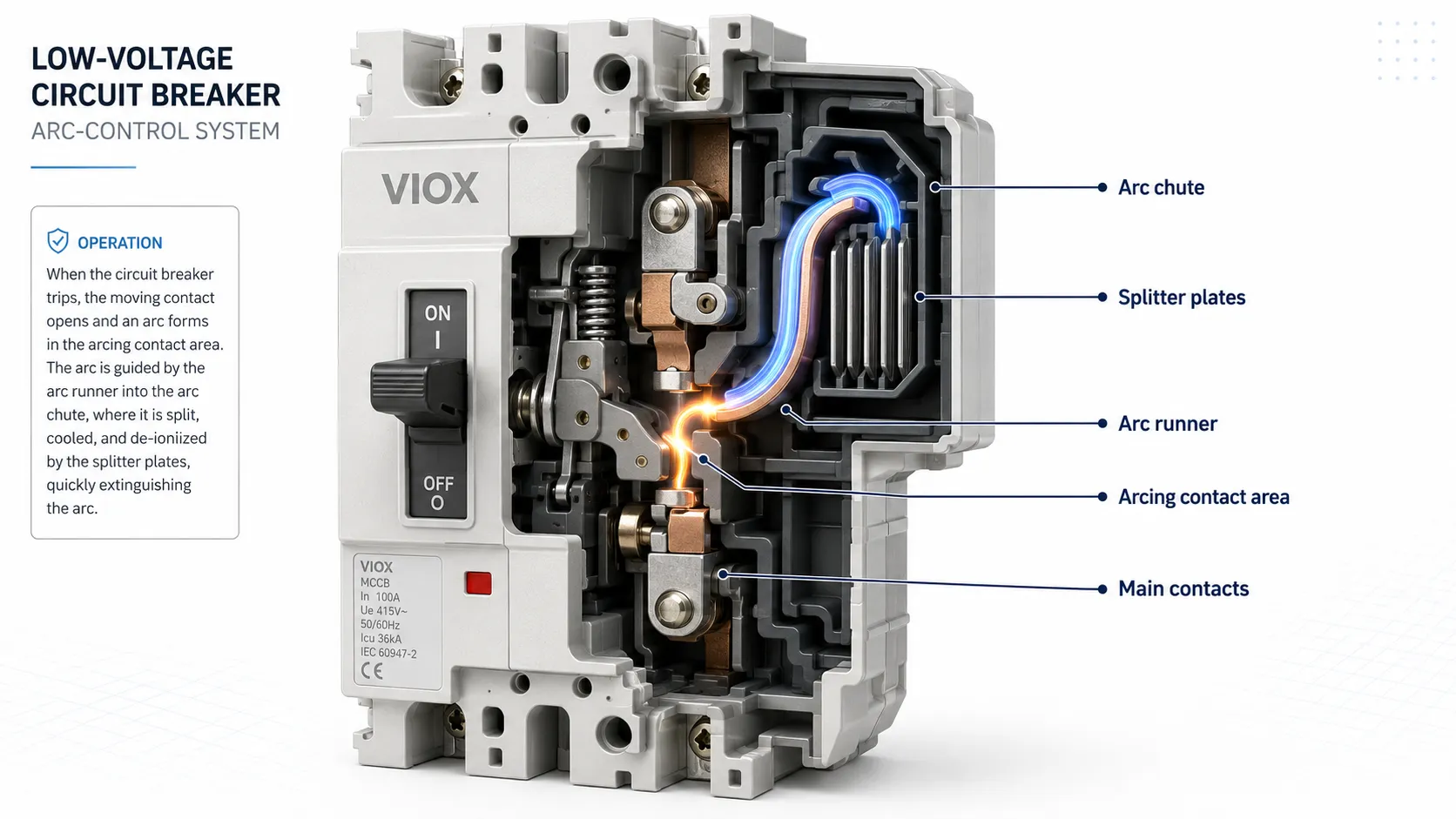
Ang tungkulin nito ay praktikal:
- bawasan ang pinsala sa contact;
- gabayan ang arc sa tamang landas;
- tumulong sa paglipat ng arc mula sa contact area patungo sa arc chamber;
- suportahan ang mas mabilis at mas kontroladong pagpapatay ng arc.
Sa maraming disenyo ng breaker, ang arc runner ay gumagana kasabay ng magnetic forces na nalilikha ng fault current. Ang isang pinapayak na paraan upang ipahayag ang driving force ay F = I × L × B, saan F ay ang puwersang kumikilos sa arc, ako ay ang arc current, L ay ang epektibong haba ng arc sa magnetic field, at B ay ang magnetic flux density. Sa praktikal na disenyo ng breaker, ang mas malaking short-circuit current ay nakakalikha ng mas malakas na magnetic driving force, na tumutulong upang itulak ang arc sa kahabaan ng runner patungo sa arc chute kung saan maaari itong hatiin at palamigin.
F = I × L × BPaano Inililipat ng Magnetic Force ang Arc patungo sa Arc Chute
Kapag ang mataas na kuryente ay dumadaloy sa isang breaker, ang daluyan ng kuryente ay lumilikha ng magnetic field. Ang arc mismo ay nagdadala rin ng kuryente. Ang interaksyon sa pagitan ng arc na may dalang kuryente at ng magnetic field ay lumilikha ng puwersa na kayang itulak ang arc palayo sa mga contact.
Ang magnetic movement na ito ay kapaki-pakinabang dahil ito ay:
- hinihila ang arc palayo sa contact surface;
- inililipat ang arc patungo sa arc runner;
- itinutulak ang arc papasok sa mga splitter plate;
- binabawasan ang tagal ng arc sa main contact area.
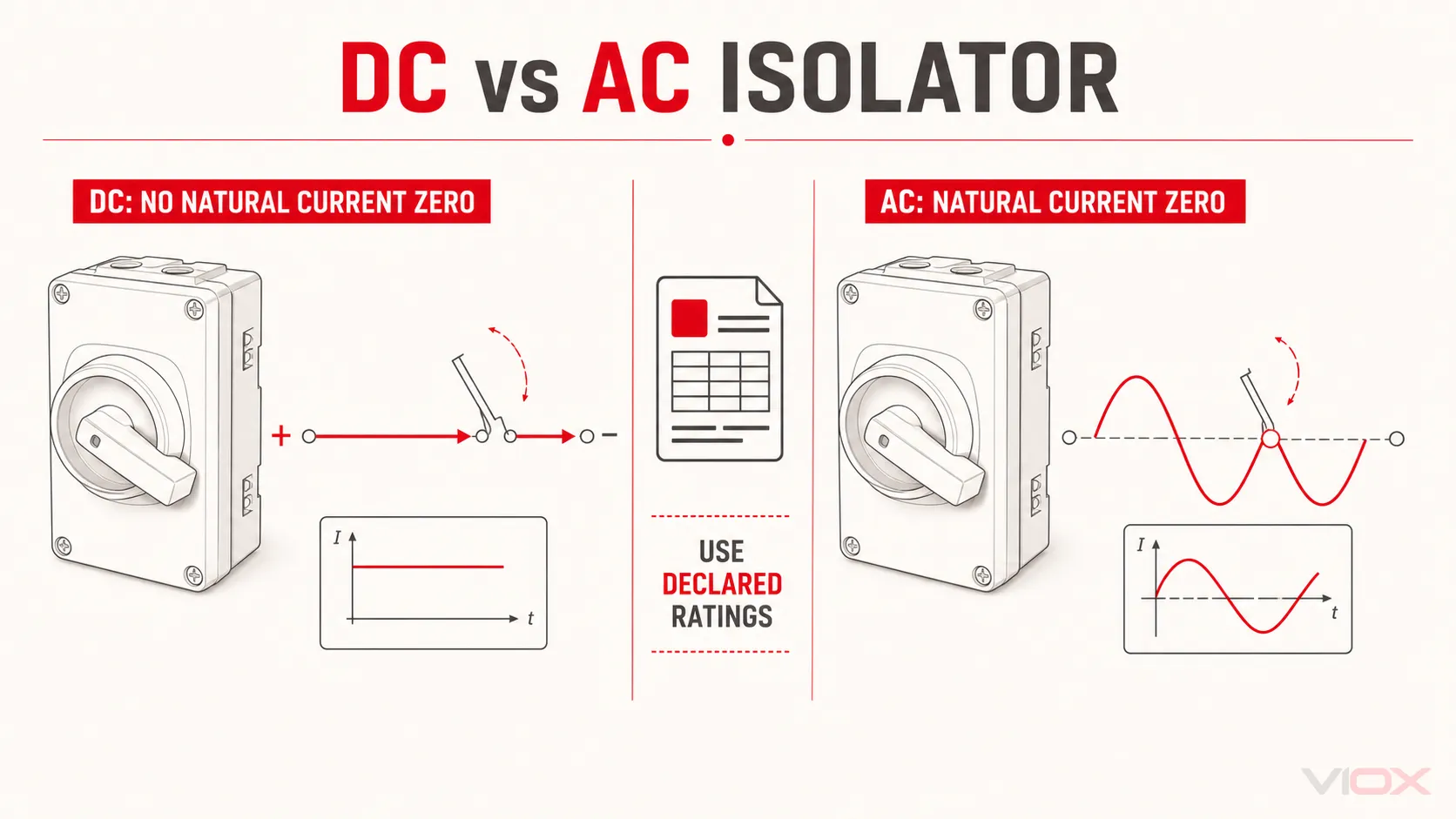
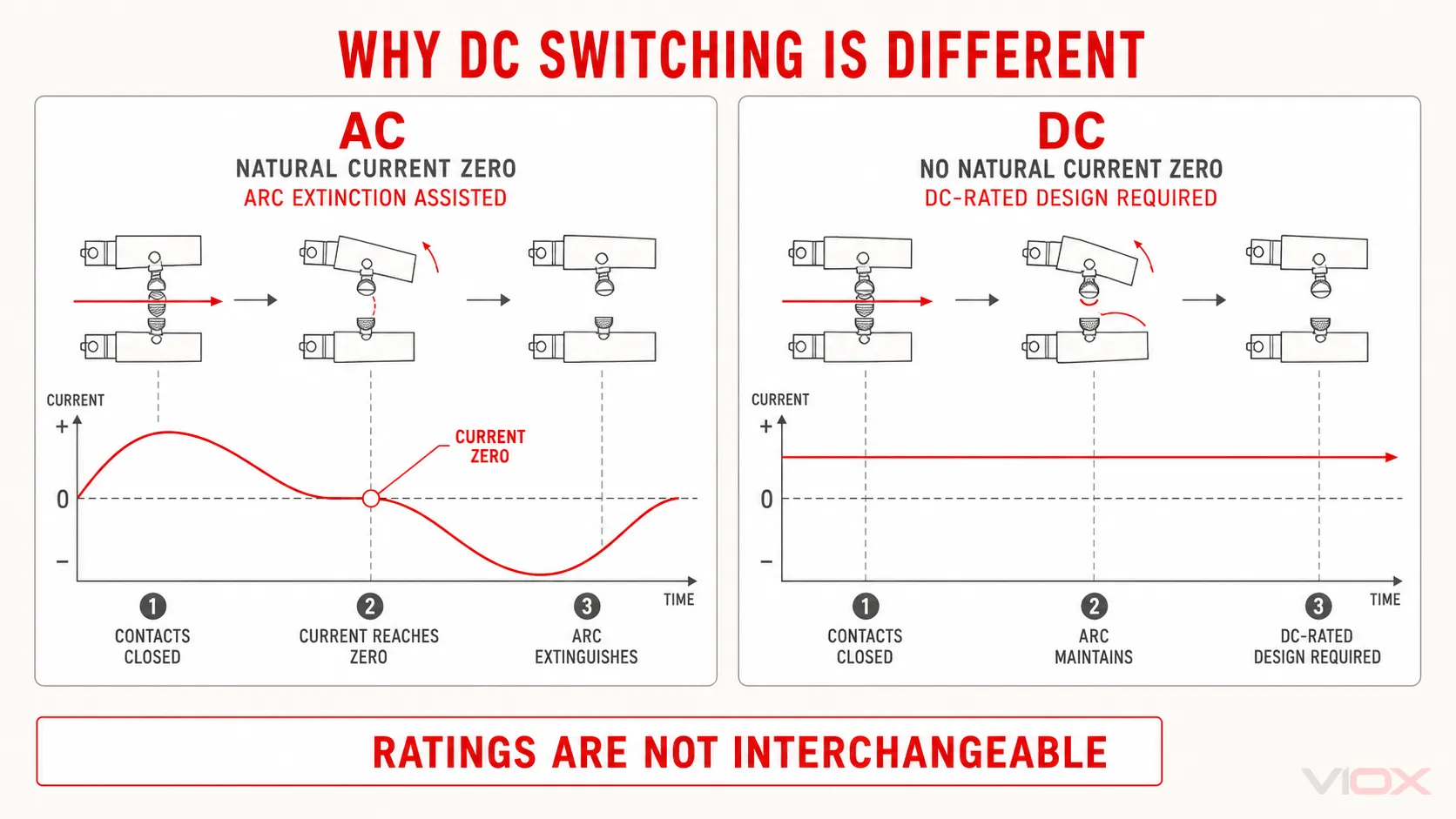
Sa mga DC breaker, mas nagiging mahalaga ang magnetic arc control dahil walang natural na current zero crossing. Ito rin ang dahilan kung bakit mahalaga ang polarity sa ilang disenyo ng DC breaker.
Mula sa pananaw ng disenyo ng produkto, hindi sapat ang pagkakaroon lamang ng arc chute. Ang hugis ng arc runner, bilis ng pagbukas ng contact, pagkakaayos ng splitter plate, daanan ng hangin (vent path), at materyales na insulator sa paligid ng chamber ay pawang nakakaapekto kung ang arc ay lilipat nang maayos sa extinguishing zone sa halip na manatili malapit sa mga contact.
Arc Chute at Arc Extinguishing Chamber
An arc chute ay ang istruktura na tumutulong sa pagpatay ng arc matapos itong umalis sa contact area. Ito ay madalas na binubuo ng maraming splitter plate o arc plate na nakaayos sa loob ng isang insulating chamber.
Ang arc chute ay gumagana sa pamamagitan ng:
- pagpapahaba ng landas ng arc;
- paghahati ng isang malaking arc sa mas maliliit na bahagi;
- pagpapalamig sa mainit na ionized gas;
- pagpapataas ng boltahe ng arc;
- pagtulong sa pag-de-ionize ng landas ng arc;
- pagkulong sa mga mainit na gas at partikulo sa loob ng disenyo ng breaker.
Ang pariralang arc extinguishing chamber karaniwang tumutukoy sa espasyo o asembliya kung saan nagaganap ang pagkontrol sa arc.
Mga Materyales ng Contact: Bakit Ginagamit ang Tungsten-Copper at Silver Alloys
Ang mga contact ng circuit breaker ay dapat magdaloy ng kuryente sa normal na operasyon at makayanan ang init ng arc sa panahon ng pagkaputol nito. Lumilikha ito ng trade-off sa materyales.
Ang mga karaniwang estratehiya sa materyales ng contact ay kinabibilangan ng mga silver-based alloy para sa conductivity at arc resistance, at mga materyales na istilong tungsten-copper kung saan kailangan ng mas matibay na resistensya laban sa arc erosion. Ang eksaktong materyales ay nakadepende sa uri ng breaker, current rating, aplikasyon, at disenyo ng manufacturer.
Ang pangunahing ideyang pang-inhinyero ay ito: ang tungsten ay nagbibigay ng mataas na melting-point para sa arc erosion resistance, habang ang copper naman ay nagpapabuti sa conductivity at paglipat ng init. Ang layunin ay panatilihing matatag ang istruktura ng contact sa ilalim ng paulit-ulit na pag-init ng arc habang pinapanatili ang katanggap-tanggap na contact resistance.
Mas tumpak ito kaysa sa pagsasabing ang tungsten-copper ay ginagamit lamang upang bawasan ang electron emission. Sa mga contact ng breaker, ang melting point, erosion resistance, thermal behavior, conductivity, at mechanical integrity ay pawang mahalaga.
Ano ang Arc Quenching?
Pagpapatay ng arc ay ang proseso ng pagpatay sa arc upang huminto ang daloy ng kuryente.
Ang mga circuit breaker ay maaaring gumamit ng iba't ibang paraan ng arc-quenching depende sa uri at boltahe nito:
| Uri ng Breaker | Karaniwang Paraan ng Arc-Quenching |
|---|---|
| MCB | Arc chute na may mga splitter plate |
| MCCB | Arc chamber, arc runners, splitter plates, molded insulation |
| ACB | Air arc interruption na may mas malalaking arc chamber |
| DC breaker | Arc chute na may magnetic blowout o multi-pole series design |
| High-voltage breaker | Vacuum, SF6, air blast, o iba pang espesyalisadong paraan ng pagputol ng kuryente |
Para sa mga low-voltage MCB at MCCB, ang arc chutes at splitter plates ang pinakakilalang mga bahagi.
Ano ang Arc Voltage?
Arc voltage ay ang boltahe sa kabuuan ng arc habang nagaganap ang pagputol ng kuryente. Habang hinahatak, hinahati, at pinapalamig ng breaker ang arc, tumataas ang arc voltage. Kapag ang arc voltage ay naging sapat na mataas kumpara sa kondisyon ng circuit, ang kuryente ay mapipilitang bumaba at ang arc ay mamamatay.
Sa praktikal na aspeto, ang isang mahusay na arc-control system ay nagpapataas ng resistance at cooling ng arc upang hindi na makadaloy ang kuryente sa ionized path.
Ang arc voltage ay hindi isang nakapirming halaga sa catalog. Kasama rito ang voltage drops malapit sa cathode at anode regions, pati na ang voltage gradient sa kahabaan ng arc column. Sa disenyo ng low-voltage breaker, ang mahalagang tanong ay kung ang geometry ng contact, arc runner, splitter stack, daloy ng gas, at insulation ng chamber ay kayang magpataas ng arc voltage nang sapat na mabilis sa ilalim ng nasubukang short-circuit condition.
Ito ang isang dahilan kung bakit mahalaga ang geometry ng mga contact, runner, plate, hugis ng chamber, at daloy ng gas sa disenyo ng breaker.
AC Arc kumpara sa DC Arc sa mga Circuit Breaker
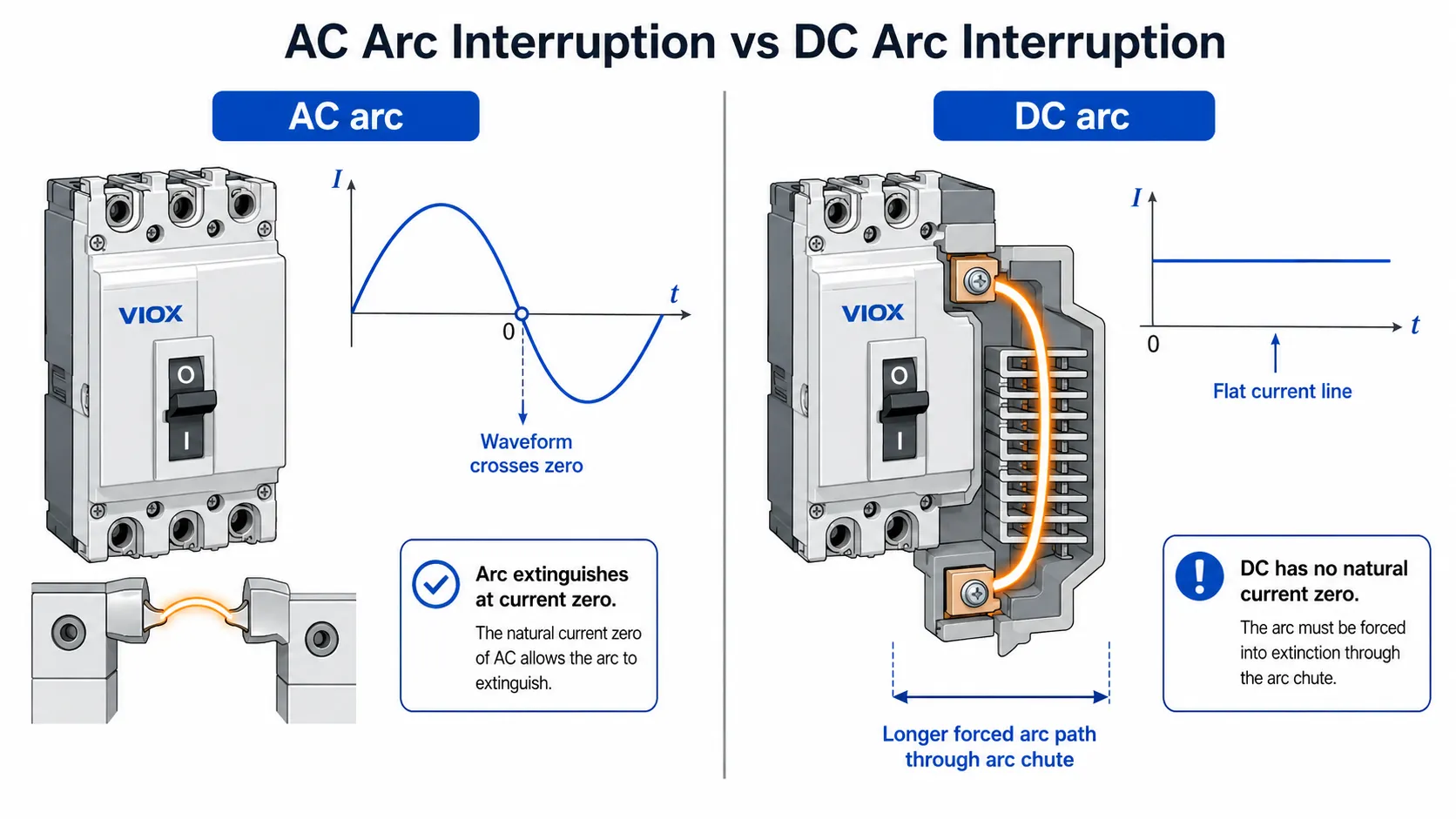
Magkaiba ang gawi ng AC at DC arc.
| Tampok | AC Arc | DC Arc |
|---|---|---|
| Current zero crossing | Natural na zero crossing bawat kalahating cycle | Walang natural na zero crossing |
| Pagkalipol ng arko | Tinutulungan ng current zero | Kailangang pilitin sa pamamagitan ng disenyo ng breaker |
| Disenyo ng breaker | Ang arc chute na may rating para sa AC ay maaaring sapat na para sa rating nito | Nangangailangan ng disenyo para sa pagpatay ng arc na rated para sa DC |
| Pag-aalala sa polarity | Karaniwang hindi gaanong kritikal sa mga low-voltage AC breaker | Mahalaga sa maraming polarized na DC breaker |
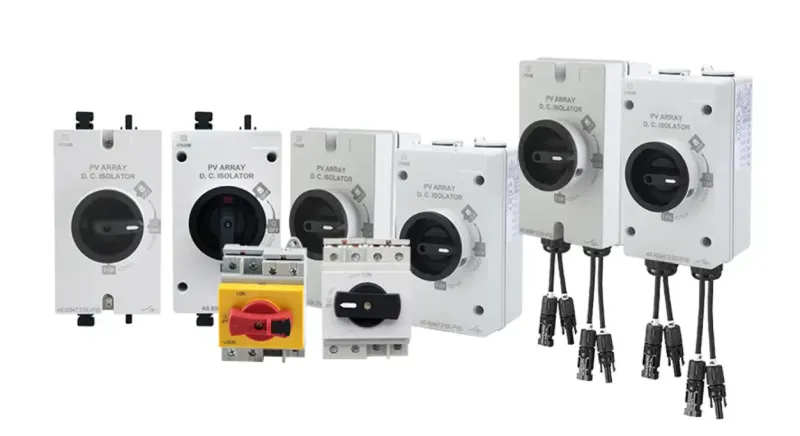
Ito ang dahilan kung bakit hindi dapat awtomatikong gamitin ang AC breaker sa isang DC circuit. Ang mga DC arc ay maaaring magpatuloy maliban kung ang breaker ay partikular na idinisenyo at rated para sa pagputol ng DC.
Para sa mga detalye ng DC breaker, tingnan ang Ano ang DC Circuit Breaker?.
Arc sa MCB vs MCCB vs ACB
| Uri ng Breaker | Kung saan nagaganap ang Arc Control | Praktikal na Pagkakaiba |
|---|---|---|
| MCB | Compact arc chute malapit sa contact system | Maliit na espasyo, mabilis na paghati ng arc, limitadong laki ng frame |
| MCCB | Mas malaking molded arc chamber at arc runners | Mas mataas na frame sizes at mas matibay na interruption structures |
| ACB | Mas malaking air arc chamber | Ginagamit sa mas mataas na current na low-voltage switchgear |
Ang pangunahing prinsipyo ay magkatulad: binubuksan ng breaker ang mga contact, bumubuo ng arc, itinutulak ang arc sa loob ng chamber, hinahati at pinapalamig ito, at pinuputol ang daloy ng kuryente. Ang pisikal na laki at kakayahan sa pagputol ng kuryente ay nagbabago depende sa uri ng breaker.
Para sa mga internal na bahagi ng MCCB, tingnan ang Panloob na istruktura at mga bahagi ng MCCB.
IEC 60947-2, UL 489, at mga Arc Interruption Rating
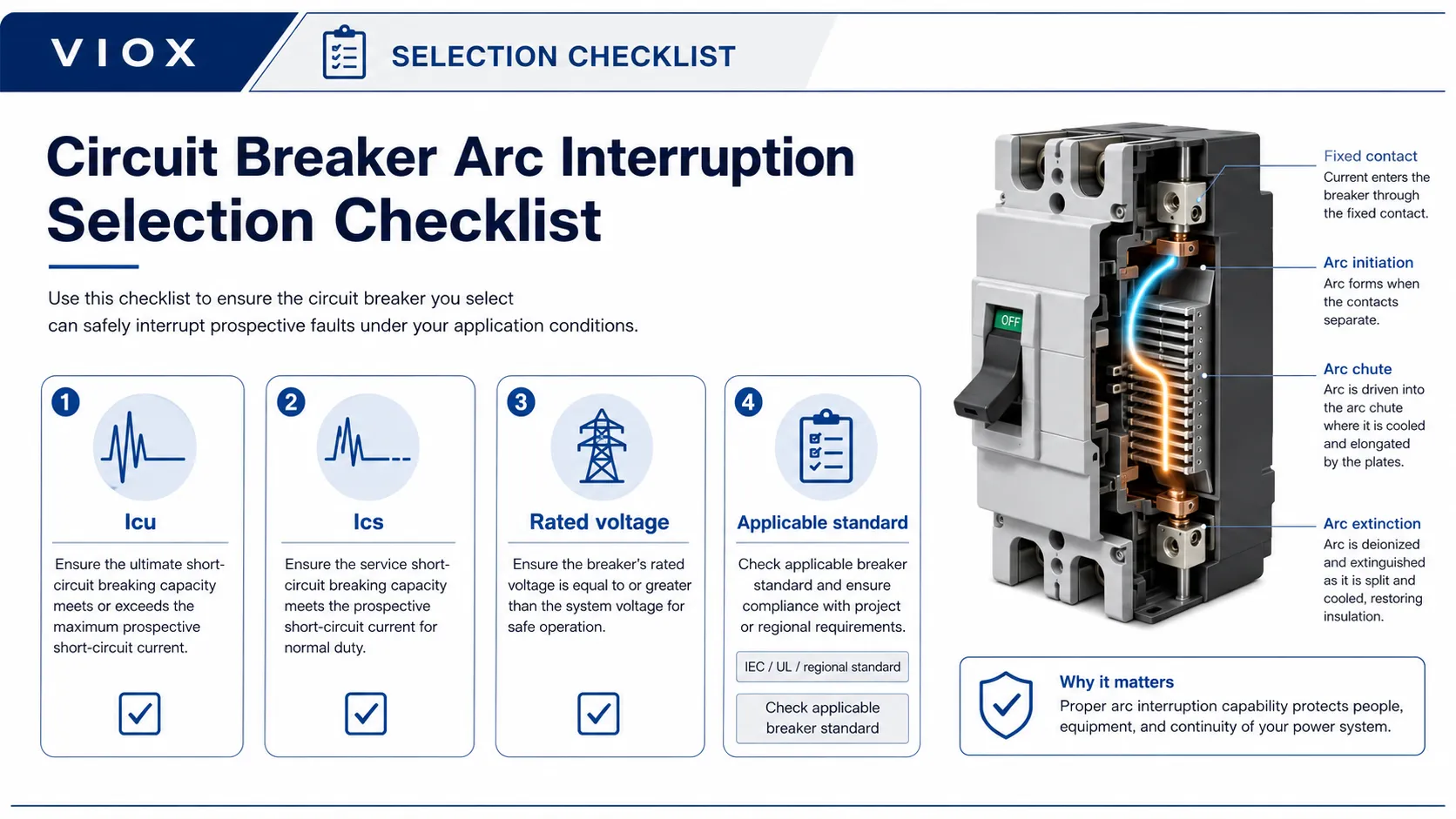
Ang arc interruption ay hindi sinusuri base lamang sa visual na disenyo. Ang mga circuit breaker ay sinusubok sa ilalim ng mga standard na framework na nagtatakda kung paano binibigyang-patunay ang performance ng interruption.
Para sa mga low-voltage industrial breaker, IEC 60947-2 ay isang mahalagang konteksto ng pamantayan. Sa mga merkado ng branch at molded-case breaker sa North America, UL 489 ay isang mahalagang sanggunian. Ang naaangkop na pamantayan ay nakadepende sa uri ng produkto, merkado, at pag-install.
Ang mga mahahalagang rating na may kaugnayan sa arc interruption ay kinabibilangan ng:
| Rating | Ibig sabihin | Bakit ito may kaugnayan sa Arc Control |
|---|---|---|
| Icu | Ultimate short-circuit breaking capacity | Pinapatunayan nito na kayang putulin ng breaker ang isang malalang fault sa ilalim ng mga itinakdang kondisyon ng pagsubok |
| Ics | Service short-circuit breaking capacity | Ipinapahiwatig nito ang performance pagkatapos ng pagkaputol sa ilalim ng mga kondisyon ng pagsubok na may kaugnayan sa serbisyo |
| Icw | Short-time withstand current | Mahalaga para sa selectivity at withstand behavior sa ilang uri ng breaker |
| Rated voltage | Boltahe kung saan sinusubok ang pagkaputol (interruption) | Ang mas mataas na boltahe ay karaniwang nagpapahirap sa pagpawi ng arc |
Ang mga rating na ito ay dapat basahin mula sa datasheet at konteksto ng pamantayan. Ang isang breaker na may mukhang matibay na arc chute ay nangangailangan pa rin ng nasubukang breaking capacity na angkop para sa aktwal na circuit.
Para sa gabay sa pagpili ng produkto ng VIOX, ang praktikal na tanong ay hindi kung ang breaker ay may nakikitang arc chamber. Halos bawat low-voltage breaker ay mayroong anyo ng arc-control structure. Ang mas kapaki-pakinabang na tanong ay kung ang contact system, arc runner, splitter stack, molded insulation, vent path, at terminal structure ay sabay-sabay na na-validate sa ilalim ng mga kinakailangang kondisyon ng pagsubok para sa breaking capacity. Dito mas mahalaga ang Icu, Ics, rated voltage, at ang naaangkop na pamantayan kaysa sa pisikal na anyo.
Arc sa Circuit Breaker kumpara sa Arc Fault Circuit Breaker
Ang salitang “arc” ay lumalabas sa dalawang magkaibang paksa ng breaker, ngunit magkaiba ang kahulugan nito.
| Termino | Ibig sabihin |
|---|---|
| Arc sa loob ng circuit breaker | Ang internal arc na nabubuo kapag bumukas ang mga contact ng breaker sa panahon ng pagputol ng kuryente |
| Arc fault | Hindi gustong pag-arc sa mga wiring, kurdon, terminal, o kagamitan |
| Arc fault circuit breaker / AFCI | Isang breaker na idinisenyo upang matukoy ang mga mapanganib na arc-fault signature sa isang circuit |
Ang normal na arc ng breaker ay nangyayari sa loob ng breaker habang naglilipat (switching) o kapag naputol ang kuryente dahil sa fault. Ang arc fault naman ay nangyayari sa labas ng nilalayong contact system at maaaring magpahiwatig ng sirang wiring, maluwag na koneksyon, o pagkasira ng insulation.
Mga Senyales ng Posibleng Problema sa Arcing ng Breaker
Ang arcing ng breaker sa loob ng device ay normal habang may interruption, ngunit ang mga abnormal na sintomas sa labas ay hindi dapat balewalain.
Tumawag ng kwalipikadong electrician o technician kung mapansin mo ang:
- amoy sunog malapit sa panel;
- pag-ugong, pag-sizzle, o pag-crack mula sa isang breaker;
- pinsala dahil sa init o pagbabago ng kulay;
- natunaw na insulation malapit sa mga terminal;
- paulit-ulit na pag-trip ng breaker;
- nakikitang kislap sa labas ng breaker;
- maluwag o sirang mga terminal.
Huwag buksan o suriin ang loob ng breaker habang may kuryente. Ang mga circuit breaker ay mga selyado o binuong kagamitang pangkaligtasan, hindi ito mga arc chamber na maaaring kumpunihin sa field.
Arc Erosion, Contact Pitting, at Kailan Nagiging Problema ang Arcing ng Breaker
Ang bawat pangyayari ng pagkaputol ng kuryente ay maaaring magbigay ng stress sa mga contact ng breaker. Sa normal na operasyon, inaasahan ito, ngunit ang paulit-ulit na malalang fault o hindi maayos na kondisyon ng terminal ay maaaring magpabilis ng pagkasira.
Ang mga posibleng senyales ng labis na stress na may kaugnayan sa arc ay kinabibilangan ng:
- mga pitted o eroded na contact sa mga magagamit pang industrial equipment;
- pagbabago ng kulay sa paligid ng mga terminal o vent;
- hindi pangkaraniwang amoy pagkatapos ng operasyon;
- pinsala sa case ng breaker;
- paulit-ulit na pag-trip sa ilalim ng magkakatulad na kondisyon ng load;
- pagtaas ng contact resistance sa mga kagamitan kung saan ang pagsukat ay bahagi ng nakagawiang maintenance.
Para sa mga sealed miniature breaker, ang inspeksyon sa loob ng contact ay karaniwang hindi praktikal. Para sa mas malalaking serviceable switchgear, ang inspeksyon at maintenance ay dapat sumunod sa mga tagubilin ng manufacturer at sa mga pamamaraan ng kaligtasan sa site.
Mga Karaniwang Maling Akala Tungkol sa Circuit Breaker Arcs
Maling Akala 1: Ang pag-aakalang ang anumang arc ay nangangahulugang depektibo ang breaker
Ang internal arc habang nagaganap ang interruption ay normal. Ang breaker ay idinisenyo upang kontrolin ito.
Pagkakamali 2: Ang pag-aakalang ang arc chute ay nakakapigil sa lahat ng pinsala sa breaker
Ang arc chute ay nagpapababa at kumokontrol sa enerhiya ng arc, ngunit ang paulit-ulit na pagputol ng mataas na fault ay maaari pa ring magdulot ng stress sa mga contact at panloob na bahagi.
Pagkakamali 3: Pagkalito sa pagitan ng arcing ng breaker at arc fault protection
Ang panloob na arc control ng breaker at ang AFCI arc-fault detection ay magkaibang paksa.
Pagkakamali 4: Paggamit ng mga assumption para sa AC arc sa mga DC breaker
Ang mga DC arc ay mas mahirap apulahin dahil walang natural na zero crossing. Gumamit ng mga breaker na may rating para sa DC sa mga DC circuit.
Pagkakamali 5: Pagwawalang-bahala sa kondisyon ng terminal
Ang maluwag na mga terminal ay maaaring magdulot ng panlabas na init at arcing. Iba ito sa normal na panloob na arc na nabubuo habang nagti-trip ang breaker.
FAQ
Kaya ba ng AC arc chute na pumatay ng DC arc?
Hindi awtomatiko. Ang pagputol ng AC ay nakikinabang sa natural na pagtawid ng kuryente sa zero, habang ang pagputol ng DC ay nangangailangan ng pagpapahaba, pagpapalamig, at pagpatay sa arc nang walang tulong na iyon. Ang breaker na ginagamit sa mga DC circuit ay dapat na partikular na rated para sa boltahe, kuryente, kondisyon ng polarity, at aplikasyon ng DC.
Ano ang pagkakaiba ng arcing contacts at main contacts?
Ang main contacts ay optimized para sa pagdadala ng kuryente na may mababang resistance sa normal na operasyon. Ang arcing contacts ay idinisenyo upang tanggapin ang electrical stress sa oras ng pagbubukas at pagsasara, kaya ang main contacts ay hindi nalalantad sa matinding pagkasira dulot ng arc.
Gaano kadalas dapat suriin ang arcing contacts sa mga industrial breaker?
Sundin ang mga tagubilin sa maintenance ng manufacturer ng breaker at ang electrical safety procedure ng site. Ang dalas ng inspeksyon ay nakadepende sa uri ng breaker, kasaysayan ng fault, switching duty, kapaligiran, at kung ang device ay maaaring kumpunihin. Ang mga sealed MCB at maraming MCCB ay karaniwang pinapalitan na lamang sa halip na buksan para sa inspeksyon ng contact.
Bakit amoy sunog ang breaker pagkatapos itong mag-trip?
Ang bahagyang amoy pagkatapos ng matinding pagputol ng kuryente ay maaaring magmula sa mainit na gas at mga byproduct ng arc sa loob ng breaker. Ang tuloy-tuloy na amoy sunog, pagbabago ng kulay, natunaw na insulation, pag-init ng terminal, o paulit-ulit na pag-trip ay hindi normal at dapat suriin bago muling lagyan ng kuryente ang circuit.
Ang mas mataas ba na Icu rating ay nangangahulugan ng mas mahusay na arc chute?
Hindi lamang sa aspetong iyon. Ang Icu ay isang nasubukang ultimate short-circuit breaking capacity sa ilalim ng mga itinakdang kondisyon. Mahalaga ang disenyo ng arc chute, ngunit gayundin ang bilis ng contact, geometry ng runner, molded insulation, disenyo ng terminal, rated voltage, at ang kumpletong pagkakasunod-sunod ng pagsubok. Mahalaga rin ang Ics dahil ipinapahiwatig nito ang service short-circuit performance sa ilalim ng naaangkop na pamantayan.
Maaari bang kumpunihin ang arcing ng circuit breaker?
Para sa mga sealed na MCB at maraming MCCB, ang pinsalang dulot ng internal arcing ay hindi maaaring kumpunihin sa field. Palitan ang device kung ang inspeksyon o gabay ng manufacturer ay nagpapahiwatig ng pinsala. Ang mas malalaking breaker na maaaring i-service ay maaaring may mga pamamaraan ng pagpapanatili na inaprubahan ng manufacturer, ngunit ang pagkukumpuni ay dapat lamang gawin ng mga kwalipikadong tauhan gamit ang mga aprubadong piyesa at paraan ng pagsubok.
Kaugnay na VIOX Resources
Konklusyon
Ang arc sa isang circuit breaker ay isang normal ngunit matinding electrical event na nalilikha kapag bumukas ang mga contact habang may daloy ng kuryente. Dapat ilipat ng breaker ang arc na iyon sa isang arc-control system, hatiin ito, palamigin, itaas ang arc voltage, at patayin ito.
Ang pinakamahalagang bahagi na dapat maunawaan ay ang arc runner, arc chute, mga arc splitter plate, at arc extinguishing chamber. Ang mga bahaging ito ang nagpapahintulot sa isang circuit breaker na maputol ang daloy ng kuryente nang ligtas sa halip na magsilbi lamang bilang isang simpleng switch.