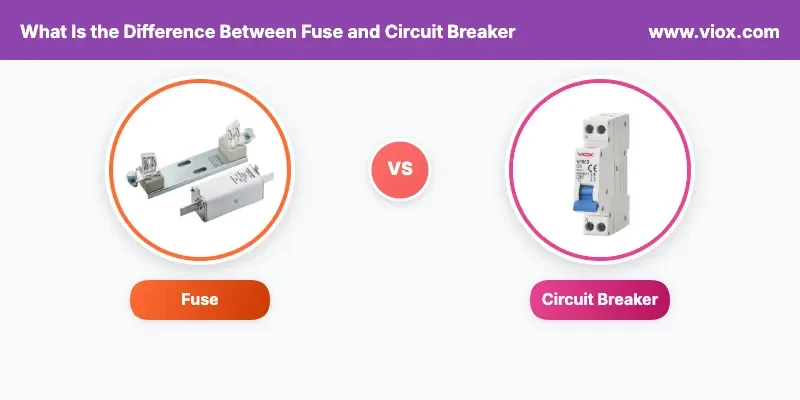
The difference between a fuse and a circuit breaker is simple: a fuse protects a circuit by melting a calibrated element and permanently opening the circuit, while a circuit breaker protects a circuit by tripping a mechanical switching mechanism that can usually be reset after the fault is cleared.
Both devices are used for overcurrent protection, but they are not interchangeable in every application. In practice, the better choice depends on the circuit type, the need for reset convenience, the fault level, coordination requirements, equipment sensitivity, and the operating environment. For modern residential and commercial distribution, circuit breakers are usually the standard solution. For certain equipment protection duties, semiconductor protection, and high-current-limiting applications, fuses still offer clear advantages.
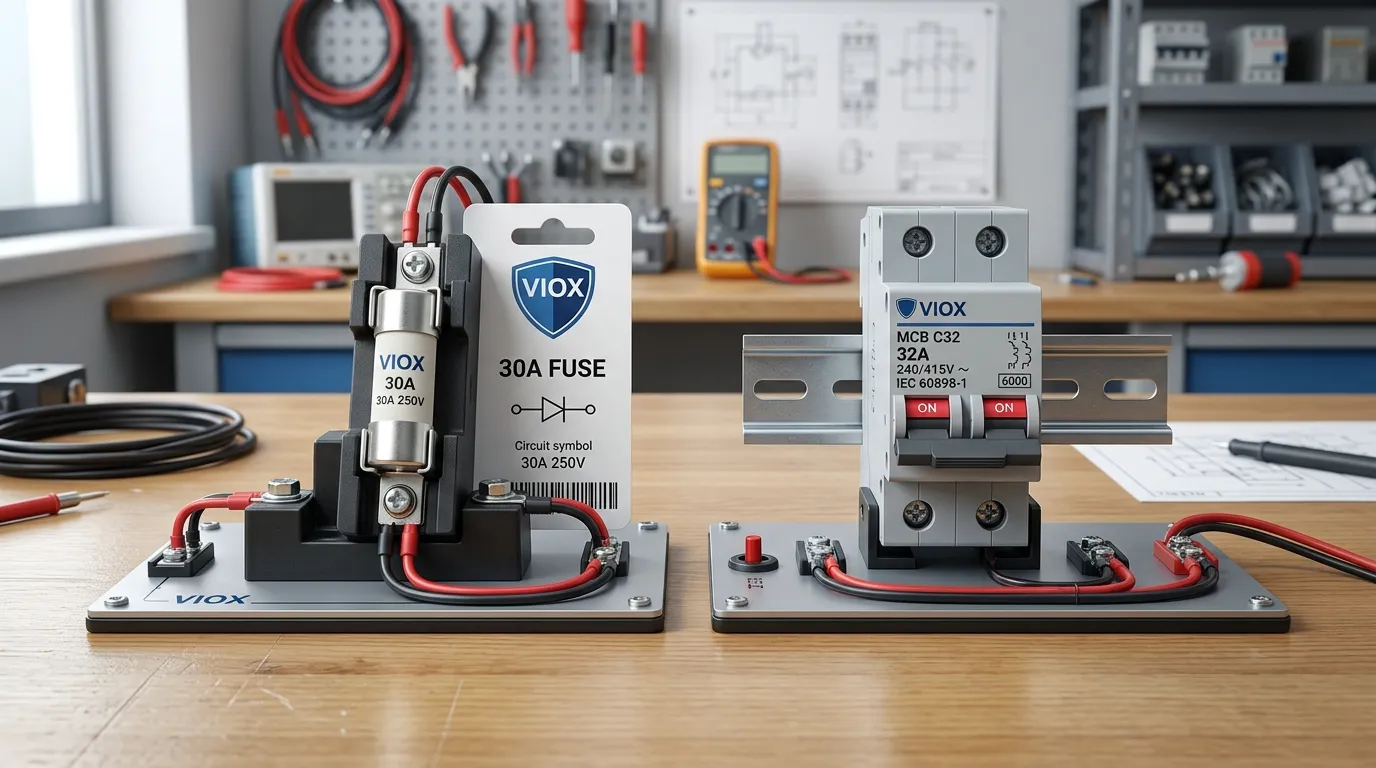
Fuse vs Circuit Breaker at a Glance
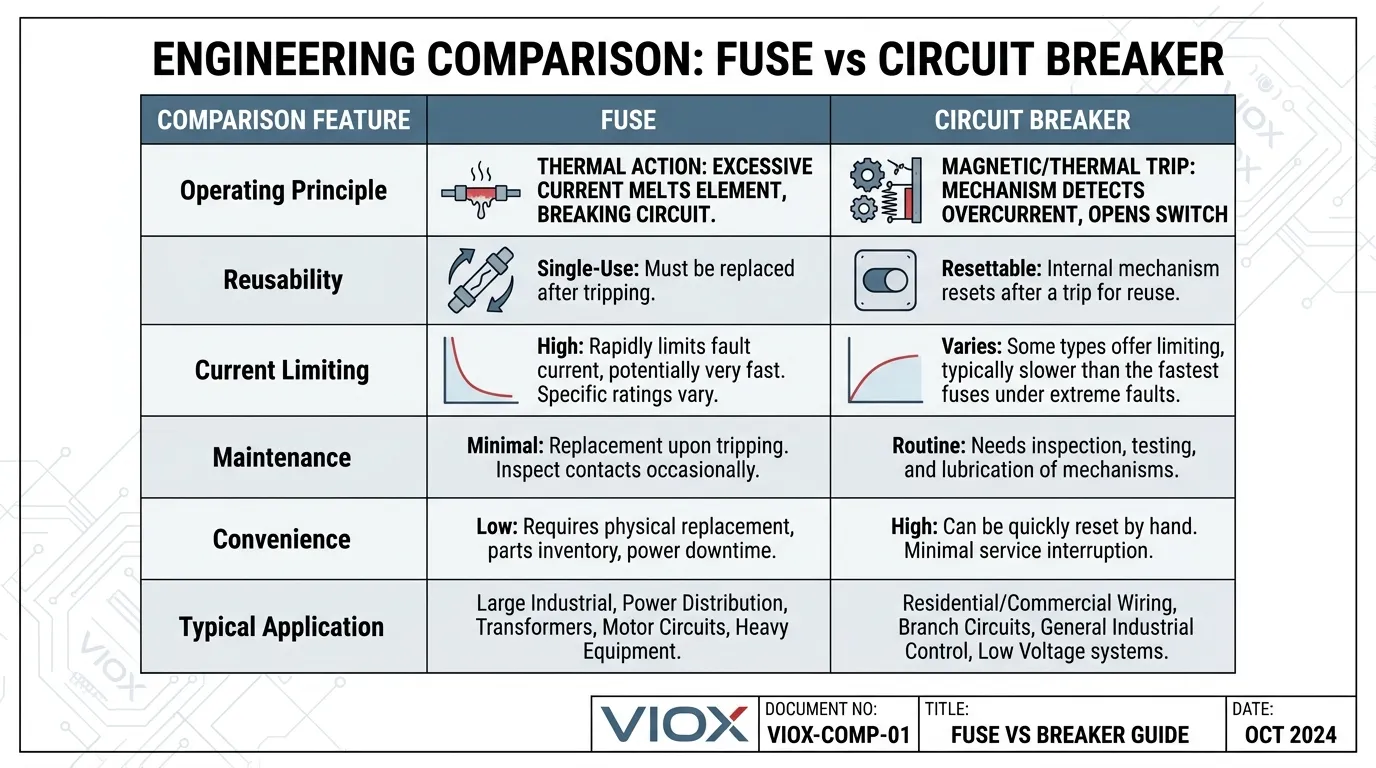
| 비교 포인트 | 퓨즈 | 회로 차단기 |
|---|---|---|
| Basic operating principle | Melts a calibrated element | Trips and opens mechanical contacts |
| 재사용 가능성 | 일회용 | Usually resettable |
| After a fault | Must be replaced | Can usually be reset after the cause is corrected |
| 전류 제한 | Often very strong, depending on fuse class | Depends on breaker design and rating |
| 편의 | Lower | 더 높음 |
| Maintenance approach | Replace with identical rated fuse | Inspect, test, and replace only if faulty or worn |
| 일반적인 용도 | Equipment protection, control circuits, industrial protection, electronics, automotive | Distribution boards, branch circuits, feeders, motor circuits, modern building electrical systems |
| User error risk | Wrong replacement rating is a major hazard | Wrong breaker type or rating is also a risk, but day-to-day reset is simpler |
What Is a Fuse?
A 퓨즈 is an overcurrent protection device that opens a circuit when current exceeds the design limit long enough to melt the fuse element. Once the element melts, the circuit remains open until the fuse is replaced.
Fuses are valued for simplicity, predictable behavior, and strong current-limiting performance in many applications. Different fuse types are designed for different duties, including general circuit protection, motor circuits, semiconductor protection, and DC applications. That is why a comparison between fuse and circuit breaker should never assume that all fuses behave the same way.
If your project also involves fuse accessories, 퓨즈 홀더는 어떻게 작동하나요? 그리고 퓨즈 홀더에 대한 완벽한 가이드 are useful supporting references.
서킷 브레이커란 무엇인가요?
A circuit breaker is a resettable protective switching device that interrupts fault current by opening contacts when an overload, short circuit, or another defined abnormal condition is detected.
Low-voltage circuit breakers are available in several families. In smaller branch and final circuits, an MCB is common. For higher current and feeder applications, an MCCB is often used instead. Some breaker families also integrate additional protection functions such as residual-current or arc-fault protection.
Unlike a fuse, a breaker does not need routine replacement after every trip. That convenience is one reason breakers dominate modern distribution panels.
Main Differences Between Fuse and Circuit Breaker
1. Operating principle
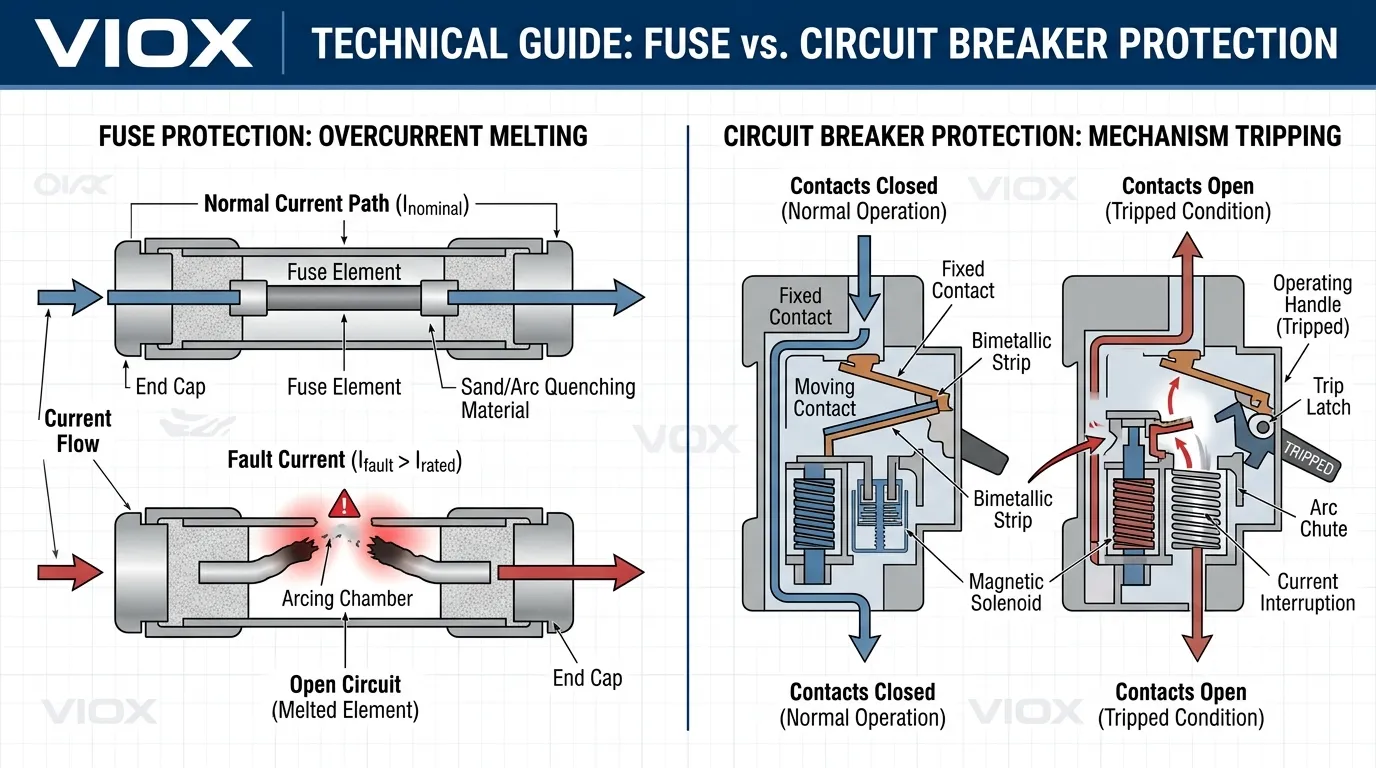
A fuse works by thermal destruction of its calibrated element. A breaker works by detecting a fault condition and mechanically separating contacts. That means the fuse is fundamentally sacrificial, while the breaker is fundamentally resettable.
2. Reusability
This is the most obvious difference.
- A fuse must be replaced after operation.
- A circuit breaker can usually be reset after the fault is removed.
Resettable does not mean permanent. Breakers still age, and repeated severe faults can damage contacts, trip units, or mechanisms. But in normal service they are far more convenient than fuses for circuits that may need restoration after an isolated fault.
3. Response and current limiting
Many fuses provide excellent current-limiting behavior. In practical terms, that can reduce the let-through energy seen by downstream equipment during a high fault event. This is one reason fuses are still common in equipment protection, drives, power electronics, and control applications.
Circuit breakers can also provide effective protection, but the comparison depends on the breaker family, instantaneous trip behavior, and interrupting rating. A blanket statement that one is always faster than the other is too simplistic. The right comparison is application-specific.
4. Convenience in operation and maintenance
This is where circuit breakers usually win in buildings and general power distribution.
- A blown fuse requires access, identification of the correct replacement, and safe replacement procedure.
- A tripped breaker can usually be identified and reset quickly after the fault is understood and cleared.
That difference matters in facilities where downtime, maintenance speed, and operating continuity are important.
5. Safety in real-world use
Both devices can be safe when correctly specified and installed. The risk often comes from misuse.
Common fuse-related mistakes include:
- replacing a fuse with the wrong current rating
- using the wrong fuse class or voltage rating
- bypassing a blown fuse
Common breaker-related mistakes include:
- selecting the wrong trip characteristic
- using an incompatible breaker in a panel
- repeatedly resetting a breaker without finding the fault
If the discussion is specifically about branch-circuit breaker families, MCB, MCCB, RCB, RCD, RCCB 및 RCBO의 차이점은 무엇입니까? helps clarify where different breaker types fit.
6. Cost profile
Fuses usually have a lower unit price. Circuit breakers usually have a higher initial device cost.
But total cost depends on the application:
- For low-cost equipment protection, fuses may still be the economical choice.
- For circuits where service continuity and maintenance speed matter, breakers often reduce downtime and replacement labor.
That is why the useful question is not “Which one is cheaper?” but “Which one is more economical for this protection duty over time?”
When a Fuse Is the Better Choice
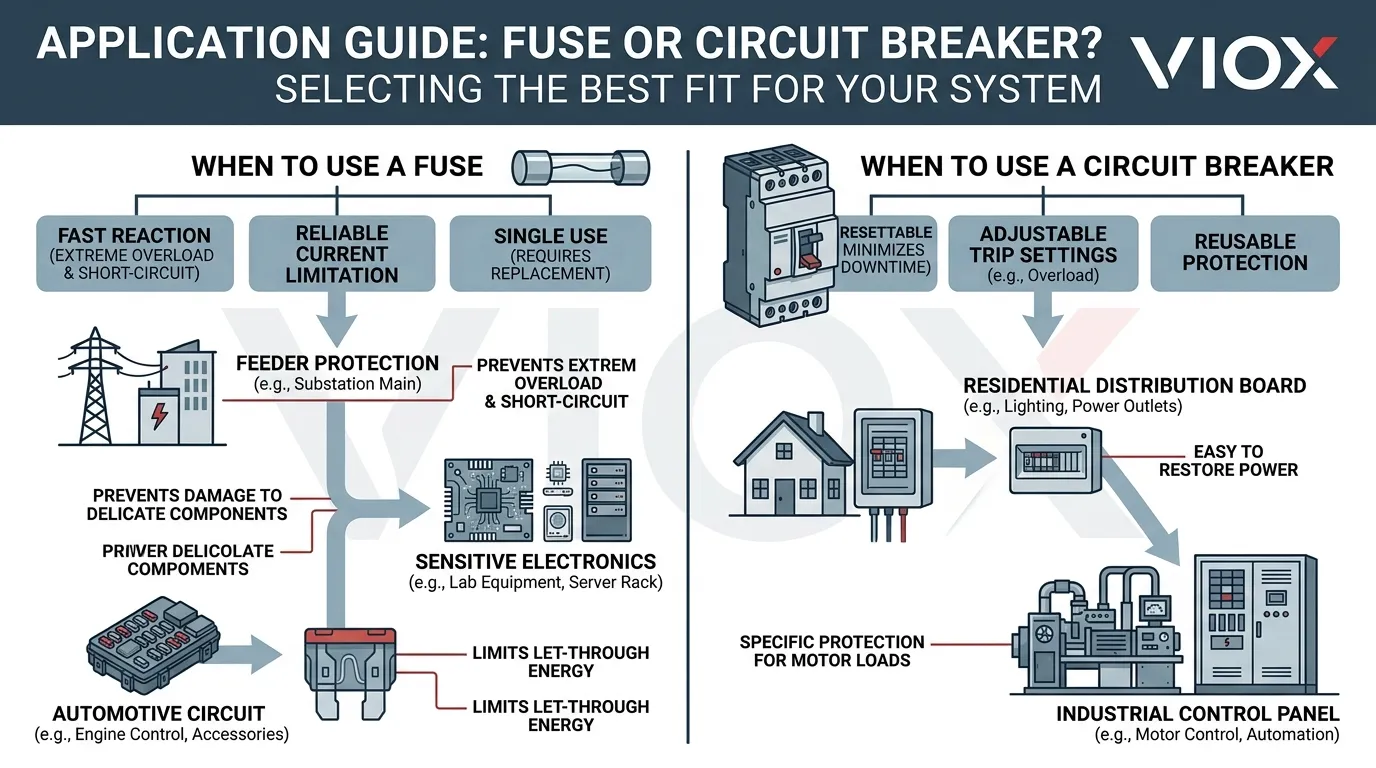
A fuse may be the better choice when:
- strong current limiting is important
- compact protection is needed
- the circuit protects sensitive electronics or power semiconductors
- the design calls for a specific fuse class or coordination method
- replacement after operation is acceptable
This is common in control circuits, power electronic assemblies, drives, battery systems, and specialized industrial equipment. In some DC systems, fuse selection is also highly application-specific, which is why AC 퓨즈 대 DC 퓨즈 is worth reviewing separately.
When a Circuit Breaker Is the Better Choice
A circuit breaker is usually the better choice when:
- the circuit is part of a building distribution panel
- fast reset and service restoration matter
- the installation is expected to see occasional trip-and-reset events
- maintenance staff need visible switching status
- coordination with panelboard architecture matters
- future expansion or standardization is important
This is why circuit breakers dominate residential, commercial, and much of industrial low-voltage distribution.
Fuse Box vs Circuit Breaker Panel
Many searchers are really comparing older fuse-based residential panels with modern breaker panels. That is a related but slightly different question.
An old fuse box is not automatically unsafe just because it uses fuses. The real issue is whether the installation is correctly rated, correctly maintained, and still suitable for the present electrical load. In many homes, the practical preference shifts toward breaker panels because they are easier to maintain, easier to expand, and more aligned with current residential expectations.
즉, fuse vs circuit breaker is still a device comparison first. A fuse box upgrade decision should be based on panel condition, service capacity, code compliance, and actual load growth, not only on the idea that “breakers are newer.”
Common Mistakes When Comparing Fuse and Circuit Breaker
Assuming all fuses only protect against overload
This is one of the biggest comparison mistakes. Fuses are used in overload and short-circuit protection roles depending on fuse type, class, and application. The correct comparison has to be tied to the actual device family.
Assuming circuit breakers last forever
Breakers are resettable, but they are still mechanical protective devices with service limits. Severe fault interruption, wear, corrosion, or repeated stress can justify inspection or replacement.
Comparing residential convenience with industrial protection duty
A homeowner comparing a fuse box with a breaker panel is asking a different question from an engineer selecting protection for a motor starter, drive cabinet, or DC assembly. One page can address both contexts, but it should not mix them without clarifying the difference.
Reducing the decision to speed alone
Speed matters, but so do:
- interrupting capability
- 전류 제한
- 조정
- reset convenience
- replacement logistics
- cost of downtime
Which Is Better: Fuse or Circuit Breaker?
For most modern homes and standard building distribution, circuit breakers are usually the better choice because they are resettable, easier to operate, and better suited to modern panel design.
For certain equipment protection duties, industrial current-limiting roles, and specialized electronic applications, fuses may still be the better engineering choice.
So the best answer is not that one universally replaces the other. The real answer is:
- choose a fuse when the protection duty benefits from its current-limiting and application-specific characteristics
- choose a circuit breaker when distribution convenience, resettable operation, and system maintainability are the main priorities
자주 묻는 질문
What is the difference between fuse and circuit breaker?
A fuse opens a circuit by melting an element and must then be replaced. A circuit breaker opens a circuit by tripping a switching mechanism and can usually be reset after the fault is cleared.
Which is better, a fuse or a circuit breaker?
For most building distribution systems, a circuit breaker is the more practical choice. For some equipment protection and current-limiting applications, a fuse may be the better choice.
Are fuses faster than circuit breakers?
Some fuses provide very strong current-limiting and fast fault-clearing behavior, but the practical comparison depends on the exact fuse class, breaker type, and fault condition. It is better to compare specific devices than to rely on one universal time claim.
Can a fuse replace a circuit breaker?
Not as a casual swap. Any conversion between fuse-based and breaker-based protection has to match the circuit design, voltage, current rating, fault level, enclosure arrangement, and applicable code requirements.
Why are circuit breakers used in most homes?
They are widely used because they are resettable, easier to identify after a trip, and fit modern residential panel architectures better than traditional fuse systems.
Are fuses still used in modern systems?
Yes. Fuses are still widely used in industrial equipment, control circuits, electronics, battery systems, photovoltaic systems, and other applications where their specific protection characteristics are useful.