

이 페이지 정보
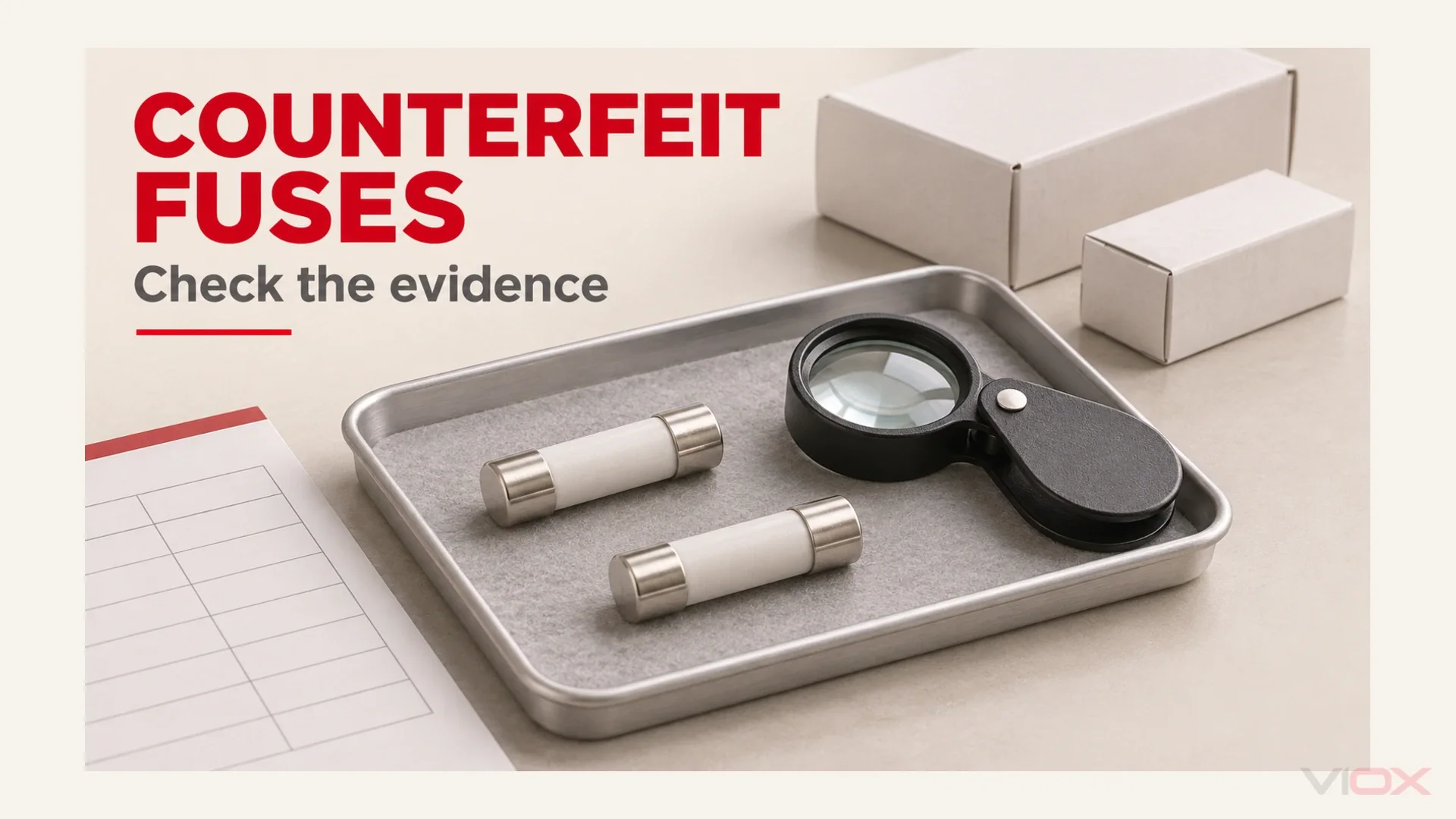
Counterfeit fuses can look intact, fit their holders and pass a multimeter continuity check while failing to provide the protection their markings promise. A continuity beep proves a conducting path; it cannot verify opening behavior or safe fault interruption. Buyers and electricians need matching product identification, credible performance documents, independently checked certification claims and traceable supply records. If those checks leave material doubts, quarantine the batch rather than accepting its printed rating as proof.
Counterfeit does not simply mean cheap or unbranded. It involves false identity or representation, such as an unauthorized manufacturer’s name or certification mark. A fuse that fails its declared performance is at least suspect or nonconforming; that result alone does not establish that it impersonates another manufacturer. An honestly identified unbranded product that meets its declared requirements is a different case.
The practical question is whether this particular batch has a defensible basis for acceptance, not whether its packaging looks expensive.
Why a Fuse That Fails to Open Can Remain Undetected
A fuse is an intentionally controlled interruption point. Its element and construction must respond to overcurrent according to the relevant characteristic and interrupt the resulting current safely. It is not supposed to open immediately at its rated current. Judge opening behavior against the correct time-current curve and specified test conditions.
If the element does not open when required, conductors, terminals or equipment may overheat before protection operates. The circuit can appear normal during everyday operation because its load has not yet demanded that protective function. An intact genuine fuse and a conductive imitation can therefore give the same continuity indication.
There is another failure mode: the element melts, but the fuse cannot extinguish the arc or contain the interruption safely. “Never blow” describes the concern behind this article; it is not a claim that every counterfeit remains conductive under every conceivable fault. Delayed opening and unsafe interruption both undermine protection, through different mechanisms.
What Published Third-Party Testing Actually Shows
In PAT Testing Training’s examination and bench test of suspected counterfeit BS 1362 plug fuses, opened samples lacked the expected sand filling. During its deliberate short-circuit test, one fuse exploded and left a scorch mark on the socket outlet. These were that organization’s samples and tests, not VIOX testing.
The result demonstrates a containment and interruption problem in the tested construction. It does not establish a universal failure rate, authenticate another batch or prove that all counterfeit fuses behave identically. Nor should a buyer repeat the experiment: deliberate fault testing requires suitable facilities, containment, instrumentation and competent personnel.
Keep that distinction when reading test videos. A useful report identifies the sample, its claimed specification, applied conditions and observed result. A finite test supports “did not open during the test,” not a literal promise that the specimen could never open.
Where Counterfeit or Misrepresented Fuses Can Fail Inspection
Element Material and Cross-Section
An element’s material and geometry contribute to its opening characteristic. A conductor that merely fits inside a familiar package is not evidence of calibrated protection. The key acceptance question is whether the exact identified fuse has supporting performance data and whether samples conform to that declared design.
A visible element in a transparent fuse may raise a question when it differs from a confirmed reference. It cannot, by appearance alone, prove the correct alloy or opening performance. Leave internal examination and material or performance testing to the manufacturer or a qualified laboratory. Do not open installed or spare stock and then return it to service.
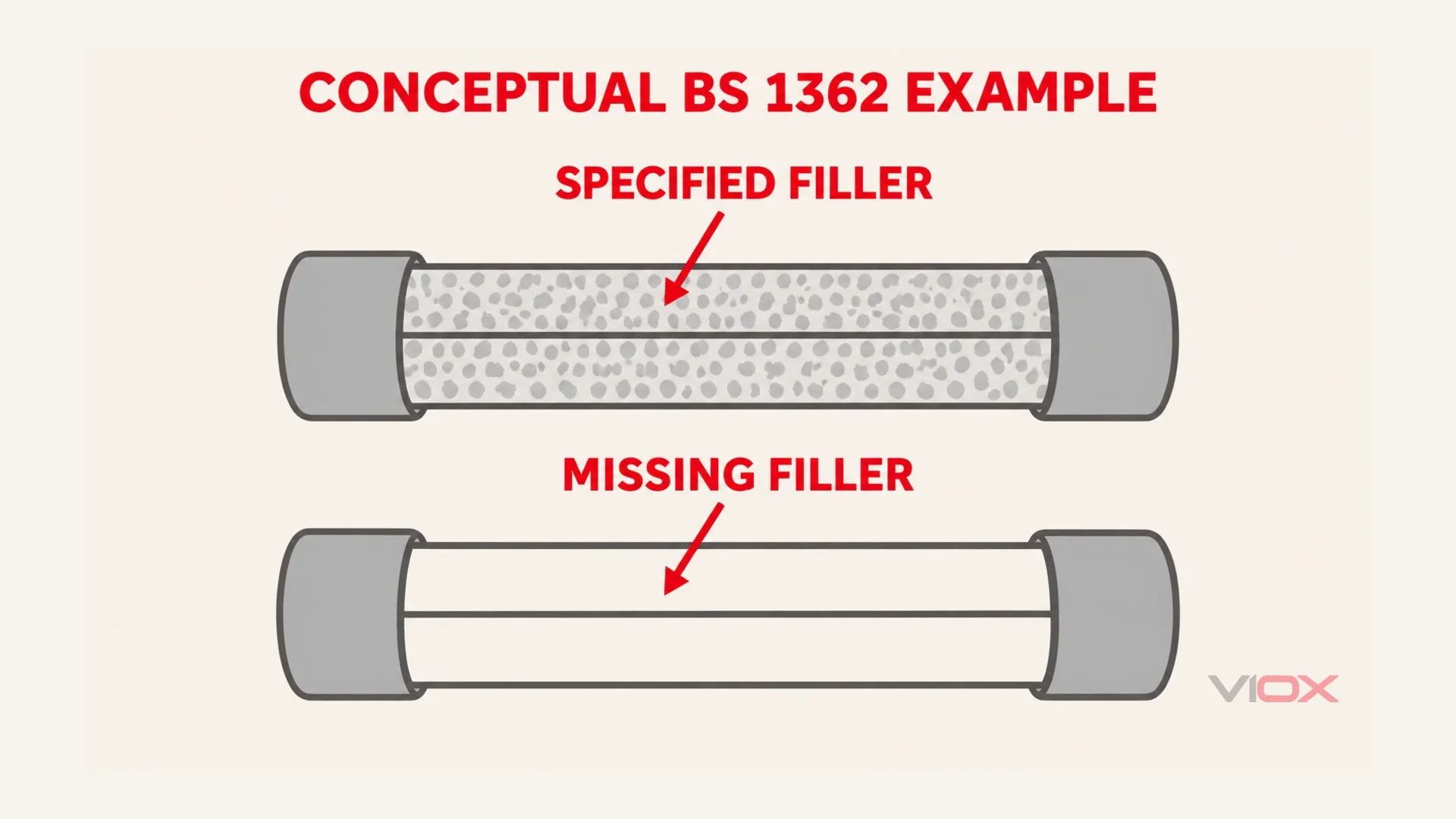
Missing or Inadequate Arc-Quenching Filler
For designs that specify arc-quenching filler, its presence and proper construction matter. PAT Testing Training’s BS 1362 examination gives a concrete example of an empty body where sand was expected. Missing filler in such a design is a serious discrepancy.
That is not a rule that every genuine fuse contains quartz sand. Fuse construction varies. Compare the suspect sample with the exact manufacturer’s design and applicable product requirements, not with a general picture of a high-breaking-capacity fuse. External appearance cannot confirm an enclosed fill, and shaking a cartridge is not an acceptance test.
Body Material and End-Cap Construction
Glass is not inherently a sign of a fake, and ceramic is not proof of authenticity. A genuine glass-bodied fuse can be correct for its specified duty. The discrepancy is substituting a construction that does not match the claimed model or interruption capability.
Compare body appearance, cap fit, terminal finish and visible assembly quality with an authenticated sample and manufacturer information. Loose caps, unexpected gaps or exposed element connections warrant investigation. A shiny finish does not identify the base metal or plating thickness. Do not scrape contacts to identify material: that damages the part without validating its protective performance.
Printing, Standard Claims and Weight
Check for contradictory current markings, incorrect model identifiers, distorted approval symbols, spelling errors and packaging that describes a different fuse. A printed standard number is a claim to verify, not a certificate. Different fuse families use different standards and marking rules.
An unexplained weight difference from an authenticated specimen of the same model can flag a construction change, including a possible missing component or filler. Compare like with like; packaging, fuse family and model revision matter. There is no universal gram threshold in this checklist. Normal-looking printing and a matching weight still cannot prove authenticity.
Treat these observations as screening evidence. The U.S. Department of Energy’s suspect/counterfeit resource framework supports structured investigation of suspect items rather than relying on a single visual clue.
What a Real Fuse Must Prove
Its Marking and Claimed Duty Agree
Record the manufacturer or identifying mark, exact model, current and voltage ratings, AC/DC applicability, relevant category and any declared breaking capacity. Check the unit, packaging and data sheet for agreement, allowing for the marking locations permitted for that product family.
Industrial IEC 60269 fuses, UL 248 products and BS 1362 plug fuses do not all carry an identical label. Categories such as gG, gPV and aM are meaningful where applicable, not a checklist of symbols that every fuse must display. Use the IEC 60269 selection guide for category and application questions.
Any Certification Claim Is Independently Checkable
Start from the issuing organization’s official website, not a supplier’s screenshot or an unfamiliar verification link. For a claimed UL certification, use UL Product iQ. Search using the manufacturer, file number, model information or product category, then compare the returned record with the actual item and its claimed scope.
Check whether the entry covers the fuse link, holder or another component. A holder’s certification does not certify an unidentified fuse installed in it. A company’s appearance in a database does not establish that every product it sells is covered, or that the physical item in your hand is genuine.
If the result is missing or ambiguous, hold acceptance and ask the issuing body or manufacturer to clarify. UL’s certification FAQ explains that an unavailable record can have several explanations; it is not, by itself, conclusive proof of counterfeiting. Apply equivalent checks to other claimed approval schemes.
Performance Documents Match the Exact Fuse
Obtain a data sheet and time-current characteristic that identify the same model, rating and applicable conditions. A generic curve for a different family is not evidence for the supplied item. Check declared voltage and interruption capability separately from opening time; one does not establish the other.
The document should come through a source whose identity can be verified. If its revision, model range or approval scope conflicts with the sample, resolve the difference before release. For curve interpretation, use How to Read a Fuse Time-Current Curve; here the task is checking the curve’s identity, not reproducing a coordination study.
The Supplied Batch Has Provenance
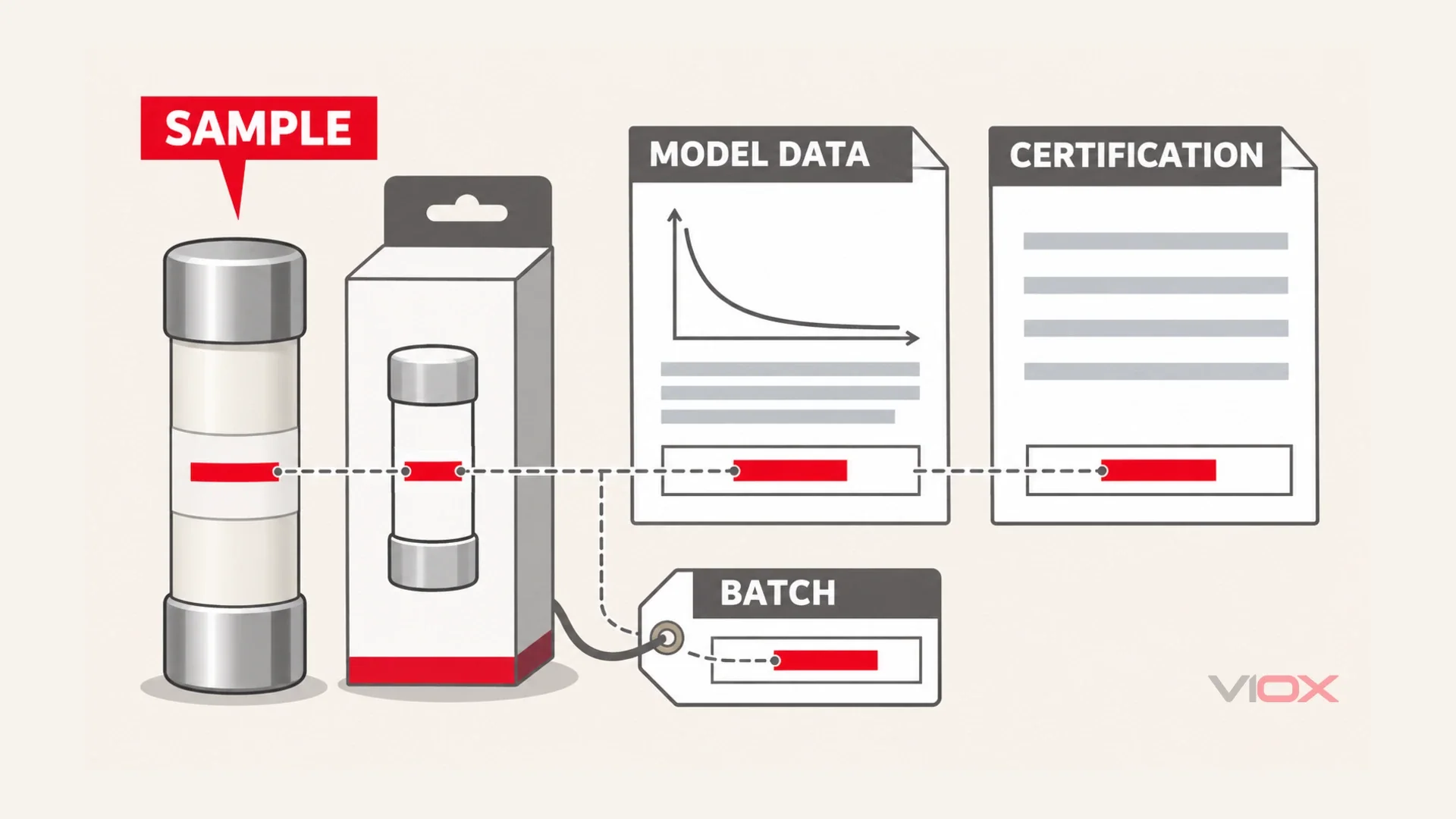
Retain purchase records, supplier identity, packaging, receiving photographs and available lot or date identifiers. Confirm the source through the manufacturer’s published distribution information or direct confirmation when authorization is claimed. A familiar logo on a resealed bag is not a chain of custody.
Traceability links the delivered goods to their claimed origin. Certification and documents describe an approved or declared product; provenance helps connect your particular batch to that product. Missing links require clarification, not assumptions based on appearance or price.
Receiving Inspection: Checks That Lead to a Decision
Inspect loose stock away from energized equipment. Mark unresolved goods as held, separate them from usable inventory and record the discrepancy. That prevents an electrician from unknowingly fitting a questioned sample while procurement is still investigating.
| 확인 | 비교할 내용 | What an anomaly means | 다음 조치 |
|---|---|---|---|
| Marking and print | Sample, packaging and exact-model data | Wrong or inconsistent identity; visual quality alone is inconclusive | Photograph and hold for manufacturer clarification |
| 무게 | Authenticated specimen of the same model and revision | Possible construction difference, not a standalone authenticity verdict | Record the comparison; request examination if unexplained |
| Caps and body | Verified construction, fit and visible finish | Damage, substitution or manufacturing discrepancy may be present | Segregate; do not scrape, dismantle or repair |
| Claimed certification | Issuer’s record, manufacturer, model and scope | Mark or record does not yet substantiate this supplied item | Confirm with issuer/manufacturer before acceptance |
| 기술 문서 | Markings against data sheet and matching curve | Declared protection is unsupported or inconsistent | Obtain correct controlled documents |
| Channel and price | Purchase trail and substantiated source | An unusual offer or untraceable batch increases doubt, but is not proof | Verify source; no percentage-based price verdict |
| Unresolved performance | Applicable specification and laboratory test plan | Visual/document checks cannot establish conformity | Send representative samples to a qualified laboratory |
Release requires closure of material discrepancies and approval under your purchasing or maintenance procedure. A corrected invoice alone does not resolve a mismatched fuse. Record who authorized the disposition and what evidence supported it.
For laboratory escalation, request testing against the applicable product standard and declared characteristic, with documented sample identity and relevant conditions. Keep the report attached to the batch record. Passing one test does not demonstrate every claimed property; opening behavior and safe interruption may require different assessments. Do not create a short circuit, overload a field circuit or increase current until a sample bursts as an improvised authenticity check.
If Suspect Fuses Are Already Installed
Do not credit a suspect fuse with its claimed protective capability while the issue remains unresolved. An upstream device may still provide some protection, but that does not validate the questionable fuse or the intended coordination. Arrange safe isolation and assessment by qualified personnel under the site’s procedures.
PV conductors can remain energized in daylight, and battery systems can supply high short-circuit energy. These are reasons for qualified site-specific handling, not instructions for live fuse removal or experimentation. Verify the required isolation before access.
Identify the affected circuits and batch. Replace the suspect installed set with correctly specified, traceable genuine units; do not leave questioned old units mixed with replacements in the affected circuit. Recheck application suitability rather than simply copying a potentially false marking. The 전기 퓨즈 선택 가이드를 사용하십시오. covers that separate task.
Inspect holders, terminals and connected conductors for heat damage. A replacement fuse does not restore a damaged contact interface; follow the separate fuse-holder melting diagnosis when the holder has deteriorated.
Retain suspect samples, packaging, photographs and purchase records safely, identified as unsuitable for reuse. Follow the applicable supplier, manufacturer and reporting process rather than returning loose parts to stock. Counterfeit protective devices may affect compliance or insurance assessments; the outcome depends on the installation and relevant requirements.
Applying the Same Evidence Standard to a VIOX Enquiry
VIOX의 RT18-63 product page identifies a DIN-rail cartridge fuse-holder product. The VOPV combiner configuration page identifies VOPV-32 within its fuse-holder configuration. Neither listing, by itself, authenticates an individual supplied fuse link or proves a batch’s provenance.
For an order, request the precise holder and matching fuse-link identification, applicable data sheet, performance characteristic, claimed approval records and available batch documentation. Verify those records on their merits. A holder model is not a substitute for fuse-link evidence, and this article makes no independent certification or batch-traceability claim for those VIOX listings.
자주 묻는 질문
How can you tell if a fuse is counterfeit?
Combine construction and marking checks with exact-model documents, independent verification of claimed certification and a traceable source. A suspicious weight or blurred print justifies holding the batch, not a final verdict by itself. Ask the manufacturer or a qualified laboratory to resolve uncertainty.
Do counterfeit fuses really fail to blow?
They can fail to open as claimed or fail to interrupt safely after the element melts. The PAT Testing Training example documents unsafe rupture in its tested samples. The behavior of another sample requires its own evidence; the title is not a claim that every counterfeit is physically incapable of melting.
Is a cheap unbranded fuse the same as a counterfeit fuse?
No. Price and lack of a familiar brand do not prove counterfeiting. Honest identification and demonstrated conformity differ from false branding or approval claims. A nonconforming unbranded product still requires rejection or investigation, even without evidence of impersonation.
Can you test a fuse with a multimeter to check it is genuine?
No. Continuity shows that the conducting path is intact, which can be true for genuine and counterfeit fuses. It does not test the time-current characteristic, arc interruption, certification or origin. Use marking, document, certification and provenance checks, with laboratory testing where needed.
What should I do if I find counterfeit fuses already installed?
Arrange qualified isolation and replace the affected suspect set with correctly specified, traceable units. Inspect holders and terminals for damage, retain samples and purchasing evidence, and document the disposition. Do not leave questionable units mixed with genuine replacements or attempt a live demonstration.
Sources and Editorial Method
This guide combines the linked third-party examination, official certification guidance and an original receiving-inspection framework. Illustrations are conceptual. VIOX did not perform the cited bench test. No universal weight, price or opening-time threshold is proposed.
Prepared by the VIOX Team. No named independent engineering review is claimed.