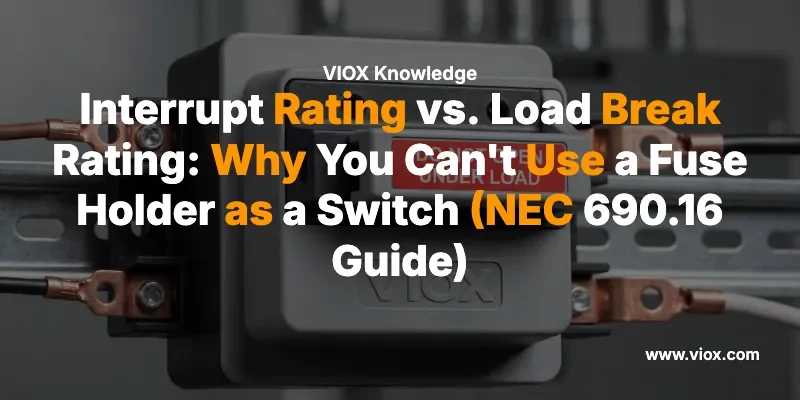
In the high-stakes world of industrial electrical safety, a dangerous misconception persists among technicians and system designers. It often surfaces during field maintenance on photovoltaic (PV) systems: an electrician needs to service an inverter or check a string. Seeing a fuse holder rated for a massive 10,000 Amps of Interrupting Capacity (AIC), they assume it is safe to manually pull open the holder to cut a mere 10 Amps of load current.
The logic seems sound on the surface: “If this device can handle a catastrophic 10,000A short circuit, surely it can handle a tiny 10A operational load.”
This logic is not just flawed; it is potentially fatal. This specific scenario, frequently debated in professional circles like the Mike Holt electrical forum, highlights a fundamental confusion between two critical engineering ratings: Interrupt Rating and Load Break Rating. While the fuse link inside is a marvel of physics capable of quenching a massive fault, the fuse holder itself is often nothing more than a mechanical clamp.
For B2B buyers and engineers specifying components for solar combiners and DC distribution systems, understanding this distinction is not just about NEC compliance—it is about preventing arc flash incidents that can destroy equipment and injure personnel. This comprehensive guide will dissect the technical differences, explore the physics of DC arcing, and outline how VIOX Electric solutions ensure compliance with NEC 690.16.
Interrupt Rating (AIC) vs. Load Break Rating: The Terminology Gap
To select the correct fuse holder for your application, you must first distinguish between the capabilities of the consumable fuse link and the mechanical holder that secures it. These are two separate devices with two separate functions, often conflated because they are sold as a unit.
1. Interrupt Rating (AIC / AIR)
- The Subject: The Fuse Link (The consumable cartridge).
- The Definition: Ampere Interrupting Capacity (AIC) is the maximum fault current the fuse can safely clear without rupturing, exploding, or allowing the arc to bypass the casing.
- The Mechanism: This is a passive, chemical-physical reaction. Inside a high-quality DC fuse, a silver element is surrounded by silica sand. When a massive short circuit occurs (e.g., 20kA), the element vaporizes instantly. The sand melts into glass (fulgurite), absorbing the energy and quenching the arc within the sealed ceramic tube.
- The Limitation: This is a one-time event. The fuse gives its life to save the circuit. It does not require moving parts or manual operation.
2. Load Break Rating (Switching Capacity)
- The Subject: The Fuse Holder or Disconnect Switch (The manual mechanism).
- The Definition: This is the ability of the device to safely extinguish an electric arc while the contacts are being mechanically separated by a human operator under normal load conditions.
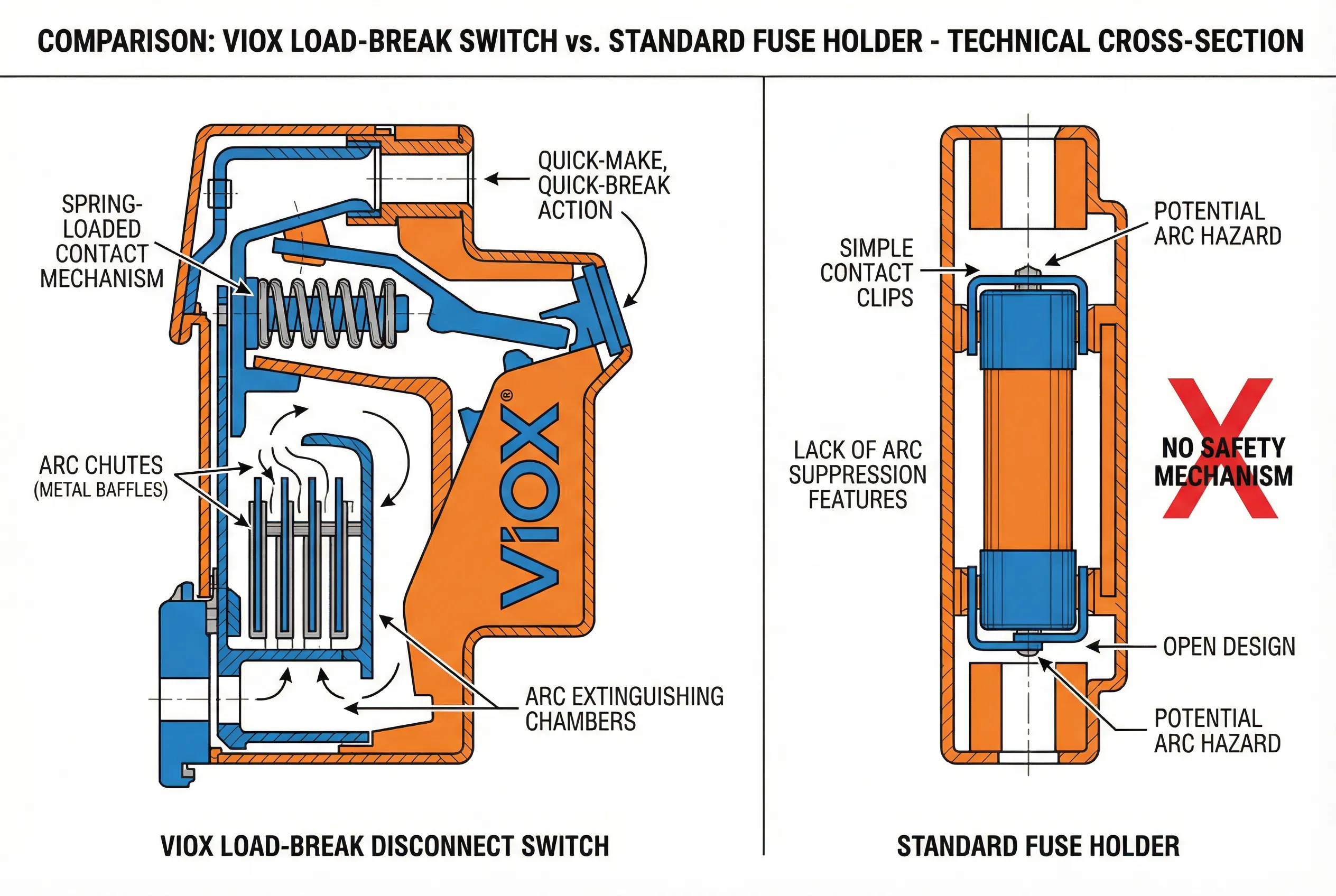
- The Mechanism: This requires active engineering features such as spring-loaded snap action (to separate contacts faster than the speed of the operator’s hand) and arc chutes (metal plates that split and cool the arc).
- The Reality: A standard touch-safe fuse holder usually has zero load break rating. It is designed solely to hold the fuse in place.
The Component vs. Control Distinction
The root of the danger lies in treating a “component” (the holder) as a “control” (a switch). A fuse holder is designed to maintain contact pressure to minimize resistance and heat. It is not designed to manage the plasma arc that forms when those contacts are separated while current is flowing.
Comparison: Interrupting Capacity vs. Load Break Capability
| Feature | Interrupt Rating (AIC) | Load Break Rating |
|---|---|---|
| Primary Component | The Fuse Link (Internal Element) | The Switch/Holder Mechanism |
| Function | Protects against short circuits/faults | Manually isolates or switches loads |
| Typical DC Values | 10kA, 20kA, up to 50kA | 0A (for standard holders) to Rated Current |
| Operation Type | Automatic (Thermal/Magnetic) | Manual (Handle/Lever) |
| Arc Suppression | Silica sand encapsulation | Arc chutes, spring mechanisms, air gaps |
| Design Intent | Catastrophic failure protection | Maintenance isolation & functional switching |
The Physics of Danger: Why DC Arcs are “Sticky”
Why can you unplug a vacuum cleaner (AC) while it’s running without an explosion, but pulling a DC fuse holder under load creates a fireball? The answer lies in the fundamental difference between Alternating Current (AC) and Direct Current (DC).
The AC Zero-Crossing Safety Net
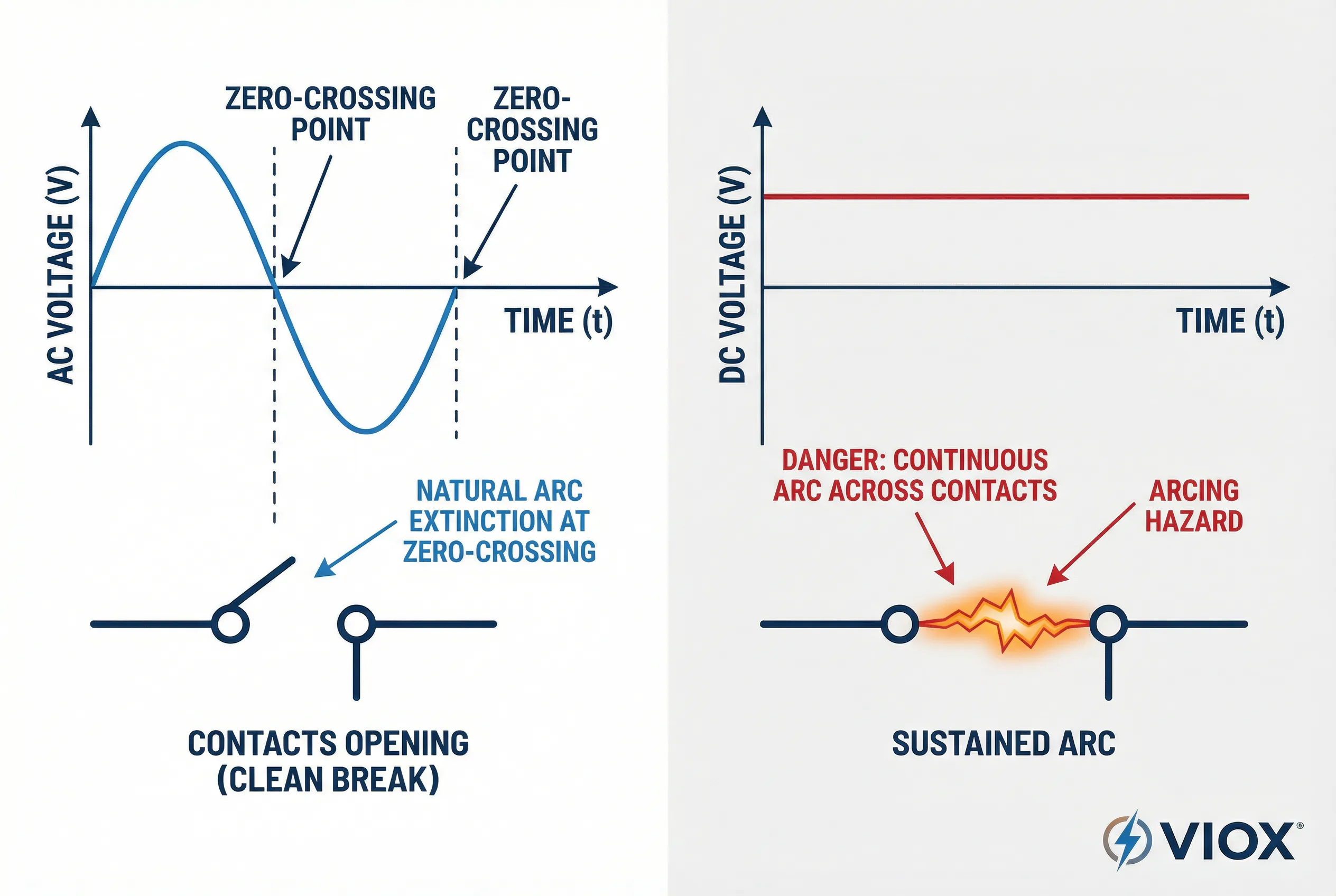
In an AC system (60Hz), the voltage naturally drops to zero 120 times every second. This phenomenon is known as the “zero-crossing.” If you open a switch and an arc forms, the arc is naturally extinguished milliseconds later when the voltage hits zero. The air cools down, the ionization stops, and the circuit breaks cleanly.
The DC “Continuous Fire”
Photovoltaic systems operate on high-voltage DC (often 600V, 1000V, or 1500V). DC voltage never crosses zero; it pushes current continuously and relentlessly.
When a technician pulls open a non-load-break fuse holder:
- Ionization: As the metal contacts separate, the electricity forces its way through the air gap, ionizing the nitrogen and oxygen molecules into plasma.
- Sustainment: Because there is no zero-crossing to give the air a “breather,” the arc sustains itself. It becomes a conductive bridge of superheated plasma (up to 19,000°C / 35,000°F).
- The “Taffy” Effect: DC arcs behave like sticky taffy. You can pull the contacts inches apart, and the arc will stretch and hold, melting the plastic housing of the fuse holder and potentially engulfing the operator’s hand.
NEC 690.16: The Code That Saves Lives
The National Electrical Code (NEC) recognized this hazard early in the adoption of high-voltage solar arrays. NEC Article 690.16 specifically addresses “Fuse Servicing” to prevent technicians from using fuse holders as impromptu switches.
NEC 690.16(B) Requirements: “Isolate, Then Open”
The code mandates that fuses in PV source circuits (over 30V) must be able to be disconnected from all sources of supply. However, the crucial nuance lies in how that disconnection happens.
If a fuse holder is not rated for load-break operation (which most are not), the NEC requires one of the following safety measures:
- Upstream Isolation (The Standard Solution): A separate, Load-Break Rated Disconnect Switch must be installed to isolate the fuse holder. The procedure becomes:
- Step 1: Open the Load-Break Switch (killing the current).
- Step 2: Open the Fuse Holder (safe isolation).
- Interlocked Design: The equipment uses a fuse holder mechanically interlocked with a switch, such that the fuse cannot be accessed unless the switch is in the “OFF” position.
- Tool Required: The fuse holder requires a tool to open. This prevents “impulse” operation by hand, forcing the technician to pause and hopefully follow proper lockout/tagout (LOTO) procedures.
The Evolution of “Touch-Safe”
Modern “finger-safe” or “touch-safe” fuse holders (often DIN-rail mounted) are popular because they protect operators from accidental contact with live parts when the fuse is closed. However, their pull-out design mimics a switch handle, inviting misuse. NEC 690.16 warns explicitly against being fooled by this form factor. Just because it looks like a switch does not mean it arcs like a switch.
Compliance Matrix for NEC 690.16(B)
| Equipment Type | Load Break Rated? | Required Warning Label | NEC 690.16 Compliant usage |
|---|---|---|---|
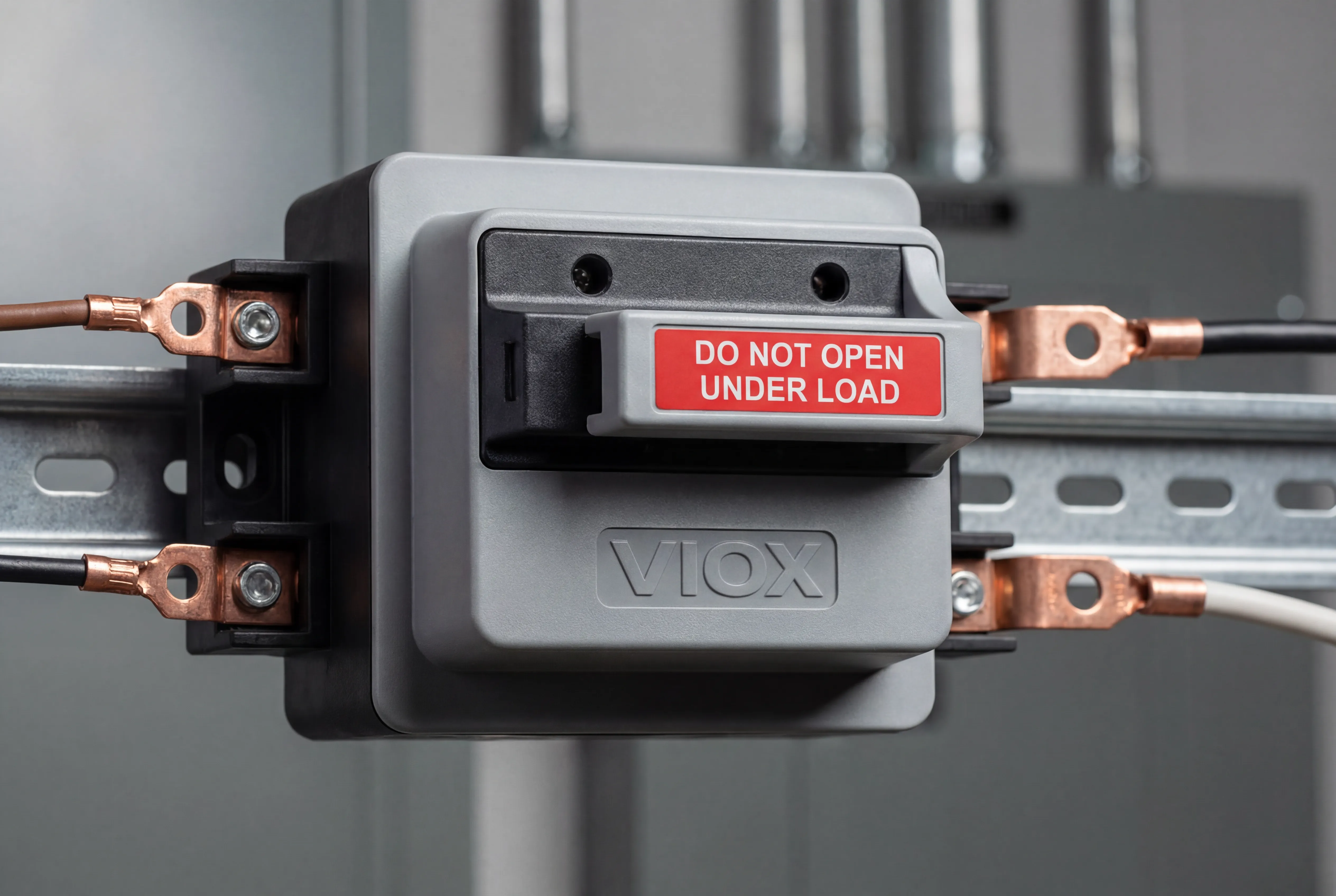
| Standard Fuse Clip | No | “DANGER – DO NOT OPEN UNDER LOAD” | Must have separate upstream disconnect |
| Touch-Safe Fuse Holder | Generally No | “DO NOT OPEN UNDER LOAD” | Must have separate disconnect or require tool |
| Fused Disconnect Switch | Yes | N/A (Switch acts as disconnect) | Fully compliant as standalone isolation |
| Circuit Breaker | Yes | N/A | Compliant (Functions as both protection & switch) |
VIOX Selection Guide: Choosing the Right Component
At VIOX Electric, we engineer our components to ensure clear distinction between protection and isolation. When designing combiner boxes or inverter input circuits, selecting the right fuse holder versus switch is paramount.
When to Use a Standard Touch-Safe Fuse Holder
Use a standard VIOX PV Fuse Holder (e.g., VIOX VFX-1000 Series) when:
- You have a dedicated DC Isolator / Disconnect Switch elsewhere in the circuit (e.g., external to the combiner or integrated into the inverter).
- Space is at a premium, and you need high-density fusing (DIN rail mount).
- Cost optimization is critical, and isolation is handled at the string level via connectors or group switching.
Key VIOX Feature: Our holders utilize high-grade DMC (Dough Molding Compound) or Polyamide housings that resist tracking, but even the best materials cannot defy physics if opened under load. We prominently label our non-load-break holders to ensure operator awareness.
When to Use a Fused Disconnect Switch
Use a VIOX Fused Disconnect Switch when:
- You need to combine overcurrent protection and isolation in a single device.
- The device serves as the primary “Emergency Stop” or maintenance disconnect for that sub-circuit.
- You are designing for maximum safety and want to eliminate the risk of operator error.
Common Mistakes in DC System Design
Even experienced engineers can fall into traps when specifying DC protection. Avoid these three common errors:
1. The “AC Rating” Trap
Never use a fuse holder rated only for AC in a DC application. AC devices rely on that zero-crossing we discussed. An AC-rated holder used at 600V DC will likely catch fire on the first operation under load. Always verify the VDC rating on the spec sheet.
2. Ignoring the “Do Not Open Under Load” Label
Manufacturers do not add these labels for liability cover; they are operational instructions. Placing a standard fuse holder in a location where it is the only means of disconnection is a violation of NEC code and a severe safety hazard.
3. Oversizing the Holder, Undersizing the Wire
While the holder might be rated for 30A, using it with undersized wire can cause excessive heat at the terminals. As fuse holders rely on contact pressure, thermal cycling from poor wiring can loosen connections, creating a “hot spot” that mimics an arc fault, melting the holder even without manual operation.
Technical Comparison: Arc Characteristics
Understanding the enemy is the key to safety. Here is how AC and DC arcs differ in the context of switching equipment.
| Characteristic | AC Arc (Alternating Current) | DC Arc (Direct Current) |
|---|---|---|
| Current Flow | Bi-directional (cycles +/-) | Uni-directional (constant) |
| Extinguishment | Self-extinguishing at zero-crossing (every 8.3ms) | Requires active stretching/cooling to extinguish |
| Arc Stability | Unstable, easier to break | Highly stable, difficult to break |
| Device Wear | Moderate contact erosion | Severe contact erosion and heat generation |
| Safety Risk | High, but manageable with standard gaps | Extreme – risk of continuous burn and equipment melt-down |
Frequently Asked Questions (FAQ)
Q: Can I use a standard AC fuse holder for my 24V DC battery system?
A: While low voltage (12V-24V) DC is less likely to sustain a dangerous long arc compared to high voltage solar (600V+), you should always use equipment rated for DC. At high currents, even 24V can sustain an arc if the inductance is high. For solar applications (PV), strictly use DC-rated holders.
Q: What is the difference between a disconnect switch and a circuit breaker?
A: A circuit breaker automatically trips during a fault and can also be used as a switch. A disconnect switch is manually operated to isolate the circuit but usually offers no automatic protection unless it is a “Fused Disconnect,” which contains fuses for the protection element.
Q: Does VIOX offer fuse holders that are load-break rated?
A: VIOX manufactures specific Fused Disconnect Switches which are load-break rated. However, our standard modular DIN-rail fuse holders are defined as “Fuse Carriers” and are generally not load-break rated. Always check the datasheet and the label on the device.
Q: Why do I see electricians pulling fuses under load in videos?
A: This is a dangerous practice known as “hot swapping.” It may work 99 times out of 100 on low-current circuits, but on a high-voltage DC system, it is Russian roulette. It violates OSHA regulations and NFPA 70E safety standards.
Q: What is the “Finger Safe” rating?
A: “Finger Safe” (often IP20) means you cannot touch live parts with your finger while the device is closed or during the removal of the fuse carrier. It refers to shock protection, not arc flash protection. A device can be finger-safe but still explode if opened under load.
Q: Does NEC 690.16 apply to grounded and ungrounded systems?
A: Yes. The requirement to safely disconnect the fuse from all sources of supply applies regardless of the system grounding configuration. In ungrounded PV arrays, both the positive and negative legs are fused and must be disconnected simultaneously.
Conclusion: Respect the Rating, Protect the Operator
The distinction between Interrupt Rating and Load Break Rating is not just academic semantics; it is the boundary between a safe maintenance procedure and a catastrophic arc flash event. A fuse holder is a vital component of the protection ecosystem, designed to hold the fuse that clears the massive energy of a short circuit. It is not, however, designed to be the control switch that interrupts normal current flow in high-voltage DC systems.
When designing or maintaining photovoltaic systems, adherence to NEC 690.16 is non-negotiable. Always ensure that non-load-break fuse holders are paired with appropriate upstream isolation switches.
VIOX Electric stands at the forefront of DC electrical safety, manufacturing premium fuse holders, DC disconnects, and circuit protection devices rigorously tested for the demanding environment of renewable energy. Don’t leave safety to chance—specify VIOX for equipment that respects the physics of DC power.
Ensure your projects are compliant and your personnel are safe. Explore VIOX Electric’s full range of PV Fuse Holders and Load-Break Switches today.