

Sur cette page
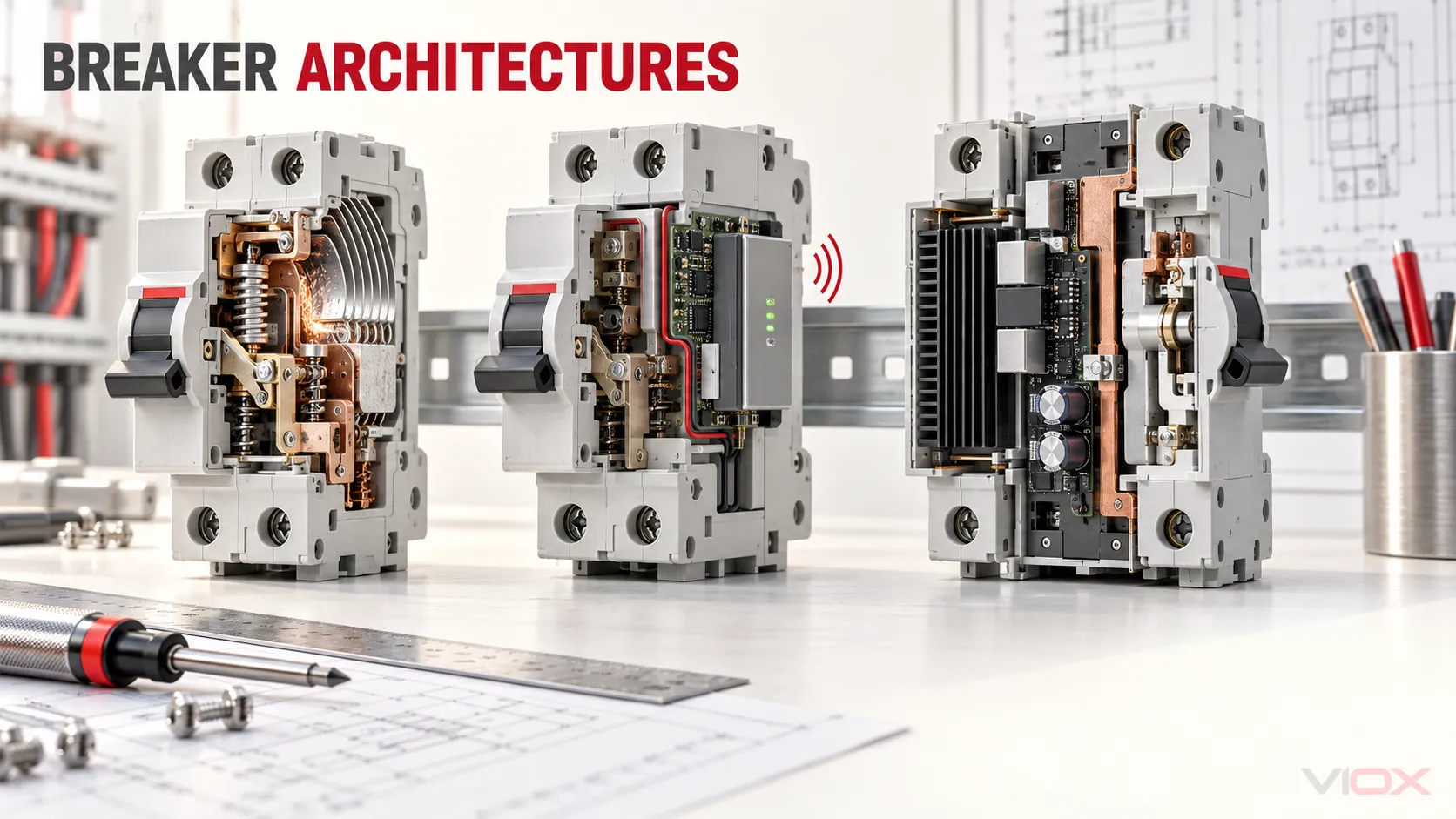
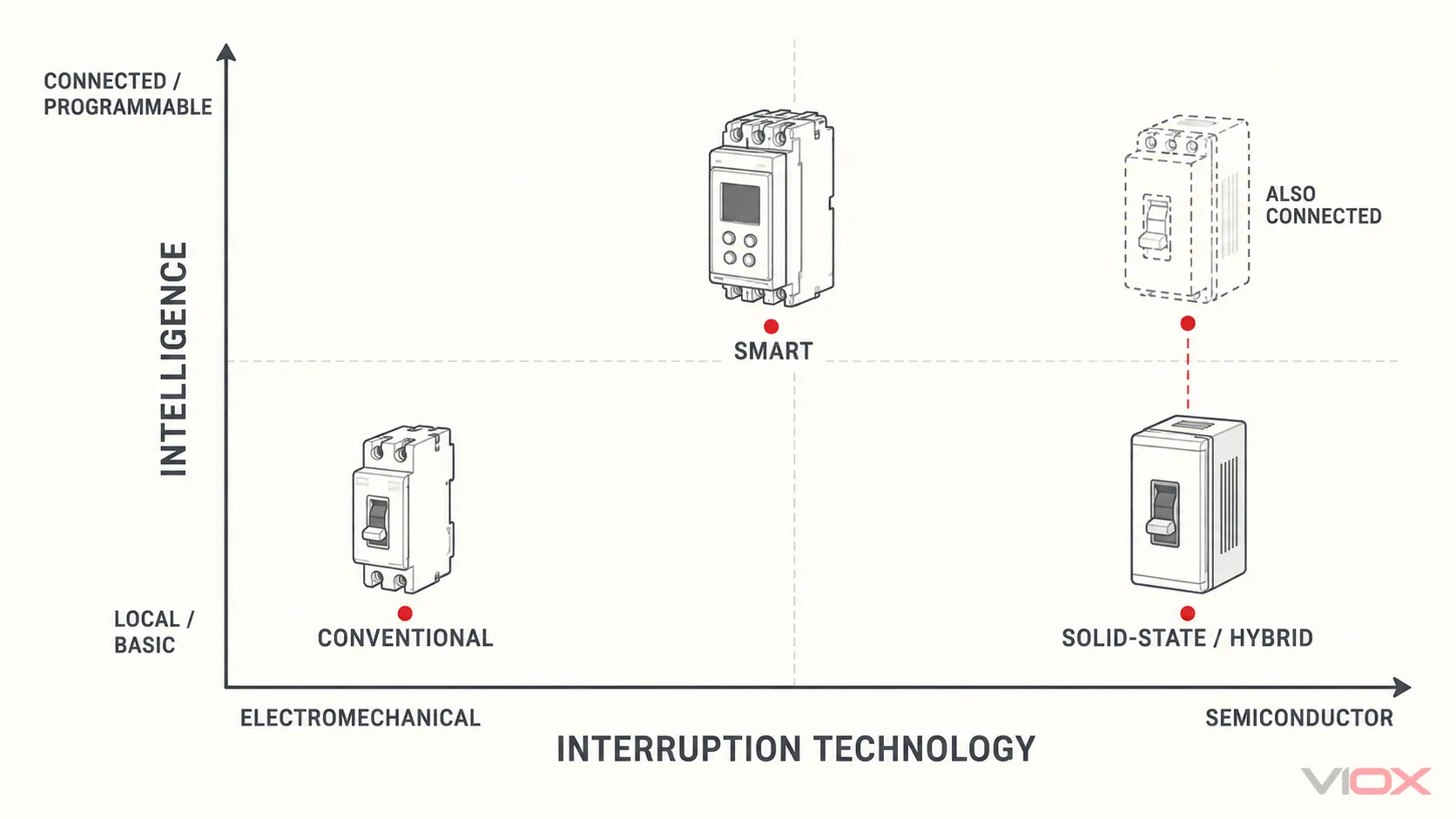
La différence entre un disjoncteur intelligent et un disjoncteur traditionnel n'est pas la même chose que la différence entre un disjoncteur électromécanique et un disjoncteur à semi-conducteurs. Ces étiquettes décrivent deux questions de conception différentes :
- Comment l'appareil interrompt-il le courant ? Un disjoncteur électromécanique ouvre des contacts physiques ; un disjoncteur à semi-conducteurs interrompt le courant via des composants électroniques de puissance ; une conception hybride combine des chemins à semi-conducteurs et mécaniques.
- Quelle intelligence ajoute-t-il ? La surveillance, les communications, le fonctionnement à distance, les journaux d'événements et le contrôle programmable peuvent être ajoutés à plus d'une architecture d'interruption.
Cette distinction modifie la décision d'achat. Un disjoncteur intelligent peut toujours utiliser des contacts mécaniques conventionnels, tandis qu'un disjoncteur à semi-conducteurs peut également être connecté et configurable par logiciel. Le choix correct dépend de la fonction de protection requise, du comportement d'élimination des défauts, de l'isolation, des pertes à l'état normal, de l'intégration au système, de la certification du produit et du support du cycle de vie, et non du fait que l'appareil dispose d'une application.
La classification à deux axes qui évite l'erreur la plus courante
Le terme disjoncteur traditionnel fait généralement référence à un dispositif électromécanique dont les contacts principaux se séparent physiquement pour interrompre le courant. La détection de défaut peut être magnétothermique ou électronique ; “ traditionnel ” ne signifie pas nécessairement que chaque fonction interne est purement mécanique.
Un disjoncteur intelligent ajoute des fonctions de détection, de communication, de données, de contrôle ou d'automatisation. Son chemin de courant principal peut rester électromécanique. Dans d'autres produits, un module connecté séparé surveille ou commute un circuit tandis qu'un disjoncteur conventionnel demeure le véritable dispositif de protection contre les surintensités.
Un disjoncteur statique (SSCB)—appelé disjoncteur à semi-conducteurs dans IEC 60947-10:2026—utilise des éléments de commutation à semi-conducteurs pour l'interruption du courant. La norme reconnaît également les disjoncteurs hybrides à semi-conducteurs, qui combinent des éléments de commutation à semi-conducteurs et mécaniques et incluent des contacts d'isolement mécaniques.
La classification pratique est donc la suivante :
| Architecture d'interruption principale | Aucune intelligence connectée | Intelligence connectée ou programmable |
|---|---|---|
| Contacts électromécaniques | Disjoncteur conventionnel à déclenchement magnétothermique ou électronique | Disjoncteur électromécanique intelligent/connecté |
| Commutation à semi-conducteurs avec isolation mécanique | Disjoncteur à semi-conducteurs de base | Disjoncteur statique intelligent |
| Chemins hybrides à semi-conducteurs et mécaniques | Disjoncteur hybride | Disjoncteur hybride intelligent |
“ Intelligent ” décrit les capacités. “ Statique ” décrit la technologie d'interruption principale. Un produit peut être les deux.
Traditionnel vs intelligent vs statique : comparaison technique
| Facteur de décision | Disjoncteur électromécanique conventionnel | Disjoncteur intelligent ou connecté | Disjoncteur à semi-conducteurs ou hybride |
|---|---|---|---|
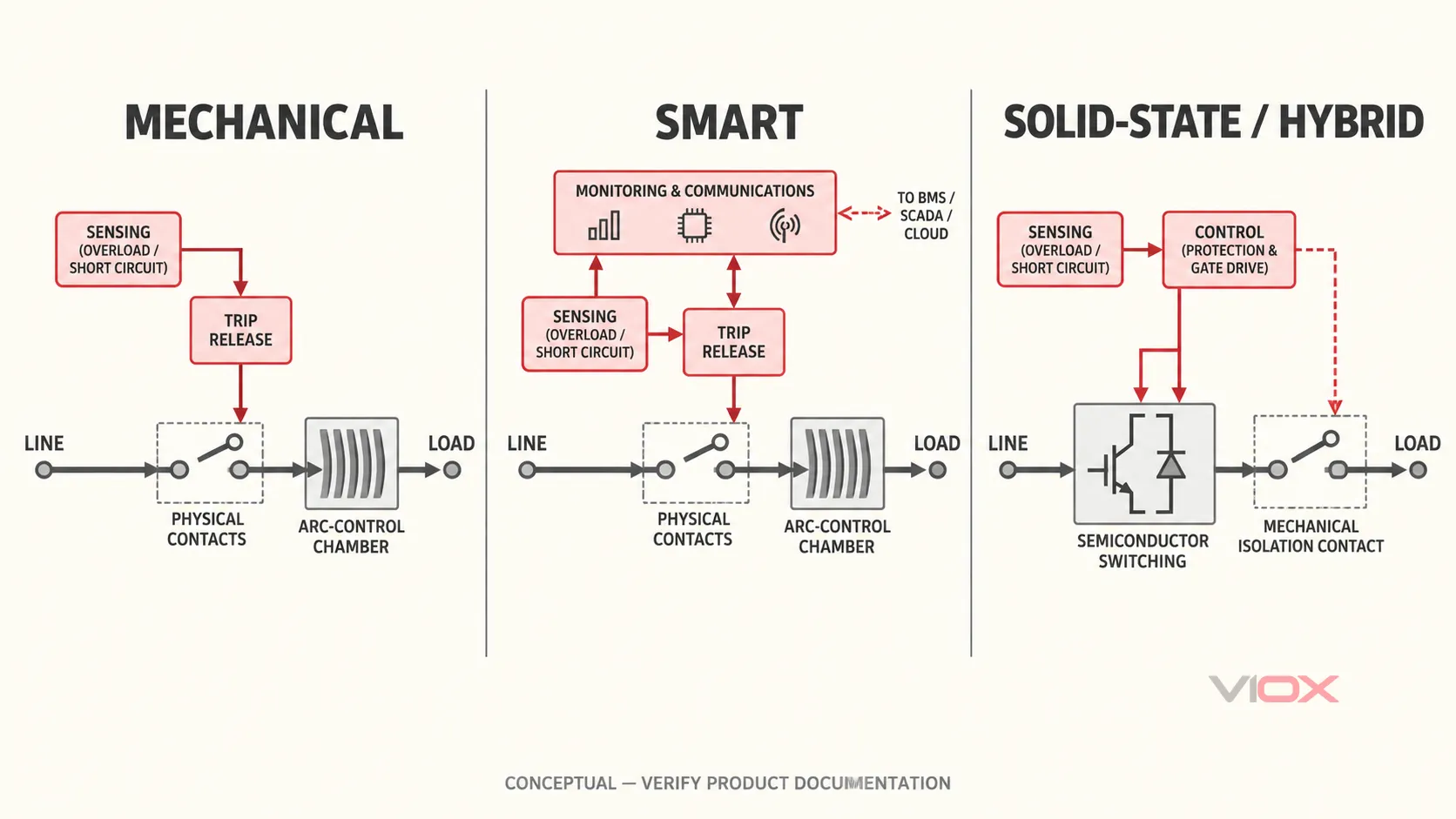
| Caractéristique principale | Coupure mécanique éprouvée et protection locale | Surveillance, communications ou commande à distance ajoutées à un système de protection ou de commutation | Coupure de défaut par semi-conducteurs ; les versions hybrides ajoutent des chemins de commutation mécaniques |
| Interruption de défaut | Les contacts physiques s'ouvrent et un système de contrôle d'arc interrompt le courant | Dépend de l'architecture du disjoncteur sous-jacent | La commutation par semi-conducteurs peut interrompre sans attendre le déplacement des contacts mécaniques |
| Fonction de protection | Défini par la conception du disjoncteur, le déclencheur, les caractéristiques assignées et la norme produit applicable | Doit être vérifié ; la connectivité seule ne prouve pas la protection contre les surintensités | Doit être vérifié par rapport à la norme semi-conducteur-disjoncteur pertinente et à la documentation du produit |
| Perte de puissance à l'état normal | Généralement faible aux bornes des contacts fermés | Similaire au disjoncteur sous-jacent, plus l'électronique auxiliaire | Les pertes par conduction des semi-conducteurs nécessitent une étude thermique ; les conceptions hybrides peuvent réduire les pertes en régime permanent |
| L'isolement | Un disjoncteur ne peut être adapté à l'isolation que si sa conception, son marquage et ses instructions l'indiquent | L'arrêt à distance ne constitue pas automatiquement un état d'isolement | Le blocage par semi-conducteur seul ne constitue pas une fonction d'isolement vérifiée ; les normes applicables peuvent exiger des contacts d'isolement mécaniques |
| Surveillance et données | Généralement limité à moins que des accessoires ou une unité de déclenchement électronique ne soient installés | Raison courante du choix de l'architecture | Peut être intégré avec une détection haute vitesse et une commande programmable |
| Fonctionnement à distance | Nécessite un opérateur de moteur, un déclencheur à émission de tension, un déclencheur à manque de tension ou un autre mécanisme approuvé approprié | Souvent disponible, mais les autorisations de fermeture, d'ouverture et de réenclenchement automatique doivent être vérifiées | Un contrôle électronique inhérent est possible, tandis que l'isolation de sécurité demeure une exigence distincte |
| Comportement en cas de défaillance des communications | La protection locale demeure indépendante d'un réseau | Doit être vérifié : le fonctionnement de la protection, le contrôle local et l'état de sécurité ne doivent pas être présumés à partir du langage marketing | La perte de puissance de commande et les défauts électroniques internes font partie de l'évaluation de la sécurité du produit |
| Rénovation et intégration dans le tableau | Mature, mais le disjoncteur exact doit être compatible avec l'assemblage | L'écosystème, la passerelle, le tableau et la compatibilité du micrologiciel peuvent limiter les options de rénovation | Il s'agit généralement d'une décision d'ingénierie système plutôt que d'un remplacement direct. |
| Facteur de décision typique | Protection de circuit mature et rentable | Visibilité, commande à distance, données énergétiques ou gestion de charge | Coupure très rapide, protection contrôlable et systèmes exigeants en DC ou en électronique de puissance |
Ce tableau est un guide d'architecture et ne remplace pas la fiche technique d'un modèle. La tension assignée, le courant assigné, le pouvoir de coupure, les caractéristiques de déclenchement, les limites environnementales, la fonction d'isolement, la compatibilité avec le tableau et les certifications restent spécifiques à chaque produit.
Quand un disjoncteur électromécanique conventionnel est justifié
Un disjoncteur conventionnel demeure le choix par défaut lorsque l'exigence principale est une protection fiable contre les surintensités avec de faibles pertes en état normal et sans besoin de visibilité à distance.
C'est généralement la solution la plus adaptée lorsque :
- les exigences de protection sont déjà satisfaites par une MCB ou MCCB architecture établie ;
- une commande manuelle locale est acceptable ;
- le tableau n'a pas besoin de données énergétiques au niveau du circuit ;
- une maintenance simple et une disponibilité de remplacement à long terme importent plus que les fonctionnalités connectées ;
- l'application nécessite une voie de produit standard mature et largement comprise.
Cela ne signifie pas que les disjoncteurs conventionnels sont techniquement simples. Les MCCB à déclenchement électronique peuvent fournir une protection réglable, des informations sur les événements et des communications tout en utilisant des contacts mécaniques pour l'interruption. La distinction la plus utile est l'interruption mécanique par rapport à l'interruption à semi-conducteurs, et non “ ancien ” par opposition à “ numérique ”.”
Pour une vue d'ensemble des familles de dispositifs de protection, consultez le guide VIOX sur les types de disjoncteurs.
Quand un disjoncteur intelligent mérite d'être envisagé
Un disjoncteur intelligent mérite d'être envisagé lorsque ses données ou sa fonction de commande résolvent un problème opérationnel défini. Les exemples incluent l'identification des circuits fortement chargés, le signalement des événements de déclenchement, la programmation des charges non critiques, la coordination de la production et du stockage sur site, ou l'autorisation pour un système de supervision approuvé d'ouvrir certains circuits sélectionnés.
Avant de considérer un appareil connecté sur rail DIN comme un disjoncteur, vérifiez quatre fonctions distinctes :
- Protection : L'appareil exact fournit-il la protection automatique contre les surintensités requise, ou s'agit-il uniquement d'un interrupteur, d'un relais, d'un compteur ou d'un contrôleur connecté ?
- Coupure : Quel mécanisme élimine un défaut, et quels sont les pouvoirs de coupure indiqués ?
- Commande : Quelles fonctions restent disponibles localement si une passerelle, un réseau ou un service cloud est indisponible ?
- Compatibilité : L'appareil est-il approuvé pour le tableau, l'assemblage, les conducteurs, la tension et l'installation prévue ?
Le terme “ intelligent ” ne garantit aucun de ces points. Une interface de smartphone peut commander un appareil sans pour autant en faire un dispositif de protection de circuit de dérivation acceptable. De même, la surveillance de l'énergie ne prouve pas la capacité d'interruption de court-circuit.
Le fonctionnement à distance nécessite également une formulation prudente. L'ouverture d'un circuit à distance peut être utile pour la gestion de la charge, mais elle ne crée pas automatiquement une condition d'isolement sûre pour la maintenance. Le marquage de l'appareil, la norme produit, les instructions et la procédure d'installation déterminent s'il est adapté à l'isolement.
Quand un disjoncteur statique ou hybride est justifié
Les disjoncteurs à semi-conducteurs sont particulièrement pertinents lorsque le comportement du système pendant les premiers instants d'un défaut importe plus que la perte de conduction minimale ou le coût initial le plus bas. Leur chemin de commutation électronique peut prendre en charge une réponse rapide aux défauts, un comportement programmable et une intégration avec une détection à haute vitesse.
Leurs compromis sont tout aussi importants :
- les dispositifs à semi-conducteurs dissipent de la puissance lorsqu'ils transportent le courant de charge ;
- le dissipateur thermique et la conception thermique de l'enveloppe deviennent partie intégrante du système de protection ;
- la surtension produite lors de l'interruption d'un courant inductif doit être gérée ;
- l'alimentation de commande auxiliaire, le comportement du logiciel et les défaillances des composants internes nécessitent une vérification ;
- un état OFF ou de veille d'un semi-conducteur n'est pas automatiquement équivalent à un isolement mécanique ;
- la certification et la maturité de l'application peuvent différer des produits MCB et MCCB établis.
IEC 60947-10:2026 now provides an international standard scope for semiconductor circuit-breakers and semiconductor hybrid circuit-breakers up to 1,000 V AC or 1,500 V DC for operation by instructed or skilled persons. In North American contexts, UL Solutions describes UL 489I comme une voie d'évaluation utilisée parallèlement à UL 489 pour les disjoncteurs à boîtier moulé à semi-conducteurs et hybrides.
Pour une explication plus approfondie de la commutation à semi-conducteurs, de l'énergie de défaut et de la conception thermique, utilisez le guide VIOX séparé pour disjoncteurs statiques. Cette page de comparaison s'arrête intentionnellement à la limite de sélection.
Quelle architecture correspond à l'application ?
| Besoin applicatif | Architecture de départ raisonnable | Ce qui doit être vérifié avant la sélection |
|---|---|---|
| Distribution finale ordinaire sans surveillance à distance | MCB conventionnel ou autre disjoncteur électromécanique approprié | Calibre du circuit, protection des câbles, pouvoir de coupure, courbe de déclenchement, configuration des pôles et règles d'installation applicables |
| Alimentation industrielle nécessitant une protection réglable et des communications | MCCB électromécanique à déclencheur électronique avec accessoires ou communications pris en charge | Fonctions de l'unité de déclenchement, architecture de communication, alimentation auxiliaire, sélectivité et compatibilité d'assemblage |
| Surveillance énergétique au niveau du circuit et délestage contrôlé | Disjoncteur intelligent ou combinaison approuvée de disjoncteur, d'appareils de mesure et de commutation | Quel composant assure la protection, le comportement de repli local, la fonction de commutation, l'homologation du tableau et le cycle de vie de la cybersécurité |
| Ouverture à distance de charges sélectionnées | Disjoncteur intelligent ou disjoncteur avec un accessoire de commande à distance approuvé | Si la fermeture à distance est autorisée, le comportement de l'alimentation de commande, les verrouillages et si la position OFF assure l'isolation |
| Protection rapide de l'électronique de puissance DC sensible | Un disjoncteur à semi-conducteurs ou hybride peut justifier une évaluation | Tension DC, montée du courant de défaut, pouvoir de coupure, absorption d'énergie, conception thermique, isolation et certification |
| Protection économique et peu complexe | Disjoncteur électromécanique conventionnel | Calibre correct et compatibilité vérifiée ; ne pas ajouter de connectivité sans avantage opérationnel défini |
Il n'existe pas de solution universelle. Les disjoncteurs conventionnels optimisent la maturité, les faibles pertes et la protection directe. Les disjoncteurs intelligents sont justifiés lorsque les informations ou le contrôle apportent un avantage opérationnel mesurable. Les disjoncteurs à semi-conducteurs et hybrides sont justifiés lorsque leur comportement de coupure résout un problème de protection contre les défauts qu'une architecture conventionnelle ne peut pas traiter aussi efficacement.
Normes et limites de certification
La norme correcte ne peut pas être sélectionnée sur la seule base du terme “ intelligent ”.
| Norme ou voie | Périmètre pertinent |
|---|---|
| CEI 60898-1:2015+A1:2019 | Disjoncteurs à coupure dans l'air en AC pour installations domestiques et analogues dans les limites de tension, de courant et de pouvoir de coupure de la norme |
| IEC 60947-2:2024 | Disjoncteurs basse tension destinés à être utilisés par des personnes averties ou qualifiées, dans les limites de leur plage de tension AC et DC déclarée |
| IEC 60947-10:2026 | Disjoncteurs à semi-conducteurs et disjoncteurs hybrides à semi-conducteurs, incluant les exigences d'isolement et de conditions anormales |
| UL 489 | Disjoncteurs à boîtier moulé, interrupteurs et enveloppes nord-américains dans la catégorie de produit applicable |
| UL 489I | Disjoncteurs à boîtier moulé à semi-conducteurs et hybrides à semi-conducteurs évalués selon la voie UL décrite par UL Solutions |
Une approbation radio sans fil, une certification d'application ou une marque de conformité générique ne prouve pas en soi que l'appareil est acceptable en tant que disjoncteur requis. Demandez le certificat ou le référencement du modèle exact, la norme de produit applicable, les caractéristiques nominales marquées, les instructions d'installation et la compatibilité d'assemblage.
Les Guide de marquage des disjoncteurs UL distingue également une commande par semi-conducteur VEILLE de la position OFF état requis avant toute intervention sur le côté charge. C'est un rappel utile que la commande logicielle et l'isolation électrique sont des fonctions de sécurité différentes.
Pour une comparaison détaillée des deux principaux contextes de disjoncteurs IEC, voir CEI 60898-1 vs CEI 60947-2. Pour la terminologie nord-américaine et les limites des normes de produits, utilisez le guide VIOX sur les normes de disjoncteurs UL, NEC, NEMA et ANSI.
Liste de contrôle d'approvisionnement : Vérifiez l'appareil, pas l'étiquette
Avant d'approuver tout disjoncteur traditionnel, intelligent, statique ou hybride, obtenez des preuves concernant :
- les fonctions de protection exactes fournies par l'appareil ;
- l'architecture d'interruption et la méthode d'isolement ;
- la tension assignée, le courant assigné et l'application AC/DC ;
- le pouvoir de coupure ou d'interruption selon la norme applicable ;
- la caractéristique de déclenchement ou les réglages de protection programmables ;
- les exigences relatives aux conducteurs, aux bornes et à l'enveloppe ;
- la compatibilité avec le tableau de distribution ou l'ensemble d'appareillage ;
- le comportement après une perte d'alimentation auxiliaire ou de communications ;
- autorisations de commande locale, d'ouverture à distance, de fermeture à distance et de réenclenchement automatique ;
- mise à jour du micrologiciel, contrôle d'accès et politique de support pour les produits connectés ;
- certification, homologation ou documentation d'essai spécifique au modèle ;
- exigences en matière de pertes thermiques et de refroidissement pour les conceptions à semi-conducteurs.
Choisissez un disjoncteur conventionnel lorsque la protection est la seule tâche requise. Choisissez une architecture intelligente lorsqu'une surveillance ou un contrôle vérifié justifie la dépendance accrue du système. Évaluez un disjoncteur à semi-conducteurs ou hybride lorsque l'interruption électronique plus rapide et la programmabilité justifient le travail de thermique, d'intégration et de certification. Dans tous les cas, la fonction de protection vérifiée du modèle importe plus que l'étiquette imprimée sur la page produit.