In electrical engineering and power distribution, ρεύματος διαρροής, υπολειπόμενου ρεύματος, και ground current are closely related, but they are not the same thing. Mixing them up can lead to poor device selection, misleading troubleshooting notes, nuisance tripping, and confusion when moving between IEC and NEC terminology.
Άμεση απάντηση
Ρεύμα διαρροής is the broad phenomenon: current is escaping the intended load path through insulation, capacitance, filters, contamination, or another unintended route.
Υπολειπόμενο ρεύμα is the measured imbalance between the currents in the live conductors of a circuit. In IEC-style terminology, this is the quantity detected by an ΚΚΔ, RCCB, ή RCBO.
Ground current is current actually flowing through a ground or earth path. In North American practice, this often sits close to ground-fault language and shows up in GFCI and ground-fault protection discussions.
One event can create all three at once. A wet insulation fault, for example, can produce leakage current, send current to ground, and create a residual-current imbalance large enough to trip a protective device.
Βασικά συμπεράσματα
- Ρεύμα διαρροής is the broadest term and does not automatically mean a severe fault.
- Υπολειπόμενο ρεύμα is a detection quantity, not a diagnosis.
- Ground current is path-focused: it tells you current is flowing through earth, PE, or another grounding route.
- Modern electronics, drives, inverters, EMI filters, and long cable runs can create measurable leakage current even in otherwise healthy systems.
- IEC markets usually speak in RCD/RCCB/RCBO language, while NEC and UL discussions more often use GFCI και ground-fault terminology.
Γρήγορος Συγκριτικός Πίνακας
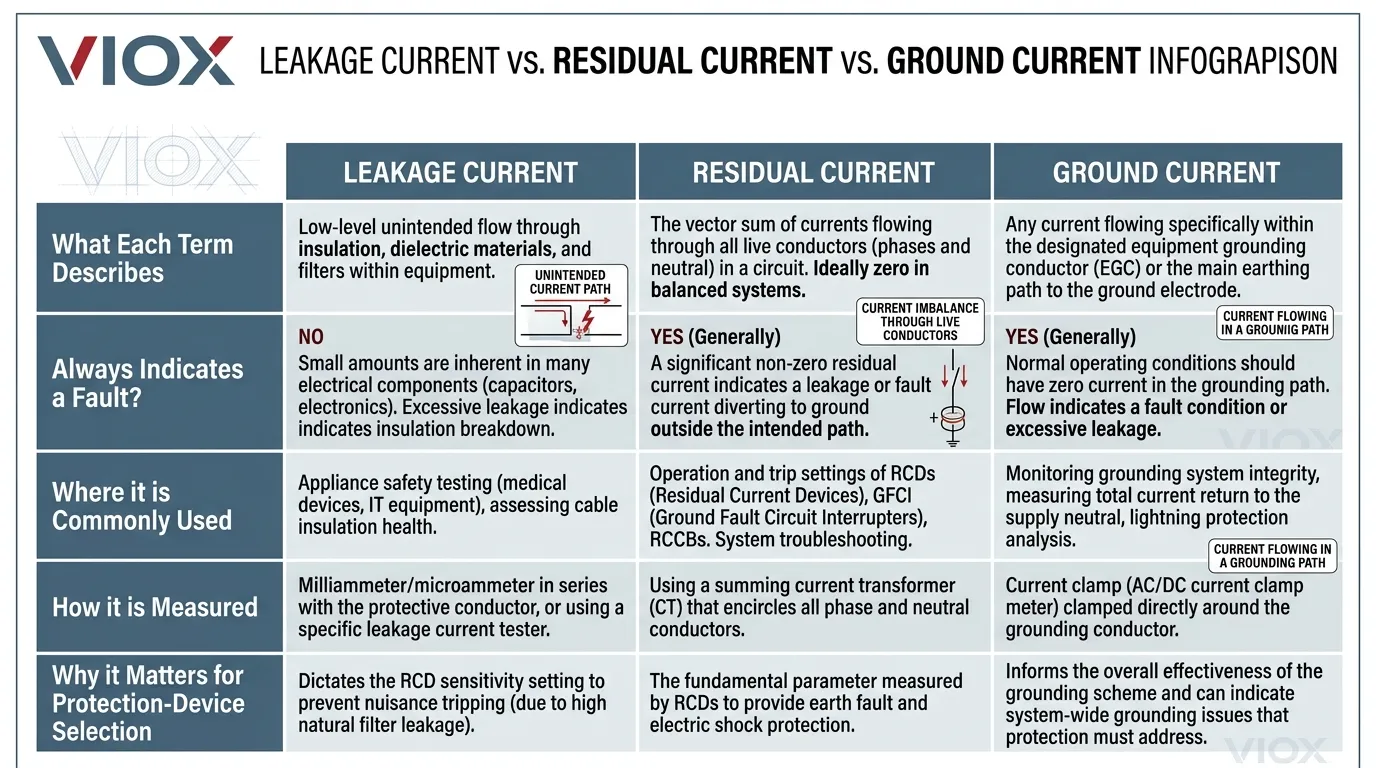
| Όρος | What it describes | Does it always mean a fault? | Most common context | Γιατί έχει σημασία |
|---|---|---|---|---|
| Ρεύμα διαρροής | Unintended current flow outside the ideal circuit path | Όχι | Equipment specs, insulation discussions, EMC, power electronics | Helps distinguish normal leakage from abnormal deterioration |
| Υπολειπόμενο ρεύμα | Imbalance between outgoing and returning current in live conductors | Όχι | RCD, RCCB, RCBO, IEC protection discussions | This is the quantity residual-current devices monitor |
| Ground current | Current flowing through a ground or earth path | Often abnormal, but not always | GFCI, ground-fault protection, NEC or UL language | Helps describe current actually using the grounding system as part of its return path |
Why These Terms Are So Often Confused
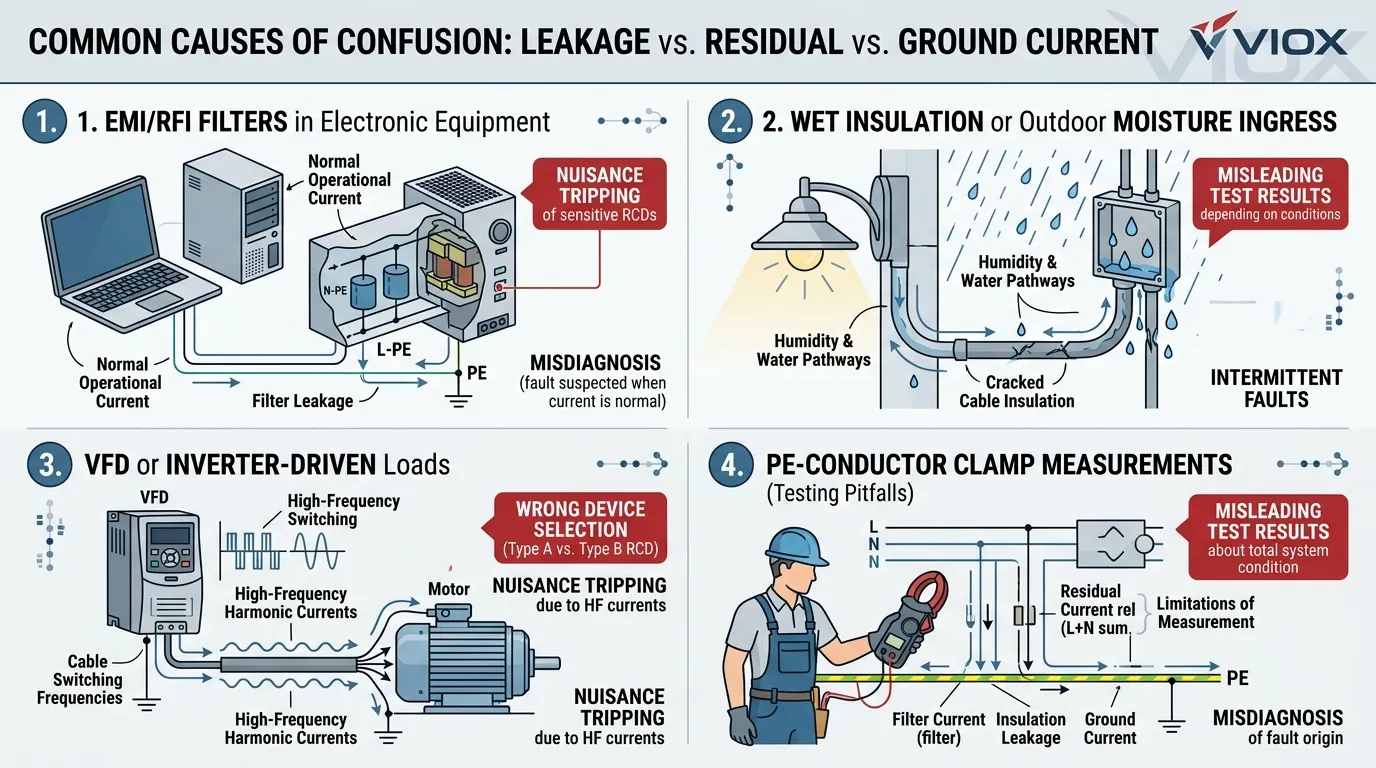
The confusion comes from the fact that the same event can be described in three different ways:
- by the phenomenon: current is leaking
- by the measurement: the circuit currents no longer balance
- by the μονοπάτι: some current is now flowing to ground
That is why one technician may call it leakage current, a datasheet may call it residual current, and a North American maintenance report may describe the same event as a ground-fault or current-to-ground problem.
The easiest rule is:
- χρησιμοποιήστε ρεύματος διαρροής for the general unwanted current flow
- χρησιμοποιήστε υπολειπόμενου ρεύματος for the imbalance measured by residual-current protection devices
- χρησιμοποιήστε ground current when you specifically mean current flowing through ground or earth
What Is Leakage Current?
Leakage current refers to the current that flows from energized conductors to ground, earth, equipment frames, or other conductive parts through or across insulation, capacitance, filters, contamination, or parasitic paths.
It is important not to treat leakage current as a synonym for catastrophic failure. Some amount of leakage current is inherent in real electrical systems.
The physics behind leakage current
No insulation system is ideal. A simplified insulation path between a live conductor and a grounded conductive part can be modeled as a high resistance in parallel with a small capacitance:
$$ I_{leak} = V \cdot \left(\frac{1}{R_{ins}} + j\omega C_{ins}\right) $$
This expression is useful because it explains why leakage current often has both:
- a resistive component, associated with insulation quality, contamination, and moisture
- a capacitive component, associated with conductor geometry, cable length, filters, and frequency
That capacitive component is one reason modern power electronics complicate protection design. Variable frequency drives, switch-mode power supplies, PV inverters, UPS systems, and EMC filters can all increase leakage current under normal operation.
Leakage current is not always a hard fault
This is the first big practical mistake.
A circuit can have measurable leakage current and still be functioning normally. The engineering question is not simply “Is there leakage current?” but:
- how much leakage current is present
- what creates it
- whether it is expected for that equipment class
- whether the protection architecture was selected with that background leakage in mind
If you are already at the device-selection stage, Πλήρης μορφή RCCB: Circuit Breakers: Κατανόηση των διακοπτών υπολειπόμενου ρεύματος is the most useful supporting article.
What Is Residual Current?
Residual current is the vectorial sum of the currents flowing in the live conductors of a circuit.
In a healthy single-phase circuit:
$$ I_{\Delta} = I_L – I_N $$
If 10 A leaves on line and 10 A returns on neutral, the residual current is zero. If 10.003 A leaves and only 10.000 A returns, the residual current is 3 mA. That missing current is going somewhere else.
In a three-phase system, the same idea applies, but the residual current is the vector sum of all live-conductor currents, including neutral where present.
Why the word “residual” matters
Residual current is not a diagnosis. It does not tell you whether the imbalance is caused by:
- normal capacitive leakage
- deteriorated insulation
- a conductive fault to earth
- a person touching an energized part
- a waveform issue associated with power electronics
It only tells you that the currents in the intended supply-and-return path do not fully cancel.
That is why residual-current protection devices are named the way they are:
- ΚΚΔ: Residual Current Device
- RCCB: Residual Current Circuit Breaker
- RCBO: Residual Current Breaker with Overcurrent Protection
These devices are built around residual-current measurement logic, not around a vague concept of “leakage.”
If the next question is how device families differ, RCBO Πλήρης μορφή στα ηλεκτρικά και RCBO έναντι RCCB συν MCB are the best next reads.
What Is Ground Current?
Ground current is current flowing through a ground or earth path.
Depending on the system and the market vocabulary, that path may include:
- protective earth conductors
- equipment grounding conductors
- bonding conductors
- grounding electrodes
- metallic structures connected to earth
Ground current in normal operation
Ground current is not limited to severe fault conditions.
In real installations, some current may flow through the grounding system during normal operation because of:
- capacitive leakage from cables and equipment
- EMI filter capacitors to earth
- distributed leakage from many electronic loads
- system topology and grounding arrangement
That is why a clamp around a PE conductor can show measurable current even when no obvious damage is present.
Ground current during a fault
When a live conductor makes unintended contact with a grounded conductive part, the magnitude of current in the ground path can rise sharply. In that case, the language often shifts from general “ground current” to the more specific ground-fault current.
This distinction matters because some articles blur:
- normal protective-conductor current
- cumulative earth leakage current
- high-magnitude ground-fault current
They are related, but not identical conditions.
For the IEC-to-NEC terminology bridge, RCD vs GFCI Breaker: IEC vs NEC Terminology and Protection Logic is the most relevant supporting page. For the broader protection context, Κατανόηση της προστασίας από σφάλματα γείωσης is the better follow-up.
How the Three Terms Relate
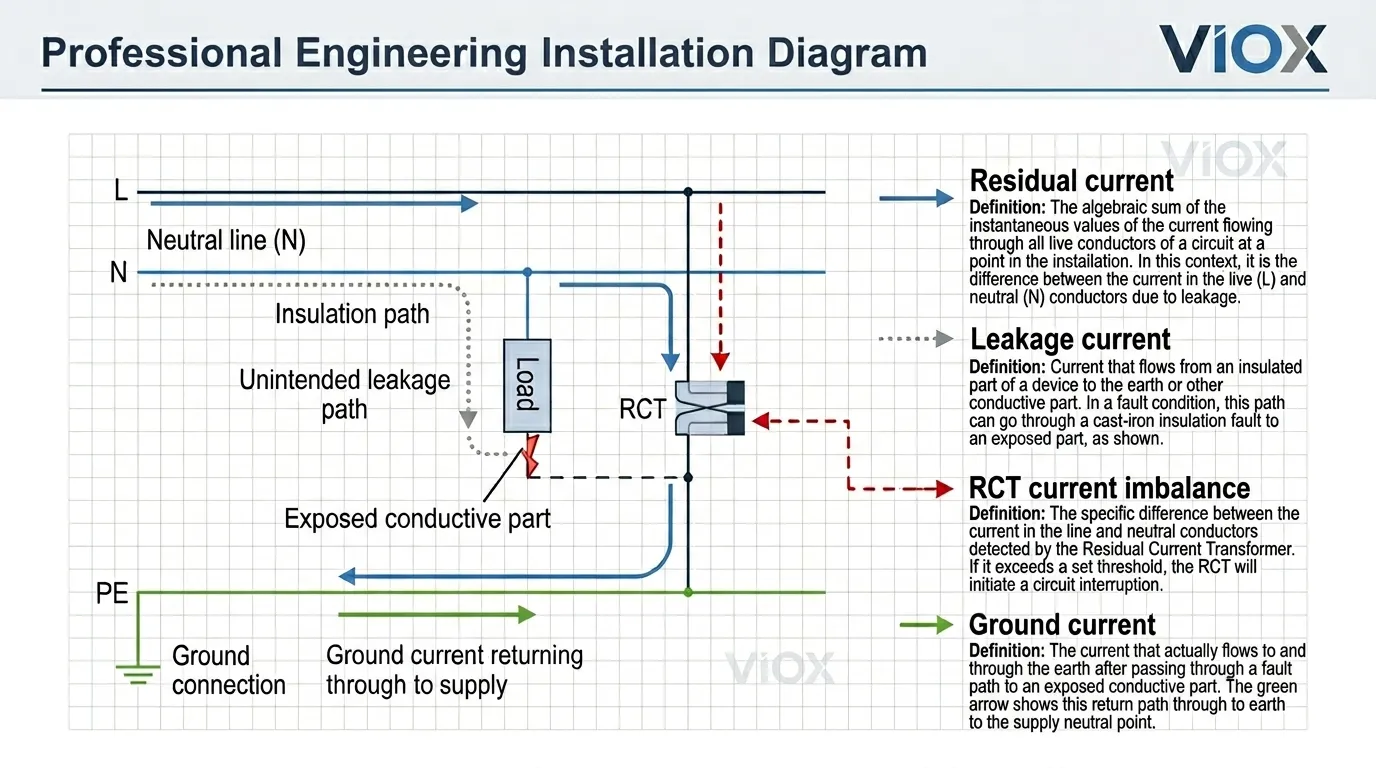
The relationship is easiest to understand through scenarios.
| Σενάριο | Leakage current? | Residual current? | Ground current? | Comment |
|---|---|---|---|---|
| Healthy electronic equipment with EMI filters | Yes, often small | Possibly | Συχνά ναι | Can be normal operating behavior |
| Wet appliance leaking to earth | Ναι | Ναι | Ναι | Classic shock-risk and nuisance-trip scenario |
| Insulation fault from line to metal enclosure | Ναι | Ναι | Ναι | Protection response depends on earthing and device coordination |
| Multiple drives or inverters on one feeder | Ναι | Yes, in aggregate | Συχνά ναι | Common reason for background residual current buildup |
The short version is:
Leakage current describes the phenomenon. Residual current describes the imbalance. Ground current describes the current in the ground path.
Why the Distinction Matters for Device Selection
This is where terminology becomes an engineering issue rather than a wording issue.
1. Residual-current devices are selected around imbalance detection
RCCBs and RCBOs do not directly “understand” why current is leaking. They detect imbalance.
That means selection has to consider:
- expected background leakage
- load waveform behavior
- whether overcurrent protection is needed in the same device
- whether the installation uses RCCB, RCBO, GFCI, monitoring, or another protection strategy
If the reader has moved from terminology into product evaluation, the VIOX RCCB landing page και RCBO landing page are the natural next steps.
2. IEC and NEC language can point to similar goals through different vocabulary
An IEC-oriented reader may search for:
- υπολειπόμενου ρεύματος
- ΚΚΔ
- RCCB
- RCBO
A North American reader may search for:
- σφάλμα γείωσης
- current to ground
- GFCI
- ground-fault protection
The safety objective can be similar, but the terminology and product categories are not always one-to-one.
3. “Leakage current” alone is not enough to choose a device
This is one of the most common specification mistakes.
A designer sees “leakage current” in a datasheet or maintenance note and jumps directly to a protection decision without asking:
- Is this normal equipment leakage or a sign of deteriorated insulation?
- Is the current returning through earth?
- Is the circuit better served by residual-current protection, ground-fault protection, monitoring, or a different architecture?
- Is nuisance tripping coming from aggregate background leakage rather than a single hard fault?
The wording helps narrow the right protection family before detailed selection begins.
Μέθοδοι μέτρησης και δοκιμών

Measuring leakage current
Leakage current is commonly evaluated with:
- dedicated leakage current meters
- insulation-resistance testing
- clamp measurements on protective earth conductors
- standardized measurement networks in product testing, depending on equipment category
Insulation-resistance testing is useful, but it mainly tells you about the resistive side of insulation performance. It does not fully represent the operating-frequency capacitive leakage behavior of modern systems.
Measuring residual current
Residual current is measured with a differential current clamp or summation current transformer that encircles all live conductors together.
The instrument is looking for imbalance. It is not directly measuring the fault path itself.
This distinction is critical in troubleshooting. If residual current is high, the next step is to identify what is creating that imbalance rather than assuming a single insulation failure.
Measuring ground current
Ground current is measured by clamping the protective earth, grounding conductor, or another defined ground path.
That tells you current is actually flowing in the grounding system. It does not, by itself, tell you whether the cause is:
- normal capacitive leakage
- multiple loads contributing cumulative leakage
- deteriorated insulation
- a significant ground fault
Application Notes That Matter in the Field
Industrial plants with drives and power electronics
Large numbers of VFDs, long motor cables, UPS systems, and filters can create enough background leakage to complicate residual-current protection. In these installations, nuisance tripping is often caused by accumulated normal leakage plus waveform complexity rather than one obvious damaged load.
TT, TN, and IT systems
The system grounding arrangement affects how current returns during fault conditions and therefore how effective different protective methods will be. In TT systems, residual-current protection often plays a more central role because earth-fault current may be too limited for ordinary overcurrent devices to operate quickly enough. In IT systems, the first fault can be low-current and may be handled through insulation monitoring rather than immediate disconnection.
PV, EV, UPS, and modern electronic loads
Inverters, chargers, and electronic converters can create residual-current waveforms that are not well represented by simple AC-only assumptions. That is why device type, waveform compatibility, and application-specific protection guidance matter so much in these sectors.
Standards and Terminology Context
The standards landscape around these terms is broad, but the practical framing is:
- IEC 60364 governs low-voltage installation concepts including shock protection, earthing, and verification
- IEC 61008 και IEC 61009 define RCCB and RCBO performance requirements
- IEC 62020 covers residual current monitors
- IEC 60990 addresses touch-current and protective-conductor current measurement methods
- Άρθρο 210.8 του NEC and related North American provisions use GFCI and ground-fault language rather than residual-current family language
- UL 943 is central in GFCI product discussions
- UL 101 is relevant when leakage current and interoperability topics arise in modern utilization equipment
The main point is not memorizing standard numbers. It is understanding that υπολειπόμενου ρεύματος is the dominant device language in IEC contexts, while ground-fault language is more common in NEC and UL contexts.
Συνήθεις παρανοήσεις
“Leakage current and residual current are the same thing”
Not exactly. In some simple circuits they may be numerically close, but one is the unwanted current phenomenon and the other is the imbalance measured at a specific point.
“Ground current only exists during a fault”
Not true. Some ground-path current can exist in normal operation because of filters, capacitance, and distributed leakage from connected equipment.
“Higher sensitivity is always better”
Not necessarily. Protection settings and device type have to match the application. Overly aggressive selection can create nuisance tripping, and nuisance tripping often creates its own safety and operational problems.
“Type AC devices work for every modern installation”
This is a risky assumption in applications involving inverters, drives, EV charging equipment, UPS systems, and other modern electronics. Residual-current waveform compatibility matters.
“A good insulation-resistance test tells the whole story”
It tells an important part of the story, but not the whole one. A circuit can look acceptable on a DC insulation test and still create meaningful operating-frequency leakage behavior under real service conditions.
Practical Rule of Thumb
If you need one fast mental model:
- say ρεύματος διαρροής when you mean unintended current flow in general
- say υπολειπόμενου ρεύματος when you mean the imbalance detected by an RCD-family device
- say ground current when you mean current actually flowing in a ground or earth path
That level of clarity is usually enough to avoid the most common protection and troubleshooting mistakes.
ΣΥΧΝΈΣ ΕΡΩΤΉΣΕΙΣ
How much leakage current is acceptable before an RCD or RCCB starts to become a nuisance-trip risk?
There is no one universal number because acceptable background leakage depends on the device rating, circuit grouping, waveform content, and application. In practice, engineers usually compare expected steady-state leakage against the residual-current device setting and keep enough margin so normal operating leakage does not sit too close to the trip threshold.
Why does an RCD trip only when it rains or when humidity is high?
Moisture can reduce insulation resistance, increase surface tracking, and change leakage paths across cable terminations, outdoor enclosures, heating elements, or contaminated equipment surfaces. The residual-current device is responding to the resulting imbalance, even if the visible symptom appears only in wet conditions.
Why do VFDs, UPS systems, and inverters create more leakage-current problems than simple loads?
These devices often include EMC filters, power electronics, and higher-frequency switching behavior that increase capacitive leakage and can introduce more complex residual-current waveforms. That combination can raise background leakage and may require more careful device-type selection and circuit grouping.
If I measure current in the PE conductor, am I measuring leakage current or ground current?
Usually you are measuring current actually flowing in the grounding path, so ground current is the more precise term. That measured current may be caused by leakage current from one load or by the combined effect of several loads sharing the same grounding system.
Can a circuit pass an insulation-resistance test and still trip an RCD in normal service?
Yes. A DC insulation-resistance test mainly reflects the resistive part of insulation behavior. It may not capture the operating-frequency capacitive leakage and waveform effects that appear under real energized conditions, especially with modern electronic equipment.
When should I think about residual current monitors instead of automatic tripping devices?
Residual current monitoring becomes attractive when background leakage is expected, continuity of service matters, and the site wants early warning before nuisance trips or insulation deterioration turn into outages. The exact choice still depends on the code framework, the application risk, and whether automatic disconnection is mandatory.