What Is an Air Circuit Breaker (ACB)?
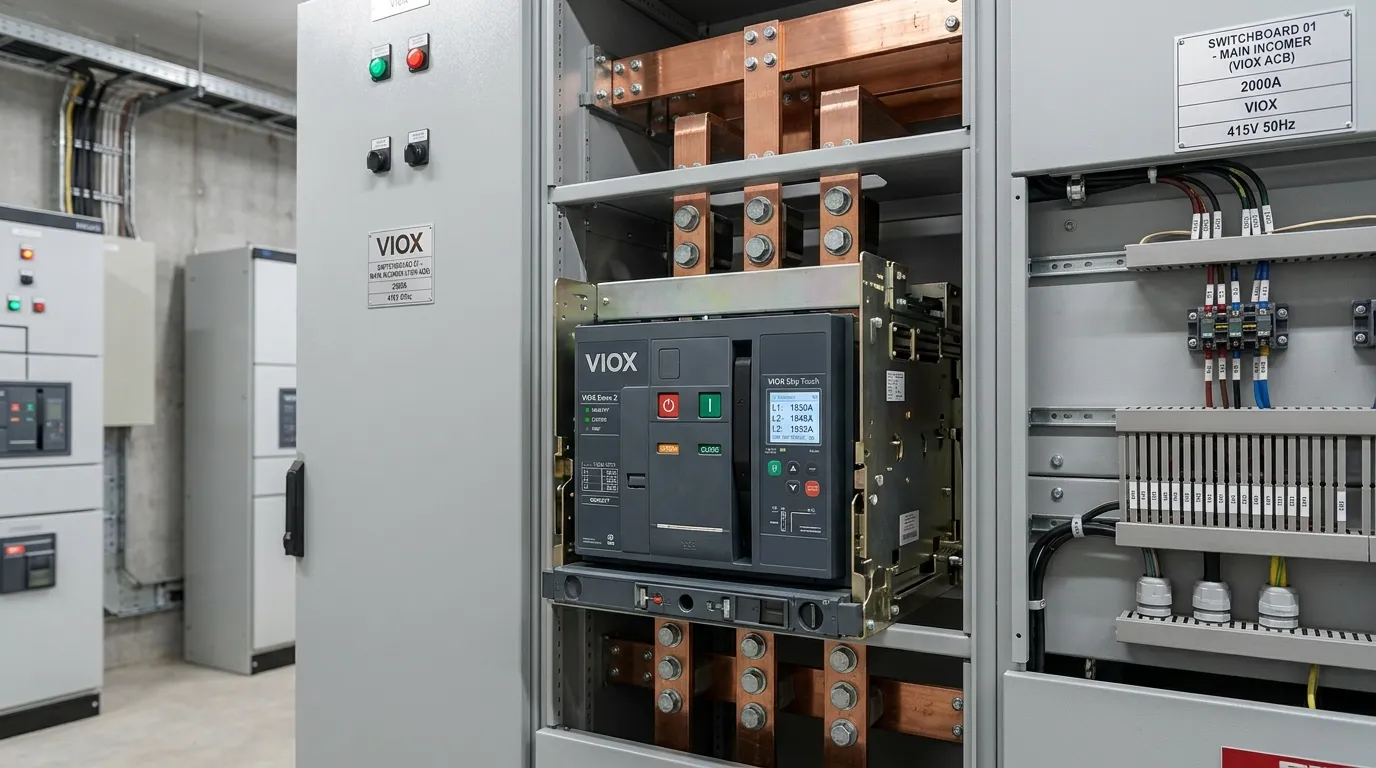
An air circuit breaker is a low-voltage circuit breaker designed to protect high-current power distribution systems against overloads, short circuits, and other electrical faults. Commonly shortened to ACB, this type of circuit breaker uses air at atmospheric pressure as its arc-extinguishing medium — the mechanism that safely interrupts the electrical arc formed when the breaker opens under fault or load conditions. Because of their high current capacity, adjustable protection settings, and robust construction, air circuit breakers are the standard choice for main distribution boards, switchboards, motor control centers, and other high-capacity installations in commercial and industrial electrical systems.
Quick Reference: ACB at a Glance
| Parameter | Specification |
|---|---|
| Voltage Rating | Low voltage (typically up to 690 V AC per IEC 60947-2) |
| Current Range | Commonly 630 A to 6300 A (varies by manufacturer) |
| Typical Role | Main incomer, bus coupler, generator breaker |
| Construction Type | Fixed or draw-out |
| Trip Unit | Electronic (microprocessor-based) with adjustable LSI/LSIG protection |
| Arc Medium | Air at atmospheric pressure |
| Primary Standard | IEC 60947-2 (or regional equivalent) |
ACB vs MCCB vs VCB: Quick Comparison
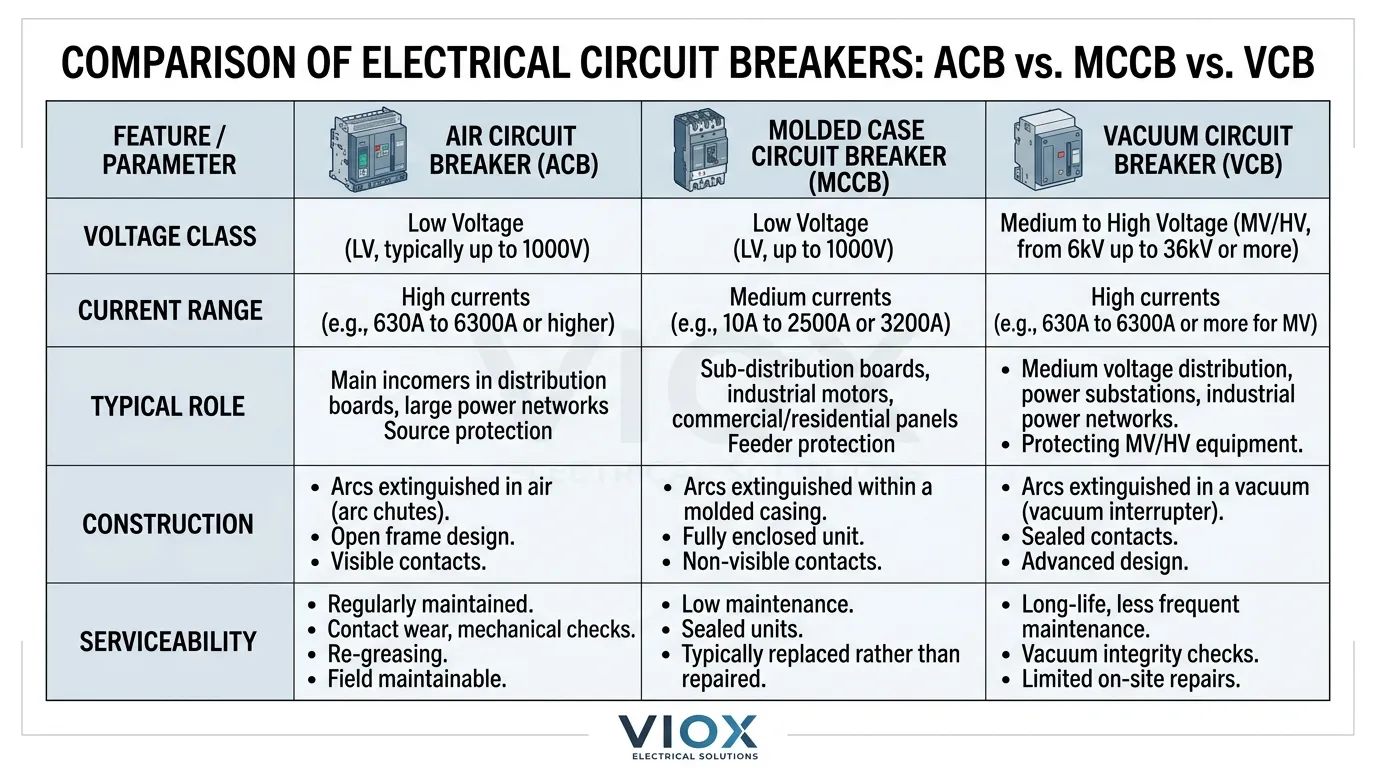
Understanding where air circuit breakers fit in the protection hierarchy requires comparing them to related breaker types. The table below shows how ACBs differ from molded case circuit breakers and vacuum circuit breakers:
| Feature | ACB | MCCB | VCB |
|---|---|---|---|
| Voltage Class | Low voltage (≤690 V) | Low voltage (≤690 V) | Medium voltage (3.3–36 kV) |
| Current Range | 630–6300 A | 16–2500 A | 630–4000 A |
| Typical Role | Main distribution protection | Feeder protection | Medium-voltage switching |
| Trip Unit | Electronic, adjustable | Thermal-magnetic or electronic | Relay-based |
| Construction | Fixed or draw-out | Fixed (bolt-on/plug-in) | Fixed or withdrawable |
| Arc Medium | Air | Air | Vacuum |
| Serviceability | Field-maintainable | Sealed, limited service | Sealed vacuum bottles |
An ACB typically serves at the main switchboard level as an incomer or bus coupler, while MCCBs protect downstream feeders and distribution circuits. VCBs operate in a different voltage class entirely — medium voltage — and sit upstream of the distribution transformer.
In practical terms, an ACB is selected when the system current exceeds what smaller branch-circuit devices can handle, when the protection settings need to be precisely adjustable for coordination purposes, or when the installation demands a breaker that can be inspected, tested, and maintained without replacing the entire device. This is why air circuit breakers are commonly discussed alongside MCCBs rather than MCBs — ACBs sit at the top of the low-voltage protection hierarchy, where current levels are highest and coordination requirements are most demanding.
Low-voltage ACB selection and performance are typically discussed within the framework of IEC 60947-2 or the applicable regional equivalent (UL 1066 in North America, GB 14048.2 in China). If you are looking for the acronym-only explanation, ACB Full Form in Electrical is the shorter companion page.
What an ACB Is
An air circuit breaker is a protective switching device engineered for low-voltage power systems where high current capacity, adjustable electrical fault protection, and long-term maintainability matter simultaneously. Understanding what sets an ACB apart requires looking beyond the arc-extinguishing medium — the differences are structural, functional, and operational.
An ACB typically offers higher frame sizes and rated currents than other low-voltage breaker families. Where an MCCB might reach 1600 A to 2500 A depending on the manufacturer, air circuit breakers commonly cover 630 A to 6300 A, with some industrial models extending higher. This current capacity is essential for main switchboard applications where the entire building or facility load flows through a single device.
The electronic trip unit in a modern ACB is a microprocessor-based controller that can be programmed with adjustable pickup levels, time delays, and coordination curves across multiple protection zones — long-time, short-time, instantaneous, and ground fault. This adjustability allows the ACB to coordinate properly with downstream MCCBs and upstream utility protection devices, ensuring selective fault clearing rather than system-wide tripping.
Air circuit breakers are designed to integrate into switchboards as the central protective device, with standardized cradle systems, interlocking mechanisms, and communication interfaces. Most ACB families are available in both fixed and draw-out configurations, giving engineers flexibility to match installation style to maintenance requirements — a choice that only arises with ACBs, not smaller circuit breakers.
Where Air Circuit Breakers Are Used
Air circuit breakers are used wherever power distribution current levels exceed the practical range of standard branch protection devices and wherever adjustable, coordinated protection is essential. In the low-voltage hierarchy, the ACB typically sits closest to the origin of supply — where current is highest and protection failure would have the broadest consequences.
The most common application is as the main incomer breaker on a low-voltage switchboard. When a distribution transformer steps voltage down to 400 V or 415 V for building distribution, the main breaker on the secondary side is almost always an ACB, carrying the full load current and providing overcurrent and short-circuit protection for the entire bus.
Tie breakers between bus sections represent another core application. In split-bus configurations — common in hospitals, data centers, and critical manufacturing — a tie breaker connects two bus sections and must coordinate with both incoming breakers simultaneously. Generator and transfer switchboards rely on ACBs because the electronic trip unit can be configured for the specific fault characteristics of generator sources, which differ from utility supplies.
Motor control centers use ACBs as the main incoming device in heavy industrial environments — steel mills, petrochemical plants, water treatment facilities — where the incomer may carry 2000 A or more while coordinating with dozens of downstream motor circuits. Large industrial feeders and commercial building main distribution systems — office towers, shopping centers, airports — also depend on ACBs as incoming and section breakers.
In most projects, an air circuit breaker is not installed at every final circuit. It is used closer to the origin of the low-voltage distribution system, where larger currents and coordination duties are concentrated, with MCCBs and MCBs protecting downstream circuits.
Main Components of an Air Circuit Breaker
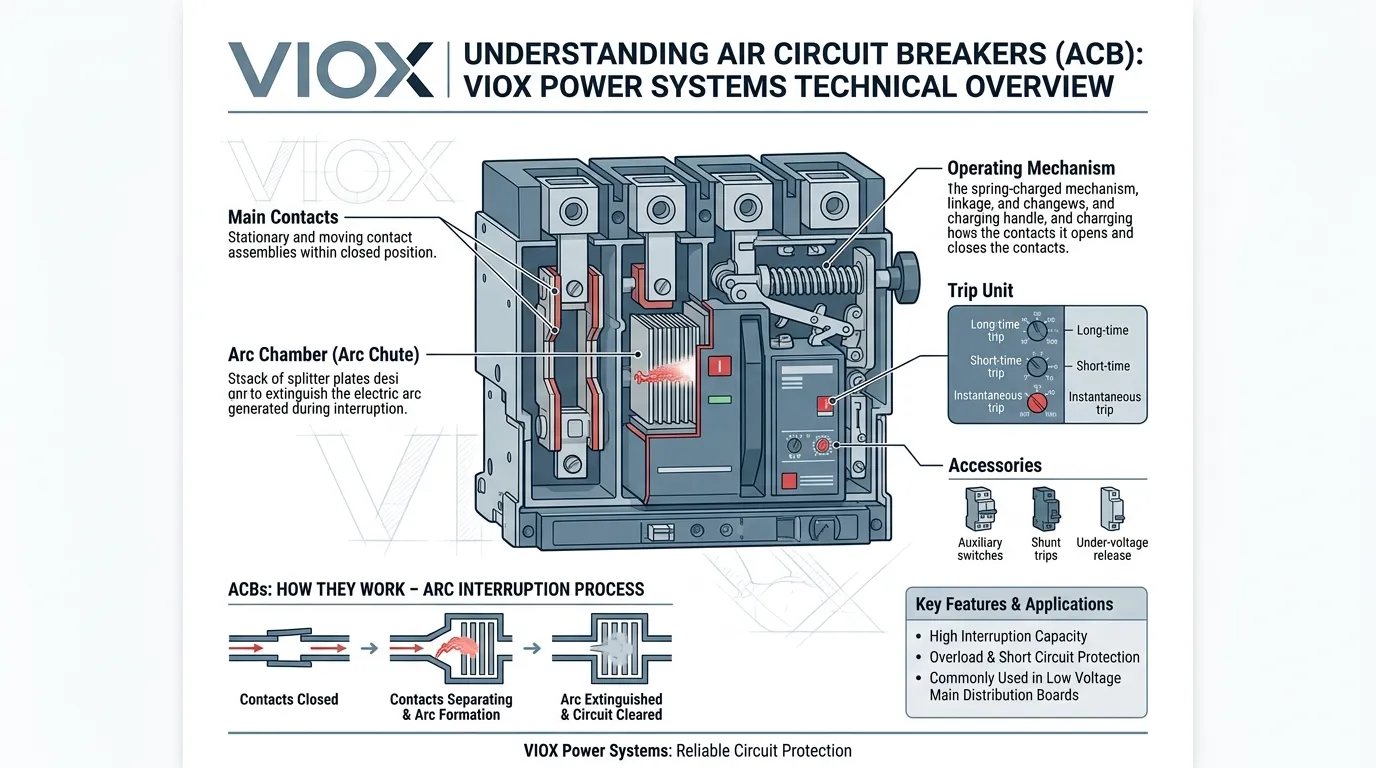
Every modern air circuit breaker contains the same fundamental sections, regardless of manufacturer.
Main contacts are the primary current-carrying elements, typically made from silver-plated copper with contact surfaces engineered for low resistance under continuous load. Their design directly affects thermal performance, reliability, and service life.
Arc contacts and arc chamber manage the electrical arc that forms when the breaker opens. The arc contacts separate last, drawing the arc away from the main contacts. The arc is then guided into an arc chamber (arc chute) — typically a stack of insulated metal splitter plates — where it is stretched, cooled, split into smaller series arcs, and extinguished. This design allows the breaker to interrupt high fault currents using only atmospheric air.
Operating mechanism stores and releases the mechanical energy needed to open and close the breaker. Most modern ACBs use spring-charged mechanisms, with closing springs charged manually or electrically. The mechanism provides manual and electrical control interfaces for local or remote operation.
Trip unit is the protection brain of the breaker. In modern ACBs, this is almost universally electronic — a microprocessor-based controller using current transformers to measure phase currents and evaluate them against user-adjustable protection settings. This provides precise adjustment of pickup currents and time delays, enabling coordination with upstream and downstream devices.
Accessories and releases expand functionality within larger power distribution systems. Common accessories include shunt release (remote tripping), undervoltage release (voltage drop protection), auxiliary contacts (status signals), motor operators (remote closing), and communication modules (Modbus, Profibus, Ethernet integration for monitoring and control).
Fixed vs Draw-Out ACB
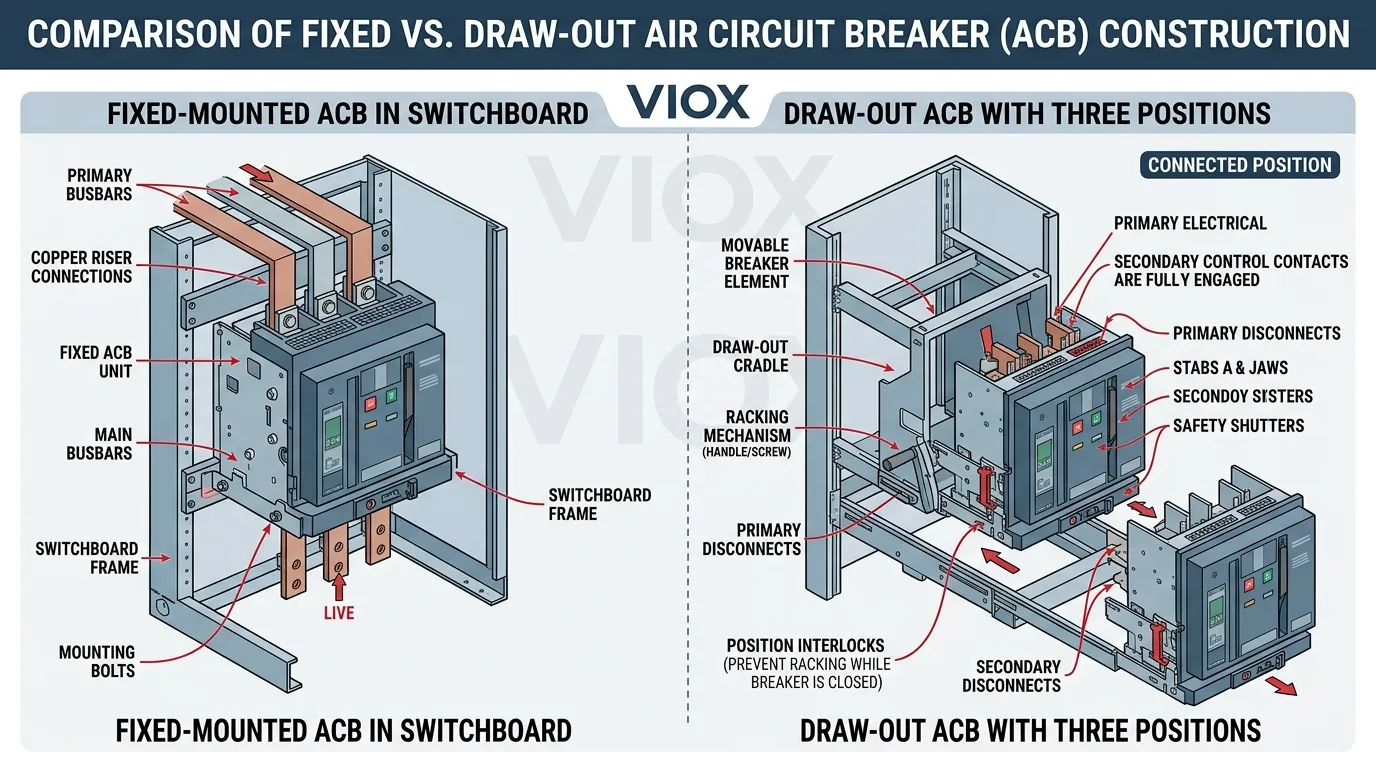
One of the most consequential decisions in air circuit breaker selection is whether to specify a fixed or draw-out configuration.
Fixed ACB is mounted permanently into the switchboard structure. The breaker cannot be removed without disconnecting and unbolting its connections. Fixed ACBs have simpler mechanical structure and lower installed cost, making them practical for projects where withdrawal for testing or maintenance is not a core requirement, or where planned shutdown-based maintenance is acceptable.
Draw-out ACB is mounted in a standardized cradle or drawer system. The breaker can be moved between defined service positions — connected (normal operation), test (main circuit disconnected, auxiliary circuits energized for trip testing), and disconnected (fully withdrawn for inspection or replacement) — without tools and without disassembling the switchboard.
Draw-out types improve maintenance flexibility and operational safety significantly. The breaker can be tested while the bus remains energized, replaced quickly with a spare to minimize downtime, and inspected away from energized bus bars. Operating positions include mechanical and electrical interlocks preventing unsafe operations. Draw-out ACBs are standard in critical systems — data centers, hospitals, continuous-process manufacturing — where testing speed, maintenance access, and downtime reduction are priorities.
Trip Unit Basics
For many engineers, the trip unit is the most important practical component of an air circuit breaker. It determines how the breaker responds to fault conditions and coordinates with other protection devices.
A modern ACB trip unit continuously monitors current through the breaker using internal current transformers. When measured current exceeds a programmed threshold for a programmed duration, the trip unit commands the breaker to open. The key advantage is adjustability: each protection function can be independently configured with its own pickup level and time delay.
Standard protection functions are organized into a well-established framework:
- Long-time overcurrent protection (L) handles sustained overload conditions. Pickup is typically adjustable from 0.4× to 1.0× rated current (per IEC 60947-2), with time delays from seconds to minutes, allowing the breaker to ride through normal load transients while clearing persistent overloads.
- Short-time overcurrent protection (S) addresses moderate fault currents. The adjustable pickup and time delay allow the ACB to delay tripping briefly to see if a downstream breaker clears the fault first — the essence of time-graded selectivity.
- Instantaneous protection (I) provides immediate tripping at very high fault currents where there is no time for selectivity.
- Ground fault protection (G), where provided, detects current leaking to earth and trips the breaker to limit fire and shock risk.
These functions are grouped as LSI or LSIG (adding ground fault). Advanced trip units may also provide energy metering, power quality monitoring, demand monitoring, event logging, and communication interfaces for SCADA or building management system integration.
Frequently Asked Questions
What is an air circuit breaker?
An air circuit breaker is a low-voltage circuit breaker that uses air at atmospheric pressure to extinguish the electrical arc formed when the breaker opens. ACBs are designed for high-current commercial and industrial power distribution systems, typically serving as main switchboard incomers, bus couplers, and section breakers.
What is the difference between ACB and MCCB?
An ACB is typically used at the main switchboard or incomer level, offering higher current capacity (commonly 630–6300 A), more advanced adjustable protection, and draw-out mounting options. An MCCB is more commonly used on feeders and downstream distribution circuits (16–2500 A), with a more compact form factor. In most systems, the two breaker types work together at different levels of the protection hierarchy.
Where are air circuit breakers used?
Air circuit breakers are used in main low-voltage switchboards, generator and transfer switchboards, bus coupler sections, motor control centers, and large commercial or industrial distribution systems. They are installed wherever the system current exceeds the practical range of MCCBs and wherever adjustable, coordinated protection is required.
What is the difference between fixed and draw-out ACB?
A fixed ACB is permanently mounted in the switchboard and cannot be removed without disconnecting its terminals. A draw-out ACB can be moved between connected, test, and disconnected positions within a standardized cradle, allowing testing, inspection, and replacement without disassembling the switchboard. Draw-out types are preferred in critical systems where maintenance access and minimized downtime are priorities.
Is an ACB a low-voltage or medium-voltage breaker?
An air circuit breaker is a low-voltage device, typically rated for systems up to 690 V AC per IEC 60947-2. Medium-voltage applications (3.3 kV and above) are served by vacuum circuit breakers (VCBs), SF6 circuit breakers, and other breaker families designed for that voltage class.
Why do ACBs use electronic trip units?
Electronic trip units provide adjustable and more precise protection compared to traditional thermal-magnetic elements. This adjustability is essential for selectivity and coordination in larger power distribution systems, where the ACB’s trip settings must be configured to work in concert with downstream MCCBs and MCBs. Electronic trip units also enable advanced features such as ground fault protection, energy metering, event logging, and communication with supervisory systems.
What is the rated current range of an air circuit breaker?
Most air circuit breaker families cover rated currents from 630 A to 6300 A, though specific ranges vary by manufacturer and product series per IEC 60947-2. The frame size determines the maximum rated current the breaker can carry, while the trip unit setting determines the actual protection threshold within that frame.
How long does an air circuit breaker last?
With proper maintenance per manufacturer specifications, an ACB can remain in service for 20 to 30 years or more. Electrical life — the number of operations under load or fault conditions — typically ranges from 10,000 to 20,000 operations depending on the interrupted current and manufacturer design. Mechanical life for no-load operations is significantly higher. Regular inspection of contacts, arc chambers, and operating mechanisms is essential to achieving full expected service life.