In electrical control panels, you might encounter two nearly identical DIN rail devices: same form factor, same amperage, same toggle. One costs $50. The other? Just $15. The difference isn’t marketing—it’s regulation.
This pricing gap marks a critical regulatory divide. Panel shops, OEM manufacturers, and electrical contractors need to understand the distinction between UL 489 circuit breakers and UL 1077 supplementary protectors. Mix them up, and you’ll face rejected projects during Authority Having Jurisdiction (AHJ) inspections, expensive re-work, and—worst case—equipment fires when overcurrent protection fails.
This guide clarifies when to use each device, how to identify them visually, and why substituting one for the other violates electrical codes.
What Are UL 489 Circuit Breakers?
UL 489 defines the standard for “Molded-Case Circuit Breakers, Molded-Case Switches and Circuit-Breaker Enclosures.” These devices are UL Listed, meaning they’ve passed comprehensive testing as complete, stand-alone protective devices suitable for installation directly into electrical distribution systems.
A UL 489 circuit breaker serves as branch circuit protection—the primary overcurrent device safeguarding conductors from the service panel to the final load. Think of it as the “first responder” in your electrical system. When a fault occurs, a UL 489 breaker must independently interrupt the full available fault current (often 5 kA, 10 kA, or higher depending on the rating) without assistance from upstream devices.
Key capabilities that define UL 489 devices:
- High interrupting capacity: Tested to break massive short-circuit currents safely, dissipating arc energy through robust internal arc chutes
- Rigorous spacing standards: Generous electrical clearances and creepage distances that prevent tracking and flashover under fault conditions
- Stand-alone operation: No requirement for upstream protection; the breaker can serve as the sole protective device in its circuit
- Field wiring approval: Designed and tested for protecting conductors that leave the enclosure—powering receptacles, lighting circuits, machinery, and other loads
Common applications: Distribution panels, machinery disconnects, lighting circuits, and receptacle protection per NEC Article 240.
What Are UL 1077 Supplementary Protectors?
UL 1077 governs “Supplementary Protectors for Use in Electrical Equipment.” The keyword is supplementary—these devices are UL Recognized Components, not stand-alone listed products. They’re designed to work inside equipment where branch-circuit protection already exists (or isn’t required by code).
Think of a UL 1077 device as a “specialist”—providing targeted, granular protection for sensitive components within an enclosure: a PLC power supply, a transformer secondary, a control circuit, or an instrumentation bus. It’s not replacing the main circuit breaker; it’s adding a second layer of defense tailored to a specific sub-circuit’s needs.
Key characteristics that define UL 1077 devices:
- Component status: UL Recognized, not Listed; must be evaluated within the context of the end product (e.g., a control panel certified to UL 508A)
- Lower interrupting capacity: Adequate for equipment-internal faults, but not tested to the same fault-current levels as UL 489 breakers
- Reduced spacing requirements: Electrical clearances and creepage distances meet UL 1077 and UL 840 standards but are less stringent than UL 489
- Dependency on upstream protection: Assumes a UL 489 breaker upstream will limit fault energy before the supplementary protector sees destructive current levels
- Internal wiring only: Explicitly restricted to protecting conductors inside the equipment enclosure; not approved for field wiring, receptacles, or loads outside the cabinet
Common applications: Internal circuits in control panels, machinery controllers, and instrumentation—always with UL 489 protection upstream.
Side-by-Side Comparison: UL 489 vs. UL 1077
| Attribute | UL 489 Circuit Breaker | UL 1077 Supplementary Protector |
|---|---|---|
| Certification Status | UL Listed (complete product) | UL Recognized Component (must be used in listed equipment) |
| Primary Function | Branch-circuit overcurrent protection | Supplementary protection within equipment |
| Interrupting Capacity | High (5-25 kA typical, tested to full rating) | Lower (adequate for internal faults, limited testing) |
| Electrical Clearance | Stringent (designed for stand-alone fault interruption) | Reduced (assumes upstream protection limits fault energy) |
| Installation Location | Service panels, distribution boards, machinery disconnects | Inside control panels, equipment enclosures, appliances |
| Field Wiring Protection | Yes – approved for conductors leaving the enclosure | No – internal wiring only |
| Receptacle Protection | Yes – can directly protect outlets and receptacles | No – violates NEC if used for receptacle circuits |
| Upstream Protection Required | No – operates independently | Yes – requires UL 489 breaker upstream (or no protection required by code) |
| NEC Article Reference | NEC Article 240 (branch-circuit protection) | NEC Article 240.10 (supplementary overcurrent protection) |
| Visual Identification | UL Listed mark (circle with “UL” and ®) | UL Recognized mark (“UR” symbol, often backward) |
| Typical Price Range | $30-$80+ (depending on rating and features) | $10-$25 (lower due to reduced testing scope) |
| Use Case Example | Main breaker protecting a 20A receptacle circuit in a workshop | 2A protector safeguarding a PLC power supply inside a control panel |
Application Scenarios: Where Each Device Belongs
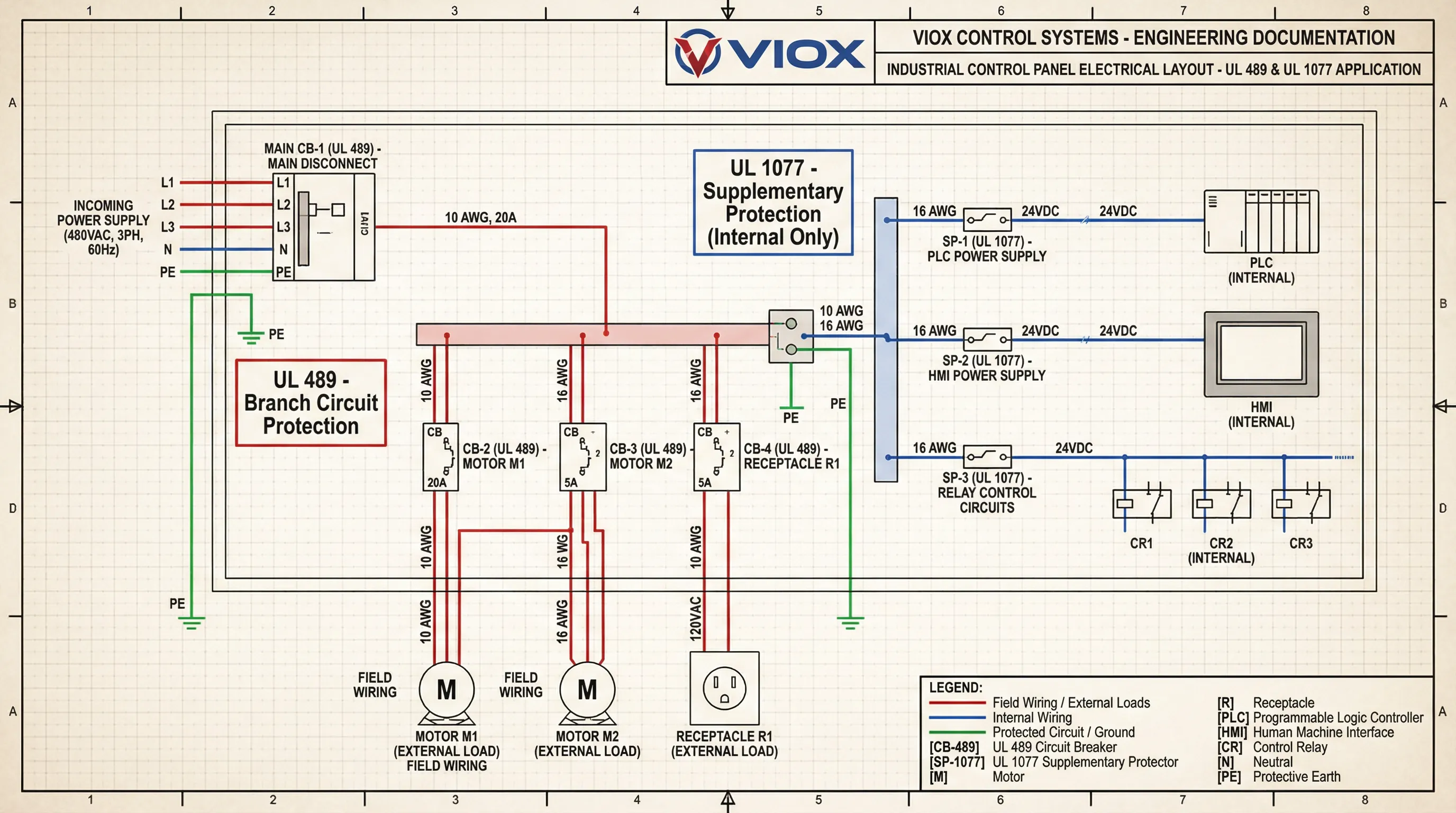
Understanding where to deploy each device type is essential for code compliance. The most common violations occur when panel builders or OEMs use UL 1077 supplementary protectors in applications that require UL 489 circuit breakers. Here’s a decision framework based on wiring type and load location.
Scenario 1: Protecting Receptacles (Outlets)
Requirement: UL 489 circuit breaker
Why: Any receptacle is considered a branch-circuit load under the NEC, requiring branch-circuit overcurrent protection.
Correct approach: Use a UL 489 breaker (15A or 20A typical) to protect the receptacle circuit.
Scenario 2: Field Wiring to External Loads
Requirement: UL 489 circuit breaker
Why: “Field wiring” (conductors leaving the enclosure to power external loads) must be protected by listed branch-circuit devices per NEC.
Correct approach: Install a UL 489 circuit breaker rated for the conductor size and load.
Scenario 3: Internal Control Circuits and Components
Requirement: UL 1077 supplementary protector (with UL 489 breaker upstream)
Why: Inside control panels, dozens of small loads each need protection. UL 1077 devices provide granular protection while the main UL 489 breaker protects the incoming feeder.
Compliant example: A UL 508A-listed panel has a 20A UL 489 breaker feeding the panel. Inside, circuits use 2A UL 1077 protectors for the PLC, 5A for the HMI, and 1A for safety relays.
Key rule: UL 1077 devices protect internal wiring only. If any conductor exits the panel, use UL 489.
Scenario 4: Lighting Circuits
Requirement: Typically UL 489 circuit breaker
Why: Lighting circuits are branch circuits by definition, requiring branch-circuit protection per NEC.
Example: Panel lights inside an enclosure can use UL 1077 if they’re part of internal wiring. External lighting must have UL 489 protection.
Quick Decision Table: Which Device Do I Need?
| Application | Device Required | Reason |
|---|---|---|
| Receptacles (any location) | UL 489 | NEC requires branch-circuit protection for all receptacles |
| Field wiring to external loads | UL 489 | Conductors leaving enclosure are branch circuits |
| Internal panel wiring (PLC, relays) | UL 1077 | Supplementary protection; upstream UL 489 already present |
| Lighting circuits (building/general) | UL 489 | Branch-circuit requirements apply |
| Panel internal lights | UL 1077 | If part of equipment internal wiring; check UL 508A rules |
| Transformer primary (external) | UL 489 | Primary is branch-circuit load |
| Transformer secondary (internal) | UL 1077 | Secondary circuits within equipment can use supplementary |
Visual Identification: How to Tell Them Apart
Since UL 489 and UL 1077 devices often share identical form factors—especially in DIN rail miniature circuit breaker formats—knowing how to identify them on sight is crucial for field inspections, inventory management, and compliance verification.
Look for the Certification Mark
The most reliable identifier is the UL certification mark printed or molded onto the device body or label:
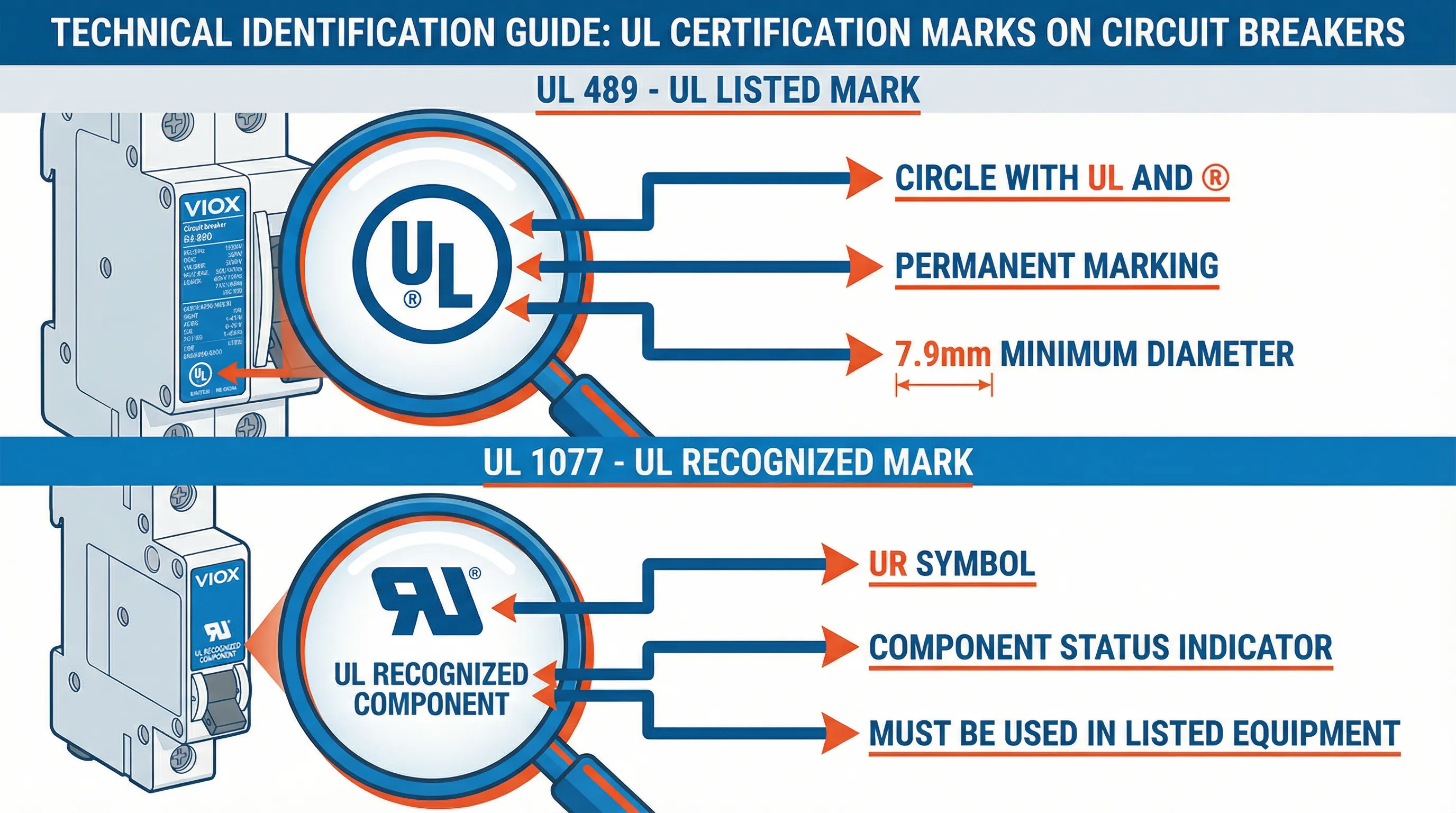
UL 489 Circuit Breakers display the UL Listed mark: a circle with “UL” and ®. This indicates a complete product approved for direct installation in electrical systems.
UL 1077 Supplementary Protectors carry the UL Recognized Component mark: “UR” symbol or “UL Recognized Component,” indicating component-only status.
Check the Device Label and Model Number
Manufacturers often encode the certification type in the product labeling:
- Model number prefixes or suffixes: Some brands use distinct series names—e.g., “CB-” for circuit breakers (UL 489) and “SP-” for supplementary protectors (UL 1077).
- Label text: Look for explicit statements like “Branch Circuit Protector” (UL 489) or “Supplementary Protector for Use in Electrical Equipment” (UL 1077).
- Standards references: The device label may cite “UL 489” or “UL 1077” directly.
Inspect the Datasheet or Catalog
When ordering or specifying devices, cross-reference the manufacturer’s technical documentation:
- Certification listings: Reputable manufacturers clearly state whether a product is UL Listed (489) or UL Recognized (1077).
- Electrical ratings: UL 1077 devices have lower interrupting ratings (3-5 kA) vs. UL 489 (10-25 kA).
Many manufacturers use the same housing for both types. Always verify the certification mark—never rely on appearance alone.
Quick Visual Identification Checklist
| Check This | UL 489 Indicator | UL 1077 Indicator |
|---|---|---|
| Certification Mark | Circle with “UL” and ® | “UR” symbol or “UL Recognized Component” |
| Label Wording | “Listed,” “Circuit Breaker” | “Recognized,” “Supplementary Protector” |
| Datasheet | Lists as UL 489, shows high Icu/Ics | Lists as UL 1077, notes component use |
| Application Description | Branch-circuit, field wiring approved | Internal equipment use only |
Compliance Warnings and Best Practices
Misusing UL 1077 supplementary protectors in place of UL 489 circuit breakers isn’t just a technical mistake—it’s a code violation that can lead to serious consequences.
What Happens When You Mix Them Up?
Failed inspections: Electrical inspectors and AHJs routinely check for proper overcurrent protection on branch circuits. A UL 1077 device protecting a receptacle or field wiring will trigger a red-tag rejection. You’ll face project delays, re-work costs, and potential contractor liability.
UL audit failures: If you’re building UL-listed equipment (control panels, machinery, appliances), UL auditors verify that components are used within their certification scope. Using a UL Recognized component (1077) where a UL Listed device (489) is required violates the listing and can result in loss of your UL certification.
Safety risks: Under high fault conditions, a UL 1077 device may not safely interrupt the available short-circuit current. Without adequate arc suppression and electrical clearances, the device could fail catastrophically—resulting in fire, enclosure breach, or electric shock hazards.
Insurance and liability issues: In the event of an electrical fire or injury, investigations will scrutinize whether all devices were properly applied. Incorrect device selection can void insurance coverage and expose your company to legal liability.
Best Practices for Panel Shops and OEMs
1. Establish clear procurement policies: Segregate UL 489 and UL 1077 inventory physically and in your parts database. Use distinct part numbers and labeling so assemblers can’t accidentally substitute one for the other.
2. Train your team: Ensure engineers, technicians, and purchasing staff understand the difference. A 30-minute training session can save thousands in re-work costs.
3. Design reviews: Include overcurrent device selection as a mandatory checkpoint in your panel design reviews. Ask: “Is this conductor leaving the enclosure? If yes, is it protected by a UL 489 device?”
4. Label your panels clearly: Use wire markers or panel schedules to indicate which circuits are branch circuits (UL 489) and which are supplementary-protected internal circuits (UL 1077). This helps during maintenance and future modifications.
5. When in doubt, use UL 489: If you’re unsure whether a circuit qualifies as “internal wiring,” default to the UL 489 breaker. It’s more expensive upfront but eliminates compliance risk.
6. Consult the end-product standard: Refer to UL 508A (control panels), NFPA 79 (machinery), or relevant UL appliance standards.
A Word on Cost
Yes, UL 489 breakers cost 2-3 times more than UL 1077 devices, but the difference reflects rigorous testing and broader application approval. Using UL 1077 where UL 489 is required can cost $10,000+ in re-work and project delays.
Frequently Asked Questions
Q: Can I use a UL 1077 supplementary protector if I already have a UL 489 breaker upstream?
A: It depends on the application. If the UL 1077 device is protecting internal equipment wiring (circuits that stay inside the enclosure), yes—that’s its intended use. But if the circuit feeds a receptacle or field wiring that exits the enclosure, no—you must use a UL 489 breaker for that circuit, even with another UL 489 upstream.
Q: Why are UL 1077 devices so much cheaper than UL 489 breakers?
A: UL 1077 devices undergo less rigorous testing because they’re designed to work within equipment that already has branch-circuit protection. They have lower interrupting capacity requirements, reduced spacing standards, and are certified as components rather than stand-alone products. This narrower scope reduces manufacturing and testing costs.
Q: What happens if an inspector finds a UL 1077 device protecting a receptacle?
A: The installation will fail inspection. You’ll receive a code violation notice requiring correction before the project can proceed. This typically means replacing the UL 1077 device with a properly rated UL 489 circuit breaker and potentially re-routing wiring to meet code.
Q: Can I use UL 1077 devices in a residential electrical panel?
A: No. Residential branch circuits require UL 489 circuit breakers per NEC. UL 1077 devices are for equipment internal use only.
Q: How do I identify which type of device I have?
A: Check the certification marks: circular “UL” mark (489) or “UR” / “UL Recognized Component” mark (1077).
Conclusion
UL 489 circuit breakers and UL 1077 supplementary protectors serve distinct roles. Circuit breakers protect branch circuits, field wiring, and receptacles with full UL listing and NEC compliance. Supplementary protectors provide internal equipment protection where branch-circuit protection already exists.
The rule is simple: conductor leaves the enclosure or feeds a receptacle? Use UL 489. Protecting an internal sub-circuit with UL 489 upstream? UL 1077 works.
VIOX Electric offers industrial-grade circuit breakers and supplementary protectors meeting both UL 489 and UL 1077 standards—engineered for compliance and long-term performance in demanding applications.