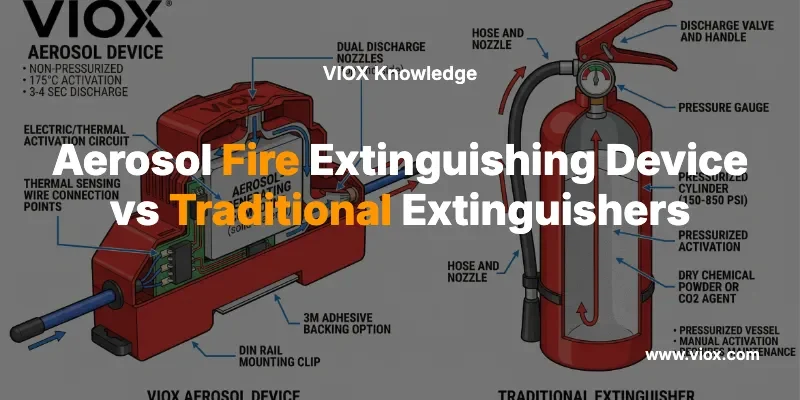
When electrical fires erupt inside distribution cabinets or control panels, every second counts—and so does every cubic centimeter of space. Facility managers and safety engineers face a critical dilemma: traditional fire extinguishers offer proven reliability but often at the cost of collateral damage, maintenance overhead, and installation complexity. Aerosol fire extinguishing devices promise a compact, automated alternative that protects sensitive equipment without residue or pressurized vessels.
But which technology truly delivers better protection for your facility? This guide compares aerosol and traditional fire suppression systems across technical specifications, real-world performance, regulatory compliance, and lifecycle costs—giving you the data to make an informed decision.
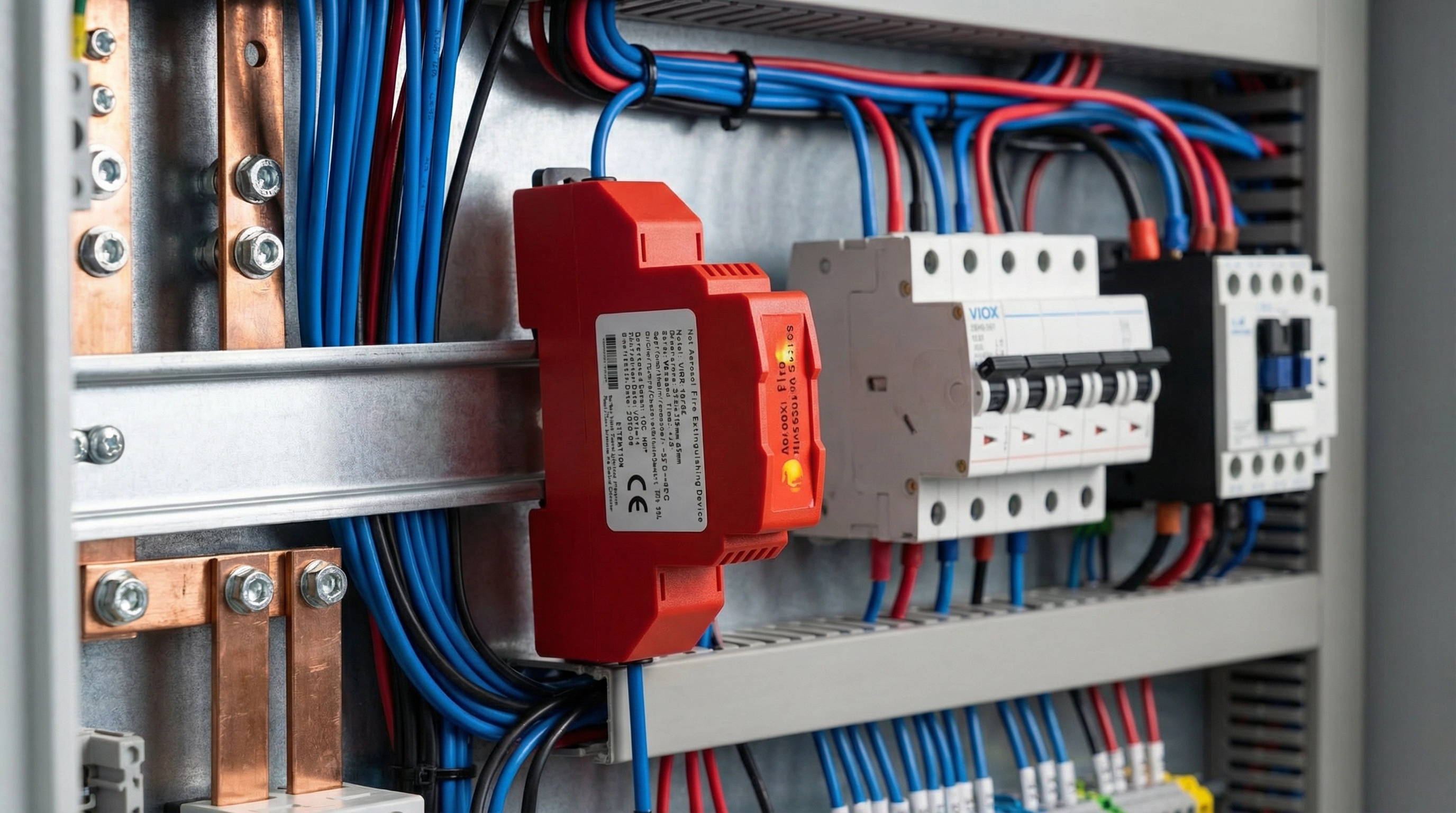
How Aerosol Fire Extinguishing Devices Work
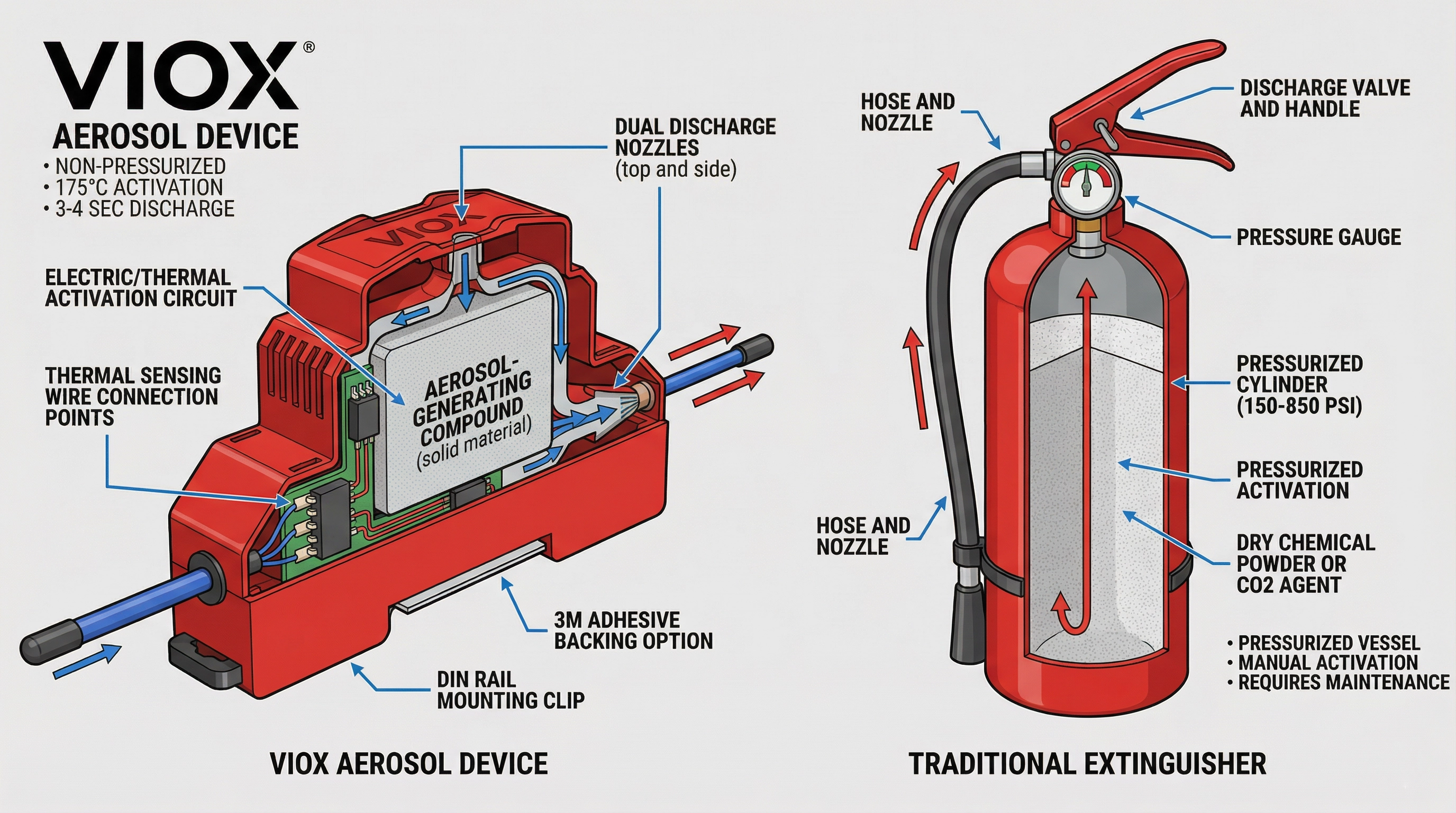
Aerosol fire extinguishing devices operate on a fundamentally different principle than traditional extinguishers. When activated by heat (typically at 175°C±5°C), these units generate and release condensed aerosol particles—microscopic solid and liquid compounds, usually potassium-based—that interrupt the fire’s chemical chain reaction at a molecular level. The particles remain suspended in the air, interacting with combustion free radicals to halt oxidation without depleting oxygen significantly.
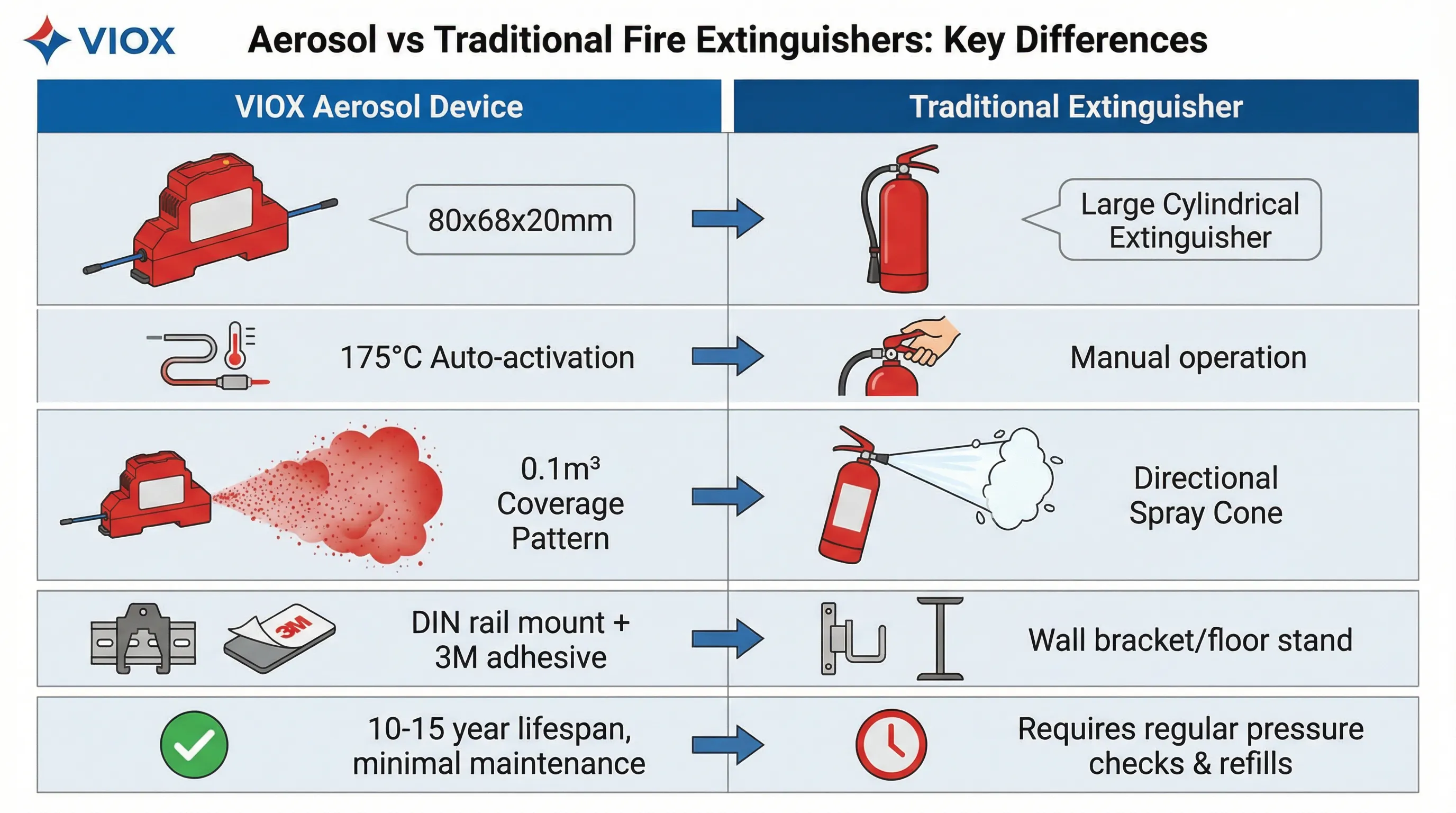
Modern condensed aerosol systems like VIOX’s DIN rail-mounted units measure as compact as 80×68×20mm yet provide fire suppression coverage up to 0.1 cubic meters. The agent discharges in 3-4 seconds through strategically placed nozzles, flooding the protected enclosure with fire-suppressing particles. Unlike gaseous systems, aerosol generators require no pressurized storage cylinders, external piping, or complex installation infrastructure.
The technology gained prominence in the 1990s as an environmentally safer alternative to Halon systems. The EPA has approved condensed aerosols as acceptable Halon 1301 substitutes for total flooding applications, recognizing their zero Ozone Depletion Potential (ODP) and minimal Global Warming Potential (GWP).
Traditional Fire Extinguisher Technologies: A Brief Overview
Traditional portable and fixed fire extinguishers encompass several distinct technologies, each with specific fire class applications:
ABC Dry Chemical Extinguishers use monoammonium phosphate powder to smother fires by forming a barrier between fuel and oxygen while interrupting the chemical reaction. Effective on Class A (combustibles), B (flammable liquids), and C (electrical) fires, these represent the most common multipurpose extinguisher type. However, the fine powder residue can be corrosive to electronics and challenging to clean.
CO2 (Carbon Dioxide) Extinguishers displace oxygen and cool the fire using compressed carbon dioxide gas. Ideal for Class B and C fires, CO2 leaves no residue, making it suitable for server rooms and laboratories. Limitations include ineffectiveness on Class A fires, asphyxiation risk in confined spaces, and potential for cold burns from the discharge horn.
Water-Based Extinguishers (including water mist and foam) cool burning materials through heat absorption. Highly effective on Class A fires, water extinguishers are cost-effective and environmentally safe. Major drawbacks include unsuitability for electrical or flammable liquid fires, potential water damage to equipment, and freezing risk in cold environments.
Each technology relies on pressurized vessels, manual or automatic activation systems, and periodic maintenance including pressure checks and agent replacement.
Technical Specifications Comparison
Understanding the core technical differences helps identify which technology suits specific protection requirements.
| Specification | Aerosol Fire Extinguishing Device | Traditional Extinguishers |
|---|---|---|
| Suppressant Type | Condensed aerosol particles (potassium compounds) | Dry chemical powder, CO2 gas, water/foam liquid |
| Particle/Agent Size | Submicron to 10 microns | 5-75 microns (dry powder), gaseous (CO2), liquid droplets (water) |
| Activation Method | Automatic thermal activation (175°C) or electric trigger | Manual operation or automatic (sprinkler, heat detector) |
| Discharge Time | 3-4 seconds | 8-60 seconds (varies by type and size) |
| Pressurization | Non-pressurized; chemical reaction generates aerosol | Pressurized cylinders (150-850 psi) requiring regular checks |
| Coverage per Unit | 0.1-1.0 m³ (compact units) | 0.5-10 m³ (depends on size and agent) |
| Installation Complexity | DIN rail mount or adhesive; no piping required | Wall brackets, floor stands, or piped distribution systems |
| Maintenance Frequency | Minimal; visual inspection annually | Quarterly to annual pressure checks; agent replacement every 3-5 years |
| Service Life | 10-15 years | 5-12 years (varies by type) |
| Operating Temperature | -40°C to +95°C | Varies: Water (+4°C to +65°C), Dry powder (-20°C to +60°C) |
Performance Comparison: Real-World Effectiveness
Performance metrics reveal how each technology behaves under actual fire conditions.
| Performance Factor | Aerosol Devices | ABC Dry Chemical | CO2 | Water-Based |
|---|---|---|---|---|
| Response Time | <1 second detection to activation | Manual: operator-dependent; Auto: 3-5 seconds | Manual: operator-dependent; Auto: 3-5 seconds | Manual: operator-dependent; Auto: 5-10 seconds |
| Fire Class Effectiveness | Class A, B, C, E (electrical) | Class A, B, C | Class B, C | Class A only (mist: A, B, C) |
| Extinguishing Speed | 3-4 seconds full discharge | 10-30 seconds | 10-20 seconds | 30-60 seconds |
| Residue Level | Minimal fine particulate, non-corrosive | Heavy powder residue, corrosive to electronics | None (gas) | Water damage to equipment |
| Visibility Impact | Moderate temporary haze | Severe powder cloud | Moderate fog | Minimal |
| Collateral Damage Risk | Very low; safe for electronics | High; electronics damage from powder | Very low | High; water damage to equipment |
| Re-ignition Prevention | Excellent; particles remain suspended | Good | Poor for Class A fires | Good for Class A |
| Enclosed Space Safety | Safe; minimal oxygen displacement | Respiratory irritation risk | Asphyxiation risk | Safe |
| Environmental Impact | Zero ODP, minimal GWP | Low environmental concern | Greenhouse gas (GWP: 1) | Environmentally friendly |
The data reveals aerosol technology’s advantage in protecting sensitive electronic equipment within enclosed spaces, where residue-free operation and rapid automated response provide critical protection without secondary damage.
Regulatory Compliance and Certification
Both technologies operate under distinct regulatory frameworks that govern design, installation, and maintenance.
Aerosol Fire Suppression Standards:
- NFPA 2010: Standard for Fixed Aerosol Fire-Extinguishing Systems. Covers design, installation, testing, and maintenance requirements for fixed aerosol systems protecting stationary hazards like electrical cabinets and switchgear rooms.
- UL 2775: Standard for Fixed Condensed Aerosol Extinguishing System Units. Certifies components for compliance with NFPA 2010.
- International Standards: EN 15276, ISO 15779, IMO MSC.1/Circ.1270 (marine applications)
- EPA Approval: Listed as acceptable Halon 1301 substitute for total flooding systems
Traditional Extinguisher Standards:
- NFPA 10: Standard for Portable Fire Extinguishers. Establishes selection, installation, inspection, and maintenance requirements.
- UL 299: Standard for Dry Chemical Fire Extinguishers
- UL 154: Standard for Carbon-Dioxide Fire Extinguishers
- NFPA 13: Standard for Installation of Sprinkler Systems (water-based fixed systems)
Both VIOX aerosol devices and quality traditional extinguishers carry appropriate certifications (CE, UL, NFPA compliance) ensuring regulatory acceptance across jurisdictions.
Application Suitability: Where Each Technology Excels
Selecting the right fire suppression technology depends heavily on the protected environment, fire risk profile, and operational constraints.
| Application Scenario | Aerosol Devices | Traditional Extinguishers | Recommended Choice |
|---|---|---|---|
| Electrical Cabinets | ✓ Excellent (compact, automated, residue-free) | Limited (size constraints, residue concern) | Aerosol |
| Distribution Boxes/Meter Boxes | ✓ Ideal (DIN rail mount, 0.1 m³ coverage) | Poor (space limitations) | Aerosol |
| Server Rooms/Data Centers | ✓ Good (electronics-safe, automated) | ✓ Good (CO2: residue-free; Dry chem: damaging) | Aerosol or CO2 (room size dependent) |
| Control Panels/PLC Enclosures | ✓ Excellent (installation flexibility, automated protection) | Limited (manual operation delay, size) | Aerosol |
| Vehicle Engine Compartments | ✓ Excellent (vibration-resistant, automated) | Limited (accessibility, manual operation) | Aerosol |
| Industrial Warehouses | Limited (open space dispersion) | ✓ Excellent (coverage, multipurpose) | Traditional |
| Office Spaces | Limited (cost-effectiveness at scale) | ✓ Excellent (multipurpose, manual control) | Traditional |
| Commercial Kitchens | Not recommended | ✓ Excellent (Class K wet chemical) | Traditional (K-Class) |
| Marine/Boat Engine Rooms | ✓ Excellent (corrosion-resistant, automated) | ✓ Good (CO2 systems common) | Aerosol or CO2 |
| Transformer Enclosures | ✓ Excellent (outdoor-rated, automated) | Limited (maintenance access) | Aerosol |
| Battery Energy Storage (BESS) | ✓ Good (thermal runaway response) | ✓ Good (depends on system design) | Aerosol (early-stage fires) |
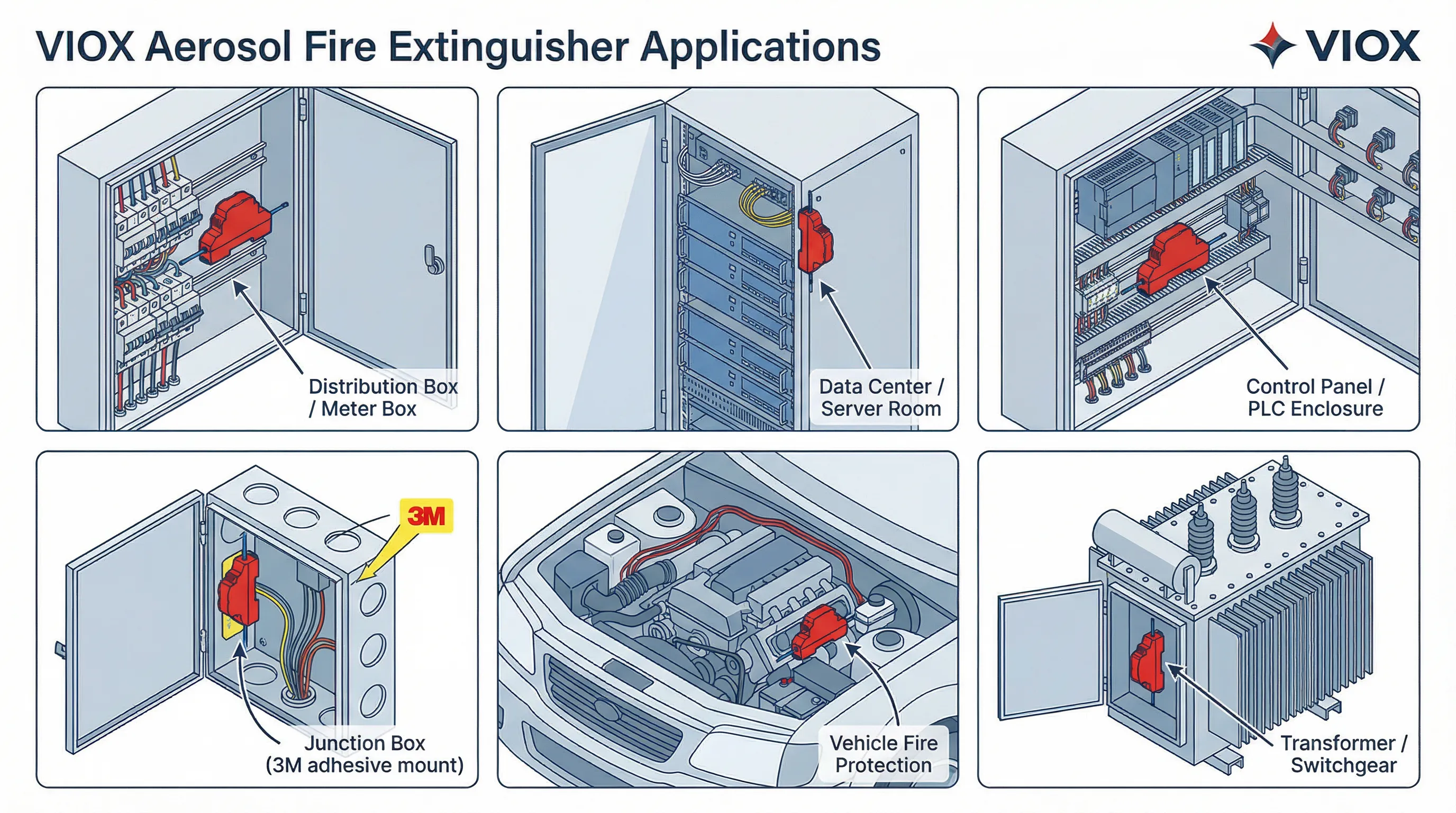
VIOX DIN Rail Aerosol Fire Extinguisher: Purpose-Built for Electrical Protection
For electrical distribution systems specifically, VIOX offers a 10-gram DIN rail-mounted aerosol fire extinguisher engineered to match the form factor and installation method of standard air circuit breakers. This innovative design allows the fire suppression unit to install alongside electrical components within distribution cabinets, meter boxes, and control panels using the same rail mounting system.
With dimensions of 80×68×20mm and 0.1 m³ coverage capacity, the unit provides comprehensive protection for typical electrical enclosures. The thermal cord activation (175°C±5°C) ensures automatic fire response without external detection systems, while the ABS fire-retardant housing withstands operating temperatures from -40°C to +95°C. Dual-side nozzle placement enables rapid, even aerosol distribution throughout the protected space.
Selection Guidance: Choosing the Right Technology
Making the optimal fire suppression choice requires evaluating multiple decision factors:
Choose Aerosol Fire Extinguishing Devices When:
- Protecting electrical equipment where powder or water residue would cause significant damage
- Space constraints prevent traditional extinguisher installation
- Automated, fail-safe protection is required without human intervention
- The protected area is enclosed or semi-enclosed (0.1-10 m³)
- Long service life (10-15 years) and minimal maintenance are priorities
- Installation simplicity matters (no piping, no external power for thermal activation)
- Operating in extreme temperature environments (-40°C to +95°C)
Choose Traditional Extinguishers When:
- Protecting large open areas (warehouses, factories, retail spaces)
- Multipurpose coverage is needed for varied fire risks
- Manual control and selective deployment are preferred
- Initial equipment cost is the primary constraint
- Water or Class K (kitchen) fire risks are present
- Regulatory requirements specify specific traditional extinguisher types
- Workforce training already covers traditional extinguisher operation
Hybrid Approach:
Many facilities implement both technologies strategically—aerosol devices protecting critical electrical infrastructure (distribution panels, server cabinets, control systems) while traditional portable extinguishers provide general coverage for corridors, offices, and open work areas. This layered approach optimizes protection across diverse fire risk profiles.
Cost Considerations: Lifecycle Analysis
While purchase price comparisons favor traditional extinguishers initially, total cost of ownership reveals a different picture:
| Cost Factor | Aerosol Devices | Traditional Extinguishers |
|---|---|---|
| Initial Unit Cost | $80-$300 per unit | $50-$200 (portable); $500-$5,000 (fixed systems) |
| Installation Cost | Minimal ($0-$50 labor) | Low (portable: $50-$100); High (fixed: $1,000-$10,000+) |
| Annual Maintenance | $0-$20 (visual inspection) | $50-$150 (inspection, pressure check, documentation) |
| Agent Replacement | None (one-time use, replace after discharge) | $30-$150 every 3-5 years (hydrostatic testing) |
| Collateral Damage Risk | Minimal (electronics-safe) | High (powder cleanup: $500-$5,000+; water damage: $2,000-$50,000+) |
| Downtime Cost | Low (minimal cleanup) | Moderate to High (cleanup, equipment damage recovery) |
| 10-Year Lifecycle Cost | $100-$500 per unit | $500-$2,000 per unit (excluding damage/downtime) |
For electrical cabinet protection specifically, aerosol devices offer superior lifecycle economics when accounting for avoided collateral damage and reduced maintenance overhead.
Frequently Asked Questions
Q: Are aerosol fire extinguishing devices safe for occupied spaces?
A: Yes, when properly specified. Modern condensed aerosol systems comply with NFPA 2010 requirements for occupied space protection. The aerosol particles do not significantly deplete oxygen levels, though discharge may temporarily reduce visibility. For small enclosed electrical cabinets, occupant exposure is minimal since the device activates inside sealed enclosures. Always verify specific product certifications and follow NFPA 2010 guidelines for room volume and ventilation requirements.
Q: Can aerosol devices replace all traditional fire extinguishers in a facility?
A: No. Aerosol technology excels in enclosed spaces protecting electrical equipment but loses effectiveness in large open areas where particle dispersion occurs. Facilities should maintain traditional portable extinguishers for general fire response, especially for Class A fires in open areas and situations requiring manual operator control. Aerosol devices complement, rather than completely replace, traditional extinguisher coverage.
Q: How long do aerosol fire extinguishers last before replacement?
A: Quality aerosol fire suppression units like VIOX products typically provide 10-15 years of service life with minimal maintenance. Unlike pressurized traditional extinguishers requiring periodic agent replacement and pressure testing, aerosol devices need only annual visual inspection to verify mounting integrity and check for physical damage. After activation, the unit must be replaced, as the aerosol-generating compound is consumed during discharge.
Q: What happens to sensitive electronics after aerosol discharge?
A: Condensed aerosol agents leave minimal residue—fine non-corrosive particles that can be cleaned with standard methods (dry cloth, compressed air, or HEPA vacuum). Unlike dry chemical powder (which is corrosive and requires specialized cleaning) or water (which causes immediate equipment failure), aerosol residue typically allows electronic equipment to resume operation after basic cleaning. Some equipment may continue functioning even without immediate cleaning, though thorough post-discharge inspection is always recommended.
Q: Do aerosol fire extinguishers work on lithium-ion battery fires?
A: Aerosol devices can suppress early-stage fires involving lithium-ion batteries before thermal runaway fully develops. However, once thermal runaway is established, battery fires generate their own oxygen, making suppression challenging for any technology. For Battery Energy Storage Systems (BESS), aerosol devices work best as part of a layered approach including thermal monitoring, early detection, and ventilation systems. They provide valuable protection for fires originating outside battery cells (electrical connections, housing components) that might otherwise trigger thermal runaway.
Q: What maintenance do aerosol fire extinguishing devices require?
A: Minimal. Annual visual inspection should verify: (1) secure mounting with no physical damage, (2) thermal cord integrity (no fraying or disconnection), (3) nozzle openings remain unobstructed, and (4) environmental conditions stay within operating range (-40°C to +95°C for VIOX units). No pressure testing, agent refilling, or recertification is required during the 10-15 year service life. This contrasts sharply with traditional extinguishers requiring quarterly to annual professional inspection, pressure verification, and periodic recharging.
Q: Are aerosol systems more expensive than traditional fire extinguishers?
A: Initial purchase costs are comparable or slightly higher for aerosol units versus portable traditional extinguishers. However, lifecycle costs favor aerosol technology when accounting for: (1) eliminated maintenance expenses (no pressure testing or agent replacement), (2) avoided collateral damage (no corrosive powder or water damage to protected equipment), and (3) reduced downtime after discharge. For electrical cabinet protection specifically, aerosol devices typically deliver lower total cost of ownership over their 10-15 year service life.
Conclusion: Making the Right Choice for Your Facility
The choice between aerosol fire extinguishing devices and traditional extinguishers isn’t binary—it’s application-specific. Aerosol technology delivers unmatched advantages for protecting electrical infrastructure, control systems, and sensitive equipment within enclosed spaces. The combination of automated response, residue-free operation, compact installation, and minimal maintenance makes aerosol devices the superior choice for distribution cabinets, control panels, server enclosures, and similar applications where traditional extinguishers create space, residue, or response time challenges.
Traditional extinguishers remain essential for general facility coverage, large open areas, and situations requiring manual operator control. The ideal fire protection strategy often combines both technologies—aerosol devices safeguarding critical electrical assets while traditional portable units provide versatile, accessible protection throughout occupied spaces.
For facility managers and safety engineers specifying fire protection for electrical distribution systems, VIOX’s DIN rail-mounted aerosol fire extinguishers offer a purpose-engineered solution that integrates seamlessly with standard electrical cabinet infrastructure. With 10+ year service life, automatic thermal activation, and electronics-safe operation, these devices represent the evolution of fire protection technology specifically designed for the unique challenges of modern electrical systems.
The question isn’t whether aerosol or traditional technology is “better”—it’s which technology best matches your specific protection requirements, facility layout, and operational constraints. Understanding the technical differences, performance characteristics, and application strengths outlined in this guide empowers you to make informed decisions that optimize fire safety while minimizing lifecycle costs and operational impact.