

On this page
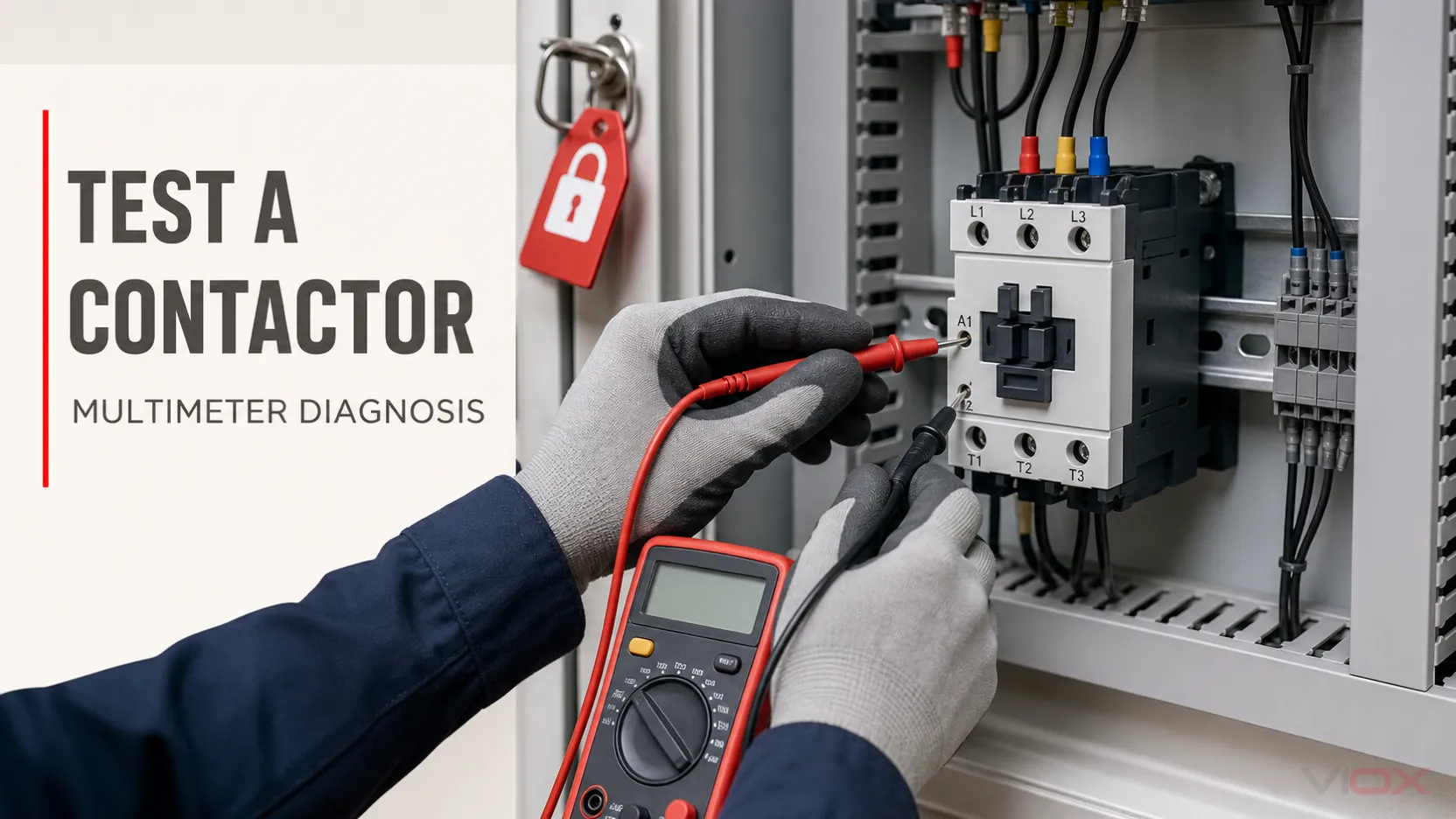
To test a contactor with a multimeter, isolate power, measure the coil at A1–A2, and check the main and auxiliary contacts. If a live check is authorized, measure control voltage across A1 and A2 during the command. Together, the results separate coil, contact, mechanism, and control faults.
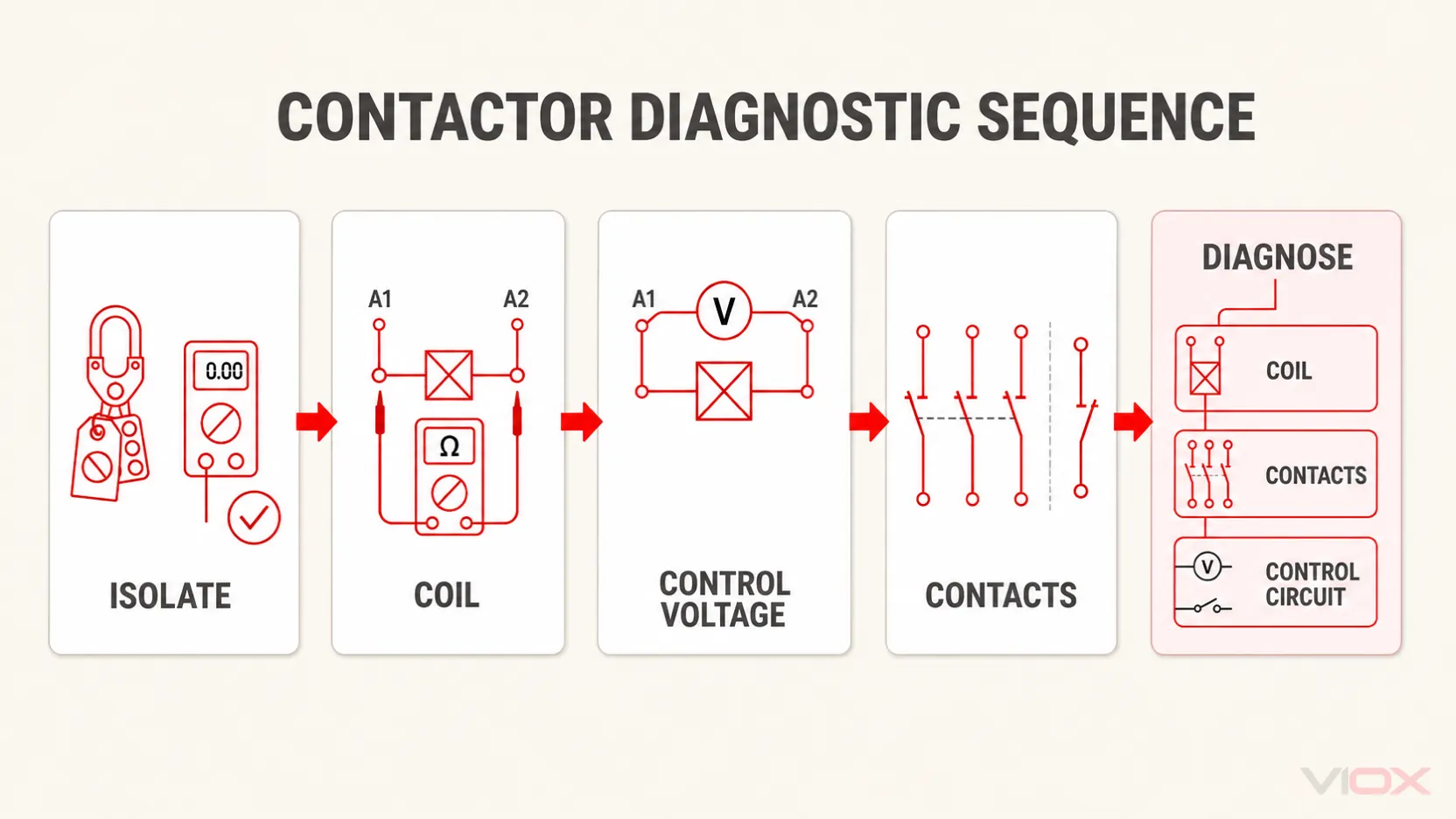
The reliable sequence is:
Identify → Isolate → Inspect → Test the coil → Verify control voltage → Test main contacts → Test auxiliary contacts → Diagnose
Safety: Resistance and continuity measurements must be made on a de-energized circuit. Energized testing inside a panel exposes personnel to shock and arc-flash hazards and should be performed only by qualified electrical workers under the site's approved procedure, using properly rated instruments and PPE.
Key Takeaways
- A coil resistance reading alone cannot prove that the whole contactor is healthy.
- An open-circuit reading across A1–A2 usually indicates an open coil, but there is no universal “correct” resistance for every contactor.
- Check control voltage across A1 and A2—not from A1 to an arbitrary ground point.
- A contactor can pull in normally and still have damaged main contacts, faulty auxiliary contacts, or poor terminals.
- Separate a contactor fault from an overload, interlock, PLC output, control transformer, or wiring fault before replacing the device.
Quick Contactor Diagnostic Matrix
| Symptom | Meter mode | Test points | Result pattern | Likely direction |
|---|---|---|---|---|
| Contactor will not pull in | Resistance, power off | A1–A2 | OL/open circuit | Open coil or disconnected coil lead |
| Contactor will not pull in | AC or DC volts, commanded on | Across A1–A2 | No or incorrect voltage | Upstream control-circuit fault |
| Contactor hums or chatters | Voltage, commanded on | Across A1–A2 | Low or unstable voltage | Supply, wiring, interlock, or coil-rating problem |
| Contactor pulls in; load stays off | Continuity/resistance, power off | L1–T1, L2–T2, L3–T3 | Contact does not change state | Worn, damaged, or mechanically obstructed main contact |
| Control feedback is wrong | Continuity, power off | Marked NO/NC auxiliary pair | State does not change correctly | Auxiliary block or mechanism fault |
| Terminal runs hot | Visual inspection; voltage-drop test only if authorized | Relevant terminal/contact path | Heat damage, looseness, or abnormal drop | Poor termination or high-resistance connection |
Use the matrix with the device schematic and manufacturer limits; markings and normal states can differ.
What You Need Before Testing
Use a correctly CAT-rated multimeter, sound probes, the schematic, and the contactor datasheet. Record coil voltage, AC/DC type, polarity, terminals, internal electronics, and any external suppressor. If needed, review what a contactor is.
Do not assume that every three-pole contactor uses identical labels. Many use L1/L2/L3 on the line side and T1/T2/T3 on the load side, while coil terminals are commonly A1 and A2. Confirm the markings on the actual device.
Step 1: Record the Symptom and Nameplate Data
Record whether the contactor:
- does not pull in;
- pulls in but does not energize the load;
- chatters, hums, or drops out;
- remains closed after the command is removed;
- operates intermittently; or
- shows localized overheating.
Compare the nameplate with the control circuit; a replacement can have the right current rating but the wrong coil voltage or frequency. Identify series overload, emergency-stop, permissive, PLC, and interlock contacts.
Step 2: Isolate Power and Verify Absence of Voltage
Open all power and control sources, apply lockout/tagout, and account for backfeeds or stored energy. Prove the test instrument, verify absence of voltage, and recheck the instrument according to site practice.
Disconnect a coil conductor when parallel paths could distort resistance. Isolate alternate paths through loads, transformers, suppressors, or feedback circuits, and label removed conductors.
Step 3: Inspect the Device, Wiring, and Mechanism
Look for housing damage, loose conductors, overheated insulation, damaged lugs, contamination, blocked movement, a miswired suppressor, or unseated accessories.
Do not condemn a contactor from color or roughness alone. Contact faces can discolor through normal switching. Use the manufacturer's wear indicator or replacement criteria. Do not file or grind contacts unless the manufacturer explicitly permits it.
Remove a heat-damaged, binding, or welded contactor from service rather than repeatedly energizing it.
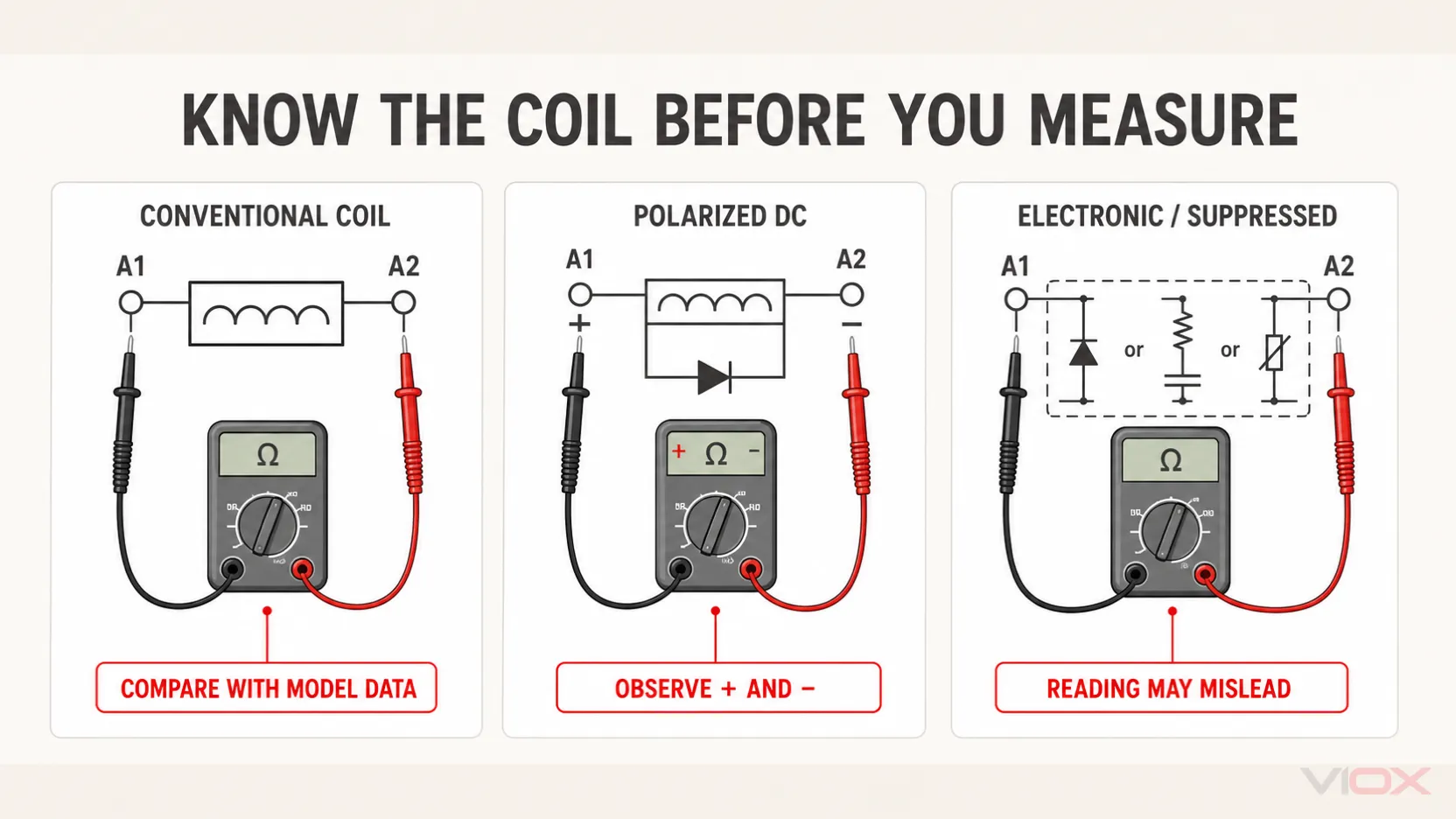
Step 4: Test the Contactor Coil at A1 and A2
With the circuit isolated and the coil separated from misleading parallel paths:
- Set the multimeter to resistance.
- Place one probe on A1 and the other on A2.
- Allow the reading to stabilize.
- Compare it with the manufacturer's data, an identical known-good unit, or a documented baseline for that exact model and coil code.
Interpret the reading carefully:
- OL or infinite resistance: the winding or an internal connection is probably open.
- Finite resistance: the winding is continuous, but this does not prove that it will generate adequate magnetic force or remain stable in service.
- Unexpectedly low resistance: the coil may be damaged, but confirm the specified value, lead compensation, connected suppression components, and test setup before deciding.
- Unstable reading: check probe contact, terminals, removable coil connections, and temperature effects before blaming the winding.
Before testing, identify the coil technology:
- Polarized DC coil: observe the marked
+and−terminals. A reverse connection may be blocked by an internal diode or may damage an electronic coil or suppression device. - Electronically controlled coil: a resistance or continuity reading may not represent the winding and can vary with meter polarity. Follow the manufacturer's diagnostic method.
- Surge suppressor fitted: a diode, resistor-capacitor network, metal-oxide varistor, or indicator module across A1–A2 can alter the reading. Disconnect an external module only when permitted, and restore its polarity and wiring correctly.
Do not apply an insulation-resistance tester across an electronic coil or suppression module unless its instructions explicitly allow it. There is no universal normal ohm value for a contactor coil. For an AC coil, a DC resistance test also does not reproduce energized impedance or armature effects; use it to find an open circuit or clear deviation, not to certify operation.
For more context on why coil behavior differs, see AC vs. DC contactors.
Step 5: Verify Control Voltage Across A1 and A2
If coil resistance is plausible but the contactor will not close, verify command voltage. Skip this energized measurement unless the worker, equipment state, risk assessment, instrument, and PPE are suitable.
With the contactor commanded on, measure across A1 and A2 and compare with the nameplate and manufacturer tolerance. A1-to-ground can show voltage even when the A2 return, overload contact, neutral, or interlock is open. Measuring across the coil tests its actual applied voltage.
- Correct voltage with no pull-in points to the coil, magnetic mechanism, or wrong coil rating.
- Missing voltage points upstream to wiring, protection, interlocks, outputs, transformer, or return conductor.
- Low or unstable voltage can cause incomplete closing, chatter, heat, and dropout; trace the control circuit first.
Step 6: Test the Main Contacts
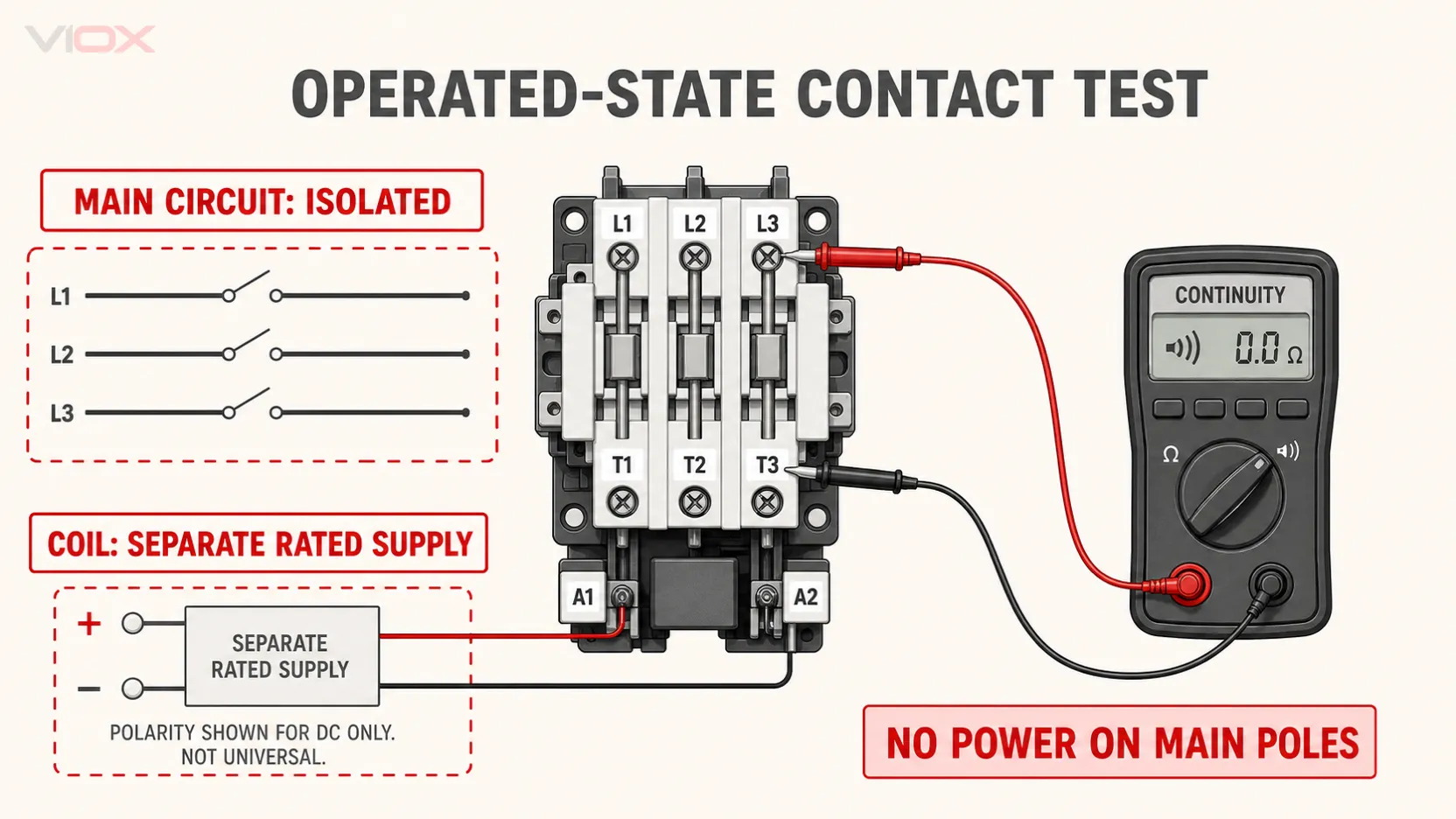
For every resistance or continuity check, isolate and verify absence of voltage in both the main power circuit and the control circuit. Prevent backfeed from loads, generators, variable-frequency drives, control transformers, or parallel circuits. Disconnect and label conductors when the schematic cannot prove an isolated test path. Never place a meter in resistance or continuity mode on an energized pole.
Identify each pole and check L1–T1, L2–T2, and L3–T3, or the actual device markings. A standard normally open main pole should read open at rest.
To test the operated state, keep the main circuit fully de-energized and isolated from every source while the coil is operated separately under an approved manufacturer or controlled bench procedure. Use only the coil's rated supply and observe polarity. Do not use the installed control circuit unless its isolation and operating procedure are specifically established, and do not force an inaccessible armature. Closed poles should show a stable path; an open or intermittent pole indicates a contact, linkage, or test-path problem.
A continuity beep is only a screening test and may miss excessive resistance under load. If overheating or single-phasing is suspected, qualified personnel may need comparative pole voltage-drop, current, or thermal measurements under controlled conditions.
Step 7: Test Auxiliary Contacts and Mechanical Action
Using the printed diagram, verify each normally open and normally closed auxiliary contact at rest and when operated. A failed PLC feedback or holding contact can stop a machine while the main poles remain functional.
Confirm full travel and prompt release. Binding, contamination, weak return action, or misaligned accessories can mimic an electrical fault; coil continuity cannot rule out a jam.
Step 8: Decide Whether the Contactor or the Surrounding Circuit Has Failed
Combine the measurements instead of making the decision from one result.
| Findings | Diagnosis direction | Next action |
|---|---|---|
| Open coil; wiring and voltage source otherwise correct | Failed coil | Replace the coil assembly if approved and economical, or replace the contactor |
| Coil plausible; no command voltage across A1–A2 | Control-circuit fault | Trace fuse, overload, E-stop, interlocks, output device, transformer, and return path |
| Correct voltage; coil does not pull in | Coil, magnetic assembly, wrong rating, or mechanical obstruction | Confirm model data; replace defective device |
| Clean pull-in; one main pole remains open or intermittent | Main-contact or linkage fault | Replace contactor or approved contact kit |
| Main poles switch; auxiliary feedback does not | Auxiliary contact/block fault | Reseat or replace approved auxiliary component |
| Chatter with low or unstable A1–A2 voltage | Control-supply or wiring problem | Correct voltage loss or unstable command before replacing contactor |
| Welded contacts, severe heat damage, or unreliable release | Unsafe end-of-life condition | Isolate and replace; inspect protection and load conditions |
For replacement, match coil, utilization category, operational current, poles, auxiliaries, duty, and protection coordination. Then review the VIOX AC contactor range or motor-power selection guide.
Frequently Asked Questions
How do you test a contactor with a multimeter?
Isolate power, measure the coil at A1–A2, and check main and auxiliary contacts at rest and when operated. If authorized, measure control voltage across A1–A2 during the close command.
What resistance should a contactor coil have?
No single value applies to all coils. Compare with manufacturer data or an identical coil code. An open reading suggests a broken winding; finite resistance proves continuity only.
How do you test a three-phase contactor?
Test A1–A2, then each main pole—typically L1–T1, L2–T2, and L3–T3. Every pole must show the correct rest state and change consistently. Test control-circuit auxiliaries too.
Can a contactor coil test good but the contactor still be bad?
Yes. The main contacts may be worn or welded, an auxiliary contact may fail, the mechanism may bind, or a terminal may have excessive resistance. A resistance test only shows that the coil winding has a conductive path.
Why is there voltage at A1 but the contactor does not pull in?
An A1-to-ground measurement does not prove that voltage exists across the coil. Measure across A1 and A2. An open overload contact, interlock, neutral, or return conductor can leave a misleading voltage at A1 without providing a complete coil circuit.
Does a continuity beep prove the main contacts are good?
No. It confirms a conductive path at the meter's small test current. It does not prove acceptable performance under load. Intermittent readings, uneven pole behavior, overheating, or excessive voltage drop require further controlled diagnosis.
When should a contactor be replaced?
Replace it when the coil is open and not serviceable, contacts are welded or unreliable, the housing is heat-damaged, the mechanism is inconsistent, or the manufacturer's wear limit is reached. Correct upstream voltage, load, termination, and protection faults before fitting the replacement.
Technical References
- IEC 60947-4-1:2023, Edition 5.0 (corrected version 2026-03): Low-voltage switchgear and controlgear—electromechanical contactors and motor-starters
- ABB: Contactor inspection and maintenance guidance
- Schneider Electric: Contactor troubleshooting guidance
- Schneider Electric: Effects of low control voltage on contactors
- Eaton: Freedom/FlashGard motor control center installation and maintenance manual