

Bu sayfada
MCCB trip unit codes identify protection functions and adjustment options within a manufacturer’s product range. The ABB SACE examples below distinguish thermal-magnetic, generator and magnetic-only releases. Read each designation against the exact supplier catalogue; replacement suitability depends on the complete breaker/release combination.
The useful questions are: which protection functions are present, which pickups are adjustable, and what exact breaker/release combination does the documentation cover? Keep those questions separate from selecting the actual setting.
ABB SACE Trip Unit Codes: Protection and Adjustability
This lookup follows ABB SACE’s May 2016 Tmax technical catalogue, printed section 2/5, and the earlier Tmax catalogue 1SDC210004D0203, printed sections 2/7-2/10. It describes those catalogue examples; other manufacturers have their own systems, and current availability requires the applicable series documentation.
| ABB SACE code | Protection present | Thermal pickup | Magnetic pickup |
|---|---|---|---|
| TMF | Thermal and magnetic | Sabit | Sabit |
| TMD | Thermal and magnetic | Ayarlanabilir | Sabit |
| TMA | Thermal and magnetic | Ayarlanabilir | Ayarlanabilir |
| TMG | Thermal and magnetic; generator application | Check exact variant | Check exact variant; lower-pickup application |
| MA | Magnetic only | Sağlanmadı | Ayarlanabilir |
| MF | Magnetic only | Sağlanmadı | Sabit |
After identifying the function, check the exact current range and characteristic in the relevant datasheet.
Catalogue example: the earlier Tmax catalogue’s T5 TMA has a thermal setting range of 0.7-1 × In at a 40°C reference temperature and a magnetic setting range of 5-10 × In (printed section 2/10). Here, In is the catalogue’s release-current reference. These are that model’s adjustment ranges, not universal definitions of TMA or recommended settings for a load.
Thermal and Magnetic Protection: What Can Be Adjusted?
Thermal protection addresses sustained overload through an inverse-time response: higher overload current generally produces shorter operating time within the applicable characteristic. Magnetic protection addresses high overcurrent through an instantaneous release, meaning no intentional time delay rather than literally zero operating time.
TM commonly indicates thermal-magnetic protection. For longer designations, use the manufacturer’s stated function rather than guessing a word for each suffix letter.
The cited product systems use MA for magnetic-only releases; the catalogue also establishes their adjustment capability.
For the device’s overall construction and operation, see the MCCB tanımı ve çalışma prensibi kılavuzunu.
Two adjustment axes explain the thermal-magnetic options
For the ABB SACE examples above, map thermal and magnetic pickup adjustability independently:
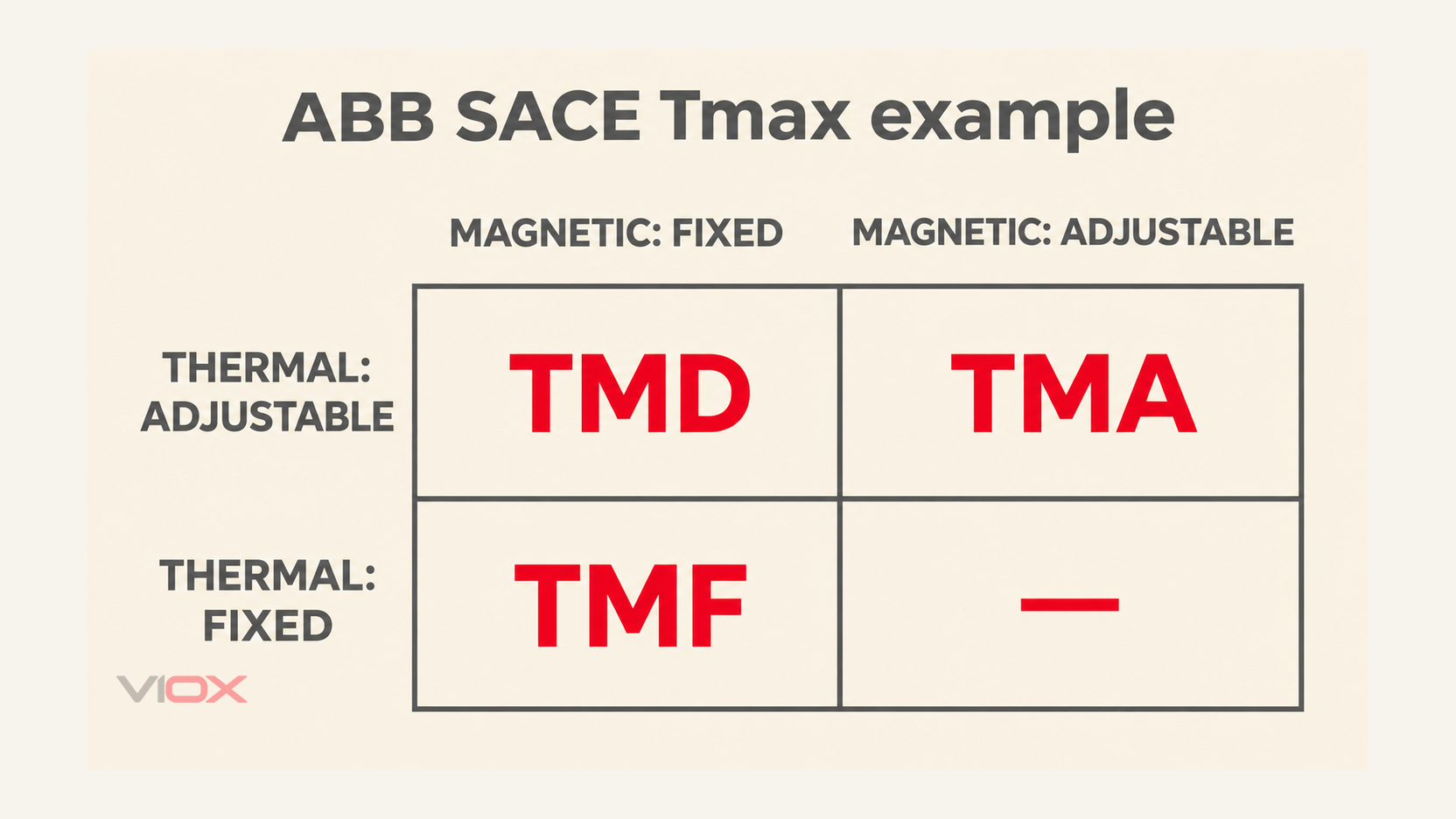
Adjustment capability lets an engineer match the pickup to permitted load transients while preserving fault protection. Motor starting and transformer energization are reasons to examine that fit. A suitable fixed release can also meet the duty; the decision comes from the full characteristic and available fault current.
Ayrı olanı kullanın MCCB trip unit settings guide and the exact manufacturer’s instructions for pickup symbols and setting decisions.
ABB SACE vs Schneider ComPacT NSX: Code Differences
Schneider Electric'in ComPacT NSX thermal-magnetic summary, DOCA0187EN-04 illustrates how similar labels can describe different adjustment options. Compare its function table with the cited ABB SACE catalogues:
| Koruma rolü | ABB SACE Tmax examples | Schneider ComPacT NSX summary |
|---|---|---|
| Distribution thermal-magnetic | TMD: thermal pickup adjustable; magnetic pickup fixed | TM-D: thermal pickup adjustable; magnetic pickup fixed or adjustable according to rating |
| Generator thermal-magnetic | TMG: T3 magnetic pickup fixed; T5 magnetic pickup adjustable | TM-G: magnetic pickup fixed in the cited summary |
| Magnetic-only | MA: no thermal protection; magnetic pickup adjustable | MA: no thermal protection; magnetic pickup adjustable |
Matching functions are only the first replacement check. Compare pickup ranges, operating curves and the approved breaker/release combination, recording the series, breaker frame and release reference.
For the broader technology choice, see thermal-magnetic versus electronic-trip MCCBs.
IEC 60947-2 and Manufacturer Trip Unit Designations
IEC 60947-2:2024 covers industrial circuit-breakers and their performance requirements. A supplier’s code tells you which release to investigate; its time-current characteristic shows the overload and instantaneous operating bands for the stated conditions.
Separate the adjustment range gücü gerçekten kontrol eden operating tolerance: the range identifies selectable pickup values, while the tolerance describes permitted variation around a stated setting. Read the characteristic’s reference current, temperature and test conditions when comparing releases.
For replacement review, compare the complete characteristic and permitted settings, then check rated voltage/current, ultimate short-circuit breaking capacity (Icu) ve service short-circuit breaking capacity (Ics) at the intended voltage, plus assembly compatibility. Matching a suffix or pickup multiplier alone leaves these checks unresolved.
TMG Generator Releases: Pickup and Model Differences
In the cited earlier ABB SACE Tmax catalogue, T3 TMG has adjustable thermal protection and a fixed magnetic threshold; T5 TMG has both thresholds adjustable. The documented T5 TMG magnetic range is 2.5-5 × In, using the release-current reference defined in that catalogue. This is a model-specific example; other manufacturers and variants require their own data.
Why might generator protection need a lower magnetic pickup? A synchronous generator’s fault-current contribution can change substantially as subtransient and transient conditions develop. Its excitation system also matters, as explained in ABB’s Generator Protection Fundamentals, slide 21.
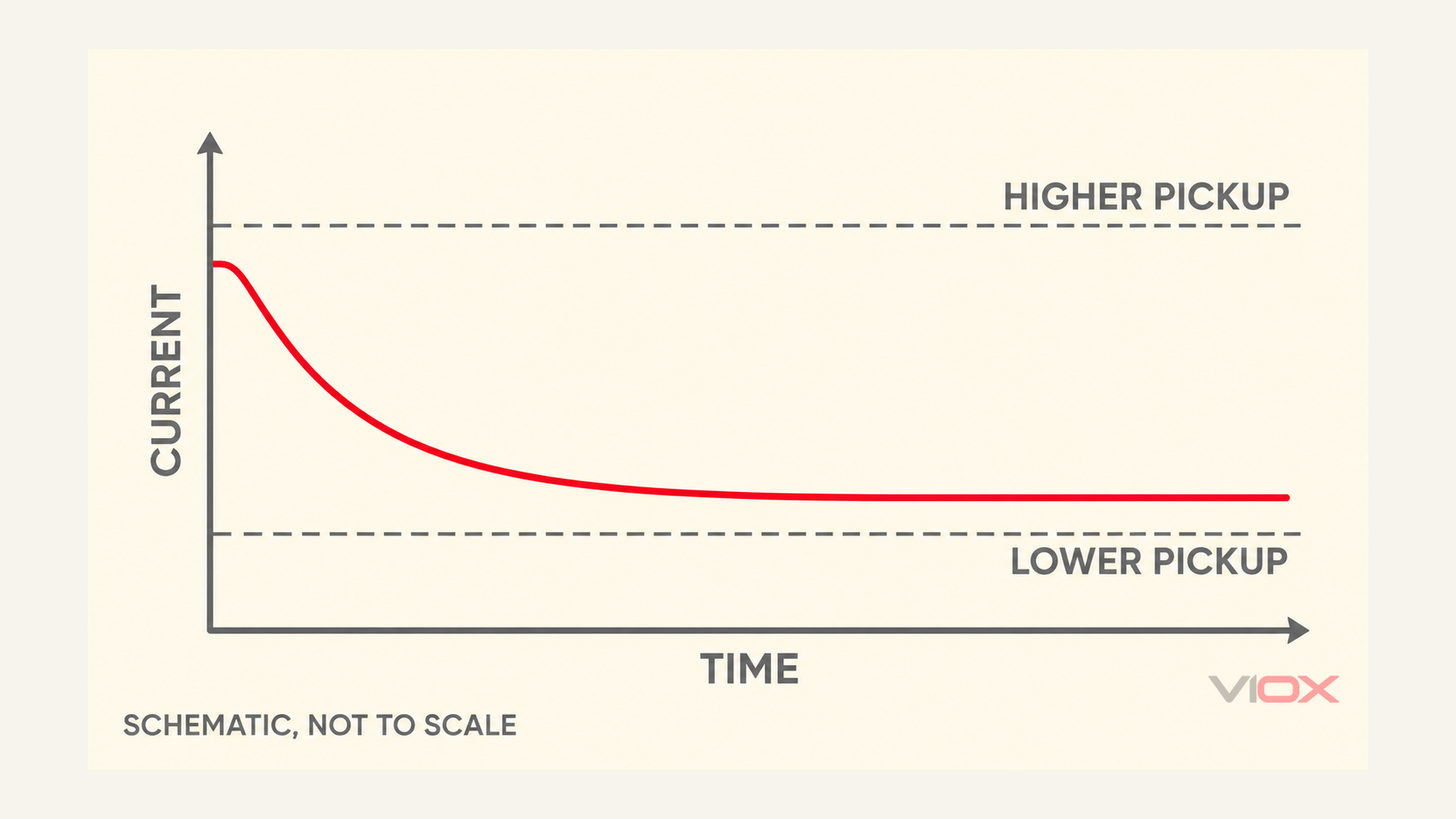
A high instantaneous pickup may not be reached by the available fault current, or the current may fall below it before the particular protection operates. But a high initial current can also cause early operation. Neither the initial peak nor a simplified decay sketch is enough to decide the outcome.
The engineering task is to compare the generator’s relevant fault-decrement information with the exact protective characteristic and equipment limits. A lower pickup must also be checked against permitted load transients; “lower” is not automatically correct.
A long feeder creates a different reason to examine pickup: line impedance can reduce the available fault current at its far end. Check that reduced fault current against the required operating characteristic.
MA vs MF: Magnetic-Only Protection and Overload Requirements
In the ABB SACE definitions cited above, MA has adjustable magnetic protection and MF has fixed magnetic protection. Both omit thermal overload protection.
A coordinated motor circuit can provide overload protection through another suitable device, such as an overload relay. Select the breaker, contactor and overload device as a documented compatible combination. Compare the motor’s starting-current profile with the breaker’s characteristic using the correct current reference and peak versus root-mean-square (RMS) basis; a motor-current multiple cannot be copied directly into a breaker setting. ABB’s motor-starter guide, sections 3.2.3.3 and 3.2.6, explains the starting-current stages and influencing factors.
Changing from thermal-magnetic to magnetic-only protection therefore requires an explicit check of where overload protection is provided in the circuit.
Can an MCB Also Carry an MA Designation?
Yes. Common household thermal-magnetic MCBs use familiar characteristic letters, while special products can have other designations. Schneider’s official Acti9 iC60L MA example is a miniature breaker with magnetic trip technology. Read the product class and protection function together. For the distinction between familiar letter bands and MCCB characteristic documentation, see why MCCBs do not use standard B/C/D bands.
Turn an Unfamiliar Designation Into a Checkable Specification
Use this identification sequence:
- Identify the exact source. Record the manufacturer, series, breaker reference and release reference. Keep the catalogue revision with the record, especially for legacy equipment.
- Identify the functions. Confirm whether overload and instantaneous protection are present. Record any protection that must be supplied elsewhere in the circuit.
- Identify the available adjustments. Obtain each pickup’s fixed value or permitted range, its reference current and the applicable operating characteristic. Do not assume the frame rating is the multiplier base.
- Verify the proposed combination. Check electrical duty and assembly compatibility before treating another breaker or release as a replacement. Similar naming is not evidence of fit or protective equivalence.
A useful release-identification record is short:
Manufacturer / series:
Breaker reference / release reference:
Overload function present:
Instantaneous function present:
Fixed pickups / permitted adjustment ranges:
Reference current and characteristic document:
Catalogue revision / compatibility evidence:
For the other markings needed in that record, use the MCCB nameplate-reading guide. Use the completed record with the exact series documentation when reviewing a replacement.
For VIOX equipment, use the MCCB ürün kategorisi to identify the relevant series. Include the exact model and required protection functions when requesting release documentation or selection support.
Kaynaklar
- IEC 60947-2:2024 official scope and publication details.
- ABB SACE Tmax catalogue, 1SDC210004D0203: earlier catalogue marked Preliminary; printed sections 2/7-2/10 and 2/23.
- ABB SACE Tmax technical catalogue, May 2016, 1SDC210015D0208: printed section 2/5.
- Schneider Electric ComPacT NSX thermal-magnetic summary: DOCA0187EN-04.
- ABB Generator Protection Fundamentals: qualitative generator fault-current behavior, slide 21.
- Schneider Electric Acti9 iC60L MA product example: magnetic-only miniature-breaker boundary.
- ABB Manual Motor Starter Guide: sections 3.2.3.3 and 3.2.6, motor-starting current profile and influencing factors.