Introduction: Material Selection Determines Junction Box Longevity
When specifying electrical enclosures for challenging environments, the junction box material choice directly impacts system reliability, maintenance costs, and operational safety. For procurement managers and electrical engineers, understanding the corrosion resistance differences between stainless steel and aluminum junction boxes is critical for long-term asset protection.
VIOX Electric, a leading B2B manufacturer of electrical equipment, has conducted extensive field testing across marine, industrial, and chemical processing environments. Our research demonstrates that while both materials offer superior corrosion resistance compared to standard steel, their performance characteristics vary significantly based on environmental exposure, chemical composition, and operating conditions.
This comprehensive analysis examines the metallurgical properties, corrosion mechanisms, and real-world performance of stainless steel versus aluminum junction boxes. We provide data-driven recommendations to help you select the optimal enclosure material for your specific application requirements.
Understanding Corrosion in Electrical Enclosures
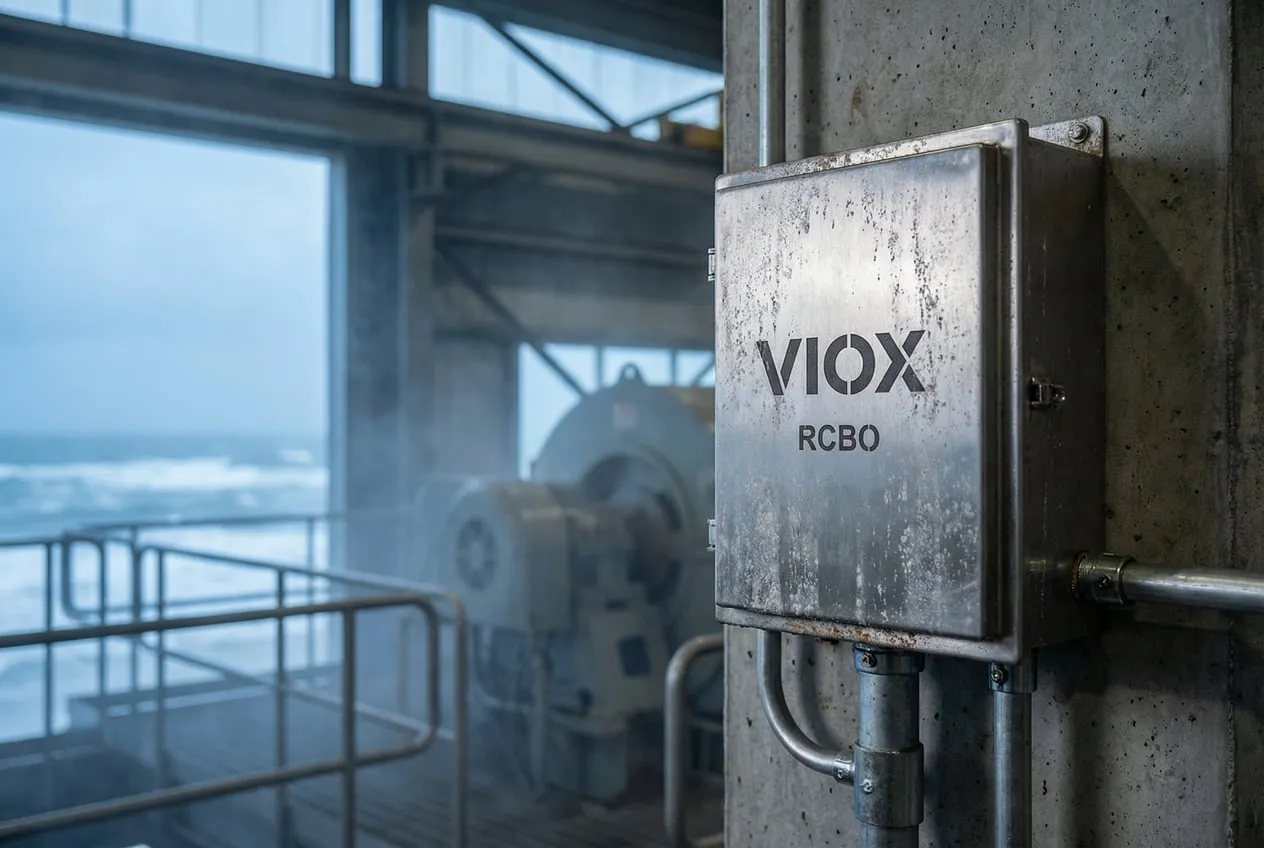
Corrosion represents the primary failure mode for junction boxes in outdoor and industrial applications. The degradation process occurs when metal reacts with environmental elements—moisture, oxygen, chlorides, and chemical contaminants—leading to structural weakening and potential electrical hazards.
Primary Corrosion Mechanisms
- Uniform Corrosion: Occurs across the entire metal surface when exposed to moisture and oxygen. Both stainless steel and aluminum develop protective oxide layers that significantly reduce this corrosion type.
- Pitting Corrosion: Localized corrosion creating small cavities or “pits” in the metal surface. Particularly problematic in chloride-rich environments like coastal installations or deicing salt exposure.
- Galvanic Corrosion: Develops when dissimilar metals contact in the presence of an electrolyte. This consideration becomes critical when mounting junction boxes with fasteners or connecting to different metal conduit systems.
- Crevice Corrosion: Forms in confined spaces where oxygen concentration differs from the bulk environment—under gaskets, at mounting points, or within threaded connections.
Understanding these mechanisms helps explain why material selection must align with specific environmental conditions rather than following a one-size-fits-all approach.
Stainless Steel Junction Boxes: Properties and Performance
Stainless steel junction boxes utilize chromium-enriched steel alloys that form a self-healing passive layer, providing exceptional corrosion resistance across diverse environments.
Metallurgical Composition
- Type 304 Stainless Steel: Contains 18% chromium and 8% nickel. Provides excellent general corrosion resistance for most industrial applications. Suitable for NEMA 4X and IP66/IP67 rated enclosures in non-marine environments.
- Type 316/316L Stainless Steel: Adds 2-3% molybdenum to the 304 composition. This molybdenum addition dramatically enhances resistance to chloride-induced pitting and crevice corrosion. Designated as “marine-grade” stainless steel, 316L is the preferred specification for coastal installations, offshore platforms, and chemical processing facilities.
Corrosion Protection Mechanisms
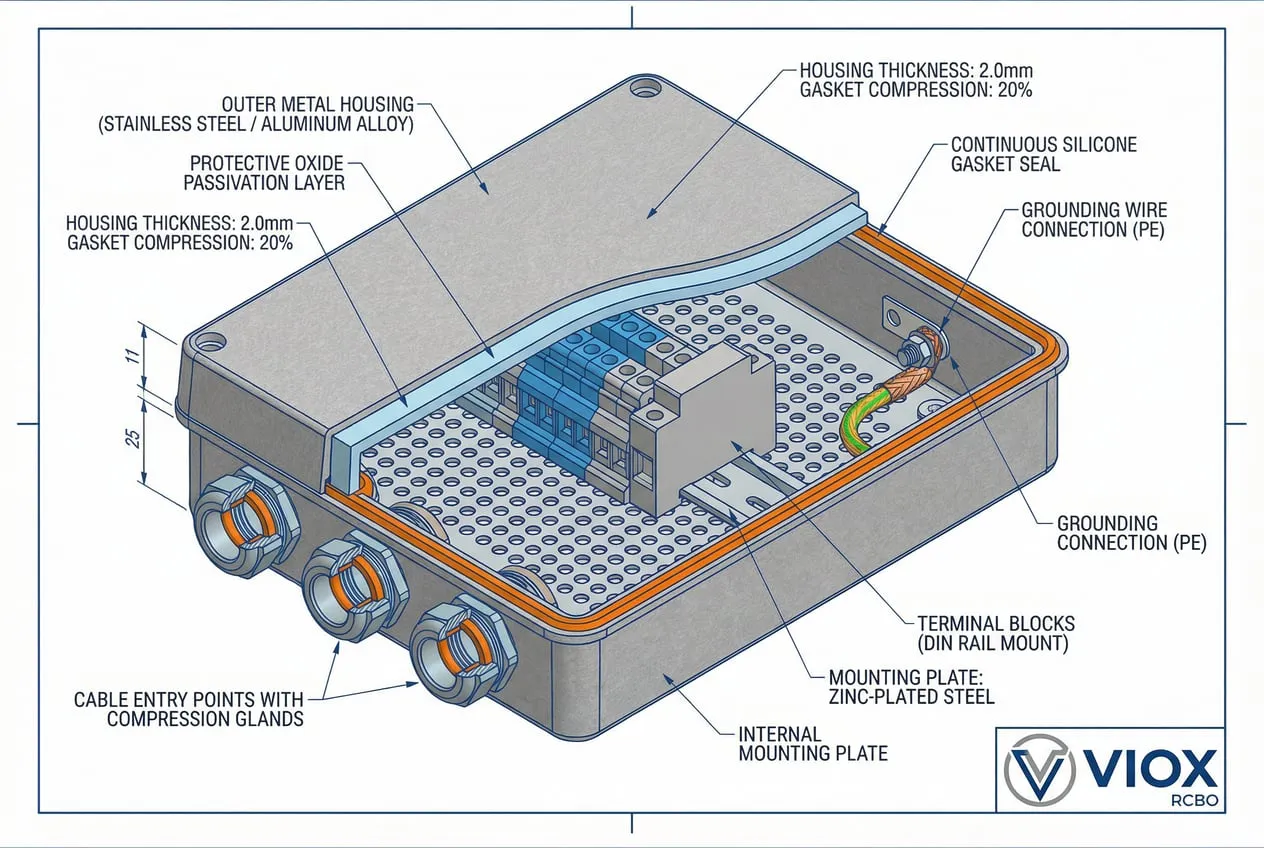
The chromium content in stainless steel reacts with oxygen to form a transparent chromium oxide layer (Cr₂O₃) approximately 1-5 nanometers thick. This passive film demonstrates self-healing properties—when scratched or damaged, it reforms spontaneously in the presence of oxygen.
This passivation layer provides:
- Continuous protection without coating requirements
- Resistance to sulfuric, sulfurous, and acetic acids
- Superior performance in high-humidity environments
- Excellent resistance to industrial solvents and chemicals
Performance Characteristics
- Structural Strength: Stainless steel junction boxes offer superior mechanical protection with high tensile strength (505-860 MPa for 304/316 grades). This rigidity makes them ideal for high-impact applications or installations subject to physical abuse.
- Temperature Tolerance: Maintains structural integrity from -40°C to +120°C, with some grades rated for continuous operation up to 870°C. This wide temperature range suits both cryogenic and high-heat applications.
- Fire Resistance: Non-combustible construction provides inherent fire protection, containing sparks and arcing during electrical faults. Critical for compliance with building codes in commercial and industrial installations.
- EMI/RFI Shielding: The conductive metal housing provides effective electromagnetic interference shielding, protecting sensitive electronic components from radio frequency interference.
Aluminum Junction Boxes: Properties and Performance
Aluminum junction boxes leverage the metal’s natural corrosion resistance, lightweight construction, and excellent thermal conductivity for diverse electrical applications.
Alloy Specifications
- 5052 Aluminum Alloy: The industry standard for junction box fabrication. Contains 2.5% magnesium and 0.25% chromium, providing excellent corrosion resistance while maintaining good formability. Designated as “marine-grade aluminum” due to exceptional saltwater resistance.
- 6061 Aluminum Alloy: Offers higher mechanical strength with magnesium and silicon additions. Used for heavy-duty industrial enclosures requiring superior structural rigidity.
Natural Corrosion Protection
Aluminum forms a protective aluminum oxide layer (Al₂O₃) within milliseconds of exposure to air. This oxide layer exhibits:
- 3-5 nanometer thickness in natural conditions
- Self-healing properties similar to stainless steel
- Exceptional resistance to atmospheric corrosion
- Superior performance in saltwater environments
Anodizing Enhancement
Anodized aluminum junction boxes feature a controlled electrochemical process that increases oxide layer thickness to 5-25 micrometers, providing:
- Enhanced corrosion resistance in aggressive environments
- Improved surface hardness and abrasion resistance
- Colored finish options for identification and aesthetics
- UV stabilization for long-term outdoor exposure
Aluminum Advantages
- Weight Reduction: Aluminum weighs approximately 35% of equivalent steel components, reducing structural loading requirements and simplifying installation in elevated locations or crowded cable trays.
- Thermal Conductivity: Aluminum’s thermal conductivity (205 W/m·K) exceeds stainless steel (16 W/m·K) by more than 10x, providing superior heat dissipation for junction boxes housing power distribution components or high-current connections.
- Cost Efficiency: Raw material costs typically run 20-40% lower than stainless steel, though this advantage narrows for specialized marine-grade alloys.
- Saltwater Superiority: The 5052 alloy’s magnesium content provides exceptional resistance to chloride-induced corrosion, often outperforming even 316 stainless steel in direct seawater exposure.
Head-to-Head Material Comparison
The following comprehensive analysis compares critical performance parameters for industrial junction box selection.
Core Material Properties Comparison
| Property | Stainless Steel 316L | Aluminum 5052 | Significance |
|---|---|---|---|
| Density | 8.0 g/cm³ | 2.68 g/cm³ | Aluminum 66% lighter |
| Tensile Strength | 485-690 MPa | 193-290 MPa | Stainless 2.4x stronger |
| Yield Strength | 170-310 MPa | 65-195 MPa | Higher impact resistance |
| Thermal Conductivity | 16.3 W/m·K | 138 W/m·K | Aluminum 8.5x better heat dissipation |
| Thermal Expansion | 16.5 µm/m·°C | 23.8 µm/m·°C | Stainless more dimensionally stable |
| Electrical Conductivity | 1.45 MS/m | 17.0 MS/m | Better grounding performance |
| Modulus of Elasticity | 193 GPa | 70 GPa | Stainless resists deformation |
| Corrosion Potential | -0.05V (SCE) | -0.85V (SCE) | Affects galvanic coupling |
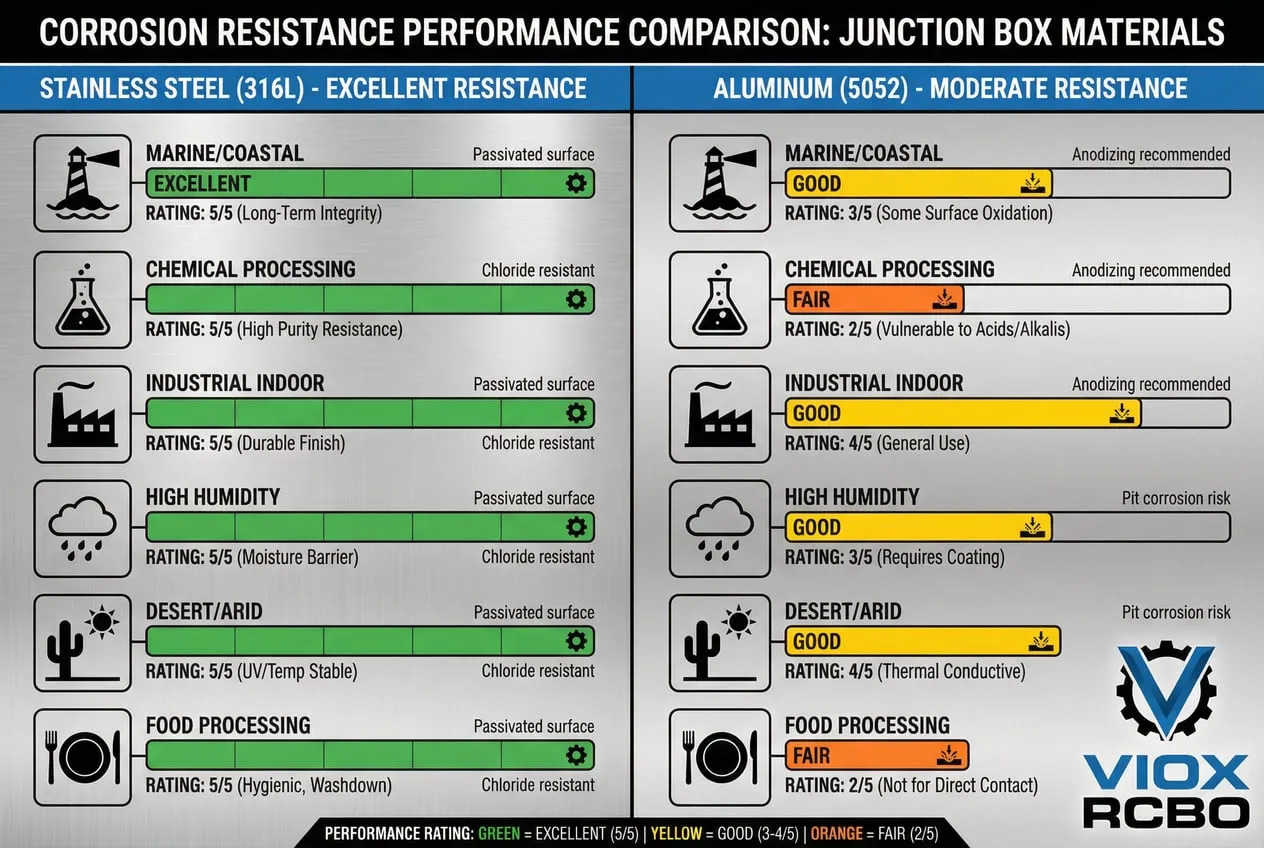
Corrosion Resistance by Environment
| Environment Type | Stainless Steel 316L | Aluminum 5052 | Recommended Material |
|---|---|---|---|
| Coastal/Marine (direct saltwater) | Excellent | Outstanding | Aluminum (coated) |
| Coastal/Marine (salt spray) | Excellent | Excellent | Either (aluminum cost advantage) |
| Industrial indoor | Excellent | Very Good | Either (cost-dependent) |
| Chemical processing | Outstanding | Good-Fair | Stainless (acid resistance) |
| Food/pharmaceutical | Outstanding | Good | Stainless (cleanability) |
| High humidity (non-marine) | Excellent | Excellent | Either (cost-dependent) |
| Desert/arid | Excellent | Excellent | Aluminum (weight advantage) |
| Urban/suburban outdoor | Excellent | Excellent | Either (aluminum cost advantage) |
| Cryogenic applications | Excellent | Very Good | Stainless (strength retention) |
| High-temperature (>150°C) | Outstanding | Fair | Stainless |
Environmental Performance Ratings
- IP Rating Achievement: Both materials readily achieve IP65, IP66, IP67, and IP68 ratings when properly gasketed and sealed. Material choice does not limit ingress protection capability.
- NEMA Rating Compliance: Stainless steel and aluminum junction boxes meet NEMA 4, 4X, 6, and 6P requirements. NEMA 4X specifically addresses corrosion resistance, where both materials excel but through different mechanisms.
Application-Specific Material Recommendations
Marine and Coastal Installations
Optimal Choice: Aluminum 5052 (anodized or powder-coated)
Marine environments present the most aggressive corrosion challenge due to chloride concentration, high humidity, and salt spray. Research from marine equipment manufacturers demonstrates that properly coated aluminum outperforms stainless steel in direct saltwater immersion scenarios.
Critical Considerations:
- Specify powder-coated finish for enhanced UV and abrasion resistance
- Use stainless steel fasteners with dielectric isolation washers
- Ensure proper drainage design to prevent water accumulation
- Select junction boxes with continuous gasket seals rated for marine service
Applications: Offshore oil platforms, coastal infrastructure, port facilities, marine vessels, dock electrical systems, beach lighting installations.
Chemical Processing Facilities
Optimal Choice: Stainless Steel 316L
Chemical exposure requires consideration of specific corrosive agents. Stainless steel’s chromium-nickel-molybdenum composition provides superior resistance to acids, caustics, and industrial solvents.
Chemical Resistance Profile:
- Excellent: Sulfuric acid, nitric acid, phosphoric acid, acetic acid
- Good: Hydrochloric acid (dilute concentrations)
- Outstanding: Caustic solutions, bleaches, photographic chemicals
Applications: Petrochemical refineries, pharmaceutical manufacturing, pulp and paper mills, water treatment plants, industrial cleaning facilities.
Food and Beverage Processing
Optimal Choice: Stainless Steel 304/316L
FDA compliance and cleanability requirements favor stainless steel. The non-porous surface resists bacterial growth and withstands aggressive washdown procedures using hot water, steam, and sanitizing chemicals.
Regulatory Advantages:
- Meets FDA food contact surface requirements
- NSF International certified options available
- Resists staining from food products and cleaning agents
- Maintains aesthetic appearance through repeated cleaning cycles
Applications: Breweries, dairy processing, meat processing, commercial kitchens, beverage production lines.
Solar and Renewable Energy Installations
Optimal Choice: Aluminum 5052 (anodized)
Solar junction boxes benefit from aluminum’s lightweight construction, thermal management properties, and cost efficiency. The reduced weight simplifies roof mounting and minimizes structural loading.
Performance Benefits:
- Superior heat dissipation reduces thermal stress on connections
- UV-resistant anodized finishes withstand decades of sun exposure
- Lightweight construction reduces installation labor costs
- Excellent performance in desert environments with high UV and temperature extremes
Applications: Photovoltaic arrays, wind turbine control systems, solar farms, rooftop installations.
Industrial Automation and Control Systems
Optimal Choice: Application-dependent (typically aluminum for cost/weight)
Factory environments with controlled conditions allow either material selection based on cost optimization and specific exposure risks.
Decision Factors:
- Aluminum: General manufacturing, clean rooms, indoor installations
- Stainless Steel: Welding areas, metalworking, high-vibration environments
Applications: Manufacturing plants, warehouse automation, conveyor systems, robotic work cells, assembly lines.
Cost-Benefit Analysis
Understanding total cost of ownership requires examining initial purchase price, installation costs, maintenance requirements, and service life expectancy.
Initial Cost Comparison
| Cost Factor | Stainless Steel 316L | Aluminum 5052 | Cost Differential |
|---|---|---|---|
| Raw material (per kg) | $4.50-$6.50 | $2.80-$3.50 | Aluminum 35-45% lower |
| Fabrication complexity | Moderate-High | Low-Moderate | Aluminum easier to form |
| Standard junction box (6″×6″×4″) | $45-$75 | $28-$50 | Aluminum 30-40% lower |
| Large junction box (12″×12″×6″) | $120-$200 | $75-$130 | Aluminum 35-40% lower |
| Coating/finish options | Mill finish, electropolish | Anodized, powder coat | Comparable finishing costs |
Total Cost of Ownership Analysis
| Lifecycle Factor | Stainless Steel 316L | Aluminum 5052 | Winner |
|---|---|---|---|
| Initial purchase cost | Higher | Lower | Aluminum |
| Installation labor | Standard | 15-20% faster (weight) | Aluminum |
| Maintenance frequency | Minimal | Minimal | Tie |
| Coating maintenance | None required | Periodic inspection | Stainless |
| Expected service life (marine) | 25-30 years | 25-35 years (coated) | Tie |
| Expected service life (industrial) | 30-40 years | 25-35 years | Stainless |
| Replacement cost | Higher | Lower | Aluminum |
| Disposal/recycling value | Moderate | High | Aluminum |
Break-Even Analysis
For most industrial applications, aluminum junction boxes provide 25-35% lower total cost of ownership over a 20-year service life. However, stainless steel becomes cost-competitive in:
- High-temperature applications (>120°C) where aluminum cannot perform
- Extreme vibration environments where superior structural rigidity prevents fastener loosening
- Chemical exposure scenarios requiring specific acid resistance
- Food processing facilities where cleanability and FDA compliance justify premium pricing
Material Selection Guide by Industry
Oil and Gas
Primary Choice: Stainless Steel 316L (offshore), Aluminum 5052 (onshore)
Offshore platforms require 316L stainless steel for direct saltwater exposure and fire-rated zones. Onshore wellhead installations benefit from aluminum’s cost advantage in less aggressive environments.
Special Considerations: Explosion-proof ratings, hazardous location classifications (Class I, Division 1/2), fire-rated construction.
Water and Wastewater Treatment
Primary Choice: Aluminum 5052 (anodized)
Municipal water treatment facilities face moderate corrosive exposure from chlorination processes and high humidity. Anodized aluminum provides optimal cost-performance balance.
Special Considerations: Chemical resistance to chlorine, hypochlorite solutions, and pH variations. IP67/IP68 ratings for wet locations.
Data Centers and Telecommunications
Primary Choice: Aluminum (standard), Stainless Steel (coastal/high-humidity)
Controlled indoor environments allow aluminum junction boxes for cost optimization. Coastal data centers benefit from stainless steel’s superior humidity resistance.
Special Considerations: EMI shielding effectiveness, grounding reliability, thermal management for power distribution.
Mining and Heavy Industry
Primary Choice: Stainless Steel 316L
Mining operations present combined challenges: abrasive dust, chemical exposure from processing, high-vibration equipment, and outdoor exposure. Stainless steel’s mechanical strength and comprehensive corrosion resistance justify higher initial costs.
Special Considerations: Impact resistance, dust ingress protection (IP6X ratings), structural mounting strength.
VIOX Electric’s Junction Box Solutions
VIOX Electric manufactures comprehensive junction box solutions engineered for demanding industrial applications. Our product portfolio includes both stainless steel and aluminum options, each optimized for specific environmental challenges.
Material Specifications
Stainless Steel Junction Boxes:
- Type 316L marine-grade construction as standard
- Electropolished finish available for pharmaceutical/food processing
- Continuous gasket design achieving IP67/IP68 ratings
- NEMA 4X certification with UL listing
- Available in standard and custom configurations
- Heavy-duty mounting hardware included
Aluminum Junction Boxes:
- 5052 marine-grade alloy construction
- Class II anodized finish (25 μm) with UV stabilization
- Powder coating options for enhanced protection
- IP66/IP67 ratings across product range
- Lightweight design reduces installation costs
- Superior thermal management properties
Engineering Support
VIOX Electric provides comprehensive technical support for junction box selection:
- Environmental assessment: Analysis of installation conditions including temperature range, chemical exposure, humidity levels, and physical hazards
- Material recommendations: Data-driven guidance on optimal material selection based on total cost of ownership
- Custom fabrication: Engineering services for non-standard sizes, special mounting requirements, or unique environmental challenges
- Testing and certification: In-house testing capabilities for IP rating verification, salt spray resistance, and electrical performance validation
Quality Standards
All VIOX Electric junction boxes meet or exceed:
- UL 508A Industrial Control Panels
- IEC 60529 Ingress Protection standards
- NEMA 250 Enclosure specifications
- ISO 9001:2015 manufacturing quality systems
- RoHS compliance for environmental protection
Conclusion: Making the Right Material Choice
Selecting between stainless steel and aluminum junction boxes requires systematic evaluation of environmental conditions, performance requirements, and budget constraints. Neither material represents a universally superior choice—each excels in specific applications.
Choose Stainless Steel 316L when applications demand:
- Exceptional chemical resistance to acids and industrial solvents
- Maximum mechanical strength and impact resistance
- High-temperature operation above 120°C
- FDA compliance for food and pharmaceutical processing
- Cryogenic performance requirements
- Long-term performance in mixed chemical environments
Choose Aluminum 5052 when applications benefit from:
- Optimal saltwater and chloride corrosion resistance
- Lightweight construction for simplified installation
- Superior thermal management and heat dissipation
- Cost optimization with excellent corrosion protection
- UV resistance for long-term outdoor exposure
- Rapid heat cycling without thermal fatigue
For assistance with junction box material selection for your specific application, VIOX Electric’s engineering team provides comprehensive technical consultation. Our B2B focus ensures you receive industrial-grade products backed by extensive field experience and ongoing technical support.
Frequently Asked Questions
Q: Can stainless steel junction boxes rust in marine environments?
A: While 316L stainless steel offers excellent marine corrosion resistance, it can develop surface rust (“tea staining”) in extreme coastal conditions without regular maintenance. This superficial oxidation does not compromise structural integrity but affects aesthetics. Proper installation with adequate drainage and occasional freshwater rinsing maintains appearance. For direct saltwater immersion, anodized aluminum often provides superior long-term performance.
Q: How does powder coating affect aluminum junction box performance?
A: Powder coating adds significant corrosion protection by creating a barrier layer 50-100 micrometers thick over the natural aluminum oxide. This enhancement extends service life in industrial environments and provides color-coding options for identification. Quality powder coating should be applied over anodized aluminum for maximum adhesion and corrosion resistance. VIOX Electric uses electrostatically applied powder coatings cured at 200°C for optimal durability.
Q: What causes galvanic corrosion in junction box installations?
A: Galvanic corrosion occurs when dissimilar metals contact in the presence of an electrolyte (moisture). Common scenarios include stainless steel fasteners with aluminum enclosures or copper bus bars inside steel boxes. Prevention requires dielectric isolation washers, compatible fastener selection, or conductive grease barriers. The voltage potential difference between materials determines corrosion severity—aluminum-stainless steel combinations require careful attention to prevent accelerated aluminum degradation.
Q: Which material provides better EMI/RFI shielding performance?
A: Both stainless steel and aluminum provide effective electromagnetic interference shielding, but through different mechanisms. Stainless steel offers higher magnetic permeability for low-frequency magnetic field attenuation. Aluminum excels at high-frequency electric field shielding due to superior electrical conductivity. For most junction box applications involving 50/60 Hz power distribution, both materials provide adequate shielding. Critical RF applications may require specific material selection based on frequency range and attenuation requirements.
Q: How do I determine if my application requires NEMA 4X versus NEMA 4 rating?
A: NEMA 4 provides protection against water ingress, windblown dust, and external ice formation. NEMA 4X adds corrosion resistance requirements, making it necessary for coastal installations, chemical processing, or any location with corrosive atmospheric conditions. Both stainless steel 316L and anodized aluminum readily achieve 4X ratings. If your installation is within 5 miles of coastal saltwater, in an industrial area with chemical emissions, or subject to deicing salt exposure, specify NEMA 4X.
Q: What maintenance is required for outdoor junction boxes?
A: Properly specified junction boxes require minimal maintenance. Quarterly visual inspections should verify gasket integrity, fastener tightness, and coating condition. Annual detailed inspections include opening enclosures to check for moisture ingress, connection tightness, and internal corrosion. Coastal installations benefit from periodic freshwater rinsing to remove salt accumulation. Stainless steel requires no coating maintenance, while powder-coated aluminum may need touch-up repairs in high-abrasion areas after 10-15 years.
Q: Can I use aluminum junction boxes in hazardous locations?
A: Yes, aluminum junction boxes are approved for hazardous location installations when properly rated for the specific environment. Class I, Division 1 and 2 locations (flammable gases) require explosion-proof construction meeting NEC Article 500 requirements. Many aluminum junction boxes carry UL 1203 (explosion-proof) and CSA C22.2 certifications. Verify that the specific enclosure model includes appropriate hazardous location certifications for your application. Aluminum offers advantages in weight-sensitive installations like offshore platforms.