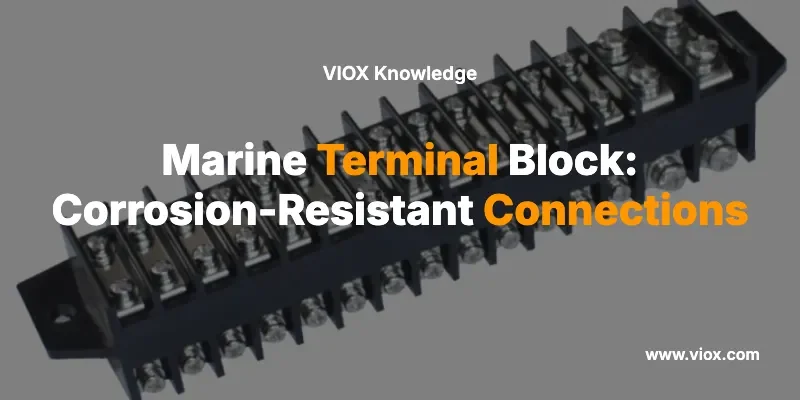
If you’ve ever opened a boat’s electrical panel after a season at sea and found green-crusted terminal connections that should be clean copper, you understand why marine-grade electrical components exist. Standard terminal blocks—the workhorse connectors used throughout industrial automation and building wiring—can fail catastrophically in saltwater environments within months.
Salt spray, constant humidity, temperature cycling, and vibration combine to create one of the harshest operating environments for electrical equipment. A corroded terminal block doesn’t just mean maintenance headaches; it creates fire risks, system failures at sea, and expensive emergency repairs in port.
Marine terminal blocks solve this problem through specific material choices, environmental sealing, and certification testing designed for saltwater exposure. This guide explains what makes a terminal block truly marine-grade, which specifications matter for different vessel zones, and how to select terminal blocks that maintain reliable connections throughout years of maritime service.
What is a Marine Terminal Block?
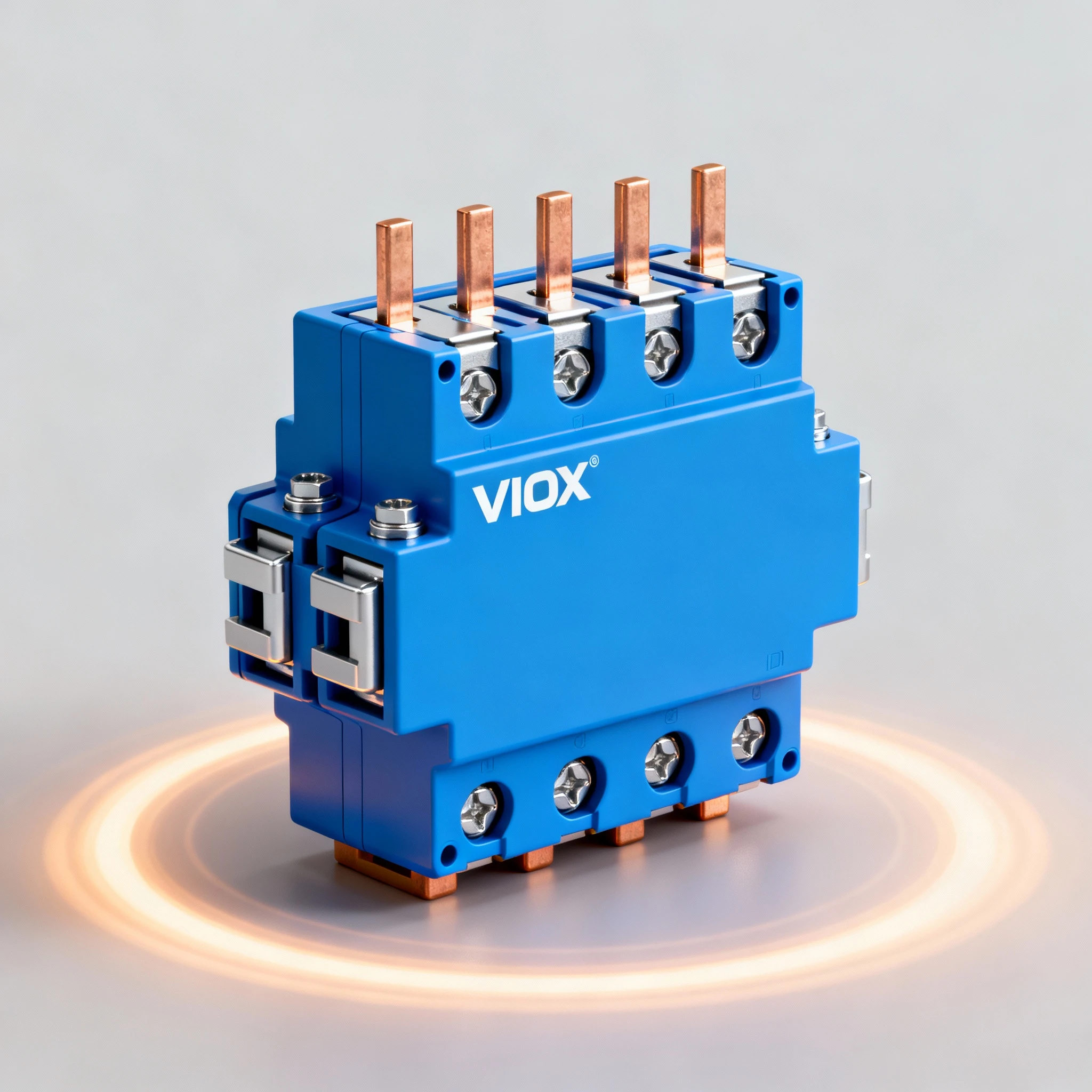
A marine terminal block is an electrical connector specifically engineered to withstand the corrosive effects of saltwater environments. While it serves the same fundamental purpose as standard terminal blocks—providing organized connection points for multiple wires—marine-grade variants use corrosion-resistant materials, enhanced environmental sealing, and pass rigorous maritime certification testing.
Key characteristics that define marine terminal blocks:
- Corrosion-resistant conductors: Tin-plated copper or nickel-plated brass bus bars instead of bare copper or standard brass
- Stainless steel hardware: Terminal screws, mounting hardware, and clamps made from marine-grade stainless steel (typically 316 or similar corrosion-resistant alloys)
- Marine-durable housings: Flame-retardant, UV-resistant polymer bases (nylon, polycarbonate, or PA66) that withstand salt spray, temperature extremes, and prolonged sun exposure
- Enhanced environmental sealing: IP65, IP67, or IP68-rated designs with gaskets and sealed connections to prevent water and salt ingress
- Vibration resistance: Robust clamping mechanisms designed to maintain contact integrity under continuous engine vibration and hull movement
- Maritime certifications: Type-approved by classification societies (DNV, ABS, Lloyd’s Register, RINA) and tested per IEC 60092 maritime electrical standards
Marine terminal blocks come in various configurations—from simple busbar distribution blocks for DC power systems to complex DIN rail terminal assemblies for shipboard control panels. Current ratings typically range from 20A to over 300A, with voltage ratings up to 800V depending on application and insulation class.
The critical distinction isn’t just marketing; marine-grade components undergo salt mist testing, damp heat cycles, temperature extremes (-25°C to +70°C or wider), and severe vibration profiles that standard industrial terminal blocks never face. This testing ensures reliability in engine rooms, weather decks, and bilge areas where failure can leave vessels stranded.
The Saltwater Corrosion Challenge
Saltwater doesn’t just accelerate normal oxidation—it creates an electrochemical environment that attacks metal connections through multiple mechanisms. Understanding why standard terminal blocks fail helps explain why marine-grade specifications matter.
Electrochemical (Galvanic) Corrosion
Seawater acts as an electrolyte, enabling galvanic corrosion whenever dissimilar metals contact in the presence of moisture. The electrochemical series ranks metals by their tendency to donate electrons (become anodes and corrode). In a typical connection:
- Zinc, aluminum, steel (anodes) corrode sacrificially when coupled with
- Copper, brass, bronze (cathodes) which remain protected
But the picture reverses when you mix copper terminals with stainless steel screws in salt spray—the copper becomes relatively anodic and can corrode preferentially. Mismatched metals create localized battery cells that accelerate material loss.
Chloride-Induced Pitting and Crevice Corrosion
Chloride ions in seawater can depassivate stainless steel, breaking down the protective oxide film that normally protects these alloys. Once compromised, localized attack creates:
- Pitting corrosion: Deep, penetrating holes that compromise structural integrity and electrical contact
- Crevice corrosion: Concentration cells form in gaps between washers, under screws, and within connection points, where oxygen depletion creates aggressive micro-environments
Crevices trap saltwater and create oxygen-starved zones. The metal inside these crevices shifts from passive to active corrosion states, leading to rapid material loss invisible from outside inspection.
Salt Spray and Humidity Effects
Even without direct water immersion, salt-laden air deposits hygroscopic chloride crystals on surfaces. These crystals absorb atmospheric moisture, creating persistent electrolyte films that sustain corrosion 24/7. Engine rooms with 80-95% relative humidity accelerate this process.
Temperature Cycling Stress
Daily and seasonal temperature swings cause expansion/contraction cycles that crack protective coatings, loosen mechanical connections, and pump moisture into sealed enclosures through thermal breathing. A terminal block in a sun-exposed deck box can cycle from -5°C overnight to +60°C by afternoon—hundreds of stress cycles per year.
Vibration and Mechanical Wear
Continuous engine vibration and hull flexing cause fretting corrosion at connection interfaces. Micro-movement between contact surfaces wears away protective oxide films faster than they can reform, exposing fresh metal to the corrosive environment.
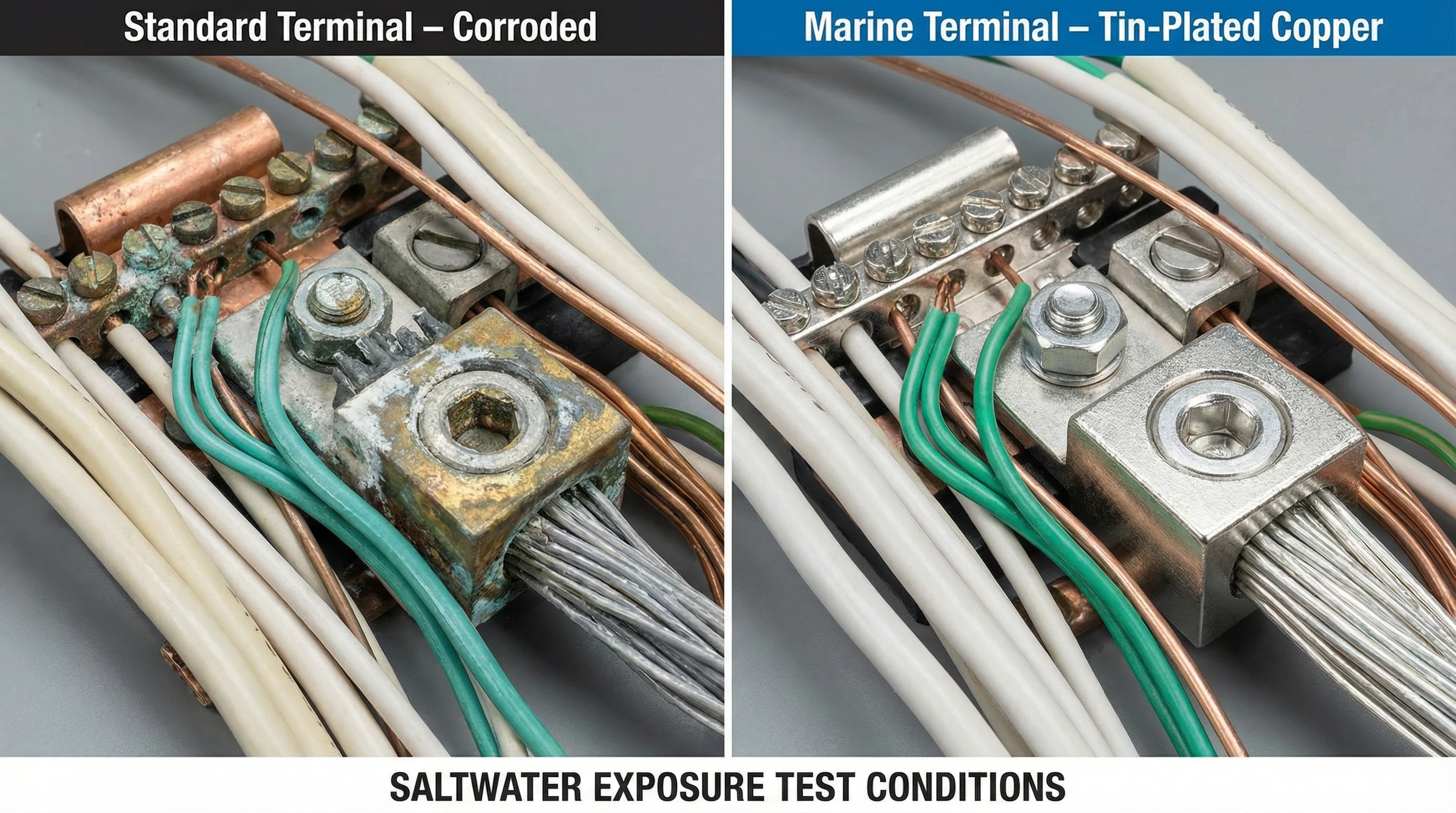
The result: Standard brass terminals with zinc-plated steel screws installed in an engine room bilge area can show heavy green patina (copper carbonate/chloride) and connection resistance increases within 6-12 months. By 18-24 months, connections may fail completely, causing nuisance trips, voltage drops, or fire hazards from high-resistance arcing.
Marine terminal blocks counter these mechanisms through compatible alloy selection (tin-plated copper + stainless steel eliminates galvanic couples), sealed housings that exclude electrolytes, and materials that maintain passive protection in chloride environments.
Material Specifications That Matter
The difference between a standard terminal block and a marine-grade unit comes down to specific material choices at every connection point and structural component.
Conductor Materials and Platings
Tin-Plated Copper Bus Bars
Pure tin plating (typically 5-10 microns thick) over copper conductors provides excellent corrosion resistance while maintaining high conductivity. Tin is anodic to copper in the galvanic series, meaning it sacrificially protects the base metal. Even if the tin coating develops microscopic defects, localized corrosion products form slowly and don’t rapidly propagate.
Tin plating also:
- Remains solderable (unlike nickel)
- Provides lower contact resistance than unplated copper under compression
- Resists oxidation in humid air without forming insulating films
- Complies with RoHS environmental requirements (lead-free)
Nickel-Plated Brass or Copper
Nickel plating creates a hard, wear-resistant surface with superior corrosion resistance in chloride environments. Nickel-plated brass is common in marine terminal blocks rated 20-30A. The nickel layer (typically 3-8 microns) passivates in seawater and resists both pitting and crevice corrosion.
Trade-off: Nickel has slightly higher contact resistance than tin, but the difference is negligible at properly torqued screw connections.
Terminal Hardware
Stainless Steel Screws and Fasteners
Marine-grade terminal blocks use corrosion-resistant stainless steel (typically 316, 316L, or A4 grade) for all terminal screws, mounting hardware, and clamps. These alloys contain molybdenum, which enhances pitting resistance in chloride environments.
Critical specification: Verify that screws are passivated after machining. Passivation removes free iron from the surface and promotes formation of a stable chromium oxide layer that resists corrosion initiation.
Avoid: Zinc-plated steel or standard 304 stainless in splash zones. Zinc plating sacrifices quickly in salt spray; 304 stainless lacks molybdenum and can pit in marine environments.
Housing Materials
Flame-Retardant, Marine-Durable Polymers
Terminal block housings must provide:
- Flame resistance: UL 94 V-0 rating (self-extinguishing within 10 seconds) to meet shipboard fire safety requirements
- UV resistance: Stabilized formulations that resist embrittlement and discoloration under prolonged sun exposure on weather decks
- Chemical resistance: Withstand diesel fuel, hydraulic oil, battery acid, and cleaning agents common in marine environments
- Dimensional stability: Maintain creepage and clearance distances through temperature cycles and humidity
Common marine-grade housing materials:
- Polyamide 66 (PA66, Nylon 66): Excellent mechanical strength, chemical resistance, and temperature range; absorbs minimal moisture
- Polycarbonate: Superior impact resistance and transparency (for inspection), though slightly lower chemical resistance than PA66
- Reinforced thermoplastics: Glass-filled or mineral-filled variants for enhanced dimensional stability and flame resistance
Material Compatibility Table
| Component | Standard Industrial | Marine-Grade Specification | Corrosion Benefit |
| Bus Bar | Bare copper/brass | Tin-plated copper or nickel-plated brass | Sacrificial/passive protection; maintains contact |
| Terminal Screws | Zinc-plated steel | 316 stainless steel (passivated) | Eliminates galvanic couple; resists pitting |
| Housing | Standard nylon/polycarbonate | UV-resistant, UL 94 V-0 rated PA66 or polycarbonate | Fire safety; dimensional stability in marine cycles |
| Washers/Springs | Carbon steel, zinc-plated | 316 stainless steel | Maintains clamping force; prevents rust |
| Mounting Screws | Zinc-plated steel | A4 (316) stainless steel | Long-term installation integrity |
Verification and Sourcing
When specifying marine terminal blocks, request:
- Material certificates documenting conductor plating (tin or nickel thickness, substrate composition)
- Stainless steel grade certification (verify 316/A4, not 304/A2)
- UL 94 V-0 flammability rating for housing material
- Salt spray test results per ASTM B117 or IEC 60068-2-52 (typically 500-1000 hours without functional degradation)
At VIOX Electric, our marine terminal blocks use tin-plated copper bus bars with 316 stainless hardware and UL 94 V-0 rated housings, meeting the material specifications required for reliable saltwater service.
IP Ratings and Environmental Protection
Ingress Protection (IP) ratings quantify how well an enclosure or component excludes solid particles and water. For marine terminal blocks, the IP code directly determines which vessel zones are safe for installation.
Understanding the IP Code
The IP rating format is IP followed by two digits:
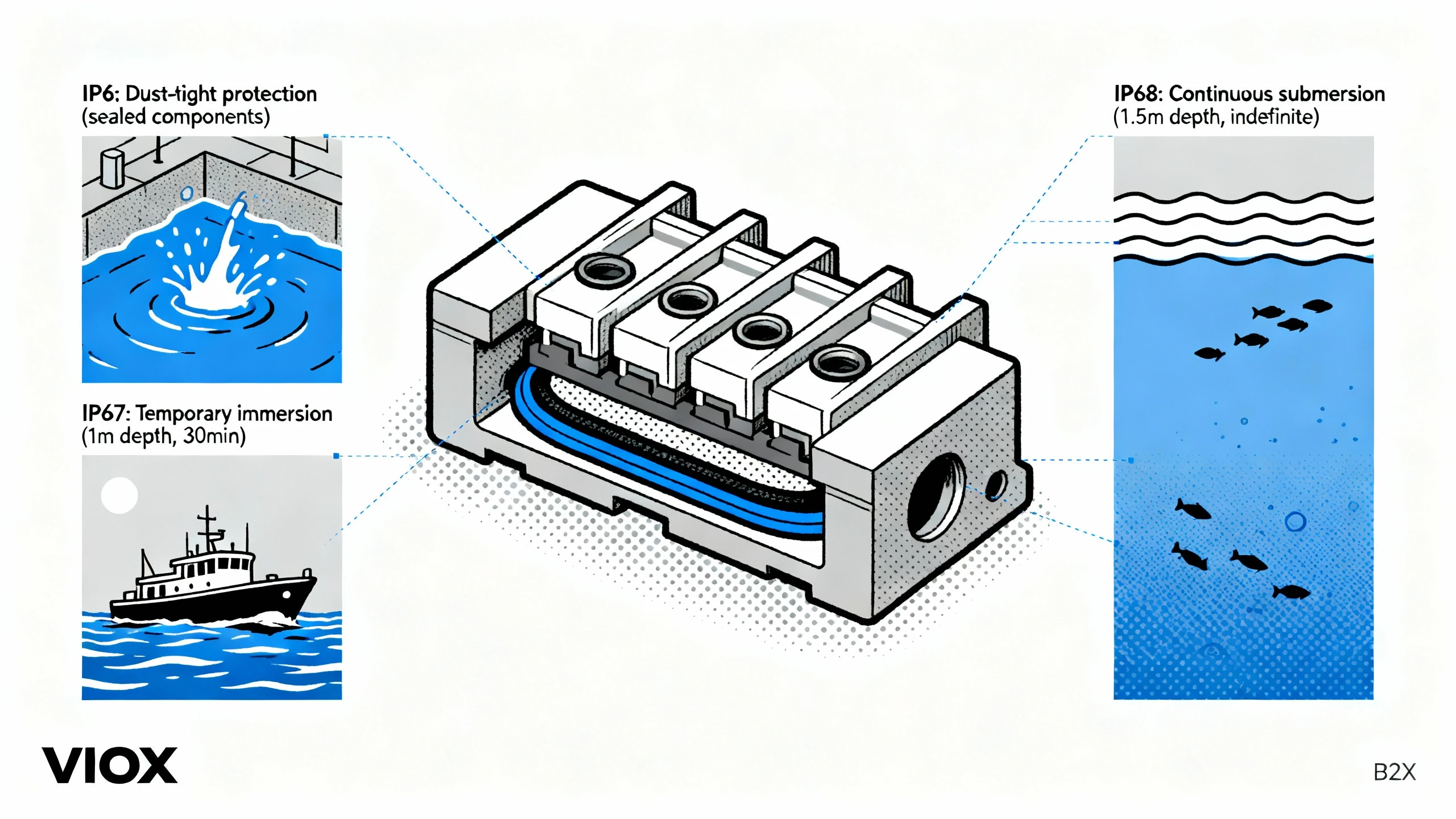
First digit (solids protection): 0-6, where 6 = dust-tight (no ingress whatsoever)
Second digit (liquids protection):
- 0: No protection
- 2: Protected against dripping water (15° tilted)
- 4: Protected against splashing water from any direction
- 5: Protected against water jets (12.5 liters/min from a 6.3mm nozzle)
- 6: Protected against powerful water jets or heavy seas
- 7: Protected against temporary immersion (up to 1 meter depth, 30 minutes)
- 8: Protected against continuous immersion (depth/duration specified by manufacturer)
Marine Zone Requirements
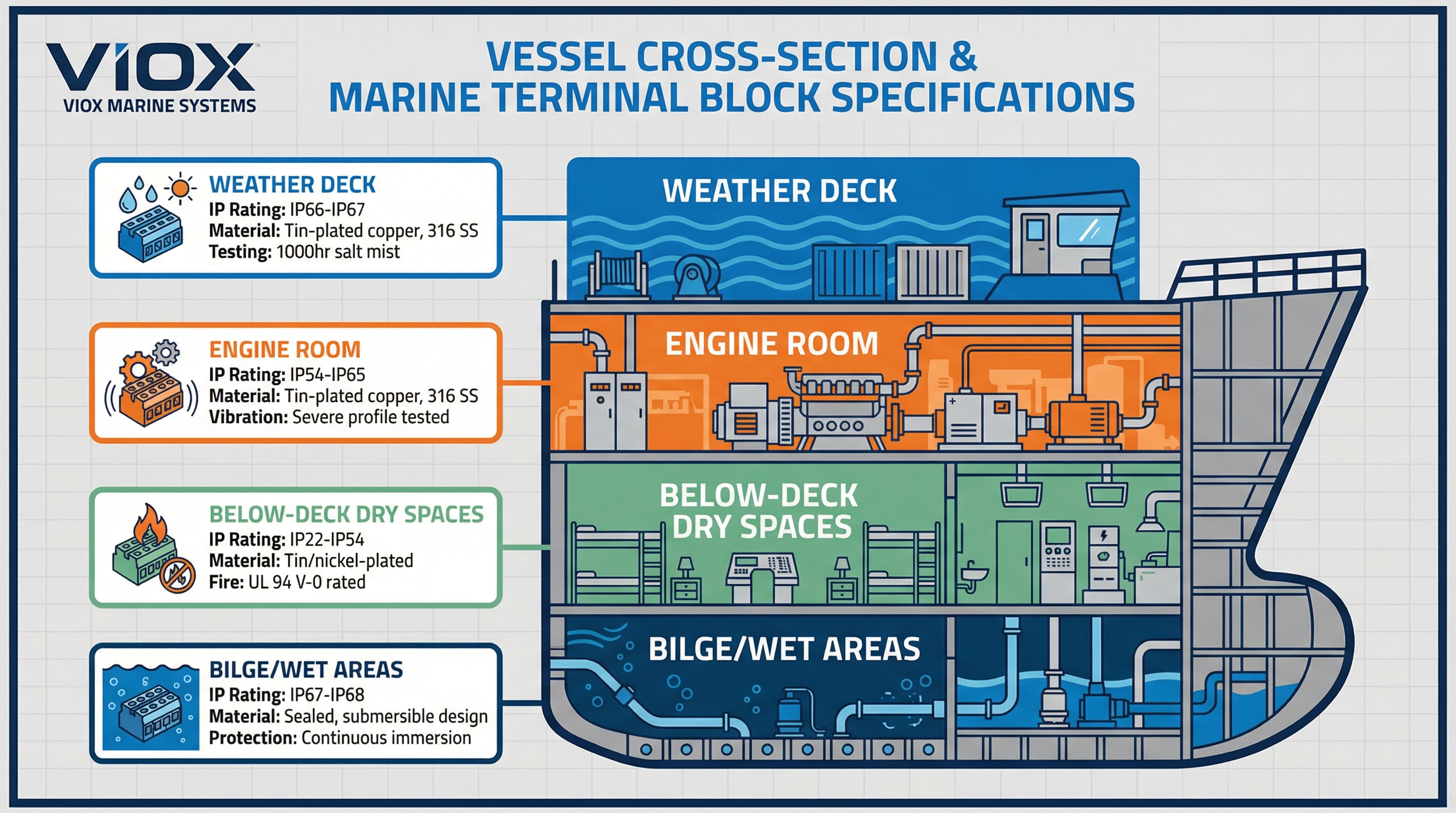
Weather Deck and Exposed Areas (IP66-IP67)
Open weather decks face direct rain, spray from heavy seas, and high-pressure washdown. National maritime standards define “weatherproof” and “watertight” performance requirements—watertight enclosures must survive a 15-minute high-pressure hose test (13mm nozzle, 11m head pressure, 3m distance) without leakage.
Terminal blocks installed on weather decks or in exposed electronics boxes should achieve IP66 or IP67 ratings. IP67 provides a safety margin for temporary immersion (flooding, heavy spray events).
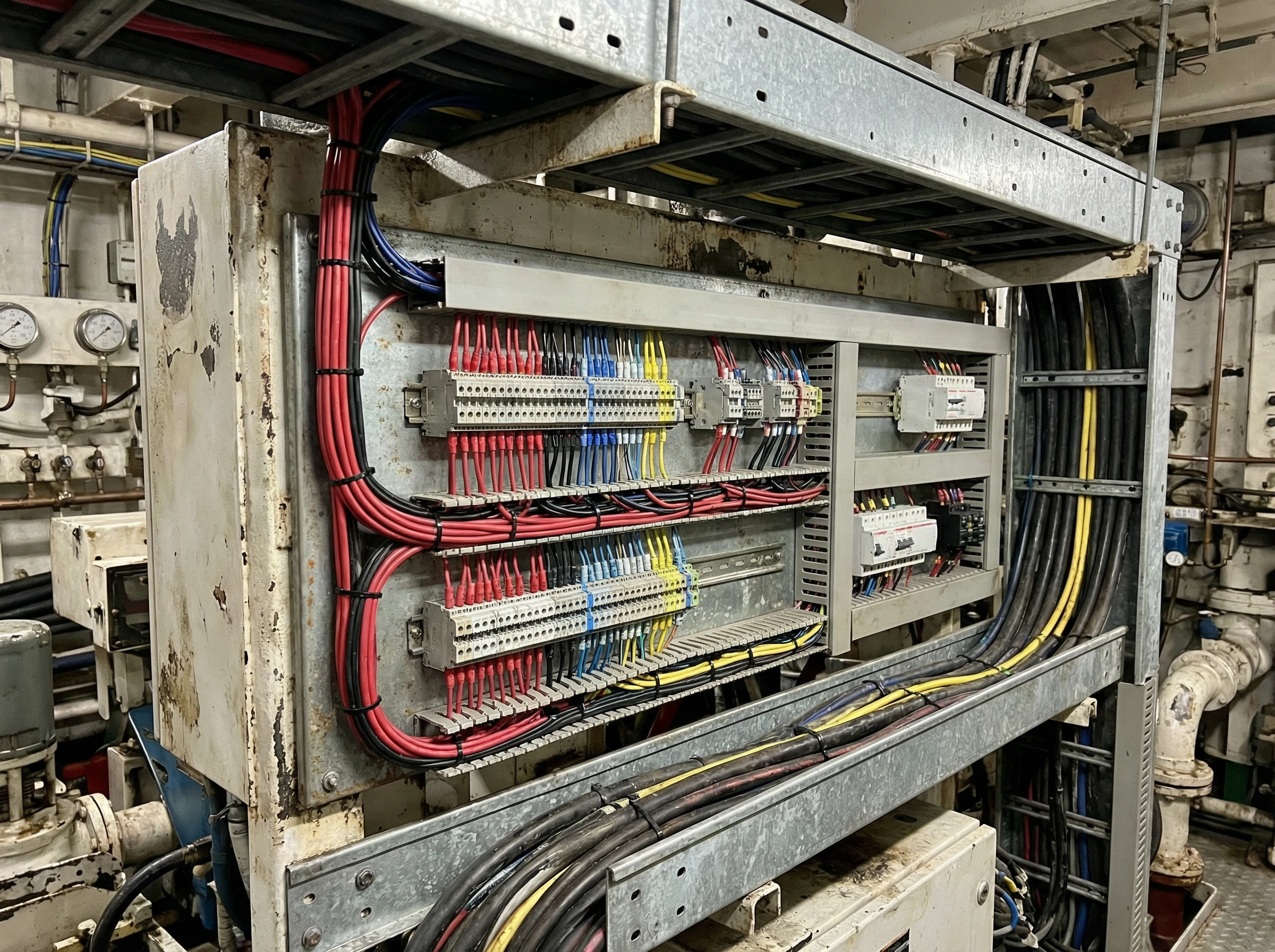
Engine Rooms and Machinery Spaces (IP44-IP65)
Engine rooms combine spray from cooling systems, condensation, oil mist, vibration, and temperatures that can exceed 50°C near exhaust manifolds. While direct water jets are uncommon, heavy spray during maintenance and periodic washdowns occur.
Terminal blocks in engine room panels typically require IP44 minimum (splash-proof) for general locations, escalating to IP54-IP65 for bilge-adjacent installations or near cooling system components. IP54 protects against dust accumulation and splashing; IP65 adds protection against direct water jets.
Below-Deck Dry Spaces (IP22-IP40)
Accommodation electrical panels, navigation equipment rooms, and technical spaces below deck in dry zones can use lower IP ratings. IP22 (protection against dripping water and finger contact) often suffices, though IP40 (protection against solid objects >1mm) provides margin against dust and incidental contact.
Note: “Dry” is relative on vessels. Condensation during rapid temperature changes and occasional leaks mean even dry spaces experience humidity cycles.
Bilge and Wet Areas (IP67-IP68)
Bilge pumps, ballast systems, and technical spaces with standing water or submersion risk require the highest protection levels. IP67 (dust-tight, 30-minute immersion to 1m) protects against temporary flooding. IP68 (continuous immersion, depth/duration per manufacturer specs) is necessary for permanently submerged or frequently flooded installations.
How IP Sealing is Achieved
Gasket Seals
Terminal blocks designed for high IP ratings use elastomer gaskets (silicone, EPDM, neoprene) that compress between housing sections, creating watertight seals. Gasket materials must remain flexible through temperature extremes (-25°C to +70°C or wider) and resist saltwater degradation.
Cable Entry Sealing
The weak point in many IP-rated installations is cable entry. Marine terminal blocks use:
- Cable glands with compression seals that grip outer cable insulation
- Potting/encapsulation with marine-grade epoxy or polyurethane
- Sealed conduit entries with threaded adapters and O-rings
A terminal block rated IP67 loses that protection if cables enter through unsealed knockouts or loose conduit fittings.
Screw Terminal Sealing
Enclosed terminal blocks achieve high IP ratings by housing screw terminals inside sealed cavities. Wire insertion may occur through sealed cable glands or push-in entries with integrated seals. The terminal screws themselves remain protected inside the housing.
IP Rating vs. Corrosion Resistance
Important distinction: IP ratings indicate water/dust exclusion, not corrosion resistance. A terminal block can be IP67-rated yet corrode rapidly if internal materials are not marine-grade. Conversely, excellent corrosion-resistant materials don’t guarantee water exclusion.
Marine terminal blocks require both:
- High IP rating appropriate to installation zone (water/dust exclusion)
- Corrosion-resistant materials for long-term reliability (tin-plated copper, stainless steel, marine polymers)
IP Rating Selection Guide by Vessel Zone
| Vessel Zone | Minimum IP Rating | Recommended IP Rating | Typical Hazards |
| Weather Deck (Exposed) | IP65 | IP66-IP67 | Rain, sea spray, heavy seas, washdown |
| Engine Room | IP44 | IP54-IP65 | Splash, condensation, spray, oil mist, vibration |
| Bilge/Wet Technical Spaces | IP67 | IP67-IP68 | Standing water, flooding, submersion |
| Below-Deck Dry (Navigation) | IP22 | IP40-IP54 | Condensation, incidental contact, dust |
| Accommodation Spaces | IP20 | IP22-IP40 | Condensation, cleaning water, minimal exposure |
| Offshore/Heavy Duty | IP66 | IP67-IP68 | Extreme weather, wave impact, continuous saltwater spray immersion |
At VIOX Electric, our marine terminal block series includes IP54, IP65, IP67, and IP68-rated options to match specific vessel zone requirements, ensuring reliable connections across all maritime environments.
Marine Certifications and Standards
Marine terminal blocks must pass rigorous type-approval testing by classification societies to ensure they meet shipboard safety and reliability requirements. Understanding these certifications helps you select components that satisfy maritime regulations.
Classification Societies and Type Approval
Classification societies are independent organizations that establish and enforce technical standards for ship design, construction, and equipment. Major societies include:
- DNV (Det Norske Veritas, merged with GL): Global leader in maritime classification
- ABS (American Bureau of Shipping): Dominant in North American and international shipping
- Lloyd’s Register: British classification society with worldwide recognition
- RINA (Registro Italiano Navale): Italian classification authority
- Bureau Veritas: French classification society
- ClassNK (Nippon Kaiji Kyokai): Japanese classification authority
- KR (Korean Register): South Korean classification authority
Type approval means the manufacturer has submitted product samples, design documentation, and test results demonstrating compliance with the society’s requirements. Once approved, the product receives a certificate and can be specified for vessels under that society’s class.
IEC 60092 Maritime Electrical Standards
The IEC 60092 series defines electrical installation standards for ships and mobile/fixed offshore units. Key sections relevant to terminal blocks:
IEC 60092-101: Definitions and general requirements for electrical systems
IEC 60092-201: System design – general principles and requirements for AC and DC distribution
IEC 60092-350: Shipboard power cables – construction and test requirements (relevant for cable-to-terminal interface)
IEC 60092-504: Special features – control circuits, alarm systems (covers auxiliary connections)
Terminal blocks must meet voltage and current ratings, insulation resistance, dielectric strength, and temperature rise limits specified in these standards. Type-approval testing verifies compliance.
Environmental Test Requirements
Maritime type-approval testing harmonizes with IEC 60068 environmental test methods. Terminal blocks undergo:
Dry Heat Test (IEC 60068-2-2)
- Conditioning at 55°C or 70°C for 16 hours depending on equipment class
- Verifies dimensional stability, material integrity, and electrical function at elevated temperature
- Simulates engine room heat and tropical operating conditions
Cold Test (IEC 60068-2-1)
- Exposure to -25°C for equipment rated for cold climates or weather-exposed locations
- Confirms material flexibility, seal integrity, and electrical function at low temperature
- Critical for Arctic/polar vessel operations
Damp Heat Cyclic Test (IEC 60068-2-30)
- 55°C at 95% relative humidity in cyclic profile over 24-hour periods
- Severe test for insulation resistance degradation and corrosion initiation
- Simulates tropical/humid maritime conditions with condensation cycles
Vibration Test (IEC 60068-2-6)
- Standard profile: 3-13.2 Hz at ±1mm amplitude; 13.2-100 Hz at ±0.7g, 90 minutes minimum
- Severe profile (for machinery locations): 2-25 Hz at ±1.6mm; 25-100 Hz at ±4.0g
- Verifies mechanical integrity and electrical contact stability under ship/engine vibration
- Terminal screws must maintain torque; connections cannot loosen
Salt Mist Test (IEC 60068-2-52)
- Exposure to salt fog (5% NaCl solution atomized in chamber) for extended periods (96-1000 hours depending on exposure category)
- Weather-exposed equipment requires passing this test with no functional degradation or excessive corrosion
- Most critical test for marine corrosion resistance
Electrical Performance Testing
Before and after environmental exposure, terminal blocks undergo:
Insulation Resistance Test
- Minimum 2 MΩ (often 100 MΩ+ for new equipment) measured at 500V DC between terminals and ground
- Must remain above threshold after damp heat, salt mist, and temperature cycling
- Failure indicates moisture ingress or insulation degradation
Dielectric Withstand Test (High-Pot Test)
- AC voltage test at 2x rated voltage + 1000V for 1 minute (e.g., 2800V for 400V-rated terminal block)
- Verifies insulation integrity and creepage/clearance distances
- Critical safety test for shock hazard prevention
Temperature Rise Test
- Terminal blocks carry rated current until thermal equilibrium; temperature rise above ambient must not exceed limits (typically 50-70K depending on insulation class)
- Excessive temperature rise indicates undersized conductors or poor contact resistance
Flame Testing and Fire Safety
Shipboard fire safety is paramount. Terminal block housings must meet:
UL 94 V-0 Rating (or equivalent IEC 60695-11-10)
- Self-extinguishing within 10 seconds after flame removal
- No flaming drips that ignite cotton indicator
- Critical for limiting fire spread in electrical cabinets
Low Smoke and Toxicity (IMO FTPC)
- For passenger vessels and high-occupancy spaces, materials may require IMO Fire Test Procedures Code compliance
- Limits smoke density and toxic gas generation during combustion
Certification Documentation
When specifying marine terminal blocks, request:
- Type-approval certificate from relevant classification society (DNV, ABS, Lloyd’s, etc.)
- Test reports documenting environmental testing (salt mist, vibration, damp heat)
- IEC 60092 compliance declaration specifying applicable sections
- Material certificates for conductor plating and stainless steel grades
- UL 94 flammability rating documentation
Regional and National Requirements
Beyond classification societies, certain flag states impose additional requirements:
- USCG (United States Coast Guard): U.S.-flagged vessels may require additional approvals beyond classification society certification
- Transport Canada TP 127: Canadian ship electrical standards referencing IEC 60092 with specific national interpretations
- SOLAS (Safety of Life at Sea): International maritime safety treaty establishing minimum safety standards; electrical equipment must support overall SOLAS compliance
At VIOX Electric, our marine terminal blocks carry type-approval certificates from DNV, ABS, and Lloyd’s Register, with full IEC 60092 compliance and documented salt mist, vibration, and damp heat testing—ensuring acceptance across global maritime markets and vessel classes.
Applications by Vessel Zone
Different areas of a vessel present unique environmental challenges. Matching terminal block specifications to the specific zone ensures reliable service and regulatory compliance.
Engine Room and Machinery Spaces
Environmental Challenges: High temperature (often 40-60°C), continuous vibration from diesel engines and auxiliary machinery, oil mist, condensation, periodic spray from cooling systems, bilge water exposure in low areas.
Terminal Block Requirements:
- Material: Tin-plated copper bus bars, 316 stainless screws, oil-resistant housing
- IP Rating: IP54 minimum for panel-mounted blocks; IP65-IP67 for bilge-adjacent or spray-exposed locations
- Vibration Resistance: Must pass severe vibration profile (IEC 60068-2-6: 2-25 Hz at ±1.6mm, 25-100 Hz at ±4.0g)
- Temperature Rating: -25°C to +70°C minimum; better if +85°C+ for near-exhaust installations
- Certifications: DNV/ABS/Lloyd’s type approval, IEC 60092 compliance
Typical Applications:
- Main and auxiliary engine starter circuits (high current, 100-250A)
- Generator output distribution (three-phase AC, 400V, 100-250A)
- Bilge pump control and power feeds (often submerged-rated IP67-IP68 for low installations)
- Cooling system sensor and alarm circuits
- Fuel transfer pump controls
Installation Notes: Mount terminal blocks above bilge water level where possible. Use DIN rail systems for maintainability—engine room electrical systems require frequent troubleshooting and modifications. Ensure adequate ventilation around terminal blocks to prevent heat accumulation.
Weather Deck and Exposed Locations
Environmental Challenges: Direct sun exposure (UV), rain, salt spray from heavy seas, temperature extremes (-25°C to +60°C), high-pressure washdown during maintenance.
Terminal Block Requirements:
- Material: Tin-plated copper, 316 stainless hardware, UV-resistant PA66 or polycarbonate housing
- IP Rating: IP66-IP67 minimum; IP68 for locations subject to wave submersion (bow thruster controls, deck equipment)
- UV Resistance: Housing must resist yellowing, cracking, and embrittlement over years of sun exposure
- Salt Mist Testing: Must pass 1000-hour salt spray test per IEC 60068-2-52
- Sealing: Cable glands with compression seals; gasket-sealed enclosures
Typical Applications:
- Deck lighting circuits (LED navigation lights, work lights)
- Windlass and anchor winch controls (high current, 50-150A)
- Davit and crane power distribution
- Weather deck instrument connections (anemometers, radar)
- Deck wash pump circuits
Installation Notes: Install terminal blocks inside watertight junction boxes rated for weather deck service. Use marine-grade cable glands at all cable entries. Apply dielectric grease on connections to displace moisture and inhibit corrosion initiation. Inspect connections annually and clean salt deposits.
Navigation and Accommodation Spaces (Below-Deck Dry)
Environmental Challenges: Moderate humidity, condensation during temperature changes, minimal salt exposure, low vibration.
Terminal Block Requirements:
- Material: Tin or nickel-plated conductors acceptable; 316 stainless or nickel-plated brass hardware
- IP Rating: IP22-IP40 sufficient; IP54 provides margin for condensation and cleaning
- Flame Resistance: UL 94 V-0 critical for accommodation fire safety
- Low Smoke/Toxicity: Passenger vessels may require IMO FTPC compliance
Typical Applications:
- Navigation equipment power distribution (chartplotters, radar, AIS, VHF radios)
- Accommodation lighting and receptacle circuits
- HVAC control systems
- Galley equipment (DC and AC distribution for refrigeration, cooking)
- Entertainment systems
Installation Notes: Standard DIN rail terminal blocks work well in these zones if materials are marine-grade. Organize by circuit function (navigation, lighting, power) using color-coded terminal blocks and clear labeling. Ensure adequate creepage/clearance for AC/DC mixing in multipurpose panels.
Bilge and Wet Technical Spaces
Environmental Challenges: Periodic or continuous water immersion, standing bilge water (often contaminated with fuel/oil), minimal ventilation, high humidity.
Terminal Block Requirements:
- Material: Tin-plated copper, 316 stainless hardware, sealed housing
- IP Rating: IP67 minimum (temporary immersion); IP68 for permanently wet locations
- Enclosure: Fully sealed with potted cable entries; no open knockouts
- Contact Protection: Submersible designs with sealed terminals or fully encapsulated connections
Typical Applications:
- Bilge pump power and float switch connections
- Ballast pump controls
- Through-hull sensor wiring (depth transducers, speed logs)
- Sewage system pump circuits
- Low-level alarm circuits
Installation Notes: Use IP68-rated junction boxes with potted terminal blocks or fully molded cable assemblies. Avoid screw terminals exposed to water—prefer sealed push-in or spring-clamp designs inside sealed housings. Mount above expected water level where possible; if submersion is unavoidable, verify continuous immersion rating with depth/duration specs from manufacturer.
Offshore and Heavy-Duty Marine (Oil Rigs, Wind Farms, Research Vessels)
Environmental Challenges: Extreme weather, continuous saltwater spray/immersion, ice buildup (Arctic), high vibration (platform drilling, turbine nacelles), potential explosive atmospheres (oil/gas platforms).
Terminal Block Requirements:
- Material: Tin-plated copper, A4 (316L) stainless hardware, reinforced glass-filled PA66
- IP Rating: IP67-IP68 standard; IP69K for high-pressure/high-temperature washdown areas
- ATEX/IECEx: Explosion-proof or intrinsically safe variants for hazardous zones
- Cold Temperature: Rated to -40°C for Arctic operations
- Certifications: DNV offshore certification, ATEX/IECEx Zone 1/2 approvals where required
Typical Applications:
- Offshore platform drilling equipment power distribution
- Wind turbine nacelle electrical systems (high vibration, temperature extremes)
- ROV (remotely operated vehicle) tether connections (submersible)
- Subsea equipment junction boxes (rated for depth/pressure)
- Helideck lighting and fire suppression controls
Installation Notes: Offshore installations demand the highest reliability—component failure can mean costly downtime, helicopter mobilization, or safety incidents. Over-specify rather than under-specify. Use redundant connections where practical. Implement condition monitoring (thermal imaging, insulation resistance testing) as part of preventive maintenance.
Small Craft and Recreational Boats
Environmental Challenges: Limited space, DC-dominant electrical systems (12V/24V), frequent vibration from outboard/stern drive, less rigorous maintenance than commercial vessels, budget constraints.
Terminal Block Requirements:
- Material: Tin-plated copper (nickel acceptable for DC low-current)
- IP Rating: IP54-IP65 for enclosed panels; IP67 for exposed locations
- Compact Design: Space-efficient busbar blocks or feed-through terminal blocks
- Wire Range: Accept 10-18 AWG for small craft wiring
Typical Applications:
- House battery distribution (lighting, instruments, pumps)
- Ignition and engine start circuits
- Bilge pump connections
- Stereo and electronics power distribution
- Navigation light circuits
Installation Notes: Recreational marine terminal blocks often use simpler busbar designs rather than DIN rail systems. Blue Sea Systems and similar brands offer compact, corrosion-resistant terminal blocks purpose-built for small craft. Use heat-shrink tubing over connections for added moisture protection. Keep DC positive and negative buses separate to avoid accidental shorts.
Selection Guide for Marine Environments
Choosing the right marine terminal block requires matching material specifications, IP ratings, and certifications to your specific vessel zone, electrical system, and regulatory requirements.
Step-by-Step Selection Process
Step 1: Identify Installation Zone and Environmental Exposure
Determine where the terminal block will be installed:
- Weather deck (exposed to spray, rain, sun)
- Engine room (heat, vibration, oil mist)
- Bilge/wet spaces (immersion risk)
- Below-deck dry (navigation, accommodation)
- Offshore/extreme duty (continuous spray, extreme weather)
Step 2: Match IP Rating to Zone Requirements
Refer to the IP rating table (Section 5) to select minimum protection level:
- Weather deck: IP66-IP67
- Engine room: IP54-IP65
- Bilge/wet: IP67-IP68
- Below-deck dry: IP22-IP54
- Offshore: IP67-IP69K
Step 3: Verify Material Specifications
Confirm corrosion-resistant materials:
- Conductors: Tin-plated copper (first choice) or nickel-plated brass
- Hardware: 316 stainless steel screws and fasteners (A4 grade)
- Housing: UV-resistant, UL 94 V-0 rated PA66 or polycarbonate
Reject: Bare copper/brass conductors, zinc-plated steel hardware, non-flame-retardant housings
Step 4: Determine Electrical Ratings
Calculate load requirements:
- Current rating: Select In ≥ 1.25 x maximum continuous load current
- Voltage rating: Must match or exceed system voltage (e.g., 400V AC, 24V DC)
- Wire size compatibility: Verify terminal accepts your conductor cross-section (e.g., 2.5mm², 10 AWG)
Account for derating if ambient temperature exceeds 40°C (common in engine rooms)
Step 5: Check Certification Requirements
Verify the terminal block carries appropriate approvals:
- Classification society: DNV, ABS, Lloyd’s Register, RINA (match your vessel’s class)
- IEC 60092 compliance: Required for commercial vessels
- National approvals: USCG (U.S. flag), Transport Canada (Canadian flag) if applicable
- Hazardous area: ATEX/IECEx if installing in Zone 1/2 (oil/gas platforms, fuel spaces)
Step 6: Consider Maintenance and Accessibility
- DIN rail vs. fixed mount: DIN rail offers modularity for systems requiring frequent modifications (engine room controls); fixed busbar blocks suit stable installations (power distribution)
- Screw vs. spring-clamp terminals: Spring-clamp or push-in terminals resist vibration loosening and speed installation; screw terminals provide proven high-current capability
- Test points and indicators: Some marine terminal blocks offer integrated voltage test points or LED indicators for troubleshooting
Common Selection Mistakes to Avoid
Mistake 1: Specifying Standard Industrial Terminal Blocks for Marine Use
Standard terminal blocks lack corrosion-resistant materials and salt mist testing. They will corrode in months, not years.
Mistake 2: Ignoring Cable Entry Sealing
An IP67-rated terminal block loses protection if cables enter through unsealed knockouts. Always use marine-grade cable glands with compression seals.
Mistake 3: Under-Rating IP Protection
Specifying IP54 for a weather deck installation because it’s “enclosed in a box” fails when the box gasket leaks during heavy spray. Over-specify IP rating by one level for safety margin.
Mistake 4: Accepting 304 Stainless Instead of 316
304 stainless lacks molybdenum and can pit in saltwater. Insist on 316 (A4) stainless for all hardware.
Mistake 5: Skipping Certification Verification
A terminal block claimed to be “marine-grade” without DNV/ABS/Lloyd’s type-approval certificates may not meet classification society requirements, delaying vessel acceptance or failing survey.
Quick Selection Decision Table
| If Your Application Is… | Choose This Specification |
| Engine room distribution panel (AC/DC) | IP54-IP65, tin-plated copper, 316 SS, vibration-tested, DNV/ABS approved |
| Weather deck junction box (lighting, instruments) | IP66-IP67, tin-plated copper, 316 SS, UV-resistant housing, 1000hr salt mist |
| Bilge pump connection (submerged risk) | IP67-IP68, tin-plated copper, 316 SS, sealed/potted entries |
| Navigation panel (below-deck, dry) | IP22-IP54, tin/nickel-plated, 316 SS, UL 94 V-0, IEC 60092 |
| Offshore platform (extreme conditions) | IP67-IP68, tin-plated copper, A4 SS, -40°C rated, DNV offshore cert, ATEX if required |
| Small craft DC distribution (12V/24V house system) | IP54-IP65, tin-plated copper busbar, compact design, 20-30A rating |
At VIOX Electric, our marine terminal block product line spans IP54 through IP68 ratings, all featuring tin-plated copper bus bars, 316 stainless hardware, and DNV/ABS/Lloyd’s type approvals—engineered to match the full range of vessel zones and applications.
Reliable Connections Start with the Right Materials
Marine terminal blocks aren’t just industrial components with a higher price tag—they’re purpose-engineered solutions to the electrochemical, mechanical, and environmental challenges that destroy standard terminal blocks in saltwater environments within months.
The difference comes down to specifics: tin-plated copper instead of bare brass, 316 stainless instead of zinc-plated steel, IP67 sealing instead of open housings, and certification testing that proves performance under salt mist, damp heat, and severe vibration rather than claims without documentation.
For marine electricians, yacht builders, and offshore engineers, choosing genuine marine-grade terminal blocks means:
- Avoiding premature failures that strand vessels or shut down production platforms
- Meeting classification society requirements without re-engineering or replacement during survey
- Reducing maintenance burden through corrosion-resistant materials that maintain connection integrity
- Ensuring fire safety with UL 94 V-0 rated housings and proper creepage/clearance
- Protecting crew and passengers through reliable electrical connections in safety-critical systems
Whether you’re wiring a bilge pump on a recreational sailboat, distributing 400V three-phase power in a ship’s engine room, or connecting offshore wind turbine nacelle systems, the terminal block specification you choose determines whether those connections remain reliable through years of saltwater exposure or corrode into maintenance nightmares.
VIOX Electric engineers marine terminal blocks with the material specifications, IP ratings, and certifications that maritime professionals require: tin-plated copper conductors, 316 stainless hardware, IP54-IP68 protection levels, and DNV/ABS/Lloyd’s type approvals. Our products are built for the harsh reality of marine electrical systems—not just catalog claims, but proven performance in saltwater service.