

Auf dieser Seite
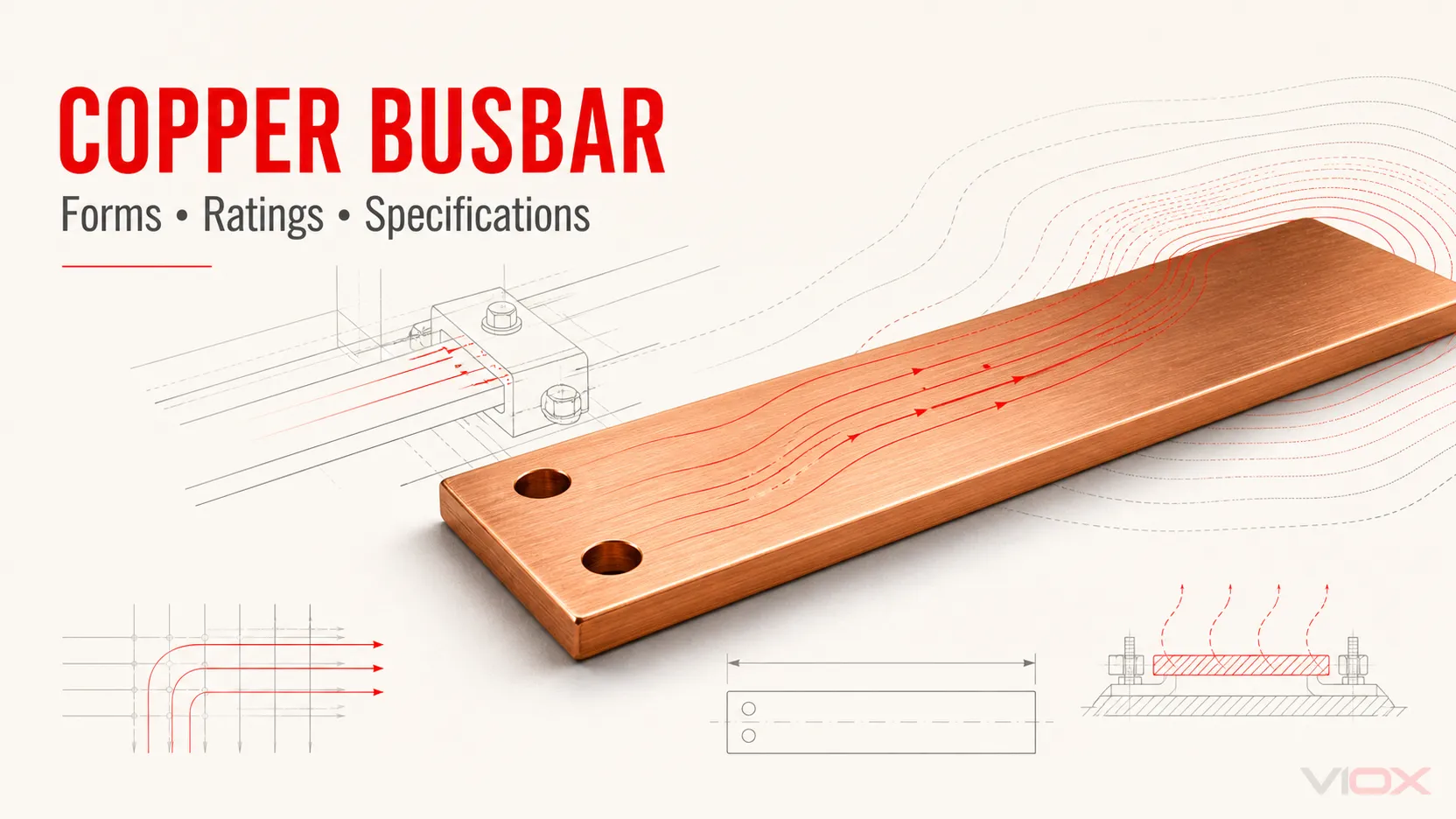
Ein Kupfersammelschiene ist ein niederohmiger Kupferleiter, der dazu dient, elektrischen Strom zwischen mehreren Stromkreisen oder Komponenten zu sammeln und zu verteilen. Es kann sich um eine starre Flachschiene, ein flexibles Geflecht, eine laminierte Leiteranordnung oder eine Kammbrücke für modulare Geräte handeln. Im Gegensatz zu einem vollständigen Sammelschienensystem ist die Sammelschiene der stromführende Leiter selbst.
Die wichtige technische Grenze besteht darin, dass Material und Abmessungen keine universelle Strombelastbarkeit definieren. Eine fertige Kupfersammelschiene muss hinsichtlich ihrer Installationsumgebung, des zulässigen Temperaturanstiegs, der Verbindungen, der Isolierung, der Halterungen, der Kurzschlussfestigkeit sowie der für das Gerät oder die Baugruppe erforderlichen Verifizierungsmethode bewertet werden.
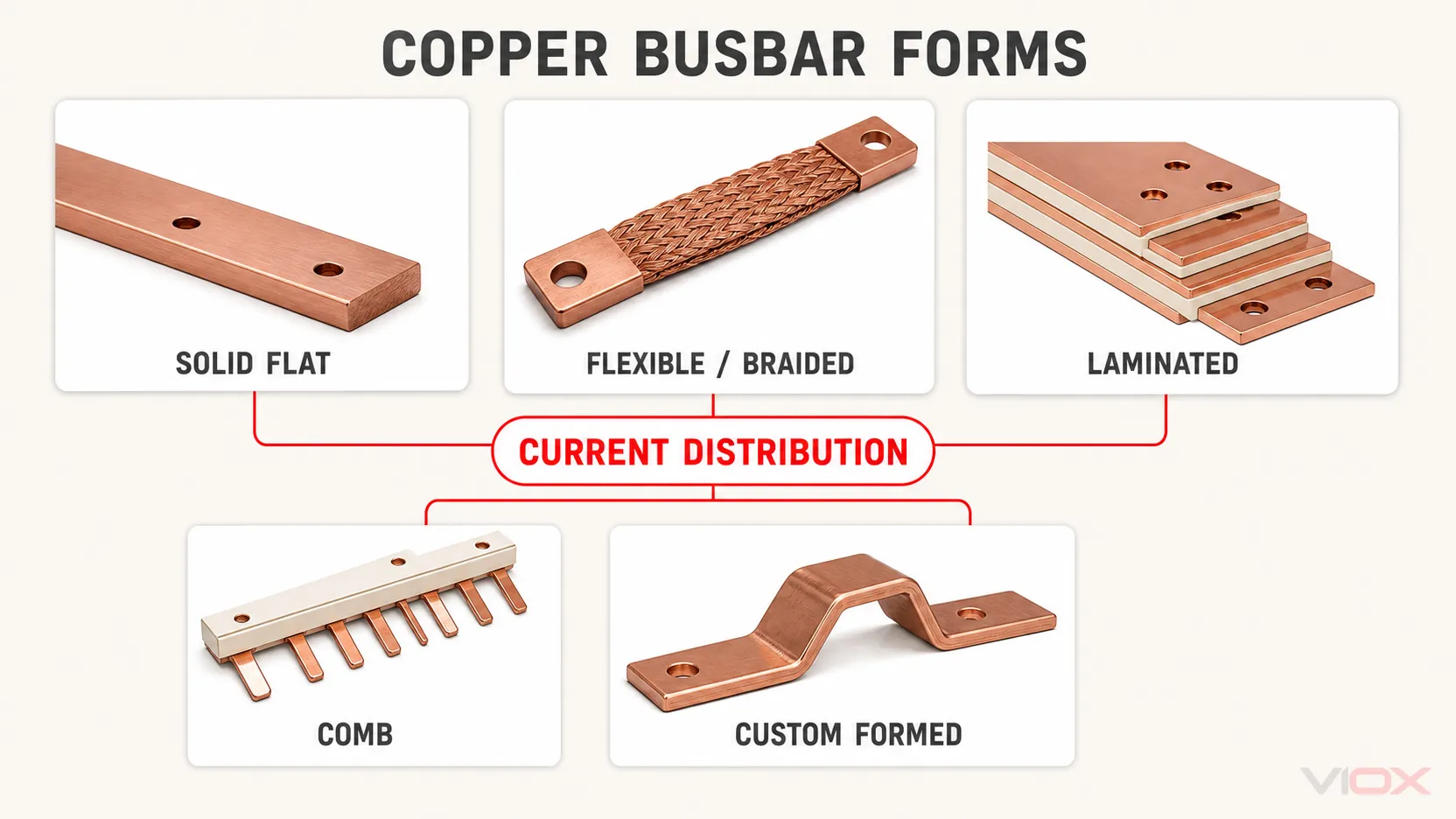
Kupfersammelschienenformen auf einen Blick
“Kupfersammelschiene” beschreibt eine Funktion und ein Material, keine feste Form. Die korrekte Form hängt davon ab, wie der Leiter Strom führen, Geräte verbinden, Bewegungen ausgleichen und in die Baugruppe passen muss.
| Kupfersammelschienenform | Physische Konstruktion | Hauptzweck | Typische Beispiele |
|---|---|---|---|
| Massive Flachstromschiene | Rechteckige Kupferschiene, blank oder beschichtet | Kompakte Hochstromverteilung und starre Verbindung | Schaltschränke, Verteilerfelder, Stromverteilungsanlagen |
| Flexible oder geflochtene Stromschiene | Kupferfolien, Lamellen, Litzen oder Geflecht an den Enden verbunden | Stromführung bei gleichzeitiger Aufnahme von Vibrationen, Toleranzen oder Bewegungen | Transformatoren, Batterien, Maschinen, bewegliche Verbindungen |
| Laminierte Stromschiene | Mehrere geformte leitfähige Schichten, die durch dielektrisches Material getrennt sind | Erzeugen eine kompakte, kontrollierte Mehrleiterstruktur | Wechselrichter, Leistungselektronik, Energiespeicherumrichter |
| Phasenschiene | Isolierte Kupferschiene mit regelmäßig angeordneten Stiften oder Gabeln | Versorgen eine Reihe kompatibler modularer Geräte | Leitungsschutzschalter und modulare Verteiler |
| Kundenspezifisch geformte Sammelschiene | Gestanzter, gebogener, maschinell bearbeiteter oder geprägter Leiter | Passen Sie ein spezifisches Gehäuse und eine Anschlussklemmenanordnung an | OEM-Schaltschränke, Batteriesysteme, Schaltgerätekombinationen |
Diese Formen sind nicht austauschbar. Ein flexibles Geflecht löst mechanische Bewegungen; eine laminierte Sammelschiene steuert einen mehrschichtigen Strompfad; eine MCB-Kammstromschiene muss zur Geometrie und zum Rastermaß der Anschlussklemmen passen. Für eine umfassendere Übersicht elektrischer Sammelschienen siehe den VIOX umfassenden Sammelschienen-Leitfaden.
Warum wird Kupfer für Sammelschienen verwendet?
Kupfer kombiniert eine hohe elektrische Leitfähigkeit mit nützlicher Wärmeleitfähigkeit, mechanischer Festigkeit und Verarbeitbarkeit. Elektrolyt-Kupfer, wie UNS C11000, ist eine gängige hochleitfähige elektrische Sorte. Die Copper Development Association führt C11000 mit einer Leitfähigkeit von mindestens 100 % des International Annealed Copper Standard im geglühten Zustand.
Eine hohe Leitfähigkeit hilft, den Widerstand für eine gegebene Geometrie zu reduzieren, aber “Kupfer” allein ist keine fertige Spezifikation. Legierung oder Sorte, Härtegrad, Abmessungen, Kantenbeschaffenheit, Oberflächenbeschaffenheit, Lochbild und Prüfnachweise können alle beeinflussen, ob das gelieferte Teil der Zeichnung und der Anwendung entspricht.
Der aktive ASTM B187/B187M-26 Spezifikation behandelt Kupfersammelschienen, Stangen und Profile für elektrische Anwendungen. Ihr Anwendungsbereich umfasst Materialbezeichnungen sowie Anforderungen an Abmessungen, mechanische Eigenschaften, elektrischen Widerstand und chemische Zusammensetzung. Andere Märkte verwenden möglicherweise andere Material- und Produktformnormen.
Wenn ein Projekt chinesische Materialbezeichnungen verwendet, erklärt der VIOX-Leitfaden zu Kupfergüten T1, T2 und T3 warum die Gütebezeichnung nicht als vollständige Leitfähigkeits- oder Fertigbauteilbewertung betrachtet werden darf.
Kupfergüte und Leitfähigkeit sind nicht die Strombelastbarkeit
Drei getrennte Aussagen werden oft miteinander vermischt:
- Materialgüte identifiziert einen Rahmen für die chemische Zusammensetzung und Produktform.
- Leitfähigkeit oder spezifischer Widerstand beschreibt eine elektrische Eigenschaft des Materials unter definierten Bedingungen.
- Strombelastbarkeit der Sammelschiene gilt für den fertigen Leiter oder die Baugruppe unter deklarierten thermischen und Installationsbedingungen.
Ein Materialzertifikat kann die Kupferqualität und Leitfähigkeit bestätigen, beweist jedoch nicht, dass eine installierte Sammelschiene einen bestimmten Strom in einem speziellen Gehäuse führen kann. Umgekehrt können zwei Schienen aus derselben Kupferqualität unterschiedliche Strombelastbarkeiten aufweisen, da sich ihre Geometrie, Kühlung, Verbindungen, Isolierung oder die umgebenden Geräte unterscheiden.
Diese Unterscheidung ist bei der Beschaffung wichtig. “C11000 Kupfersammelschiene” oder “T2 Kupfersammelschiene” beschreibt einen Teil der Anforderung; es ersetzt weder eine Maßzeichnung, eine Bemessung der Baugruppe noch einen Nachweis der Temperaturerhöhung.
Warum Breite × Dicke keine universelle Strombelastbarkeit ergibt
Der Querschnitt ist eine wesentliche Ausgangsgröße, aber die Strombelastbarkeit von Kupfersammelschienen wird durch das Gleichgewicht zwischen elektrischen Verlusten und Wärmeabfuhr bestimmt. Relevante Variablen sind:
- Laststrom, Einschaltdauer, Frequenz und Oberschwingungsgehalt;
- Schienenbreite, -dicke, -länge, Ausrichtung, Abstand und Anzahl der parallelen Schienen;
- Umgebungstemperatur und zulässige Temperaturerhöhung;
- Bedingungen bei freier Luft, Belüftung, Kapselung oder Unterteilung des Gehäuses;
- Oberflächenbeschaffenheit: blank, beschichtet, lackiert oder isoliert;
- Übergangswiderstand, Kontaktfläche, Befestigungssystem und Design der Anschlussklemme;
- nahegelegene Wärmequellen sowie die thermischen Grenzwerte angrenzender Isolierungen und Komponenten.
Veröffentlichte Tabellen der Copper Development Association zeigen, dass Emissionsgrad, zulässiger Temperaturanstieg, Abstände und die Anzahl paralleler Schienen die Strombelastbarkeit derselben Nennschienengröße wesentlich verändern können. Die Tabellen sind nur dann nützliche Referenzen, wenn ihre angegebenen Bedingungen mit dem Entwurf übereinstimmen.
Bei Niederspannungs-Schaltgerätekombinationen gehört der Nachweis des Temperaturanstiegs zum Entwurf der Baugruppe und nicht zur isolierten Kupferschiene. IEC TR 60890:2022, beschreibt beispielsweise ein Berechnungsverfahren für den Lufttemperaturanstieg in bestimmten Niederspannungs-Schaltgerätekombinationen und steht im Einklang mit IEC 61439-1:2020. Dessen Anwendungsbereich und Einschränkungen sind zu beachten.
Verwenden Sie den VIOX Strombelastbarkeitsrechner für Sammelschienen für eine vorläufige Abschätzung und überprüfen Sie das Ergebnis anschließend anhand der geltenden Gerätenorm, Herstellerdaten, Installationsbedingungen sowie der erforderlichen Prüf- oder Entwurfsnachweismethode.
Spezifikations-Checkliste für Kupfersammelschienen
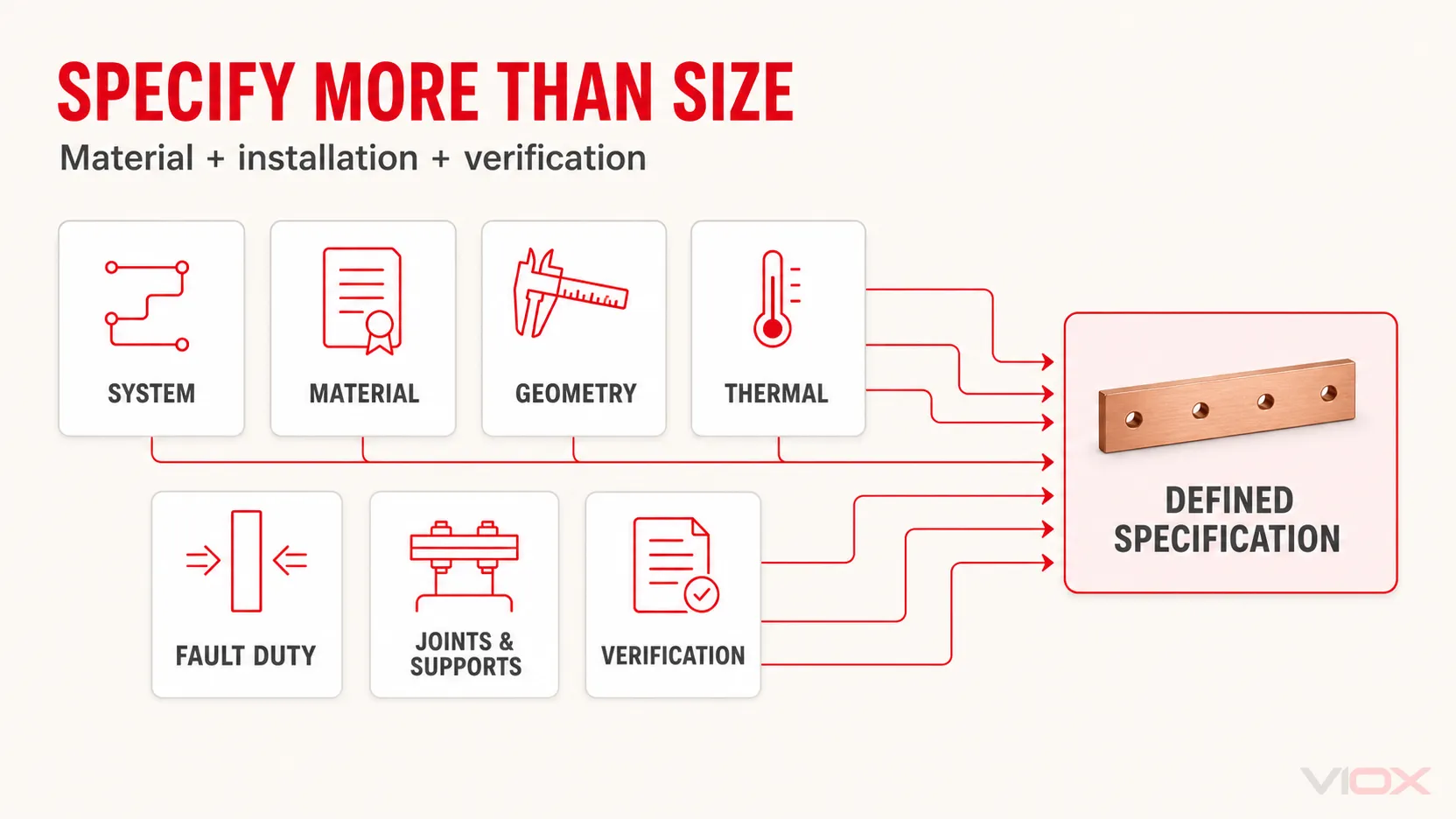
Eine nützliche Anfrage für ein Angebot oder eine technische Spezifikation sollte mehr als nur Material und Größe spezifizieren.
| Spezifikationsfeld | Was anzugeben oder zu überprüfen ist | Warum es wichtig ist |
|---|---|---|
| Sammelschienenfunktion und System | AC oder DC, Nennspannung, Dauerstrom, Betriebsart und Schaltkreisposition | Legt die elektrische Aufgabe und den Isolationskontext fest |
| Material | Kupferbezeichnung, maßgebliche Norm, Härtegrad, Leitfähigkeits- oder Widerstandsanforderung | Verhindert mehrdeutige “Reinkupfer”-Substitutionen |
| Geometrie | Breite, Dicke, Länge, Biegegeometrie, Lochbild, Toleranzen und Kantenbeschaffenheit | Passform der Bedienelemente, Querschnitt, Spannungskonzentration und Anschlussbereich |
| Thermische Bedingungen | Umgebung, Gehäusetyp, Belüftung, zulässiger Temperaturanstieg und benachbarte Wärmequellen | Definiert die Bedingungen hinter dem Bemessungsstrom |
| Kurzschlussfestigkeit | Voraussichtlicher Fehlerpegel, Dauer, Anforderung an die Stoßstromfestigkeit und Stützanordnung | Bestimmt die Anforderungen an die elektrodynamische und thermische Festigkeit |
| Oberfläche und Isolierung | Blank, verzinnt, versilbert, isoliert, beschichtet oder laminiert ausgeführt | Ändert das Umweltverhalten, die Schnittstellen und die Wärmeübertragung |
| Verbindungen und Anschlussklemmen | Kontaktüberlappung, Loch- und Befestigungssystem, Kompatibilität der Anschlussklemmen und Herstelleranweisungen | Der Übergangswiderstand kann die lokale Erwärmung dominieren |
| Stützen und Abstände | Isolatortyp, Spannweite, Phasenabstand, Luftstrecke, Kriechstrecke und Gehäuseanordnung | Unterstützt die mechanische Stabilität und die Isolationskoordination |
| Verifizierungsnachweis | Materialzertifikat, Maßprüfung, Leitfähigkeitsnachweis, Erwärmungsprüfung und Montagedokumentation | Verbindet das gelieferte Teil mit dem deklarierten Design |
Die Oberflächenbeschaffenheit erfordert eine eigene Entscheidung. Der VIOX-Vergleich von blanken, verzinnten und versilberten Kupfersammelschienen erläutert, wo Umwelteinflüsse, Verbindungsverhalten und Kontaktanforderungen die Wahl beeinflussen.
Wo werden Kupfersammelschienen eingesetzt?
Kupfersammelschienen finden sich überall dort, wo Anlagen einen kompakten, reproduzierbaren Stromverteilungspfad benötigen. Häufige Beispiele sind Niederspannungsschaltanlagen, Verteilerschränke, Motor-Control-Center, Transformatoren, Gleichrichter, Wechselrichter, Batteriespeichersysteme, Ladestationen für Elektrofahrzeuge und Anlagen zur solaren Stromumwandlung.
In modularen Verteilern ist das relevante Produkt normalerweise eine Phasenschiene anstelle einer gefertigten Hauptsammelschiene. Die Auswahl hängt dann von der Gerätezulassung, dem Stift- oder Gabelanschluss, der Polanordnung, dem Teilungsmaß, der Isolierung, der Schneidmethode und der Kompatibilität der Anschlussklemme ab. Verwenden Sie die dedizierte Auswahlleitfaden für MCB und Kammsammelschienen für diese Aufgabe.
Für Projekte, bei denen Leitermaterialien verglichen werden, verwenden Sie den separaten Vergleich von Kupfer- und Aluminium-Sammelschienen. Zur Zustandsbewertung siehe die Leitfäden zu Kupfersammelschienenkorrosion und Überhitzung von Sammelschienenverbindungen. Die Trennung dieser Entscheidungen verhindert, dass eine Definitionsseite zu einem unzuverlässigen universellen Konstruktionshandbuch wird.
Kupfersammelschiene, Sammelschienensystem und Stromschienensystem: Ist das dasselbe?
Nein. Eine Kupfersammelschiene ist das leitfähige Element. Ein Sammelschienensystem kombiniert Leiter mit Halterungen, Adaptern, Abdeckungen, Schutz- und Verbindungskomponenten. Ein Stromschienensystem oder eine Sammelschienen-Verteileranlage ist ein gekapseltes, vorgefertigtes Verteilersystem mit definierten Abschnitten und Abzweigvorrichtungen. Die Begriffe können sich im allgemeinen Sprachgebrauch überschneiden, beschreiben jedoch unterschiedliche Ausrüstungsstufen.
Häufig Gestellte Fragen
Ist “busbar” dasselbe wie “bus bar”?
Ja. Beide Schreibweisen beziehen sich auf den elektrischen Leiter. “Busbar” ist in der internationalen Fachliteratur gebräuchlich, während “bus bar” in nordamerikanischen Materialspezifikationen und Suchanfragen weiterhin weit verbreitet ist.
Kann der Strom einer Kupfersammelschiene allein aus dem Querschnitt berechnet werden?
Nein. Der Querschnitt ist nur ein vorläufiger Eingangswert. Die tatsächliche Strombelastbarkeit hängt zudem von der Temperaturerhöhung, den Umgebungs- und Gehäusebedingungen, der Ausrichtung, dem Abstand, der Oberfläche, AC-Effekten, Verbindungsstellen, der Isolierung und der anwendbaren Nachweismethode ab.
Wird jede Kupfersammelschiene aus C11000-Kupfer hergestellt?
Nein. C11000 ist eine gängige Sorte von elektrolytischem Zähkupfer, aber ASTM B187/B187M lässt mehrere Kupferbezeichnungen für elektrische Sammelschienenanwendungen zu. Die Bestellung und die maßgebliche Norm sollten das akzeptierte Material spezifizieren, anstatt von einer universellen Sorte auszugehen.
Quellen
- ASTM B187/B187M-26 — Kupfer, Stromschiene, Stangen und Profile
- Copper Development Association — Eigenschaften der Legierung C11000
- Copper Development Association — Strombelastbarkeit und Emissionsgrad von rechteckigen Kupfersammelschienen
- IEC TR 60890:2022 — Nachweis der Erwärmung durch Berechnung
VIOX liefert MCB-Sammelschienenprodukte für die modulare Energieverteilung. Nachdem Sie die erforderliche Anschlussform, Phasenanordnung, Teilung, Bemessungswerte und die kompatible Gerätefamilie identifiziert haben, prüfen Sie das VIOX MCB-Sammelschienenreihe oder reichen Sie die Projektspezifikation zur technischen Prüfung ein.