Auf dieser Seite
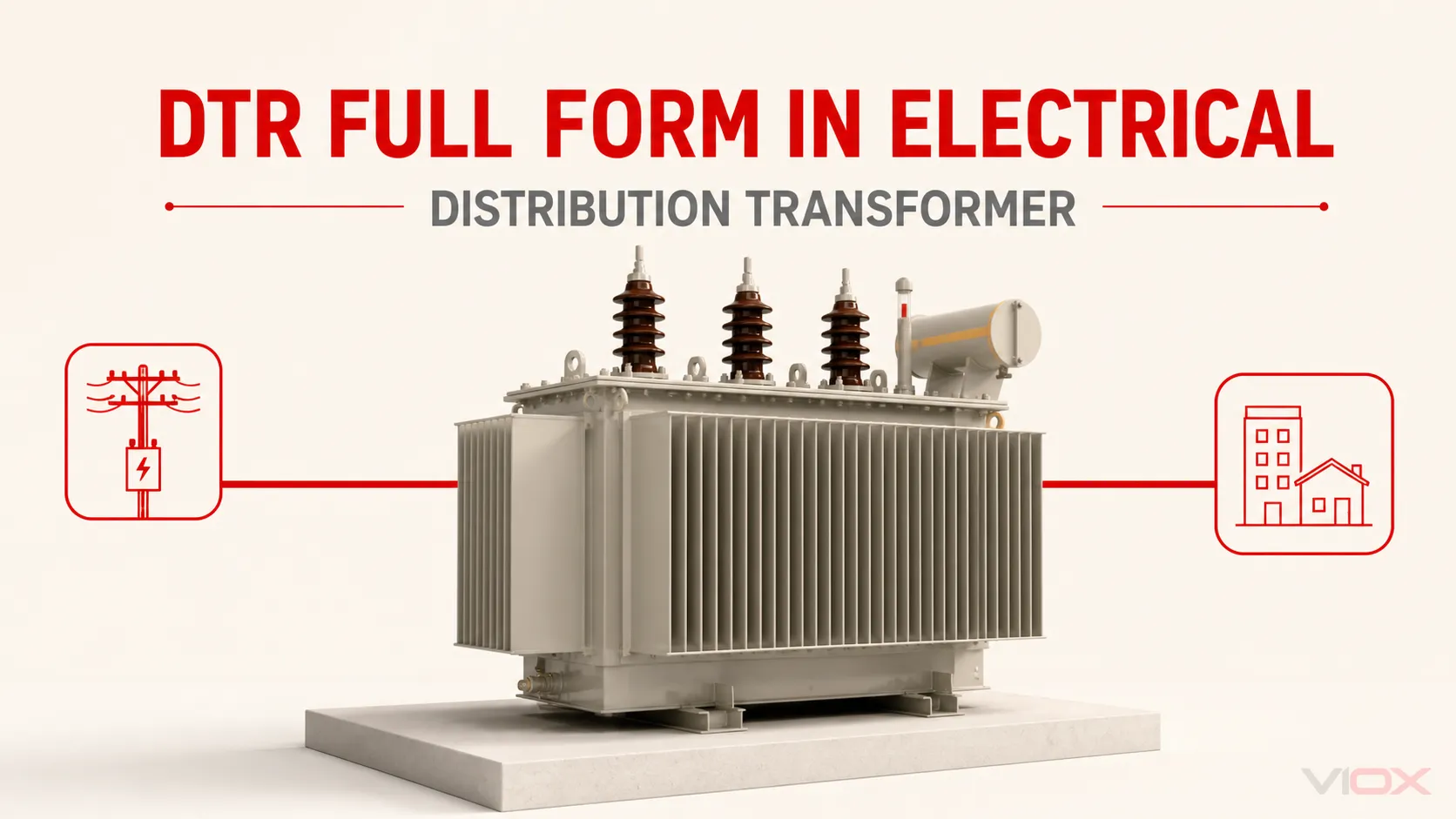
DTR steht in elektrischen Systemen üblicherweise für Verteilungstransformator. Ein Verteilungstransformator führt die letzte Spannungstransformation zwischen einem Verteilungsnetz und der für Endverbraucher oder lokale Niederspannungsanlagen bereitgestellten Spannung durch.
In einem typischen indischen Netz kann ein DTR einen 11 kV Einspeiser auf ein 415/240 V, 50 Hz Nutzungssystem heruntertransformieren. Dies ist ein häufiges Beispiel, keine universelle Bemessung: Verteilungsspannungen, Phasenanordnungen, Transformatorleistungen und geltende Normen variieren je nach Versorgungsunternehmen und Projekt.
Was bedeutet DTR in einem Stromnetz?
DTR ist eine Industrieabkürzung und kein separates Funktionsprinzip eines Transformators. Das Gerät arbeitet weiterhin mittels elektromagnetischer Induktion, wobei AC-Leistung zwischen Wicklungen übertragen wird, während Spannungs- und Strompegel ohne Frequenzänderung angepasst werden.
Die Position im System ist das definierende Merkmal:
Erzeugungs- und Übertragungssystem
             |
Umspannwerk / Verteilungseinspeiser
             |
Verteilungstransformator (DTR)
             |
Niederspannungsverteiler
             |
Wohnungen, Gebäude, Geschäfte oder lokale industrielle Lasten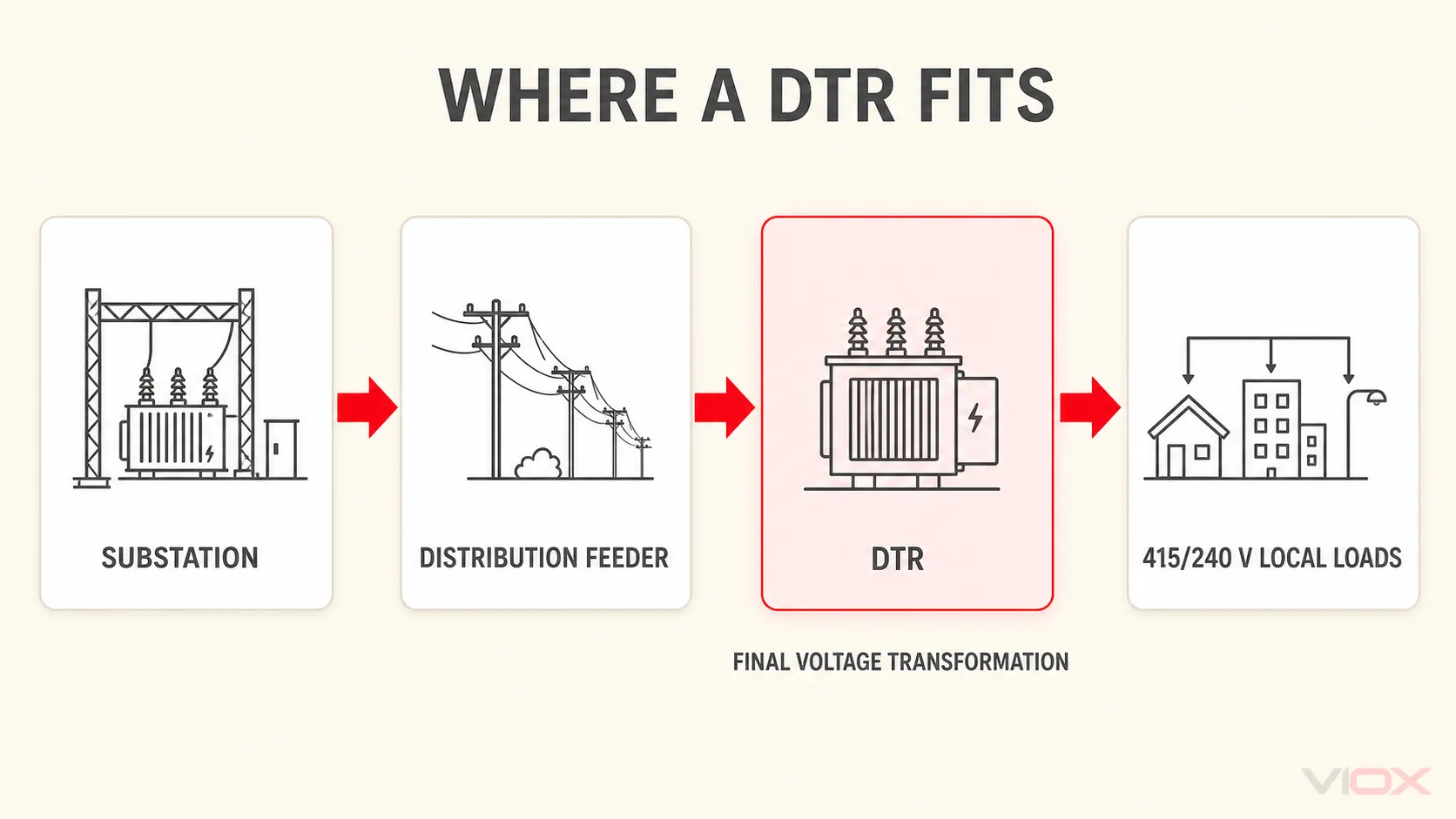
Das Bureau of Indian Standards beschreibt einen Verteilungstransformator als den Transformator, der die letzte Spannungstransformation innerhalb eines Verteilungsstromkreises oder von diesem Stromkreis zu einem Endverbraucher oder einer Anwendung bereitstellt.
Für das zugrunde liegende Funktionsprinzip lesen Sie Wie funktioniert ein elektrischer Transformator?.
Was macht ein Verteilungstransformator?
Ein Verteilungstransformator muss mehrere Systemfunktionen gemeinsam erfüllen:
- die Speisespannung auf die erforderliche Nutzspannung transformieren;
- die erforderliche Phasen- und Neutralleiteranordnung bereitstellen;
- eine Last tragen, die sich im Tagesverlauf ändert;
- den Spannungsabfall innerhalb seiner Impedanz- und Regelungscharakteristika begrenzen;
- normalen thermischen, dielektrischen und mechanischen Beanspruchungen standhalten;
- die Schnittstelle zu vor- und nachgeschalteten Schutz- und Erdungssystemen bilden.
Die Bemessungsleistung auf dem Typenschild eines Transformators garantiert nicht, dass die gesamte Anlage korrekt geschützt ist. Die Auswahl von Sicherungen oder Leistungsschaltern, Überspannungsschutz, Erdung, Leiterbemessung, Fehlerstrompegel, Einschaltstrom und die Abstimmung mit dem Versorgungsnetz bleiben Aufgaben der Systemplanung.
DTR im Vergleich zu Leistungstransformatoren
Verteiltransformatoren und Leistungstransformatoren nutzen dieselben elektromagnetischen Grundlagen. Die nützlichste Unterscheidung ist ihre Systemanwendung, keine willkürliche Leistungsgrenze.
| Vergleichspunkt | Verteilungstransformator | Leistungstransformator |
|---|---|---|
| Hauptsystemrolle | Endspannungstransformation in der Nähe von Endverbrauchern oder lokalen Lasten | Großübertragung zwischen Erzeugung, Übertragung und großen Umspannwerken |
| Typisches Lastmuster | Kontinuierlich unter Spannung bei erheblicher täglicher Lastschwankung | Oft basierend auf der Auslastung des Gesamtsystems und der Netzsteuerung geplant |
| Konstruktionsschwerpunkte | Ganztägiger Wirkungsgrad, Leerlaufverlust, Spannungsregelung, lokale Installationsbedingungen | Hochleistungsübertragung, Systemzuverlässigkeit, Netzsteuerung und Einsatz in großen Umspannwerken |
| Typische Installation | Mastmontiert, bodenmontiert (auf Sockel oder Fundament), Innenraum- oder Freiluft-Umspannwerk | Netz, Kraftwerk, Übertragungs- oder großes Industrie-Umspannwerk |
| Entscheidet die Nennleistung allein über die Kategorie? | Keine | Keine |
Die Begriffe können sich an den Grenzen überschneiden. Projektspezifikationen, Versorgerpraxis und geltende Normen bestimmen die Klassifizierung. Klassifizieren Sie einen Transformator nicht ausschließlich anhand von kVA oder MVA.
Gängige DTR-Typen
Nach Phasenanordnung
- Einphasen-DTR: versorgt oft eine kleinere lokale Last oder ist Teil einer Gruppe, abhängig von der Praxis des Energieversorgers.
- Dreiphasen-DTR: versorgt ein dreiphasiges Niederspannungsnetz und einphasige Lasten, die auf die Phasen verteilt sind.
Nach Isolations- und Kühlmedium
- Flüssigkeitsgefüllter Transformator: verwendet Mineralöl oder eine andere spezifizierte Isolierflüssigkeit zur Isolierung und Wärmeübertragung.
- Trockentransformator: verwendet Feststoffisolierung und Luft oder eine andere angegebene Kühlungsart, die oft dort gewählt wird, wo Brandschutz-, Umwelt- oder Wartungsaspekte in Innenräumen maßgeblich sind.
Nach Installationsart
- mastmontiert;
- sockel- oder bodenmontiert;
- Kiosk- oder Kompaktstationsinstallation;
- Installation im Innenraum-Transformatorraum.
Jede Form hat unterschiedliche Anforderungen an Gehäuse, Zugang, Belüftung, Brandschutz, Umgebungsbedingungen, Kabelanschluss und Schutz. Der VIOX-Vergleich von Trockentransformatoren und ölgefüllten Transformatoren erläutert diese separate Auswahlentscheidung.
DTR-Leistung und Stromformel
Verteilungstransformatoren werden normalerweise in kVA bemessen, da die Wicklungs- und Kernbelastungen von Spannung und Strom abhängen, während die angeschlossene Last den Leistungsfaktor bestimmt.
Für einen symmetrischen Drehstromtransformator:
I = kVA × 1.000 / (sqrt(3) × V_L-L)Für einen Einphasentransformator:
I = kVA × 1.000 / VBerechnungsbeispiel: 100 kVA, 11 kV/415 V Drehstrom-Verteilungstransformator
Ungefährer Strom der Hochspannungswicklung:
I_HV = 100,000 / (sqrt(3) × 11,000)
I_HV ≈ 5.25 A
Ungefährer Strom der Niederspannungswicklung:
I_LV = 100.000 / (sqrt(3) × 415)
I_LV ≈ 139 A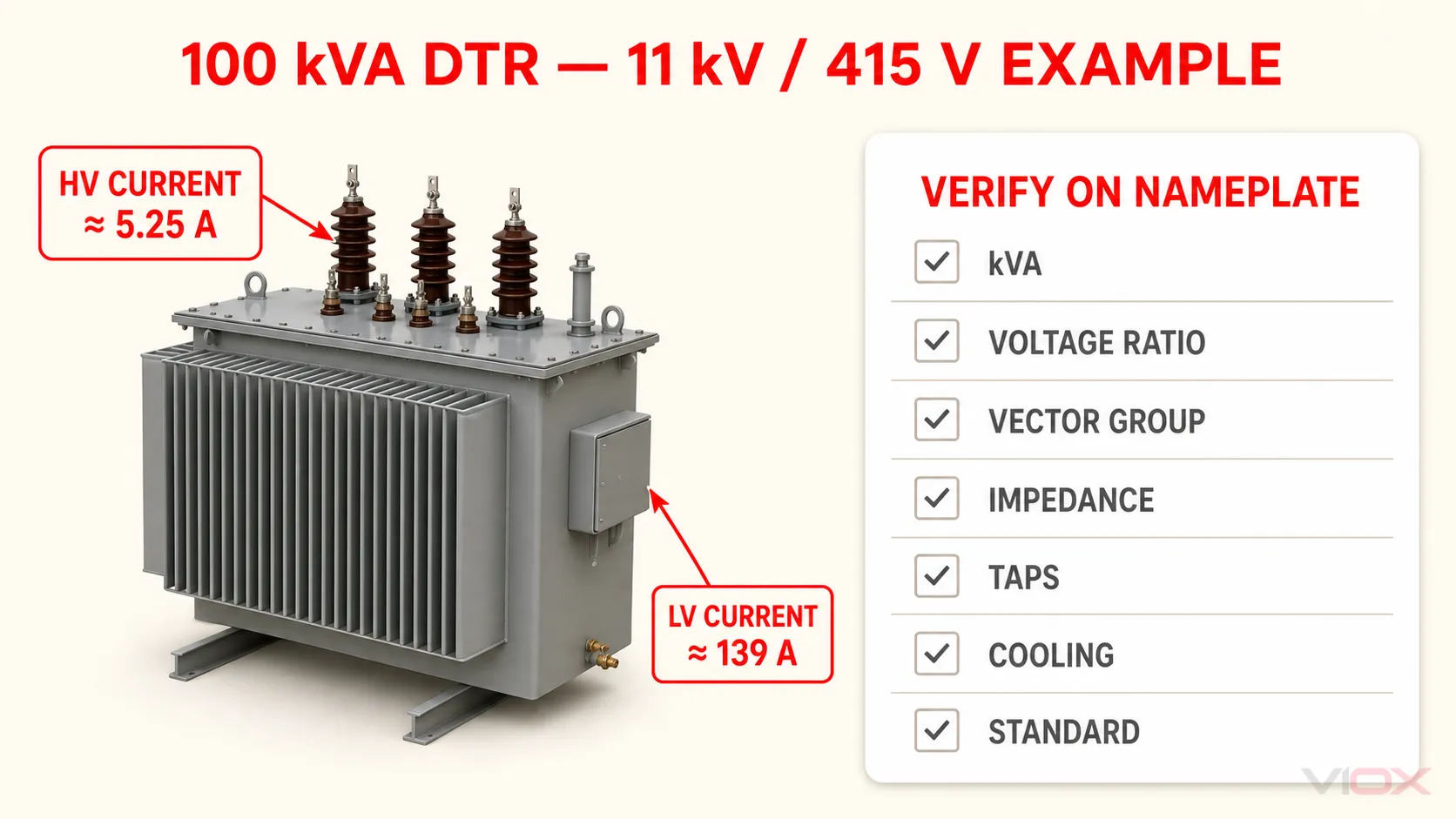
Dies sind Berechnungen der Volllast-Leitungsströme basierend auf Nennwerten. Dies sind keine Schutzeinstellungen. Einschaltstrom des Transformators, zulässige Belastung, Umgebungsbedingungen, Kühlung, Impedanz, Oberschwingungen, Leiterregeln und Koordinationsanforderungen müssen ebenfalls bewertet werden.
Für weitere Details, warum Transformatoren Scheinleistungsnennwerte verwenden, siehe Die kVA-Nennleistung von Transformatoren verstehen.
Wie man ein DTR-Typenschild liest
Überprüfen Sie mindestens die folgenden Felder:
| Typenschildangabe | Warum es wichtig ist |
|---|---|
| Nennleistung in kVA | Bestimmt die Scheinleistungskapazität der Wicklung unter den angegebenen Bedingungen |
| HV- und LV-Nennspannung | Bestimmt die Systemkompatibilität und den Nennstrom |
| Phase und Frequenz | Muss mit dem Netz übereinstimmen |
| Schaltgruppe | Definiert die Wicklungsschaltung und Phasenverschiebung |
| Relative Kurzschlussspannung | Beeinflusst die Spannungsregelung und den prospektiven Kurzschlussstrom |
| Stufenbereich | Zeigt die verfügbare Einstellung des Spannungsverhältnisses |
| Kühlungsbezeichnung | Identifiziert das deklarierte Verfahren zur Wärmeabfuhr |
| Isolationspegel | Unterstützt die dielektrische Koordination mit dem System |
| Temperaturerhöhungsgrenzen | Bezug zwischen Belastung und thermischer Auslegung sowie Betriebsbedingungen herstellen |
| Leerlauf- und Lastverluste | Beeinflussung der ganztägigen Energieeffizienz und der Beschaffungsbewertung |
| Anwendbare Norm | Definiert den erklärten Auslegungs- und Prüfrahmen |
Leiten Sie keine fehlenden Daten von einem anderen Transformator mit der gleichen kVA-Leistung ab. Spannung, Impedanz, Verluste, Schaltgruppe, Isolationspegel und Betriebsbedingungen können wesentlich abweichen.
Häufig referenzierte Standards für DTRs
Der anwendbare Standard hängt vom Markt, der Transformatorkonstruktion und der Beschaffungsspezifikation ab.
- Die IEC 60076-Reihe bietet den internationalen Rahmen für Leistungstransformatoren und damit verbundene Anforderungen.
- In Indien befasst sich die IS 1180-Reihe mit Verteiltransformatoren; die BIS-Richtlinien weisen Teil 1 für ölgefüllte Verteiltransformatoren und Teil 2 für Ausführungen mit natürlichen/synthetischen Esterflüssigkeiten aus.
- Versorgerspezifikationen können Anforderungen an die Verlustkapitalisierung, den Wirkungsgrad, Armaturen, den Schutz, Abmessungen, die Messung und die Inspektion ergänzen.
Ein Verweis auf “IEC 60076” oder “IS 1180” sollte anhand des zutreffenden Teils, der Ausgabe, der Ergänzungen, des Transformatortyps und der Käuferspezifikation geprüft werden. Leiten Sie die Konformität nicht allein aus der Familiennummer ab.
Was in einer DTR-Spezifikation enthalten sein sollte
Eine praxisorientierte Anfrage für ein Angebot sollte Folgendes angeben:
- Bemessungs-kVA;
- Primär- und Sekundärspannung sowie höchste Spannung des elektrischen Systems;
- Phasen, Frequenz, Schaltgruppe und Neutralleiteranforderungen;
- prozentuale Impedanz und Stufenstellbereich;
- flüssigkeitsgefüllte oder Trockenbauweise und Kühlungsart;
- Innen-/Außenaufstellung, Mast-/Sockel-/Rauminstallation, Umgebungstemperatur und Aufstellungshöhe;
- Verlust-, Wirkungsgrad-, Geräusch- und Temperaturanstiegsanforderungen;
- Isolationspegel, Überspannungsumgebung und Erdungskonzept;
- Zubehör, Anschlussklemmen, Kabelkästen, Überwachungs- und Schutzschnittstellen;
- anwendbare Normen, Prüfungen, Dokumentation und Inspektionsanforderungen.
Häufige Fragen
Ist ein DTR dasselbe wie ein Leistungstransformator?
Ein DTR ist ein Transformator, der für die Verteilungsfunktion verwendet wird, insbesondere für die letzte Spannungstransformation in der Nähe der Endverbraucher. “Leistungstransformator” ist ein breiterer Begriff und wird häufig mit der Übertragung großer Energiemengen in Verbindung gebracht. Die Abgrenzung basiert auf der Anwendung und Spezifikation, nicht nur auf der Kapazität.
Was ist die Ausgangsleistung eines DTR?
Die Ausgangsleistung hängt vom Netz ab. In Indien sind 415/240 V ein üblicher Niederspannungsausgang eines 11 kV-Verteilungstransformators, aber weltweit werden auch andere Übersetzungsverhältnisse verwendet.
Warum wird ein DTR in kVA bemessen?
Sein Kern und seine Wicklungen müssen Spannung und Strom unabhängig vom Leistungsfaktor der angeschlossenen Last standhalten. Daher ist die Scheinleistung in kVA die geeignete Bemessungsgrundlage.
Abschließende Definition
DTR steht für Distribution Transformer in der Terminologie der elektrischen Energieverteilung. Er führt die endgültige Spannungstransformation von einer Verteilungszuleitung zu einem lokalen Versorgungsnetz durch. Die korrekte Auswahl erfordert mehr als nur kVA: Überprüfen Sie das Übersetzungsverhältnis, die Phase und Schaltgruppe, die Impedanz, die Anzapfungen, die Verluste, die Kühlung, die Isolierung, die Installationsumgebung, die Schutzschnittstellen und die geltende Norm.