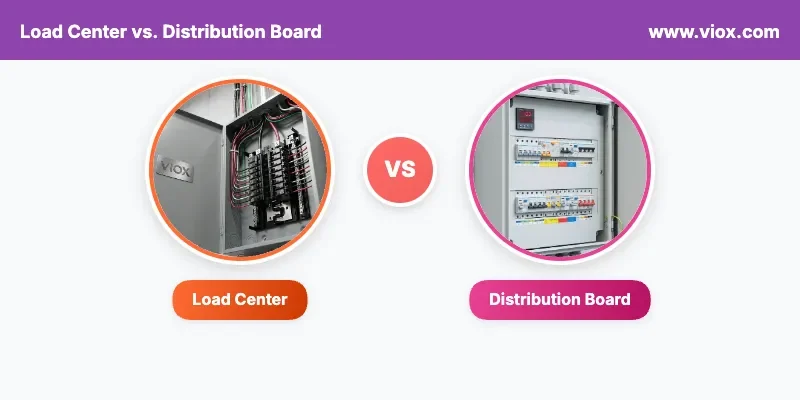
When a European contractor recently submitted specifications for a 400V distribution board on a North American manufacturing facility project, the procurement team faced an unexpected challenge: the local electrical inspector rejected the equipment citing non-compliance with UL 67 standards. The root cause? A fundamental misunderstanding between “load centers” and “distribution boards”—two terms describing functionally similar equipment governed by entirely different regulatory frameworks.
This scenario plays out frequently in today’s globalized electrical industry. As projects span continents and supply chains cross borders, the distinction between NEMA (National Electrical Manufacturers Association) and IEC (International Electrotechnical Commission) standards becomes more than academic—it directly impacts equipment selection, regulatory compliance, and project budgets.
Understanding these differences is essential for electrical engineers, panel builders, and project managers working on international projects or selecting equipment for facilities with global operations. This guide clarifies the technical and regulatory distinctions between load centers and distribution boards, helping you specify the right equipment for your specific requirements.
Terminology Matters – Load Centers vs. Distribution Boards
The terms “load center” and “distribution board” often appear interchangeable, but they reflect distinct regulatory traditions that evolved on different continents.
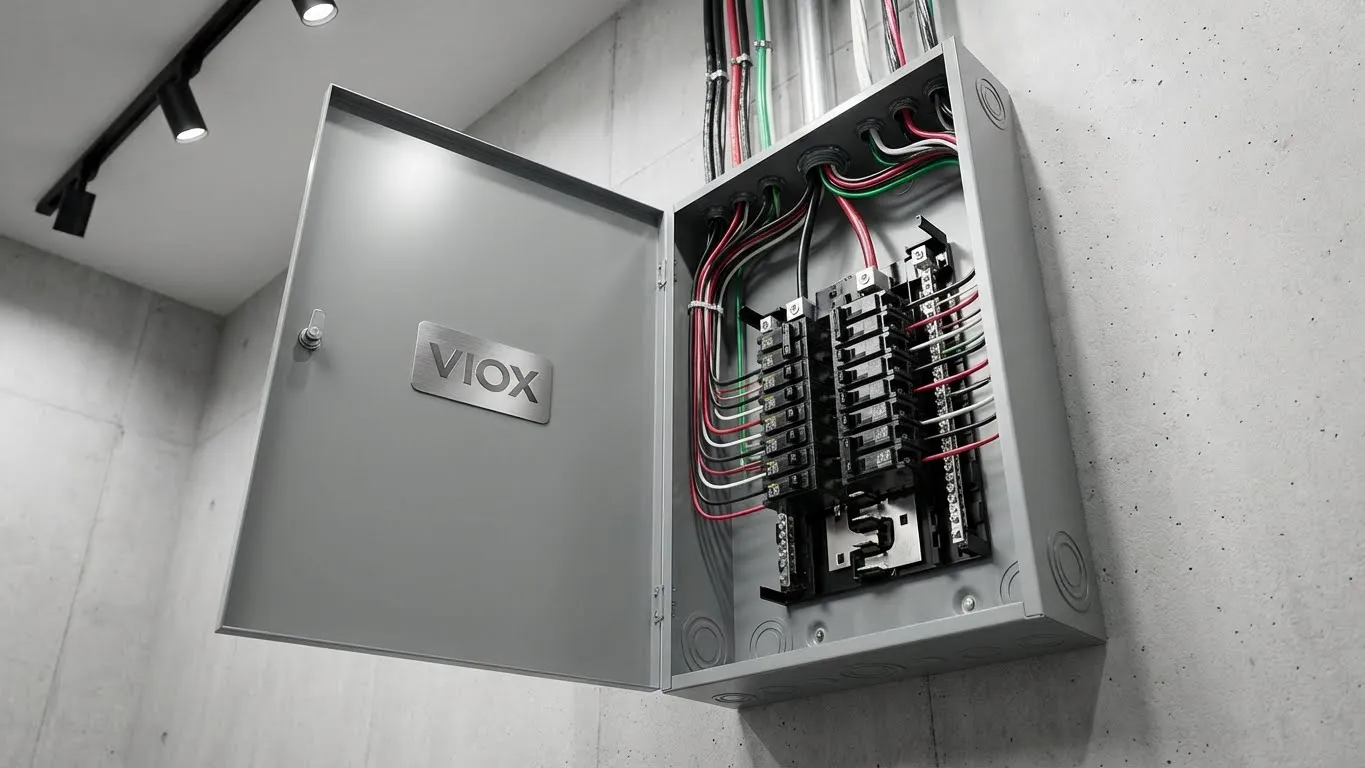
A load center is the North American term for a residential or light commercial electrical panel that distributes incoming electrical power to individual branch circuits. The term originated with NEMA standards and is deeply embedded in UL 67 (Standard for Panelboards) and the National Electrical Code (NEC). Load centers typically serve 120/240V single-phase systems and use plug-on circuit breakers mounted on aluminum or copper bus bars.
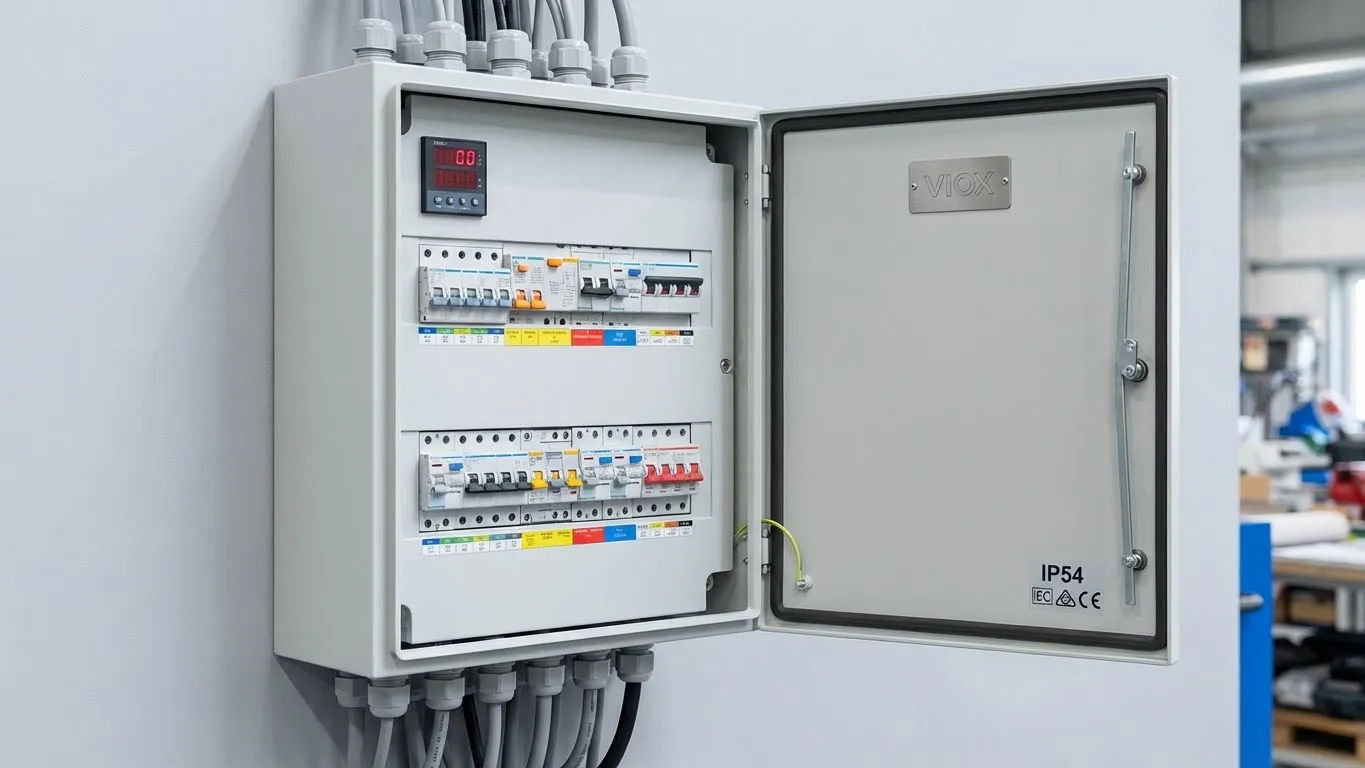
Distribution boards represent the IEC terminology for the same functional equipment. Governed primarily by IEC 61439-3 (Distribution boards intended to be operated by ordinary persons), these assemblies serve identical purposes but follow different design verification methods and performance criteria. The IEC framework uses the abbreviation “DBO” (Distribution Board for Ordinary persons) to distinguish consumer units from industrial switchgear.
The terminology split originated from parallel regulatory development. NEMA formed in 1926 to standardize electrical manufacturing in North America, while IEC emerged in 1906 as a European-led international standards body. For decades, these organizations operated independently, creating distinct technical vocabularies that persist today.
From a functional standpoint, both devices perform the same essential tasks: receiving incoming electrical power, dividing it into branch circuits, and providing overcurrent protection for each circuit. However, the regulatory frameworks governing their design, testing, and installation differ significantly.
Table 1: Terminology Comparison Across Standards
| NEMA/North America | IEC/International | Functional Description |
|---|---|---|
| Load Center | Distribution Board (DBO) | Residential/light commercial panel |
| Panelboard | Distribution Board/Switchboard Assembly | Commercial/industrial panel |
| Main Breaker | Main Protective Device | Primary overcurrent protection |
| Branch Breaker | Outgoing Circuit Protective Device | Individual circuit protection |
| Bus Bar | Busbar/Main Distribution Bar | Current distribution conductor |
| AIC Rating | Icw/Ipk Rating | Short-circuit withstand capacity |
NEMA Standards – The North American Approach to Load Centers
The National Electrical Manufacturers Association (NEMA) sets comprehensive standards for electrical equipment used primarily in the United States, Canada, and parts of Latin America. Founded in 1926, NEMA’s approach emphasizes robust construction, built-in safety factors, and ease of selection—principles that shaped modern load center design.
UL 67 and NEMA PB1 Requirements
Load centers manufactured for the North American market must comply with UL 67 (Panelboards), which establishes construction, performance, and safety requirements. NEMA Standard PB1 supplements UL 67 with additional guidelines for low-voltage switchboards and panelboards rated 600V and below.
These standards mandate specific construction features including dead-front design (no exposed live parts when the door is closed), main bonding provisions, and temperature rise limitations. The 2017 revision to UL 67 added service entrance requirements, mandating protective barriers against inadvertent contact with energized parts in main breaker panels.
Typical NEMA Load Center Specifications
NEMA load centers serve voltage systems ranging from 120/240V single-phase residential installations to 480V three-phase commercial applications. Residential load centers typically range from 100A to 200A main breaker ratings, while commercial panelboards can handle up to 1200A with appropriately sized bus bars.
Short-circuit ratings use the AIC (Amperes Interrupting Capacity) metric, with common residential load centers rated at 10,000 AIC or 22,000 AIC. Industrial panelboards may require 42,000 AIC or 65,000 AIC ratings for installations near utility transformers or large generators.
Design Philosophy: Robustness and Safety Margins
NEMA’s design philosophy incorporates substantial safety factors. Load centers are engineered to operate reliably under continuous loads while maintaining significant thermal headroom. This approach prioritizes long-term durability over space efficiency or initial cost.
Circuit breakers mount to bus bars using either plug-on or bolt-on connections. Plug-on breakers dominate residential applications, offering quick installation and replacement. Bolt-on breakers provide more secure mechanical and electrical connections for commercial and industrial installations where vibration or high fault currents are concerns.
NEMA Enclosure Types
Load center enclosures follow NEMA 250 standards, which define protection levels against environmental conditions:
- Type 1: Indoor use, general purpose protection against dust and accidental contact
- Type 3R: Outdoor use, rain-resistant with drain provisions
- Type 4X: Indoor/outdoor, corrosion-resistant (typically stainless steel or fiberglass), protection against hose-directed water
Table 2: Common NEMA Load Center Specifications
| Parameter | Residential Range | Commercial/Industrial Range |
|---|---|---|
| Voltage | 120/240V 1-phase | 208Y/120V or 480Y/277V 3-phase |
| Main Breaker Rating | 100A – 225A | 225A – 1200A |
| Short-Circuit Rating | 10kA – 22kA AIC | 22kA – 65kA AIC |
| Bus Material | Aluminum (tinned) or Copper | Copper (silver-plated) |
| Breaker Type | Plug-on | Plug-on or Bolt-on |
| Standard Enclosure | NEMA Type 1 | NEMA Type 1, 3R, 12 |
| Governing Standards | UL 67, NEMA PB1, NEC Article 408 | UL 67, NEMA PB1, UL 891 |
IEC Standards – The Global Framework for Distribution Boards
The International Electrotechnical Commission (IEC) provides the technical framework for electrical equipment used across Europe, Asia, Africa, the Middle East, and increasingly in multinational projects worldwide. Founded in 1906, IEC’s approach emphasizes performance-based verification and design flexibility within defined safety parameters.
IEC 61439 Series: The Foundation
Distribution boards fall under the IEC 61439 series, which replaced the older IEC 60439 standards in 2009. This comprehensive framework consists of multiple parts addressing different assembly types.
IEC 61439-1 establishes general rules applicable to all low-voltage switchgear and controlgear assemblies, including definitions, verification requirements, and construction standards. This document defines fundamental concepts like rated current (InA for assembly, Inc for circuits), rated voltage, and design verification procedures.
IEC 61439-3 specifically addresses “Distribution boards intended to be operated by ordinary persons (DBO),” covering residential consumer units and light commercial distribution panels. This standard defines the equipment most directly comparable to NEMA load centers.
Key Technical Parameters Under IEC 61439-3
Distribution boards governed by IEC 61439-3 have specific operating limitations:
- Nominal voltage to earth: Not exceeding 300V AC (per Table G.1 of IEC 61439-1:2020)
- Inc (circuit rated current): Not exceeding 125A for outgoing circuits
- InA (assembly rated current): Not exceeding 250A for the complete assembly
- Frequency: Typically 50 Hz (though 60 Hz applications are covered)
These parameters define DBOs as equipment for non-industrial applications where ordinary persons (homeowners, office workers) may operate switches or replace fuses without specialized electrical training.
Performance-Based Design Verification
IEC 61439 introduces a performance-based approach fundamentally different from NEMA’s prescriptive requirements. Manufacturers must verify designs through:
- Type Testing: Comprehensive testing of a representative assembly design, including temperature rise verification, short-circuit testing, dielectric properties, and mechanical operation. Once type tested, a design becomes a “verified assembly.”
- Routine Testing: Every manufactured unit undergoes basic verification including dielectric testing and operational checks, but not the full type test suite.
- Design Verification by Comparison: Panel builders can construct assemblies using verified systems from original manufacturers without repeating type tests, provided they follow the system manufacturer’s specifications exactly.
This approach allows greater design flexibility while maintaining safety through rigorous initial verification. However, it places significant responsibility on manufacturers to maintain documentation proving compliance.
IP Ratings Replace NEMA Types
Instead of NEMA enclosure types, IEC uses the IP (Ingress Protection) rating system defined in IEC 60529. IP ratings consist of two digits: the first indicates solid particle protection, the second indicates liquid ingress protection.
Common ratings for distribution boards:
- IP40: Protection against solid objects >1mm, no liquid protection (indoor applications)
- IP54: Dust-protected, protection against water splashing (light industrial)
- IP65: Dust-tight, protection against water jets (outdoor or harsh environments)
Table 3: IEC 61439 Distribution Board Key Parameters
| Parameter | IEC 61439-3 (DBO) Specification | Notes |
|---|---|---|
| Nominal Voltage to Earth | ≤300V AC | Residential and light commercial |
| Inc (Circuit Rated Current) | ≤125A | Individual outgoing circuits |
| InA (Assembly Rated Current) | ≤250A | Main incoming supply |
| Frequency | Typically 50 Hz | 60 Hz applications covered |
| IP Rating | IP2X minimum (typical IP40-IP54) | Higher ratings for outdoor use |
| Protective Devices | MCB, RCCB, RCBO per IEC 60898, 61008, 61009 | Standardized component interface |
| Verification Method | Type test + Routine test | Or verification by comparison |
| Governing Standards | IEC 61439-1, IEC 61439-3 | Part 1: general rules, Part 3: DBO specific |
Key Technical Differences: A Detailed Comparison
While load centers and distribution boards serve identical functional purposes, their underlying standards create meaningful technical distinctions that affect specification, installation, and operation.
Standards Body and Geographic Prevalence
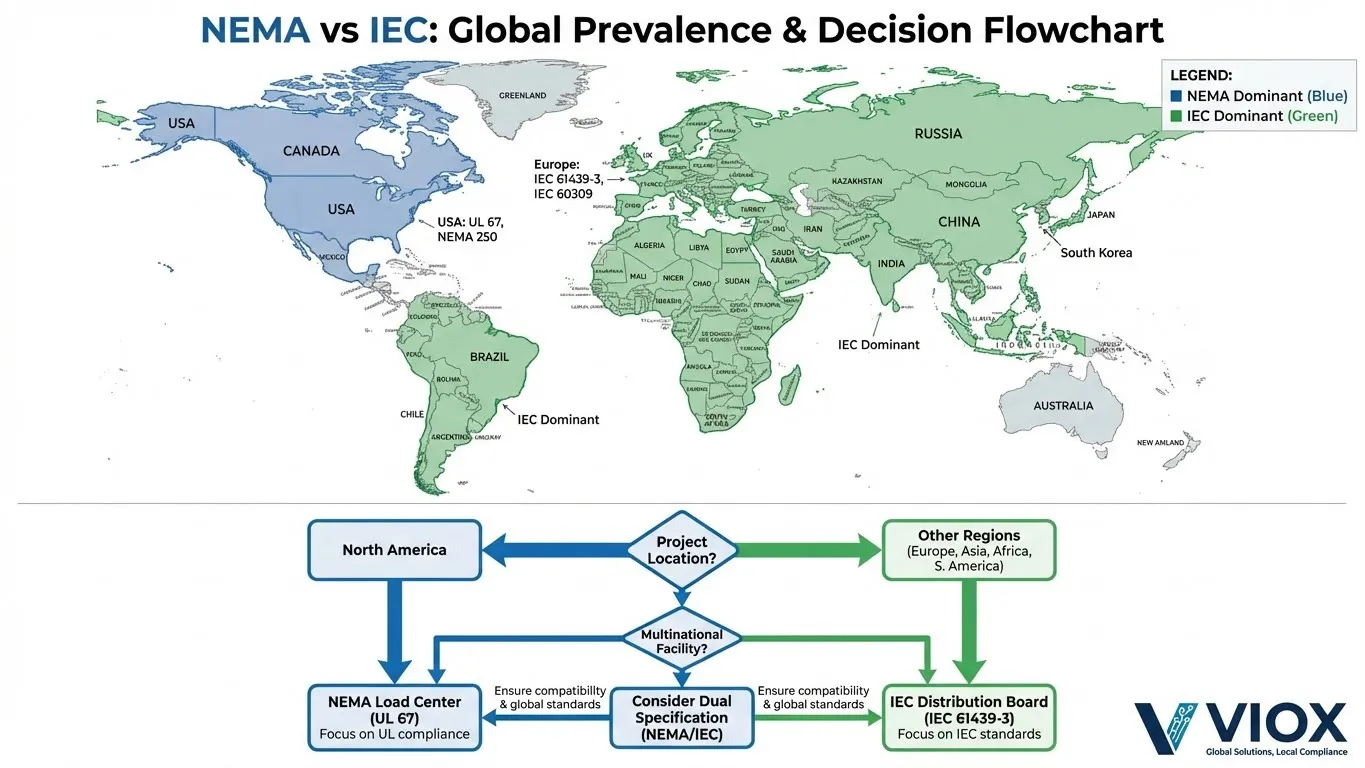
NEMA standards dominate North America (United States, Canada, parts of Mexico) and countries with historical U.S. electrical infrastructure ties. IEC standards govern the majority of global installations, including all of Europe, Asia, Africa, the Middle East, and Latin America outside NEMA regions.
This geographic split creates practical challenges. A facility designed to NEMA standards cannot easily accept IEC equipment without regulatory approval, and vice versa. Projects spanning multiple countries often require parallel specifications to accommodate both frameworks.
Voltage and Frequency Considerations
North American systems typically operate at 60 Hz with common voltages of 120/240V single-phase or 208Y/120V and 480Y/277V three-phase. IEC regions predominantly use 50 Hz systems with 230V single-phase (phase-to-neutral from 400V three-phase wye systems).
These fundamental differences extend beyond the distribution board itself—they affect connected loads, motor speeds, transformer selection, and harmonic considerations. Simply substituting a distribution board without addressing system frequency creates operational problems.
Current Rating Philosophy
NEMA load centers incorporate service factors—the ability to operate continuously at 100% of rated current with significant thermal margin. This conservative approach means a 200A load center can reliably handle 200A continuously without derating.
IEC distribution boards rate components more precisely to their tested capacity, using utilization categories to match devices to specific applications. A DBO rated at 250A InA operates at that level under defined conditions, with less inherent overhead than comparable NEMA equipment.
Short-Circuit Performance Metrics
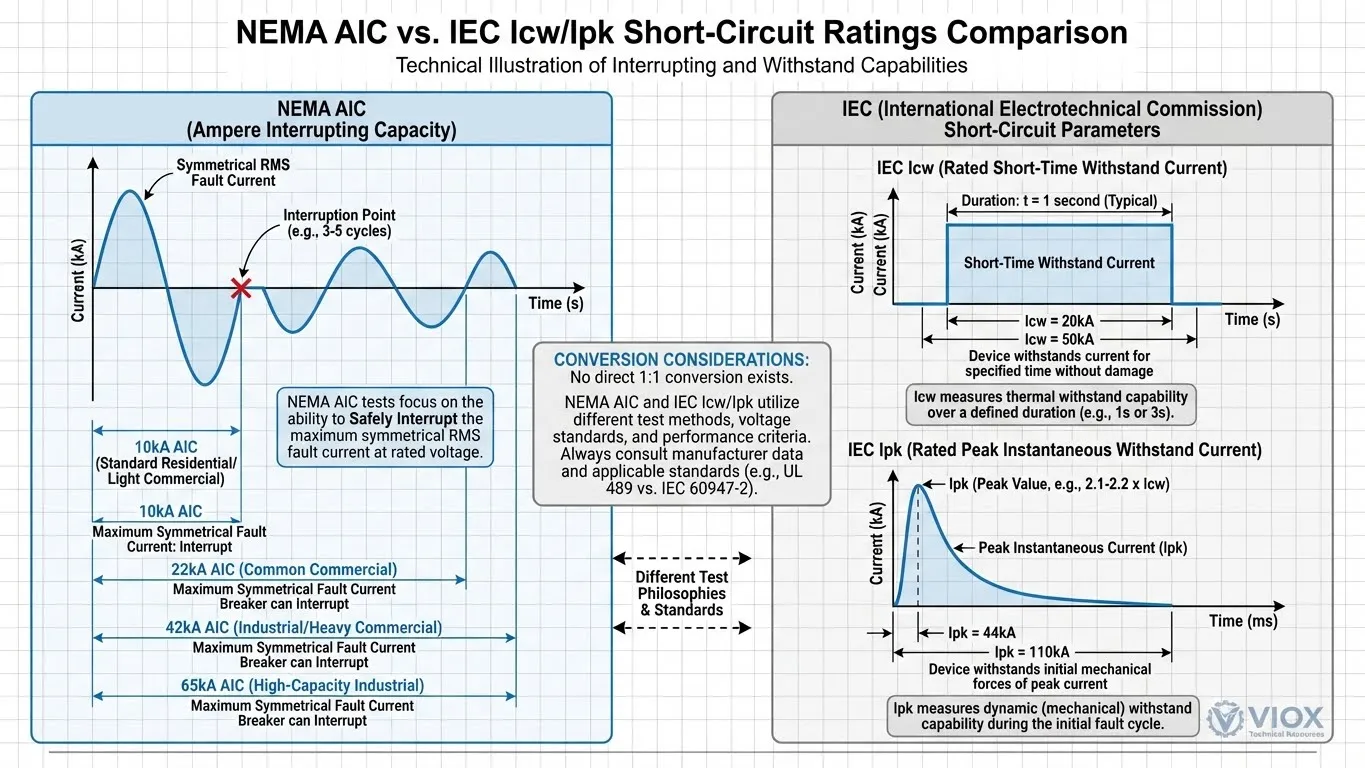
NEMA uses AIC (Amperes Interrupting Capacity) ratings, typically 10kA, 22kA, 42kA, or 65kA for load centers. This single number represents the maximum fault current the assembly can safely interrupt and clear.
IEC employs multiple short-circuit parameters:
- Icw (rated short-time withstand current): The current level an assembly can withstand for a specified duration (typically 1 second)
- Ipk (rated peak withstand current): The maximum instantaneous peak current during a fault
- Icc (conditional short-circuit current): Short-circuit protection coordinated with specific upstream devices
This multi-parameter approach provides more detailed fault performance information but requires more sophisticated analysis during specification.
Enclosure Protection Philosophy
NEMA Type ratings (1, 3R, 4X, 12) describe complete enclosure performance against environmental hazards through broad categories. An engineer specifying “NEMA 3R” knows the enclosure provides outdoor rain protection without detailed analysis.
IEC IP ratings offer more granular specification. An IP54 enclosure provides dust protection (5) and splash protection (4), allowing precise matching to environmental conditions. However, IP ratings don’t address corrosion resistance, impact protection, or other factors covered by NEMA types, which can require additional specifications.
Verification and Compliance Approach
NEMA follows a prescriptive approach—standards define specific construction requirements, materials, and test procedures that manufacturers must follow. Compliance means meeting defined criteria.
IEC uses performance-based verification—standards define required performance levels but allow manufacturers flexibility in achieving them. Type testing proves design adequacy; ongoing routine testing ensures consistency. This approach encourages innovation but demands rigorous documentation.
Table 4: NEMA Load Center vs. IEC Distribution Board – Technical Comparison Matrix
| Aspect | NEMA Load Center | IEC Distribution Board |
|---|---|---|
| Primary Standard | UL 67, NEMA PB1 | IEC 61439-1, IEC 61439-3 |
| Geographic Use | North America, parts of Latin America | Europe, Asia, Africa, Middle East, globally |
| Typical Voltage | 120/240V (1φ), 208Y/120V, 480Y/277V (3φ) | 230V (1φ), 400Y/230V (3φ) |
| Frequency | 60 Hz | 50 Hz (60 Hz covered) |
| Residential Current Range | 100A – 200A | InA up to 250A, Inc up to 125A |
| Short-Circuit Rating | AIC (10kA, 22kA, 42kA, 65kA) | Icw/Ipk (kA for specified duration) |
| Enclosure Protection | NEMA Type 1, 3R, 4X, 12 | IP Rating (IP40, IP54, IP65) |
| Design Philosophy | Prescriptive, safety factor built-in | Performance-based, design verification |
| Breaker Mounting | Plug-on or bolt-on to bus | DIN rail, bolt-on, or plug-in modular |
| Verification Method | Compliance testing per UL 67 | Type testing + routine testing |
| Component Selection | Conservative sizing, higher service factors | Precise matching through utilization categories |
| Typical Bus Material | Aluminum (tinned) or copper | Aluminum or copper with appropriate plating |
Practical Implications for Engineers and Specifiers
Understanding the technical differences between NEMA and IEC standards translates into practical specification decisions that affect project success, cost, and long-term operation.
Geographic Location Drives Primary Standard
Project location remains the dominant factor in standard selection. North American projects require NEMA-compliant load centers to satisfy local electrical codes and inspection requirements. Projects in IEC regions must specify distribution boards meeting IEC 61439 to gain regulatory approval.
International projects present specification challenges. A global manufacturing company building identical facilities in the U.S., Germany, and China needs parallel specifications: NEMA load centers for the U.S. facility, IEC distribution boards for Germany and China. This duplication increases engineering effort but ensures local compliance.
Direct Interchangeability Limitations
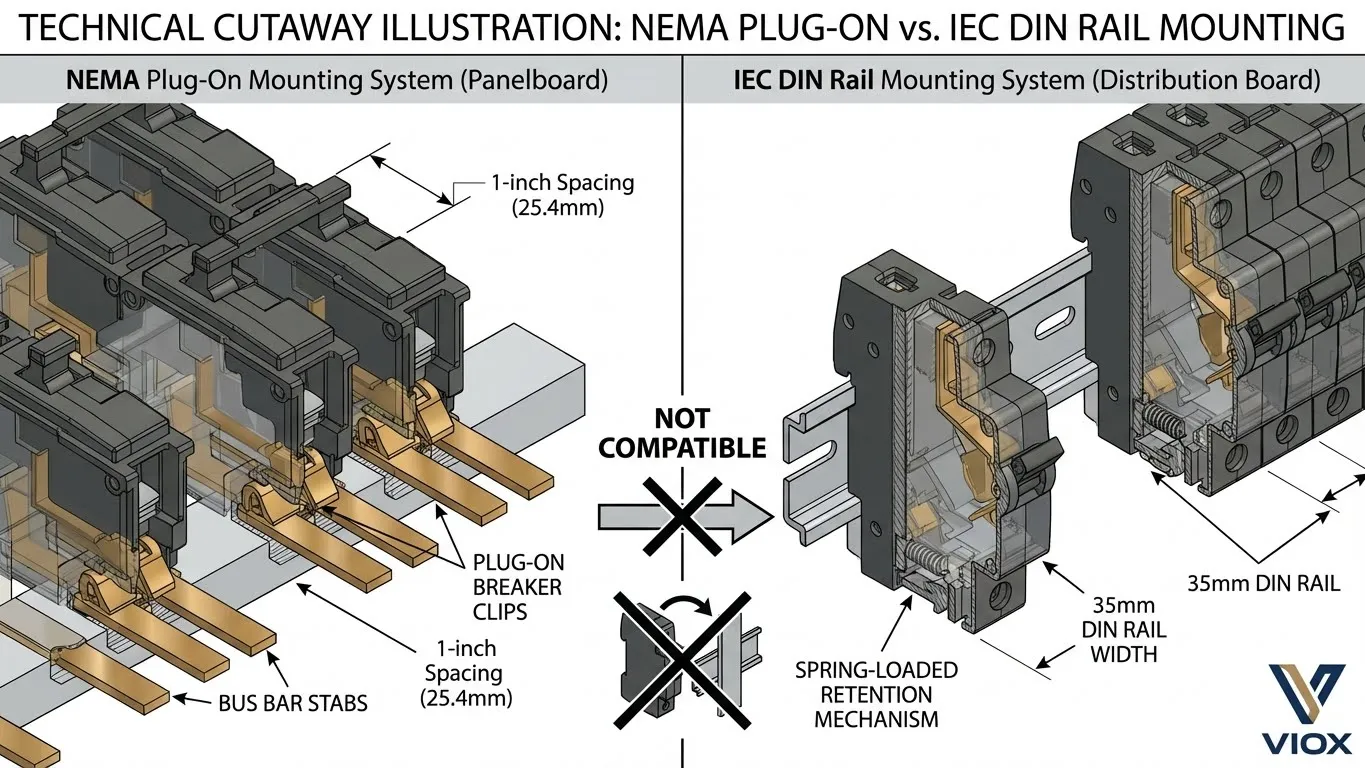
NEMA load centers and IEC distribution boards are not directly interchangeable, even when voltage and current ratings appear similar. Circuit breakers designed for NEMA bus systems don’t mechanically fit IEC DIN rail mounting. The verification documentation required differs fundamentally between standards.
Attempting to substitute one standard for another creates multiple problems: mechanical incompatibility, regulatory non-compliance, voided warranties, and potential safety issues. Equipment must match the standard specified in project documents and required by local authority having jurisdiction.
When to Specify NEMA Load Centers
NEMA equipment suits projects with these characteristics:
- Location: United States, Canada, or other NEMA-dominant regions
- Environment: Harsh industrial conditions where robust construction provides long-term reliability
- Simplicity: Applications where straightforward selection (voltage + current = model number) speeds specification
- Availability: Regions where NEMA equipment is readily available with short lead times
- Service: Facilities where maintenance personnel are trained on NEMA systems
When to Specify IEC Distribution Boards
IEC equipment makes sense for:
- Location: Europe, Asia, Africa, Middle East, or IEC-dominant regions
- Space constraints: Installations where compact, modular design maximizes available room
- Customization: Projects requiring flexible configurations within verified systems
- Global consistency: Multinational facilities seeking worldwide equipment standardization
- Supply chain: Situations where IEC manufacturers offer better pricing or delivery
Cost and Availability Factors
Regional manufacturing concentration affects pricing. NEMA equipment typically costs less in North America due to local production and distribution networks. IEC equipment enjoys price advantages in European and Asian markets.
Lead times follow similar patterns. Standard NEMA load centers ship quickly within North America but may require extended delivery in IEC regions. IEC distribution boards offer short lead times in Europe and Asia but longer delivery to North American projects.
Maintenance and Spare Parts Considerations
Long-term operating costs depend partly on spare parts availability. Facilities should stock replacement breakers and components matching their installed standard. A facility with NEMA load centers maintains inventory of plug-on breakers rated for 120/240V operation. Converting to IEC equipment later requires replacing existing spare parts inventory.
Personnel training represents another ongoing cost. Electricians familiar with NEMA load centers need training to service IEC distribution boards, and vice versa. Facilities with both standards require broader training programs and potentially specialized maintenance teams.
VIOX Electric Solutions for Both Standards
VIOX Electric manufactures distribution equipment compliant with both NEMA and IEC standards, providing customers with flexibility for projects in any region worldwide. Our manufacturing facilities maintain certifications from UL, CE, and other international certification bodies, ensuring products meet required standards regardless of project location.
Comprehensive Testing Capabilities
Our in-house testing laboratories perform verification testing per both UL 67 and IEC 61439 requirements. Temperature rise testing, short-circuit testing, dielectric testing, and mechanical endurance testing validate designs before production. This dual-standard capability lets us provide appropriate documentation for projects in any regulatory jurisdiction.
For IEC 61439 assemblies, we maintain complete type-test documentation for our verified system ranges, supporting panel builders who construct assemblies using VIOX verified systems. For NEMA applications, our UL 67 listings cover standard and custom panelboard configurations.
Technical Support for Specification Assistance
VIOX technical support teams assist engineers in selecting appropriate equipment for specific applications. Whether your project requires NEMA load centers, IEC distribution boards, or both, our specialists can recommend configurations meeting technical requirements while optimizing cost and delivery schedules.
Our engineering team can also support projects transitioning between standards—for example, specifying IEC-equivalent equipment for a multinational facility standardization program, or identifying NEMA equipment for a facility in an IEC region with existing NEMA infrastructure.
For detailed technical specifications on our load center and distribution board product lines, explore our complete switchgear current ratings guide, which covers InA, Inc, and RDF ratings under IEC 61439. We also provide comprehensive resources on protection component selection for solar distribution applications, demonstrating our expertise across diverse electrical distribution scenarios. Our team maintains deep expertise in both NEC and IEC terminology standards, ensuring accurate specification across regulatory jurisdictions.
Conclusion
Load centers and distribution boards represent regional terminology for functionally equivalent equipment governed by different regulatory frameworks. NEMA standards emphasize robust construction with built-in safety factors, serving North American markets through prescriptive requirements in UL 67 and NEMA PB1. IEC standards provide a global framework centered on performance-based verification per IEC 61439, offering design flexibility within defined safety parameters.
Neither standard is inherently superior—each evolved to serve its regional electrical infrastructure, regulatory environment, and industry practices. Modern electrical engineers must understand both frameworks to specify equipment correctly for projects spanning international boundaries or serving multinational organizations.
Selecting the appropriate standard for your project depends on location, regulatory requirements, available expertise, and long-term operational considerations. Partnering with manufacturers like VIOX Electric, who maintain expertise in both NEMA and IEC standards, ensures proper equipment specification regardless of project location or regulatory jurisdiction.
Frequently Asked Questions
Q1: Can I use a NEMA load center in a project specified for IEC distribution boards?
No, NEMA load centers and IEC distribution boards are not interchangeable without formal engineering analysis and regulatory approval. They follow different construction standards, use incompatible mounting systems for circuit breakers, and require different verification documentation. Using equipment that doesn’t match the specified standard creates code compliance issues, voids warranties, and may create safety hazards. If your project location or specifications require IEC equipment, you must use distribution boards compliant with IEC 61439, not NEMA load centers.
Q2: What is the main difference between UL 67 and IEC 61439-3?
UL 67 follows a prescriptive approach, defining specific construction requirements, materials, and test procedures that manufacturers must follow exactly. IEC 61439-3 uses a performance-based approach, specifying required performance levels (temperature rise limits, short-circuit withstand, etc.) while allowing manufacturers flexibility in how they achieve those levels through design verification. Additionally, UL 67 covers a broader range of panelboards including industrial switchboards, while IEC 61439-3 specifically addresses distribution boards for operation by ordinary persons (DBOs) with current and voltage limitations appropriate for residential and light commercial applications.
Q3: Are NEMA and IEC circuit breakers interchangeable?
No, NEMA and IEC circuit breakers are mechanically and electrically incompatible. NEMA breakers use plug-on or bolt-on connections to panelboard bus bars with specific spacing (typically 1-inch centers for residential load centers). IEC breakers mount to DIN rails with different mechanical interfaces and spacing. Beyond mechanical differences, the trip characteristics, testing standards, and marking requirements differ between NEMA (UL 489) and IEC (IEC 60898) breakers. Installing the wrong breaker type creates serious safety hazards including poor electrical connections, improper fault protection, and violation of listing requirements.
Q4: Which standard is more stringent – NEMA or IEC?
Neither standard is inherently more or less stringent—they emphasize different aspects of safety and performance. NEMA standards typically require larger safety factors and more robust construction, making equipment less likely to operate near design limits. IEC standards require more detailed performance verification through type testing but allow operation closer to tested limits when properly applied through utilization categories. Both standards effectively ensure safety when equipment is properly specified, installed, and maintained. The key difference lies in philosophy: NEMA favors conservative design margins; IEC favors precise matching of component capabilities to application requirements.
Q5: How do I convert between NEMA AIC ratings and IEC short-circuit ratings?
Direct conversion between NEMA AIC ratings and IEC Icw/Ipk ratings is not straightforward because they measure different aspects of short-circuit performance. NEMA AIC (Amperes Interrupting Capacity) indicates the maximum symmetrical RMS fault current a breaker can interrupt and clear. IEC Icw (short-time withstand current) indicates the RMS current level the assembly can withstand for a specified duration (often 1 second), while Ipk (peak withstand current) indicates maximum instantaneous peak current. As a rough approximation, multiply IEC Icw by 2.5 to estimate peak fault current, but this varies with system X/R ratio. For critical applications, consult manufacturers for proper fault current analysis rather than attempting direct conversions, as the underlying test methods and safety philosophies differ fundamentally between standards.