
Άμεση απάντηση
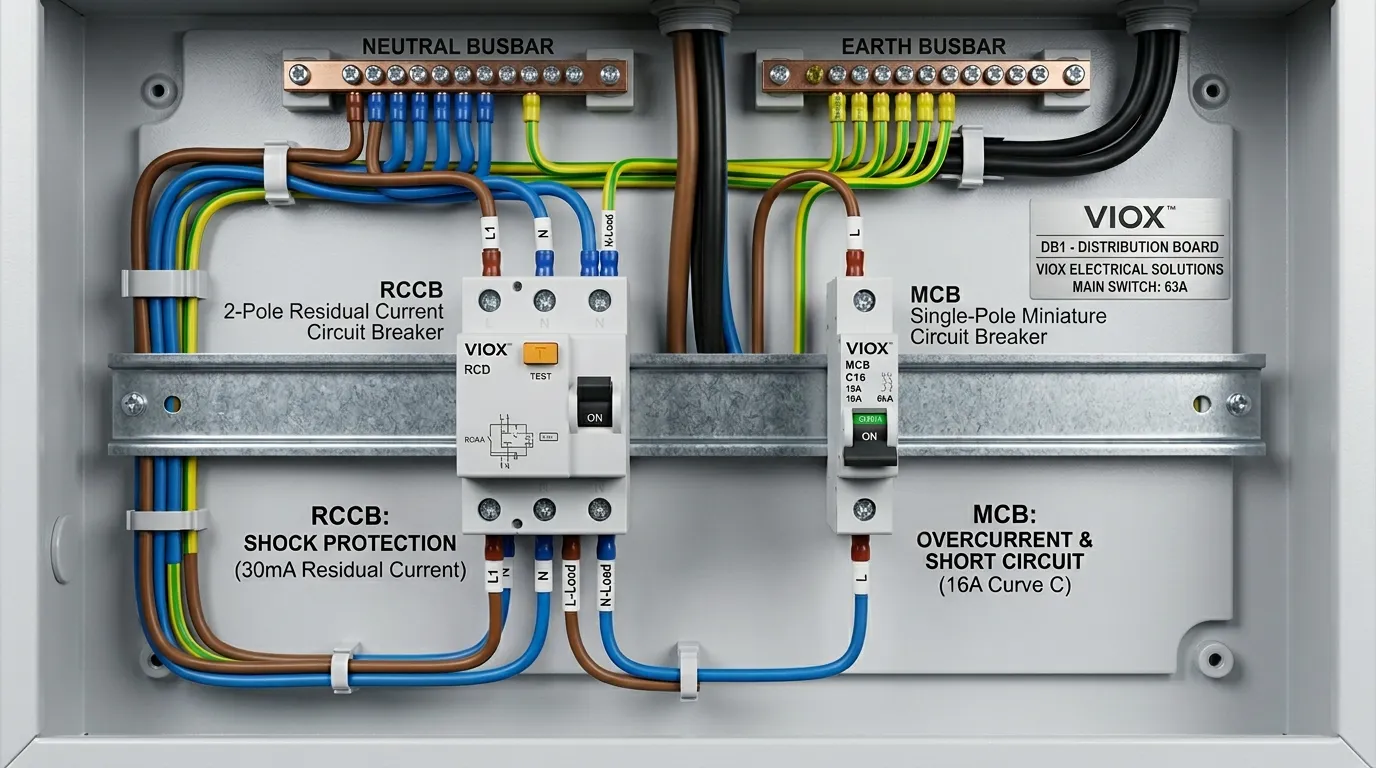
You do not use an RCCB instead of an MCB for every purpose. You use an RCCB when you need electric shock and earth-leakage protection, and you use an MCB when you need overload and short-circuit protection. In most real installations, the correct answer is not RCCB ή MCB, but RCCB + MCB together, or a single RCBO that combines both functions.
That distinction matters because an MCB can protect cables and equipment from excessive current, but it cannot detect the small leakage currents that can pass through a human body. An RCCB is designed specifically to detect that imbalance and disconnect the circuit quickly enough to reduce shock risk.
If your real question is “which device protects people,” the answer is simple: RCCB protects people from earth-leakage faults; MCB protects wiring from overcurrent faults. In practical design, that usually means residual-current protection must be combined with properly coordinated overcurrent protection rather than treated as a standalone replacement.
Βασικά συμπεράσματα
- RCCB and MCB are not substitutes. They protect against different fault types.
- The essential job of an RCCB is detecting current imbalance between live and neutral conductors.
- Ένα
MCBτο χρησιμοποιούν. δεν provide personal shock protection. - In most residential and light commercial systems, the correct protection strategy is MCB + RCCB ή RCBO.
- In many markets,
RCBis used loosely for residual-current devices, whileRCCBis the more precise term.
RCCB vs MCB: The Core Difference
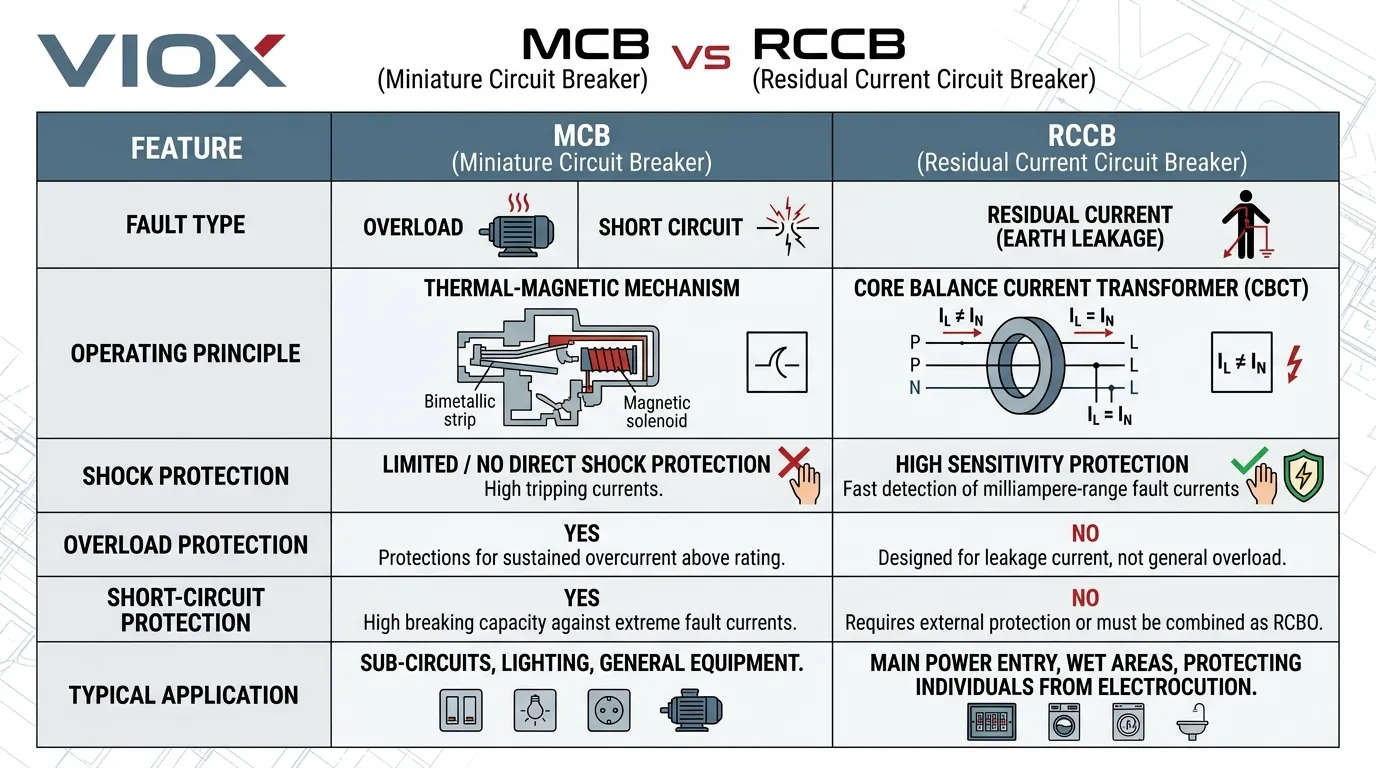
The clearest way to compare them is to look at the fault each device is built to detect.
| Συσκευή Προστασίας | Πλήρης μορφή | Main Job | Ανιχνεύει | Does It Protect Against Electric Shock? | Τυπικός Ρόλος |
|---|---|---|---|---|---|
| RCCB | Διακόπτης Διαρροής Ρεύματος | Disconnects the circuit when leakage current flows to earth | Earth leakage / residual current imbalance | Yes, for earth-fault shock risk | Personal protection and leakage protection |
| MCB | Μικροσκοπικός διακόπτης κυκλώματος | Disconnects the circuit when current exceeds the rated limit | Υπερφόρτωση και βραχυκύκλωμα | Όχι | Προστασία από υπερένταση κυκλώματος διακλάδωσης |
| RCBO | Διακόπτης Υπολειπόμενου Ρεύματος με Προστασία από Υπερένταση | Combines both functions in one device | Earth leakage + overload + short circuit | Ναι | Combined protection where space or selectivity matters |
That is why comparing RCCB και MCB as if they are interchangeable is misleading. They are not interchangeable in function. They are complementary devices.
If you want the broader terminology map, see Ποια είναι η διαφορά μεταξύ MCB, MCCB, RCB, RCD, RCCB και RCBO;.
What Is the Function of an RCCB?
An RCCB compares the current leaving on the live conductor with the current returning on the neutral conductor.
Under normal conditions:
- current out = current back
- the magnetic balance inside the device remains stable
- the RCCB stays closed
Under an earth-fault condition:
- some current leaks to earth through damaged insulation, metal enclosures, moisture, or a human body
- current out no longer equals current back
- the RCCB detects the imbalance
- the device trips and disconnects the circuit
This is what makes an RCCB different from a standard overcurrent breaker. It is not looking for “too much current” in the conventional sense. It is looking for missing current that has taken an unintended path.
Because the device can fail mechanically or electrically over time, regular checking matters. The built-in T ή Δοκιμή button should be part of normal maintenance awareness. Pressing it confirms that the device can still trip, although it does not replace instrument testing during professional inspection.
For a deeper explanation of leakage-current hazards, see Κατανόηση της προστασίας από σφάλματα γείωσης.
Why an MCB Cannot Protect People from Electric Shock
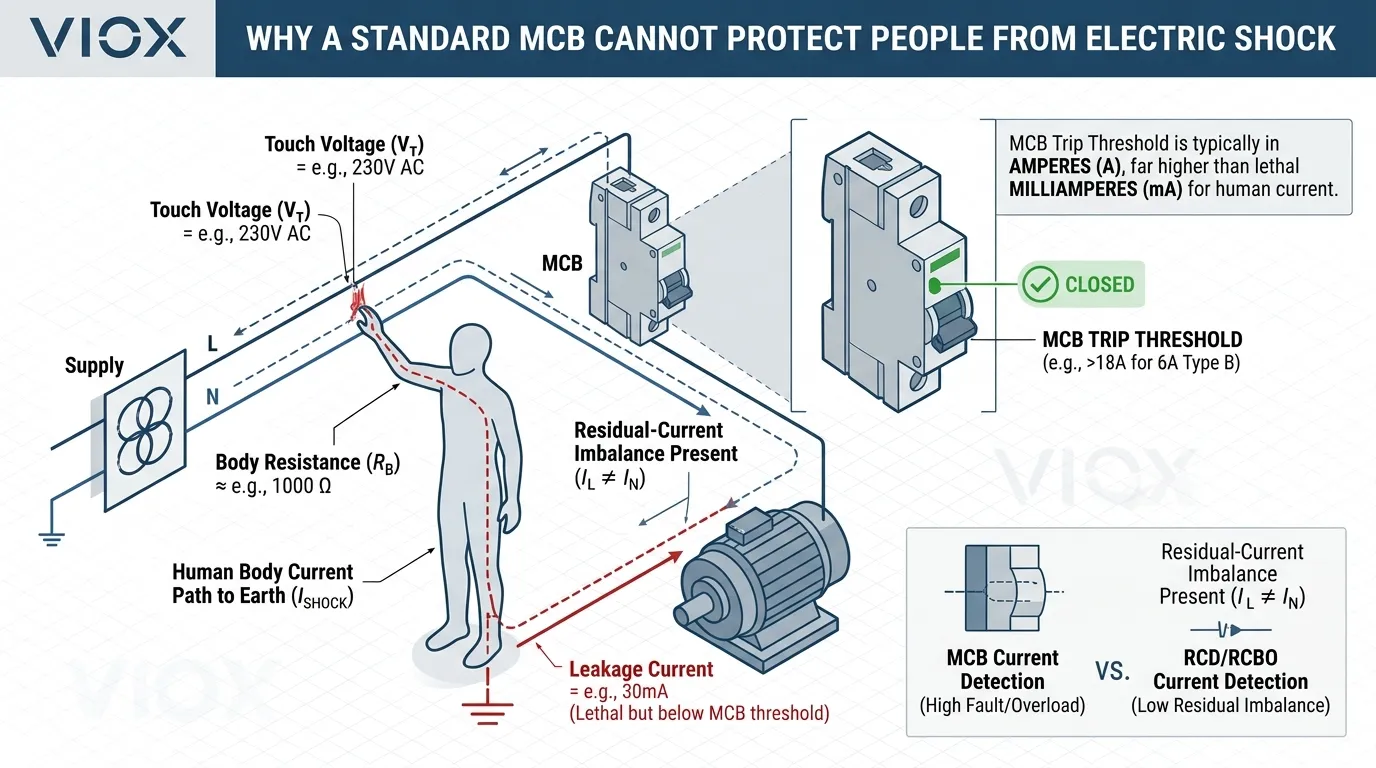
An MCB trips when the circuit current exceeds its designed threshold. A person can receive a dangerous or even fatal electric shock at a leakage level far below the current required to trip a typical MCB. That means:
- a 6 A, 10 A, 16 A, or 32 A MCB may remain closed
- the fault current may still be high enough to injure or kill a person
- the MCB is doing exactly what it was designed to do, but the fault type is outside its job
This becomes easier to understand when you compare human-body current levels with breaker ratings. In low-voltage safety practice, 50 V AC is commonly treated as an important conventional touch-voltage threshold under normal dry conditions, but the real shock outcome still depends on body resistance, contact conditions, skin moisture, and the current path through the body. Once current rises into the tens of milliamps, the risk becomes serious even though it is still tiny compared with the rated current of a branch MCB.
That is the protection gap:
- a human may be exposed to dangerous leakage current measured in milliamps
- a standard MCB is waiting for fault current measured in amps
- the shock can be severe long before the MCB sees anything abnormal
This is also why a panel can appear “fully protected” and still be unsafe from a personal-protection perspective if it contains only MCBs.
If you want the broader homeowner-safety version of this topic, see Why Circuit Breakers Don’t Protect People.
When Should You Use RCCB Instead of MCB?
The wording γιατί να χρησιμοποιήσετε RCCB αντί για MCB needs one technical correction: in most installations, you should not replace the MCB function entirely. You should add the missing residual-current protection function.
In practice, choose RCCB where the main design concern is shock risk or earth leakage, especially in:
- bathrooms
- kitchens
- laundry rooms
- outdoor sockets and lighting
- garages and workshops
- circuits serving portable tools
- damp or conductive environments
Επιλέγω MCB where the main design concern is:
- προστασία υπερφόρτωσης
- προστασία από βραχυκύκλωμα
- branch-circuit cable protection
- protecting downstream conductors and connected loads from excessive current
Επιλέγω RCCB + MCB together when you need both:
- personal protection
- cable and equipment overcurrent protection
Επιλέγω RCBO when you want both functions in one device and need:
- individual circuit protection
- less shared-tripping impact
- simpler single-circuit residual-current protection
If RCBO is part of your design path, see Πώς να επιλέξετε το σωστό RCBO.
RCCB vs MCB in Real Installations
In most practical boards, the protection hierarchy looks like this:
- Το MCB protects the circuit against overload and short circuit.
- Το RCCB monitors for leakage to earth.
- The combination protects both the installation and the user.
This is why professional panel design rarely frames the decision as pure substitution. In field installations, the more useful questions are:
- Does this circuit need personal leakage protection?
- Is overcurrent protection already present?
- Would a shared RCCB be acceptable, or is per-circuit RCBO better?
- What residual-current sensitivity is appropriate?
That is the level where the choice becomes a design decision instead of a glossary question.
RCCB + MCB vs RCBO: Breaking Capacity and Backup Protection
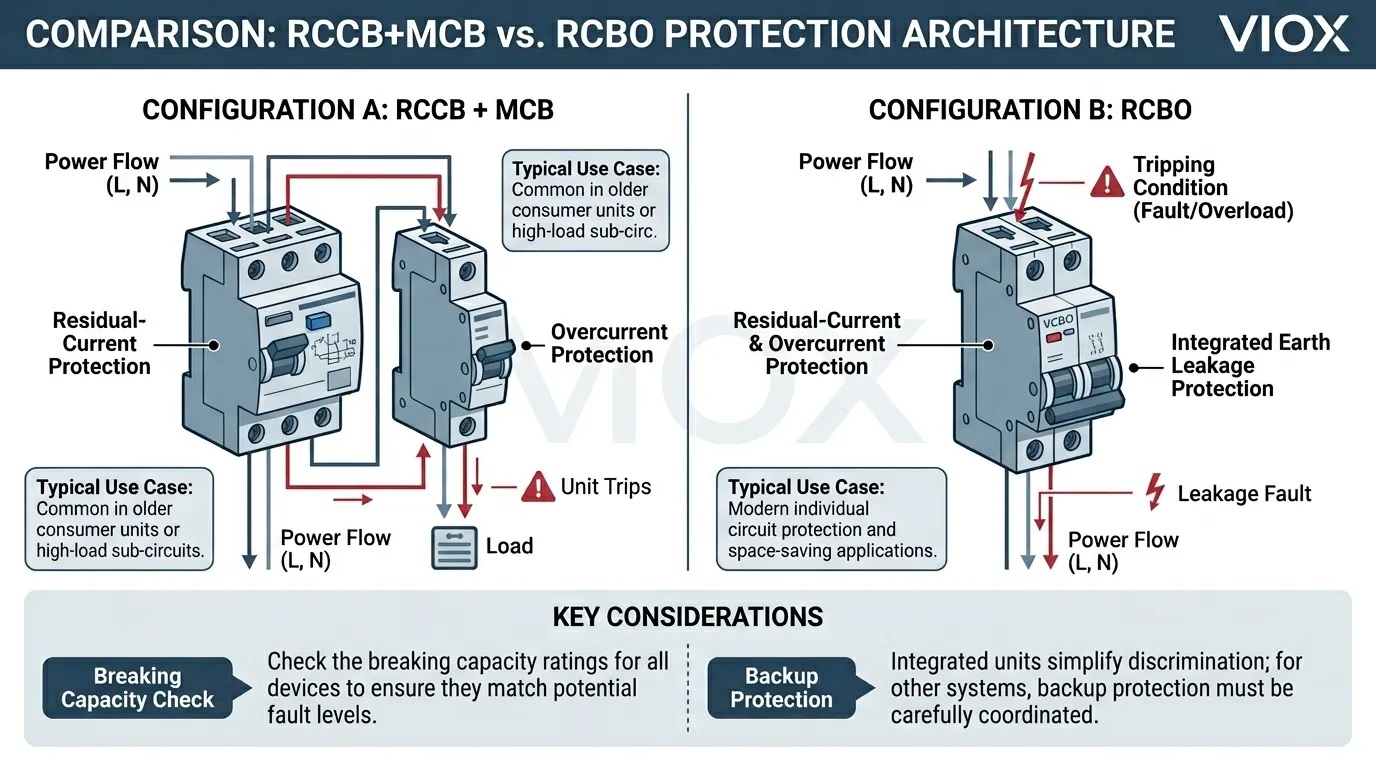
This is one of the most important design checks in the whole discussion.
An RCCB is primarily a residual-current protection device. It is not selected the same way as an overcurrent protective device, and in practical switchboard design it normally relies on correctly coordinated upstream or companion short-circuit protection. That is why a panel designer cannot stop at leakage sensitivity alone.
When evaluating an RCCB + MCB arrangement, engineers should verify:
- the prospective short-circuit current at the installation point
- the breaking capacity of the MCB or upstream protective device
- any backup-protection or coordination requirements stated by the RCCB manufacturer
- whether the full protective assembly is suitable for the available fault level
When evaluating an RCBO, the same principle still applies: the residual-current function may be integrated with overcurrent protection, but the device’s short-circuit breaking capability still has to match the system fault level.
This is why experienced engineers do not stop at asking whether a device is 30 mA Type A ή 30 mA Type B. They also ask whether the protective combination is correct for the fault level at that board.
RCCB Selection Basics: Sensitivity, Type, and Pole Count
RCCB Sensitivity
Common sensitivity ratings include:
30 mAfor personal protection100 mAfor upstream or fire-risk-oriented applications depending on system design300 mAfor higher-level fire protection, not personal shock protection
For most life-protection discussions, 30 mA is the key value. If you want the detailed sizing logic, see Πώς να Επιλέξετε τη Σωστή Ευαισθησία RCCB.
Τύπος RCCB
Residual-current device type matters because modern loads may generate different leakage-current waveforms.
Τύπος ACdetects sinusoidal AC residual currentΤύπος Αdetects AC and pulsating DC residual currentΤύπος Βis used where smooth DC residual currents may occur
For modern residential and light commercial loads, Type A is often the more relevant baseline discussion than Type AC.
Practical Type Selection Example
This is where selection becomes less theoretical. In real projects, the correct residual-current device type depends heavily on the connected load.
- For a standard residential final circuit feeding sockets, lighting, washing machines, and inverter-based air conditioners,
Τύπος Αis usually the more realistic starting point because many modern appliances contain electronic control and rectification stages. - For an EV charger, PV inverter interface, or industrial equipment with frequency converters and more complex power electronics, the residual-current waveform question becomes more demanding. Depending on the charger or drive design, a
Τύπος Βdevice, or a Type-A-based arrangement with additional DC residual-current protection built into the equipment, may be required by the application design and applicable standards.
This is especially important in EV charging. Under the IEC 60364-7-722 framework, a charging point may be protected upstream by a Τύπος Α device if the EVSE already provides 6 mA DC residual-current detection through an RDC-DD function complying with IEC 62955. That can be a meaningful cost optimization compared with specifying Type B everywhere. But if that built-in 6 mA DC detection is not present, or if the equipment documentation requires a different protective arrangement, the upstream device strategy must change accordingly.
In practice, this is why engineers should not choose RCCB type by price alone. A basic Type AC device may look acceptable on paper, but it can be the wrong choice for a circuit serving modern electronic loads. If the circuit includes EV charging, solar conversion, or advanced motor control, always verify the device requirement against the equipment manufacturer guidance and the relevant installation standard.
Διαμόρφωση πόλου
2-pole RCCBis typically used in single-phase systems4-pole RCCBis used in three-phase systems with neutral monitoring as required by the installation design
Choosing the correct pole count matters because all monitored current-carrying conductors must pass through the residual-current sensing path.
Difference Between MCB and RCB
In many markets, RCB is used as a loose shorthand for a residual-current protective device. But technically, the term can be broader and less precise than RCCB.
For practical buying and selection:
MCB= overcurrent protection onlyRCBήΚΚΔ= residual-current protection familyRCCB= residual-current device without integral overcurrent protectionRCBO= residual-current + overcurrent protection in one unit
So if someone asks for the difference between MCB and RCB, the practical answer is:
MCB protects against overload and short circuit; RCB-family devices protect against leakage-current faults and shock risk.
For the term-level breakdown, see RCB Full Form in Electrical: Residual Current Breaker και Πλήρης μορφή RCCB: Circuit Breakers: Κατανόηση των διακοπτών υπολειπόμενου ρεύματος.
RCCB vs MCB vs RCBO
Once a project moves beyond basic awareness, many engineers and buyers stop asking RCCB έναντι MCB and start asking whether RCBO is the better architecture.
| Συσκευή | Προστασία υπερφόρτωσης | Προστασία από βραχυκύκλωμα | Earth-Leakage Protection | Τυπική Περίπτωση Χρήσης |
|---|---|---|---|---|
| MCB | Ναι | Ναι | Όχι | Standard branch-circuit overcurrent protection |
| RCCB | Όχι | Όχι | Ναι | Shared leakage protection with separate MCBs |
| RCBO | Ναι | Ναι | Ναι | Individual circuit protection with combined functionality |
If panel space, nuisance-trip isolation, and per-circuit selectivity matter, RCBO often becomes the better engineering answer.
For a deeper architectural comparison, see RCBO vs RCCB + MCB: Comparison of Space, Cost, and Selectivity.
Common Mistakes When Choosing Between RCCB and MCB
1. Using MCB alone where shock protection is required
This is the most common conceptual mistake. MCB-only protection is incomplete in wet, outdoor, or high-touch circuits where residual-current protection is expected.
2. Assuming RCCB replaces overcurrent protection
An RCCB does not replace the overcurrent function of an MCB. If you install RCCB alone without proper upstream or coordinated overcurrent protection, the installation is incomplete.
3. Choosing the wrong RCCB sensitivity
Too high a residual-current threshold may fail to provide the intended personal protection. Too low may cause nuisance tripping if the application is unsuitable.
4. Ignoring device type
Loads with electronic power conversion can change the required residual-current device type. This is one reason older Τύπος AC assumptions no longer fit every modern load.
5. Ignoring short-circuit coordination and backup protection
It is not enough to choose the right leakage function. The protective arrangement must also be suitable for the available fault current at that point in the system.
6. Mixing terminology without clarifying the device function
Users often say RCB, ΚΚΔ, και RCCB interchangeably. That is common in conversation, but for specification and procurement, the exact device type matters.
Recommended Protection Strategy
If you want the shortest technically sound recommendation, it is this:
- use MCB for overload and short-circuit protection
- use RCCB where earth-leakage and personal protection are required
- use RCBO where you want both in one device
That is the practical answer behind most field-selection discussions on this topic.
Συχνές Ερωτήσεις
What is the main difference between RCCB and MCB?
The main difference is the fault type they detect. RCCB detects earth-leakage current imbalance, while MCB detects overload and short-circuit current.
What is the function of RCCB?
The core job of an RCCB is to detect current leaking from the intended circuit path to earth and disconnect the circuit before that leakage becomes a severe shock or fire hazard.
Can RCCB replace MCB?
Not by itself. RCCB does not provide standard overcurrent protection. In most installations, RCCB must work with MCB, or you should use an RCBO.
Is RCCB better than MCB?
Not in a general sense. RCCB is better for leakage and shock protection. MCB is better for overload and short-circuit protection. They solve different problems.
What is the difference between MCB and RCB?
MCB protects against overcurrent faults. RCB-type devices protect against residual-current or leakage faults. In practice, many users mean RCCB when they say RCB.
Why does my RCCB trip but the MCB does not?
That usually means the fault is leakage to earth rather than overload or short circuit. The RCCB is detecting imbalance, while the MCB does not see enough overcurrent to trip.
Should I use RCCB or RCBO for a final circuit?
If you want combined overcurrent and leakage protection on a single circuit, RCBO is often the cleaner solution. If the design uses shared residual-current protection with separate branch overcurrent devices, RCCB + MCB may still be appropriate.
Συμπέρασμα
If your question is γιατί να χρησιμοποιήσετε RCCB αντί για MCB, the technically correct answer is:
Use RCCB where you need protection against electric shock and earth leakage. Use MCB where you need protection against overload and short circuit. In most practical systems, use both together, or use RCBO when you want both functions in one device.
That is also the cleanest way to understand:
rccb vs mcbrccb and mcb differencerccb functionrccb circuit breakerdifference between mcb and rcb
Those distinctions are what matter in real selection work, because leakage protection, overcurrent protection, and fault-level coordination all have to be correct at the same time.