Στα σύγχρονα συστήματα ηλεκτρικής διανομής, η διασφάλιση αδιάλειπτης παροχής ρεύματος, διατηρώντας παράλληλα την ασφάλεια και την αποδοτικότητα, είναι υψίστης σημασίας. Το Δακτυλιοειδές Κύριο Μονάδα (RMU) έχει αναδειχθεί ως ένα κρίσιμο στοιχείο στα δίκτυα διανομής ισχύος μέσης τάσης, ιδιαίτερα σε αστικά περιβάλλοντα όπου οι χωρικοί περιορισμοί και οι απαιτήσεις αξιοπιστίας είναι υψηλές. Αυτός ο περιεκτικός οδηγός διερευνά τις βασικές αρχές, τα εξαρτήματα, τις αρχές λειτουργίας και τις εφαρμογές των RMU στα συστήματα ηλεκτρικής διανομής.
Βασικά συμπεράσματα
- Δακτυλιοειδείς Κύριες Μονάδες (RMU) είναι συμπαγείς, εργοστασιακά συναρμολογημένοι πίνακες διανομής σχεδιασμένοι για διανομή ισχύος μέσης τάσης (7,2kV-36kV) σε δίκτυα δακτυλιοειδούς τύπου
- Τα RMU παρέχουν πλεονάζουσες διαδρομές ισχύος μέσω διαμόρφωσης κλειστού βρόχου, διασφαλίζοντας συνεχή παροχή ακόμη και κατά τη διάρκεια αστοχιών εξαρτημάτων
- Τα βασικά εξαρτήματα περιλαμβάνουν διακόπτες φορτίου, αυτόματους διακόπτες, ασφάλειες, ζυγούς και συσκευές προστασίας που λειτουργούν σε συντονισμό
- Τα RMU προσφέρουν σχεδιασμό εξοικονόμησης χώρου (έως και 60% μικρότερα από τους παραδοσιακούς πίνακες διανομής), καθιστώντας τα ιδανικά για αστικές εγκαταστάσεις
- Συμμόρφωση με IEC 62271-200 και άλλα διεθνή πρότυπα διασφαλίζει την ασφάλεια και την αξιοπιστία
- Οι εφαρμογές εκτείνονται σε αστικά δίκτυα, βιομηχανικές εγκαταστάσεις, εμπορικά κτίρια και συστήματα ανανεώσιμης ενέργειας
- Τα σύγχρονα RMU ενσωματώνουν έξυπνες δυνατότητες παρακολούθησης για απομακρυσμένο έλεγχο και προληπτική συντήρηση
Τι είναι μια Δακτυλιοειδής Κύρια Μονάδα (RMU);
A Δακτυλιοειδές Κύριο Μονάδα (RMU) είναι μια εργοστασιακά συναρμολογημένη, μεταλλική συσκευή διανομής σχεδιασμένη ειδικά για δίκτυα ηλεκτρικής διανομής μέσης τάσης που λειτουργούν σε διαμόρφωση δακτυλίου ή βρόχου. Σύμφωνα με τα πρότυπα IEC 62271-200, τα RMU χρησιμεύουν ως σημεία σύνδεσης φορτίου σε συστήματα διανομής δακτυλιοειδούς τύπου, ενσωματώνοντας πολλαπλές λειτουργίες μεταγωγής, προστασίας και απομόνωσης σε ένα ενιαίο συμπαγές περίβλημα.
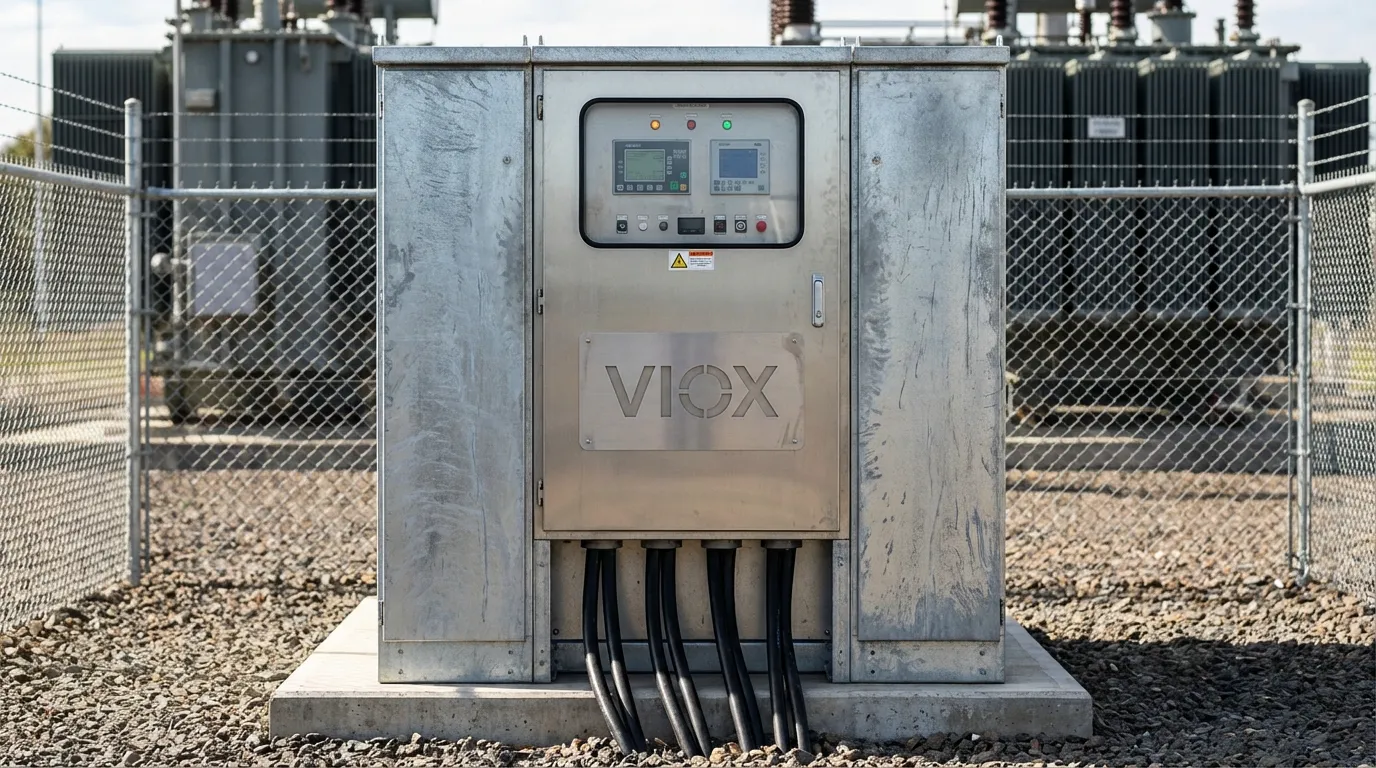
Ο όρος “Δακτυλιοειδής Κύρια Μονάδα” προέρχεται από την κύρια εφαρμογή του σε δίκτυα διανομής δακτυλιοειδούς τύπου, όπου η ισχύς μπορεί να ρέει από πολλές κατευθύνσεις. Αυτή η διαμόρφωση δημιουργεί πλεονασμό—εάν ένα τμήμα του δικτύου αποτύχει, η ηλεκτρική ενέργεια ανακατευθύνεται αυτόματα μέσω εναλλακτικών διαδρομών, διατηρώντας συνεχή παροχή στα συνδεδεμένα φορτία.
Τα RMU λειτουργούν συνήθως σε επίπεδα τάσης που κυμαίνονται από 7,2kV έως 36kV, με τις πιο κοινές ονομαστικές τιμές να είναι 12kV, 17,5kV και 24kV. Έχουν σχεδιαστεί για να χειρίζονται ονομαστικά ρεύματα μεταξύ 630A έως 1250A για τροφοδότες ζυγών, αν και ορισμένες εξειδικευμένες μονάδες μπορούν να φιλοξενήσουν έως και 3150A.
Σε αντίθεση με τους παραδοσιακούς πίνακες διανομής που απαιτούν σημαντικό χώρο εγκατάστασης και πολύπλοκη συναρμολόγηση, τα RMU είναι προσυναρμολογημένα και δοκιμασμένα στο εργοστάσιο, φτάνοντας ως έτοιμες για εγκατάσταση μονάδες. Αυτή η φιλοσοφία σχεδιασμού μειώνει σημαντικά τον χρόνο εγκατάστασης, ελαχιστοποιεί τα σφάλματα επί τόπου και διασφαλίζει σταθερή ποιότητα σε όλες τις αναπτύξεις.
Βασικά Εξαρτήματα μιας Δακτυλιοειδούς Κύριας Μονάδας
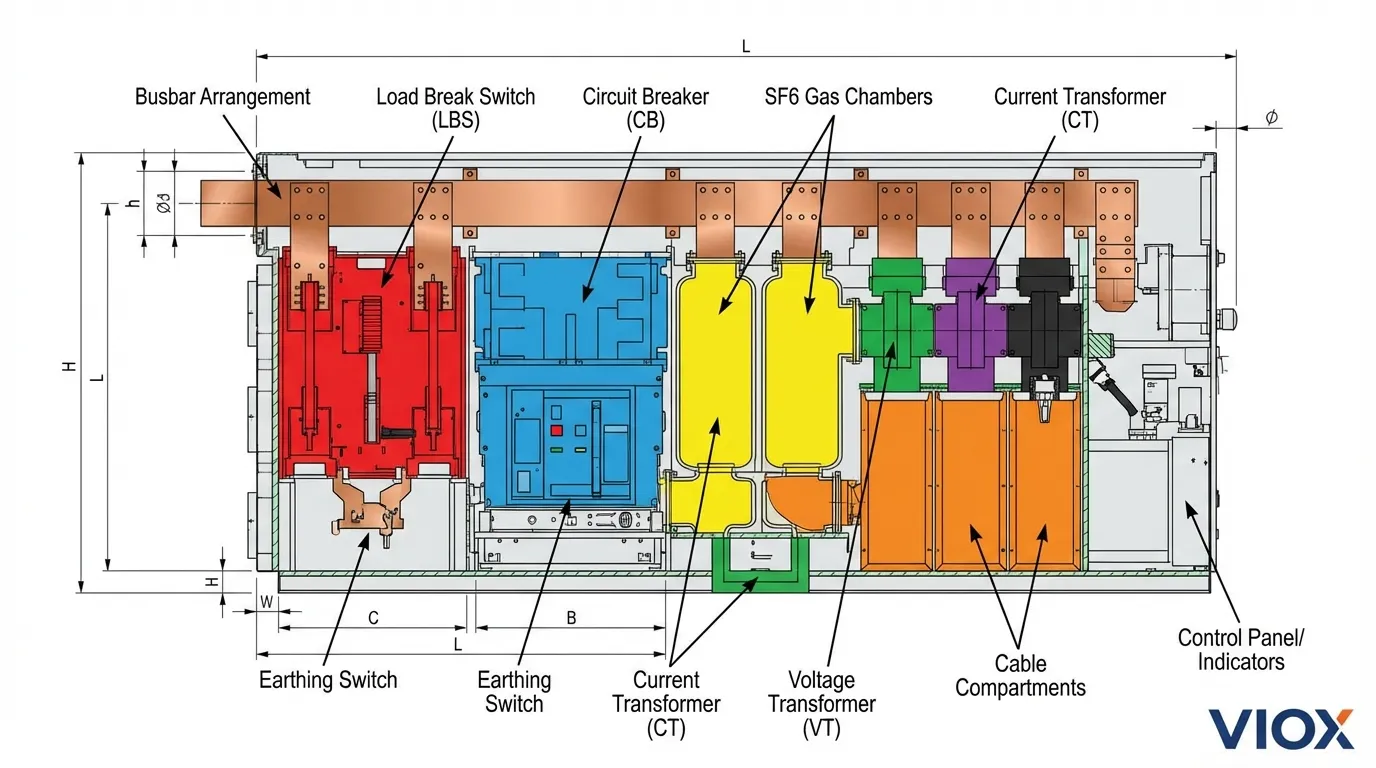
Η κατανόηση της εσωτερικής αρχιτεκτονικής ενός RMU είναι απαραίτητη για την εκτίμηση της λειτουργικότητάς του. Κάθε εξάρτημα παίζει έναν συγκεκριμένο ρόλο στη διασφάλιση ασφαλούς, αξιόπιστης διανομής ισχύος.
1. Διακόπτης Φορτίου (LBS)
Το διακόπτης φορτίου είναι η κύρια συσκευή μεταγωγής στα περισσότερα RMU, ικανή να δημιουργεί και να διακόπτει κυκλώματα υπό κανονικές συνθήκες φορτίου. Σε αντίθεση με τους απλούς απομονωτές, οι διακόπτες φορτίου μπορούν να διακόψουν ρεύματα φορτίου (συνήθως έως 630A) αλλά δεν έχουν σχεδιαστεί για να διακόπτουν ρεύματα σφάλματος.
Βασικά χαρακτηριστικά:
- Ικανότητα δημιουργίας: Ικανότητα κλεισίματος σε ένα κυκλωμένο κύκλωμα
- Σπάζοντας ικανότητα: Διακόπτει το κανονικό ρεύμα φορτίου
- Μηχανική αντοχή: Συνήθως 10.000 λειτουργίες
- Μέσο μόνωσης: Αέριο SF6 ή τεχνολογία κενού
Οι διακόπτες φορτίου λειτουργούν σε συνδυασμό με ασφάλειες για να παρέχουν πλήρη προστασία. Όταν συμβεί ένα σφάλμα, η ασφάλεια λειτουργεί πρώτα για να διακόψει το ρεύμα σφάλματος και ο διακόπτης φορτίου στη συνέχεια απομονώνει το κύκλωμα.
2. Αυτόματος Διακόπτης
Σε πιο προηγμένες διαμορφώσεις RMU, αυτόματοι διακόπτες κενού (VCB) αντικαθιστούν τον συνδυασμό διακόπτη φορτίου-ασφάλειας. Οι αυτόματοι διακόπτες προσφέρουν ανώτερη απόδοση:
- Ικανότητα διακοπής σφάλματος: Μπορεί να διακόψει ρεύματα βραχυκυκλώματος (συνήθως 16kA έως 25kA)
- Ικανότητα επανακλεισίματος: Μπορεί να επαναφερθεί και να επαναχρησιμοποιηθεί μετά την εκκαθάριση σφάλματος
- Μεγαλύτερη διάρκεια ζωής: Έως 30.000 μηχανικές λειτουργίες
- Πλεονεκτήματα συντήρησης: Δεν απαιτείται αντικατάσταση ασφάλειας
Οι αυτόματοι διακόπτες είναι ιδιαίτερα πολύτιμοι σε εφαρμογές που απαιτούν συχνές λειτουργίες μεταγωγής ή όπου επιθυμείται αυτόματο επανακλείσιμο, όπως σε συστήματα αυτόματου διακόπτη μεταφοράς.
3. Αποζεύκτης Διακόπτη Ασφάλειας
Το αποζεύκτης διακόπτη ασφάλειας συνδυάζει λειτουργίες απομόνωσης και προστασίας σε μία μόνο συσκευή. Οι ασφάλειες υψηλής τάσης παρέχουν:
- Προστασία υπερέντασης: Ταχεία απόκριση σε συνθήκες υπερφόρτωσης
- Προστασία από βραχυκύκλωμα: Διακόπτει ρεύματα σφάλματος μέχρι την ονομαστική ικανότητα διακοπής
- Προστασία μετασχηματιστή: Ειδικά διαστασιολογημένο για προστασία μετασχηματιστών διανομής
- Οικονομική αποδοτικότητα: Χαμηλότερη αρχική επένδυση σε σύγκριση με τους διακόπτες κυκλώματος
Οι ασφάλειες που χρησιμοποιούνται σε RMU πρέπει να συμμορφώνονται με τα πρότυπα IEC 60282-1 για ασφάλειες υψηλής τάσης, εξασφαλίζοντας συντονισμένη προστασία με τις ανάντη και κατάντη συσκευές.
4. Ζυγοί (Busbars)
Ράβδοι μεταφοράς αποτελούν τη ραχοκοκαλιά του RMU, παρέχοντας διαδρομές χαμηλής αντίστασης για τη ροή ρεύματος μεταξύ διαφορετικών τμημάτων. Τα σύγχρονα RMU συνήθως διαθέτουν:
- Υλικό: Ηλεκτρολυτικό χαλκό ή κράμα αλουμινίου
- Διαμόρφωση: Συστήματα μονών ή διπλών ζυγών
- Τρέχουσα βαθμολογία: 630A έως 3150A ανάλογα με την εφαρμογή
- Επεξεργασία επιφάνειας: Επικασσιτερωμένο ή επαργυρωμένο για ενισχυμένη αγωγιμότητα
Οι διαμορφώσεις διπλών ζυγών προσφέρουν αυξημένη αξιοπιστία—εάν ένας ζυγός αποτύχει, το σύστημα συνεχίζει να λειτουργεί στον δευτερεύοντα ζυγό. Αυτή η σχεδιαστική αρχή αντικατοπτρίζει τη φιλοσοφία πλεονασμού της τοπολογίας δικτύου δακτυλίου. Για περισσότερα σχετικά με την τεχνολογία ζυγών, ανατρέξτε στον οδηγό μας για επιλογή ζυγών.
5. Διακόπτης Γείωσης
Το διακόπτης γείωσης (ή διακόπτης γείωσης) παρέχει μια κρίσιμη λειτουργία ασφαλείας δημιουργώντας μια σκόπιμη σύνδεση με τη γη. Αυτή η συσκευή:
- Εξασφαλίζει ασφαλείς συνθήκες εργασίας κατά τη διάρκεια της συντήρησης
- Εκφορτίζει την υπολειπόμενη τάση από καλώδια και εξοπλισμό
- Παρέχει ορατή επιβεβαίωση απομόνωσης
- Αποτρέπει την τυχαία ενεργοποίηση
Οι διακόπτες γείωσης πρέπει να είναι μηχανικά αλληλοκλειδωμένοι με διακόπτες φορτίου ή διακόπτες κυκλώματος για να αποφευχθεί το ταυτόχρονο κλείσιμο, το οποίο θα δημιουργούσε άμεσο βραχυκύκλωμα.
6. Μετασχηματιστές Ρεύματος (CTs) και Μετασχηματιστές Τάσης (VTs)
Μετασχηματιστές οργάνων επιτρέπουν λειτουργίες μέτρησης και προστασίας:
Μετασχηματιστές ρεύματος:
- Υποβιβάζουν υψηλά ρεύματα σε μετρήσιμα επίπεδα (συνήθως 5A ή 1A δευτερεύον)
- Παρέχουν είσοδο για ρελέ προστασίας και μέτρησης
- Πολλαπλοί πυρήνες για διαφορετικές λειτουργίες προστασίας και μέτρησης
- Κατηγορίες ακρίβειας σύμφωνα με τα πρότυπα IEC 61869
Μετασχηματιστές Τάσης:
- Υποβιβάζουν υψηλές τάσεις σε ασφαλή επίπεδα (συνήθως 110V ή 100V δευτερεύον)
- Επιτρέπουν τη μέτρηση τάσης και την ανίχνευση σφάλματος γείωσης
- Παρέχουν σήματα συγχρονισμού για παράλληλη λειτουργία
7. Ρελέ Προστασίας και Συστήματα Ελέγχου
Τα σύγχρονα RMU ενσωματώνουν έξυπνες ηλεκτρονικές συσκευές (IEDs) που παρέχουν:
- Προστασία υπερέντασης: Στοιχεία χρονικής καθυστέρησης και στιγμιαία
- Προστασία από σφάλματα γης: Ευαίσθητη ανίχνευση σφαλμάτων γείωσης
- Κατευθυντική προστασία: Καθορίζει την κατεύθυνση σφάλματος σε δίκτυα δακτυλίου
- Διεπαφές επικοινωνίας: Πρωτόκολλα IEC 61850, Modbus, DNP3 για ενσωμάτωση SCADA
Τα προηγμένα ρελέ προστασίας μπορούν να εφαρμόσουν προσαρμοστικά σχήματα προστασίας που προσαρμόζουν τις ρυθμίσεις με βάση τη διαμόρφωση του δικτύου, παρόμοια με τις αρχές που χρησιμοποιούνται στον συντονισμό διακοπτών κυκλώματος.
8. Μέσο Μόνωσης
Τα RMU χρησιμοποιούν διαφορετικές τεχνολογίες μόνωσης:
Μόνωση με Αέριο SF6:
- Ανώτερη διηλεκτρική αντοχή
- Συμπαγής σχεδιασμός
- Κατασκευή σφραγισμένης διάρκειας ζωής
- Περιβαλλοντικές εκτιμήσεις (υψηλό GWP)
Στερεά Μόνωση (Αέρας ή Ρητίνη):
- Φιλικό προς το περιβάλλον
- Δεν υπάρχουν απαιτήσεις χειρισμού αερίου
- Ελαφρώς μεγαλύτερο αποτύπωμα
- Αυξανόμενη προτίμηση της αγοράς
Μόνωση με Κενό:
- Χρησιμοποιείται κυρίως σε θαλάμους διακοπτών κυκλώματος
- Εξαιρετικές ιδιότητες απόσβεσης τόξου
- Μεγάλη διάρκεια ζωής
Αρχή Λειτουργίας των Μονάδων Δακτυλιοειδούς Κύριας Διάταξης
Η λειτουργική φιλοσοφία των RMU επικεντρώνεται στη διατήρηση της συνεχούς παροχής ρεύματος μέσω της έξυπνης τοπολογίας δικτύου και της συντονισμένης προστασίας.
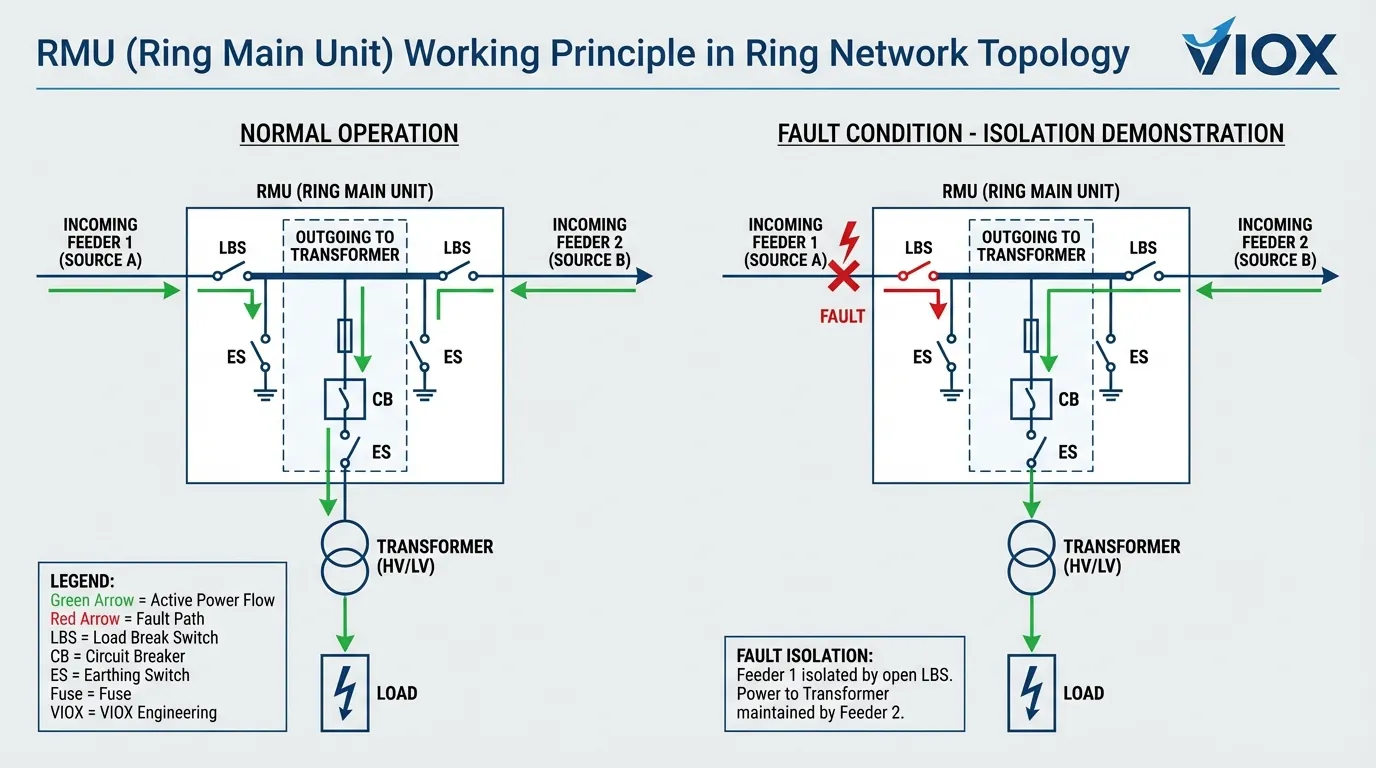
Διαμόρφωση Δικτύου Δακτυλίου
Σε ένα τυπικό δίκτυο δακτυλίου:
- Δυνατότητα διπλής τροφοδοσίας: Κάθε RMU συνδέεται με δύο εισερχόμενους τροφοδότες από διαφορετικές πηγές
- Τοπολογία βρόχου: Πολλαπλά RMU διασυνδέονται για να σχηματίσουν έναν κλειστό δακτύλιο
- Αμφίδρομη ροή ισχύος: Η ηλεκτρική ενέργεια μπορεί να φτάσει σε οποιοδήποτε σημείο από οποιαδήποτε κατεύθυνση
- Δυνατότητα τμηματοποίησης: Κάθε RMU μπορεί να απομονώσει συγκεκριμένα τμήματα του δικτύου
Αυτή η διαμόρφωση διασφαλίζει ότι ακόμη και αν ένας τροφοδότης αποτύχει, όλα τα φορτία συνεχίζουν να λαμβάνουν ισχύ μέσω της εναλλακτικής διαδρομής—μια αρχή γνωστή ως N-1 πλεονασμός.
Κανονική Ακολουθία Λειτουργίας
Κατά τη διάρκεια της κανονικής λειτουργίας:
- Και οι δύο εισερχόμενοι τροφοδότες είναι ενεργοποιημένοι: Η ισχύς ρέει μέσω του δακτυλίου από πολλαπλές πηγές
- Οι διακόπτες διακοπής φορτίου παραμένουν κλειστοί: Διατήρηση της συνέχειας του κυκλώματος
- Οι εξερχόμενοι τροφοδότες τροφοδοτούν μετασχηματιστές διανομής: Υποβιβασμός της τάσης για τους τελικούς χρήστες
- Οι ρελέ προστασίας παρακολουθούν συνεχώς: Ανίχνευση μη φυσιολογικών συνθηκών
- Οι διακόπτες γείωσης παραμένουν ανοιχτοί: Διασφάλιση μηδενικής σύνδεσης γείωσης κατά τη λειτουργία
Απόκριση σε συνθήκες σφάλματος
Όταν συμβεί ένα σφάλμα, το RMU ανταποκρίνεται μέσω συντονισμένης προστασίας:
- Ανίχνευση σφάλματος: Τα ρελέ προστασίας εντοπίζουν υπερβολικό ρεύμα ή σφάλμα γείωσης
- Λειτουργία ασφάλειας ή ενεργοποίηση διακόπτη: Διακόπτει το ρεύμα σφάλματος μέσα σε χιλιοστά του δευτερολέπτου
- Απομόνωση σφάλματος: Το τμήμα που επηρεάζεται αποσυνδέεται από το υγιές δίκτυο
- Ενεργοποίηση εναλλακτικής διαδρομής: Η ισχύς ανακατευθύνεται μέσω της διαμόρφωσης δακτυλίου
- Δημιουργία συναγερμού: Ειδοποιεί τους χειριστές για τη θέση του σφάλματος
Αυτή η ταχεία απόκριση ελαχιστοποιεί την πληγείσα περιοχή και τη διάρκεια των διακοπών ρεύματος, ένα κρίσιμο πλεονέκτημα στα αστικά δίκτυα διανομής.
Μηχανισμοί αλληλοασφάλισης
Τα RMU ενσωματώνουν εξελιγμένους μηχανικούς και ηλεκτρικούς αλληλοασφαλίσεις για την αποφυγή μη ασφαλών λειτουργιών:
- Διακόπτης διακοπής φορτίου και διακόπτης γείωσης: Δεν μπορούν να κλείσουν ταυτόχρονα
- Εισερχόμενοι και εξερχόμενοι διακόπτες: Συντονισμένες ακολουθίες λειτουργίας
- Αυτόματος διακόπτης και αποζεύκτης: Σωστή απομόνωση πριν από τη συντήρηση
- Αλληλοασφαλίσεις θυρών: Αποτρέπουν την πρόσβαση σε μέρη υπό τάση
Αυτά τα χαρακτηριστικά ασφαλείας ευθυγραμμίζονται με τις αρχές που συζητήθηκαν στις Διαδικασίες lockout tagout MCB.
Τύποι Μονάδων Δακτυλιοειδούς Κύριας Παροχής
Τα RMU ταξινομούνται με βάση διάφορα κριτήρια:
Ανά Μέσο Μόνωσης
| Τύπος | Μόνωση | Πλεονεκτήματα | Μειονεκτήματα | Τυπικές εφαρμογές |
|---|---|---|---|---|
| Μόνωση με αέριο SF6 | Αέριο εξαφθορίου του θείου | Συμπαγές μέγεθος, εξαιρετικές διηλεκτρικές ιδιότητες, σφραγισμένο για όλη τη διάρκεια ζωής | Περιβαλλοντικές ανησυχίες (GWP 24.300), απαιτείται παρακολούθηση αερίου | Αστικοί υποσταθμοί, εγκαταστάσεις με περιορισμένο χώρο |
| Μόνωση με στερεό υλικό | Ρητίνη εποξειδική ή αέρας | Οικολογικό, χωρίς χειρισμό αερίου, χωρίς συντήρηση | Ελαφρώς μεγαλύτερο αποτύπωμα, υψηλότερο αρχικό κόστος | Πράσινα έργα, περιβαλλοντικά ευαίσθητες περιοχές |
| Μόνωση με αέρα | Ατμοσφαιρικός αέρας | Απλός σχεδιασμός, εύκολη συντήρηση, χαμηλότερο κόστος | Μεγάλο μέγεθος, περιορισμένη χρήση σε εξωτερικούς χώρους | Εσωτερικές εγκαταστάσεις, βιομηχανικές εγκαταστάσεις |
| Μόνωση με κενό αέρος | Θάλαμοι κενού | Εξαιρετική διακοπή τόξου, μεγάλη διάρκεια ζωής, συμπαγής σχεδιασμός | Υψηλότερη τεχνολογική πολυπλοκότητα | Εφαρμογές υψηλών απαιτήσεων, κρίσιμες υποδομές |
Κατά Διαμόρφωση
RMU 2 τμημάτων:
- Δύο εισερχόμενοι τροφοδότες
- Βασικός κόμβος δικτύου δακτυλίου
- Η πιο κοινή διαμόρφωση
RMU 3 τμημάτων:
- Δύο εισερχόμενοι τροφοδότες + ένας εξερχόμενος τροφοδότης
- Τυπικό σημείο διανομής
- Τροφοδοτεί έναν μετασχηματιστή διανομής
RMU 4 τμημάτων:
- Δύο εισερχόμενοι τροφοδότες + δύο εξερχόμενοι τροφοδότες
- Εξυπηρετεί πολλαπλούς μετασχηματιστές
- Ενισχυμένη ευελιξία
RMU 6 τμημάτων:
- Πολλαπλοί συνδυασμοί εισερχόμενων και εξερχόμενων
- Τμήμα ζεύξης ζυγών
- Σύνθετοι κόμβοι διανομής
Ανά τύπο τοποθέτησης
Εσωτερικοί RMU:
- Προστασία IP3X έως IP4X
- Εγκατάσταση ελεγχόμενου περιβάλλοντος
- Χαμηλότερη περιβαλλοντική καταπόνηση
Εξωτερικοί RMU:
- Προστασία IP54 έως IP65
- Περίβλημα ανθεκτικό στις καιρικές συνθήκες
- Υλικά σταθεροποιημένα στην υπεριώδη ακτινοβολία
- Αντιδιαβρωτική επίστρωση
Τεχνικές προδιαγραφές και πρότυπα
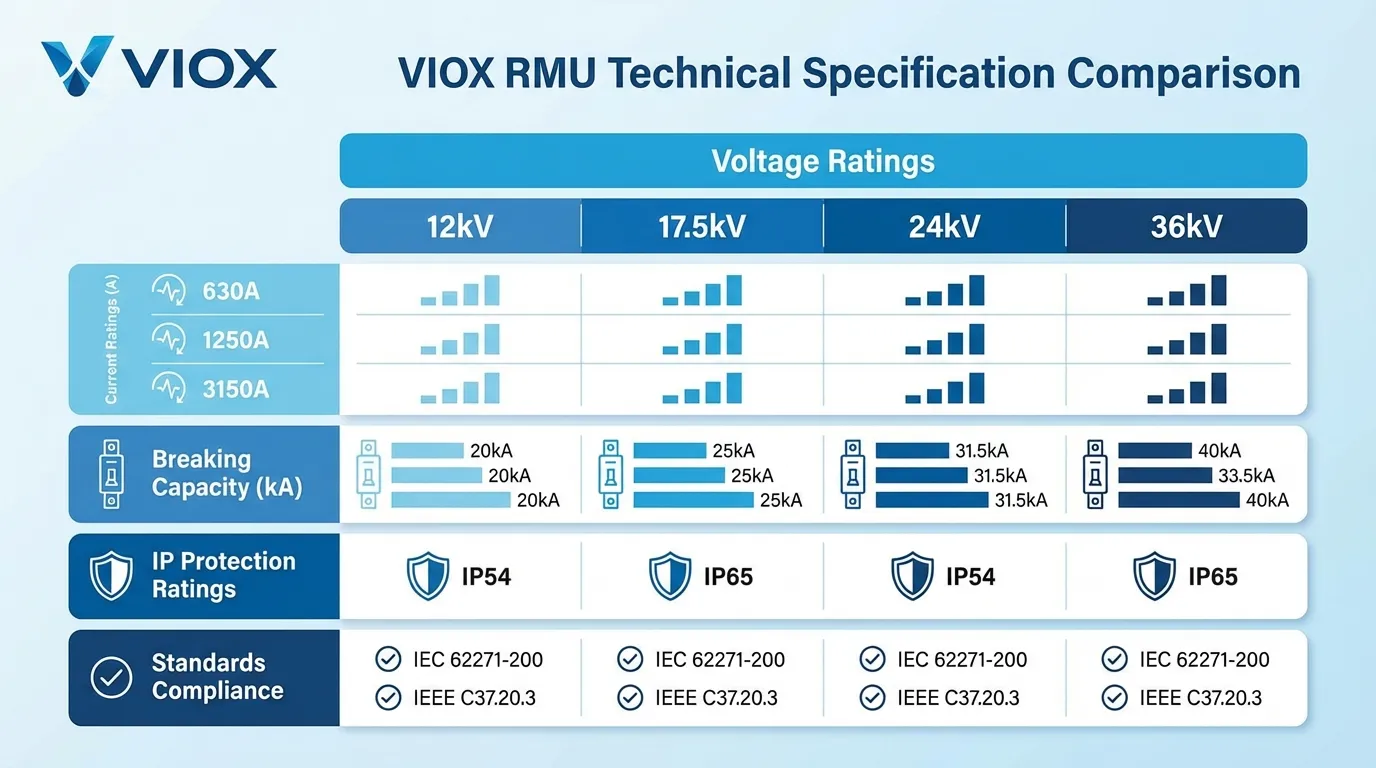
Βασικές Ηλεκτρικές Παράμετροι
| Παράμετρος | Τυπικό εύρος | Τυπική αναφορά |
|---|---|---|
| Ονομαστική τάση | 7.2kV – 36kV | IEC 62271-1 |
| Ονομαστικό Ρεύμα (Ζυγός) | 630A – 3150A | IEC 62271-200 |
| Ονομαστικό Ρεύμα (Τροφοδότης) | 200A – 630A | IEC 62271-200 |
| Ικανότητα Διακοπής Βραχυκυκλώματος | 16kA – 25kA | IEC 62271-100 |
| Ικανότητα Δημιουργίας Βραχυκυκλώματος | 40kA – 63kA (αιχμή) | IEC 62271-100 |
| Τάση Αντοχής Συχνότητας Ισχύος | 28kV – 95kV (1 λεπτό) | IEC 60060-1 |
| Τάση Αντοχής σε Κρουστική Κεραυνική | 60kV – 170kV (αιχμή) | IEC 60060-1 |
Εφαρμοστέα Πρότυπα
Διεθνή πρότυπα:
- IEC 62271-200: Μεταλλικός θάλαμος διακοπτών και ελέγχου AC (βασικό πρότυπο για RMU)
- IEC 62271-100: Διακόπτες κυκλώματος εναλλασσόμενου ρεύματος υψηλής τάσης
- IEC 62271-103: Διακόπτες για ονομαστικές τάσεις άνω του 1 kV
- IEC 61869: Μετασχηματιστές οργάνων
- IEC 60529: Ταξινόμηση προστασίας IP
Περιφερειακά πρότυπα:
- IEEE C37.20.3: Μεταλλικός θάλαμος διακοπτών διακοπής (Βόρεια Αμερική)
- GB 3906: Μεταλλικός θάλαμος διακοπτών AC (Κίνα)
- BS EN 62271-200: Βρετανική εφαρμογή των προτύπων IEC
Η κατανόηση αυτών των προτύπων είναι ζωτικής σημασίας για τις προμήθειες και τη συμμόρφωση, παρόμοια με τις εκτιμήσεις σε επιλογή MCCB.
Εφαρμογές των Δακτυλιοειδών Κεντρικών Μονάδων
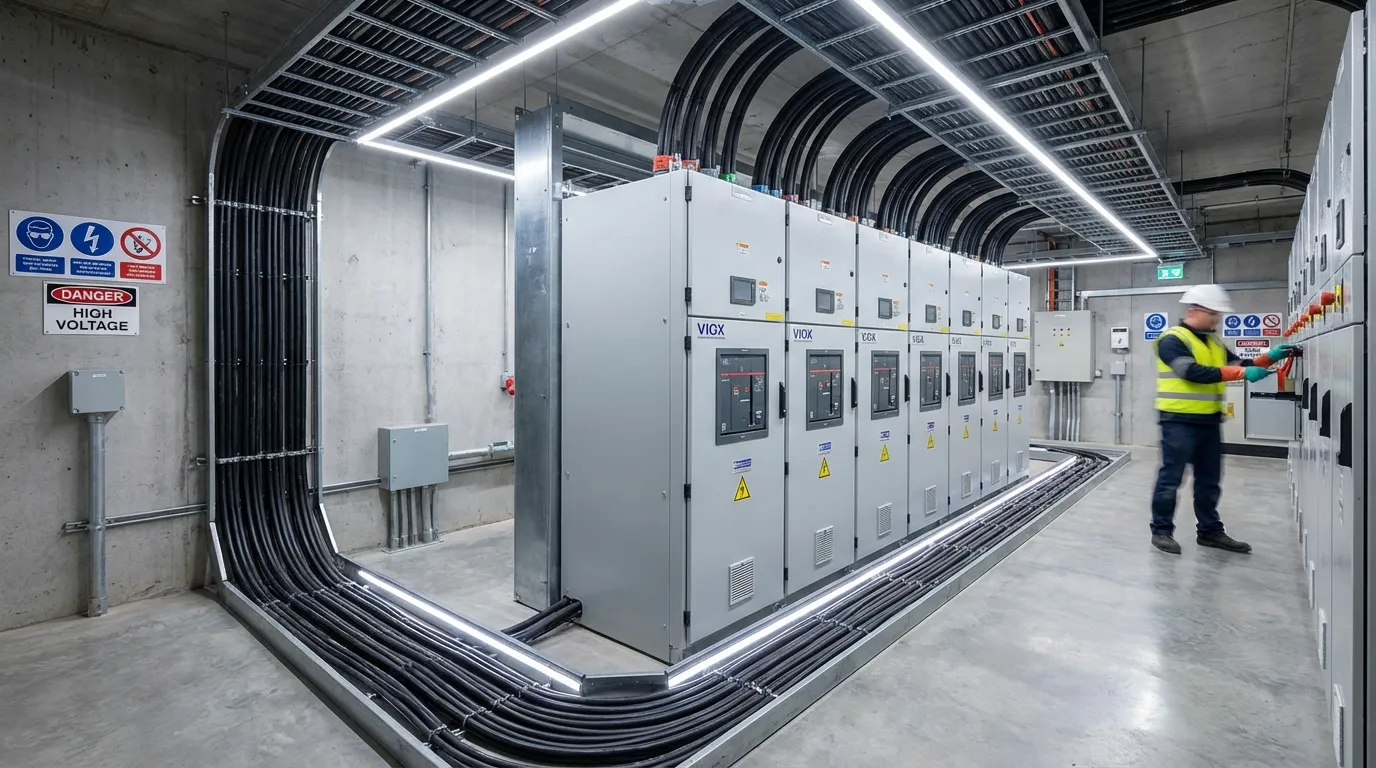
Αστική Διανομή Ενέργειας
Οι RMU είναι η ραχοκοκαλιά των σύγχρονων ηλεκτρικών δικτύων πόλεων:
- Υπόγειοι υποσταθμοί: Συμπαγής σχεδιασμός που χωράει σε περιορισμένο χώρο
- Πολυώροφα κτίρια: Αξιόπιστη ισχύς για κρίσιμες υποδομές
- Εμπορικά κέντρα: Συνεχής παροχή για εμπορικές λειτουργίες
- Κόμβοι μεταφορών: Αεροδρόμια, σταθμοί μετρό, σιδηροδρομικοί σταθμοί
Η διαμόρφωση δακτυλίου διασφαλίζει ότι η συντήρηση σε ένα τμήμα δεν διακόπτει την υπηρεσία σε άλλες περιοχές—μια κρίσιμη απαίτηση σε πυκνοκατοικημένα αστικά περιβάλλοντα.
Βιομηχανικές εγκαταστάσεις
Οι μονάδες παραγωγής και επεξεργασίας βασίζονται σε RMU για:
- Συνέχεια διαδικασίας: Ελαχιστοποιεί το χρόνο διακοπής της παραγωγής
- Προστασία εξοπλισμού: Συντονισμένη προστασία για ακριβό μηχανολογικό εξοπλισμό
- Ευέλικτη επέκταση: Ο αρθρωτός σχεδιασμός φιλοξενεί την ανάπτυξη
- Συμμόρφωση με την ασφάλεια: Πληροί αυστηρά βιομηχανικά πρότυπα ασφαλείας
Οι βιομηχανικές εφαρμογές απαιτούν συχνά ενσωμάτωση με συστήματα ελέγχου κινητήρων και επαφείς.
Εμπορικά κτίρια
Τα συγκροτήματα γραφείων, τα ξενοδοχεία και τα κέντρα δεδομένων επωφελούνται από:
- Υψηλή αξιοπιστία: Υποστηρίζει λειτουργίες κρίσιμης σημασίας
- Συμπαγές αποτύπωμα: Μεγιστοποιεί τον χρησιμοποιήσιμο χώρο του κτιρίου
- Χαμηλή συντήρηση: Μειώνει το λειτουργικό κόστος
- Έξυπνη ενσωμάτωση: Συνδέεται με συστήματα διαχείρισης κτιρίων
Συστήματα ανανεώσιμων πηγών ενέργειας
Οι RMU διαδραματίζουν αυξανόμενο ρόλο στην υποδομή βιώσιμης ενέργειας:
- Ηλιακά πάρκα: Συνδέει πολλαπλά Κουτιά συνένωσης PV στο δίκτυο
- Αιολικά πάρκα: Συλλέγει ισχύ από κατανεμημένους γεννήτορες
- Συστήματα αποθήκευσης μπαταριών: Ενσωματώνει την αποθήκευση ενέργειας με τη διανομή
- Μικροδίκτυα: Ενεργοποιεί την αυτόνομη λειτουργία και τη σύνδεση στο δίκτυο
Η αμφίδρομη ικανότητα ροής ισχύος των RMU τα καθιστά ιδανικά για εφαρμογές ανανεώσιμης ενέργειας όπου η ισχύς μπορεί να ρέει προς οποιαδήποτε κατεύθυνση.
Έργα Υποδομής
Οι κρίσιμες αναπτύξεις υποδομών περιλαμβάνουν:
- Μονάδες επεξεργασίας νερού: Διασφαλίζει τη συνεχή λειτουργία των βασικών υπηρεσιών
- Νοσοκομεία: Παρέχει αξιόπιστη ισχύ για συστήματα ασφάλειας ζωής
- Τηλεπικοινωνίες: Υποστηρίζει την υποδομή δικτύου
- Κυβερνητικές εγκαταστάσεις: Πληροί τις απαιτήσεις ασφάλειας και αξιοπιστίας
Πλεονεκτήματα των Μονάδων Δακτυλιοειδούς Κύριας Γραμμής
1. Ενισχυμένη Αξιοπιστία
Η τοπολογία δικτύου δακτυλίου παρέχει εγγενή πλεονασμό. Η στατιστική ανάλυση δείχνει ότι τα δίκτυα που βασίζονται σε RMU επιτυγχάνουν 99,95% διαθεσιμότητα σε σύγκριση με 99,5% για ακτινικά δίκτυα—που μεταφράζεται σε περίπου 4 ώρες λιγότερο χρόνο διακοπής λειτουργίας ανά έτος.
2. Αποδοτικότητα Χώρου
Οι RMU καταλαμβάνουν 40-60% λιγότερο χώρο από ισοδύναμες παραδοσιακές εγκαταστάσεις μεταγωγικού εξοπλισμού. Ένα τυπικό RMU 3 τμημάτων έχει διαστάσεις περίπου 1200mm (Π) × 1400mm (Β) × 2100mm (Υ), σε σύγκριση με 3000mm × 2000mm × 2500mm για συμβατικό μεταγωγικό εξοπλισμό.
3. Μειωμένος Χρόνος Εγκατάστασης
Η εργοστασιακή συναρμολόγηση και δοκιμή σημαίνει:
- 50-70% ταχύτερη εγκατάσταση σε σύγκριση με τον επιτόπου συναρμολογημένο μεταγωγικό εξοπλισμό
- Μειωμένες απαιτήσεις εργασίας επί τόπου
- Ελαχιστοποιημένα σφάλματα εγκατάστασης
- Συντομότερα χρονοδιαγράμματα έργων
4. Χαμηλότερες Απαιτήσεις Συντήρησης
Οι σφραγισμένοι για όλη τη διάρκεια ζωής σχεδιασμοί, ιδιαίτερα οι μονάδες με μόνωση αερίου SF6, απαιτούν ελάχιστη συντήρηση:
- Χωρίς χειρισμό αερίου ρουτίνας
- Εκτεταμένα διαστήματα συντήρησης (συνήθως 5-10 χρόνια)
- Μειωμένο κόστος συντήρησης (30-40% χαμηλότερο από τον παραδοσιακό μεταγωγικό εξοπλισμό)
- Υψηλότερη διαθεσιμότητα εξοπλισμού
5. Βελτιωμένη Ασφάλεια
Πολλαπλά χαρακτηριστικά ασφαλείας προστατεύουν το προσωπικό και τον εξοπλισμό:
- Μεταλλική κατασκευή: Αποτρέπει την τυχαία επαφή με μέρη υπό τάση
- Μηχανισμοί αλληλοασφάλισης: Αποτρέπει μη ασφαλείς λειτουργίες
- Σχέδια ανθεκτικά στο τόξο: Διαθέσιμο για εφαρμογές υψηλού κινδύνου
- Σαφής ένδειξη κατάστασης: Οπτική επιβεβαίωση των θέσεων του διακόπτη
Ευελιξία και επεκτασιμότητα
Η αρθρωτή σχεδίαση επιτρέπει:
- Εύκολη επέκταση δικτύου: Προσθήκη τμημάτων χωρίς σημαντική αναδιαμόρφωση
- Προσαρμόσιμες διαμορφώσεις: Προσαρμογή για συγκεκριμένες εφαρμογές
- Σχεδίαση με προοπτική για το μέλλον: Καλύπτει τις μεταβαλλόμενες απαιτήσεις φορτίου
- Τυποποιημένες διεπαφές: Απλοποίηση της ενσωμάτωσης με την υπάρχουσα υποδομή
RMU έναντι Παραδοσιακούς Διακόπτες: Σύγκριση
| Χαρακτηριστικό γνώρισμα | Δακτυλιοειδές Κύριο Μονάδα (RMU) | Παραδοσιακοί Διακόπτες |
|---|---|---|
| Διαμόρφωση | Συμπαγής, ενσωματωμένη μονάδα | Ξεχωριστά εξαρτήματα, συναρμολογημένα επί τόπου |
| Μέγεθος | Μικρό αποτύπωμα (1-2 m²) | Μεγάλο αποτύπωμα (4-8 m²) |
| Εγκατάσταση | Συναρμολογημένο στο εργοστάσιο, γρήγορη εγκατάσταση | Απαιτείται συναρμολόγηση επί τόπου, μεγαλύτερη εγκατάσταση |
| Typical Application | Δακτυλιοειδή δίκτυα, αστική διανομή | Ακτινικά δίκτυα, μεγάλοι υποσταθμοί |
| Εύρος τάσης | 7.2kV – 36kV (μέση τάση) | 1kV – 800kV (χαμηλή έως εξαιρετικά υψηλή τάση) |
| Συντήρηση | Χαμηλό (σφραγισμένες μονάδες) | Μέτριο έως υψηλό |
| Ευελιξία | Περιορισμένες επιλογές επέκτασης | Εξαιρετικά ευέλικτο, εύκολα επεκτάσιμο |
| Κόστος | Μέτριο αρχικό κόστος | Υψηλότερο αρχικό κόστος, χαμηλότερο κόστος ανά μονάδα για μεγάλες εγκαταστάσεις |
| Αξιοπιστία | Πολύ υψηλή (πλεονασμός δακτυλίου) | Υψηλή (εξαρτάται από τη διαμόρφωση) |
| Προστασία του περιβάλλοντος | Πρότυπο IP54 έως IP65 | Διαφέρει (IP3X έως IP54) |
Αυτή η σύγκριση βοηθά στη λήψη τεκμηριωμένων αποφάσεων, παρόμοια με την επιλογή μεταξύ RCBO έναντι RCCB+MCB διαμορφώσεων.
Κριτήρια επιλογής για μονάδες δακτυλιοειδούς δικτύου
Όταν καθορίζετε ένα RMU για το έργο σας, λάβετε υπόψη:
1. Ηλεκτρικές απαιτήσεις
- Επίπεδο τάσης: Αντιστοιχίστε την ονομαστική τάση του συστήματος
- Τρέχουσα βαθμολογία: Λάβετε υπόψη το τρέχον και το μελλοντικό φορτίο
- Επίπεδο βραχυκυκλώματος: Διασφαλίστε επαρκή ικανότητα διακοπής
- Απαιτήσεις προστασίας: Υπερβολικό ρεύμα, σφάλμα γείωσης, κατευθυντικό
2. Περιβαλλοντικές Συνθήκες
- Θέση εγκατάστασης: Εσωτερικού έναντι εξωτερικού χώρου
- Θερμοκρασία περιβάλλοντος: Εύρος λειτουργίας συνήθως -25°C έως +40°C
- Υψόμετρο: Απαιτείται υποβάθμιση πάνω από 1000m
- Επίπεδο ρύπανσης: Επηρεάζει τις απαιτήσεις μόνωσης
- Σεισμικές απαιτήσεις: Για περιοχές που είναι επιρρεπείς σε σεισμούς
3. Διαμόρφωση δικτύου
- Δακτύλιος ή ακτινικό: Καθορίζει τη διάταξη μεταγωγής
- Αριθμός τροφοδοτών: Απαιτήσεις εισερχόμενων και εξερχόμενων
- Μελλοντική επέκταση: Πρόβλεψη για πρόσθετα τμήματα
- Ανάγκες ενσωμάτωσης: SCADA, συστήματα αυτοματισμού
4. Πρότυπα και συμμόρφωση
- Περιφερειακά πρότυπα: IEC, IEEE, GB, κ.λπ.
- Απαιτήσεις δικτύου κοινής ωφέλειας: Συγκεκριμένες προδιαγραφές δικτύου κοινής ωφέλειας
- Πιστοποιήσεις ασφαλείας: CE, CCC, UL κατά περίπτωση
- Περιβαλλοντικοί κανονισμοί: Περιορισμοί SF6 σε ορισμένες περιοχές
5. Λειτουργικές Απαιτήσεις
- Συχνότητα μεταγωγής: Επηρεάζει την επιλογή της συσκευής μεταγωγής
- Τηλεχειριστήριο: Χειροκίνητη έναντι μηχανοκίνητης λειτουργίας
- Ανάγκες παρακολούθησης: Βασική ένδειξη έναντι ολοκληρωμένης παρακολούθησης
- Πρόσβαση συντήρησης: Ζητήματα χώρου και ασφάλειας
Εγκατάσταση και Συντήρηση των Βέλτιστων Πρακτικών
Οδηγίες εγκατάστασης
- Προετοιμασία τοποθεσίας: Εξασφαλίστε επαρκή θεμελίωση και πρόσβαση καλωδίων
- Περιβαλλοντικός έλεγχος: Διατηρήστε την καθορισμένη θερμοκρασία και υγρασία κατά την εγκατάσταση
- Τερματισμός καλωδίων: Ακολουθήστε τις προδιαγραφές του κατασκευαστή για την προετοιμασία των καλωδίων
- Γείωση: Δημιουργήστε σύνδεση γείωσης χαμηλής αντίστασης
- Δοκιμές: Εκτελέστε δοκιμές θέσης σε λειτουργία σύμφωνα με το IEC 62271-200
Συστάσεις συντήρησης
Ετήσιες Επιθεωρήσεις:
- Οπτικός έλεγχος του περιβλήματος και των στεγανοποιήσεων
- Επαλήθευση της ένδειξης και των αλληλοασφαλίσεων
- Καθαρισμός μονωτήρων και ακροδεκτών
- Έλεγχος σφιξίματος των συνδέσεων
Περιοδικές Δοκιμές (3-5 χρόνια):
- Μέτρηση αντίστασης μόνωσης
- Δοκιμή αντίστασης επαφής
- Επαλήθευση ρελέ προστασίας
- Μηχανικές δοκιμές λειτουργίας
Μακροπρόθεσμη Συντήρηση (10+ χρόνια):
- Ολοκληρωμένες ηλεκτρικές δοκιμές
- Ανάλυση αερίου SF6 (εάν υπάρχει)
- Αντικατάσταση εξαρτημάτων όπως απαιτείται
- Αναβάθμιση των συστημάτων προστασίας και ελέγχου
Η σωστή συντήρηση παρατείνει τη διάρκεια ζωής του εξοπλισμού και εξασφαλίζει αξιόπιστη λειτουργία, παρόμοια με τις πρακτικές που περιγράφονται στον οδηγό συντήρησης βιομηχανικών επαφέων μας.
Μελλοντικές Τάσεις στην Τεχνολογία RMU
1. Ενσωμάτωση Έξυπνου Δικτύου
Τα σύγχρονα RMU ενσωματώνουν όλο και περισσότερο:
- Επικοινωνία IEC 61850: Τυποποιημένος αυτοματισμός υποσταθμού
- Αισθητήρες IoT: Παρακολούθηση κατάστασης σε πραγματικό χρόνο
- Προγνωστική ανάλυση: Πρόβλεψη αστοχιών βάσει AI
- Αυτοθεραπευόμενα δίκτυα: Αυτόματη απομόνωση και αποκατάσταση σφαλμάτων
2. Περιβαλλοντική Βιωσιμότητα
Η βιομηχανία μεταβαίνει προς:
- Σχέδια χωρίς SF6: Στερεά μόνωση και εναλλακτικά αέρια
- Μειωμένο αποτύπωμα άνθρακα: Ενεργειακά αποδοτική κατασκευή
- Ανακυκλώσιμα υλικά: Ζητήματα τέλους ζωής
- Εκτεταμένη διάρκεια ζωής: Βελτιώσεις ανθεκτικότητας και αξιοπιστίας
3. Ψηφιοποίηση
Τα ψηφιακά δίδυμα και η προηγμένη παρακολούθηση επιτρέπουν:
- Εικονική θέση σε λειτουργία: Μειωμένος χρόνος εγκατάστασης
- Απομακρυσμένη διάγνωση: Ταχύτερη αντιμετώπιση προβλημάτων
- Βελτιστοποίηση απόδοσης: Λήψη αποφάσεων βάσει δεδομένων
- Διαχείριση κύκλου ζωής: Ολοκληρωμένη παρακολούθηση περιουσιακών στοιχείων
4. Εξέλιξη Συμπαγούς Σχεδίασης
Οι συνεχιζόμενες προσπάθειες σμίκρυνσης επικεντρώνονται σε:
- Υψηλότερες τρέχουσες αξιολογήσεις: 3150A+ σε μικρότερα αποτυπώματα
- Ενσωματωμένη προστασία: Λύσεις "όλα σε ένα"
- Αρθρωτές αρχιτεκτονικές: Εξαρτήματα plug-and-play
- Τυποποιημένες διεπαφές: Απλοποιημένη ενσωμάτωση
Συχνές ερωτήσεις (FAQ)
Ε1: Ποια είναι η διαφορά μεταξύ ενός RMU και ενός διακοπτικού εξοπλισμού;
Ένας RMU είναι ένας συγκεκριμένος τύπος συμπαγούς, προσυναρμολογημένου πίνακα διανομής σχεδιασμένου για εφαρμογές δικτύου δακτυλίου σε διανομή μέσης τάσης (7.2kV-36kV). Ο παραδοσιακός πίνακας διανομής είναι ένας ευρύτερος όρος που περιλαμβάνει διάφορες διαμορφώσεις για διαφορετικά επίπεδα τάσης και εφαρμογές. Οι RMU είναι συνήθως μικρότερες, σφραγισμένες μονάδες βελτιστοποιημένες για αστική διανομή, ενώ οι πίνακες διανομής μπορούν να προσαρμοστούν για διάφορες εφαρμογές από χαμηλή έως εξαιρετικά υψηλή τάση.
Ε2: Πόσο διαρκεί συνήθως ένα RMU;
Με την κατάλληλη συντήρηση, τα σύγχρονα RMU έχουν διάρκεια ζωής 25-30 χρόνια. Οι μονάδες με μόνωση αερίου SF6 και στερεάς μόνωσης συχνά διαρκούν περισσότερο λόγω της σφραγισμένης κατασκευής τους που προστατεύει τα εσωτερικά εξαρτήματα από την περιβαλλοντική υποβάθμιση. Η πραγματική διάρκεια ζωής εξαρτάται από τις συνθήκες λειτουργίας, την ποιότητα συντήρησης και τη συχνότητα μεταγωγής.
Ε3: Μπορούν τα RMU να χρησιμοποιηθούν σε εξωτερικές εγκαταστάσεις;
Ναι, οι RMU εξωτερικού χώρου είναι ειδικά σχεδιασμένοι για εξωτερική εγκατάσταση με βαθμολογίες προστασίας IP54 έως IP65. Αυτές οι μονάδες διαθέτουν ανθεκτικά στις καιρικές συνθήκες περιβλήματα, υλικά σταθεροποιημένα στην υπεριώδη ακτινοβολία και ανθεκτικές στη διάβρωση επιστρώσεις. Ωστόσο, θα πρέπει να εγκαθίστανται με σωστή στεγανοποίηση εισόδου καλωδίων και επαρκή αερισμό, όπως καθορίζεται από τον κατασκευαστή.
Ε4: Ποια είναι η τυπική διαφορά κόστους μεταξύ RMU και παραδοσιακού διακοπτικού εξοπλισμού;
Για εφαρμογές διανομής μέσης τάσης, τα RMU συνήθως κοστίζουν 15-25% περισσότερο ανά μονάδα από τον αντίστοιχο παραδοσιακό διακοπτικό εξοπλισμό. Ωστόσο, όταν λαμβάνεται υπόψη το συνολικό κόστος εγκατάστασης, συμπεριλαμβανομένου του μειωμένου χρόνου εγκατάστασης, των μικρότερων έργων πολιτικού μηχανικού και των χαμηλότερων εξόδων συντήρησης, τα RMU συχνά παρέχουν καλύτερη αξία κύκλου ζωής, ιδιαίτερα σε αστικά περιβάλλοντα με περιορισμένο χώρο.
Ε5: Τα RMU με μόνωση αερίου SF6 καταργούνται σταδιακά;
Η Ευρωπαϊκή Ένωση έχει επιβάλει τη σταδιακή κατάργηση του SF6 σε νέους μεσαίου τάσης πίνακες διανομής έως 24kV, με ισχύ από την 1η Ιανουαρίου 2026, σύμφωνα με τον Κανονισμό (ΕΕ) 2024/573. Πολλοί κατασκευαστές προσφέρουν πλέον εναλλακτικές λύσεις χωρίς SF6, χρησιμοποιώντας στερεά μόνωση ή εναλλακτικά αέρια με χαμηλότερο δυναμικό υπερθέρμανσης του πλανήτη. Ωστόσο, οι μονάδες SF6 παραμένουν διαθέσιμες σε πολλές περιοχές και συνεχίζουν να εγκαθίστανται όπου το επιτρέπουν οι κανονισμοί.
Ε6: Μπορούν τα RMU να ενσωματωθούν σε συστήματα ανανεώσιμης ενέργειας;
Απολύτως. Οι Μονάδες Δακτυλιοειδούς Δικτύου (RMUs) χρησιμοποιούνται όλο και περισσότερο σε ηλιακά πάρκα, αιολικά πάρκα και συστήματα αποθήκευσης ενέργειας με μπαταρίες. Η αμφίδρομη ικανότητα ροής ισχύος και η ευέλικτη διαμόρφωσή τους τις καθιστούν ιδανικές για εφαρμογές ανανεώσιμων πηγών ενέργειας. Οι σύγχρονες RMUs μπορούν να εξοπλιστούν με εξειδικευμένους ρελέ προστασίας για λειτουργίες συνδεδεμένες στο δίκτυο και αυτόνομης λειτουργίας.
Ε7: Τι συντήρηση απαιτείται για τα RMU "σφραγισμένα εφ' όρου ζωής";
Ακόμη και τα “χωρίς συντήρηση” σφραγισμένα RMU επωφελούνται από περιοδικούς οπτικούς ελέγχους, επαλήθευση ενδείξεων και αλληλοασφαλίσεων και δοκιμές ρελέ προστασίας. Τα τυπικά διαστήματα συντήρησης είναι 5-10 χρόνια για ολοκληρωμένες ηλεκτρικές δοκιμές. Η σφραγισμένη κατασκευή εξαλείφει τις συνήθεις εργασίες, όπως ο χειρισμός αερίου, ο καθαρισμός επαφών και η λίπανση που απαιτούνται στον παραδοσιακό διακοπτικό εξοπλισμό.
Συμπέρασμα
Οι Μονάδες Δακτυλιοειδούς Κύριας Παροχής αντιπροσωπεύουν μια εξελιγμένη εξέλιξη στην τεχνολογία διανομής ισχύος μέσης τάσης, συνδυάζοντας συμπαγή σχεδίαση, υψηλή αξιοπιστία και λειτουργική ευελιξία σε ένα ενιαίο εργοστασιακά συναρμολογημένο πακέτο. Η ικανότητά τους να διατηρούν συνεχή παροχή ρεύματος μέσω τοπολογίας δακτυλιοειδούς δικτύου, σε συνδυασμό με προηγμένες δυνατότητες προστασίας και παρακολούθησης, τα καθιστά απαραίτητα στη σύγχρονη ηλεκτρική υποδομή.
Καθώς οι αστικοί πληθυσμοί αυξάνονται και οι προσδοκίες για την αξιοπιστία της ισχύος αυξάνονται, τα RMU θα συνεχίσουν να διαδραματίζουν κεντρικό ρόλο στα δίκτυα διανομής παγκοσμίως. Η συνεχιζόμενη μετάβαση σε τεχνολογίες χωρίς SF6 και η ενσωμάτωση με συστήματα έξυπνου δικτύου τοποθετούν τα RMU στην πρώτη γραμμή της βιώσιμης, έξυπνης διανομής ισχύος.
Για τους ηλεκτρολόγους μηχανικούς, τους διαχειριστές εγκαταστάσεων και τους υπεύθυνους σχεδιασμού έργων, η κατανόηση της τεχνολογίας RMU είναι απαραίτητη για το σχεδιασμό ανθεκτικών, αποδοτικών συστημάτων ισχύος που πληρούν τις σημερινές απαιτητικές απαιτήσεις, ενώ παραμένουν προσαρμόσιμα για τις μελλοντικές ανάγκες.
VIOX Electric προσφέρει μια ολοκληρωμένη σειρά Μονάδων Δακτυλιοειδούς Κύριας Παροχής σχεδιασμένων σύμφωνα με τα διεθνή πρότυπα, παρέχοντας αξιόπιστες λύσεις για διάφορες εφαρμογές από την αστική διανομή έως τις βιομηχανικές εγκαταστάσεις. Τα RMU μας συνδυάζουν δοκιμασμένη τεχνολογία με καινοτόμα χαρακτηριστικά για να προσφέρουν εξαιρετική απόδοση και αξία.
Για τεχνικές προδιαγραφές, συμβουλές για έργα ή για να συζητήσετε τις συγκεκριμένες απαιτήσεις σας, επικοινωνήστε με την ομάδα μηχανικών της VIOX Electric για να εξερευνήσετε πώς οι λύσεις RMU μπορούν να βελτιώσουν την υποδομή διανομής ισχύος σας.
Σχετικά άρθρα:
- Τι είναι ένας Διακόπτης Κυκλώματος Χυτού Περιβλήματος (MCCB);
- Πλήρης οδηγός για τους διακόπτες κυκλώματος αέρα (ACB)
- Αυτόματος Διακόπτης έναντι Διακόπτη Απομόνωσης
- Τι είναι ένας διακόπτης αυτόματης μεταφοράς διπλής ισχύος;
- Τύποι Ηλεκτρικών Πινάκων Χαμηλής Τάσης: Οδηγός GGD, GCK, GCS, MNS, XL21
- Πίνακας Διανομής εναντίον Switchgear
- Κατανόηση των Ονομαστικών Τιμών των Αυτόματων Διακοπτών Κυκλώματος: ICU, ICS, ICW, ICM
- Τι είναι το SCCR;