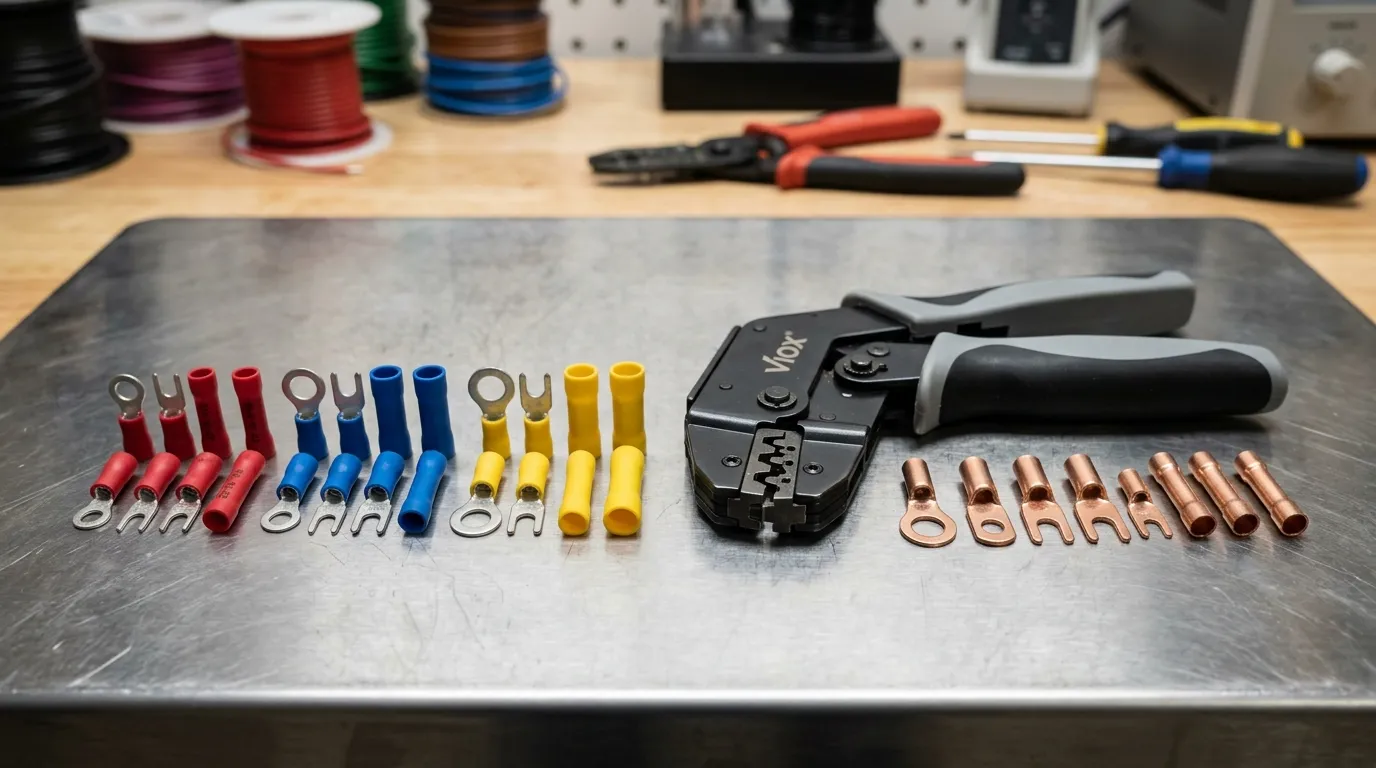
Was ist der Unterschied zwischen isolierten und nicht-isolierten Crimpverbindern?
Isolierte Crimpverbinder haben eine schützende Vinyl-, Nylon- oder Schrumpfschlauchhülse, die um den Crimpbereich geformt ist und elektrische Isolation, Zugentlastung und Umweltschutz bietet. Nicht-isolierte Crimpverbinder sind blanke Metallverbinder – typischerweise verzinntes Kupfer oder Messing – ohne jegliche Hülse, die eine kompakte und wirtschaftliche Verbindung bieten, wenn bereits eine sekundäre Isolierung oder eine geschlossene Umgebung vorhanden ist.
Wichtigste Erkenntnisse
- Isolierte Crimpverbinder schützen vor versehentlichem Kontakt, Feuchtigkeitseintritt und vibrationsbedingten Kurzschlüssen; nicht-isolierte Crimpverbinder sind auf das Gehäuse oder eine sekundäre Hülse als Schutz angewiesen.
- Die Standard-Farbcodierung folgt den IEC- und UL-Konventionen: rot (22–16 AWG / 0,5–1,5 mm²), rot (16–14 AWG / 1,5–2,5 mm²), gelb blau.
- (12–10 AWG / 4–6 mm²).
- Die Verwendung eines nicht-isolierten Crimpwerkzeugs auf einem isolierten Crimpverbinder durchsticht die Hülse und erzeugt eine Stoß- und Kurzschlussgefahr – stimmen Sie das Werkzeug immer auf den Crimpverbinder-Typ ab.
- Für UL 508A industrielle Schaltschränke muss die Verwendung von Aderendhülsen Abschnitt 29.3.6 entsprechen, der die Crimpqualität, die Leiterfreilegungsgrenzen und die Abstandsbedingungen festlegt.
- Wärme-schrumpfisolierte Crimpverbinder bieten den höchsten Umweltschutz und sind in Schiffs-, Außen- und chemisch aggressiven Anwendungen obligatorisch.
Nicht-isolierte Crimpverbinder sind in IP-geschützten Gehäusen zulässig, wenn ausreichende Luft- und Kriechstrecken gemäß IEC 60998-1 eingehalten werden.
Konstruktions- und Materialunterschiede Klemmenblockauswahl.
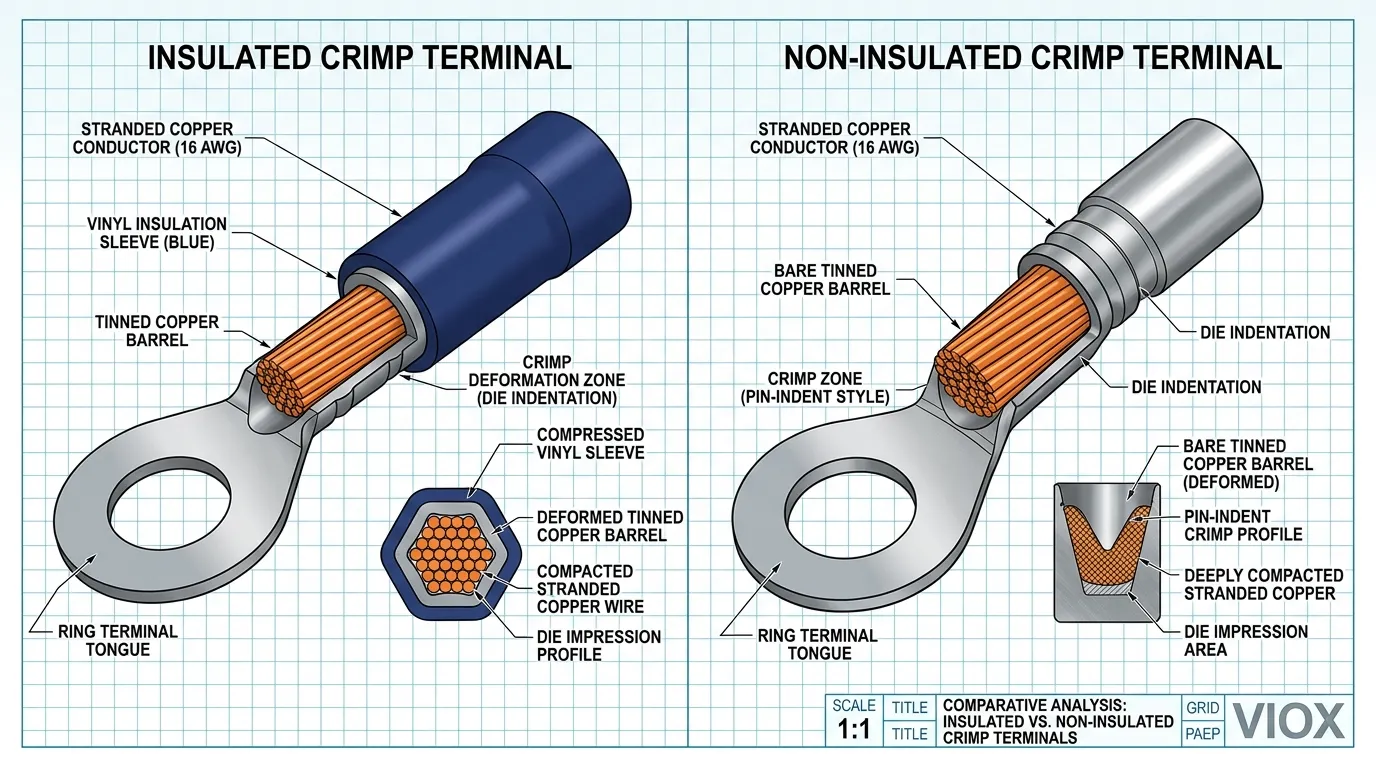
Detaillierter technischer Querschnitt, der die internen Konstruktionsunterschiede und die Crimpverformungszonen zwischen isolierten und nicht-isolierten Crimpverbindern veranschaulicht.
Grundmetalloptionen
- Sowohl isolierte als auch nicht-isolierte Crimpverbinder verwenden eines von drei primären Grundmetallen: Elektrolytisch raffiniertes Kupfer (ETP).
- Verzinntes Kupfer — höchste Leitfähigkeit (~100 % IACS), verwendet, wenn minimaler Spannungsabfall entscheidend ist.
- — Verzinnung (typischerweise 2–5 µm) bietet Korrosionsbeständigkeit bei gleichzeitiger Aufrechterhaltung einer Leitfähigkeit von >85 % IACS. Dies ist die häufigste Wahl für industrielle Crimpverbinder. Messing (CuZn).
— härter als Kupfer, bietet eine höhere mechanische Haltbarkeit in trennbaren Crimpverbindern, aber mit geringerer Leitfähigkeit (~28 % IACS).
Nicht-isolierte Crimpverbinder legen den blanken oder beschichteten Metallbereich direkt frei. Isolierte Crimpverbinder fügen eine Hülse über diesem Bereich in einem von drei Materialien hinzu:
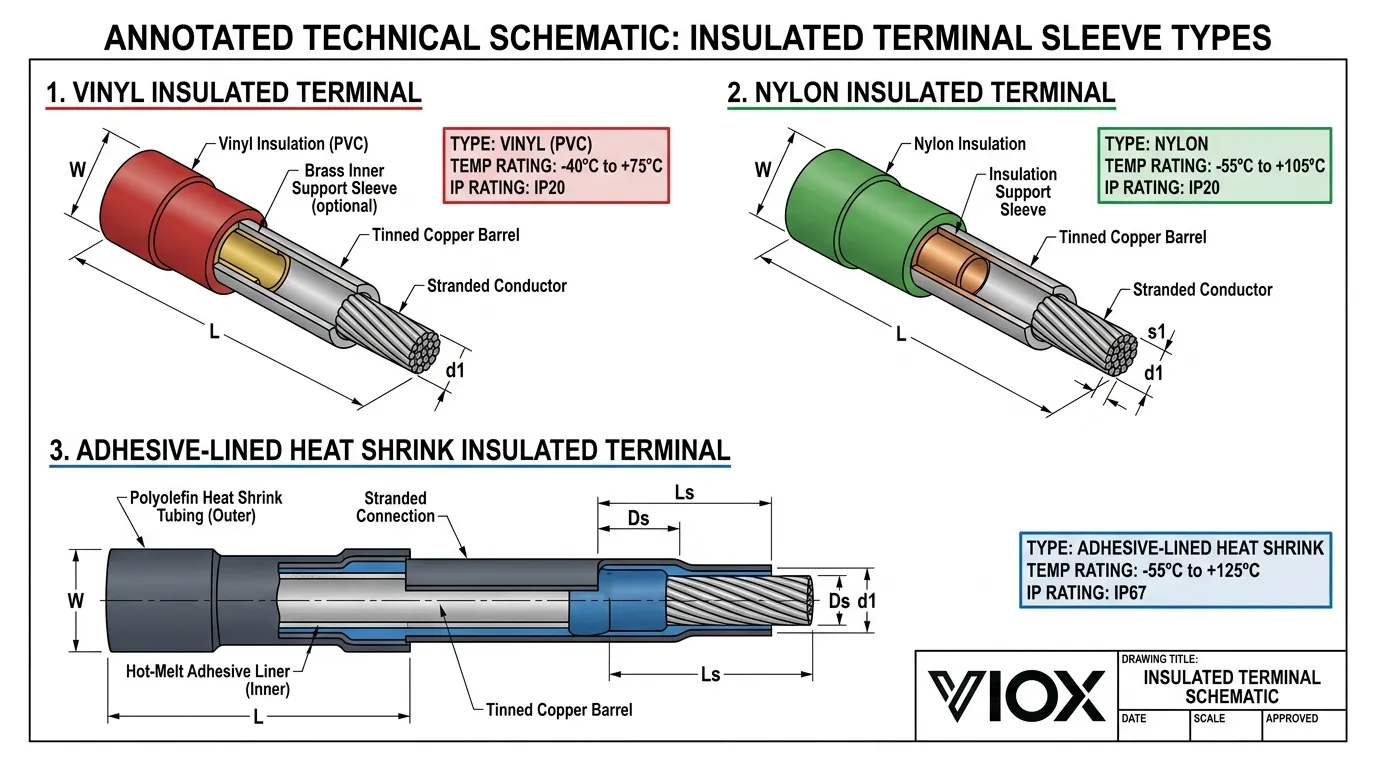
| Eigentum | Technische Skizze, die Vinyl-, Nylon- und klebstoffbeschichtete Schrumpfschlauch-isolierte Crimpverbinder zusammen mit ihren jeweiligen Temperatur- und IP-Schutzarten darstellt. | Vinyl (PVC) | Nylon (PA66) |
|---|---|---|---|
| Temperaturbereich | Schrumpfschlauch (Polyolefin) | −20 °C bis +105 °C | −40 °C bis +105 °C |
| −55 °C bis +125 °C | Mäßig | Hoch | Sehr hoch |
| Chemische Beständigkeit | Abriebfestigkeit | Niedrig–Mittel | Hoch |
| Mittel–Hoch | Feuchtigkeitsabdichtung | Feuchtigkeitsabdichtung | Nur Reibungssitz |
| Klebstoffbeschichtete Dichtung (IP67-fähig) | Crimp-Inspektionsfähigkeit | Undurchsichtig | Halbtransparent |
| Undurchsichtig nach dem Schrumpfen | Entflammbarkeitsklasse (UL 94) | V-2 typisch | V-2 bis V-0 |
| Relative Kosten | Niedrig | Mäßig | Hoch |
schwer entflammbarem Schrumpfschlauch
Farbcodierungsstandards und Drahtstärkenanpassung
| Isolierte Crimpverbinder folgen einer universellen Farbcodierungskonvention, die in IEC- und UL-Standards anerkannt ist. Dieses System eliminiert Rätselraten bei Installation und Inspektion: | Hülsenfarbe | AWG-Bereich | Typische Anwendungen |
|---|---|---|---|
| Rot | Metrischer Bereich (mm²) | 22–16 AWG | 0,5–1,5 mm² |
| Blau | Signalverkabelung, Steuerschaltungen, Sensorleitungen | 16–14 AWG | 1,5–2,5 mm² |
| Gelb | Allzweckstromversorgung, Beleuchtungsschaltungen, Relaisverdrahtung | 12–10 AWG | 4–6 mm² |
Motorzuleitungen, hochstromführende Abzweigstromkreise, Stromverteilung.
Richtiges Verständnis Nicht-isolierte Crimpverbinder haben diese visuelle Identifizierung nicht. Bei der Spezifizierung von nicht-isolierten Crimpverbindern müssen sich Ingenieure auf Durchmesser-Messungen oder Teilenummer-Querverweise verlassen, um die Kompatibilität der Drahtstärke sicherzustellen. In Produktionsumgebungen mit hoher Variantenvielfalt, in denen mehrere Drahtstärken gleichzeitig verarbeitet werden, reduziert der Farbcodierungsvorteil von isolierten Crimpverbindern messbar Montagefehler. In Bezug auf den Schutz von Stromkreisen ist dies von entscheidender Bedeutung – ein zu kleiner Aderendhülsenschaft an einem überdimensionierten Leiter führt zu mechanischem Versagen, während ein zu großer Schaft an einem dünnen Draht keinen gasdichten Kontakt herstellt.
Isolierte vs. nicht isolierte Klemmen: Vollständiger Vergleich
| Feature | Isolierte Klemmen | Nicht isolierte Klemmen |
|---|---|---|
| Elektrische Isolierung | Eingebaute Hülse verhindert Kontakt | Keine – erfordert externe Maßnahmen |
| Größe / Profil | Größer aufgrund der Hülse | Kompakt; passt in enge Räume |
| Farbcodierte Größenbestimmung | Ja (rot / blau / gelb) | Keine |
| Crimpwerkzeug erforderlich | Isolierte Crimpmatrize (ovales Profil) | Nicht isolierte Matrize (Eindrück-/Stiftprofil) |
| Schutz vor Nässe | Moderat (Vinyl/Nylon) bis Hoch (wärmeschrumpfend) | Keiner |
| Vibrationsbeständigkeit | Hülse sorgt für Zugentlastung | Blanker Schaft; keine Zugentlastung |
| Klebstoffbeschichtete Dichtung (IP67-fähig) | Begrenzt (Nylon ist semi-transparent) | Vollständig sichtbar |
| Stückkosten | Höher | Unter |
| Gängige Standards | IEC 60998-1, UL 486A/B | IEC 60998-1, UL 486A/B |
| Ideale Umgebung | Freiliegende Verkabelung, Außenbereich, Marine, vibrierende Maschinen | Geschlossene Schalttafeln, trockene Umgebungen, Erdungsanschlüsse |
Crimpen: Die entscheidende Fähigkeit, die die Zuverlässigkeit bestimmt
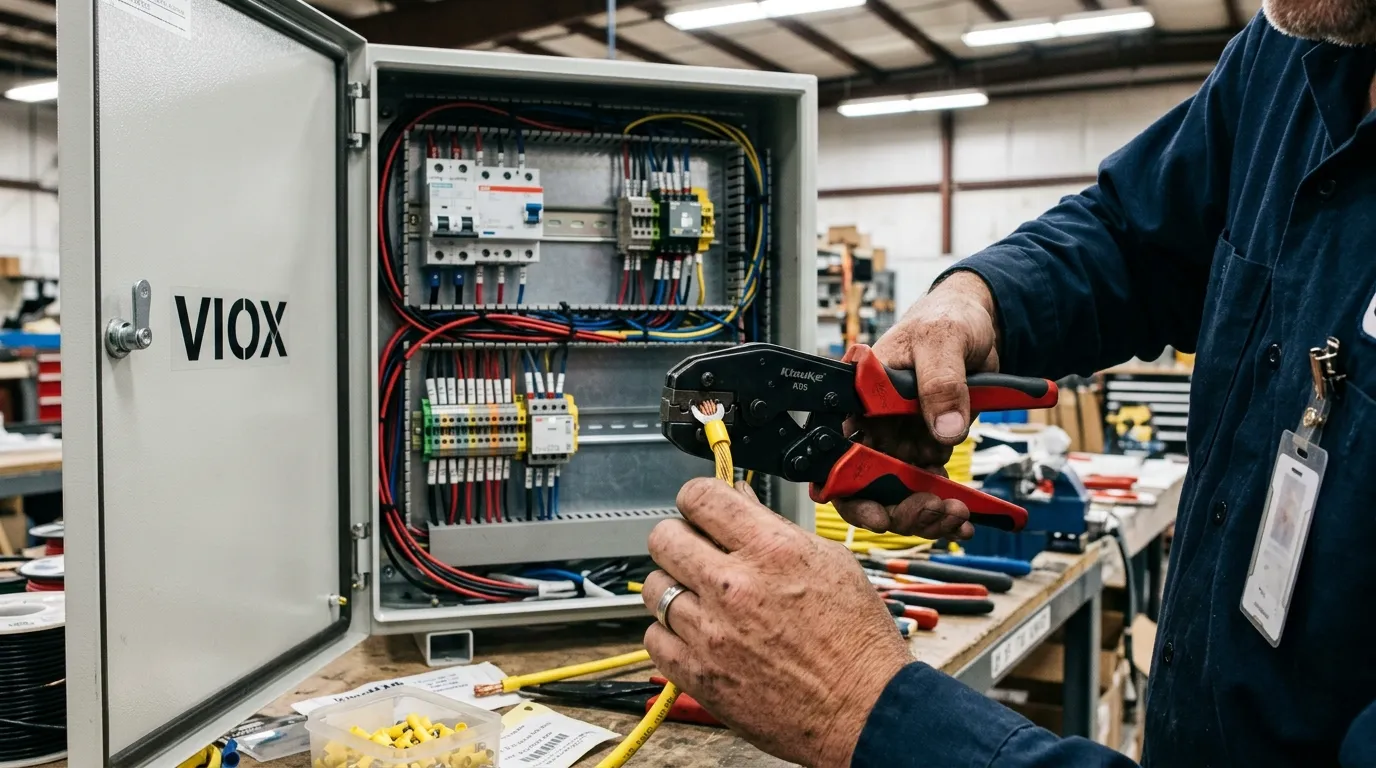
Die Zuverlässigkeit jeder Crimp-Klemme – ob isoliert oder nicht – hängt von der Qualität der Crimpverbindung selbst ab. Hier wird die Wahl zwischen Crimpen vs. Löten relevant: Fachgerecht ausgeführte Crimpverbindungen übertreffen Lötverbindungen in Bezug auf Vibrationsfestigkeit, Konsistenz und Produktionsgeschwindigkeit.
Anpassen der Matrize an die Klemme
Dies ist eine nicht verhandelbare Sicherheitsanforderung, die bei Feldinstallationen häufig verletzt wird:
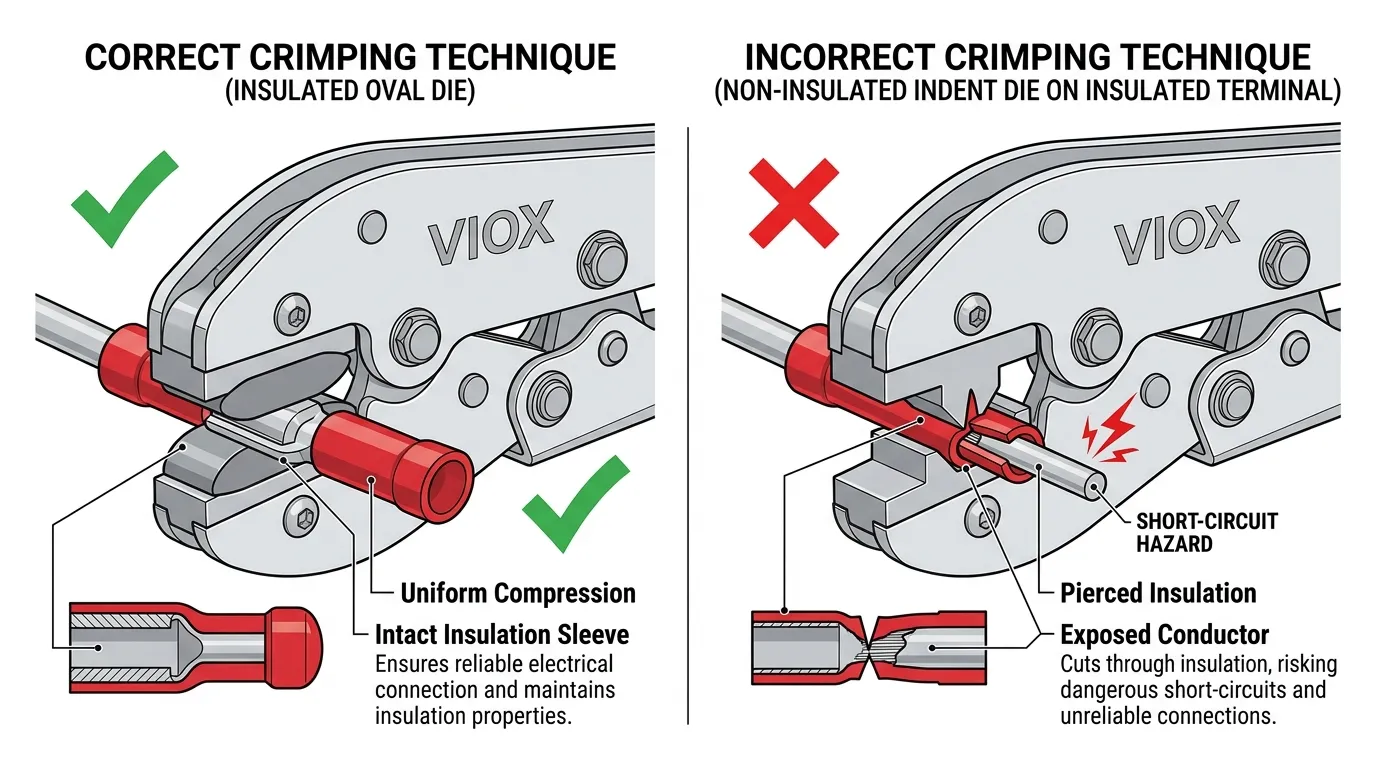
- Isolierte Klemmen-Crimpzangen verwenden ein ovales oder gepolstertes Matrizenprofil, das die Hülse und den Schaft gleichmäßig zusammendrückt, ohne die Isolierung zu durchdringen.
- Nicht isolierte Klemmen-Crimpzangen verwenden eine Stift-und-Amboss-(Eindrück-)Matrize, die eine lokalisierte Vertiefung in den blanken Metallschaft treibt, um einen maximalen gasdichten Kontakt zu erzielen.
Wichtiger Sicherheitshinweis: Die Verwendung einer nicht isolierten Eindrückmatrize auf einer isolierten Klemme stanzt direkt durch die Isolierhülse und legt blankes Metall frei. Dies erzeugt eine Kurzschluss- und Stromschlaggefahr, die nach der Installation möglicherweise nicht sichtbar ist. Das Gegenteil – die Verwendung einer isolierten Matrize auf einer nicht isolierten Klemme – erzeugt eine schwächere Crimpverbindung, die zwar einen anfänglichen Zugtest bestehen kann, aber unter thermischer Beanspruchung versagen kann.
Ratschenwerkzeuge und Qualitätssicherung
Für Produktions- und Schaltschrankbauumgebungen werden Ratschen-Crimpwerkzeuge dringend empfohlen. Diese Werkzeuge lösen erst, wenn der Crimpzyklus vollständig abgeschlossen ist, wodurch die bedienerabhängige Variabilität beseitigt wird, die Standard-Handcrimpzangen plagt. Beim Bau von Komponenten für industrielle Schaltschränke, ist eine gleichbleibende Crimpqualität keine Option – sie ist eine UL-Listungsanforderung.
Wann welcher Typ zu verwenden ist
Isolierte Klemmen werden bevorzugt, wenn:
- Leiter außerhalb eines Gehäuses freiliegen oder durch Bereiche geführt werden, die für Personal zugänglich sind.
- Die Installation Vibrationen ausgesetzt ist (Motoren, mobile Geräte, Kabelbäume in der Automobilindustrie) – die Hülse bietet eine kritische Zugentlastung am Übergang von Draht zu Schaft.
- Umgebungsbedingungen Feuchtigkeit, Kondensation, chemische Spritzer oder UV-Strahlung umfassen. Wärmeschrumpfvarianten mit Klebstoffauskleidung sind für Marine- und Solarinstallationen im Freien obligatorisch.
- Mehrere Leiter in unmittelbarer Nähe mit minimalem Abstand verlegt werden, wodurch das Risiko eines versehentlichen Kontakts zwischen benachbarten Klemmen erhöht wird.
Nicht isolierte Klemmen sind akzeptabel, wenn:
- Verbindungen innerhalb eines abgedichteten, IP-geschützten Gehäuses hergestellt werden, in dem ausreichende Luftstrecken und Kriechstrecken eingehalten werden.
- Der Platz stark begrenzt ist und das größere Profil isolierter Hülsen Routing- oder Passungsprobleme verursacht.
- Die Klemme durch eine sekundäre Isolationsmethode abgedeckt wird (z. B. separat aufgebrachte Wärmeschrumpfschläuche, Stiefelabdeckungen oder Vergussmasse).
- Erdungs- und Potentialausgleichsanschlüsse, bei denen der Leiter absichtlich dem Geräteerdungssystem ausgesetzt ist.
Verständnis Klemmenblockkonstruktion hilft Ingenieuren zu verstehen, wie die Kontaktgeometrie der Klemme mit isolierten und nicht isolierten Drahtenden interagiert.
Normenkonformität: IEC 60998-1, UL 486A/B und UL 508A
IEC 60998-1
Diese internationale Norm regelt Verbindungselemente für Niederspannungskreise und deckt sowohl isolierte als auch nicht isolierte Typen ab. Sie legt Anforderungen an die mechanische Festigkeit (Auszugskraft), die Temperaturerhöhung unter Nennstrom, den Isolationswiderstand und die Durchschlagfestigkeit fest. Jede Klemme, die in einem IEC-konformen Schaltschrank verwendet wird, muss diese Anforderungen erfüllen oder übertreffen – eine wichtige Überlegung bei der Bewertung von Klemmenblockzertifizierungen.
UL 486A/B
Diese UL-Normen decken Drahtverbinder für Kupferleiter (486A) und Aluminiumleiter (486B) ab. Sie definieren Anforderungen an Drehmoment, Auszugskraft und Temperaturverhalten, die für isolierte und nicht isolierte Crimp-Klemmen gelten, die auf nordamerikanischen Märkten verkauft werden.
UL 508A Abschnitt 29.3.6 – Aderendhülsenanforderungen
Für UL-gelistete industrielle Steuerungsschränke wird die Verwendung von Aderendhülsen speziell durch UL 508A Abschnitt 29.3.6 geregelt. Zu den wichtigsten Anforderungen gehören:
- Aderendhülsen müssen so vercrimpt werden, dass der nicht isolierte Teil des Drahtes die elektrischen Abstände bei der Installation nicht verringert.
- Die Aderendhülse muss in einem Verbinder abgeschlossen werden, der für Kupferdraht und für die Anzahl und Größe der vercrimpten Leiter ausgelegt ist.
- Isolierte Aderendhülsen bieten hier einen praktischen Vorteil: Die Hülse begrenzt auf natürliche Weise die freiliegende Leiterlänge und hält den minimalen Biegeradius in engen Verdrahtungskanälen ein.
Unabhängig davon, ob isolierte oder nicht isolierte Aderendhülsen gewählt werden, ist die Einhaltung dieser Abstandsbestimmungen obligatorisch. Nicht isolierte Aderendhülsen erfordern eine sorgfältigere Installationsdisziplin, um Verstöße durch freiliegende Leiter zu vermeiden.
Kosten vs. Zuverlässigkeit: Die tatsächliche Berechnung
Nicht-isolierte Kabelschuhe kosten etwa 30–50 % weniger pro Einheit als ihre vinyl-isolierten Äquivalente. Wärme Schrumpf-isolierte Kabelschuhe sind noch einmal 2–3 Mal teurer als Vinyl. Für Einkaufsmanager, die die Gesamtbetriebskosten bewerten, erzählt der Stückpreis jedoch nur einen Teil der Geschichte.
Ein einziger Feldausfall, der durch einen Kurzschluss zwischen nicht isolierten Kabelschuhen verursacht wird – was zu Geräteausfallzeiten, Garantieansprüchen oder einer erneuten Schaltschrankprüfung führt – kann um Größenordnungen mehr kosten als die Isolationsprämie über eine gesamte Produktionsserie hinweg. In Anwendungen mit Umwelteinflüssen oder Vibrationen ist die Zuverlässigkeitsprämie von isolierten Kabelschuhen eine solide technische Investition.
Für Installationen in gut abgedichteten Gehäusen, in denen Reihenklemme vs. Klemmenblock die Auswahl bereits Abstände und Isolationsanforderungen berücksichtigt hat, stellen nicht isolierte Kabelschuhe eine rationale Kostenoptimierung dar.
Häufige Fehler und Ausfallarten
- Falsche Crimpmatrize — Der gefährlichste und häufigste Fehler. Überprüfen Sie immer die Kompatibilität von Matrize und Kabelschuh, bevor Sie mit dem Crimpen beginnen.
- Überdimensionierte Hülse für Drahtstärke — Führt zu einer losen Crimpverbindung mit hohem Kontaktwiderstand. Die Verbindung besteht einen leichten Zugtest, entwickelt aber unter Last Hotspots, die zu thermischem Durchgehen führen.
- Unzureichende Abisolierlänge — Der Leiter greift nicht vollständig in die Hülse ein, wodurch die Kontaktfläche und die Auszugsfestigkeit verringert werden.
- Übermäßige Abisolierlänge bei nicht isolierten Kabelschuhen — Freiliegender Leiter über die Hülse hinaus verringert die Kriechstrecke und kann gegen die UL 508A-Abstandsanforderungen verstoßen.
- Verwendung von vinyl-isolierten Kabelschuhen in Hochtemperaturzonen — Vinyl zersetzt sich oberhalb von 105 °C. Motoranschlüsse und Leistungswiderstandsverbindungen erfordern Kabelschuhe mit Nylon- oder Wärmeschrumpf-Isolierung.
- Auslassen des Zugtests — Jede Crimpverbindung sollte einem manuellen Zugtest als minimales Qualitätsmerkmal standhalten. Produktionsumgebungen sollten kalibrierte Zugkraftprüfungen gemäß IEC 60998-1 implementieren.
Kurze FAQ
Dürfen in einem elektrischen Schaltschrank nicht-isolierte Klemmen verwendet werden?
Ja – nicht isolierte Klemmen werden häufig in geschlossenen Industrieschränken verwendet, sofern ausreichende Luft- und Kriechstrecken gemäß IEC 60998-1 und UL 508A eingehalten werden. Viele Schaltschrankbauer bevorzugen isolierte Aderendhülsen aufgrund der zusätzlichen Farbcodierung und des besseren Biegeradiusmanagements.
Was passiert, wenn ich das falsche Crimpwerkzeug verwende?
Die Verwendung einer nicht isolierten Crimpbacke auf einer isolierten Klemme durchsticht die Isolierhülle und erzeugt eine freiliegende Metalloberfläche, die Kurzschlüsse oder Stromschläge verursachen kann. Die Verwendung einer isolierten Crimpbacke auf einer nicht isolierten Klemme erzeugt eine mechanisch schwache Crimpverbindung, die unter thermischer Belastung oder Vibration versagen kann.
Lohnt sich der Aufpreis für Schrumpfschlauchverbinder?
Für Schiffs-, Außen-, Reinigungs- oder chemisch aggressive Umgebungen – absolut. Der klebstoffbeschichtete Schrumpfschlauch erzeugt eine hermetische Abdichtung gemäß IP67 und verhindert das Eindringen von Feuchtigkeit und Verunreinigungen, die blanke oder vinylisolierte Verbindungen innerhalb von Monaten korrodieren würden. Für trockene Innenraumschalttafeln ist eine Vinyl- oder Nylonisolierung in der Regel ausreichend.
Haben isolierte und nicht isolierte Klemmen die gleiche Nennstromstärke?
Bei identischen Drahtstärken und Hülsenkonstruktionen, ja – die Isolierhülse beeinflusst die Strombelastbarkeit der Klemme selbst nicht. Die Isolierung beeinflusst jedoch die Wärmeableitung. Bei eng gebündelter Verdrahtung kann die zusätzliche thermische Barriere von isolierten Hülsen in Hochstromanwendungen eine Reduzierung der Nennleistung erforderlich machen.
Welche Normen regeln die Qualität von Crimp-Anschlussklemmen?
IEC 60998-1 behandelt allgemeine Anforderungen an Niederspannungs-Verbindungsmaterial. UL 486A/B regelt Drahtverbinder für den nordamerikanischen Markt. Für industrielle Schaltschränke definiert UL 508A Abschnitt 29.3.6 spezifisch die Anforderungen an die Aderendhülseninstallation. Darüber hinaus hilft das Verständnis der breiteren Landschaft von Keramik- vs. UKK-Klemmenblöcken sicherzustellen, dass der Klemmenblock selbst auch korrekt für die Anwendung spezifiziert ist.