When electrical installations are located at elevated altitudes, circuit breakers face unique operational challenges that can significantly impact their performance and safety. The reduced air density at higher elevations affects both the insulation properties and thermal characteristics of these critical protective devices. For electrical engineers and facility managers working on projects in mountainous regions, high-plateau industrial sites, or renewable energy installations at elevation, understanding altitude derating requirements is essential for ensuring reliable system protection.
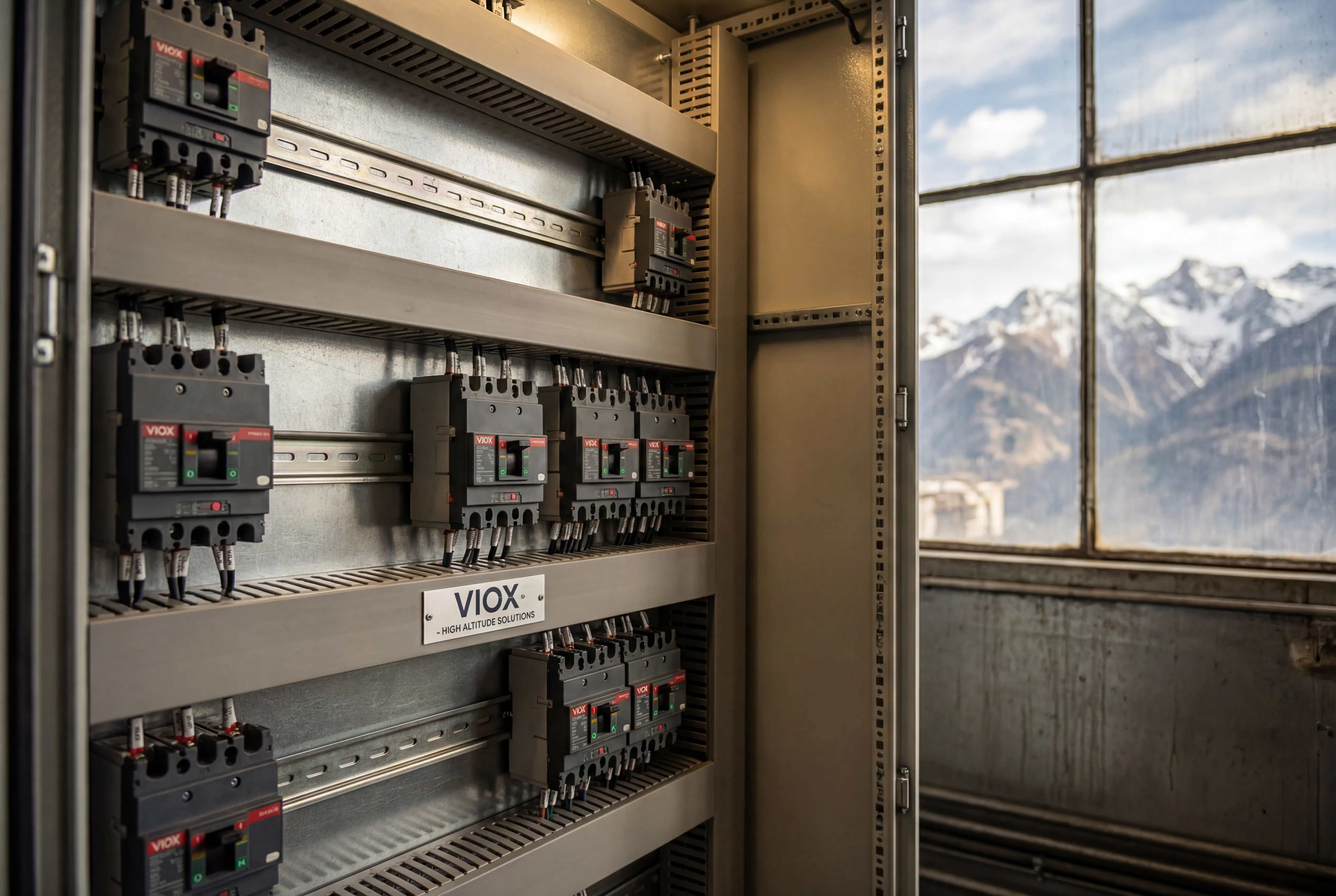
According to international standards including IEC 62271-1 and IEC 60947, circuit breakers are typically rated for operation up to 2,000 meters (6,560 feet) above sea level under normal service conditions. Beyond this threshold, specific parameters must be derated to maintain safe and reliable operation. This comprehensive guide examines which circuit breaker parameters require adjustment and provides practical derating factors for high-altitude applications.
The Physics Behind High-Altitude Derating
Air Density and Atmospheric Pressure
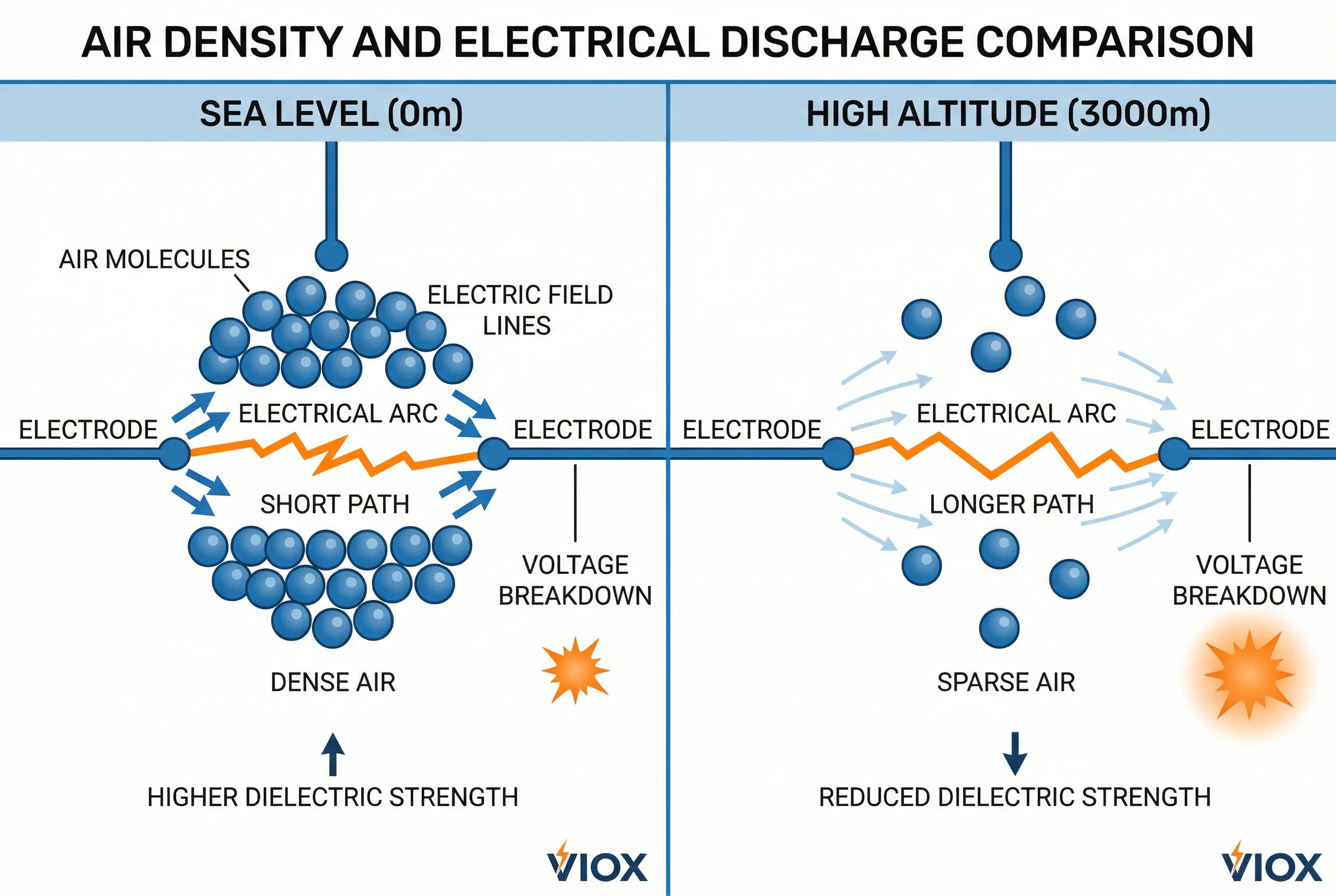
At sea level, air density is approximately 1.225 kg/m³. As altitude increases, atmospheric pressure decreases, resulting in lower air density. At 3,000 meters, air density drops to roughly 0.909 kg/m³—a reduction of approximately 26%. This reduction has profound implications for electrical equipment that relies on air as both an insulating medium and a cooling agent.
The relationship between altitude and air density follows an exponential decay pattern. For every 1,000 meters of elevation gain, atmospheric pressure decreases by approximately 11.5%, directly affecting the dielectric strength of air gaps used in circuit breaker insulation systems.
Paschen’s Law and Electrical Breakdown
Paschen’s Law governs the breakdown voltage of gases between two electrodes. This fundamental principle reveals that at lower atmospheric pressures, the voltage required to initiate an electrical arc across an air gap actually decreases. Contrary to intuition, thinner air at high altitudes becomes a less effective insulator, not a better one.
Laboratory testing demonstrates this clearly: a circuit breaker rated for 1,000 volts at sea level may begin exhibiting corona discharge at approximately 800 volts when operated at pressures simulating 3,000 meters elevation—a 20% reduction in insulation capability purely due to reduced air density.
Thermal Considerations
While higher altitudes typically feature lower ambient temperatures, the reduced air density simultaneously decreases convective heat dissipation efficiency. The net effect is that circuit breakers experience higher internal temperature rises at altitude, even when carrying the same current as at sea level. This dual impact necessitates careful consideration of thermal derating factors.
Critical Threshold: The 2,000-Meter Baseline
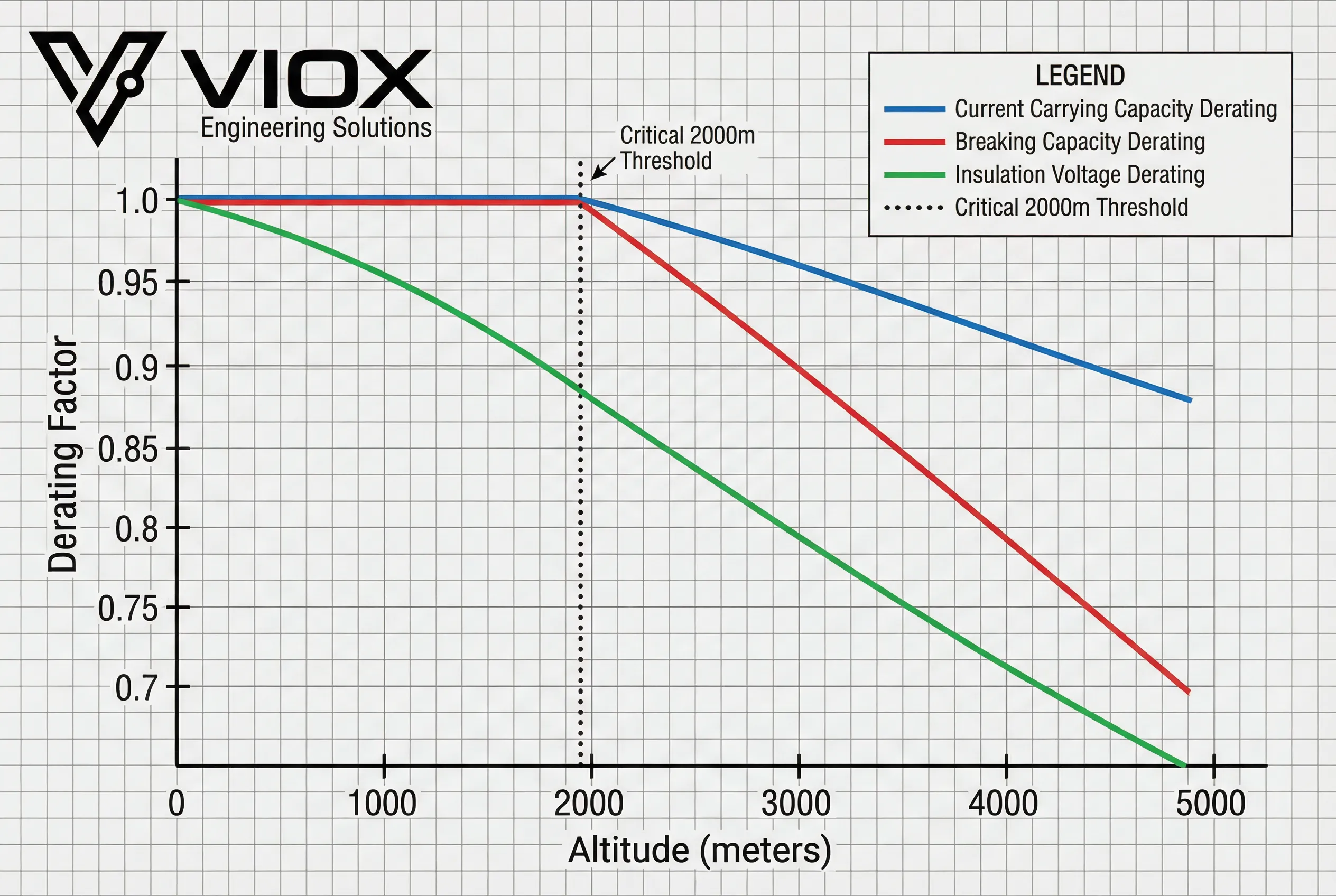
International standards establish 2,000 meters as the critical altitude threshold for circuit breaker derating. Below this elevation, most standard circuit breakers operate within their normal specifications without requiring adjustment. Above 2,000 meters, systematic derating becomes mandatory to ensure safe operation.
| Altitude Range | Required Action | Risk Level |
|---|---|---|
| 0-1,000m | Standard operation, no derating | Normal |
| 1,000-2,000m | Monitoring recommended, especially for critical applications | Low |
| 2,000-3,000m | Derating required per manufacturer specifications | Moderate |
| 3,000-4,000m | Significant derating factors applied | High |
| Above 4,000m | Specialized equipment or substantial derating essential | Very High |
Parameters Requiring Derating
1. Insulation and Voltage-Related Parameters
Rated Insulation Voltage (Ui)
The rated insulation voltage must be adjusted according to manufacturer-specified altitude correction factors. For installations above 2,000 meters, the altitude correction factor Ka is calculated using the formula:
Ka = e^[m(H-1000)/8150]
Where:
- H = installation altitude in meters
- m = correction exponent (typically 1.0 for power frequency and lightning impulse voltages)
- e = Euler’s number (approximately 2.718)
For example, at 3,000 meters with m=1.0:
Ka = e^[(3000-1000)/8150] = e^0.245 ≈ 1.28
This means the required insulation level must be 28% higher than the rated value to maintain equivalent protection.
Rated Impulse Withstand Voltage (Uimp)
Lightning impulse withstand voltage ratings are particularly sensitive to altitude. Above 2,000 meters, either the electrical clearance distances must be increased, or the rated Uimp must be reduced. The same altitude correction factor applies, but practical implementation often involves selecting circuit breakers with higher BIL (Basic Impulse Level) ratings.
Electrical Clearance
Electrical clearance—the shortest distance in air between two conductive parts—must be calculated based on the 2,000-meter baseline clearance table multiplied by the altitude correction coefficient. When physical constraints prevent increasing clearance distances, system operating voltage must be reduced accordingly.
Power Frequency Withstand Voltage
The one-minute power frequency withstand voltage capability decreases with altitude and requires derating according to manufacturer specifications. This parameter is critical for ensuring circuit breakers can withstand temporary overvoltages without failure.
2. Current Carrying and Thermal Characteristics
Rated Current (In)
The continuous current rating of circuit breakers must be adjusted using manufacturer-provided “altitude-temperature derating curves.” These curves account for the reduced cooling efficiency at higher elevations.
| Altitude (meters) | Current Derating Factor |
|---|---|
| 0-2,000 | 1.00 (no derating) |
| 2,500 | 0.98 |
| 3,000 | 0.96 |
| 3,500 | 0.94 |
| 4,000 | 0.92 |
| 4,500 | 0.90 |
| 5,000 | 0.88 |
For a circuit breaker with a rated current of 100A at sea level, operation at 4,000 meters would require derating to approximately 92A for equivalent thermal performance.
Power Loss and Temperature Rise
The reduced air density at altitude diminishes convective cooling effectiveness, causing higher temperature rises in circuit breaker enclosures and internal components. Even when carrying the same current, circuit breakers at altitude operate at elevated temperatures, accelerating aging of insulation materials and increasing contact resistance.
Testing data shows that temperature rise can increase by 5-10% at 3,000 meters compared to sea level operation under identical load conditions. This necessitates consideration in both equipment selection and enclosure ventilation design.
Thermal Trip Curves
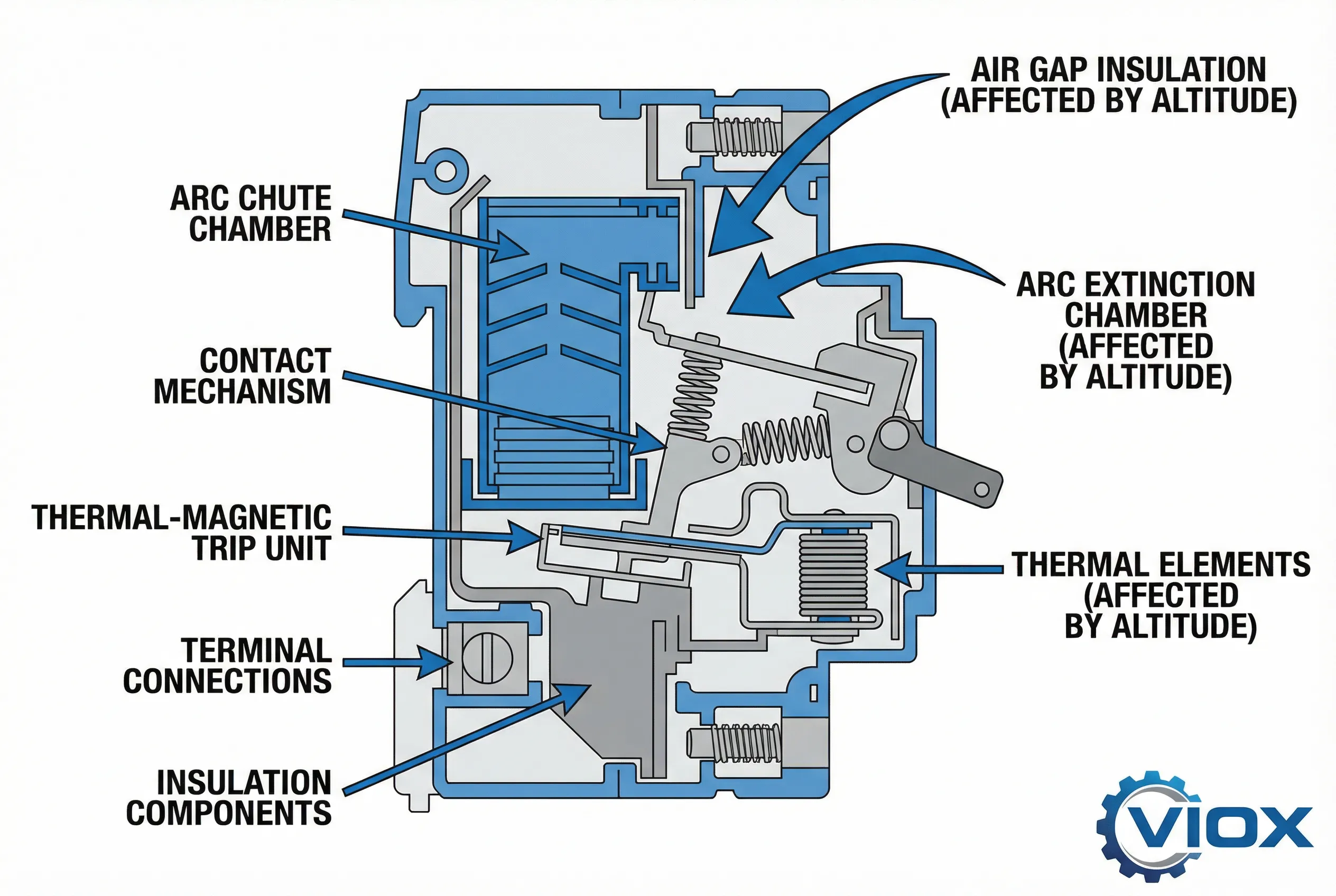
Thermal-magnetic circuit breakers utilize bimetallic elements that respond to heat generated by current flow. At high altitude, these trip elements experience faster temperature rises due to reduced cooling, causing the time-current characteristic curves to shift leftward. Practically, this means the breaker will trip earlier than indicated by its rated curve for the same overcurrent condition.
This effect must be considered during coordination studies to prevent nuisance tripping while maintaining adequate protection. Electronic trip units are less susceptible to this phenomenon, as their trip characteristics are typically not affected by altitude.
3. Breaking and Making Capacity
Short-Circuit Breaking Capacity (Icu/Ics)
The rated ultimate short-circuit breaking capacity (Icu) and rated service short-circuit breaking capacity (Ics) are among the most critically affected parameters at altitude. Reduced air density compromises arc extinction capability, making it more difficult for circuit breakers to interrupt fault currents.
Arc cooling efficiency decreases significantly with altitude, requiring selection of circuit breakers with higher interrupting ratings than would be necessary at sea level. Some manufacturers recommend increasing the breaking capacity rating by 10-15% for installations at 3,000 meters.
| Altitude (meters) | Breaking Capacity Factor | Recommended Action |
|---|---|---|
| 2,000 | 1.00 | Standard rating sufficient |
| 2,500 | 0.95 | Consider 5% margin |
| 3,000 | 0.90 | Select next higher rating |
| 3,500 | 0.85 | Select significantly higher rating |
| 4,000 | 0.80 | Specialized equipment recommended |
Electrical Life and Maintenance Intervals
The prolonged arc duration at high altitude results in increased contact erosion per operation. Circuit breakers experience accelerated contact wear, reducing their electrical life expectancy. Contact surfaces sustain more severe pitting and material transfer, necessitating more frequent inspection and maintenance.
Manufacturers typically recommend reducing maintenance intervals by 20-30% for installations above 3,000 meters. What might be a 10,000-operation electrical life at sea level could decrease to 7,000-8,000 operations at 3,500 meters under equivalent fault conditions.
4. Trip Setting Considerations
Electromagnetic Instantaneous Trip
Electromagnetic (magnetic-only) instantaneous trip mechanisms are relatively less affected by altitude compared to thermal elements. These devices operate based on magnetic force generated by fault current, which is not significantly influenced by air density. However, minor adjustments may still be necessary at extreme altitudes above 4,000 meters.
Adjustable Electronic Trip Units
Modern electronic trip units with microprocessor-based protection algorithms maintain their accuracy across a wide altitude range. The trip threshold settings and time delays programmed into electronic trip units generally do not require adjustment for altitude, making them preferred for high-elevation installations.
Parameters NOT Requiring Derating
Understanding which parameters remain unaffected by altitude is equally important for proper circuit breaker specification and application.
Creepage Distance
Creepage distance—the shortest path along the surface of insulation between conductive parts—is primarily influenced by pollution levels rather than altitude. This parameter is determined by the pollution degree classification per IEC 60664-1 and does not require altitude correction. Surface contamination, humidity, and environmental factors govern creepage requirements independently of elevation.
Mechanical Life
The mechanical endurance of circuit breakers, expressed as the number of operations under no-load conditions, is generally not affected by altitude. Operating mechanisms, springs, latches, and other mechanical components function comparably at sea level and high altitude. Standard mechanical life ratings—often 10,000 to 25,000 operations for molded case circuit breakers—apply without adjustment.
Electronic Trip Unit Settings
As mentioned previously, the current and time settings of electronic trip units maintain their calibrated values regardless of installation altitude. These solid-state protection devices use electronic sensors and processing that are immune to atmospheric pressure changes. This characteristic makes electronic trip circuit breakers particularly advantageous for high-altitude applications.
Residual Current Device (RCD) Ratings
The rated residual operating current (IΔn) of residual current devices or ground fault protection functions does not require altitude derating. These devices detect differential current imbalances through current transformers, a measurement principle unaffected by air density or atmospheric conditions.
Comprehensive Altitude Derating Table
| Parameter | Symbol | Derating Required | Typical Factor at 3,000m | Typical Factor at 4,000m |
|---|---|---|---|---|
| Rated Insulation Voltage | Ui | Yes | 1.28 (increase required) | 1.42 (increase required) |
| Impulse Withstand Voltage | Uimp | Yes | 1.28 (increase required) | 1.42 (increase required) |
| Electrical Clearance | – | Yes | 1.28× baseline | 1.42× baseline |
| Power Frequency Withstand | – | Yes | Per manufacturer | Per manufacturer |
| Rated Current | In | Yes | 0.96 | 0.92 |
| Breaking Capacity | Icu/Ics | Yes | 0.90 | 0.80 |
| Short-time Withstand Current | Icw | Yes | 0.90 | 0.80 |
| Making Capacity | Icm | Yes | 0.90 | 0.80 |
| Thermal Trip Curve | – | Yes (shifts left) | Adjusted per testing | Adjusted per testing |
| Magnetic Trip Setting | Im | Minimal | 0.98-1.00 | 0.95-1.00 |
| Electronic Trip Settings | – | No | 1.00 | 1.00 |
| Creepage Distance | – | No | 1.00 | 1.00 |
| Mechanical Life | – | No | 1.00 | 1.00 |
| RCD Rated Current | IΔn | No | 1.00 | 1.00 |
Practical Application Guidelines
System Design Considerations
When designing electrical distribution systems for high-altitude installations, engineers should:
- Conduct thorough insulation coordination studies accounting for altitude correction factors
- Verify manufacturer specifications for altitude capability and derating recommendations
- Consider environmental enclosure ratings with enhanced ventilation for thermal management
- Implement surge protection as reduced insulation margins increase vulnerability to transients
- Plan for reduced maintenance intervals to address accelerated contact wear
Alternative Technologies
For extreme altitude installations (above 3,500 meters), consider these alternatives:
- Gas-insulated switchgear (GIS): SF6 or alternative gas insulation provides consistent dielectric properties regardless of ambient air pressure
- Vacuum circuit breakers: Arc interruption occurs in vacuum, completely eliminating altitude effects on breaking performance
- Solid-insulated equipment: Epoxy-cast or resin-insulated systems offer altitude-independent insulation performance
- Electronic trip devices: Microprocessor-based protection eliminates thermal element altitude sensitivity
Enclosure and Ventilation Design
Cabinet temperature management becomes critical at altitude. Enhanced ventilation strategies include:
- Increased fan capacity to compensate for reduced air density
- Larger ventilation openings maintaining pollution protection
- Temperature monitoring systems with altitude-adjusted alarm thresholds
- Heat load calculations using altitude-corrected derating factors
Frequently Asked Questions
Why do circuit breakers need altitude derating above 2,000 meters?
At elevations above 2,000 meters, reduced air density affects both insulation and cooling properties. Thinner air provides less effective electrical insulation according to Paschen’s Law, increasing the risk of electrical breakdown. Simultaneously, reduced air density decreases convective heat transfer, causing higher operating temperatures. These combined effects can lead to premature failure, reduced breaking capacity, and safety hazards without proper derating.
How do I calculate the altitude correction factor for my installation?
The altitude correction factor Ka is calculated using the IEC formula: Ka = e^[m(H-1000)/8150], where H is your installation altitude in meters and m is typically 1.0 for most voltage parameters. For example, at 3,500 meters: Ka = e^[(3500-1000)/8150] = e^0.307 ≈ 1.36. This means insulation levels should be 36% higher than standard ratings. Always consult manufacturer datasheets for specific derating curves and recommendations.
Which circuit breaker parameters are most affected by altitude?
The three most critically affected parameters are: (1) Short-circuit breaking capacity, which can decrease by 20% or more at 4,000 meters due to reduced arc cooling; (2) Rated insulation voltage and impulse withstand capability, requiring 25-40% higher ratings at 3,000-4,000 meters; and (3) Continuous current rating, typically requiring 5-10% derating due to reduced cooling efficiency. Breaking capacity and electrical life experience the most severe degradation.
Can I use standard sea-level rated circuit breakers at 2,500 meters?
At 2,500 meters—just 500 meters above the standard threshold—circuit breakers enter the zone where derating becomes advisable though not always mandatory. For conservative engineering practice, apply at least a 2-5% safety margin on current ratings and verify that the available fault current doesn’t exceed 95% of the breaker’s rated interrupting capacity. For critical applications or severe operating conditions, consult the manufacturer for specific altitude capability certifications.
Are vacuum circuit breakers better for high-altitude applications?
Yes, vacuum circuit breakers offer significant advantages for high-altitude installations. Since arc interruption occurs in vacuum rather than air, their breaking capacity remains unaffected by atmospheric pressure. However, external insulation (bushings, terminals) still requires altitude correction. Vacuum breakers are particularly recommended for installations above 3,500 meters where air-break circuit breakers require substantial derating and may become impractical or unavailable in required ratings.
Do electronic trip circuit breakers require altitude derating?
Electronic trip circuit breakers require derating only for their current-carrying capacity and insulation parameters, not for their trip settings. The microprocessor-based protection functions maintain accurate trip thresholds regardless of altitude. This makes them superior to thermal-magnetic breakers at high elevations, as thermal elements exhibit shifted trip curves due to altitude-induced temperature effects. However, the power poles still need current derating per manufacturer specifications.
Conclusion
Proper circuit breaker selection and application at high-altitude installations demands careful attention to multiple interrelated parameters. While the 2,000-meter threshold provides a clear demarcation point, altitude effects begin influencing performance at lower elevations and become increasingly critical above 3,000 meters. Understanding which parameters require derating—insulation levels, current ratings, and breaking capacity—versus those that remain stable—creepage distance, mechanical life, and electronic trip settings—enables engineers to specify appropriate equipment and maintain reliable electrical protection systems.
The key to successful high-altitude electrical installations lies in comprehensive system design that accounts for reduced air density effects on both insulation and thermal performance. By applying manufacturer-specified correction factors, conducting thorough insulation coordination studies, and considering advanced technologies like vacuum interruption or gas-insulated switchgear for extreme conditions, facility managers can ensure safe and reliable circuit breaker operation regardless of elevation.
VIOX Electric: Your Partner for High-Altitude Solutions
VIOX Electric specializes in manufacturing high-performance circuit breakers engineered for demanding environments, including high-altitude installations. Our comprehensive product line features:
- Certified altitude ratings with detailed derating curves and correction factors
- Advanced thermal management optimized for reduced air density conditions
- Electronic trip technology providing altitude-independent protection accuracy
- Technical support services including application engineering and insulation coordination studies
- Compliance with international standards including IEC 62271, IEC 60947, and ANSI C37
Contact VIOX Electric’s technical team today to discuss your high-altitude circuit breaker requirements and discover how our engineered solutions deliver reliable protection in the most challenging environments.
References and Standards:
- IEC 62271-1: High-voltage switchgear and controlgear – Common specifications
- IEC 60947-2: Low-voltage switchgear and controlgear – Circuit breakers
- IEC 60071-2: Insulation co-ordination – Application guide
- IEC 60664-1: Insulation coordination for equipment within low-voltage systems