Introduction: When a Power Failure Becomes a Life-or-Death Moment
Picture this: A machinist steps away from an active table saw to adjust a workpiece. Suddenly, the power fails. The saw blade coasts to a stop. He reaches across the table to clear sawdust, assuming the machine is safe. Then, without warning, power returns—and the saw roars back to life. In industrial settings worldwide, this scenario has led to catastrophic injuries and fatalities that could have been prevented with one critical component: a properly configured contactor with 3-wire control.
The distinction between 2-wire and 3-wire control systems isn’t merely technical—it’s the difference between compliance and liability, between safe operation and preventable tragedy. At VIOX Electric, a leading B2B manufacturer of industrial electrical equipment, we’ve spent decades engineering contactors that don’t just switch power—they protect lives through intelligent circuit design. This article explains why modern industrial safety standards mandate 3-wire control systems and why simple switches can never replace industrial-grade contactors in hazardous applications.
What is 2-Wire Control?
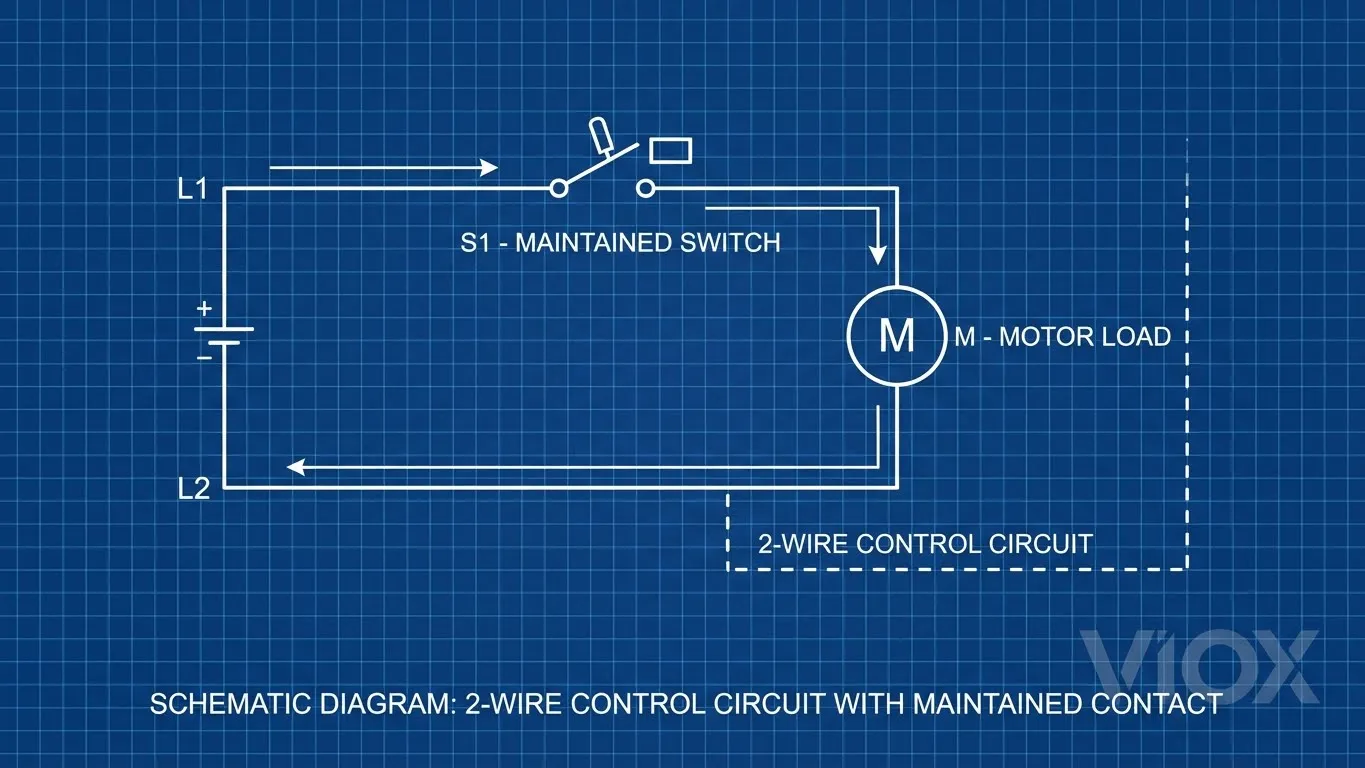
2-wire control represents the simplest form of electrical switching, commonly found in residential and light commercial applications. In this configuration, a maintained contact device—typically a toggle switch, rocker switch, or selector switch—directly controls the power supply to a load.
How 2-Wire Control Operates
The operating principle is straightforward: when you flip the switch to the “ON” position, it mechanically closes the circuit and maintains that closed position until manually opened. The switch physically latches in place, creating a continuous electrical path regardless of external factors. Power flows continuously through the closed contacts to the connected equipment—whether that’s a light fixture, HVAC unit, or motor.
Common Applications
2-wire control systems excel in applications where automatic restart prevention isn’t a safety concern:
- Residential lighting circuits: Standard wall switches that control lighting
- HVAC systems: Thermostats maintaining contact closure for heating/cooling
- Pumps and fans: Equipment where unexpected restart poses minimal risk
- Indicator lamps: Signal lights and status indicators
Advantages and Limitations
The primary advantage of 2-wire control is simplicity. These systems require fewer components, simpler wiring, and minimal maintenance. Installation costs remain low, and troubleshooting is intuitive—if the switch is closed, power flows.
However, this simplicity creates a critical vulnerability: the switch retains its position during power interruptions. If a power failure occurs while the switch is in the “ON” position, the equipment will automatically restart the instant power returns. In residential settings, this might mean a ceiling fan unexpectedly spinning. In industrial environments, it could mean a 50-horsepower motor suddenly energizing machinery while a technician’s hands are inside the equipment.
What is 3-Wire Control? The Foundation of Industrial Safety
3-wire control systems represent the gold standard for industrial motor control, specifically designed to prevent the automatic restart hazard inherent in 2-wire systems. This configuration requires contactors—electromagnetic switching devices with specialized auxiliary contacts that create what engineers call a “seal-in” or “holding” circuit.
The Seal-In Circuit Mechanism
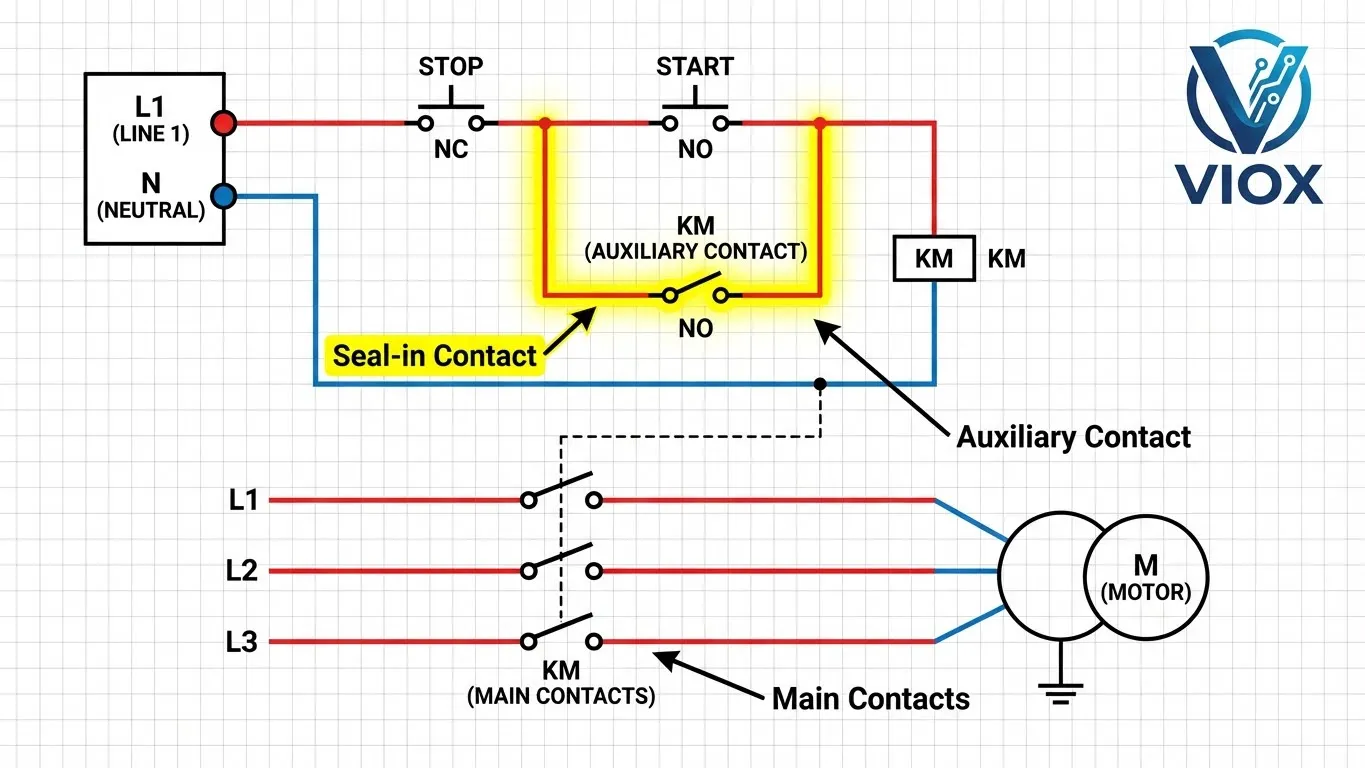
Unlike a maintained-contact switch, 3-wire control uses momentary-contact push buttons (START and STOP) in combination with a contactor’s auxiliary contact to create a self-maintaining circuit. Here’s the step-by-step operation:
Step 1 – Operator Initiation: When an operator presses the START button (a normally-open momentary contact), it closes temporarily, allowing current to flow to the contactor coil.
Step 2 – Electromagnetic Engagement: The energized coil creates a magnetic field that pulls in the contactor’s armature, simultaneously closing both the main power contacts (feeding the motor) and an auxiliary contact mounted on the contactor.
Step 3 – The “Holding” Action: This auxiliary contact, wired in parallel with the START button, creates an alternative current path to the coil. Even when the operator releases the START button (and it springs back open), current continues flowing through the auxiliary contact, keeping the coil energized.
Step 4 – Controlled Shutdown: Pressing the STOP button (a normally-closed contact wired in series) breaks the circuit. The coil de-energizes, springs push the contacts open, and the auxiliary contact opens—breaking the seal-in path. The system requires a deliberate START action to operate again.
The “Ghost Finger” Concept
Industrial engineers often describe the auxiliary contact as a “ghost finger”—an invisible presence that continues “pressing” the START button after you release it. This isn’t magic; it’s precision-engineered mechanical linkage. The auxiliary contact block physically attaches to the contactor’s moving armature, guaranteeing that it operates in lockstep with the main contacts.
Why Contactors Are Essential
Simple relays cannot reliably provide this function in industrial applications. Contactors are purpose-built for:
- High current switching: Main contacts rated for motor starting currents (often 6-10x running current)
- Arc suppression: Specialized contact materials and arc chutes that safely extinguish switching arcs
- Mechanical durability: Rated for millions of operations under full load
- Auxiliary contact blocks: Standardized mounting systems for adding multiple control contacts
3-wire control systems dominate industrial applications including CNC machines, conveyor systems, industrial mixers, compressors, and any application where unexpected equipment startup creates personnel hazards.
The Critical Safety Difference: Low Voltage Protection
Low voltage protection (LVP), also called undervoltage protection, represents the fundamental safety advantage of 3-wire control systems. This feature prevents automatic equipment restart following power interruptions or voltage sags—a capability mandated by international safety standards and codified in law.
Understanding the Automatic Restart Hazard
Consider this real-world scenario that OSHA investigates repeatedly:
A maintenance technician is servicing a large industrial mixer. Following proper lockout/tagout procedures seems cumbersome for a “quick adjustment,” so he simply turns off the mixer at its control station. While his arm is inside the mixing chamber adjusting a scraper blade, an electrical fault trips a breaker elsewhere in the facility. When maintenance resets that breaker, power surges back through the facility.
In a 2-wire system: The mixer’s switch remained in the “ON” position throughout the outage. Power restoration means immediate motor restart. The mixer’s 30-horsepower motor instantly energizes, rotating the mixing paddle at full speed. The results are catastrophic.
In a 3-wire system: When power failed, the contactor coil de-energized and springs opened all contacts—including the seal-in auxiliary contact. Even though the START button might still be depressed or stuck, the seal-in path is broken. Power restoration energizes nothing. The technician completes his work safely, exits the mixer, and deliberately presses START to resume operation.
Regulatory Requirements
Safety regulations worldwide recognize this hazard and mandate low voltage protection:
OSHA 1910.213(b)(3) specifically addresses woodworking machinery: “On applications where injury to the operator might result if motors were to restart after power failures, provision shall be made to prevent machines from automatically restarting upon restoration of power.”
NFPA 79 Section 7.5.3 (Electrical Standard for Industrial Machinery, 2015 Edition) states: “Upon restoration of the voltage or upon switching on the incoming supply, automatic or unintentional restarting of the machine shall be prevented when such a restart can cause a hazardous condition.” The standard’s Annex A clarifies: “The principal objective of this device is to prevent automatic restarting of the equipment.”
IEC 60947-4-1 (Low-voltage switchgear and controlgear) establishes international standards for contactor design, including requirements for mechanically-linked auxiliary contacts that ensure reliable seal-in circuit operation.
Real-World Accident Prevention
Industrial safety records demonstrate the effectiveness of 3-wire control. Facilities that retrofit older 2-wire equipment with contactor-based 3-wire systems report dramatic reductions in restart-related incidents. The Canadian Electrical Code Part 1, Section 28-312 reinforces this, requiring low-voltage protection “when automatic restarting is liable to create a hazard.”
The physics is simple: a de-energized contactor coil cannot hold contacts closed. Spring pressure—a passive mechanical force requiring no electrical power—ensures contacts open during any power interruption. This fail-safe design means that component failure, power loss, voltage sag, or phase imbalance all result in the safe state: equipment shutdown requiring deliberate operator action to restart.
Technical Comparison: 2-Wire vs 3-Wire Control Systems
| Feature | 2-Wire Control | 3-Wire Control |
|---|---|---|
| Control Method | Maintained contact switch (toggle, selector) | Momentary contact buttons (START/STOP) with contactor |
| Device Type | Mechanical switch with latching mechanism | Electromagnetic contactor with auxiliary contacts |
| Automatic Restart After Power Loss | YES – Equipment restarts immediately when power returns if switch remained “ON” | NO – Requires deliberate START button press after power restoration |
| Low Voltage Protection | None – Switch position independent of voltage | Built-in – Coil de-energizes below ~70% rated voltage |
| Safety Level | Minimal – Suitable only for non-hazardous applications | High – Meets OSHA, NFPA, and IEC safety standards |
| Typical Applications | Lighting, HVAC, residential equipment, small pumps | Industrial motors, machinery, manufacturing equipment, any hazardous application |
| Standards Compliance | Does not meet industrial safety requirements | Compliant with OSHA 1910.213(b)(3), NFPA 79, IEC 60947-4-1 |
| Initial Cost | Lower – Simple switch and wiring | Higher – Requires contactor, push button station, additional wiring |
| Maintenance Requirements | Minimal – Mechanical switch contacts wear over time | Moderate – Contactor contacts require periodic inspection |
| Operator Action Required After Power Interruption | None – Automatic restart | Manual START button press required – prevents unexpected operation |
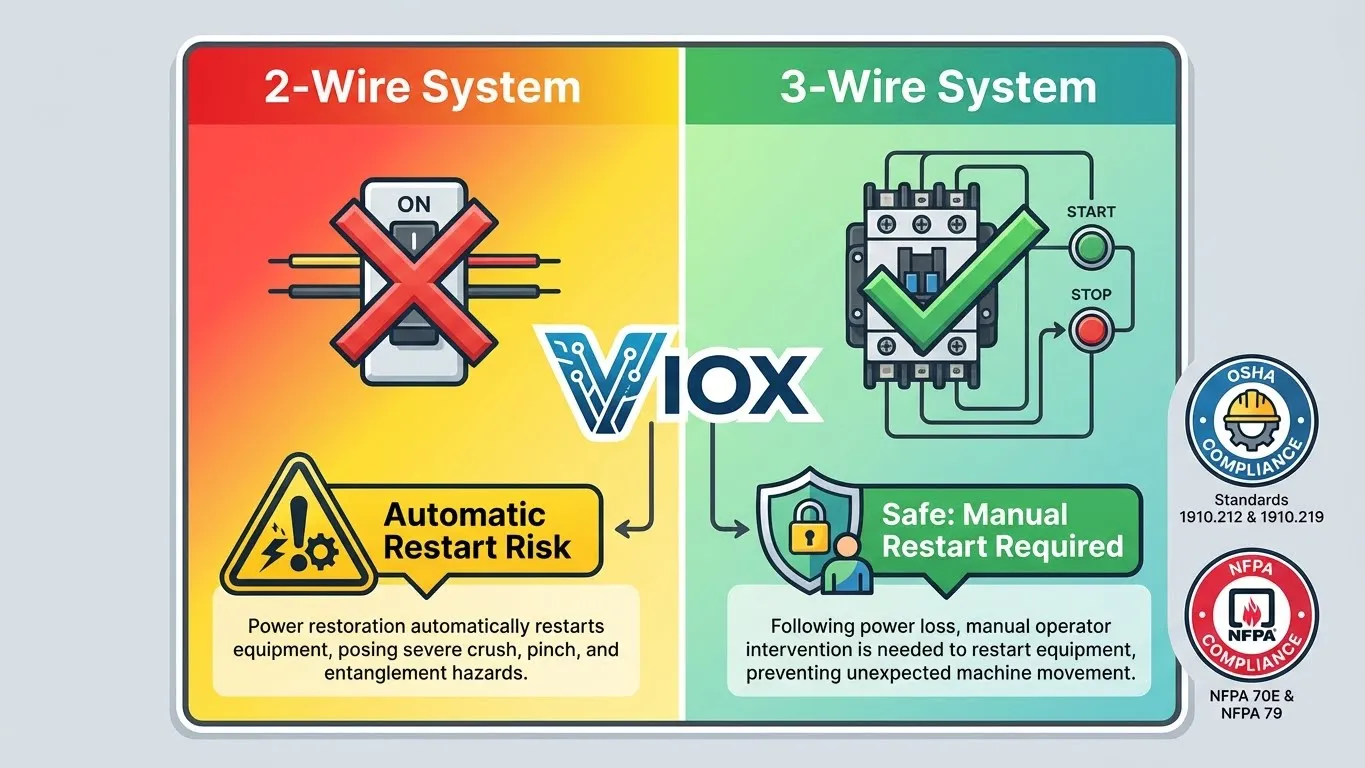
This comparison reveals why industrial electrical codes universally mandate 3-wire control for hazardous applications. The marginal cost increase provides exponential safety improvements, transforming potential fatal accidents into controlled shutdowns requiring deliberate human intervention.
How Contactors Enable 3-Wire Control
Understanding contactor anatomy explains why these devices are irreplaceable in industrial safety systems. Unlike simple switches that mechanically latch, contactors combine electromagnetic actuation with precision-engineered contact systems.
Contactor Anatomy
Electromagnetic Coil: The heart of the contactor, this copper winding creates a magnetic field when energized. Coils are available in various voltage ratings (24VAC, 120VAC, 230VAC, 480VAC, etc.) to match control circuit requirements.
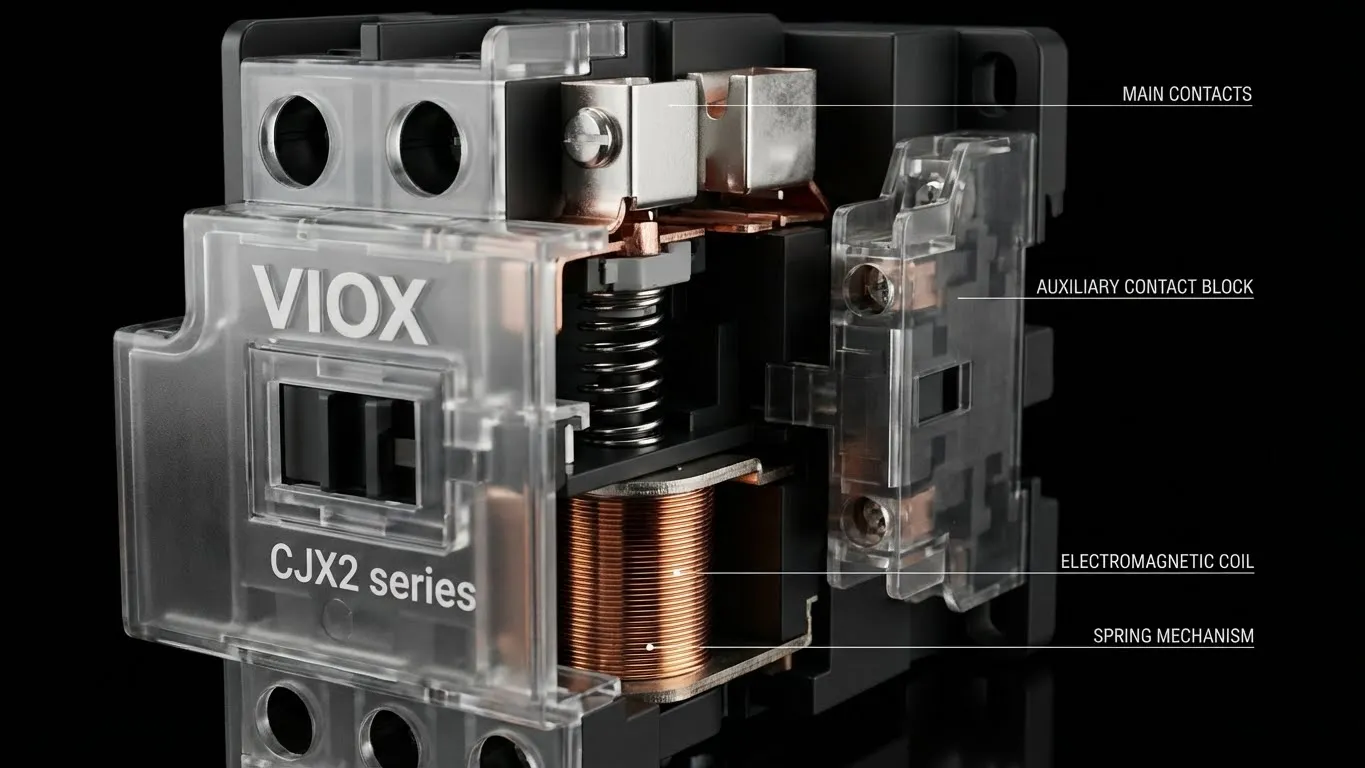
Movable Armature: A spring-loaded iron core that moves when attracted by the coil’s magnetic field. Springs ensure the armature returns to the open position when coil power is removed—the fail-safe mechanism that enables low voltage protection.
Main Power Contacts: Heavy-duty contacts rated for motor starting currents. Typically three-pole (3-phase) or single-pole configurations. These contacts use silver-cadmium oxide or tungsten alloys that resist welding under arc conditions. Contact pressure exceeds 100 Newtons in industrial contactors to minimize resistance and heat generation.
Auxiliary Contact Blocks: Separate contact assemblies mechanically linked to the main contact movement. These provide the control contacts for seal-in circuits, interlocking, and signaling functions. Auxiliary contacts are rated for control circuit currents (typically 5-10A) rather than motor loads.
The Self-Locking Mechanism
The auxiliary contact serves as the “memory” of the system. When the START button momentarily energizes the coil, the auxiliary contact closes and creates a parallel path around the START button. This parallel path maintains coil energization after the START button is released. Critically, this auxiliary contact is mechanically linked to the main contacts—if the main contacts fail to close fully (due to welding or mechanical failure), the auxiliary contact provides feedback, potentially triggering safety interlocks.
NEMA vs IEC Contactor Standards
NEMA (North American) contactors feature built-in service factors, meaning a NEMA Size 1 contactor rated for 27A can handle occasional overloads. Auxiliary contacts are typically top-mounted add-on blocks. NEMA contactors excel in applications requiring robust overload capacity.
IEC (International Electrotechnical Commission) contactors are more precisely sized to the application, requiring detailed knowledge of motor full-load current and duty cycle. Auxiliary contacts may be built-in or add-on blocks depending on the frame size. IEC contactors generally offer faster overload response and more compact dimensions.
VIOX CJX2 Series: Engineered for Reliability
The VIOX CJX2 series AC contactors exemplify modern contactor design, incorporating both NEMA robustness and IEC precision. Standard configurations include one built-in auxiliary contact (1NO or 1NC) specifically designed for seal-in applications. Side-mounted auxiliary contact blocks allow expansion to 4NO+4NC contacts for complex control requirements. Silver alloy main contacts ensure reliable switching through millions of cycles, while the compact DIN-rail mounting system simplifies panel integration.
Industry Applications Requiring 3-Wire Control
OSHA and NFPA standards mandate 3-wire control with low voltage protection across numerous industrial sectors where unexpected equipment startup poses injury or death risks:
Woodworking Machinery: Table saws, jointers, planers, band saws, and spindle shapers must prevent automatic restart per OSHA 1910.213(b)(3). The high rotational speeds and exposed cutting surfaces create immediate amputation hazards if equipment energizes unexpectedly.
Metalworking Equipment: Lathes, milling machines, press brakes, and grinders require 3-wire control. These machines process materials under extreme force, and unexpected startup can launch workpieces as projectiles or trap operators between moving components.
Conveyor Systems: Material handling conveyors in warehouses, manufacturing, and distribution centers use contactors to prevent unexpected belt movement when personnel perform maintenance or clear jams. The distributed nature of conveyor systems means power restoration after maintenance could affect multiple zones simultaneously.
Industrial Pumps and Compressors: Process industry equipment handling hazardous fluids or high-pressure gases requires controlled startup sequences. 3-wire control ensures operators can verify system readiness before energizing equipment, preventing process upsets, valve damage, or pressure excursions.
Manufacturing Assembly Lines: Automated production equipment, robotic cells, and assembly machinery integrate 3-wire control into comprehensive safety systems. Emergency stop circuits, safety interlocks, and guard monitoring all depend on contactor-based control to ensure fault conditions require operator intervention before restart.
HVAC and Building Systems: While smaller residential HVAC uses 2-wire control, large commercial and industrial systems serving critical environments (hospitals, data centers, clean rooms) employ 3-wire control to prevent compressor damage from voltage fluctuations and ensure controlled restart sequences after power events.
The common thread: any application where an operator might reasonably be in proximity to hazardous motion, cutting surfaces, or process materials during a power interruption requires automatic restart prevention—making industrial contactors non-negotiable safety components.
VIOX Contactor Solutions: Engineering Safety into Every Connection
VIOX Electric has established itself as a trusted global supplier of industrial contactors engineered to meet the most demanding safety and reliability requirements. Our product line reflects decades of manufacturing expertise and commitment to international quality standards.
VIOX CJX2 Series AC Contactors
The CJX2 series represents our flagship contactor line, available in frame sizes from 9A to 95A (AC-3 duty), covering motor applications from 4kW to 45kW at 400VAC three-phase. Key features include:
- Built-in auxiliary contacts: Every CJX2 contactor includes at least one auxiliary contact (1NO or 1NC) specifically for seal-in circuit applications
- Expandable auxiliary blocks: Side-mount and front-mount auxiliary contact modules allow system integrators to add up to 4NO+4NC contacts for complex interlocking and signaling requirements
- Universal coil voltage range: Available in AC coils (24V, 36V, 110V, 220V, 380V, 660V) and DC coils (24V, 110V, 220V) to accommodate diverse control systems
- High mechanical endurance: Rated for 10 million mechanical operations, ensuring decades of reliable service in continuous-duty applications
- Silver alloy contacts: Main contacts use AgCdO or AgSnO2 alloys providing superior arc resistance and extended electrical life
Complete Control Station Solutions
VIOX recognizes that contactors represent one component of comprehensive motor control systems. Our XB2 series push button stations provide ergonomic, IP65-rated operator interfaces perfectly matched to CJX2 contactors. Standard configurations include:
- Momentary START buttons (green, normally-open)
- Momentary STOP buttons (red, normally-closed, mushroom head for emergency applications)
- Selector switches for mode selection
- Indicator lamps for status signaling
These control stations mount directly to machine frames or remote operator panels, with modular designs allowing custom configurations without special tooling.
Global Compliance and Certifications
VIOX products carry essential international certifications:
- CE marking: Compliance with EU Low Voltage Directive and EMC Directive
- IEC 60947-4-1: Contactor performance and safety standards
- CCC certification: China Compulsory Certificate for domestic and Asian markets
- UL recognition: Select products carry UL listing for North American applications
B2B Partnership Excellence
As a specialized B2B manufacturer, VIOX supports electrical panel builders, machine manufacturers, and system integrators with:
- Volume pricing: Competitive factory-direct pricing for OEM quantities
- Technical support: Application engineering assistance for control system design
- Global logistics: Established shipping partnerships ensuring reliable delivery worldwide
- Customization services: Private labeling and specification modifications for qualified partners
VIOX Electric’s commitment extends beyond component supply—we partner with our customers to engineer safety into every installation.
Frequently Asked Questions
What is the main difference between 2-wire and 3-wire control?
2-wire control uses a maintained contact switch (like a toggle switch) that stays in position regardless of power conditions, allowing automatic restart after power interruption. 3-wire control uses momentary buttons with a contactor’s auxiliary contact creating a seal-in circuit. If power fails, the contactor de-energizes and requires a deliberate START button press to operate again—preventing automatic restart hazards.
Why can’t I use a simple switch for industrial motors?
Simple switches lack low voltage protection. If a switch remains “ON” during a power failure, the motor will restart immediately when power returns—potentially while maintenance personnel are servicing the equipment. Industrial contactors with 3-wire control de-energize during power loss and require deliberate operator action to restart, meeting OSHA and NFPA safety requirements. Additionally, contactors are rated for the extreme inrush currents (6-10x running current) that occur during motor starting—standard switches would weld shut or burn out under these conditions.
What is low voltage protection in contactors?
Low voltage protection (LVP), also called undervoltage protection, is a safety feature where the contactor coil releases its contacts when supply voltage drops below approximately 70% of rated voltage. This ensures equipment shutdown during power failures, voltage sags, or phase loss conditions. Spring mechanisms in the contactor physically push contacts open when the electromagnetic coil loses holding force. This passive mechanical action provides fail-safe operation—the safe state (equipment off) requires no electrical power to maintain.
Do all contactors have auxiliary contacts?
Most industrial contactors include at least one built-in auxiliary contact, and nearly all accept add-on auxiliary contact blocks. Small contactors (9A-32A range) typically include 1NO (normally-open) auxiliary contact suitable for basic seal-in applications. Larger contactors may include 1NO+1NC or 2NO+2NC configurations. Add-on blocks mount to the side or top of the contactor, mechanically linking to the main contact movement. Always verify auxiliary contact availability when specifying contactors for 3-wire control applications—VIOX CJX2 series contactors include standard auxiliary contacts across all frame sizes.
What is a seal-in circuit?
A seal-in circuit (also called a holding circuit or latching circuit) uses an auxiliary contact parallel-wired with the START button to maintain contactor energization after the START button is released. When you press START, the contactor coil energizes and pulls in the main contacts plus the auxiliary contact. This auxiliary contact provides an alternate current path to the coil, “sealing in” the circuit. The contactor remains energized until the STOP button breaks the circuit or power fails. This design is fundamental to 3-wire control and automatic restart prevention.
Are VIOX contactors compliant with OSHA and NFPA standards?
Yes. VIOX CJX2 series contactors are designed and manufactured to IEC 60947-4-1 international standards, which align with OSHA 1910.213(b)(3) requirements for low voltage protection and NFPA 79 Section 7.5.3 automatic restart prevention mandates. When properly wired in 3-wire control configurations, VIOX contactors provide the automatic restart prevention required by industrial safety regulations. Our technical documentation includes reference control schematics showing compliant 3-wire implementations. For specific compliance questions regarding your application, VIOX technical support can provide application-specific guidance.
Conclusion: Safety Engineered into Every Operation
The evolution from simple 2-wire switches to intelligent 3-wire contactor control represents one of industrial safety’s most significant advances. While the cost difference between a basic toggle switch and a properly specified contactor system might seem substantial, this investment purchases something priceless: the certainty that power interruptions won’t transform into personnel injuries.
Every industrial facility manager, electrical contractor, and machine builder faces a fundamental choice: specify control systems that merely switch power, or engineer systems that actively prevent accidents. The regulatory landscape—OSHA, NFPA, IEC—has made this choice explicit. 3-wire control with low voltage protection isn’t a recommendation; it’s a requirement wherever unexpected equipment startup poses hazards.
VIOX Electric engineers contactors with this safety imperative as our foundational principle. Our CJX2 series represents more than electromagnetic switching devices; they’re precision-engineered safety systems designed to fail safe, operate reliably through millions of cycles, and integrate seamlessly into comprehensive motor control applications. When you specify VIOX contactors, you’re not just purchasing components—you’re partnering with a manufacturer committed to protecting your personnel and your liability exposure.
Industrial automation will continue advancing, but the fundamental physics of contactor safety remains constant: spring pressure defeats electromagnetic force when coil power fails. This elegant fail-safe mechanism has prevented countless accidents since its adoption. By understanding the critical differences between 2-wire and 3-wire control, you’re equipped to specify, install, and maintain motor control systems that meet both regulatory requirements and the higher standard of protecting human life.
Ready to upgrade your facility’s motor control systems to industry-leading safety standards? Contact VIOX Electric today for technical consultation on contactor selection, control system design, and compliance verification. Our engineering team provides application-specific guidance ensuring your installations meet all relevant safety standards while optimizing performance and reliability. Visit viox.com or reach out to our technical support team—because in industrial electrical systems, safety isn’t optional.