

Trên trang này
Câu trả lời nhanh: So sánh cấp bảo vệ NEMA và IP
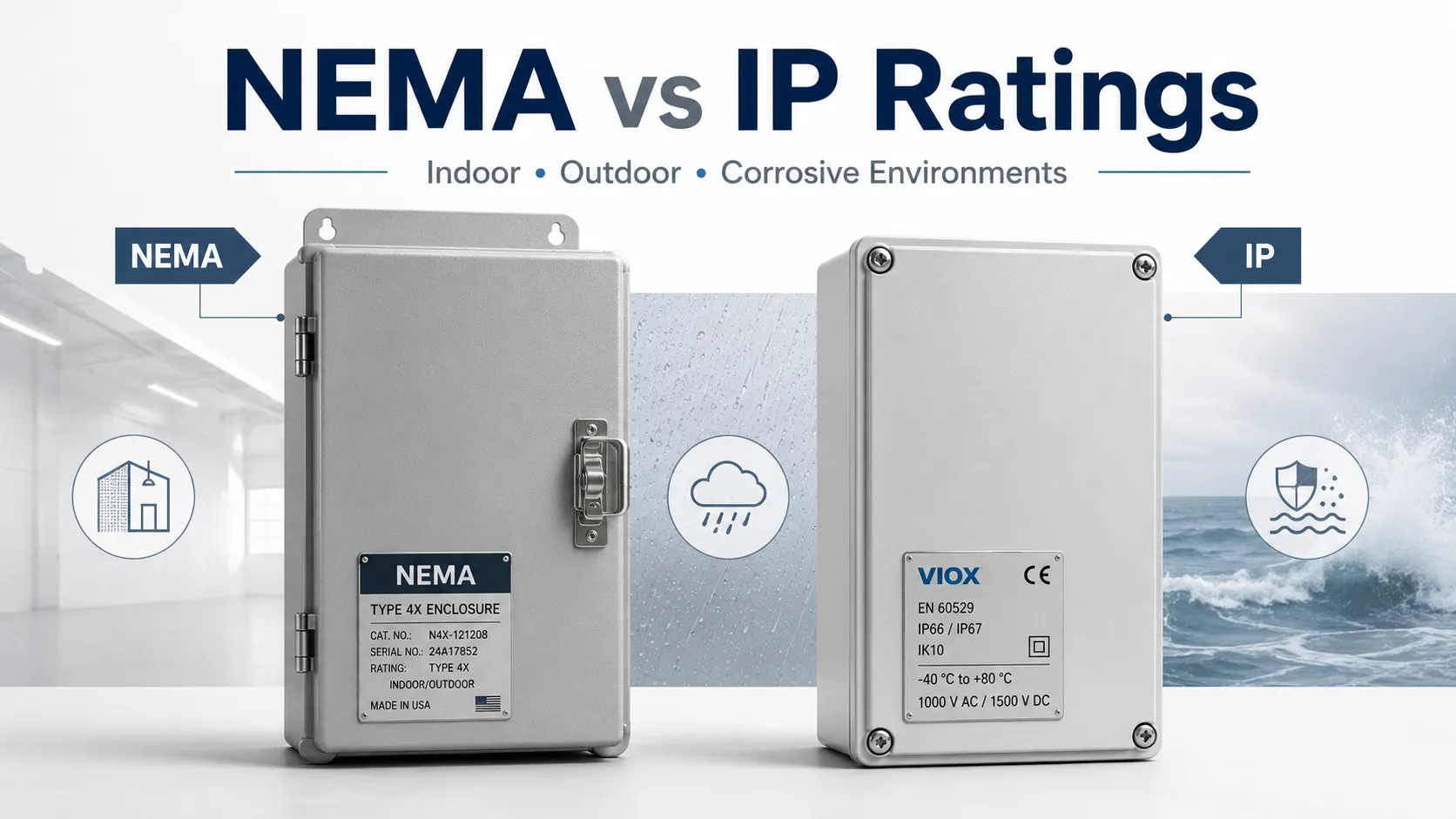
Cả cấp bảo vệ NEMA và IP đều mô tả khả năng bảo vệ của vỏ tủ điện, nhưng chúng không đo lường chính xác cùng một tiêu chí. Cấp bảo vệ IP, dựa trên tiêu chuẩn IEC 60529, tập trung vào khả năng bảo vệ chống lại vật thể rắn và sự xâm nhập của nước. Các loại vỏ tủ điện NEMA, dựa trên tiêu chuẩn NEMA 250 và thường được sử dụng ở Bắc Mỹ, bao gồm khả năng chống xâm nhập cùng với các điều kiện môi trường bổ sung như ăn mòn, hình thành băng bên ngoài, dầu, chất làm mát và tính phù hợp khi lắp đặt trong nhà hoặc ngoài trời.
Quy tắc quan trọng nhất là: NEMA sang IP có thể được sử dụng như một tham chiếu tối thiểu về khả năng chống xâm nhập, nhưng IP sang NEMA không thể được coi là một sự chuyển đổi tương đương. Ví dụ, một vỏ tủ điện được đánh dấu NEMA 4X thường được đối chiếu với IP66 về khả năng chống bụi và nước, nhưng một vỏ tủ điện IP66 không mặc định là NEMA 4X vì IP66 không chứng minh được khả năng chống ăn mòn.
Đối với khách hàng của VIOX khi lựa chọn vỏ tủ điện, hộp đấu nối, tủ phân phối hoặc hộp kết hợp PV, cấp bảo vệ phù hợp phụ thuộc vào môi trường thực tế: bụi trong nhà, mưa ngoài trời, nước rửa trôi, không khí muối, hơi hóa chất, dầu máy, tiếp xúc với tia UV, chu kỳ nhiệt độ và vật liệu của chính vỏ tủ điện đó.
So sánh nhanh xếp hạng NEMA và IP
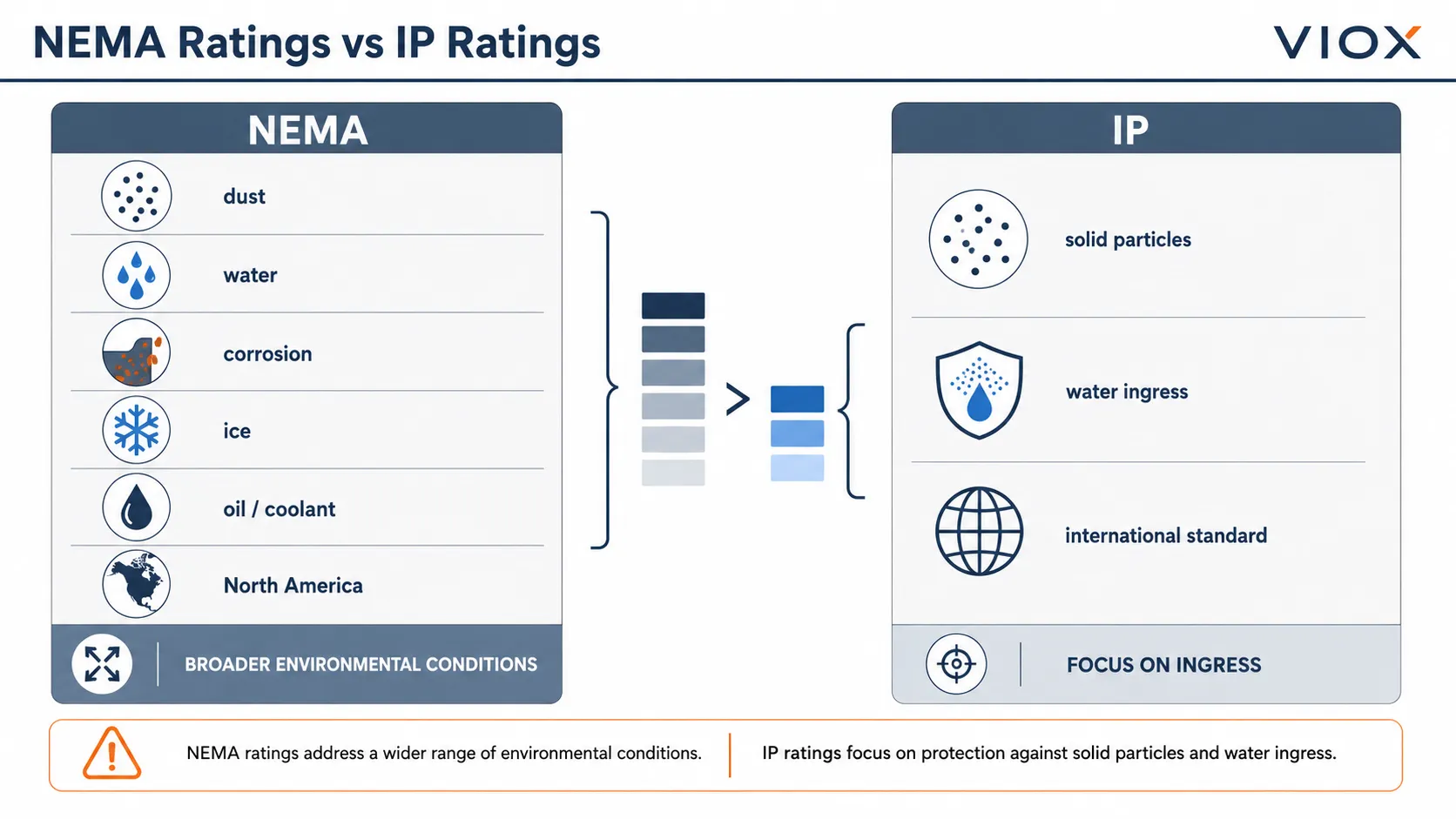
| Tố | Xếp hạng NEMA | Xếp hạng IP |
|---|---|---|
| Tiêu chuẩn chính | các loại vỏ bọc NEMA 250 | Mã IP theo tiêu chuẩn IEC 60529 |
| Thị trường chính | Bắc Mỹ | Thị trường quốc tế |
| Trọng tâm bảo vệ | Sự xâm nhập và các điều kiện môi trường | Vật thể rắn và sự xâm nhập của nước |
| Chống bụi | Được bao gồm trong định nghĩa loại | Chữ số đầu tiên, từ 0 đến 6 |
| Bảo vệ nước | Được bao gồm trong định nghĩa loại | Chữ số thứ hai, từ 0 đến 9 hoặc 9K tùy thuộc vào ngữ cảnh tiêu chuẩn |
| Khả năng chống ăn mòn | Được bao gồm trong các loại cụ thể như 4X | Không được bao gồm trong mã IP cơ bản |
| Sự hình thành băng | Được đề cập trong một số loại NEMA | Không được bao gồm trong mã IP cơ bản |
| Dầu hoặc chất làm mát | Được đề cập trong các loại như 12 và 13 | Không được bao gồm trong mã IP cơ bản |
| Chuyển đổi | Có thể cung cấp một tham chiếu IP tối thiểu | Không thể tự chứng minh loại NEMA |
| Sử dụng tốt nhất | Các dự án điện tại Bắc Mỹ, môi trường công nghiệp, các ứng dụng ăn mòn hoặc cần rửa trôi | Thiết bị toàn cầu, các dự án dựa trên tiêu chuẩn IEC, bảng dữ liệu sản phẩm, thiết bị xuất khẩu |
Xếp hạng vỏ tủ điện NEMA là gì?
NEMA là viết tắt của National Electrical Manufacturers Association (Hiệp hội các nhà sản xuất điện quốc gia). Xếp hạng vỏ tủ điện NEMA phân loại cách thức một vỏ tủ bảo vệ nhân viên và thiết bị bên trong khỏi các điều kiện môi trường. Các xếp hạng này được định nghĩa trong tiêu chuẩn NEMA 250 và được sử dụng rộng rãi tại Hoa Kỳ và Canada.
Xếp hạng NEMA không chỉ là nhãn dán về bụi và nước. Tùy thuộc vào loại, chúng có thể giải quyết các vấn đề:
- sử dụng trong nhà hoặc ngoài trời
- bụi rơi
- nước nhỏ giọt
- mưa, mưa tuyết và tuyết
- bụi do gió thổi
- nước phun từ vòi
- khả năng chống ăn mòn
- sự hình thành băng bên ngoài
- tiếp xúc với dầu hoặc chất làm mát
- ngâm trong nước tạm thời hoặc kéo dài
- các ứng dụng tại vị trí nguy hiểm trong các bối cảnh phân loại riêng biệt
Đây là lý do tại sao các tiêu chuẩn NEMA phổ biến trong các bảng điều khiển công nghiệp, tủ điện, thiết bị phân phối, hộp đấu nối ngoài trời, nhà máy xử lý nước thải, khu vực chế biến thực phẩm, xưởng máy và các tài liệu kiểm định tại Bắc Mỹ.
Để có bảng phân tích chi tiết về các loại NEMA, hãy xem VIOX Hướng dẫn xếp hạng vỏ bảo vệ NEMA.
Xếp hạng IP là gì?
IP là viết tắt của Bảo vệ chống xâm nhập hay Bảo vệ Quốc tế (International Protection) trong bối cảnh của tiêu chuẩn IEC 60529. Mã IP mô tả mức độ bảo vệ do vỏ thiết bị cung cấp nhằm chống lại sự tiếp cận các bộ phận nguy hiểm, vật thể rắn lạ và nước.
Chỉ số IP thường có hai chữ số:
| Phần mã IP | Ý nghĩa | Ví dụ |
|---|---|---|
| Chữ số đầu tiên | Bảo vệ chống lại vật thể rắn và bụi | 6 trong IP66 có nghĩa là kín bụi |
| Chữ số thứ hai | Bảo vệ chống lại sự xâm nhập của nước | 6 trong IP66 có nghĩa là bảo vệ chống lại các tia nước mạnh |
Các cấp bảo vệ IP phổ biến cho vỏ tủ điện bao gồm:
| Xếp hạng IP | 实际含义 |
|---|---|
| IP20 | Bảo vệ chống chạm tay trong nhà, không chống nước |
| IP44 | Bảo vệ chống lại các vật thể rắn nhỏ và nước bắn tung tóe |
| IP54 | Chống bụi và chống nước bắn |
| IP55 | Chống bụi và chống tia nước |
| IP65 | Kín bụi và bảo vệ chống lại tia nước |
| IP66 | Kín bụi và bảo vệ chống lại tia nước áp lực mạnh |
| IP67 | Kín bụi và bảo vệ chống lại việc ngâm nước tạm thời trong các điều kiện xác định |
| IP68 | Kín bụi và được bảo vệ chống ngâm nước liên tục trong các điều kiện do nhà sản xuất quy định |
Các chỉ số IP rất hữu ích vì chúng ngắn gọn, mang tính quốc tế và dễ đọc. Tuy nhiên, chúng không phản ánh đầy đủ về đặc tính của vỏ tủ điện. Một chỉ số IP66 tự thân nó không nói lên được khả năng chống phun muối, cấp độ thép không gỉ, thành phần hóa học của gioăng, khả năng chống lão hóa do tia UV, khả năng kháng dầu, hoặc liệu vỏ tủ đó có đáp ứng tiêu chuẩn NEMA 4X của Bắc Mỹ hay không.
Bảng đối chiếu NEMA sang IP: Hữu ích nhưng còn hạn chế
Nhiều kỹ sư sử dụng các bảng đối chiếu NEMA sang IP. Chúng rất hữu ích, nhưng chỉ khi được sử dụng đúng cách.
| Loại NEMA | Chỉ số IP tối thiểu thông dụng | Lưu ý thực tế |
|---|---|---|
| NEMA 1 | Tham chiếu cho thiết bị trong nhà kiểu IP10 hoặc IP20 | Chỉ dùng cho mục đích chung trong nhà; không phải là vỏ tủ kín bụi hoặc kín nước dùng ngoài trời |
| NEMA 3R | Tham chiếu chống mưa kiểu IP14 | Bảo vệ chống mưa ngoài trời, nhưng không tương đương với khả năng chống bụi hoàn toàn hoặc chống ăn mòn |
| NEMA 4 | Tham chiếu chống xâm nhập kiểu IP66 | Chống tia nước trực tiếp và sử dụng ngoài trời, nhưng không X Chỉ định chống ăn mòn |
| NEMA 4X | Tham chiếu chống xâm nhập kiểu IP66 | Bao gồm khả năng chống ăn mòn trong bối cảnh NEMA; tiêu chuẩn IP66 đơn thuần thì không |
| NEMA 6 | Tham chiếu chống ngâm nước kiểu IP67 | Các điều kiện ngâm nước phải được kiểm tra |
| NEMA 6P | Tham chiếu ngâm nước theo tiêu chuẩn IP68 | Độ sâu và thời gian phải được nhà sản xuất quy định |
| NEMA 12 | Tham chiếu trong nhà theo tiêu chuẩn IP52/IP54 | Cần kiểm tra các yếu tố bụi trong nhà, chất lỏng không ăn mòn nhỏ giọt, dầu/chất làm mát |
| NEMA 13 | Tham chiếu trong nhà theo tiêu chuẩn IP54 | Tiếp xúc với dầu và chất làm mát là lý do chính để sử dụng loại này |
Bảng này nên được hiểu là một tài liệu tham khảo kỹ thuật chung, không thay thế cho chứng nhận. Phương pháp thử nghiệm chính xác, kết cấu vỏ tủ, gioăng đệm, vật liệu và nhãn mác phải do nhà sản xuất vỏ tủ cung cấp.
Tại sao IP66 không tương đương với NEMA 4X
Đây là sai lầm phổ biến nhất khi lựa chọn.
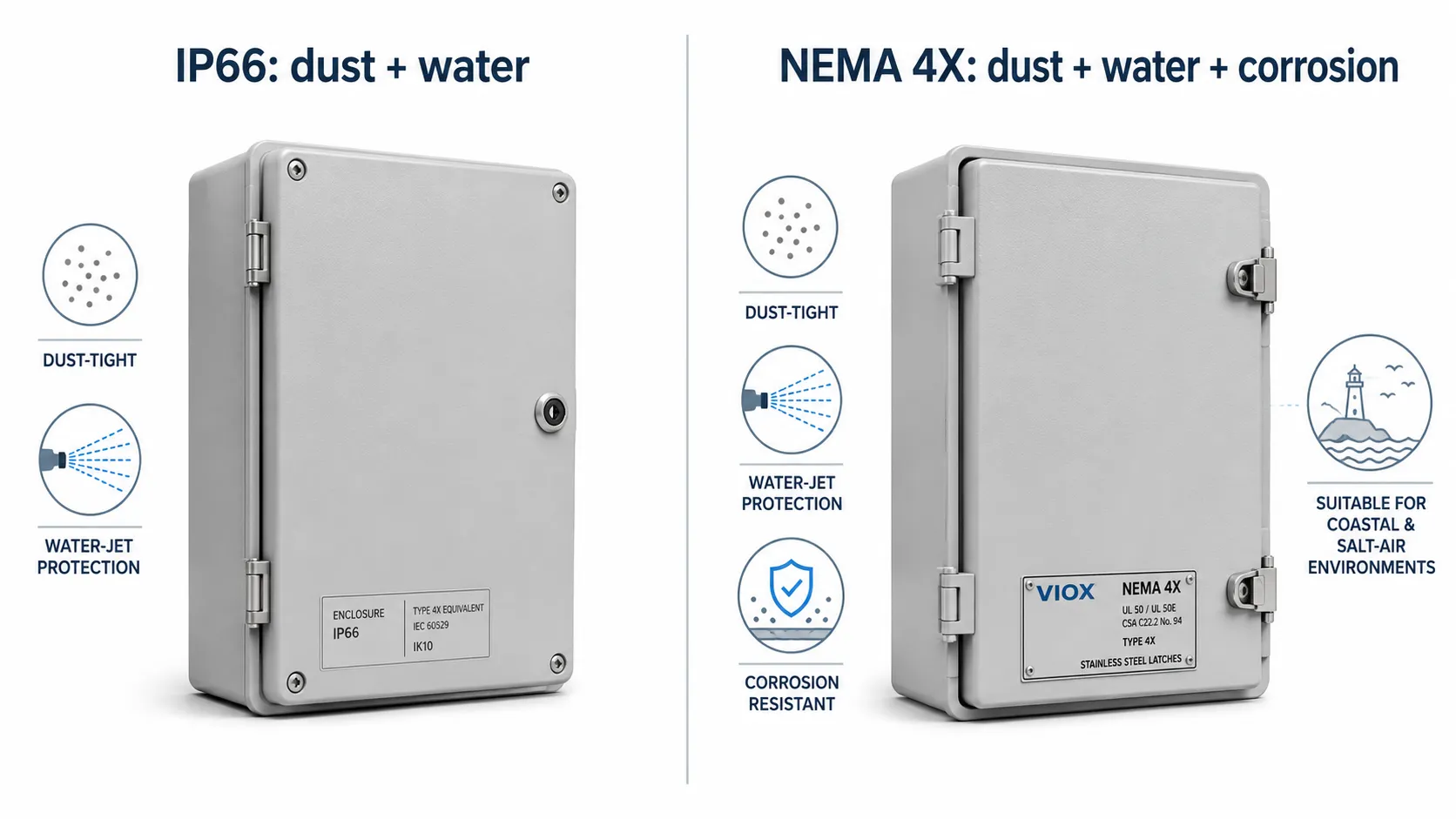
IP66 có nghĩa là vỏ tủ kín bụi và được bảo vệ chống lại các tia nước mạnh theo thử nghiệm IEC 60529. Điều đó hữu ích, nhưng không tự động chứng minh rằng vỏ tủ có khả năng chống ăn mòn.
NEMA 4X bao gồm khả năng bảo vệ liên quan đến hiệu suất ngoài trời và khả năng chịu rửa trôi của NEMA 4, cộng thêm khả năng chống ăn mòn bổ sung. X là phần mà nhiều người mua bỏ lỡ. Nếu một dự án ven biển, nhà máy hóa chất, khu xử lý nước thải hoặc khu vực rửa trôi thực phẩm yêu cầu NEMA 4X, thì vỏ tủ IP66 vẫn có thể không được chấp nhận trừ khi khả năng chống ăn mòn được chứng minh bằng tài liệu riêng.
Quy tắc thực tế:
| Yêu cầu | Cách hiểu an toàn hơn |
|---|---|
| Thông số kỹ thuật yêu cầu IP66 | Chọn vỏ tủ điện đã được kiểm nghiệm về khả năng chống bụi và chống tia nước áp lực cao |
| Thông số kỹ thuật yêu cầu NEMA 4 | Không thay thế bằng IP66 trừ khi dự án chấp nhận tài liệu IP và các giả định về môi trường tương thích |
| Thông số kỹ thuật yêu cầu NEMA 4X | Không chỉ sử dụng IP66; cần xác minh vật liệu chống ăn mòn và tài liệu NEMA/UL/Bắc Mỹ |
| Thông số kỹ thuật yêu cầu IP66 + môi trường ven biển | Xử lý vấn đề ăn mòn như một yêu cầu riêng biệt về vật liệu và hoàn thiện bề mặt |
Đối với các dự án quốc tế, một vỏ tủ điện có nhãn kép như NEMA 4X / IP66 có thể đơn giản hóa tài liệu, nhưng chỉ khi nhà sản xuất có thể cung cấp bằng chứng định mức thực tế cho mẫu sản phẩm được cung cấp.
Môi trường trong nhà: Không nên quy định quá mức cần thiết
Không phải vỏ tủ điện nào cũng cần đạt chuẩn NEMA 4X hoặc IP66. Trong các phòng điện sạch trong nhà, tủ điều khiển, không gian máy móc ít bụi hoặc môi trường không yêu cầu xịt rửa, việc sử dụng cấp bảo vệ ngoài trời cao có thể làm tăng chi phí, kích thước, khả năng giữ nhiệt và độ phức tạp khi lắp đặt mà không mang lại lợi ích gì cho dự án.
Các lựa chọn thông thường trong nhà:
| Môi trường | Hướng dẫn về cấp bảo vệ phổ biến | Ghi chú |
|---|---|---|
| Phòng điện sạch | Bảo vệ kiểu NEMA 1 hoặc IP20/IP30 | Tập trung vào bảo vệ chống chạm điện, thông gió và quản lý cáp |
| Nhà máy trong nhà có bụi | Cấp bảo vệ kiểu NEMA 12 hoặc IP54/IP55 | Kiểm tra bụi, chất lỏng nhỏ giọt và độ bền của gioăng làm kín |
| Khu vực máy móc có dầu hoặc chất làm mát | NEMA 12 hoặc NEMA 13 | Chỉ riêng cấp bảo vệ IP không bao quát được khả năng chống dầu/chất làm mát |
| Khu vực rửa trong nhà | NEMA 4 hoặc 4X, hoặc tiêu chuẩn IP66/IP69 phù hợp | Kiểm tra áp lực nước, gioăng làm kín, lỗ thoát nước và vật liệu |
Đối với tủ điều khiển trong nhà, quản lý nhiệt cũng quan trọng không kém khả năng bảo vệ chống xâm nhập. Vỏ tủ kín sẽ giữ nhiệt bên trong. Nếu các linh kiện bên trong bao gồm khởi động từ, bộ nguồn, rơ-le, cầu đấu hoặc biến tần, hãy tính toán mức tăng nhiệt độ và cân nhắc sử dụng hệ thống thông gió, quạt, bộ trao đổi nhiệt hoặc giảm tải thiết bị.
Môi trường ngoài trời: Mưa, tia UV, bụi và chu kỳ nhiệt độ
Vỏ tủ ngoài trời phải đối mặt với nhiều yếu tố hơn là chỉ nước. Mưa chỉ là một vấn đề. Một tủ điện ngoài trời thực thụ có thể còn phải đối mặt với:
- Tiếp xúc với tia cực tím
- lão hóa gioăng làm kín
- ngưng tụ hơi nước
- đóng băng và tan băng
- bụi do gió thổi
- Côn trùng
- Rò rỉ tại vị trí đi dây cáp
- Ăn mòn tại các vít và bản lề
- Giãn nở và co ngót nhiệt
Các lựa chọn điển hình cho ngoài trời:
| Điều kiện ngoài trời | Hướng định mức | Ghi chú về vật liệu |
|---|---|---|
| Tường ngoài trời có mái che | Tiêu chuẩn NEMA 3R hoặc cấp bảo vệ IP phù hợp | Có thể chỉ cần bảo vệ chống mưa nếu không có rủi ro bị xịt nước trực tiếp hoặc ăn mòn |
| Thiết bị ngoài trời lộ thiên | Tiêu chuẩn NEMA 4 hoặc cấp bảo vệ kiểu IP65/IP66 | Kiểm tra gioăng, chốt khóa, đầu vào cáp và khả năng chống tia UV |
| Môi trường ven biển hoặc môi trường hóa chất | Tiêu chuẩn NEMA 4X hoặc các biện pháp bảo vệ chống ăn mòn được kiểm chứng riêng biệt | Thép không gỉ 316 hoặc vật liệu FRP phù hợp thường được cân nhắc |
| Lắp đặt hệ thống điện mặt trời (PV) tại hiện trường | IP65/IP66, NEMA 4/4X tùy thuộc vào thị trường | Đồng thời kiểm tra các yêu cầu về tia UV, nhiệt độ, khoảng cách thành phần DC và lỗ thông hơi |
Đối với các ứng dụng VIOX PV, cấp bảo vệ của vỏ tủ phải được xem xét cùng với các thành phần DC bên trong, thiết bị chống sét lan truyền, cầu chì, bộ cách ly, cầu đấu và khả năng tản nhiệt. Tủ đấu nối điện mặt trời (PV combiner box) không chỉ đơn thuần là một lớp vỏ chống nước. Xem VIOX hộp kết hợp bối cảnh sản phẩm và hướng dẫn lựa chọn vỏ tủ đấu nối điện mặt trời (PV combiner box) để biết thêm các yếu tố thiết kế đặc thù cho điện mặt trời.
Môi trường ăn mòn: Chỉ dựa vào cấp bảo vệ là chưa đủ
Ăn mòn là nơi mà nhiều sai lầm trong việc so sánh giữa NEMA và IP trở nên đắt giá.
Một vỏ tủ điện có thể vượt qua bài kiểm tra độ kín nhưng vẫn bị hỏng sớm nếu vật liệu không phù hợp với môi trường. Không khí muối, nhà máy phân bón, xử lý nước thải, chế biến hóa chất, hóa chất tẩy rửa trong thực phẩm, phòng ắc quy và các ứng dụng hàng hải có thể tấn công vít, bản lề, chốt, lớp phủ và các bề mặt tiếp xúc của gioăng.
| Môi trường | Rủi ro chính | Logic lựa chọn tốt hơn |
|---|---|---|
| Khu vực ven biển ngoài trời | Ăn mòn do clorua | Cân nhắc sử dụng NEMA 4X, thép không gỉ 316, nhựa gia cường sợi thủy tinh (FRP) hoặc kết cấu chống ăn mòn đã được kiểm chứng |
| Khu vực tẩy rửa trong ngành thực phẩm và đồ uống | Nước, hóa chất tẩy rửa, chu kỳ vệ sinh | Kiểm tra yêu cầu NEMA 4X/IP66 hoặc yêu cầu rửa trôi, cùng với độ tương thích của gioăng và vật liệu |
| Nhà máy hóa chất | Hơi nước và sự tấn công của hóa chất | Xác minh độ tương thích của vật liệu, không chỉ riêng mã IP |
| Xử lý nước thải | Độ ẩm, khí, sự ăn mòn | Kiểm tra vật liệu vỏ tủ, ốc vít, đầu cáp và khả năng bảo vệ linh kiện bên trong |
| Khu vực ắc quy hoặc lưu trữ năng lượng | Khí ăn mòn và rủi ro về điện | Xác nhận vỏ tủ điện, hệ thống thông gió, đầu nối và các yêu cầu an toàn |
Đối với các vị trí có tính ăn mòn, không nên chấp nhận “IP66” là câu trả lời đầy đủ. Hãy yêu cầu tài liệu về vật liệu, lớp phủ, gioăng đệm, thiết bị cố định và khả năng chống ăn mòn.
Lựa chọn vật liệu: Thép, Thép không gỉ, Nhôm và Sợi thủy tinh
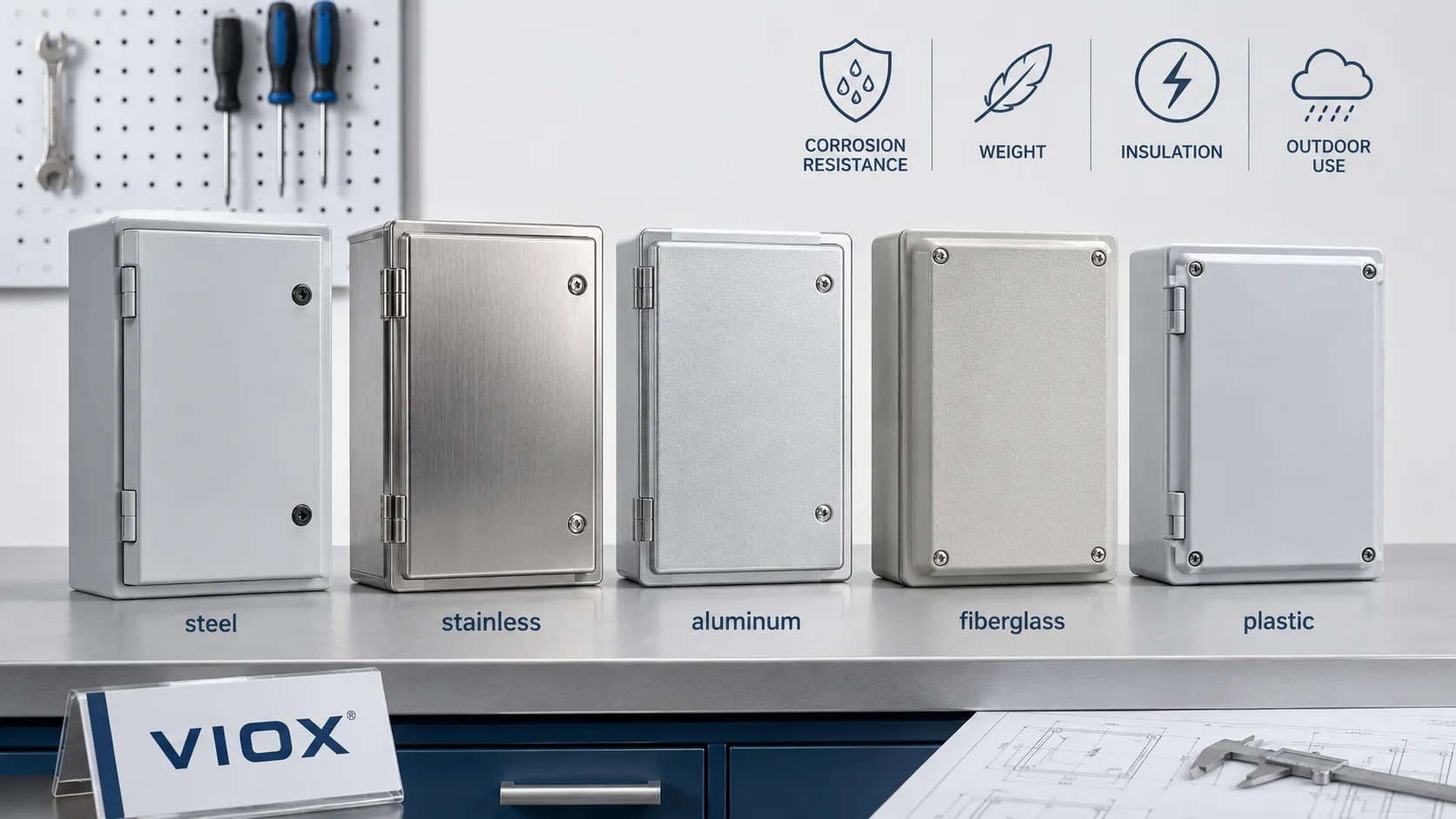
Cấp bảo vệ chỉ là một phần trong quyết định chọn vỏ tủ. Vật liệu mới là yếu tố kiểm soát độ bền, khả năng chống ăn mòn, trọng lượng, độ bền va đập, đặc tính tiếp địa và chi phí.
| Vật liệu | Điểm mạnh | Các điểm cần lưu ý |
|---|---|---|
| Thép nhẹ sơn tĩnh điện | Hiệu quả về chi phí, độ bền cao, phổ biến cho các tủ điện trong nhà | Lớp phủ bị hư hỏng có thể gây ăn mòn; không lý tưởng cho môi trường ngoài trời khắc nghiệt hoặc tiếp xúc hóa chất trừ khi được chỉ định kỹ lưỡng |
| Thép không gỉ 304 | Khả năng chống ăn mòn tốt cho nhiều môi trường công nghiệp | Có thể không đủ khả năng chống chịu đối với các điều kiện ven biển có nồng độ clorua cao hoặc môi trường hóa chất |
| Thép không gỉ 316 | Khả năng chống clorua mạnh hơn loại 304 | Chi phí cao hơn; vẫn yêu cầu gioăng, ốc vít và chất lượng gia công phù hợp |
| Nhôm | Trọng lượng nhẹ, có lớp oxit tự nhiên chống ăn mòn | Nguy cơ ăn mòn điện hóa khi tiếp xúc với các kim loại khác nhau; cần kiểm tra độ bền cơ học và lớp hoàn thiện |
| Sợi thủy tinh hoặc FRP | Phi kim loại, chống ăn mòn, cách điện | Phải xem xét công thức chống tia UV, khả năng chịu va đập và chiến lược tiếp địa |
| ABS hoặc polycarbonate | Hữu ích cho nhiều loại hộp đấu nối nhỏ gọn và tủ phân phối | Kiểm tra khả năng chống tia UV, va đập, nhiệt độ, cấp độ chống cháy và mức độ phù hợp khi lắp đặt ngoài trời |
Để biết thêm chi tiết về lựa chọn vật liệu, hãy xem VIOX hướng dẫn lựa chọn vật liệu vỏ bọc điện.
Hướng dẫn lựa chọn theo ứng dụng
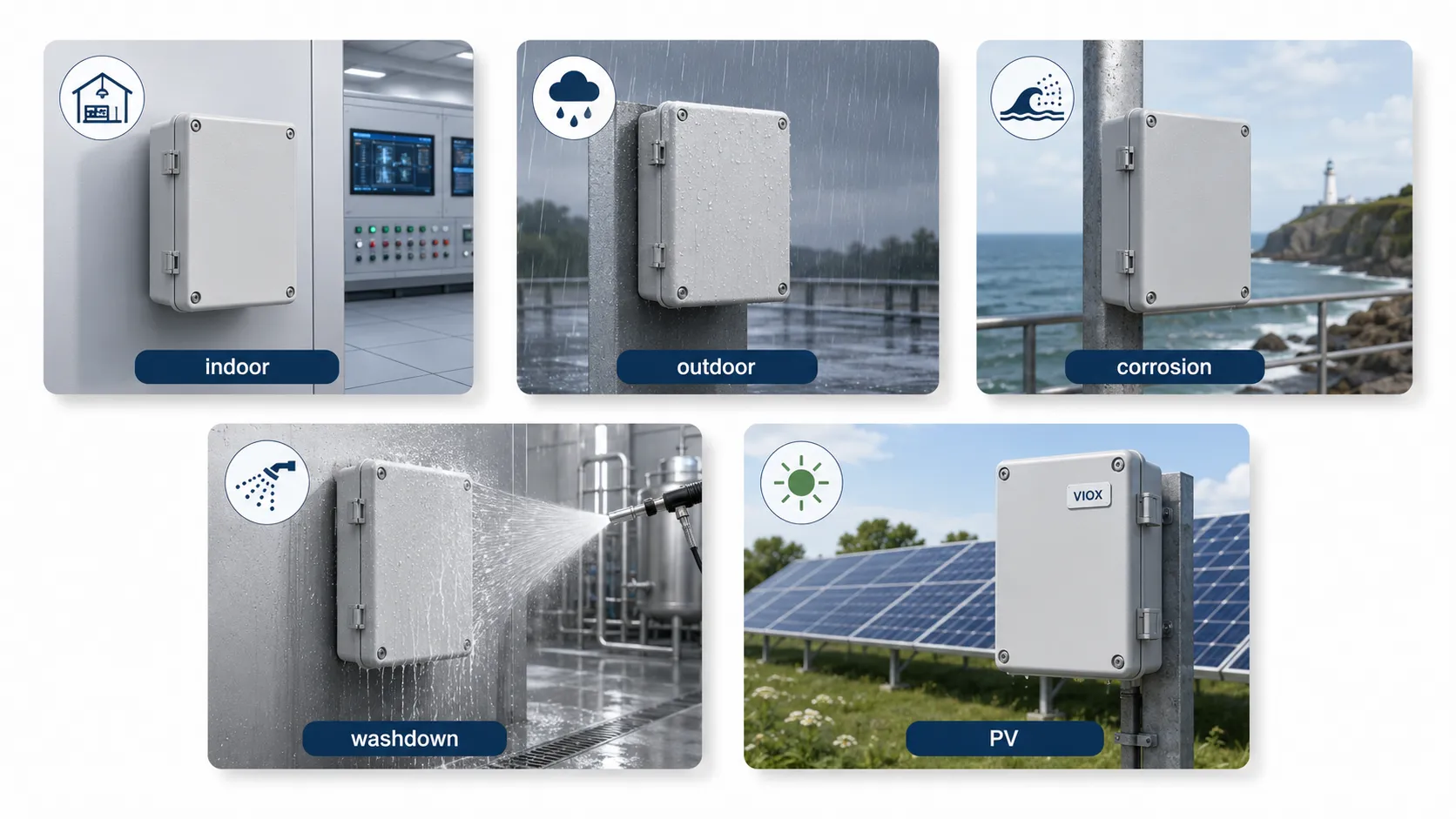
| Ứng dụng | Hướng dẫn về cấp bảo vệ phổ biến | Những điều cần kiểm tra trước khi mua |
|---|---|---|
| Tủ điện phân phối trong nhà | Tiêu chuẩn NEMA 1/12 hoặc môi trường IP20/IP54 phù hợp | Chống bụi, chống tiếp xúc, tản nhiệt bên trong, khoảng cách thanh cái |
| Hộp đấu nối ngoài trời | Tiêu chuẩn NEMA 3R/4 hoặc môi trường IP65/IP66 phù hợp | Tia UV, gioăng đệm, thoát nước, ốc siết cáp, gioăng nắp tủ |
| Hộp đấu nối chống nước | IP65/IP66/IP67/IP68 tùy thuộc vào mức độ tiếp xúc | Liệu có áp dụng tia nước, ngâm tạm thời hay ngâm liên tục hay không |
| Hộp kết hợp PV | IP65/IP66 hoặc NEMA 4/4X tùy thuộc vào thị trường | Điện áp DC, nhiệt độ, tia UV, nhiệt độ SPD/cầu chì, thông gió, đầu vào cáp |
| Vỏ tủ điện dùng cho vùng ven biển | NEMA 4X hoặc vỏ tủ điện đã được kiểm chứng khả năng chống ăn mòn | Thép không gỉ 316, nhựa gia cường sợi thủy tinh (FRP), ốc vít, mức độ tiếp xúc với muối, gioăng làm kín |
| Tủ điện dùng trong môi trường rửa trôi thực phẩm | Bối cảnh NEMA 4X hoặc tiêu chuẩn IP chống nước rửa trôi | Hóa chất tẩy rửa, bề mặt nhẵn, cấp thép không gỉ, gioăng đệm |
| Hộp điều khiển máy công cụ | Bối cảnh NEMA 12/13 hoặc tiêu chuẩn IP54/IP55 phù hợp | Dầu, dung dịch làm mát, bụi, các đầu nối bên trong, lối tiếp cận bảo trì |
| Hộp đặt ngầm hoặc hộp chìm dưới nước | Bối cảnh NEMA 6/6P hoặc IP67/IP68 | Độ sâu, thời gian, áp suất, làm kín cáp, sự ngưng tụ hơi nước |
Để lựa chọn sản phẩm chống nước, hãy xem VIOX hộp đấu nối chống nước các tùy chọn. Để biết thêm thông tin về cấp bảo vệ của hộp, hãy xem các loại cấp bảo vệ của hộp đấu nối.
Các lỗi đặc tả phổ biến
Sai lầm 1: Coi NEMA và IP là các tiêu chuẩn tương đương
Chúng có sự chồng chéo nhưng không tương đương nhau. IP chủ yếu là mã bảo vệ chống xâm nhập. NEMA bao gồm các điều kiện môi trường bổ sung trong các loại cụ thể.
Sai lầm 2: Thay thế NEMA 4X bằng IP66
IP66 không chứng minh được khả năng chống ăn mòn. Nếu dự án yêu cầu NEMA 4X, hãy yêu cầu NEMA 4X hoặc tài liệu chứng minh khả năng chống ăn mòn tương đương được cơ quan quản lý dự án chấp thuận.
Sai lầm 3: Bỏ qua các vị trí đi dây cáp
Cấp bảo vệ của vỏ tủ điện có thể bị phá hỏng bởi việc chọn sai ốc siết cáp, đầu nối ống luồn dây, van thông hơi, nút xả nước hoặc miếng bịt lỗ chờ. Toàn bộ hệ thống lắp ráp phải duy trì được cấp bảo vệ theo thiết kế.
Sai lầm 4: Chỉ lựa chọn dựa trên yếu tố mưa
Môi trường ngoài trời không chỉ có mưa. Tia UV, sự ngưng tụ hơi nước, nhiệt độ, băng giá, bụi bẩn, côn trùng, muối và các hóa chất có thể là những yếu tố quan trọng hơn cả tia nước.
Sai lầm 5: Quên mất nhiệt lượng bên trong
Cấp độ kín khít càng cao thường làm giảm khả năng lưu thông không khí tự nhiên. Một vỏ tủ điện IP66 hoặc NEMA 4X được bịt kín hoàn toàn có thể giữ lại nhiệt lượng từ bộ nguồn, khởi động từ, rơ-le và các thiết bị bảo vệ DC. Cần phải kiểm tra thiết kế tản nhiệt.
Sai lầm 6: Cho rằng vật liệu không quan trọng
Hai vỏ tủ điện có thể có cùng cấp bảo vệ nhưng hiệu suất sử dụng khác nhau vì một loại là thép sơn tĩnh điện, còn loại kia là thép không gỉ 316 hoặc nhựa FRP. Cấp bảo vệ kết hợp với vật liệu mới là yếu tố thực sự cần cân nhắc khi lựa chọn.
Danh mục kiểm tra quyết định NEMA so với IP
Trước khi ghi cấp bảo vệ của vỏ tủ điện vào thông số kỹ thuật, hãy trả lời các câu hỏi sau:
| Câu Hỏi | Tại sao nó quan trọng |
|---|---|
| Dự án nằm ở Bắc Mỹ hay thị trường tập trung vào tiêu chuẩn IEC? | Xác định xem tài liệu NEMA, UL hay IP sẽ được yêu cầu |
| Vỏ tủ điện được lắp đặt trong nhà hay ngoài trời? | Sử dụng ngoài trời đòi hỏi phải xem xét về thời tiết, tia UV, gioăng làm kín và phương pháp lắp đặt |
| Có yêu cầu xịt rửa bằng vòi, rửa trôi hoặc làm sạch bằng áp lực cao không? | Cấp độ kiểm tra nước và cấu tạo gioăng làm kín trở nên rất quan trọng |
| Có hiện tượng ăn mòn không? | Có thể cần vật liệu chống ăn mòn hoặc tiêu chuẩn NEMA 4X |
| Có dầu hoặc chất làm mát không? | NEMA 12 hoặc 13 có thể phù hợp hơn so với mã IP thông thường |
| Có khả năng bị ngập nước không? | IP67/IP68 hoặc NEMA 6/6P phải được xác định theo điều kiện thực tế |
| Yêu cầu loại vật liệu nào? | Thép, thép không gỉ, nhôm, FRP, ABS và polycarbonate có đặc tính khác nhau |
| Các lỗ đi dây cáp có được khoan tại hiện trường không? | Việc sử dụng ốc siết cáp hoặc lỗ chờ không phù hợp có thể làm mất hiệu lực bảo vệ |
| Lượng nhiệt sinh ra bên trong là bao nhiêu? | Các tủ điện kín có thể cần giảm tải nhiệt hoặc thông gió |
| Có cần tài liệu kép không? | Các dự án xuất khẩu của OEM có thể cần cả nhãn NEMA và IP |
Tủ điện định mức kép cho thiết bị toàn cầu
Đối với các nhà sản xuất thiết bị gốc (OEM) và nhà xuất khẩu, tủ điện định mức kép có thể đơn giản hóa tài liệu. Một cỗ máy bán sang Bắc Mỹ có thể cần tài liệu về tủ điện theo tiêu chuẩn NEMA hoặc UL, trong khi cùng cỗ máy đó khi bán sang châu Âu hoặc châu Á có thể được quy định theo cấp bảo vệ IP.
Ghi nhãn kép hữu ích khi:
- thiết bị được bán trên toàn cầu
- một danh mục vật tư (BOM) phải phục vụ cho nhiều khu vực
- thông số kỹ thuật của dự án bao gồm cả ngôn ngữ NEMA và IP
- nhà phân phối muốn sử dụng một dòng vỏ tủ điện cho nhiều thị trường
- vỏ tủ điện được sử dụng trong các ứng dụng điện mặt trời (PV), tự động hóa, xử lý nước hoặc điều khiển ngoài trời
Tuy nhiên, việc ghi nhãn kép phải được hỗ trợ bởi tài liệu thực tế từ nhà sản xuất. Đừng mặc định một cấp bảo vệ chỉ vì vỏ tủ điện trông giống nhau hoặc sử dụng cùng loại gioăng đệm.
Câu hỏi thường gặp
Xếp hạng NEMA và IP có giống nhau không?
Không. Cả hai đều mô tả khả năng bảo vệ của vỏ tủ điện, nhưng xếp hạng NEMA bao gồm các điều kiện môi trường bổ sung ở một số loại cụ thể, trong khi xếp hạng IP tập trung vào khả năng chống xâm nhập của vật thể rắn và nước.
Xếp hạng NEMA có thể được chuyển đổi sang xếp hạng IP không?
Chỉ có thể coi là tham chiếu tối thiểu về khả năng chống xâm nhập. Các bảng đối chiếu NEMA sang IP có thể hữu ích, nhưng chúng không thay thế cho việc kiểm thử sản phẩm, chứng nhận hoặc nghiệm thu dự án.
Xếp hạng IP có thể được chuyển đổi sang xếp hạng NEMA không?
Không, không thể chuyển đổi trực tiếp. Chỉ riêng xếp hạng IP không chứng minh được khả năng chống ăn mòn, chống dầu, khả năng chịu đóng băng bên ngoài hoặc các biện pháp bảo vệ môi trường đặc thù khác của NEMA.
IP66 có giống với NEMA 4X không?
Không. IP66 bao gồm khả năng chống bụi và chống tia nước mạnh. NEMA 4X bao gồm khả năng chống ăn mòn bên cạnh các biện pháp bảo vệ ngoài trời và liên quan đến nước. Chỉ riêng IP66 không chứng minh được tiêu chuẩn NEMA 4X.
Loại nào tốt hơn, NEMA 4X hay IP66?
Không có tiêu chuẩn nào tốt hơn một cách tuyệt đối. NEMA 4X ưu việt hơn khi yêu cầu khả năng chống ăn mòn và tài liệu kỹ thuật theo tiêu chuẩn Bắc Mỹ. IP66 hữu ích cho các thông số kỹ thuật về bảo vệ chống xâm nhập quốc tế. Nhiều dự án toàn cầu sử dụng cả hai.
Cấp bảo vệ IP nào là cần thiết cho các tủ điện ngoài trời?
Điều đó phụ thuộc vào mức độ tiếp xúc. IP54 có thể phù hợp cho một số thiết bị ngoài trời có mái che, trong khi IP65 hoặc IP66 thường được dùng cho các môi trường chống bụi và tia nước áp lực. Các yếu tố về ăn mòn, tia UV, nhiệt độ và đầu cáp vẫn phải được kiểm tra.
Cấp bảo vệ nào nên được sử dụng cho các tủ điện ở khu vực ven biển?
Môi trường ven biển thường yêu cầu thiết kế chống ăn mòn. Có thể cần đến NEMA 4X, thép không gỉ 316, nhựa gia cường sợi thủy tinh (FRP) hoặc các cấu trúc chống ăn mòn đã được kiểm chứng khác. Chỉ riêng IP66 là không đủ để chứng minh khả năng chống ăn mòn.
Sự khác biệt giữa NEMA 4 và NEMA 4X là gì?
Cả hai đều liên quan đến khả năng bảo vệ ngoài trời và chống tia nước từ vòi phun, nhưng NEMA 4X bổ sung thêm khả năng chống ăn mòn. Điều đó làm cho 4X phù hợp hơn với môi trường ven biển, khu vực xịt rửa, hóa chất và các môi trường công nghiệp có tính ăn mòn.
IP68 có luôn tốt hơn IP66 không?
Không. IP68 liên quan đến việc ngâm trong nước dưới các điều kiện xác định, trong khi IP66 liên quan đến các tia nước áp lực mạnh. Khả năng chống tia nước và khả năng chống ngâm nước là các điều kiện thử nghiệm khác nhau. Hãy lựa chọn dựa trên mức độ tiếp xúc thực tế.
Vật liệu vỏ tủ điện có ảnh hưởng đến hiệu suất NEMA hoặc IP không?
Có. Vật liệu ảnh hưởng đến khả năng chống ăn mòn, khả năng chịu va đập, tiếp địa, lão hóa do tia UV và độ bền lâu dài. Mã định mức luôn cần được đánh giá cùng với việc lựa chọn vật liệu là thép, thép không gỉ, nhôm, sợi thủy tinh hoặc nhựa.
Kết luận
Các định mức NEMA và IP đều hữu ích, nhưng chúng giải quyết các vấn đề khác nhau. Định mức IP cho biết khả năng chống lại chất rắn và nước của vỏ tủ. Định mức NEMA có thể bao gồm khả năng bảo vệ môi trường rộng hơn như chống ăn mòn, băng giá bên ngoài, dầu, chất làm mát và khả năng phù hợp với môi trường ngoài trời.
Đối với khả năng bảo vệ chống xâm nhập quốc tế đơn giản, các mã IP rõ ràng và súc tích. Đối với môi trường công nghiệp, ngoài trời, môi trường xịt rửa và ăn mòn tại Bắc Mỹ, các định mức NEMA thường cung cấp thông số kỹ thuật đầy đủ hơn. Đối với thiết bị toàn cầu, các loại vỏ tủ có định mức kép có thể giảm bớt sự nhầm lẫn, nhưng chỉ khi tài liệu hỗ trợ cả hai định mức đó.
Phương pháp lựa chọn an toàn nhất là không bắt đầu bằng một con số. Hãy bắt đầu bằng môi trường: trong nhà hay ngoài trời, khô ráo hay ẩm ướt, sạch sẽ hay bụi bặm, nhẹ nhàng hay ăn mòn, tĩnh hay xịt rửa, nội địa hay xuất khẩu. Sau đó, hãy chọn định mức vỏ tủ, vật liệu, phương pháp đi cáp, thiết kế nhiệt và bố trí bên trong cùng nhau. VIOX hỗ trợ các ứng dụng vỏ tủ điện, hộp đấu nối, tủ phân phối và hộp kết hợp PV, nơi khả năng bảo vệ của vỏ tủ phải phù hợp với điều kiện vận hành thực tế chứ không chỉ là một nhãn dán.