The three main types of Ειδικό Πιστοποιητικό Πρόσβασης (SPD) είναι Τύπος 1 SPD, Ενιαίο έντυπο δηµόσιας διαβούλευσης τύπου 2, και Ενιαίο έντυπο δηµόσιας διαβούλευσης τύπου 3. The difference between them is not simply a matter of rating or cost — it is defined by where each SPD is installed in the electrical system and what kind of surge energy it is designed to handle.
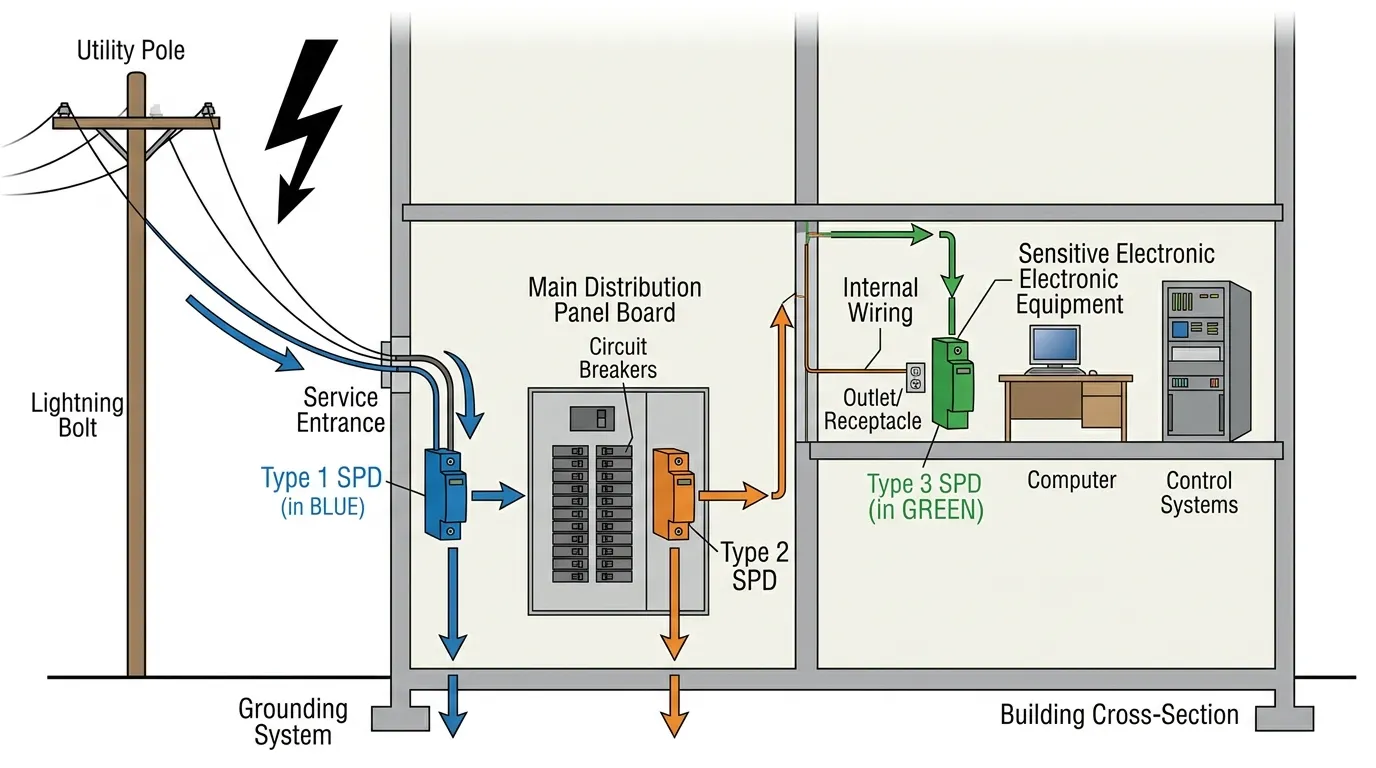
- Τύπος 1 SPD is installed at the service entrance or upstream protection point, handling high-energy external surges.
- Ενιαίο έντυπο δηµόσιας διαβούλευσης τύπου 2 is installed at distribution panels and sub-distribution boards, serving as the main protection layer for internal low-voltage systems.
- Ενιαίο έντυπο δηµόσιας διαβούλευσης τύπου 3 is installed close to sensitive equipment, providing point-of-use protection against residual surge energy.
These classifications are defined by international and national standards — including IEC 61643-11 και ANSI/UL 1449 (NEC) — and each type is tested against different surge waveforms that reflect its intended role. In many installations, the three types work together as a coordinated, layered protection strategy rather than replacing one another.
Βασικά συμπεράσματα
- Τύπος 1 SPD is the first line of defense where the building receives external surge energy, tested with the 10/350 µs waveform.
- Ενιαίο έντυπο δηµόσιας διαβούλευσης τύπου 2 is the most common panel-level surge protection device in low-voltage installations, tested with the 8/20 µs waveform.
- Ενιαίο έντυπο δηµόσιας διαβούλευσης τύπου 3 protects sensitive terminal equipment against residual surges at the point of use.
- If the goal is broad building or panel protection, Ενιαίο έντυπο δηµόσιας διαβούλευσης τύπου 2 is typically the central device.
- If the goal is final equipment-level protection, Ενιαίο έντυπο δηµόσιας διαβούλευσης τύπου 3 is essential.
- The best designs use more than one SPD type in a layered arrangement with proper energy coordination.
SPD Types at a Glance
| Τύπος SPD | Σημείο εγκατάστασης | Protection Role | Κυματομορφή δοκιμής | Typical Position |
|---|---|---|---|---|
| Τύπος 1 SPD | Service entrance or origin of installation | Handles high-energy incoming surges (lightning, utility switching) | 10/350 µs | Upstream layer |
| Ενιαίο έντυπο δηµόσιας διαβούλευσης τύπου 2 | Main distribution board or sub-panel | Protects the internal distribution system against transient overvoltage | 8/20 µs | Panel layer |
| Ενιαίο έντυπο δηµόσιας διαβούλευσης τύπου 3 | Close to sensitive equipment | Protects terminal equipment from residual surge energy | 1.2/50 µs – 8/20 µs combination | Point-of-use layer |
What the Three SPD Types Mean
The classification of Τύπος 1, Τύπος 2, και Τύπος 3 is fundamentally about application role and installation location — not product size or price tier.
Per the NEC (Εθνικός Ηλεκτρικός Κώδικας) και ANSI/UL 1449, surge protective devices are designated by type based on where they connect within the electrical system and the surge environment they are expected to manage. The IEC 61643-11 standard uses a parallel classification system that aligns closely in both naming and installation logic.
This is why a Type 3 SPD should never be treated as a substitute for service-entrance protection, and why a Type 1 SPD alone does not automatically mean sensitive downstream electronics are fully protected. Each type is engineered and tested for a specific position in the protection chain.
For most engineers and buyers, the practical question comes down to:
- Which SPD type belongs at the service entrance?
- Which SPD type belongs in the panel?
- Which SPD type belongs near the equipment?
That is exactly how the three types should be understood and specified.
Type 1 SPD Explained
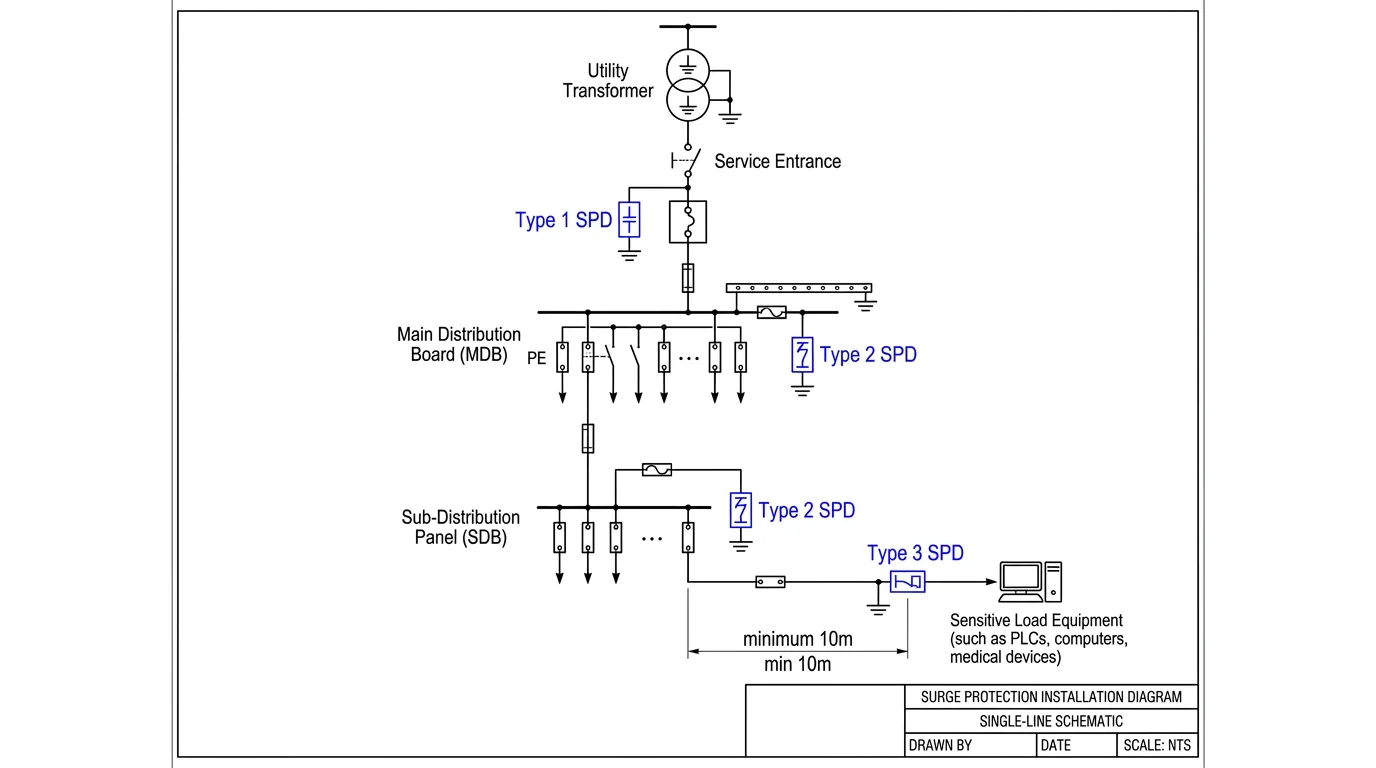
A Τύπος 1 SPD is installed at the origin of the electrical installation — typically between the secondary of the service transformer and the line side (or load side) of the service entrance overcurrent protective device.
What a Type 1 SPD Does
The primary job of a Type 1 SPD is to intercept and divert high-energy surge currents entering the installation from external sources. It is characterized by its ability to withstand the 10/350 µs current waveform, which simulates the long-duration, high-energy impulse associated with a direct or nearby lightning strike. This waveform contains approximately 20 times more energy than the 8/20 µs waveform of the same peak current, which is why only true Type 1 SPDs are designed to survive it without catastrophic failure.
Type 1 SPD is typically associated with:
- Direct and indirect lightning surge environments
- Incoming supply-side surge exposure from overhead lines
- Installations protected by an external lightning protection system (LPS)
- Utility capacitor bank switching events on the supply network
Where Type 1 SPD Is Used
Typical Type 1 SPD applications include:
- Προστασία εισόδου υπηρεσίας — before or after the main disconnect, depending on the standard and system design
- Buildings with higher exposure to lightning effects, especially those with overhead power supply lines
- Main switchboards near the incoming utility supply
- Industrial facilities, hospitals, and data centers requiring full cascade protection
- Installations where an external lightning protection system or meshed cage is present
Ανά UL 1449, a Type 1 SPD is permanently connected and intended for installation between the secondary of the service transformer and the line side of the service equipment overcurrent device. Importantly, Type 1 devices are typically dual-rated, meaning they can also be installed on the load side — giving them flexibility as Type 2 replacements at the service entrance.
Why Type 1 SPD Matters
If the system is exposed to strong incoming surge energy — particularly from lightning or overhead utility lines — a Type 1 SPD provides the essential first protective barrier. It is the upstream surge-handling layer that prevents catastrophic energy from propagating into the internal distribution system.
Τούτου λεχθέντος, Type 1 SPD is not sufficient by itself. The voltage protection level (Up) of a Type 1 device is often higher than what sensitive downstream electronics can tolerate. Downstream panels and sensitive loads still require additional SPD coordination to reduce residual voltage to safe levels.
Type 2 SPD Explained
A Ενιαίο έντυπο δηµόσιας διαβούλευσης τύπου 2 is the most widely specified surge protective device in low-voltage electrical installations. It is the main protection system for all low-voltage distribution networks, according to IEC 61643-11, and serves as the workhorse of practical surge protection design.
Type 2 SPD is typically installed in:
- Main distribution boards (MDB)
- Sub-distribution panels
- Branch distribution assemblies
- Equipment and control distribution boards
What a Type 2 SPD Does
A Type 2 SPD is characterized by the 8/20 µs current waveform and is rated by two key parameters: Στο (nominal discharge current) and Imax (maximum discharge current). Its main role is to clamp transient overvoltages within the internal electrical distribution system — including surges that are:
- Transmitted past the upstream Type 1 layer (residual lightning energy)
- Generated internally by switching events (motor starts, HVAC cycling, relay operations)
- Induced by load changes or fault clearing within the building or facility
The voltage protection level (Up) of a Type 2 SPD must remain below 2.5 kV to protect Category II equipment as defined by IEC 60664-1. When comparing two Type 2 SPDs with the same In value, the device with the higher Imax has a greater safety margin and can withstand stronger surges without degradation.
Why Type 2 SPD Is Often the Most Important Practical SPD
For the majority of commercial, industrial, and building-panel projects, Ενιαίο έντυπο δηµόσιας διαβούλευσης τύπου 2 is the central, non-negotiable protection layer. It is the device most engineers and contractors specify directly at the panel level because it addresses the most common and frequent surge threats in real-world electrical systems.
Internally generated surges — from compressor starts, elevator motors, variable frequency drives, and switching gear — are far more frequent than lightning events. A Type 2 SPD is specifically designed and tested to handle these everyday transient overvoltages repeatedly throughout its operational life.
This is also why Ενιαίο έντυπο δηµόσιας διαβούλευσης τύπου 2 carries strong standalone search intent. Many buyers are not comparing all SPD types — they are specifically looking for the correct panel-mounted SPD for their distribution board.
Typical Applications for Type 2 SPD
- Low-voltage main distribution boards
- Commercial building sub-panels
- HVAC and elevator panels
- Κέντρα ελέγχου κινητήρων (MCC)
- Industrial feeder and branch circuit panels
- UPS input and output protection
- PV inverter AC-side panels
- EV charging station distribution boards
- Control panels for automation and process equipment
When Type 2 SPD Should Be Specified
If the project question is any of the following, the answer is almost always Ενιαίο έντυπο δηµόσιας διαβούλευσης τύπου 2:
- “What SPD should I install in the distribution panel?”
- “Which SPD type is required for a sub-distribution board?”
- “What is the standard SPD type for internal power distribution protection?”
- “Which SPD protects against switching surges and internal transients?”
Even in buildings with underground cable supply — where direct lightning current is unlikely to enter through the service — a Type 2 SPD remains essential because internal switching transients still pose a continuous threat to connected equipment.
Type 3 SPD Explained
A Ενιαίο έντυπο δηµόσιας διαβούλευσης τύπου 3 is installed close to sensitive equipment and provides the final stage of surge protection. Its function is to reduce residual surge voltage to a level that is safe for delicate electronic components — after upstream Type 1 and Type 2 devices have already absorbed the main transient energy.
What a Type 3 SPD Does
Type 3 SPDs have a lower discharge capacity compared to Type 1 and Type 2 devices. They are not designed to handle high-energy surge currents on their own. Instead, they fine-tune the voltage clamping at the point of use, protecting:
- Electronic control devices and PLCs
- Communication and networking equipment
- Automation and instrumentation hardware
- IT equipment, servers, and data acquisition systems
- Medical devices and laboratory instruments
- Other sensitive end-use loads with low impulse withstand capability
Per IEC 61643-11, Type 3 SPDs must be installed as a supplement to Type 2 SPD — never as the sole surge protection in an installation. They are tested with the combination waveform (1.2/50 µs voltage combined with 8/20 µs current) and the open-circuit voltage (Uoc) parameter.
Where Type 3 SPD Is Typically Used
Typical Type 3 SPD applications include:
- Socket-outlet and plug-in surge protection
- Local protection at equipment terminals
- Control cabinet electronics
- Point-of-use protection for server racks and IT infrastructure
- Protection close to sensitive measurement and instrumentation devices
A minimum conductor length of 10 meters (30 feet) from the electrical service panel to the Type 3 SPD installation point is typically required per UL 1449 guidelines. This distance ensures adequate impedance between the upstream SPD and the Type 3 device for proper energy coordination.
Why Type 3 SPD Matters
Even with robust upstream protection, the voltage that arrives at a sensitive device can still exceed its impulse withstand rating. Cable length, impedance, and oscillation effects within the installation can allow residual transients to reach levels that degrade or damage electronics over time. A Type 3 SPD addresses this last-meter problem.
If the project question is:
- “What SPD type should be installed near sensitive equipment?”
- “Which SPD provides final protection for electronics at the load point?”
- “How do I protect control system components from residual surges?”
The answer is Ενιαίο έντυπο δηµόσιας διαβούλευσης τύπου 3, installed as the innermost layer of a coordinated protection scheme.
Technical Comparison: Type 1 vs Type 2 vs Type 3 SPD
| Παράμετρος | Τύπος 1 SPD | Ενιαίο έντυπο δηµόσιας διαβούλευσης τύπου 2 | Ενιαίο έντυπο δηµόσιας διαβούλευσης τύπου 3 |
|---|---|---|---|
| Κυματομορφή δοκιμής | 10/350 µs | 8/20 µs | 1.2/50 µs – 8/20 µs combination |
| Key Rating | Iimp (impulse current) | In (nominal) / Imax (maximum) | Uoc (open-circuit voltage) |
| Energy Handling | Highest — handles direct lightning energy | Medium — handles switching and residual surges | Lowest — handles residual voltage clamping |
| Επίπεδο Προστασίας Τάσης (Up) | Typically ≤ 4 kV | Typically ≤ 2.5 kV | Typically ≤ 1.5 kV |
| Τοποθεσία εγκατάστασης | Service entrance / origin | Distribution board / sub-panel | Near sensitive equipment |
| Standalone Use | Yes, but does not protect sensitive loads alone | Yes, most common standalone application | No — must supplement Type 2 SPD |
| Πρότυπα | IEC 61643-11 / UL 1449 Type 1 | IEC 61643-11 / UL 1449 Type 2 | IEC 61643-11 / UL 1449 Type 3 |
Why Waveform Testing Matters
The 10/350 µs waveform used to test Type 1 SPDs simulates the slow rise and extended duration of a lightning impulse current — delivering massive energy over a longer period. The 8/20 µs waveform for Type 2 SPDs simulates a faster, shorter-duration surge typical of switching transients and induced lightning effects.
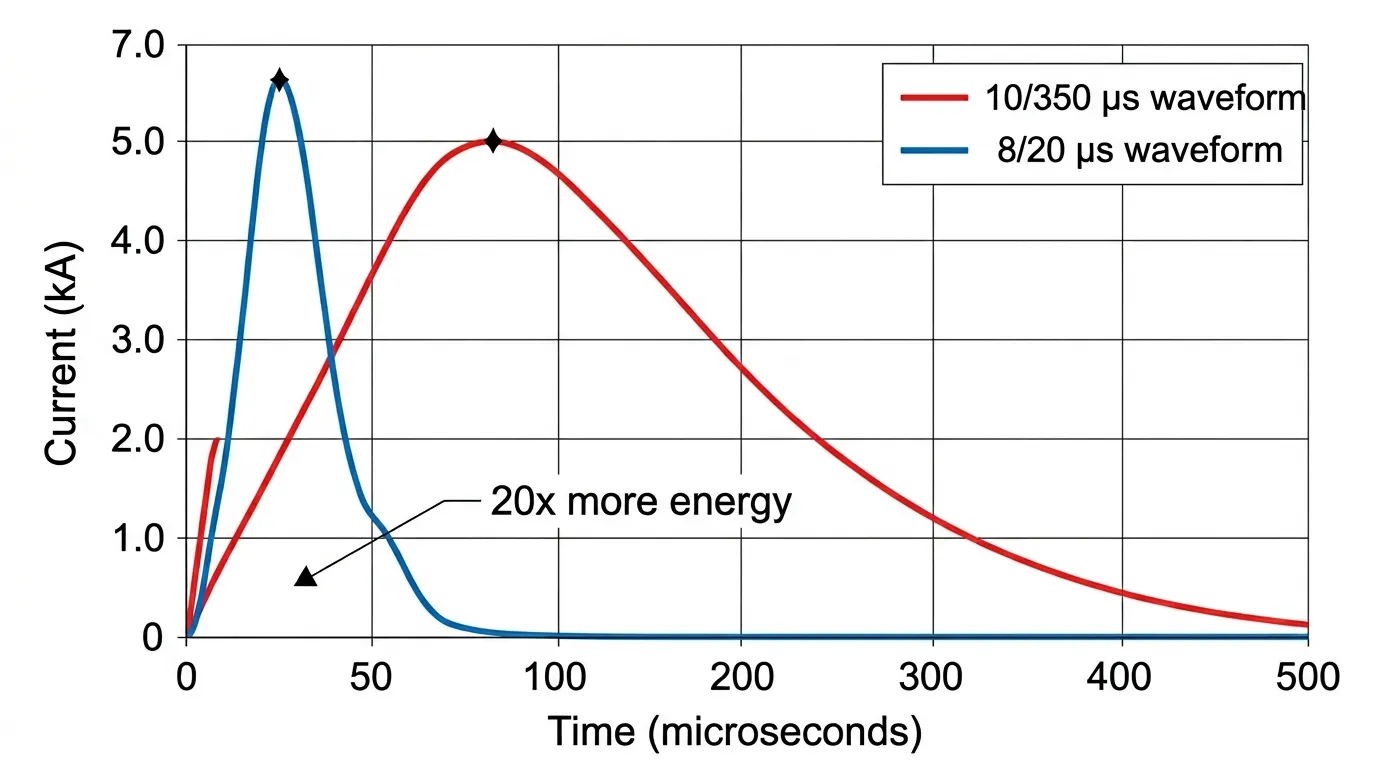
This is not just a laboratory distinction. It directly determines each SPD’s real-world energy handling capacity. A device tested only at 8/20 µs cannot reliably survive the sustained energy of a 10/350 µs event, which is why Type 2 SPDs cannot replace Type 1 SPDs at the service entrance in lightning-exposed installations.
Type 1 vs Type 2 vs Type 3: Quick Decision Guide
| Project Question | Best-Fit SPD Type |
|---|---|
| Which SPD belongs at the service entrance? | Τύπος 1 SPD |
| Which SPD is most common in distribution panels? | Ενιαίο έντυπο δηµόσιας διαβούλευσης τύπου 2 |
| Which SPD should be installed close to sensitive equipment? | Ενιαίο έντυπο δηµόσιας διαβούλευσης τύπου 3 |
| Which SPD handles lightning-level surge energy? | Τύπος 1 SPD |
| Which SPD is the main panel-level protection layer? | Ενιαίο έντυπο δηµόσιας διαβούλευσης τύπου 2 |
| Which SPD provides fine-tuned voltage clamping at the load? | Ενιαίο έντυπο δηµόσιας διαβούλευσης τύπου 3 |
| Which SPD can be specified as a standalone panel device? | Ενιαίο έντυπο δηµόσιας διαβούλευσης τύπου 2 |
| Which SPD must always be supplemented by upstream protection? | Ενιαίο έντυπο δηµόσιας διαβούλευσης τύπου 3 |
How the Three SPD Types Work Together
In properly designed installations, the best surge protection strategy is layered and coordinated:
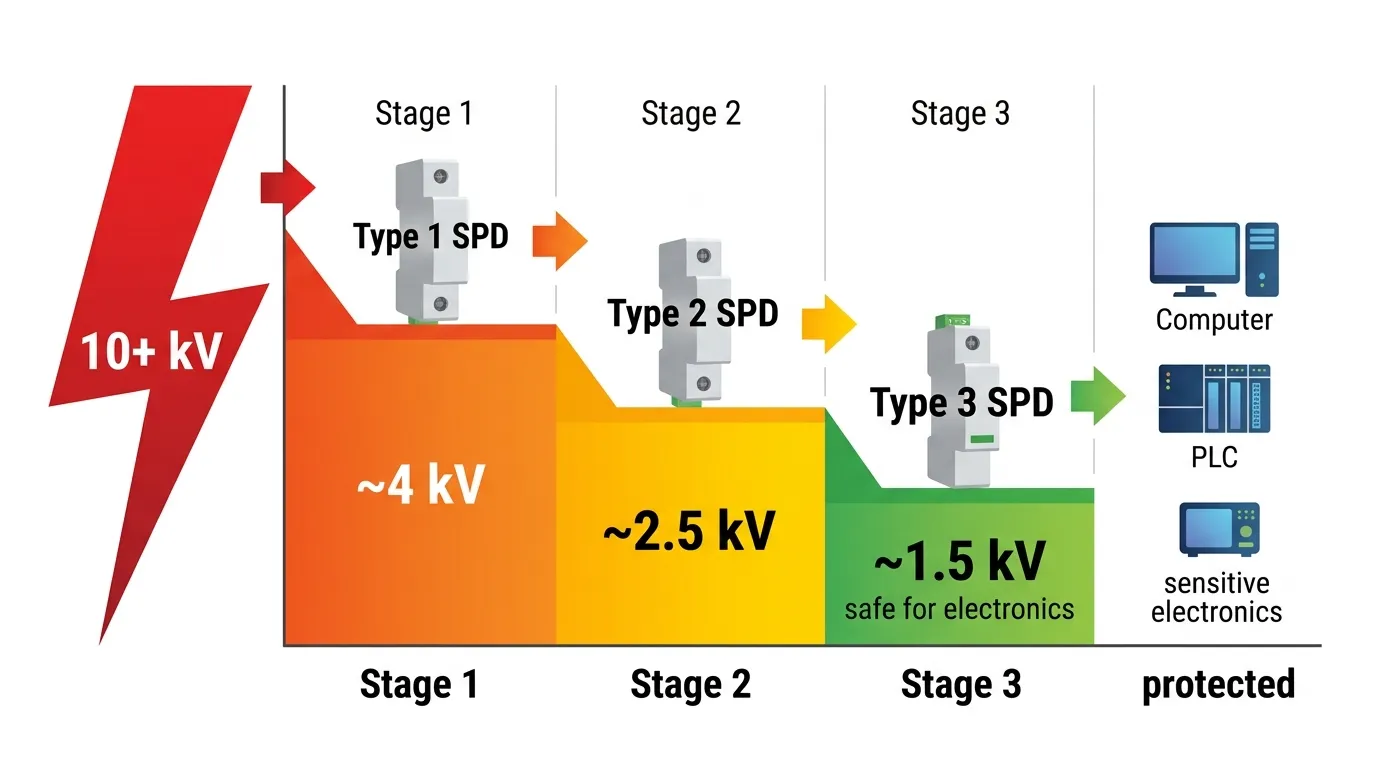
- Τύπος 1 SPD at the origin or service entrance absorbs the bulk of external surge energy, reducing kilovolts of transient voltage to a lower but still significant level.
- Ενιαίο έντυπο δηµόσιας διαβούλευσης τύπου 2 in the main distribution board or sub-panel further clamps the residual voltage and handles internally generated switching transients.
- Ενιαίο έντυπο δηµόσιας διαβούλευσης τύπου 3 close to sensitive terminal equipment reduces the final residual voltage to a level safe for electronics.
The Coordination Principle
For this layered system to work effectively, the SPDs at each stage must be energy-coordinated. Αυτό σημαίνει:
- Each downstream SPD should not operate before the upstream device has had time to absorb the primary energy. If a Type 3 SPD fires before the Type 1 device, it can be destroyed by energy it was never designed to handle.
- Sufficient cable length and impedance between SPD stages is required for proper decoupling. This is why standards recommend minimum distances — such as the 10-meter separation for Type 3 devices.
- When using SPDs from different manufacturers, coordination compatibility must be verified. Many manufacturers provide coordination tables or recommend using matched SPD families across all three types.
Where Layered Protection Is Most Important
The coordinated three-layer approach is especially critical in:
- Industrial plants with heavy motor loads and lightning-exposed overhead supply
- Εμπορικά κτίρια with dense electronic systems (BMS, HVAC controls, IT networks)
- Data centers and hospitals where downtime is unacceptable and equipment sensitivity is high
- Εγκαταστάσεις ηλιακής και ανανεώσιμης ενέργειας with inverters and monitoring systems
- Facilities with external lightning protection systems (LPS) where direct strike energy must be managed
For a broader overview of surge protection fundamentals, see Τι είναι μια συσκευή προστασίας από υπερτάσεις (SPD);.
How to Choose the Right SPD Type
Choose Type 1 SPD When:
- The design requires service-entrance surge protection against external high-energy surges
- The installation is supplied by overhead power lines with direct lightning exposure
- An external lightning protection system (LPS) is present on the building
- The project is an industrial facility, hospital, or data center requiring full cascade protection
- NEC 230.67 or equivalent local codes mandate service entrance surge protection
Choose Type 2 SPD When:
- Protection is needed inside the main distribution panel or sub-panel
- The focus is on low-voltage distribution system protection against switching transients
- The building has underground cable supply with lower external lightning risk
- The panel is the primary surge-control point in the project
- The application involves HVAC panels, motor control centers, UPS systems, or EV charging distribution
Choose Type 3 SPD When:
- The connected load includes sensitive electronic or instrumentation equipment
- Local equipment-level protection is required beyond what panel-level SPDs provide
- The final stage of a coordinated, multi-layer protection scheme is needed
- Control cabinet electronics, IT equipment, or medical devices require fine voltage clamping
When to Use Multiple SPD Types Together
In most professional installations, the answer is not “Type 1 OR Type 2 OR Type 3” — it is a combination selected based on the surge environment, system architecture, and equipment sensitivity. The investment in a coordinated multi-type approach is almost always justified when the cost of equipment failure or downtime exceeds the cost of proper protection.
Common Mistakes When Selecting SPD Types
Using Type 3 SPD as the Main Building Protection Device
Type 3 SPD has a low discharge capacity and is not designed to function as the primary or sole protection layer. Without upstream Type 2 (and where applicable, Type 1) protection, a Type 3 device will be overwhelmed by surge energy it cannot safely divert.
Assuming Type 1 SPD Makes Downstream Protection Unnecessary
Type 1 SPD is critical for absorbing bulk surge energy, but its voltage protection level (Up) is typically too high for sensitive electronics. The residual voltage passed downstream can still damage equipment rated for lower impulse withstand levels. Type 2 and Type 3 SPDs are needed to progressively reduce this voltage.
Ignoring the Role of Type 2 SPD
In many practical low-voltage projects, Type 2 SPD is the single most important and universally required device. Omitting it leaves the entire internal distribution system and all connected equipment exposed to both external residual surges and — more commonly — internally generated switching transients.
Choosing by Product Label Only
The correct selection depends on:
- Installation point within the electrical system
- Surge environment (lightning exposure, switching activity, grid quality)
- System architecture (overhead vs. underground supply, distance between panels)
- Equipment sensitivity (impulse withstand category of connected loads)
A product labeled “surge protector” without clear Type classification per IEC 61643-11 or UL 1449 cannot be properly evaluated for any specific application.
Treating All SPD Types as Interchangeable
They are not interchangeable. Each type is defined by its intended role, tested against different waveforms, and designed for a specific position in the protection chain. Installing the wrong type at the wrong location can result in either inadequate protection or device failure.
Mixing Uncoordinated Devices from Different Manufacturers
When Type 1, Type 2, and Type 3 SPDs from different manufacturers are installed together without verifying energy coordination, the protection chain may not function as intended. Always confirm coordination compatibility or use matched product families.
Internal Link Reference
For related topics in the VIOX surge protection knowledge base:
- Τι είναι μια συσκευή προστασίας από υπερτάσεις (SPD); — comprehensive definition and overview
- SPD Full Form in Electrical — terminology and meaning reference
- Surge Protection Devices Pros and Cons — balanced evaluation of SPD benefits and limitations
- How to Choose the Right SPD for Solar Systems — SPD selection for PV and renewable energy applications
Συμπέρασμα
The three main types of SPD — Type 1, Type 2, and Type 3 — are classified by where they are installed and what surge energy they are engineered to handle.
- Τύπος 1 SPD protects at the service entrance, absorbing high-energy external surges tested at the 10/350 µs waveform.
- Ενιαίο έντυπο δηµόσιας διαβούλευσης τύπου 2 protects the internal distribution system and is the most widely specified panel-level SPD, tested at the 8/20 µs waveform.
- Ενιαίο έντυπο δηµόσιας διαβούλευσης τύπου 3 protects sensitive equipment at the final use point, providing fine voltage clamping as a supplement to upstream protection.
The correct approach to choosing an SPD type is not to ask which one is “best” in isolation. The right question is: Where in the system does the protection need to happen, and what surge environment exists at that point?
When the answer involves multiple locations and mixed equipment sensitivity, a coordinated multi-type SPD strategy delivers the most reliable and cost-effective protection.
ΣΥΧΝΈΣ ΕΡΩΤΉΣΕΙΣ
What are the three types of SPD?
The three main types of SPD are Τύπος 1 SPD, Ενιαίο έντυπο δηµόσιας διαβούλευσης τύπου 2, και Ενιαίο έντυπο δηµόσιας διαβούλευσης τύπου 3, classified according to IEC 61643-11 and ANSI/UL 1449. Each type is defined by its installation location and the surge waveform it is tested against.
What is a Type 1 SPD used for?
A Type 1 SPD is installed at the service entrance or origin of the installation to intercept high-energy external surge currents, particularly those associated with lightning. It is tested with the 10/350 µs waveform.
What is a Type 2 SPD used for?
A Type 2 SPD is installed in main distribution boards or sub-panels to protect the internal electrical distribution system against transient overvoltages from both external residual surges and internal switching events. It is tested with the 8/20 µs waveform.
What is a Type 3 SPD used for?
A Type 3 SPD is installed close to sensitive equipment as the final stage of coordinated surge protection. It reduces residual voltage to safe levels for electronics and must always be used in combination with upstream Type 2 protection.
Which SPD type is most common in electrical panels?
Ενιαίο έντυπο δηµόσιας διαβούλευσης τύπου 2 is the most common and most widely specified SPD type in low-voltage distribution panels worldwide. It is considered the main protection system for all low-voltage electrical installations.
Can Type 3 SPD be used without Type 1 or Type 2?
No. Type 3 SPD has a low discharge capacity and is designed to function only as a supplement to upstream protection. Using it as the sole SPD in a system risks device failure and inadequate protection for connected equipment.
Do I need Type 1 and Type 2 SPD together?
This depends on the surge environment and system architecture. In installations with overhead supply lines, lightning protection systems, or high external surge exposure, both Type 1 and Type 2 SPDs are recommended as part of a coordinated cascade. In buildings with underground supply and lower lightning risk, a Type 2 SPD alone may be sufficient at the panel level.
What is the difference between 10/350 µs and 8/20 µs waveforms?
The 10/350 µs waveform simulates a lightning impulse with a slower rise time and longer duration, delivering approximately 20 times more energy than an 8/20 µs waveform at the same peak current. Type 1 SPDs are tested at 10/350 µs; Type 2 SPDs are tested at 8/20 µs. This energy difference is why the two types are not interchangeable.
How do I ensure SPD coordination across types?
Energy coordination requires that each downstream SPD does not activate before the upstream device absorbs the primary surge energy. This is achieved through adequate cable impedance between devices (minimum distances), matched let-through voltage levels, and — ideally — using coordinated SPD product families from the same manufacturer or verified-compatible devices.