Εάν συγκρίνετε EMC vs standard cable glands, the core difference is simple: a standard cable gland mainly provides cable retention, sealing, and strain relief, while an EMC cable gland adds a conductive 360-degree shield termination path for screened or shielded cables.
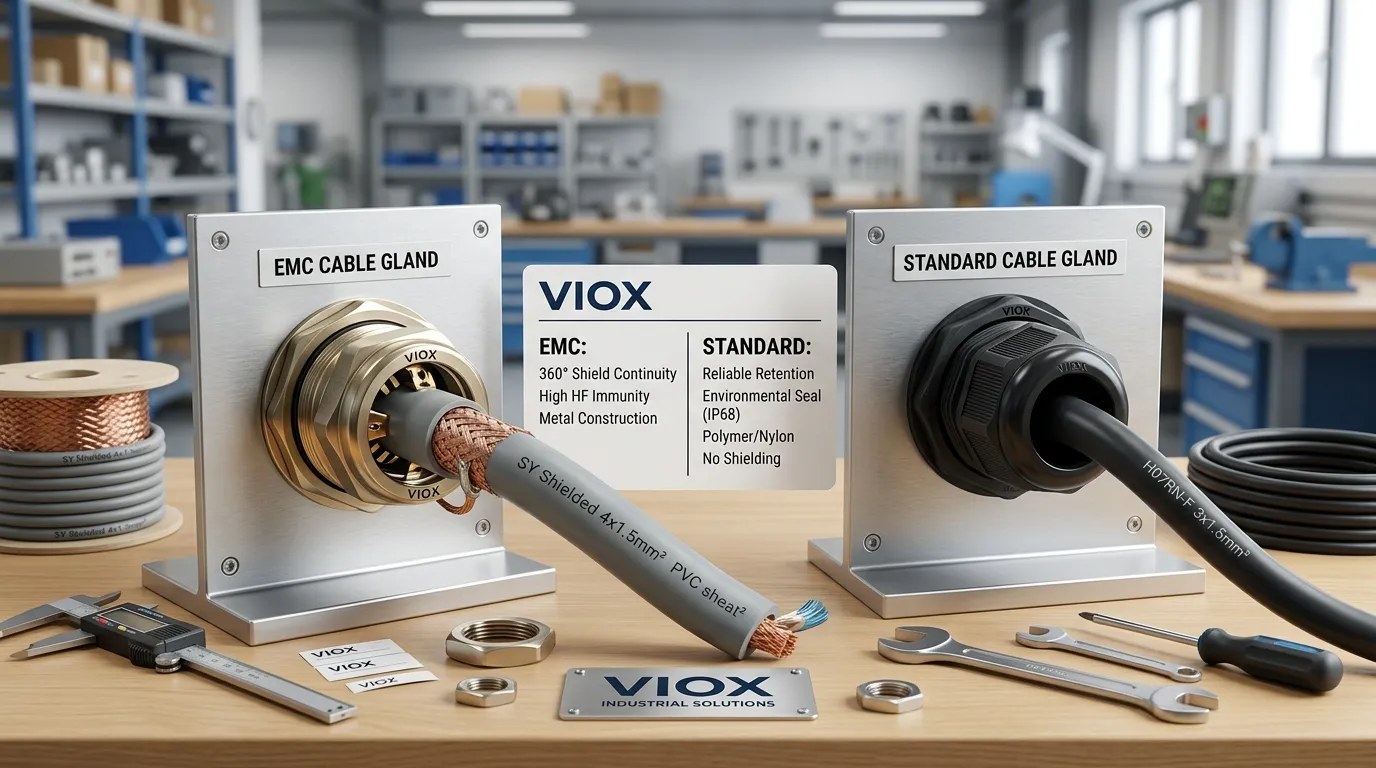
That extra EMC function matters in installations where electromagnetic interference can disrupt signal integrity, increase emissions, or create compliance problems. In low-noise, non-shielded, or purely mechanical cable-entry applications, a standard gland is often sufficient. In variable-frequency drive systems, servo panels, shielded instrumentation, and industrial automation cabinets, an EMC gland is often the better technical choice.
This guide explains the differences in practical engineering terms so you can decide when an EMC gland is necessary, when a standard gland is enough, and what to check before selecting either one.
Βασικά συμπεράσματα
- Standard cable glands focus on sealing, retention, and environmental protection.
- Στυπιοθλίπτες καλωδίων EMC do those same basic jobs while also creating a low-impedance connection between the cable shield and the enclosure.
- EMC glands are most useful with shielded or braided cables, especially where VFDs, servo drives, automation electronics, or sensitive signals are involved.
- A standard gland is often the right choice for unshielded power or general-purpose wiring where EMC continuity is not part of the design.
- The correct choice depends on the cable construction, shield termination strategy, enclosure bonding, and EMI environment, not just on IP rating or thread size.
EMC Cable Gland vs Standard Cable Gland: Quick Comparison
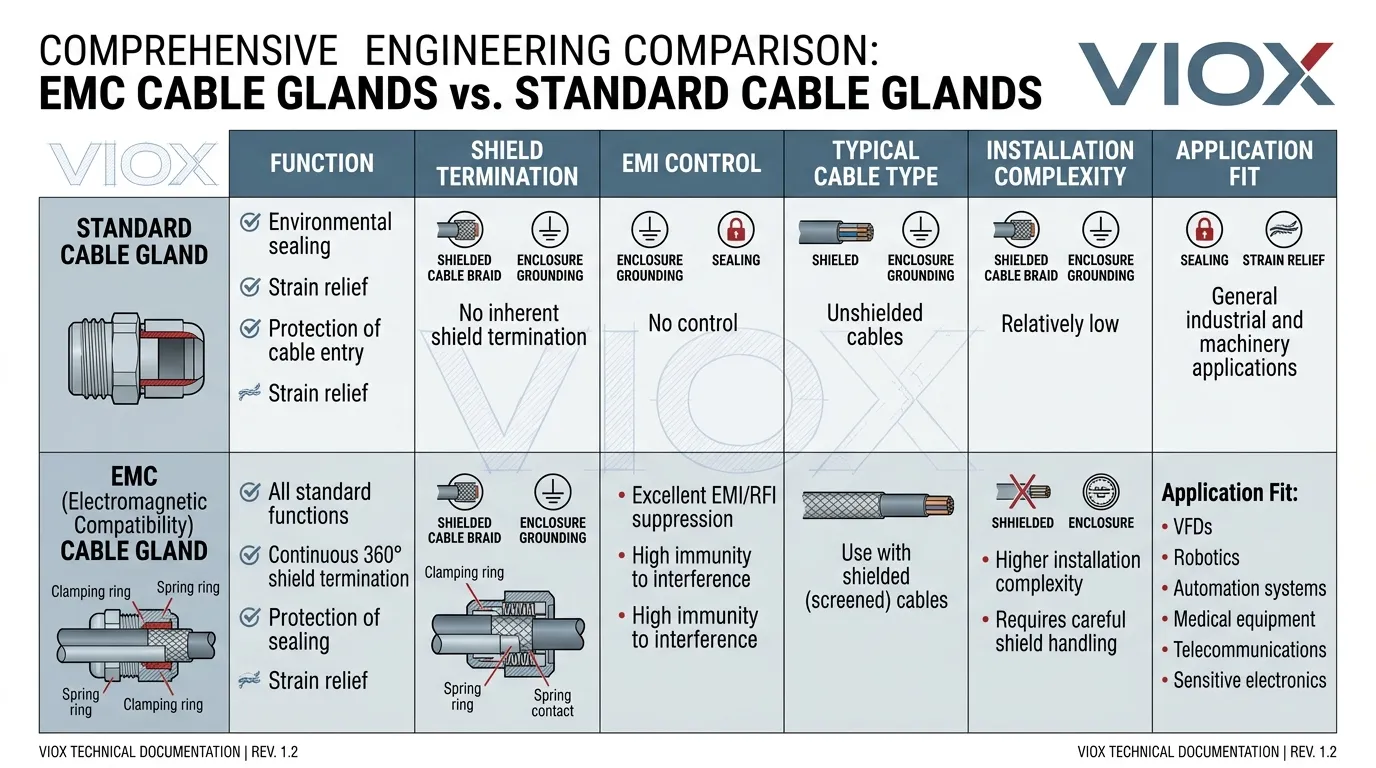
| Παράγοντας | Στυπιοθλίπτης καλωδίων EMC | Standard Cable Gland |
|---|---|---|
| Primary function | Sealing, strain relief, and shield termination | Sealing and strain relief |
| Shield continuity | Yes, designed to connect braid or foil shield to gland body | No, not intended for 360-degree shield termination |
| Typical cable type | Shielded, screened, or braided cable | Unshielded cable or cables with separate shield-termination method |
| EMI/EMC performance | Helps maintain shielding effectiveness | Does not provide EMC termination by itself |
| Installation sensitivity | Higher, because shield contact quality matters | Lower, mainly mechanical and sealing concerns |
| Τυπικές εφαρμογές | VFDs, servo drives, control cabinets, data and instrumentation cables | General power distribution, lighting, utility cable entry, low-noise environments |
| Κόστος | Usually higher | Συνήθως χαμηλότερο |
What Is an EMC Cable Gland?
Ένα EMC cable gland is a cable entry device designed for shielded cables where electrical continuity between the cable shield and the enclosure or gland body is required. In addition to sealing and mechanical retention, it provides a conductive path from the braid, foil, or screen to earth or enclosure ground.
The way it usually does this is through an internal contact system such as:
- contact spring
- contact cone
- shield clamp structure
- conductive insert that presses around the cable screen
The important point is not just “metal touching metal.” The important point is broad, low-impedance, circumferential contact that preserves shielding performance better than a small pigtail or ad hoc bonding method.
What Is a Standard Cable Gland?
A standard cable gland is designed to secure a cable where it enters an enclosure while providing environmental sealing, strain relief, and mechanical support. It may be made from nylon, nickel-plated brass, stainless steel, or other materials depending on the application.
What a standard gland normally does δεν do is provide dedicated shield termination for EMI control. It can protect the cable and keep out dust and moisture, but it does not automatically preserve the EMC performance of a screened cable.
The Real Technical Difference: Shield Termination
This is the part many comparison pages oversimplify.
The real difference between EMC and standard cable glands is not just material or price. It is how the cable shield is terminated at the enclosure entry.
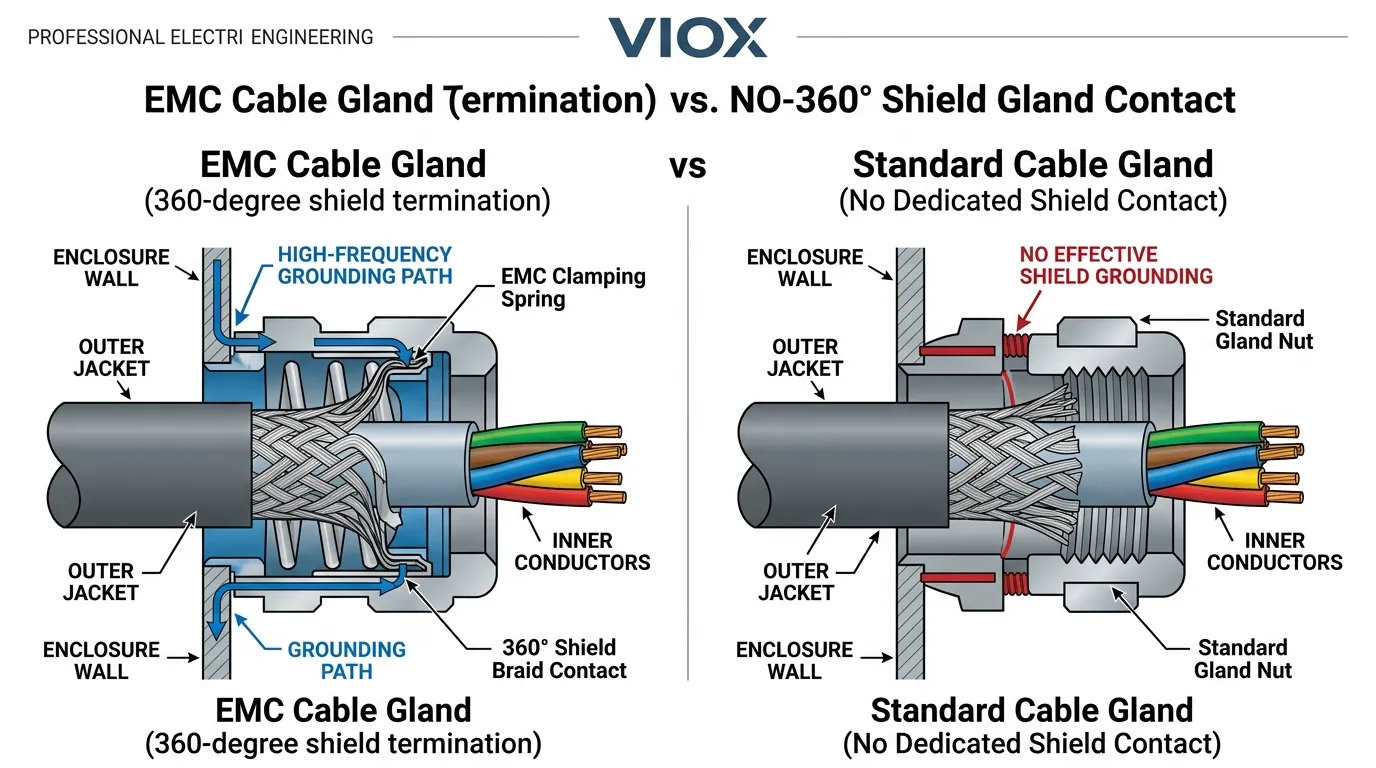
Standard gland behavior
With a standard gland:
- the outer jacket is retained
- the entry point is sealed
- the cable is protected mechanically
- the shield is usually left floating at the gland entry unless terminated elsewhere
That may be perfectly acceptable if:
- the cable is unshielded
- EMI risk is low
- the shield is terminated by a dedicated EMC clamp or gland plate elsewhere inside the panel
EMC gland behavior
With an EMC gland:
- the cable braid or screen is intentionally contacted
- the shield is bonded to the gland body
- the gland body becomes part of the enclosure grounding path
- shielding continuity is maintained more effectively across the cable entry
This is especially valuable when the cable itself is part of the EMC strategy, not just the mechanical routing.
When a Standard Cable Gland Is Usually Enough
A standard cable gland is often the right choice when EMC continuity is not a design requirement.
Typical examples:
- unshielded power cables
- κυκλώματα φωτισμού
- general utility wiring
- basic junction boxes
- outdoor enclosures where the main concern is IP sealing rather than signal integrity
In these cases, paying extra for an EMC gland may not improve system performance in any meaningful way.
Standard glands also remain common where cable shielding is handled elsewhere in the cabinet using dedicated grounding bars, EMC clamps, or shield-termination hardware rather than at the gland itself.
When an EMC Cable Gland Is the Better Choice
An EMC cable gland becomes much more valuable when cable shielding is functionally important.
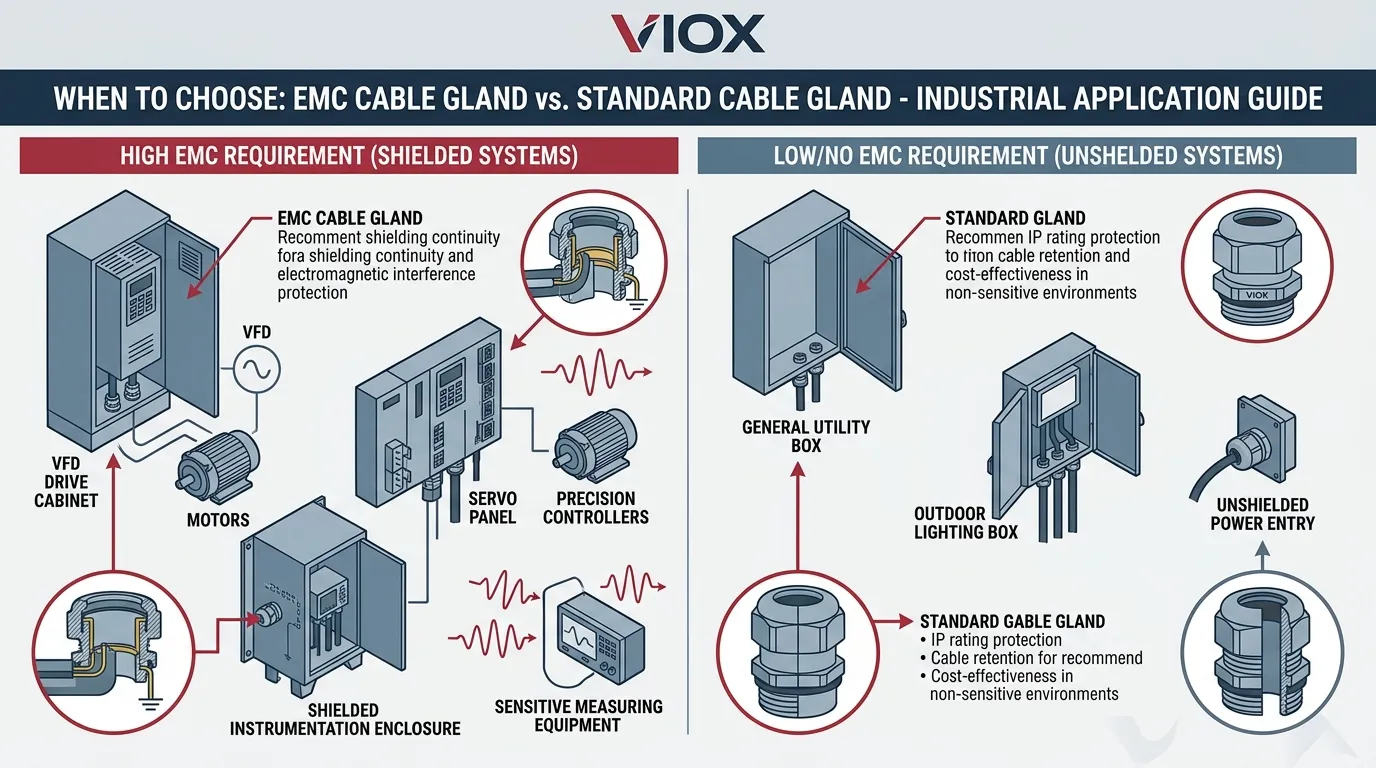
Οι τυπικές εφαρμογές περιλαμβάνουν:
- variable-frequency drive motor cables
- servo drive systems
- encoder and feedback cables
- shielded instrumentation wiring
- industrial Ethernet or communication cables in noisy cabinets
- automation panels with inverters, switching power supplies, or high-frequency electronics
- robotics and motion-control systems
In these environments, using a standard gland on a shielded cable can weaken the EMC strategy right at the enclosure boundary.
Common Applications: EMC vs Standard Cable Glands
| Εφαρμογή | Καλύτερη Επιλογή | Γιατί |
|---|---|---|
| Unshielded power cable into a utility box | Standard gland | Sealing and retention are the main requirements |
| Shielded VFD motor cable entering an inverter cabinet | EMC gland | Shield continuity and noise control matter |
| Basic outdoor lighting cable entry | Standard gland | EMC termination usually not required |
| Servo cabinet with braided control cable | EMC gland | Helps reduce susceptibility and emissions |
| Instrumentation enclosure with shielded signal cables | EMC gland or dedicated shield termination system | Depends on termination strategy |
| General-purpose cable entry for non-sensitive loads | Standard gland | Lower cost and simpler installation |
EMC vs Standard Cable Glands in VFD and Drive Systems
This is one of the clearest decision areas.
In VFD and drive installations, cable shielding often plays a real role in reducing radiated and conducted noise. That means the enclosure entry cannot be treated as just a hole that needs sealing. The shield termination quality matters.
For shielded drive cables, an EMC gland can help preserve 360-degree shield contact at the cabinet wall, which is generally better than leaving the shield floating until a later bonding point. That does not mean every VFD cable must use an EMC gland in every layout, but it does mean drive systems are one of the strongest cases for using EMC glands instead of standard glands.
A Practical Panel-Building Example
In a typical industrial panel build, the difference becomes obvious when you compare two cabinets side by side.
In a simple outdoor junction box carrying unshielded power or utility wiring, a standard gland is usually the cleanest answer. The priorities are sealing, retention, and durability. There is little value in paying for EMC hardware if the cable itself is not part of an EMC control strategy.
Now compare that with a drive cabinet containing a VFD, motor cable, encoder line, and a few sensitive control signals. In that environment, panel builders often find that the cable entry point becomes one of the weak spots in the shielding path. Even when the cable is correctly specified, a poor entry method can undermine the benefit of the screen. That is exactly where an EMC gland starts to justify itself.
The useful lesson is that the decision is rarely about whether EMC glands are “better” in the abstract. It is about whether the cable entry is part of the system’s noise-control strategy.
Material and Construction Differences
EMC glands are typically associated with conductive materials such as nickel-plated brass or stainless steel because the gland body needs to participate in the shielding and grounding path.
Standard glands can be made from those same materials, but they are also commonly available in nylon and other non-conductive forms where corrosion resistance, cost, and sealing are the main concerns.
Selection Guide: How to Choose Between EMC and Standard Cable Glands
The easiest way to choose is to work from system function, not from product catalog labels.
1. Check whether the cable is shielded
If the cable is unshielded, an EMC gland is usually unnecessary. If the cable has a braid, foil screen, or combined shield structure, then shield termination becomes part of the decision.
2. Check whether the shield must be terminated at the gland entry
Sometimes the best shield-termination point is the gland. Other times the design uses an internal shield clamp, EMC plate, or dedicated grounding rail just inside the enclosure. If the shield is being terminated elsewhere correctly, a standard gland may still be acceptable.
3. Check the EMI environment
Ask whether the installation includes:
- οι αντιστροφείς
- servo drives
- switching power supplies
- high-speed signal cables
- dense automation electronics
- sensitive instrumentation
The noisier and more sensitive the system, the stronger the case for EMC-focused termination.
4. Check the enclosure bonding path
An EMC gland only performs properly if the conductive path continues into a properly bonded enclosure or earthing structure. If the gland is installed through painted surfaces, poor bonding points, or isolated hardware, the theoretical EMC advantage may be reduced.
5. Check material, thread, and sealing requirements
Even after you decide between EMC and standard, you still need to match:
- cable diameter range
- thread type
- environmental sealing
- αντοχή στη διάβρωση
- chemical resistance
- εύρος θερμοκρασίας
This is why selection should never stop at “EMC” vs “non-EMC.”
The Most Common Selection Mistakes
Using a standard gland on shielded drive cable just because the size fits
Physical fit alone is not the same as electrical fit.
Assuming every shielded cable automatically needs an EMC gland
Sometimes the shield is terminated elsewhere by a dedicated clamp system. In that case, a standard gland may still be part of a correct design.
Forgetting that enclosure bonding matters
An EMC gland cannot solve a poor grounding or bonding design by itself.
Terminating the shield with a long pigtail when low-impedance circumferential contact is needed
This is a common way to reduce the benefit of shielded cable in high-noise systems.
Choosing gland material only by corrosion or price without considering conductivity
Material selection is part of both mechanical and EMC performance.
EMC Cable Glands vs Standard Cable Glands: Cost Trade-Off
EMC glands usually cost more, but the right cost comparison is not just gland price.
The better question is:
What is the cost of poor EMC performance compared with the cost of the better gland?
In a simple lighting or utility box, the answer may be that a standard gland is entirely adequate. In a drive cabinet, robotics system, or instrumentation panel, the extra gland cost may be insignificant compared with the cost of nuisance faults, communication errors, or failed EMC performance.
Συχνές Ερωτήσεις
What is the main difference between an EMC cable gland and a standard cable gland?
The main difference is that an EMC cable gland is designed to terminate the cable shield and maintain shielding continuity, while a standard cable gland is mainly intended for sealing, retention, and strain relief.
Do I need an EMC cable gland for every shielded cable?
No. You need to look at the shield-termination strategy of the whole system. If the shield is correctly terminated elsewhere with low impedance and good bonding, a standard gland may still be acceptable.
Can a standard cable gland provide EMC protection?
Not by itself. A standard gland can seal and secure the cable, but it is not designed to provide 360-degree shield termination.
Where are EMC cable glands commonly used?
They are commonly used in VFD systems, servo cabinets, automation panels, instrumentation enclosures, communication equipment, and other installations where shielding continuity matters.
Are EMC cable glands always metal?
They are usually associated with conductive metal construction because the gland body is part of the shield-bonding path, though exact design depends on the product family.
Is an EMC gland enough to solve all EMI problems?
No. EMC performance depends on the whole installation, including cable type, shield termination method, enclosure bonding, grounding, layout, and nearby noise sources.
Τελική Σύσταση
Επιλέξτε έναν standard cable gland when your main needs are sealing, cable retention, and strain relief in an application where EMC continuity is not part of the design.
Επιλέξτε έναν EMC cable gland when the cable is shielded and the cable entry must preserve shield continuity into a bonded enclosure, especially in drive systems, automation cabinets, instrumentation panels, and other electrically noisy environments.
If you are building a broader cable-entry strategy rather than choosing a single gland type, continue into: