Όταν οι αρθρωτοί επαφείς αστοχούν πρόωρα σε οικιακές και ελαφρές εμπορικές εφαρμογές, η βασική αιτία συχνά εντοπίζεται σε ένα κρίσιμο σφάλμα προδιαγραφών: τη χρήση ενός επαφέα με ονομαστική τιμή AC-7a για μια εφαρμογή AC-7b. Αυτή η φαινομενικά μικρή διάκριση—που ορίζεται από τα πρότυπα IEC 61095—αντιπροσωπεύει τη διαφορά μεταξύ αξιόπιστης λειτουργίας και καταστροφικής αστοχίας κατά τον έλεγχο επαγωγικών φορτίων όπως κινητήρες, ανεμιστήρες και συμπιεστές.
Η κατανόηση των τεχνικών διαφορών μεταξύ των κατηγοριών χρήσης AC-7a και AC-7b δεν αφορά μόνο τη συμμόρφωση—αφορά την πρόληψη ζημιών στον εξοπλισμό, την αποφυγή δαπανηρών διακοπών λειτουργίας και τη διασφάλιση της μακροζωίας του συστήματος. Αυτός ο οδηγός αναλύει τις μηχανικές αρχές, τους μηχανισμούς αστοχίας και τα κριτήρια επιλογής που κάθε ηλεκτρολόγος επαγγελματίας πρέπει να κατακτήσει.
Τι είναι οι κατηγορίες χρήσης AC-7a και AC-7b;
Οι κατηγορίες χρήσης, που τυποποιούνται από το IEC 61095 για οικιακές και παρόμοιες εφαρμογές, ορίζουν τα χαρακτηριστικά ηλεκτρικού φορτίου και τους κύκλους λειτουργίας μεταγωγής που πρέπει να αντέχουν οι επαφείς. Σε αντίθεση με τις πιο γνωστές κατηγορίες AC-1 και AC-3 (που ορίζονται στο IEC 60947-4-1 για βιομηχανικούς επαφείς), οι AC-7a και AC-7b απευθύνονται συγκεκριμένα σε οικιακό και ελαφρύ εμπορικό εξοπλισμό με ονομαστικές τιμές ρεύματος συνήθως ≤63A.
AC-7a: Ελαφρώς Επαγωγικά Φορτία
Οι επαφείς AC-7a έχουν σχεδιαστεί για ωμικά ή ελαφρώς επαγωγικά φορτία με συντελεστές ισχύος ≥0,95. Αυτές οι εφαρμογές περιλαμβάνουν:
- Ωμικά θερμαντικά στοιχεία
- Συστήματα φωτισμού πυρακτώσεως και LED
- Ηλεκτρικοί φούρνοι και εστίες μαγειρέματος
- Μικρά ηλεκτρικά εργαλεία (τρυπάνια, μίξερ)
- Τηλεοράσεις και συστήματα ψυχαγωγίας
Το βασικό χαρακτηριστικό: ελάχιστο ρεύμα εισόδου (συνήθως 1,2-1,5× ονομαστικό ρεύμα) και αμελητέος σχηματισμός τόξου κατά τις λειτουργίες μεταγωγής.
AC-7b: Φορτία Κινητήρα και Περιστρεφόμενων Μηχανών
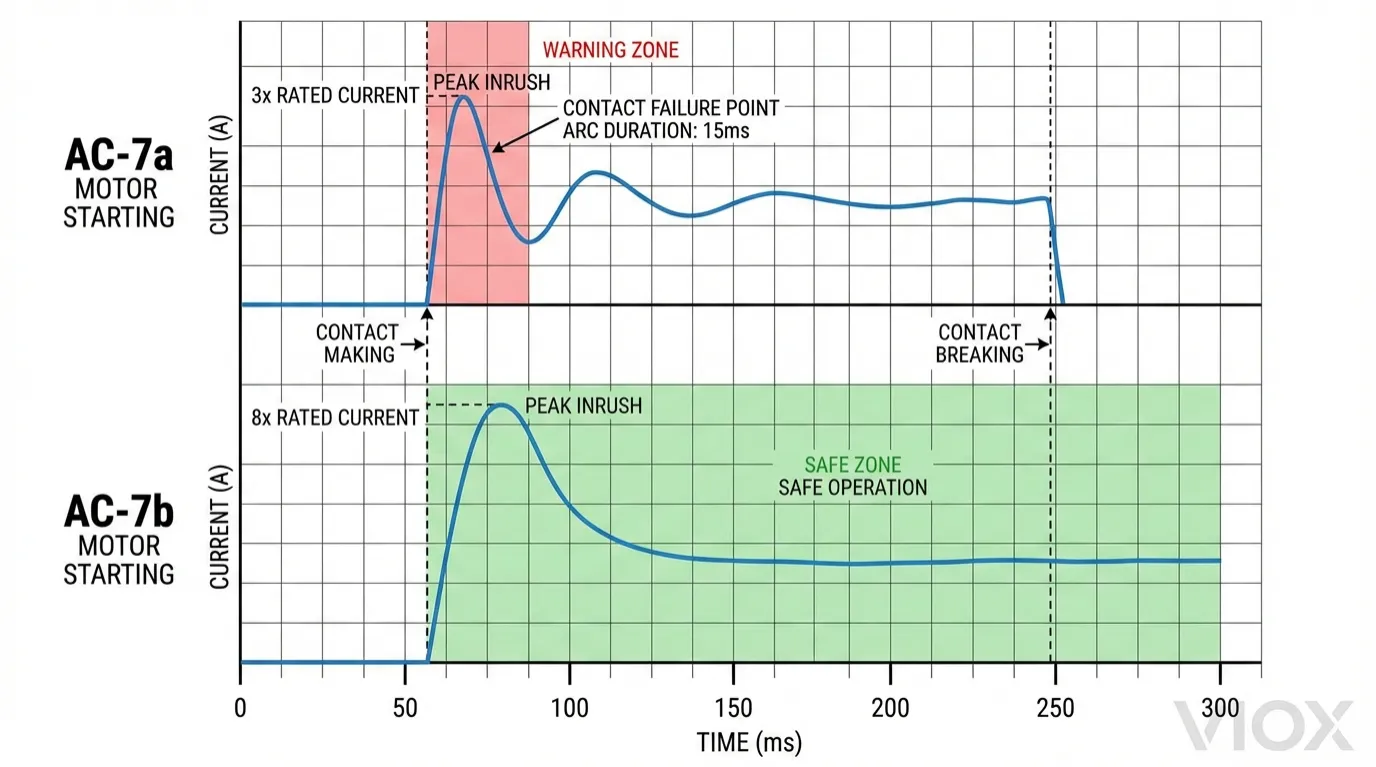
Οι επαφείς AC-7b χειρίζονται οικιακά φορτία κινητήρα με σημαντική επαγωγική αντίδραση και υψηλά ρεύματα εκκίνησης (5-8× ονομαστικό ρεύμα). Τυπικές εφαρμογές:
- Μονοφασικοί επαγωγικοί κινητήρες
- Ανεμιστήρες και συστήματα εξαερισμού
- Κεντρικές ηλεκτρικές σκούπες
- Πλυντήρια ρούχων και στεγνωτήρια
- Συμπιεστές ψύξης
- Αντλίες πισίνας και εξοπλισμός HVAC
Η κρίσιμη διαφορά: Οι επαφείς AC-7b πρέπει να αντέχουν σοβαρή ηλεκτρική καταπόνηση κατά την εκκίνηση του κινητήρα, συμπεριλαμβανομένων των υψηλών ρευμάτων εισόδου, των παροδικών τάσεων και του έντονου σχηματισμού τόξου κατά τον διαχωρισμό των επαφών.
Οι Κρίσιμες Διαφορές: AC-7a έναντι AC-7b
| Παράμετρος | AC-7a (Ελαφρώς Επαγωγικό) | AC-7b (Φορτία Κινητήρα) |
|---|---|---|
| Συντελεστής Ισχύος | ≥0,95 (σχεδόν ωμικό) | 0,45-0,85 (υψηλά επαγωγικό) |
| Ρεύμα Εισροής | 1,2-1,5× ονομαστικό ρεύμα | 5-8× ονομαστικό ρεύμα |
| Ικανότητα Δημιουργίας | Τυπικό (1,5× Ie) | Υψηλό (8-10× Ie) |
| Ικανότητα θραύσης | Χαμηλή ενέργεια τόξου | Υψηλή ενέργεια τόξου (αντεγερτική δύναμη κινητήρα) |
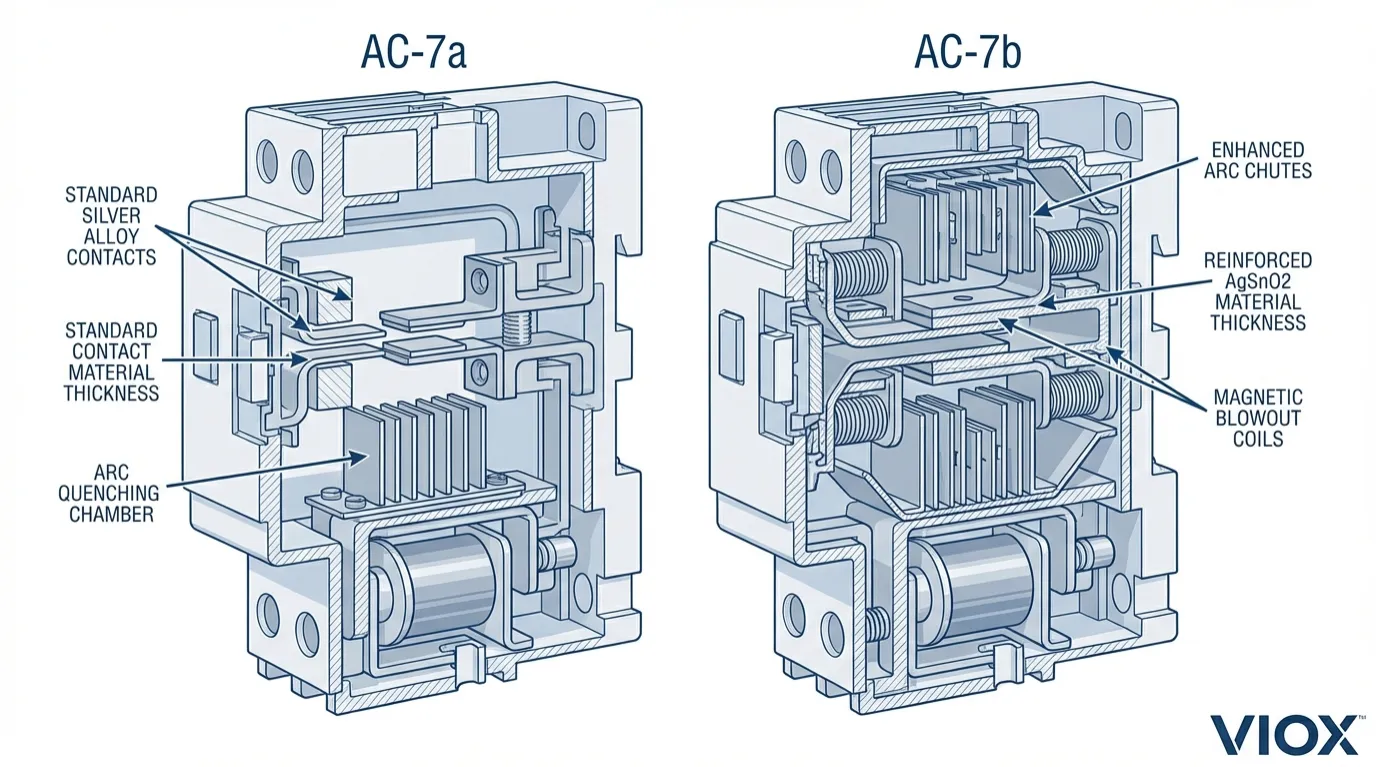
| Υλικό επικοινωνίας | Τυπικό κράμα αργύρου | AgSnO2 ή AgCdO (ανθεκτικό στο τόξο) |
| Καταστολή τόξου | Ελάχιστες απαιτήσεις | Βελτιωμένοι αγωγοί τόξου + μαγνητική εκτόξευση |
| Ηλεκτρική ζωή | 100.000-500.000 λειτουργίες | 50.000-100.000 λειτουργίες |
| Μηχανική διάρκεια ζωής | 1-10 εκατομμύρια λειτουργίες | 1-5 εκατομμύρια λειτουργίες |
| Τυπική ονομαστική τιμή ρεύματος | Έως 63A | Υποβαθμισμένο σε 25-32A (ίδιο μέγεθος πλαισίου) |
| Ισχύς Διατήρησης Πηνίου | Πρότυπο | Υψηλότερη (για την αποφυγή αποσύνδεσης κατά τη διάρκεια πτώσεων τάσης) |
| Συμμόρφωση με τα πρότυπα | Πίνακας 6 IEC 61095 | Πίνακας 7 IEC 61095 |
Βασική ιδέα: Ένας επαφέας AC-7b με ονομαστική τιμή 25A μπορεί να χειριστεί το ίδιο φορτίο κινητήρα που θα απαιτούσε ένας επαφέας AC-7a 63A—αλλά μόνο ο σχεδιασμός AC-7b επιβιώνει από τα παροδικά φαινόμενα εκκίνησης.
Γιατί οι επαφείς AC-7a αστοχούν σε φορτία κινητήρα
1. Συγκόλληση Επαφών από Ρεύμα Εισόδου
Όταν ένας κινητήρας ξεκινά, το ρεύμα εισόδου (συνήθως 6-8× ονομαστικό ρεύμα για 100-300ms) δημιουργεί μια μαγνητική δύναμη μεταξύ των επαφών που μπορεί να υπερβεί την πίεση του ελατηρίου επαφής. Στους επαφείς AC-7a με ελαφρύτερη τάση ελατηρίου, αυτό προκαλεί:
- Αναπήδηση επαφών κατά το κλείσιμο, δημιουργώντας πολλαπλά χτυπήματα τόξου
- Μικροσυγκόλληση στις επιφάνειες επαφής από επαναλαμβανόμενο σχηματισμό τόξου
- Προοδευτική υποβάθμιση έως ότου οι επαφές συγκολληθούν μόνιμα κλειστές
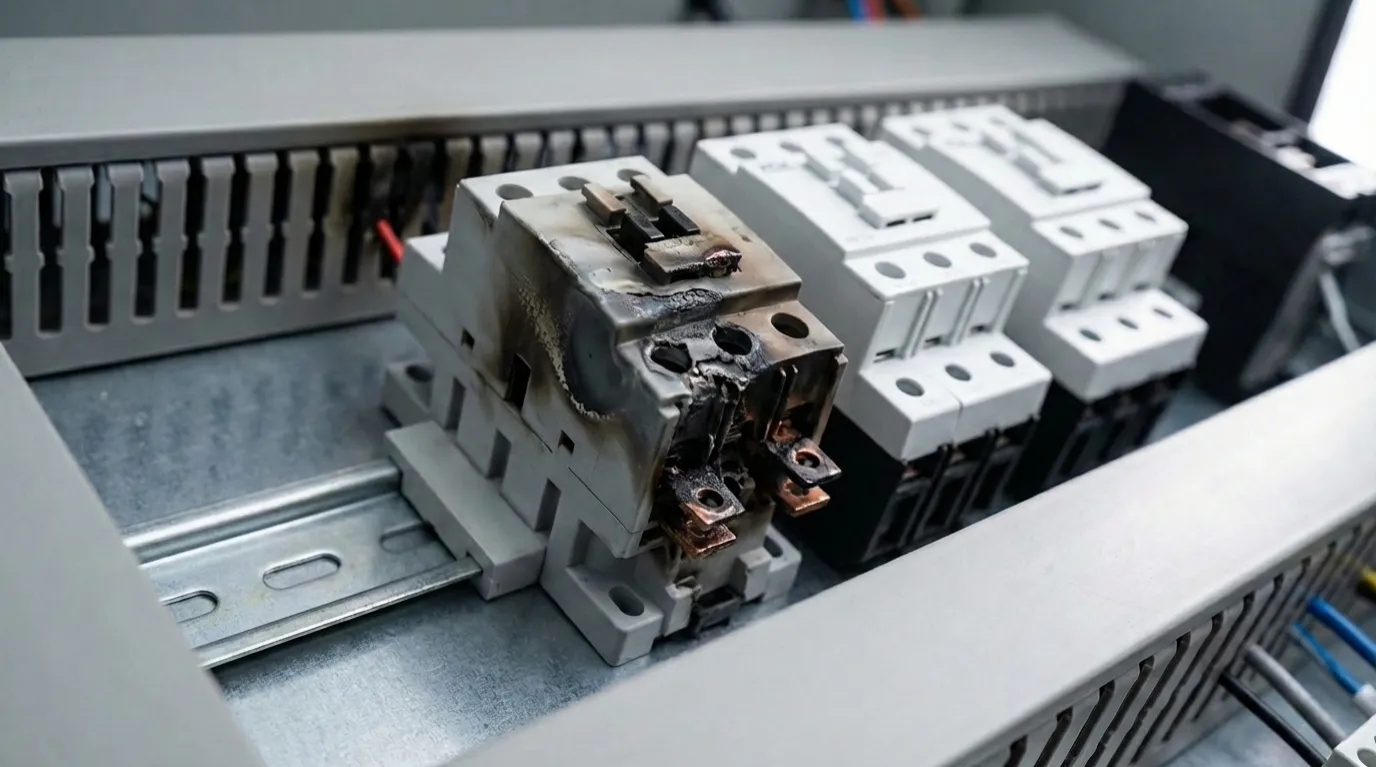
Παράδειγμα πραγματικού κόσμου: Ένας επαφέας AC-7a 16A που ελέγχει έναν κινητήρα αντλίας πισίνας 1,5kW (7A) υφίσταται ρεύμα εισόδου 56A. Οι επαφές, σχεδιασμένες για μέγιστη ικανότητα δημιουργίας 24A (1,5× 16A), υφίστανται άμεση ζημιά. Μετά από 50-100 εκκινήσεις, οι επαφές συγκολλώνται κλειστές, προκαλώντας τη συνεχή λειτουργία του κινητήρα και τελικά την υπερθέρμανση.
2. Αστοχία Απόσβεσης Τόξου
Τα φορτία κινητήρα παρουσιάζουν ένα υστερών συντελεστής ισχύος (0.45-0.85), που σημαίνει ότι το ρεύμα και η τάση είναι εκτός φάσης. Όταν ανοίγει ο επαφέας:
- Το ρεύμα συνεχίζει να ρέει λόγω της αυτεπαγωγής του κινητήρα (αντεγερτική δύναμη)
- Η τάση τόξου μπορεί να φτάσει τις 2-3 φορές την τάση τροφοδοσίας
- Οι επαφές AC-7a δεν διαθέτουν επαρκείς αγωγούς τόξου και μαγνητική εκτόξευση
- Η παρατεταμένη δημιουργία τόξου διαβρώνει το υλικό των επαφών και ανθρακοποιεί τη μόνωση
3. Θερμική Υπερφόρτωση
Η υψηλότερη ενέργεια I²t κατά την εκκίνηση του κινητήρα θερμαίνει τις επαφές πέρα από τα θερμικά όρια σχεδιασμού τους. Οι επαφείς AC-7a συνήθως χρησιμοποιούν:
- Λεπτότερο υλικό επαφών (0.5-1mm έναντι 1.5-2mm σε AC-7b)
- Ψύκτρες χαμηλότερης θερμικής μάζας
- Τυπικές συνδέσεις ακροδεκτών χωρίς ενισχυμένη ψύξη
Αποτέλεσμα: Η αντίσταση επαφής αυξάνεται, δημιουργώντας έναν θετικό βρόχο ανάδρασης θέρμανσης → οξείδωσης → υψηλότερης αντίστασης → περισσότερης θέρμανσης.
Πώς να επιλέξετε τον σωστό επαφέα
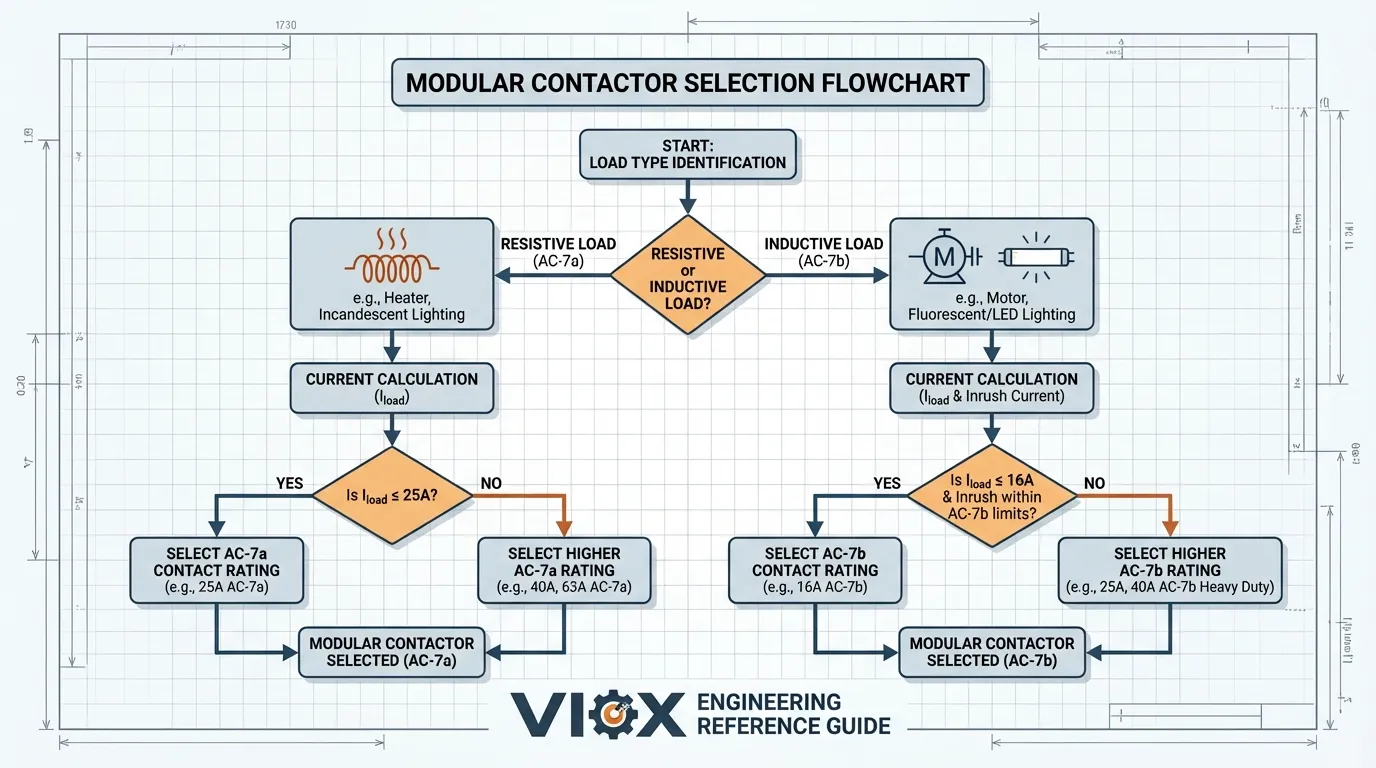
Βήμα 1: Προσδιορίστε τα Χαρακτηριστικά Φορτίου
Χρησιμοποιήστε AC-7a για:
- Αντιστάσεις θέρμανσης (συντελεστής ισχύος >0.95)
- Κυκλώματα φωτισμού (LED, φθορισμού με PFC)
- Συσκευές χωρίς κινητήρα
- Φορτία με ελάχιστη αύξηση κατά την εκκίνηση
Χρησιμοποιήστε AC-7b για:
- Οποιονδήποτε μονοφασικό κινητήρα (ανεμιστήρες, αντλίες, συμπιεστές)
- Τριφασικούς κινητήρες ≤2.2kW σε οικιακά περιβάλλοντα
- Φορτία με ρεύμα εκκίνησης >3× ονομαστικό ρεύμα
- Εξοπλισμό με συχνούς κύκλους εκκίνησης/διακοπής
Βήμα 2: Υπολογίστε την Απαιτούμενη Ονομαστική Τιμή Ρεύματος
Για φορτία AC-7a:
Για φορτία κινητήρα AC-7b:
Αλλά επαληθεύστε: Ικανότητα δημιουργίας επαφής επαφέα ≥ Ρεύμα μπλοκαρισμένου ρότορα κινητήρα (συνήθως 6-8× FLA)
Παράδειγμα υπολογισμού:
- Κινητήρας: 1.1kW, 230V, μονοφασικός
- Ρεύμα Πλήρους Φορτίου: 5.5A
- Ρεύμα Μπλοκαρισμένου Ρότορα: 33A (6× FLA)
- Απαιτείται: Επαφέας AC-7b με ονομαστική τιμή ≥7A (5.5 × 1.25)
- Επαληθεύστε την ικανότητα δημιουργίας επαφής: Πρέπει να χειριστεί εισροή 33A
Ένας επαφέας 16A AC-7b (ικανότητα δημιουργίας επαφής ~128A) είναι κατάλληλος. Ένας επαφέας 16A AC-7a (ικανότητα δημιουργίας επαφής ~24A) θα αποτύγχανε αμέσως.
Βήμα 3: Λάβετε υπόψη τους Επιχειρησιακούς Παράγοντες
| Παράγοντας | Επίπτωση στην Επιλογή |
|---|---|
| Duty Cycle | >10 εκκινήσεις/ώρα απαιτούν AC-7b ακόμη και για “ελαφρούς” κινητήρες |
| Θερμοκρασία περιβάλλοντος | >40°C απαιτεί μείωση της ονομαστικής τιμής (συνήθως 0.9× ανά 10°C) |
| Υψόμετρο | >2000m απαιτεί μείωση της ονομαστικής τιμής (0.95× ανά 1000m) |
| Τάση πηνίου | Αντιστοιχίστε την τάση του κυκλώματος ελέγχου. χρησιμοποιήστε πηνία DC για ανοσία στον θόρυβο |
| Βοηθητικές επαφές | Εξασφαλίστε επαρκείς επαφές NO/NC για αλληλομπλοκάρισμα |
Μάθετε περισσότερα σχετικά με την επιλογή αρθρωτών επαφέων
Συνηθισμένα Λάθη και Πώς να τα Αποφύγετε
Λάθος #1: Υποθέτοντας ότι “Υψηλότερη Ένταση Ρεύματος = Καλύτερα”
Λάθος: “Θα χρησιμοποιήσω έναν επαφέα 63A AC-7a για έναν κινητήρα 10A - περισσότερη χωρητικότητα σημαίνει περισσότερη ασφάλεια.”
Σωστό: Ένας επαφέας 25A AC-7b είναι η σωστή επιλογή. Το AC-7a δεν διαθέτει το υλικό επαφών και την καταστολή τόξου που απαιτούνται για την εκκίνηση του κινητήρα, ανεξάρτητα από την ονομαστική τιμή ρεύματος.
Λάθος #2: Αγνοώντας τη Μείωση της Ονομαστικής Τιμής για Μικτά Φορτία
Όταν ελέγχετε τόσο αντιστάσεις όσο και φορτία κινητήρα στον ίδιο επαφέα (π.χ., θερμαντήρας + ανεμιστήρας), χρησιμοποιείτε πάντα την ονομαστική τιμή AC-7b. Το επαγωγικό στοιχείο κυριαρχεί στους μηχανισμούς αστοχίας.
Παράδειγμα: Ένας θερμαντήρας μπάνιου με θερμαντικό στοιχείο 2kW (8.7A) και κινητήρα ανεμιστήρα 50W (0.2A). Συνολικό ρεύμα: 8.9A.
- Λανθασμένο: Επαφέας 16A AC-7a (ονομαστική τιμή για φορτίο αντίστασης)
- Σωστό: Επαφέας 16A AC-7b (μειωμένη ονομαστική τιμή για στοιχείο κινητήρα)
Λάθος #3: Παραβλέποντας τη Συχνή Εναλλαγή
Οι επαφείς AC-7b έχουν σχεδιαστεί για περιστασιακή εκκίνηση (συνήθως <5 εκκινήσεις/λεπτό). Οι εφαρμογές που απαιτούν συχνούς κύκλους ενεργοποίησης/απενεργοποίησης (π.χ., βραχυκύκλωμα συμπιεστή) χρειάζονται:
- Αναβαθμισμένο επαφέα AC-7b με υψηλότερη ονομαστική τιμή ηλεκτρικής διάρκειας ζωής
- Κυκλώματα ομαλής εκκίνησης για μείωση του ρεύματος εισροής
- Ρελέ χρονικής καθυστέρησης για την αποφυγή γρήγορης κυκλοφορίας
Αναβάθμιση από AC-7a σε AC-7b: Πρακτικές Σκέψεις
Φυσική Συμβατότητα
Οι περισσότερες οικογένειες αρθρωτών επαφέων προσφέρουν βαθμολογίες AC-7a και AC-7b στο ίδιο αποτύπωμα ράγας DIN:
| Μέγεθος Πλαισίου | Ονομαστική Τιμή AC-7a | Ονομαστική Τιμή AC-7b | Μονάδες DIN |
|---|---|---|---|
| Μικρό | 25A | 16A | 2 ενότητες |
| Μεσαίο | 40A | 25A | 3 μονάδες |
| Μεγάλο | 63A | 32A | 4 μονάδες |
Συμβουλή Αναβάθμισης: Όταν αντικαθιστάτε έναν αποτυχημένο επαφέα AC-7a, το ισοδύναμο AC-7b συνήθως ταιριάζει στον ίδιο χώρο τοποθέτησης, αλλά απαιτεί επαλήθευση της διαστασιολόγησης των καλωδίων των ακροδεκτών για το μειωμένο ρεύμα.
Ανάλυση κόστους
Οι επαφείς AC-7b κοστίζουν περίπου 20-40% περισσότερο από τα ισοδύναμα μοντέλα AC-7a λόγω:
- Βελτιωμένα υλικά επαφών (AgSnO2 έναντι τυπικού ασημιού)
- Ενισχυμένα εξαρτήματα καταστολής τόξου
- Μόνωση πηνίου υψηλότερης ποιότητας
- Εκτεταμένες απαιτήσεις δοκιμών και πιστοποίησης
Υπολογισμός ROI: Το επιπλέον κόστος αποπληρώνεται μετά την πρώτη αποτροπή αστοχίας. Μια τυπική κλήση σέρβις για αντικατάσταση επαφέα κοστίζει €150-300 μόνο σε εργασία, συν τον χρόνο διακοπής λειτουργίας του εξοπλισμού.
Καλωδίωση και Ενοποίηση Ελέγχου
Τόσο οι επαφείς AC-7a όσο και οι AC-7b χρησιμοποιούν πανομοιότυπες διεπαφές ελέγχου:
- Τυπικές τάσεις πηνίου: 24V, 110V, 230V AC/DC
- Διαμορφώσεις βοηθητικών επαφών: 2NO, 2NC, 2NO+2NC
- Συμβατό με Κυκλώματα ελέγχου 2 και 3 καλωδίων
- Τοποθέτηση σε ράγα DIN σύμφωνα με το IEC 60715
Προχωρημένα Θέματα: Πέρα από τη Βασική Επιλογή
Συντονισμός με Προστασία Υπερφόρτωσης
Οι επαφείς AC-7b πρέπει να συντονίζονται με θερμικά ρελέ υπερφόρτωσης ή διακόπτες κυκλώματος προστασίας κινητήρα. Η ικανότητα δημιουργίας του επαφέα πρέπει να υπερβαίνει το όριο ενεργοποίησης του ρελέ υπερφόρτωσης για να αποφευχθούν ενοχλητικές ενεργοποιήσεις κατά την εκκίνηση.
Συνιστώμενος συντονισμός:
- Ικανότητα δημιουργίας επαφέα ≥ 10× FLA κινητήρα
- Κατηγορία ενεργοποίησης ρελέ υπερφόρτωσης: 10A ή 20A ανά IEC 60947-4-1
- Προστασία βραχυκυκλώματος: Συντονισμός τύπου 2 σύμφωνα με το IEC 60947-4-1
Καταστολή Πηνίου για Επαγωγικά Φορτία
Κατά τον έλεγχο κινητήρων, το ίδιο το πηνίο του επαφέα γίνεται επαγωγικό φορτίο. Χωρίς κατάλληλη καταστολή, η απενεργοποίηση του πηνίου δημιουργεί αιχμές τάσης που μπορούν να βλάψουν τα κυκλώματα ελέγχου. Οι λύσεις περιλαμβάνουν:
- RC snubbers (δίκτυα αντίστασης-πυκνωτή) σε ακροδέκτες πηνίου
- Καταστολή Varistor (MOV) για απορρόφηση παροδικών φαινομένων
- Δίοδοι ελεύθερης κύλισης για πηνία DC
Μάθετε περισσότερα για τις τεχνικές καταστολής πηνίου
Περιβαλλοντική Μείωση
Τόσο οι βαθμολογίες AC-7a όσο και οι AC-7b υποθέτουν τυπικές συνθήκες δοκιμής (25°C περιβάλλοντος, επίπεδο θάλασσας, βαθμός ρύπανσης 2). Οι πραγματικές εγκαταστάσεις απαιτούν μείωση:
Υποβάθμιση θερμοκρασίας:
- 40°C: 100% ονομαστικό ρεύμα
- 50°C: 90% ονομαστικό ρεύμα
- 60°C: 80% ονομαστικό ρεύμα
Μείωση υψομέτρου:
- 0-2000m: 100% ονομαστικό ρεύμα
- 2000-3000m: 95% ονομαστικό ρεύμα
- 3000-4000m: 90% ονομαστικό ρεύμα
Αντιμετώπιση Προβλημάτων Αποτυχημένων Επαφέων
Συμπτώματα Εσφαλμένης Εφαρμογής AC-7a σε Φορτία Κινητήρα
- Συγκόλληση επαφών (ο επαφέας δεν ανοίγει)
- Υπερβολικός θόρυβος πηνίου κατά την εκκίνηση του κινητήρα
- Ορατή δημιουργία τόξου ή εκπομπή φωτός από το περίβλημα του επαφέα
- Μυρωδιά καμένου ή αποχρωματισμένο πλαστικό κοντά στους ακροδέκτες
- Πρόωρη αστοχία (<1000 λειτουργίες έναντι 100.000 ονομαστικών)
Διαγνωστική Διαδικασία
Βήμα 1: Επαληθεύστε τον τύπο και το ρεύμα φορτίου
- Μετρήστε το πραγματικό ρεύμα εκκίνησης του κινητήρα με αμπεροτσιμπίδα
- Σύγκριση με την ονομαστική ικανότητα κατασκευής του επαφέα
Βήμα 2: Έλεγχος της κατάστασης των επαφών
- Έλεγχος για διάβρωση, φθορά ή συγκόλληση
- Μέτρηση της αντίστασης επαφής (πρέπει να είναι <1mΩ)
Βήμα 3: Αξιολόγηση του περιβάλλοντος λειτουργίας
- Θερμοκρασία περιβάλλοντος, υγρασία, ρύπανση
- Συχνότητα μεταγωγής και κύκλος λειτουργίας
Βήμα 4: Επιλογή κατάλληλου ανταλλακτικού
- Χρήση ονομαστικής τιμής AC-7b για οποιοδήποτε φορτίο κινητήρα
- Μέγεθος για 125% τουλάχιστον του ονομαστικού ρεύματος πλήρους φορτίου του κινητήρα
- Επαλήθευση ότι η ικανότητα κατασκευής ≥ ρεύμα μπλοκαρισμένου ρότορα
Ολοκληρωμένος οδηγός αντιμετώπισης προβλημάτων επαφέα
Standards and Compliance
IEC 61095:2023
Το τρέχον πρότυπο για αρθρωτούς επαφείς σε οικιακές εφαρμογές ορίζει:
- Κατηγορίες χρήσης AC-7a, AC-7b, AC-7c (μεταγωγή πυκνωτών)
- Διαδικασίες δοκιμής για ικανότητα κατασκευής/διακοπής
- Απαιτήσεις δοκιμής αντοχής (ηλεκτρική και μηχανική διάρκεια ζωής)
- Όρια αύξησης θερμοκρασίας και θερμικές δοκιμές
- Απαιτήσεις συντονισμού βραχυκυκλώματος
Βασική αλλαγή στην έκδοση 2023: Εισαγωγή της κατηγορίας AC-7d για ηλεκτρονικά φορτία κινητήρα (κινητήρες που ελέγχονται από VFD), που υιοθετήθηκε τώρα στο IEC 60947-4-1.
Απαιτήσεις Πιστοποίησης
Οι επαφείς πρέπει να φέρουν σήματα πιστοποίησης για την προβλεπόμενη αγορά:
| Περιοχή | Απαιτούμενα σήματα | Πρότυπα αναφοράς |
|---|---|---|
| Ευρωπαϊκή Ένωση | CE, ENEC | IEC 61095, EN 61095 |
| Βόρεια Αμερική | UL, CSA | UL 60947-4-1, CSA C22.2 |
| Κίνα | ΣΥΜΒΟΎΛΙΟ πολιτιστικής συνεργασίας | GB/T 14048.4 |
| Αυστραλία | SAA, RCM | AS/NZS 60947.4.1 |
Συμμόρφωση VIOX: Όλοι οι αρθρωτοί επαφείς VIOX πληρούν τα πρότυπα IEC 61095 και UL 60947-4-1 με πιστοποίηση τρίτου μέρους για παγκόσμια πρόσβαση στην αγορά.
Βασικά συμπεράσματα
- ✅ Οι επαφείς AC-7a έχουν σχεδιαστεί για ωμικά ή ελαφρώς επαγωγικά φορτία (συντελεστής ισχύος ≥0,95) όπως θερμαντήρες και φωτισμός — θα αποτύχουν πρόωρα σε φορτία κινητήρα.
- ✅ Οι επαφείς AC-7b χειρίζονται οικιακά φορτία κινητήρα με υψηλά ρεύματα εκκίνησης (5-8× ονομαστικό ρεύμα) μέσω ενισχυμένων επαφών, βελτιωμένης καταστολής τόξου και υψηλότερης ικανότητας κατασκευής.
- ✅ Η ονομαστική τιμή ρεύματος από μόνη της δεν καθορίζει την καταλληλότητα— ένας επαφέας 63A AC-7a δεν μπορεί να ελέγξει με ασφάλεια έναν κινητήρα 10A που ένας επαφέας 25A AC-7b χειρίζεται αξιόπιστα.
- ✅ Το ρεύμα εισόδου εκκίνησης του κινητήρα είναι η κρίσιμη παράμετρος επιλογής— επαληθεύστε ότι η ικανότητα κατασκευής του επαφέα υπερβαίνει το ρεύμα μπλοκαρισμένου ρότορα του κινητήρα (συνήθως 6-8× ρεύμα πλήρους φορτίου).
- ✅ Τα μικτά φορτία απαιτούν ονομαστική τιμή AC-7b— όταν ελέγχετε τόσο ωμικά όσο και φορτία κινητήρα στον ίδιο επαφέα, χρησιμοποιείτε πάντα την προδιαγραφή AC-7b.
- ✅ Οι περιβαλλοντικοί παράγοντες απαιτούν υποβάθμιση— η υψηλή θερμοκρασία περιβάλλοντος (>40°C), το υψόμετρο (>2000m) και η συχνή μεταγωγή μειώνουν την αποτελεσματική ικανότητα ρεύματος.
- ✅ Ο σωστός συντονισμός με την προστασία υπερφόρτωσης είναι απαραίτητος— ο επαφέας πρέπει να αντέχει το ρεύμα εκκίνησης του κινητήρα χωρίς ενοχλητική ενεργοποίηση των προστατευτικών συσκευών.
- ✅ Οι επαφείς AC-7b κοστίζουν 20-40% περισσότερο από τους AC-7a αλλά αποτρέπουν καταστροφικές αστοχίες που κοστίζουν πολύ περισσότερο σε κλήσεις σέρβις, χρόνο διακοπής λειτουργίας και ζημιές στον εξοπλισμό.
- ✅ Η συμμόρφωση με το IEC 61095 εξασφαλίζει παγκόσμια πρόσβαση στην αγορά— καθορίστε επαφείς με τα κατάλληλα σήματα πιστοποίησης (CE, UL, CCC) για την περιοχή σας.
- ✅ Η αναβάθμιση από AC-7a σε AC-7b συνήθως δεν απαιτεί τροποποιήσεις στον πίνακα— οι περισσότεροι κατασκευαστές προσφέρουν και τις δύο ονομαστικές τιμές στο ίδιο αποτύπωμα ράγας DIN.
Συχνές Ερωτήσεις
Ε: Μπορώ να χρησιμοποιήσω έναν επαφέα AC-7b για εφαρμογές AC-7a;
Α: Ναι, οι επαφείς AC-7b είναι πλήρως συμβατοί με φορτία AC-7a. Τα βελτιωμένα υλικά επαφής και η καταστολή τόξου δεν παρέχουν κανένα μειονέκτημα για ωμικά φορτία, αν και πληρώνετε ένα ασφάλιστρο για δυνατότητες που δεν χρειάζεστε. Ωστόσο, η χρήση AC-7a για εφαρμογές AC-7b θα προκαλέσει αστοχία.
Ε: Πώς μπορώ να προσδιορίσω εάν ο υπάρχων επαφέας μου είναι AC-7a ή AC-7b;
Α: Ελέγξτε την πινακίδα ή το φύλλο δεδομένων για τη σήμανση της κατηγορίας χρήσης. Θα αναφέρει ρητά “AC-7a” ή “AC-7b” μαζί με την ονομαστική τιμή ρεύματος. Εάν αναφέρεται μόνο μία ονομαστική τιμή ρεύματος, είναι πιθανό να είναι AC-7a (η προεπιλογή για εφαρμογές εκτός κινητήρα). Οι επαφείς AC-7b συνήθως εμφανίζουν δύο ονομαστικές τιμές: μια υψηλότερη τιμή AC-7a και μια χαμηλότερη τιμή AC-7b.
Ε: Ποια είναι η διαφορά μεταξύ των επαφέων AC-7b και AC-3;
Α: Το AC-3 είναι μια κατηγορία βιομηχανικού επαφέα κινητήρα (IEC 60947-4-1) για τριφασικούς κινητήρες, συνήθως >3kW, με υψηλότερες ονομαστικές τιμές τάσης (έως 690V) και ονομαστικές τιμές ρεύματος (έως 1000A). Το AC-7b είναι ειδικά για οικιακούς μονοφασικούς κινητήρες ≤2,2kW με ονομαστικές τιμές ρεύματος ≤32A. Οι επαφείς AC-3 είναι υπερβολικά καθορισμένοι και πιο ακριβοί για οικιακές εφαρμογές. Μάθετε περισσότερα για τα πρότυπα επαφέων
Ε: Πόσες εκκινήσεις ανά ώρα μπορεί να χειριστεί ένας επαφέας AC-7b;
Α: Οι τυπικοί επαφείς AC-7b έχουν ονομαστική τιμή για περιστασιακή εκκίνηση, συνήθως ≤5 εκκινήσεις ανά λεπτό ή ≤10 εκκινήσεις ανά περίοδο 10 λεπτών. Για υψηλότερους κύκλους λειτουργίας (π.χ. εφαρμογές συμπιεστή), καθορίστε επαφείς με βελτιωμένες ονομαστικές τιμές ηλεκτρικής διάρκειας ζωής ή εφαρμόστε προστασία χρονικής καθυστέρησης.
Ε: Χρειάζομαι ειδική καλωδίωση για επαφείς AC-7b;
A: Όχι, οι απαιτήσεις καλωδίωσης είναι πανομοιότυπες με το AC-7a. Χρησιμοποιήστε καλώδιο με διατομή για 125% του ρεύματος πλήρους φορτίου του κινητήρα σύμφωνα με το άρθρο 430 του NEC ή το IEC 60364. Οι ακροδέκτες του επαφέα δέχονται τις ίδιες διατομές καλωδίων με το αντίστοιχο μοντέλο AC-7a.
Ε: Μπορώ να αντικαταστήσω έναν επαφέα AC-7b σε μια υπάρχουσα εγκατάσταση AC-7a;
Α: Ναι, στις περισσότερες περιπτώσεις. Βεβαιωθείτε ότι:
- Το αποτύπωμα στήριξης σε ράγα DIN ταιριάζει (συνήθως πανομοιότυπο εντός της ίδιας οικογένειας προϊόντων)
- Η διατομή των καλωδίων των ακροδεκτών είναι επαρκής για το ρεύμα του κινητήρα
- Η τάση του κυκλώματος ελέγχου ταιριάζει με την ονομαστική τάση του πηνίου του νέου επαφέα
- Η προστασία υπερφόρτωσης είναι συντονισμένη με τα χαρακτηριστικά εκκίνησης του κινητήρα
Ε: Τι προκαλεί τον “βόμβο” στους επαφείς που ελέγχουν κινητήρες;
Α: Ο βόμβος κατά την εκκίνηση του κινητήρα υποδεικνύει ότι η τάση του πηνίου πέφτει κάτω από το όριο συγκράτησης λόγω της πτώσης τάσης τροφοδοσίας από το υψηλό ρεύμα εισόδου. Αυτό είναι πιο συνηθισμένο με τους επαφείς AC-7a που δεν διαθέτουν την ενισχυμένη σχεδίαση πηνίου των μοντέλων AC-7b. Οι λύσεις περιλαμβάνουν τη χρήση πηνίου DC με ανορθωμένη τροφοδοσία ή την αναβάθμιση σε έναν επαφέα AC-7b με βελτιωμένα χαρακτηριστικά συγκράτησης πηνίου. Οδηγός αντιμετώπισης προβλημάτων
Ε: Υπάρχουν ανησυχίες για την ασφάλεια με τη χρήση της λάθος κατηγορίας επαφέα;
Α: Ναι. Ένας επαφέας που έχει αστοχήσει μπορεί να κολλήσει κλειστός, προκαλώντας τη συνεχή λειτουργία του κινητήρα, οδηγώντας σε υπερθέρμανση και πιθανούς κινδύνους πυρκαγιάς. Εναλλακτικά, οι επαφές μπορούν να κολλήσουν μερικώς, δημιουργώντας συνδέσεις υψηλής αντίστασης που παράγουν υπερβολική θερμότητα. Να χρησιμοποιείτε πάντα επαφείς AC-7b για φορτία κινητήρα για να διασφαλίσετε την ασφαλή λειτουργία και τη συμμόρφωση με τους ηλεκτρικούς κώδικες.
Συμπέρασμα
Η διάκριση μεταξύ των αρθρωτών επαφέων AC-7a και AC-7b αντιπροσωπεύει μια θεμελιώδη αρχή μηχανικής: αντιστοίχιση των προδιαγραφών των εξαρτημάτων με τις απαιτήσεις της εφαρμογής. Ενώ η επιπλέον χρέωση 20-40% για τους επαφείς AC-7b μπορεί να φαίνεται σημαντική, ωχριά σε σύγκριση με το κόστος της πρόωρης αστοχίας, των κλήσεων σέρβις και των πιθανών κινδύνων για την ασφάλεια.
Για τους επαγγελματίες ηλεκτρολόγους, τα κριτήρια επιλογής είναι σαφή: χρησιμοποιήστε AC-7a για ωμικά φορτία, AC-7b για κινητήρες - χωρίς εξαιρέσεις. Τα βελτιωμένα υλικά επαφών, τα συστήματα καταστολής τόξου και η ικανότητα δημιουργίας των επαφέων AC-7b δεν είναι προαιρετικά χαρακτηριστικά, αλλά βασικά στοιχεία σχεδιασμού για αξιόπιστο έλεγχο κινητήρα.
Καθώς ο οικιακός και ελαφρύς εμπορικός εξοπλισμός ενσωματώνει όλο και περισσότερο εξαρτήματα που κινούνται από κινητήρες (συστήματα HVAC, αντλίες θερμότητας, εξαερισμός), η σημασία της σωστής επιλογής επαφέα θα αυξηθεί μόνο. Κατανοώντας τις τεχνικές διαφορές που περιγράφονται σε αυτόν τον οδηγό και εφαρμόζοντας τη μεθοδολογία επιλογής, μπορείτε να διασφαλίσετε την αξιοπιστία, την ασφάλεια και τη μακροζωία του συστήματος.
VIOX Electric κατασκευάζει μια πλήρη σειρά αρθρωτών επαφέων με βαθμολογίες AC-7a και AC-7b, πιστοποιημένους σύμφωνα με τα πρότυπα IEC 61095 και UL 60947-4-1. Η ομάδα τεχνικής υποστήριξής μας μπορεί να βοηθήσει στην επιλογή συγκεκριμένων εφαρμογών και στον συντονισμό με τις συσκευές προστασίας. Επικοινωνήστε μαζί μας για λεπτομερείς προδιαγραφές και βοήθεια επιλογής.
Related Resources
- IEC 61095 έναντι IEC 60947-4-1: Πρότυπα οικιακών και βιομηχανικών επαφέων
- Εσωτερικά εξαρτήματα επαφέα AC: Λογική σχεδίασης
- Πώς να επιλέξετε αρθρωτό επαφέα: AC έναντι DC
- Επαφείς έναντι ρελέ: Κατανόηση των βασικών διαφορών
- Επαφέας έναντι εκκινητή κινητήρα: Πλήρης σύγκριση
- Ρελέ Ασφαλείας έναντι Τυπικού Ρελέ: Οδηγός Επαφών Καθοδηγούμενης Δύναμης
- Λίστα ελέγχου επιθεώρησης συντήρησης βιομηχανικού επαφέα
- Κατανόηση των επαφέων AC 1 πόλου έναντι 2 πόλων
- Πώς να επιλέξετε επαφείς και διακόπτες ισχύος με βάση την ισχύ του κινητήρα
- Διάγραμμα καλωδίωσης εκκινητή αστέρα-τριγώνου: Οδηγός μεγέθους & επιλογής