

Na této stránce
Do not replace an AC SPD with a DC SPD, or a DC SPD with an AC SPD, unless the exact proposed device is documented for the target circuit and installation conditions. Matching housings, a shared Type 2 designation or the same 40kA discharge rating does not establish interchangeability.
The practical problem often starts with a spare on the shelf: it clips onto the same rail, has a higher voltage number, and looks close enough to the failed unit. Before ordering or fitting it, compare the declared application, continuous voltage, protection level, connection modes, fault conditions and replacement-module compatibility.
Keep three checks separate: surge-current capacity is not the continuous voltage rating; a higher voltage rating is not proof of better equipment protection; and a cartridge that physically fits is not necessarily an approved replacement.
This is a replacement-assessment guide for electrical professionals and buyers. It is not a live changeout procedure. Inspection inside a panel, isolation, replacement and verification must follow the equipment instructions and applicable safety rules.
Can This SPD Replace the Existing One?
An SPD is a surge protective device. AC means alternating current; DC means direct current. Those labels identify the supply context, not two interchangeable versions of one universal protective component.
| Proposed substitution | Initial decision | Před schválením je vyžadován důkaz |
|---|---|---|
| AC-only SPD proposed for a DC power circuit | Reject the unsupported cross-use | Explicit DC application declaration for the exact model and configuration |
| PV DC SPD proposed for an AC board | Reject unless AC use is explicitly supported | AC voltage, protection modes, fault behavior and installation instructions |
| PV SPD proposed for a battery bus | Hold for source-specific review | Battery-system suitability, available fault current and coordinated disconnection |
| Same model family, different voltage cartridge | Pozdržet | Approved cartridge/base pairing and the required voltage-protection characteristics |
| Exact manufacturer-approved replacement | Candidate for verification | Confirmation that circuit conditions and installation requirements still match |
“Hold” means the information is insufficient. It does not mean the substitute has been proved unsafe or suitable. “Candidate” still requires installation-specific verification.
For basic operating principles, use the SPD overview. The question here is whether a particular replacement can perform the required job.
What Changes Between AC and DC SPDs?
An SPD remains exposed to the normal circuit voltage while waiting for a transient. The source also determines the conditions it faces if a protective element fails or a disconnector operates. A successful surge-current test does not answer every continuous-voltage or short-circuit question.
| Difference to check | obvod AC | DC obvod | Důsledky náhrady |
|---|---|---|---|
| Trvalé napětí | Declared AC voltage and frequency | Declared DC voltage and source range | Do not transfer a number between AC and DC labels |
| Režimy ochrany | May include L-N, L-PE or N-PE, depending on system | May include positive-negative and conductor-to-PE modes | Match the exact diagram and grounding arrangement |
| Fault-source behavior | Depends on the AC source and installation | Differs among PV, batteries, converters and other DC sources | Verify short-circuit and disconnection evidence for that source |
| Úroveň ochrany | Declared for particular tests and modes | Also mode- and test-dependent | Confirm suitability for the protected equipment, not only voltage survival |
| Replacement hardware | Exact assembly/base requirements apply | Exact assembly/base requirements apply | Similar terminals and module width do not establish compatibility |
AC fault current has periodic current zero crossings; DC does not have the same periodic behavior. That matters where interruption or follow-current extinction is involved. It does ne prove that every DC SPD contains the same arc-control mechanism, or that every AC SPD has identical internals. Treat the complete product’s documented behavior as the evidence.
The distinction is reflected in the product standards. IEC 61643-11:2025, including its October 2026 corrected version, addresses AC low-voltage power SPDs and is applied with IEC 61643-01. IEC 61643-41:2025 addresses eligible DC power applications, also with Part 01, and excludes PV applications. A standard number identifies a test framework; it does not certify a particular replacement.
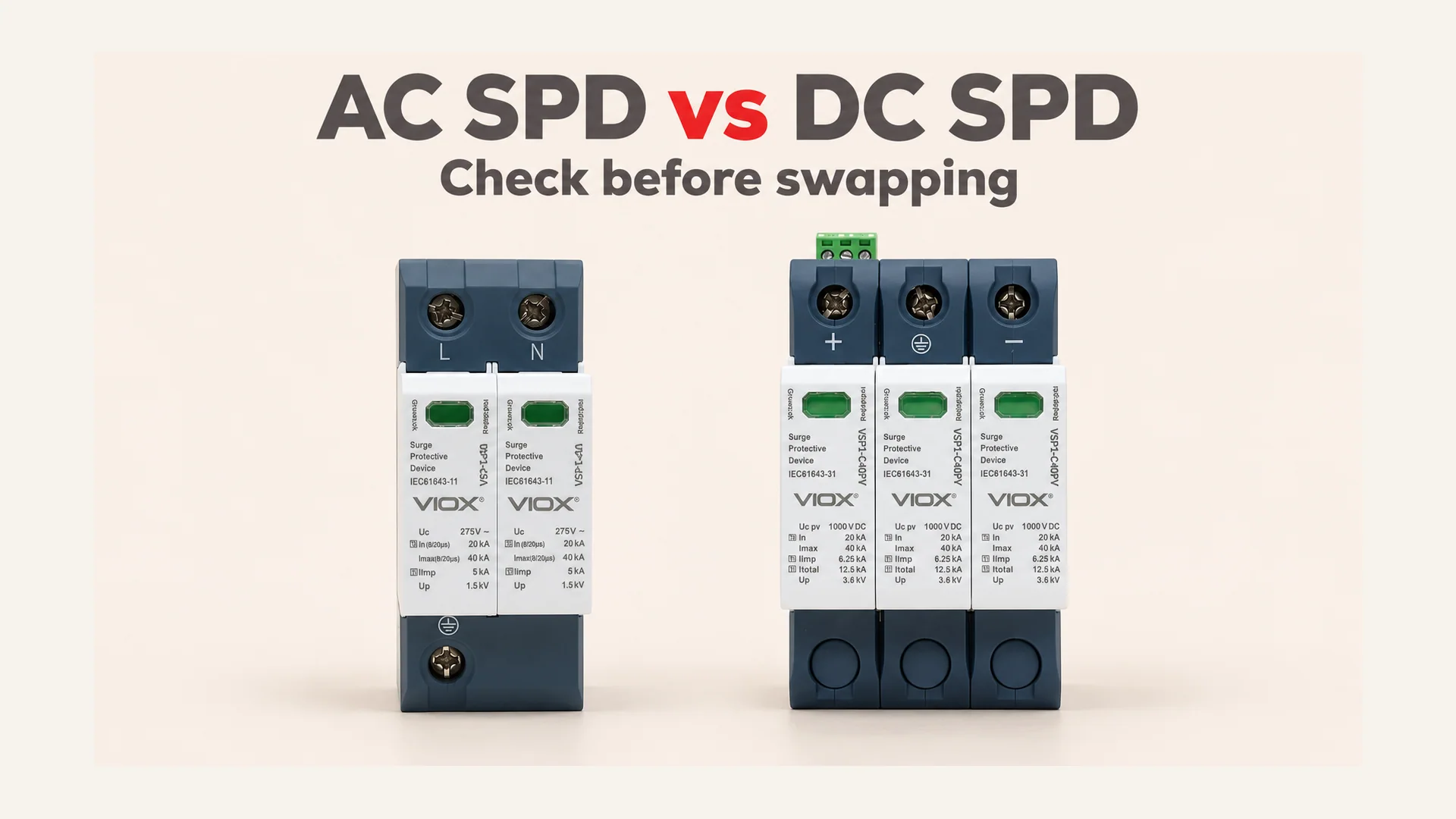
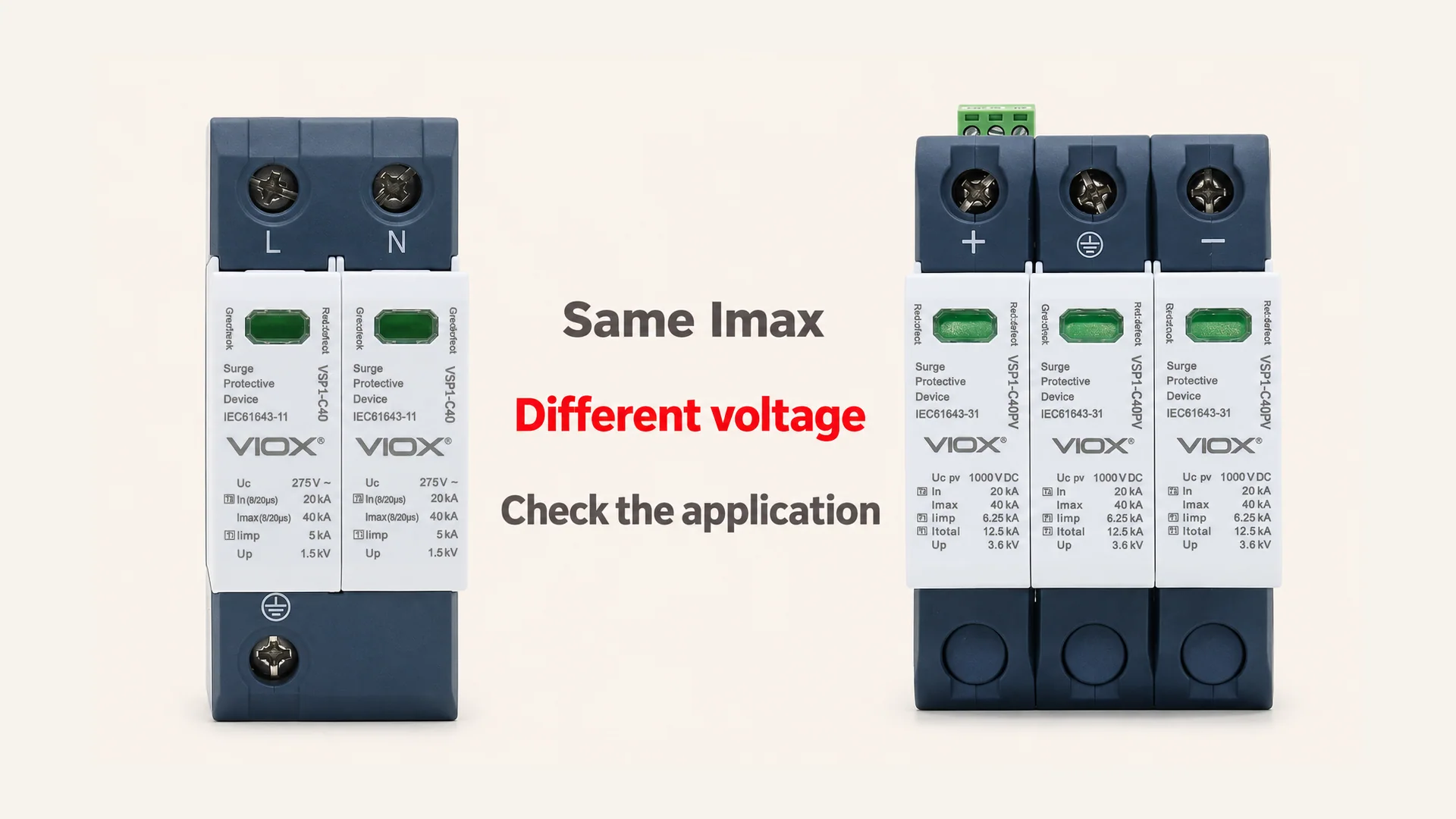
Same 40kA, Different VIOX Products
Two actual VIOX products show why one shared rating cannot approve a swap. The following is a comparison of published information, not an independent test or an installation recommendation.
| Published item | VSP1-C40/2(S) AC family | VSP1-C40PV/3(S) 1000V(D4) |
|---|---|---|
| Continuous-voltage information | Family page has multiple AC voltage variants; pictured unit is marked 275V AC | Specific PV DC listing states 1000V DC |
| Nominal discharge current In | 20kA, 8/20 microseconds | 20kA, 8/20 microseconds |
| Maximum discharge current Imax | 40kA, 8/20 microseconds | 40kA, 8/20 microseconds |
| Published voltage protection level Up | 1.5kV for the 275V AC column | 3.6kV in this specific listing |
| Published protection mode | L-PE and N-PE | DC-positive-to-PE and DC-negative-to-PE |
| Replacement conclusion | Exact variant and circuit still need checking | Same Imax does not establish AC or battery-bus suitability |
Zdroje: VIOX VSP1-C40/2(S) a VIOX VSP1-C40PV/3(S) 1000V(D4). Values are public catalog information; request the exact variant’s current technical documents before specification. These catalog references do not establish testing to the latest standard edition.
Both listings show 40kA Imax. That is a maximum discharge-current declaration under the stated impulse test, not a normal load-current rating and not permission to exchange their applications. The AC family page also contains multiple voltage variants, so the family name alone is insufficient to order a spare.
Can a Higher-Voltage DC SPD Replace a Lower-Voltage AC SPD?
A larger voltage number does not answer that question. It may describe a different supply waveform, a different conductor pair or a different product test basis.
Consider a buyer offered a 1000V PV SPD instead of a 275V AC variant because “1000 is higher.” Two questions remain unanswered:
- Does the manufacturer approve that exact model for the proposed AC circuit and protection modes?
- Is its declared protection level, together with the installed connection, suitable for the equipment being protected?
A device can have a high continuous-voltage rating without providing the required voltage limitation for a lower-voltage circuit. Conversely, an AC rating cannot be converted into a permissible DC application simply by calculating the AC peak voltage. That calculation says nothing about the complete SPD’s fault behavior, disconnector or application declaration.
If one exact product has explicit AC and DC declarations, evaluate each declared application separately. This is a documented exception to an assumption, not evidence that ordinary AC and DC cartridges can be exchanged. For parameter interpretation, refer to the SPD datasheet-reading guide rather than guessing a conversion rule.
Does “DC Rated” Include Both PV Strings and Batteries?
Not automatically. A photovoltaic source and a battery-backed bus can present different source and fault conditions. The phrase “DC SPD” does not identify all of those conditions.
IEC 61643-31:2018 addresses SPDs dedicated to the DC side of PV generators and inverters; its published scope excludes SPDs for PV systems with energy storage. IEC 61643-41 separately addresses non-PV DC power within its scope. These boundaries require checking the actual circuit, not rejecting or approving every product from its marketing category alone.
For a battery-bus replacement, ask for documentation addressing that application, the maximum DC voltage, source fault conditions, protection modes and the required backup arrangement. A PV declaration alone does not complete that review.
Full source-specific selection stays in the průvodce výběrem DC SPD. For PV string voltage and placement, use the solar SPD guide.
What If Only the Plug-In Cartridge Needs Replacing?
Record both the cartridge reference and the base reference. Do not assume that modules sharing a brand, width, color or latch shape are equivalent. The proposed pairing must be supported by the manufacturer’s replacement information, with the required voltage variant and protection function preserved.
Keep the spare-order question specific: “Is cartridge X approved for base Y in this circuit?” A photograph can help identify the part; it cannot establish an approved combination or reveal hidden contact and disconnector construction.
The existing installation needs checking too. An approved replacement part does not prove that the original SPD selection was correct, that the base is undamaged or that the circuit has remained unchanged.
Five Checks Before Approving the Substitute
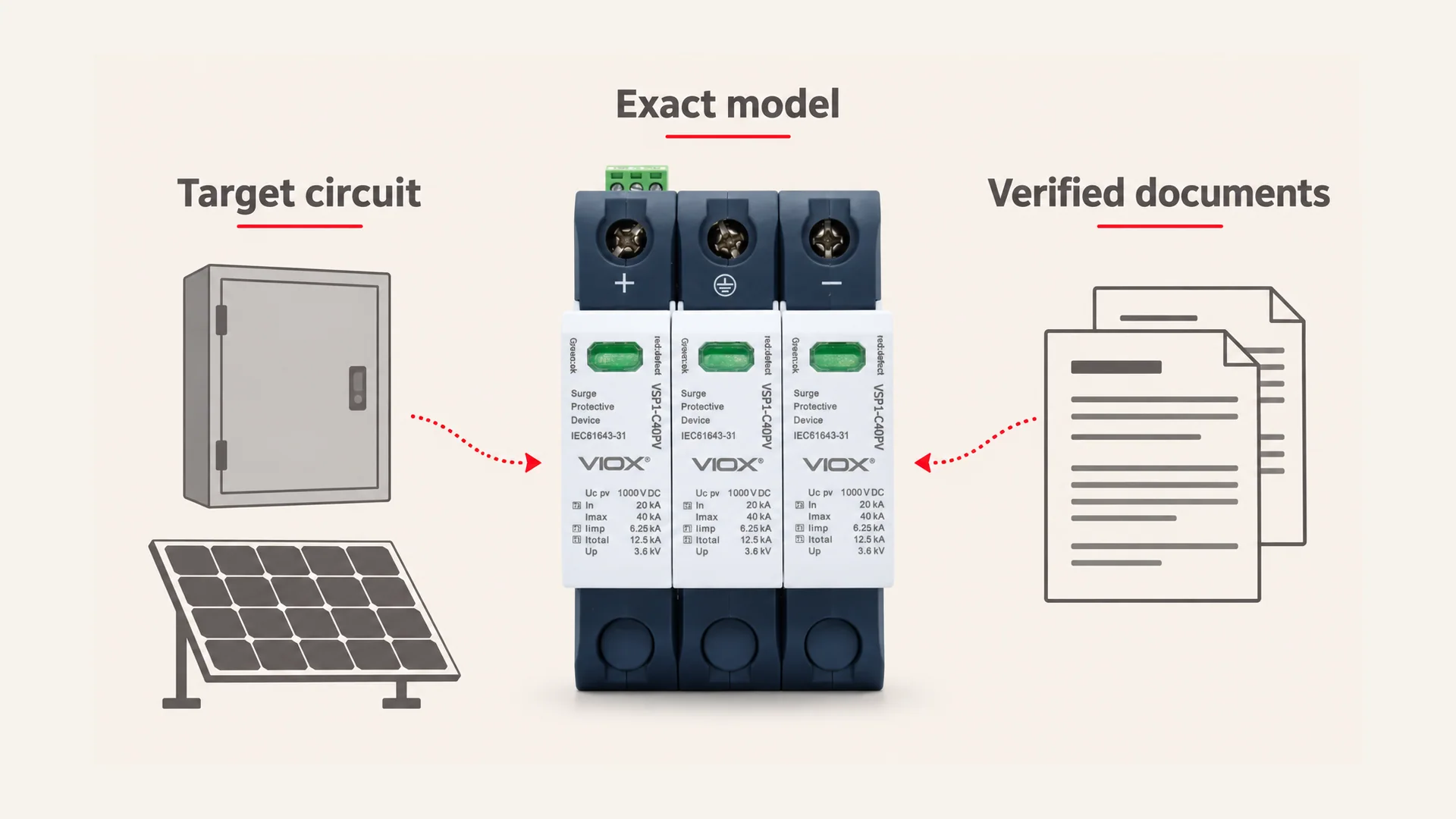
Use this record for the original device, the proposed replacement and the target circuit. A missing consequential field keeps the proposal on hold.
| Zkontrolujte | Co zaznamenat | Podmínka zastavení |
|---|---|---|
| 1. Identity and application | Full model/variant; base and cartridge references where applicable; AC, PV DC or other DC use | Only a family name, photo or generic sales claim is available |
| 2. Voltage and protection | Maximum continuous voltage for each mode; relevant protection level and equipment requirement | Proposal relies only on a higher voltage number or an AC/DC arithmetic conversion |
| 3. Connection arrangement | Target grounding system and the exact approved protection-mode diagram | Terminal count or markings are treated as sufficient wiring evidence |
| 4. Fault coordination | Application-specific short-circuit declaration, disconnector conditions and permitted fuse/breaker arrangement | An AC fault rating or an unqualified backup-fuse value is copied to a DC installation |
| 5. Replacement approval | Manufacturer-confirmed assembly/module combination and verification requirements | The argument ends at physical fit or a green status window |
Do not copy a fuse rating from a neighboring catalog column without its conditions. Require the manufacturer’s arrangement for the exact SPD, supply and available fault current. When information is incomplete, ask for clarification rather than presenting an unverified combination as compliant.
Send This Request Before Ordering a Replacement
Please confirm whether proposed SPD [full model and variant] can replace [existing full reference] on [AC / PV DC / other DC circuit] for [destination market]. The system’s maximum voltage is [value], grounding arrangement is [description], and prospective fault-current information is [reference]. Please provide the applicable standard edition and model-specific test documentation, approved protection-mode diagram, continuous-voltage and protection-level declarations, application-specific short-circuit and backup-protection requirements, and cartridge/base compatibility where relevant. Identify any conditions that prevent direct replacement.
For a VIOX proposal, start with the published SPD range and provide clear photographs of the existing label and base alongside the circuit information. Request model-specific documents; neither the product photograph nor the family listing substitutes for them.
The replacement record should end with one explicit outcome: rejected because of an identified mismatch; held pending named evidence; or accepted by the responsible professional against documented conditions. That is a usable decision. “Both say 40kA” is not.
Written by the VIOX Editorial Team. Technical sources and editorial content reviewed 4 November 2026. Product examples use public VIOX information and do not constitute certification or approval of a particular installation.