

Nesta página
Resposta Rápida
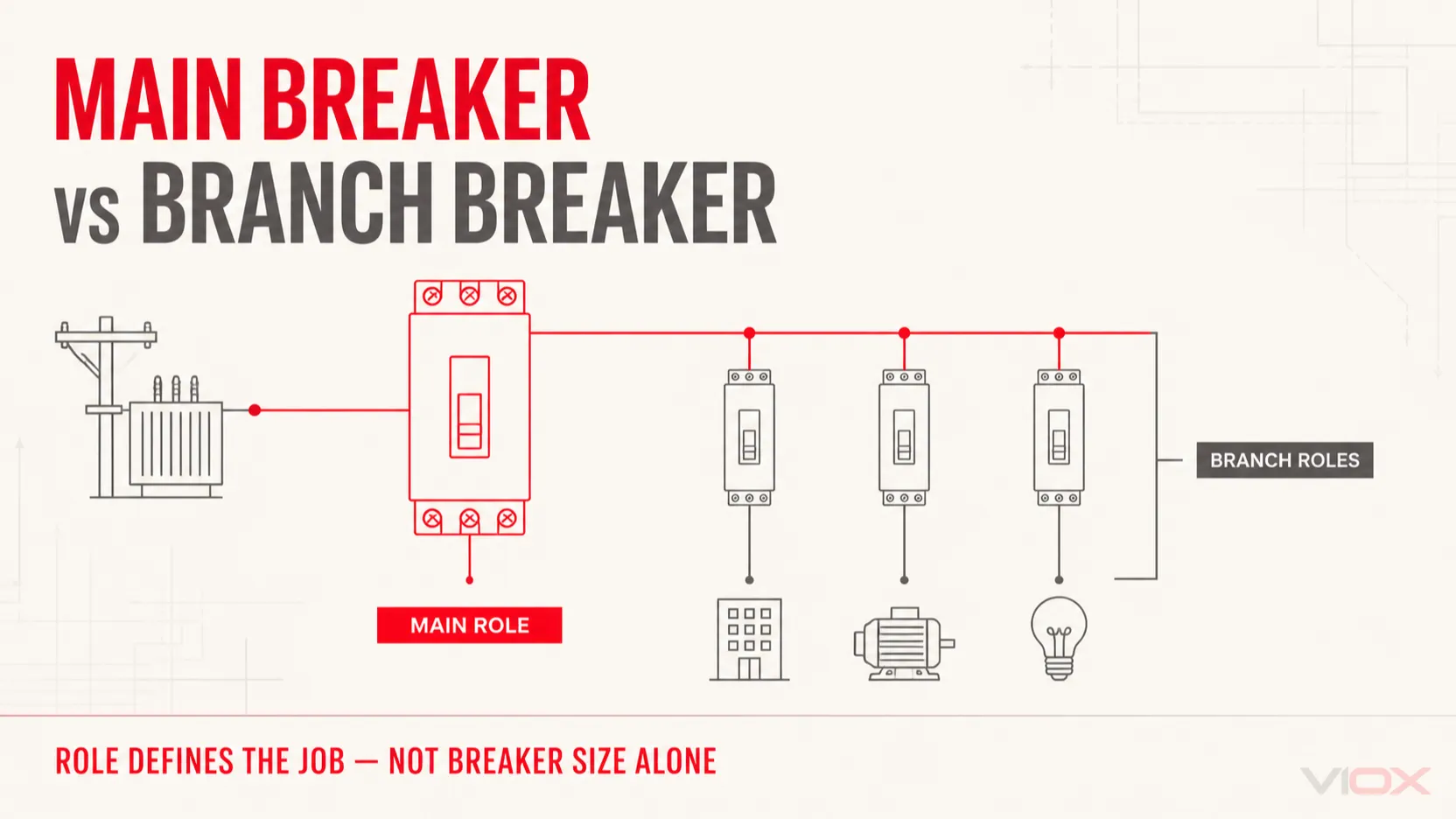
Um o disjuntor principal é um disjuntor designado para o lado a montante de um painel, seção de barramento ou sistema elétrico de distribuição. Ele pode desconectar e proteger o grupo de circuitos a jusante dentro de sua zona definida. Um disjuntor de circuito derivado é um dispositivo a jusante designado para um circuito de saída ou grupo de carga.
A distinção refere-se ao papel no sistema, não a uma construção universal de disjuntor. Dependendo da montagem e da aplicação, um disjuntor principal pode ser um disjuntor de ar (ACB), um MCCB ou outro dispositivo aprovado. Um disjuntor derivado pode ser um MCCB, um MCB ou um dispositivo de proteção especializado. A posição, a classificação de corrente e o tamanho físico, por si sós, não comprovam a função.
A regra prática é:
Principal = proteção e seccionamento do grupo a montante. Derivação = proteção e isolamento do circuito a jusante. A seletividade entre eles deve ser verificada; não é automática.
Disjuntor principal vs. disjuntor de circuito de derivação em resumo
| Ponto de comparação | Disjuntor principal | Disjuntor do circuito de ramal |
|---|---|---|
| Posição no sistema | A montante de um barramento, seção de painel, grupo de alimentadores ou dispositivos a jusante | A jusante do dispositivo principal ou de outro dispositivo alimentador |
| Zona de proteção primária | Condutores de entrada e/ou a seção de distribuição e o grupo a jusante, conforme definido pelo projeto | Uma derivação de saída, alimentador, máquina ou grupo de carga |
| Efeito de abertura manual | Remove a energia das cargas controladas por esse disjuntor principal | Remove a energia apenas do seu circuito designado |
| Objetivo de isolamento de falhas | Atua em falhas na sua zona ou como reserva quando a coordenação assim o exige | Deve eliminar uma falha na sua própria zona antes de um disjuntor principal a montante em bom estado, quando a seletividade é alcançada |
| Famílias de produtos típicas | ACB, MCCB, disjuntor principal seletivo ou outro disjuntor aprovado | MCB, MCCB, RCBO ou outro disjuntor específico para a aplicação |
| Base de dimensionamento | Fonte, alimentador, barramento/conjunto, nível de falta, coordenação a jusante, regime de operação | Condutores, carga, corrente de partida, nível de falta, função de proteção necessária, coordenação a montante |
| Principal risco de projeto | O disparo desnecessário a montante causa uma interrupção ampla; uma classificação inadequada pode expor o conjunto | Uma classificação ou curva incorreta pode falhar na proteção do ramal ou causar disparos indevidos |
| Evidências necessárias | Diagrama unifilar, estudo de carga e falta, dados do conjunto, ajustes do disjuntor, tabelas de coordenação | Dados de projeto de derivação, curva/ajustes do disjuntor, nível de falta, compatibilidade de montagem, tabelas de coordenação |
Esta comparação aplica-se de forma abrangente à distribuição de baixa tensão, mas a terminologia exata e os requisitos diferem entre os sistemas IEC e norte-americanos. Utilize sempre o diagrama unifilar do projeto, as regras de instalação aplicáveis, a documentação da montagem e os dados exatos do disjuntor.
O Mapa de Funções do Sistema
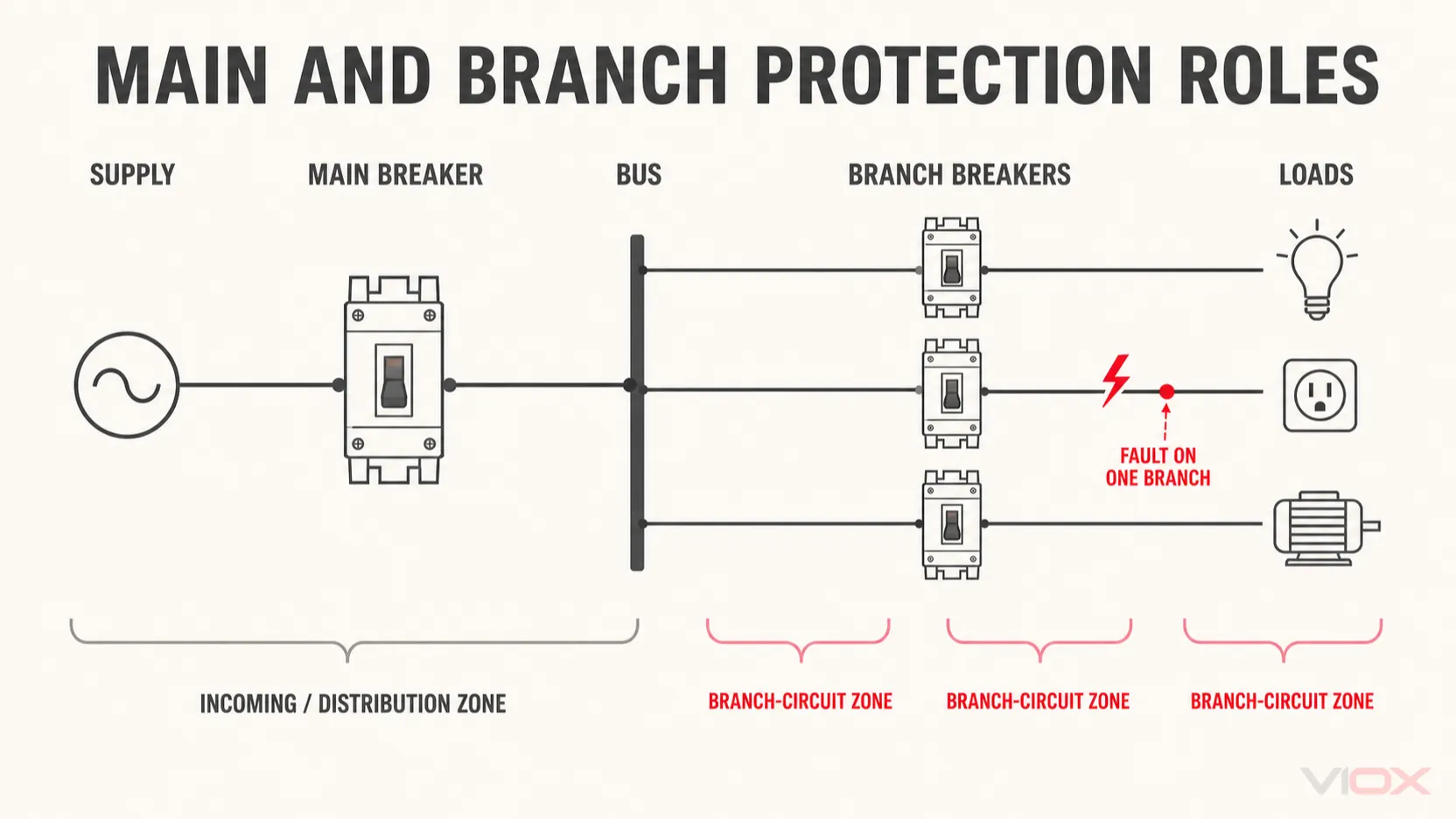
Um caminho de distribuição simplificado tem este aspeto:
Alimentação / transformador
        ↓
Disjuntor principal
        ↓
Barramento do painel ou quadro de distribuição
        ↓
Disjuntores de derivação
        ↓
Circuitos de saída e cargas
As etiquetas descrevem onde cada dispositivo se situa na hierarquia de proteção. Elas não definem a sua tecnologia interna.
O disjuntor principal é normalmente o dispositivo do lado da linha ou a montante para os disjuntores a jusante conectados ao seu barramento. Cada disjuntor de derivação é um dispositivo do lado da carga ou a jusante em relação a esse principal. Em uma instalação maior, o mesmo MCCB pode ser um dispositivo de derivação em um quadro de distribuição e o dispositivo principal para um painel a jusante. A função depende do limite que está sendo descrito.
O que o disjuntor principal faz
Dentro do limite do seu sistema declarado, um disjuntor principal pode fornecer duas funções importantes:
- Proteção contra sobreintensidades: ele responde de acordo com suas características de disparo quando a corrente através do principal excede o limite e a duração aplicáveis.
- Desconexão de grupo: abri-lo desconecta o barramento a jusante e os circuitos alimentados através desse dispositivo.
Essas funções devem ser declaradas cuidadosamente. Um disjuntor principal não protege necessariamente cada condutor a jusante de forma adequada por si só; condutores de derivação normalmente requerem proteção de derivação localizada apropriadamente. Tampouco a abertura de um disjuntor principal prova que cada parte do equipamento está desenergizada. Seus terminais do lado da linha podem permanecer energizados, e geradores, sistemas fotovoltaicos, fontes de alimentação ininterrupta, disjuntores de interligação ou outras fontes podem energizar partes do sistema elétrico.
Na terminologia de painéis norte-americana, a UL Solutions explica que a chave ou disjuntor que controla todos os circuitos de carga é marcado como principal, sujeito à configuração do painel. Em um contexto IEC, a função é estabelecida através do projeto de montagem e instalação, em vez de uma classe de produto “disjuntor principal” separada.
O que o disjuntor de derivação faz
Um disjuntor de derivação protege e secciona uma zona a jusante menor: por exemplo, um circuito final, alimentador de máquina, grupo de iluminação, circuito de tomadas ou alimentador de subquadro de saída.
Sua especificação deve corresponder a essa zona. Entradas importantes incluem:
- capacidade de condução de corrente do condutor e condições de instalação;
- corrente de carga e comportamento de partida ou de surto;
- tensão do sistema, frequência e número de polos;
- corrente de curto-circuito disponível no ponto de instalação;
- função necessária de sobrecarga, curto-circuito, corrente residual, falha de aterramento ou falha de arco;
- o dispositivo a montante e a seletividade desejada; e
- compatibilidade com o painel ou quadro de distribuição.
Um disjuntor de derivação não protege automaticamente os condutores de entrada do painel ou cada dispositivo a montante dele. Sua responsabilidade começa e termina no limite estabelecido pelo projeto elétrico.
Para a classificação mais ampla, veja Tipos de disjuntores. Para a terminologia de circuitos finais, o guia de MCB VIOX explica a função de proteção e os limites do disjuntor miniatura.
Principal e Derivado são Funções; MCB, MCCB e ACB são Famílias de Produtos
Uma fonte comum de confusão é a abreviação MCB. Na VIOX e na terminologia IEC amplamente utilizada, MCB significa disjuntor em miniatura. Alguns documentos de quadros de distribuição norte-americanos usam “quadro de distribuição MCB” para significar quadro de distribuição com disjuntor principal, mas essa abreviação não deve ser levada para uma comparação global de produtos sem explicação.
| Família de produtos | Possível função principal | Possível função de derivação | Limite importante. |
|---|---|---|---|
| MCB | Pode servir como função de proteção de entrada em alguns arranjos de quadros de distribuição aprovados de pequeno porte | Comum para circuitos finais e pequenos circuitos de saída | As características fixas, tensão, capacidade de interrupção e compatibilidade com o quadro devem corresponder à aplicação |
| Disjuntor em caixa moldada | Comum como disjuntor principal ou de alimentação em distribuição comercial e industrial | Pode proteger derivações maiores, máquinas, alimentadores ou painéis a jusante | A estrutura, unidade de disparo, ajustes, capacidade de interrupção, acessórios e dados de montagem variam conforme o modelo |
| ACB | Comum como entrada principal, acoplador de barramento ou grande alimentador de saída em quadros de distribuição de baixa tensão | Pode ser um dispositivo de alimentador de saída em grandes sistemas | A aplicação depende do projeto do quadro de distribuição, classificações, capacidade de suportabilidade, unidade de disparo e coordenação |
| RCBO ou disjuntor especializado | Normalmente não selecionado apenas porque um dispositivo é “principal” | Usado onde a derivação requer proteção combinada contra sobrecorrente e corrente residual ou outra função especializada | A função de proteção e os requisitos regionais controlam a escolha |
A tabela é um mapa de funções, não um gráfico de substituição. Um MCB, MCCB e ACB não são intercambiáveis porque suas classificações de amperagem se sobrepõem. Veja MCCB vs MCB para a decisão da família de produtos e Forma completa e função do ACB para o contexto de grande distribuição.
Disjuntor principal, seccionadora principal e painel apenas com terminais principais não são a mesma coisa
Um disjuntor principal combina uma função de proteção de disjuntor com um meio de abrir a alimentação a jusante. Uma seccionadora principal é o dispositivo designado que desconecta a alimentação relevante, mas pode ser um disjuntor, seccionadora, chave fusível ou outro dispositivo permitido, dependendo da instalação.
Um painel main-lug-only (MLO) não possui disjuntor principal integrado. Seus condutores de entrada conectam-se a terminais que alimentam o barramento, e um dispositivo de proteção a montante fornece a proteção necessária. O fundamentos de quadros de distribuição descreve essa diferença entre um disjuntor principal integrado e terminais principais.
Portanto, “sem disjuntor principal dentro deste painel” não significa necessariamente “sem proteção a montante”. Isso significa que a proteção e o limite de seccionamento devem ser localizados e verificados em outro lugar. Para essa decisão de seleção separada, consulte Quadros de distribuição MCB vs MLO.
Por que uma falha de derivação não deve desarmar automaticamente o principal
Quando ocorre uma falha em uma derivação, o resultado preferencial de continuidade de serviço é geralmente que o disjuntor da derivação abra enquanto o principal a montante permaneça fechado. As derivações saudáveis então permanecem energizadas. Esse comportamento é chamado de seletividade, coordenação seletiva, ou seletividade, dependendo do mercado e do documento.
Mas uma corrente nominal menor a jusante não garante operação seletiva. O resultado depende de:
- as características tempo-corrente e tolerâncias;
- ajustes instantâneos, de curto tempo e de longo tempo onde ajustáveis;
- a corrente de falta prospectiva no ramal;
- comportamento de limitação de corrente e energia passante;
- a combinação exata de dispositivos a montante/jusante;
- tensão do sistema e arranjo da instalação; e
- tabelas de coordenação ou seletividade do fabricante.
A ABB define seletividade como a abertura do disjuntor a jusante para uma sobrecorrente enquanto o disjuntor a montante permanece fechado. A ABB também distingue a seletividade total da seletividade parcial, que é garantida apenas até um limite de corrente declarado. A Schneider Electric da mesma forma publica orientações de seletividade e cascateamento específicas do modelo.
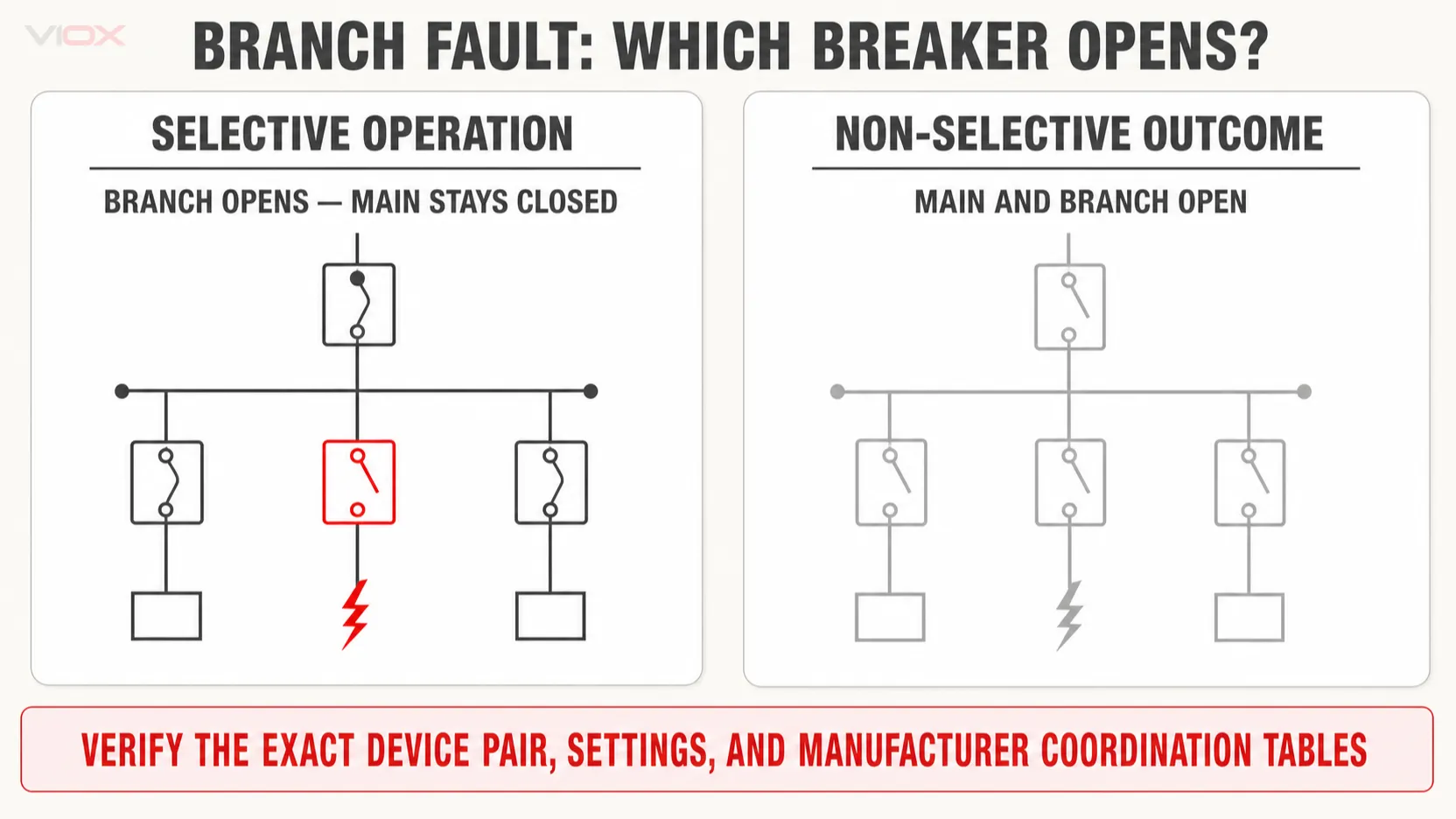
O que acontece quando a coordenação não é alcançada?
Para alguns níveis de falta, ambos os dispositivos podem abrir, ou o principal pode abrir antes que o ramal tenha isolado a falta. O resultado é uma interrupção mais ampla. Isso não é prova de que qualquer um dos disjuntores esteja com defeito; pode ser o comportamento esperado de um par não coordenado.
A proteção de retaguarda é o mesmo que seletividade?
Uma combinação testada de backup ou de classificação em série pode permitir que um dispositivo a montante auxilie um dispositivo a jusante sob condições de curto-circuito especificadas. A seletividade visa manter o dispositivo a montante fechado para uma falha a jusante. Os dois objetivos e as evidências são diferentes. Nunca deduza qualquer um dos resultados a partir de duas folhas de dados independentes.
Para fundamentos de tempo-corrente, veja Como ler uma curva de disparo de disjuntor.
Classificações que devem ser verificadas em ambos os níveis
O disjuntor principal não é selecionado somando todas as classificações das alavancas dos disjuntores de derivação, e um disjuntor de derivação não é selecionado apenas pela corrente de carga. O projeto de distribuição deve abordar a demanda, a proteção dos condutores, a capacidade da fonte, o comportamento da carga e os limites do conjunto.
| Verifique | Pergunta sobre o disjuntor principal | Pergunta sobre o disjuntor de derivação |
|---|---|---|
| Zona protegida | Qual alimentador, barramento, transformador ou grupo a jusante está dentro de seu limite de proteção? | Qual condutor, alimentador, máquina ou circuito final está protegido? |
| Corrente nominal e ajustes | A classificação e os ajustes coordenam-se com a fonte, o alimentador, o barramento, a demanda e os dispositivos a jusante? | Eles protegem o condutor e acomodam a carga normal e a corrente de partida? |
| Tensão e polos | O disjuntor é adequado ao sistema e ao arranjo de comutação? | Ele é adequado à tensão do ramal, fases, tratamento do neutro e aplicação? |
| Capacidade de interrupção | Ele consegue interromper a corrente de falta disponível em sua localização? | Ele consegue interromper a corrente de falta do circuito derivado, de forma independente ou dentro de uma combinação aprovada? |
| Característica de disparo | As funções de longa duração, curta duração, instantânea e de falta à terra são apropriadas onde fornecidas? | A curva ou o ajuste distingue a operação normal de condições de sobrecarga e falta? |
| Compatibilidade do conjunto | O dispositivo principal faz parte do projeto verificado do painel ou quadro de distribuição? | O dispositivo derivado é aprovado para o barramento, sistema de montagem e classificação do conjunto? |
| Coordenação | O dispositivo principal é seletivo com os dispositivos a jusante até o nível de falta exigido? | O ramal é seletivo com o principal e coordenado com a carga e o condutor? |
| Seccionamento e operação | A função de desconexão ou seccionamento necessária está declarada e acessível? | O ramal pode ser isolado com segurança para suas necessidades de operação e manutenção? |
Em sistemas elétricos industriais baseados na IEC, IEC 60947-2:2024 cobre disjuntores de baixa tensão dentro de seu escopo declarado, enquanto IEC 61439-2:2020 aborda conjuntos de manobra e controle de potência. A conformidade do produto não substitui a verificação do conjunto ou o projeto da instalação. Em painéis norte-americanos, as marcações de conjunto UL 67, a norma de produto aplicável do disjuntor e as combinações listadas ou documentadas devem ser respeitadas.
Lista de verificação de especificações
Antes de aprovar um arranjo de disjuntor principal e de ramal, confirme:
- o diagrama unifilar identifica claramente cada zona de proteção;
- cada fonte, interligação, gerador, fotovoltaico, bateria e caminho de realimentação é mostrado;
- os números de catálogo dos dispositivos principais e de derivação e as unidades de disparo são conhecidos;
- a tensão do sistema, frequência, polos e o arranjo de aterramento estão definidos;
- a carga contínua, demanda, condutor e as capacidades nominais do barramento foram verificados;
- a corrente de falta disponível é conhecida em ambos os locais dos dispositivos;
- a capacidade de ruptura ou capacidade de interrupção é adequada;
- os dispositivos são compatíveis com o conjunto verificado;
- a seletividade ou proteção de retaguarda é suportada pelos dados corretos do fabricante quando necessário;
- os requisitos de isolamento, intertravamento, disparo remoto e acessórios estão documentados; e
- o código de instalação aplicável e os requisitos das autoridades locais são atendidos.
O guia de especificações de disjuntores explica Icu, Ics, Icw e Icm em seus contextos IEC. Não transfira essas marcações diretamente para outro sistema de normas sem verificar a documentação do produto vigente.
FAQ
Um disjuntor principal é o mesmo que um disjuntor?
Um disjuntor principal é um disjuntor que desempenha a função principal a montante para um painel ou seção de distribuição definida. “Disjuntor” é a categoria geral do dispositivo; “principal” descreve sua posição e responsabilidade no sistema.
Um painel pode ter disjuntores de derivação, mas nenhum disjuntor principal dentro dele?
Sim. Um painel apenas com terminais (main-lug-only) pode conter disjuntores de derivação, dependendo de um dispositivo a montante para proteção e seccionamento do alimentador. Se esse arranjo é permitido depende do painel, da proteção a montante, do projeto da instalação e das normas aplicáveis.
Desligar o disjuntor principal torna todo o painel seguro?
Não presuma isso. As seções de barramento a jusante alimentadas apenas através desse disjuntor principal devem ser desconectadas, mas os terminais do lado da linha podem permanecer energizados. Fontes alternativas ou interligações também podem energizar partes do sistema elétrico. Pessoal qualificado deve verificar o isolamento e a ausência de tensão usando o procedimento aprovado.
Por que o disjuntor principal desarmou em vez do disjuntor de derivação?
Possíveis razões incluem uma falha na própria zona do disjuntor principal, ajustes que não são seletivos, corrente de falha acima do limite de seletividade do par, um comando de controle ou proteção, ou uma aplicação incorreta. Identifique a função de proteção operada e compare os dispositivos exatos, ajustes, dados de eventos e informações de coordenação do fabricante.
A corrente nominal do disjuntor principal é igual à soma de todas as correntes nominais dos disjuntores de derivação?
Não. As correntes nominais dos disjuntores de derivação não são simplesmente somadas para determinar o principal. O disjuntor principal e o conjunto são selecionados a partir do projeto de distribuição, incluindo a demanda calculada, as capacidades nominais dos condutores e barramentos, a capacidade da fonte, as condições operacionais e as normas aplicáveis.
Os disjuntores principais e de derivação devem ser do mesmo fabricante?
A questão determinante é a compatibilidade verificada, não a marca por si só. Painéis e quadros de distribuição podem restringir quais dispositivos podem ser instalados, e a seletividade ou o desempenho de classificação em série aplicam-se apenas a combinações documentadas. Siga as marcações do conjunto e os dados do fabricante.
Regra de Seleção Final
Não escolha um “disjuntor principal” e um “disjuntor de derivação” como se esses rótulos fossem especificações de produto. Primeiro, defina as zonas de proteção a montante e a jusante no diagrama unifilar. Em seguida, selecione a família de disjuntores e as classificações apropriadas para cada zona, verifique a compatibilidade da montagem e confirme a seletividade ou a combinação de backup necessária com evidências exatas do fabricante.
Para avaliação do produto, compare VIOX disjuntores miniatura, disjuntores de caixa moldadae disjuntores abertos, ou envie o diagrama unifilar, as classificações do sistema elétrico, os dados de corrente de falta e os requisitos de coordenação para [email protected].
Fontes
- IEC 60364-4-43:2023 — Proteção contra sobrecorrente
- IEC 60947-2:2024 — Disjuntores de baixa tensão
- IEC 61439-2:2020 — Conjuntos de manobra e comando de potência
- UL Solutions — Guia de Aplicação de Painéis de Distribuição
- Eaton — Fundamentos de Painéis de Distribuição
- ABB — Seletividade para Dispositivos de Baixa Tensão
- Schneider Electric — Guia de Seletividade, Cascateamento e Coordenação 2026